REVIEW 2 major objections 5 minor 296 references
This paper proves that aggregating block means through a radial Huber center—HOMER—matches median-of-means deviation bounds under a finite second moment while adding a threshold-controlled path to the sample mean and asymptotic inference.
Reviewed by Pith at T0; open to challenge. T0 means a machine referee read the full paper against a public rubric. the ladder, T0–T4 →
T0 review · deepseek-v4-flash
2026-08-01 06:10 UTC pith:3ERJ72NC
load-bearing objection Sound, honest Hilbert-space Huber-of-means theory; the practical tuning rule is outside all the theorems, and the guarantee is block-summary contamination only — send to peer review. the 2 major comments →
HOMER: Huber-of-Means for Efficient and Robust Estimation in Hilbert Spaces
The pith
A machine-rendered reading of the paper's core claim, the machinery that carries it, and where it could break.
Core claim
The central claim: aggregating block averages through a radial Huber center keeps the median-of-means high-confidence guarantee while gaining a threshold-controlled route to the sample mean and to inference. HOMER minimizes the average radial loss rho_tau(||Z_j - theta||); the canonical loss is quadratic up to tau and linear beyond, and the smooth pseudo-Huber loss converges to the sample mean as tau grows. If at least 5/8 of the block means lie within r of the truth and tau <= r, every solution is within 2r; under only a finite second moment this yields an exponential deviation bound of order sigma sqrt(log(1/delta)/n). With a finite third moment and k=o(m), fixed finite-dimensional project
What carries the argument
The load-bearing object is the radial Huber score map: the canonical map Psi_tau(y)=y when ||y||<=tau and tau y/||y|| beyond, and the pseudo-Huber map Psi_tau(y)=y/sqrt(1+||y||^2/tau^2). Both are odd and bounded by tau, which makes the HOMER objective median-like for distant block means and mean-like for central ones. The proof of the majority theorem uses a Hilbert angle lemma: if a candidate estimate is more than 2r from the true mean, each good block mean within r contributes a projected score exceeding tau sqrt(3/8), while each contaminated block can contribute no less than -tau. With at least 5/8 good blocks, the projected average score is strictly positive, contradicting the first-orde
Load-bearing premise
The robustness guarantee rests on the assumption that at least five-eighths of the block means are within r of the true mean and that the threshold tau is no larger than r using an oracle block-scale sigma; if contamination spreads across most blocks or tau is chosen by the median-distance rule, the stated bounds do not apply.
What would settle it
Test the 5/8-majority theorem directly: in R^2, place k=16 block means with 10 within the radius-r ball around a fixed mu and 6 arbitrary far points, solve the HOMER minimization exactly for both losses, and check whether every solution stays within 2r. A single configuration violating 2r disproves Theorem 3; conversely, a dispersed-contamination case where one observation in every block shifts each block mean beyond r—so the 5/8 premise fails—will show the theorem's scope is block summaries, not raw contamination.
If this is right
- With k=32 log(1/delta) blocks and tau on the block-error scale, the deviation bound ||hat_mu - mu|| <= 4 sigma sqrt(k/n) holds with probability at least 1-delta under only E||X||^2 < infinity.
- Canonical HOMER is exactly the sample mean whenever all block means lie inside its quadratic basin, while pseudo-HOMER approaches the sample mean as tau -> infinity, giving a formal interpolation path from geometric median to mean.
- The pseudo-Huber version provides a plug-in sandwich covariance that is consistent in trace norm; with a finite third moment and k=o(m), fixed finite-dimensional projections are asymptotically normal around the true mean at the parametric rate.
- The same block-mean machinery applies directly to functional means, covariance-operator means with eigenspace perturbation bounds, kernel mean embeddings with RKHS bounds, and aggregation of distributed gradient summaries.
- Pseudo-Huber is strictly convex, so the majorization-minimization weighted-average update converges monotonically to the unique minimizer using only the k block means and their Gram matrix.
Where Pith is reading between the lines
- The data-driven median-distance threshold used in experiments is outside all three theorems; a Lepski-type grid, mentioned in the paper, is the natural candidate for an adaptive threshold that would bring practice under the theory.
- Because the theorems hold for block summaries, replacing ordinary block means with robust within-block estimators should extend the guarantees to dispersed raw contamination; the paper identifies this as an open direction.
- The 5/8 majority and e^{-k/32} exponent are convenient constants, not optimal; the appendix's sharper per-loss fractions suggest the same two-radius argument could be tightened for specific contamination fractions.
- The reported small-block undercoverage suggests a finite-sample calibration of the sandwich intervals—for example, bootstrap or bias-corrected thresholds—could be tested against the asymptotic theory before routine use.
Editorial analysis
A structured set of objections, weighed in public.
Referee Report
Summary. The paper introduces HOMER, a robust aggregator for block means in Hilbert spaces that replaces the geometric median in median-of-means (MOM) with a radial Huber center. For canonical and pseudo-Huber losses, the paper proves existence and a score equation (Prop. 1), endpoint behavior connecting HOMER to MOM and the sample mean (Prop. 2), a two-radius majority theorem (Thm. 3), and an exponential high-confidence deviation bound under only a finite second moment (Thm. 4). For pseudo-Huber aggregation, it proves fixed-block asymptotic linearity around a population block-Huber target, consistent sandwich covariance estimation (Thm. 5, Prop. 14), and, under a finite third moment with k=o(m), a projected CLT centered at the true mean (Prop. 6, Cor. 7). Experiments cover finite-dimensional, functional, covariance, RKHS, distributed-gradient, and real-data settings, and the paper explicitly reports undercoverage of finite-block sandwich intervals and failure when contamination spreads across most blocks.
Significance. If the theorems hold, HOMER provides a useful threshold interpolation between geometric MOM and the sample mean, with a smooth Hessian that supports plug-in sandwich inference in Hilbert spaces. The main proof chain appears internally sound: the angle lemma, the Chebyshev/Hoeffding constants, and the k=o(m) centering argument are coherent, and the paper is unusually explicit about the limits of its guarantees. In particular, Appendix B disclaims the data-driven threshold rule, and Section 9 disclaims raw-point contamination. These disclosures are a real strength. The central caveat is that the oracle-threshold theory does not cover the median-distance tuning rule used in the experiments; thus the practical robustness/inference claims are supported by simulation rather than by the theorems. This is a scope gap rather than an algebraic inconsistency, but it is load-bearing for the paper's overall message.
major comments (2)
- [Appendix B and §8] Theorem 4 requires a user-chosen threshold 0<τ≤2σ/√m, with σ an oracle block-scale. The estimator used in the displayed robustness and efficiency experiments instead sets τ̂=c·median_j ||Z_j−μ̃|| for c∈{0.5,2,8}, and Appendix B states this rule is not covered by Theorem 4, Theorem 5, or Corollary 7. The gap is quantitative, not merely formal: on the event used by Theorem 4, with at least 5/8 block means within r=2σ/√m of μ, the median distance can exceed r by a factor that grows with pilot error; for c≥1/3, τ̂ can then exceed r, so Theorem 3's τ≤r condition fails and its 2r conclusion is unavailable. Thus the headline high-confidence guarantee does not transfer to the algorithm used in the main experiments. The theorems are internally consistent, but the paper needs either an adaptive-threshold theorem or a clear repositioning of the oracle-threshold results as the theoretical contributi
- [§6.2, Cor. 7 and §8] The inference theory covers only fixed deterministic λ with τ=λ/√m and, for centering at μ, the triangular-array limit m,k→∞ with k=o(m). The functional real-data and bike-demand studies use c·median thresholds with k=8 or 16 and are explicitly labeled descriptive; finite-block sandwich intervals undercover, as the paper acknowledges. This is acceptable as a stated limitation, but the abstract's wording that HOMER 'supports mean inference at the usual parametric rate' should be read strictly for the oracle-threshold pseudo-Huber estimator in the asymptotic regime. To make the practical inference claim match the theory, the authors should either extend the results to data-dependent thresholds or narrow the abstract/introduction claims accordingly.
minor comments (5)
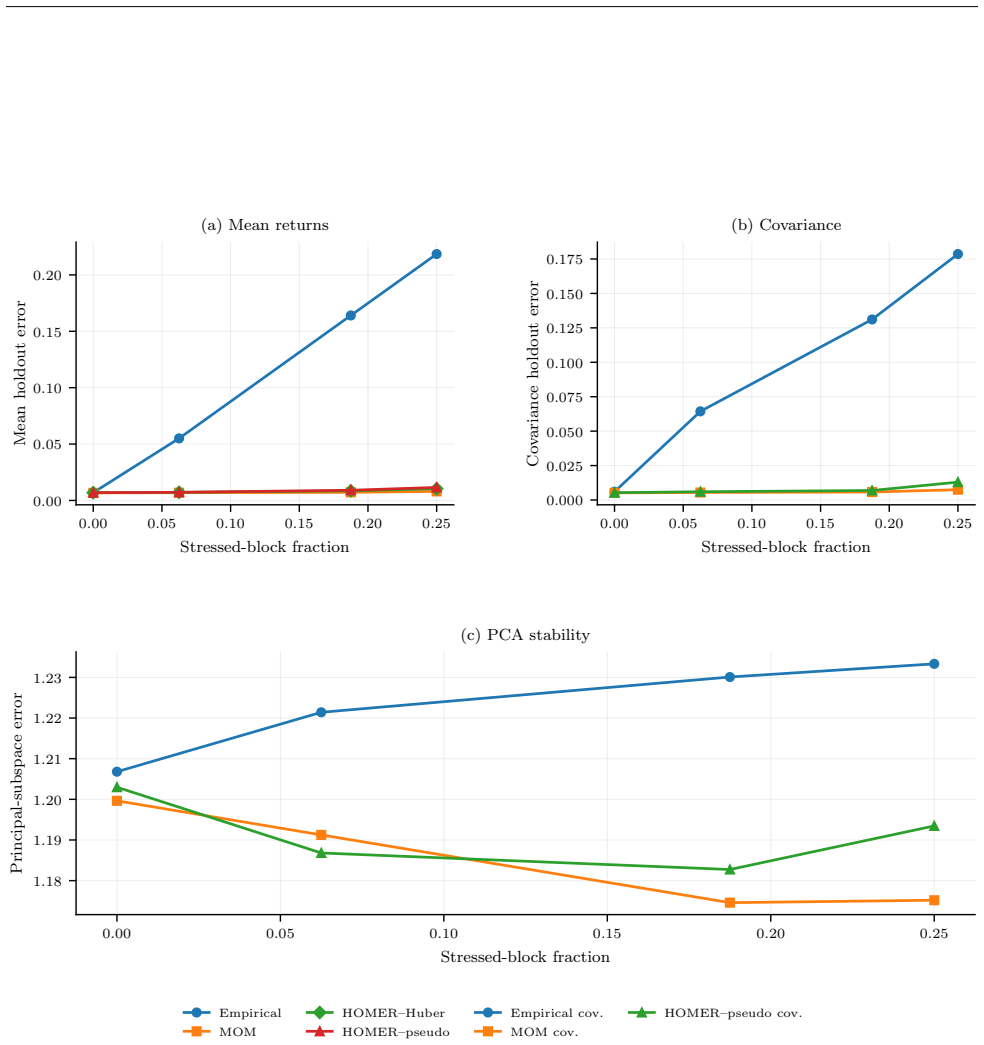
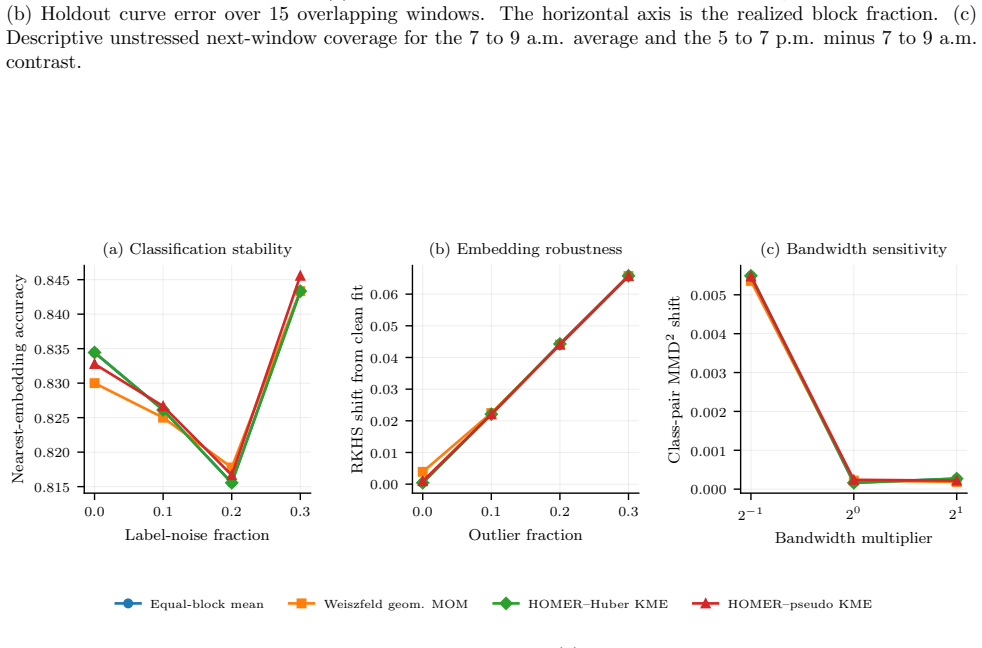
- [§8 and Figs. 2–3] The caption or text should state clearly at the figure level that the reported coverages are finite-k diagnostics rather than validations of Theorem 5 or Corollary 7. The prose already says this, but a figure-level note would prevent misinterpretation.
- [Appendix C.1] The distinction between the 'configured but unreported paper profile', the 'executed reduced grid', and the 'full grid' is confusing. Please specify unambiguously which configuration produced each displayed result and treat the other configurations as reproducible options.
- [References] Several references are incomplete or non-standard, e.g., 'Jorge Reyes-Ortiz, D. A. (2013)' and 'Fanaee-T, H. and Gama, J. (2014)'. Full titles, venues, and identifiers would improve the bibliography.
- [Algorithm 1] The algorithm returns the final iterate even if the maximum number of iterations is reached without satisfying the tolerance. It would be helpful to state explicitly that the tolerance is a stopping criterion and to report the number of iterations used in the experiments.
- [§5, KME applications] The sentence about replacing empirical kernel means in robust MMD calculations could cite the MONK comparison more precisely, since MONK already provides robust kernel mean estimation; the current wording is slightly vague about what HOMER adds beyond the smooth threshold path.
Circularity Check
No circularity: HOMER's theorems derive from explicit block-mean objective and standard probabilistic arguments; no fitted input is passed off as prediction.
full rationale
The paper's load-bearing chain is not circular. Section 4's Theorem 3 follows from Lemma 8's Hilbert angle identity and the score equation (6); Theorem 4 is a Chebyshev+Hoeffding application to the same block means. The efficiency/inference results (Theorem 5, Proposition 6, Corollary 7) are derived via the smooth-test Gaussian replacement and asymptotic expansions around the population block-Huber target, with the k=o(m) condition removing the bias to center at μ. The threshold τ is an oracle-constrained user parameter in the theoretical statements; Appendix B explicitly states that the data-driven median rule 'is not covered by Theorem 4, Theorem 5, or Corollary 7,' so no uncovered fitted value is relabeled as a theorem-based prediction. HOMER's target is not defined in terms of the estimator's output, and the cited geometric-median constants are external (Minsker 2015) rather than self-citations. The main limitation—that practical tuning lies outside the formal guarantee—is a scope gap, not circularity.
Axiom & Free-Parameter Ledger
free parameters (1)
- Huber threshold tau (or standardized lambda) =
tau_hat = c * median_j ||Z_j - tilde_mu|| with c in {0.5, 2, 8} in experiments; tau = lambda / sqrt(m) with lambda fixed
axioms (6)
- domain assumption The sample is an iid sequence of strongly measurable elements of a real separable Hilbert space with finite second moment.
- domain assumption The robustness problem is at the block-summary level: at least 5/8 of block means lie within r of the true mean.
- domain assumption Finite third moment E||X - mu||^3 < infinity for mean inference.
- domain assumption An oracle bound on the block-error scale sigma / sqrt(m) is available for the non-asymptotic theorem.
- domain assumption Under central symmetry, u_{m,lambda}=0 and mean inference does not need k=o(m).
- domain assumption For covariance applications, a finite fourth moment of X and a Davis-Kahan eigengap condition are assumed.
invented entities (1)
-
Population block-Huber target theta_{m,lambda} = mu + u_{m,lambda} / sqrt(m)
no independent evidence
read the original abstract
Heavy tails weaken high-confidence control for the empirical mean. Geometric median-of-means (MOM) also lacks a threshold that moves toward mean efficiency. We propose \emph{HOMER}, or Huber-of-Means for Efficient and Robust Estimation. HOMER aggregates block means through a radial Huber center. Its canonical and pseudo-Huber forms bound each block score and interpolate between median-like robustness and the empirical mean. We establish a Hilbert-space majority theorem and a MOM-order deviation bound under a finite second moment. Canonical HOMER recovers the sample mean inside its quadratic region. Pseudo-HOMER approaches the sample mean as the threshold grows. It also admits asymptotic linearity and consistent sandwich covariance estimation around the population block-Huber target. Under a finite third moment, fixed finite-dimensional projections support mean inference at the usual parametric rate. This result requires growing block sizes and counts, with block sizes increasing faster. Heavy-tailed simulations show that HOMER remains stable when a minority of block summaries is displaced. On clean Gaussian data, both versions closely approach the empirical mean's efficiency. Finite-block sandwich intervals undercovered, especially for skewed functional data. Further studies show failure when contamination affects most blocks or compromises ordinary within-block means.
Figures



Reference graph
Works this paper leans on
-
[1]
Jorge Reyes-Ortiz, Davide Anguita , year =. Human. doi:10.24432/C54S4K , urldate =
-
[2]
Dimension-free PAC-Bayesian bounds for the estimation of the mean of a random vector
Catoni, Olivier and Giulini, Ilaria , year =. Dimension-free. doi:10.48550/ARXIV.1802.04308 , abstract =
work page internal anchor Pith review Pith/arXiv arXiv doi:10.48550/arxiv.1802.04308
-
[3]
Electronic Journal of Statistics , author =
Distributed statistical estimation and rates of convergence in normal approximation , volume =. Electronic Journal of Statistics , author =. doi:10.1214/19-EJS1647 , number =
-
[4]
SIAM Journal on Mathematics of Data Science , author =
The. SIAM Journal on Mathematics of Data Science , author =. 2024 , pages =. doi:10.1137/23M1592420 , language =
-
[5]
and Judin, David B
Nemirovskij, Arkadij S. and Judin, David B. and Dawson, E. R. and Nemirovskij, Arkadij S. , year =. Problem
-
[6]
Mathieu, Timothée , month = jan, year =. M-estimation and. doi:10.70675/93361937z7fe3z44c0z8742zcb273d1a3dcc , abstract =
-
[7]
Proceedings of the 36th
Lerasle, Matthieu and Szabo, Zoltan and Mathieu, Timothée and Lecue, Guillaume , editor =. Proceedings of the 36th. 2019 , pages =
2019
-
[8]
Electronic Journal of Statistics , author =
On the estimation of the mean of a random vector , volume =. Electronic Journal of Statistics , author =. doi:10.1214/17-EJS1228 , number =
-
[9]
Fast estimation of the median covariation matrix with application to online robust principal components analysis , volume =. TEST , author =. 2017 , pages =. doi:10.1007/s11749-016-0519-x , language =
-
[10]
Efficient and fast estimation of the geometric median in. Bernoulli , author =. doi:10.3150/11-BEJ390 , number =
-
[11]
The Annals of Statistics , author =
Online estimation of the geometric median in. The Annals of Statistics , author =. doi:10.1214/16-AOS1460 , number =
-
[12]
Blanchard, Peva and El Mhamdi, El Mahdi and Guerraoui, Rachid and Stainer, Julien , editor =. Machine. Advances in
-
[13]
Improving the
Perronnin, Florent and Sánchez, Jorge and Mensink, Thomas , editor =. Improving the. Computer. 2010 , pages =
2010
-
[14]
Perronnin, Florent and Dance, Christopher , month = jun, year =. Fisher. 2007. doi:10.1109/CVPR.2007.383266 , urldate =
arXiv 2007
-
[15]
Journal of Computational and Graphical Statistics , author =
Search. Journal of Computational and Graphical Statistics , author =. 2022 , pages =. doi:10.1080/10618600.2022.2069779 , language =
arXiv 2022
-
[16]
Cuturi, Marco and Avis, David , month = jan, year =. Ground. Journal of Machine Learning Research , publisher =
-
[17]
Bayesian cluster analysis , volume =. Biometrika , author =. 1978 , pages =. doi:10.1093/biomet/65.1.31 , language =
-
[18]
Balocchi, Cecilia and Wade, Sara , year =. Understanding uncertainty in. doi:10.48550/ARXIV.2506.16295 , abstract =
-
[19]
Statistical Science , author =
Revisiting the. Statistical Science , author =. doi:10.1214/20-STS812 , number =
-
[20]
rotations:. The R Journal , author =. 2014 , pages =. doi:10.32614/RJ-2014-007 , language =
-
[21]
Cazelles, Elsa and Pauwels, Edouard and Portales, Léo , year =. Statistical. doi:10.48550/ARXIV.2604.22366 , abstract =
-
[22]
Rates of estimation of optimal transport maps using plug-in estimators via barycentric projections , isbn =
Deb, Nabarun and Ghosal, Promit and Sen, Bodhisattva , year =. Rates of estimation of optimal transport maps using plug-in estimators via barycentric projections , isbn =. Proceedings of the 35th
-
[23]
SIAM Journal on Imaging Sciences , author =
Regularized. SIAM Journal on Imaging Sciences , author =. 2014 , pages =. doi:10.1137/130929886 , language =
-
[24]
Outlier-
Mukherjee, Debarghya and Guha, Aritra and Solomon, Justin M and Sun, Yuekai and Yurochkin, Mikhail , editor =. Outlier-. Proceedings of the 38th. 2021 , pages =
2021
-
[25]
Near-optimal estimation of smooth transport maps with kernel sums-of-squares , copyright =
Muzellec, Boris and Vacher, Adrien and Bach, Francis and Vialard, François-Xavier and Rudi, Alessandro , year =. Near-optimal estimation of smooth transport maps with kernel sums-of-squares , copyright =. doi:10.48550/ARXIV.2112.01907 , abstract =
-
[26]
Minimax estimation of discontinuous optimal transport maps: the semi-discrete case , abstract =
Pooladian, Aram-Alexandre and Divol, Vincent and Niles-Weed, Jonathan , year =. Minimax estimation of discontinuous optimal transport maps: the semi-discrete case , abstract =. Proceedings of the 40th
-
[27]
Entropic estimation of optimal transport maps , copyright =
Pooladian, Aram-Alexandre and Niles-Weed, Jonathan , year =. Entropic estimation of optimal transport maps , copyright =. doi:10.48550/ARXIV.2109.12004 , abstract =
-
[28]
International Journal of Computer Vision , author =
The. International Journal of Computer Vision , author =. 2000 , pages =. doi:10.1023/A:1026543900054 , language =
-
[29]
Journal of Mathematical Imaging and Vision , author =
A. Journal of Mathematical Imaging and Vision , author =. 2016 , pages =. doi:10.1007/s10851-016-0653-9 , language =
-
[30]
Staerman, Guillaume and Laforgue, Pierre and Mozharovskyi, Pavlo and d'Alché-Buc, Florence , editor =. When. Proceedings of. 2021 , pages =
2021
-
[31]
scikit-image: image processing in. PeerJ , author =. 2014 , pages =. doi:10.7717/peerj.453 , language =
-
[32]
Wang, Lili and Zheng, Chao and Zhou, Wen and Zhou, Wen-Xin , month = oct, year =. A. Statistica Sinica , publisher =. doi:10.5705/ss.202019.0045 , abstract =
-
[33]
Journal of the American Statistical Association , author =
Adaptive. Journal of the American Statistical Association , author =. 2020 , pages =. doi:10.1080/01621459.2018.1543124 , language =
arXiv 2020
-
[34]
The Annals of Statistics , author =
Mean estimation with sub-. The Annals of Statistics , author =. doi:10.1214/19-AOS1843 , number =
-
[35]
The Annals of Statistics , author =
Sub-. The Annals of Statistics , author =. doi:10.1214/16-AOS1440 , number =
-
[36]
Annales de l'Institut Henri Poincaré, Probabilités et Statistiques , author =
Challenging the empirical mean and empirical variance:. Annales de l'Institut Henri Poincaré, Probabilités et Statistiques , author =. doi:10.1214/11-AIHP454 , number =
-
[37]
Progress in Artificial Intelligence , author =
Event labeling combining ensemble detectors and background knowledge , volume =. Progress in Artificial Intelligence , author =. 2014 , pages =. doi:10.1007/s13748-013-0040-3 , language =
-
[38]
Journal of Financial Economics , author =
Common risk factors in the returns on stocks and bonds , volume =. Journal of Financial Economics , author =. 1993 , pages =. doi:10.1016/0304-405X(93)90023-5 , language =
-
[39]
Cruciani, Federico and Sun, Chen and Zhang, Shuai and Nugent, Chris and Li, Chunping and Song, Shaoxu and Cheng, Cheng and Cleland, Ian and Mccullagh, Paul , month = aug, year =. A. 2019. doi:10.1109/SmartWorld-UIC-ATC-SCALCOM-IOP-SCI.2019.00071 , urldate =
arXiv 2019
-
[40]
Pattern Recognition , author =
Comparative study on classifying human activities with miniature inertial and magnetic sensors , volume =. Pattern Recognition , author =. 2010 , pages =. doi:10.1016/j.patcog.2010.04.019 , language =
-
[41]
The Annals of Statistics , author =
Invariant. The Annals of Statistics , author =. doi:10.1214/aos/1176343283 , number =
-
[42]
and Gretton, Arthur and Fukumizu, Kenji and Schölkopf, Bernhard and Lanckriet, Gert R.G
Sriperumbudur, Bharath K. and Gretton, Arthur and Fukumizu, Kenji and Schölkopf, Bernhard and Lanckriet, Gert R.G. , month = aug, year =. Hilbert. Journal of Machine Learning Research , publisher =
-
[43]
R. On. Proceedings of the. 1961 , pages =
1961
-
[44]
Journal of the American Statistical Association , author =
Sequential. Journal of the American Statistical Association , author =. 1998 , pages =. doi:10.1080/01621459.1998.10473765 , language =
arXiv 1998
-
[46]
Journal of the Royal Statistical Society Series B: Statistical Methodology , author =
Sequential. Journal of the Royal Statistical Society Series B: Statistical Methodology , author =. 2006 , pages =. doi:10.1111/j.1467-9868.2006.00553.x , language =
arXiv 2006
-
[47]
Diversity and. Ecology , author =. 1973 , pages =. doi:10.2307/1934352 , abstract =
doi:10.2307/1934352 1973
-
[48]
Measuring
Gorham, Jackson and Mackey, Lester , year =. Measuring. Proceedings of the 34th
-
[49]
Measuring
Gorham, Jackson and Mackey, Lester , year =. Measuring. Proceedings of the 29th
-
[50]
De La Peña, Víctor H. and Giné, Evarist , editor =. Decoupling , isbn =. doi:10.1007/978-1-4612-0537-1 , urldate =
-
[51]
Journal of Multivariate Analysis , author =
Modifications of the. Journal of Multivariate Analysis , author =. 2001 , pages =. doi:10.1006/jmva.2000.1922 , language =
arXiv 2001
-
[52]
Causality:
Pearl, Judea , year =. Causality:
-
[53]
and Ivanov, Sergej and Ivanov, Sergei V
Burago, Dmitrij Jurʹevič and Burago, Jurij D. and Ivanov, Sergej and Ivanov, Sergei V. , year =. A
-
[54]
Methods of
Amari, Shun'ichi and Nagaoka, Hiroshi and Amari, Shun'ichi and Amari, Shun'ichi , translator =. Methods of
-
[55]
Lange, Richard D and Kwok, Devin and Matelsky, Jordan Kyle and Wang, Xinyue and Rolnick, David and Kording, Konrad , editor =. Deep. Proceedings of 2nd. 2023 , pages =
2023
-
[56]
Nature Communications , author =
Single-cell analysis reveals inflammatory interactions driving macular degeneration , volume =. Nature Communications , author =. 2023 , pages =. doi:10.1038/s41467-023-37025-7 , language =
-
[57]
The Annals of Statistics , author =
Data-driven. The Annals of Statistics , author =. doi:10.1214/009053607000000541 , number =
-
[58]
Brown, Lawrence D. , month = jan, year =. Fundamentals of. doi:10.1214/lnms/1215466757 , urldate =
-
[59]
Transactions of the American Mathematical Society , author =
Strong laws for \. Transactions of the American Mathematical Society , author =. 1996 , pages =. doi:10.1090/S0002-9947-96-01681-9 , language =
-
[60]
Journal of the American Statistical Association , author =
Asymptotic. Journal of the American Statistical Association , author =. 1987 , pages =. doi:10.1080/01621459.1987.10478472 , language =
arXiv 1987
-
[61]
Journal of Machine Learning Research , author =
Scikit-learn:. Journal of Machine Learning Research , author =. 2011 , pages =
2011
-
[62]
Saddlepoint approximations for the. Biometrika , author =. 2005 , pages =. doi:10.1093/biomet/92.2.465 , language =
-
[63]
Computational Statistics , author =
On maximum likelihood estimation of the concentration parameter of von. Computational Statistics , author =. 2014 , pages =. doi:10.1007/s00180-013-0471-0 , language =
-
[64]
IEEE Transactions on Information Theory , author =
Information projections revisited , volume =. IEEE Transactions on Information Theory , author =. 2003 , pages =. doi:10.1109/TIT.2003.810633 , language =
arXiv 2003
-
[65]
The Annals of Statistics , author =
Exponential. The Annals of Statistics , author =. doi:10.1214/aos/1176344838 , number =
-
[66]
IEEE Transactions on Information Theory , author =
Information geometry on hierarchy of probability distributions , volume =. IEEE Transactions on Information Theory , author =. 2001 , pages =. doi:10.1109/18.930911 , number =
-
[67]
Nature Reviews Neuroscience , author =
Neural tuning and representational geometry , volume =. Nature Reviews Neuroscience , author =. 2021 , pages =. doi:10.1038/s41583-021-00502-3 , language =
-
[68]
New insights and perspectives on the natural gradient method , url =
Martens, James , month = sep, year =. New insights and perspectives on the natural gradient method , url =
-
[69]
International Statistical Review , author =
Directions. International Statistical Review , author =. 2022 , pages =. doi:10.1111/insr.12481 , abstract =
-
[70]
doi:10.1007/978-981-19-1044-9 , language =
Directional. doi:10.1007/978-981-19-1044-9 , language =
-
[71]
You, Kisung and Shung, Dennis , year =. On the spherical. doi:10.48550/ARXIV.2208.11929 , abstract =
-
[72]
Statistics and Computing , author =
Learning over von. Statistics and Computing , author =. 2026 , pages =. doi:10.1007/s11222-026-10844-6 , language =
-
[73]
Diethe, Tom , month = feb, year =. A. doi:10.48550/arXiv.1502.07104 , abstract =
-
[74]
doi:10.18637/jss.v058.i10 , language =
Journal of Statistical Software , author =. doi:10.18637/jss.v058.i10 , language =
-
[75]
Communications in Statistics - Theory and Methods , author =
A solution to the multivariate behrens-fisher problem , volume =. Communications in Statistics - Theory and Methods , author =. 1986 , pages =. doi:10.1080/03610928608829342 , language =
-
[76]
Proceedings of the Royal Society A: Mathematical, Physical and Engineering Sciences , author =
Dispersion on a. Proceedings of the Royal Society A: Mathematical, Physical and Engineering Sciences , author =. 1953 , pages =. doi:10.1098/rspa.1953.0064 , language =
arXiv 1953
-
[77]
The. Annals of Eugenics , author =. 1936 , pages =. doi:10.1111/j.1469-1809.1936.tb02137.x , language =
arXiv 1936
-
[78]
Translational Psychiatry , author =
Brain network dysfunctions in addiction: a meta-analysis of resting-state functional connectivity , volume =. Translational Psychiatry , author =. 2022 , pages =. doi:10.1038/s41398-022-01792-6 , number =
-
[79]
SIAM Journal on Matrix Analysis and Applications , author =
Permutation-. SIAM Journal on Matrix Analysis and Applications , author =. 2024 , pages =. doi:10.1137/22M1538144 , language =
-
[80]
Resting state functional connectivity in addiction:. NeuroImage , author =. 2012 , pages =. doi:10.1016/j.neuroimage.2012.01.117 , language =
-
[81]
Frontiers in Human Neuroscience , author =
Sex. Frontiers in Human Neuroscience , author =. 2019 , pages =. doi:10.3389/fnhum.2019.00104 , urldate =
arXiv 2019
discussion (0)
Sign in with ORCID, Apple, or X to comment. Anyone can read and Pith papers without signing in.