REVIEW 4 major objections 5 minor 32 references
A spin-1 truncation of the compact Abelian Higgs model supports string-meson excitations whose tension, breaking length, and effective meson mass can be extracted from ground states pinned by a local chemical potential.
Reviewed by Pith at T0; open to challenge. T0 means a machine referee read the full paper against a public rubric. the ladder, T0–T4 →
T0 review · deepseek-v4-flash
2026-08-01 05:50 UTC pith:D7QJJSL4
load-bearing objection Solid DMRG study with a genuinely new chemical-potential probe; the string-stability claim is thin but the core extraction and consistency checks hold up. the 4 major comments →
Confinement and String Breaking in the Compact Abelian Higgs Model
The pith
A machine-rendered reading of the paper's core claim, the machinery that carries it, and where it could break.
Core claim
In the high-coupling limit where electric-field domain walls are heavy, the two-domain-wall subspace of the model is exactly a one-dimensional string with a linear confining potential and endpoint hopping. The paper's discovery is that the same string physics survives at finite couplings and is numerically accessible: applying a strong local chemical potential at two sites drives the field into unit-flux configurations whose excess energy over the vacuum is a saturating linear function of separation. Fitting that potential yields a string tension that exceeds the microscopic coupling due to dressing by virtual pairs, a breaking length at the knee of the potential, and a localized meson mass
What carries the argument
The central object is the spin-1 truncation of the compact Abelian Higgs model on qutrit sites, with electric-field variable m in {-1,0,1}; pairs of domain walls in m experience a linear potential, so they act as fluctuating strings. The operative mechanism is the effective string Hamiltonian restricted to the two-domain-wall subspace, which contains a linear potential (U/2)(j-i) and endpoint hopping, and whose momentum eigenstates are built from roots of a Bessel-function equation. A local chemical potential -mu L^z on selected sites pins the field to m=1, mimicking external charges, and density-matrix renormalization group minimization then produces 'string' states below a critical length
Load-bearing premise
The claim that the measured string tension, breaking length, and meson mass are properties of the model rather than artifacts of the pinning potential depends on the string state surviving as the chemical potential is lowered, which the paper demonstrates for only one parameter set down to mu=2.25.
What would settle it
Compute the exact or high-accuracy spectrum for U=0.25, Y=6.0 while lowering mu from 100 to 0 and check whether the pinned string state remains continuously connected to an eigenstate of the unperturbed Hamiltonian; or measure the overlap of the strongly pinned state with the one-string subspace of H(U,Y) and see whether it vanishes as mu approaches zero. A crossing of the string and broken branches before mu=0 would falsify the adiabatic-continuity premise.
If this is right
- The string tension and breaking length become measurable from static ground-state calculations anywhere in the U-Y parameter plane, not just in the exactly solvable high-Y limit.
- The semiclassical string-breaking condition M_eff + sigma L* = 2 M_eff becomes exact as Y grows; at Y=6 the deviation is below 1% and essentially independent of U.
- The localized meson mass tracks the finite-volume mass gap with a Y^{-1.5} correction, so a single-site chemical potential is a practical mass probe for the model.
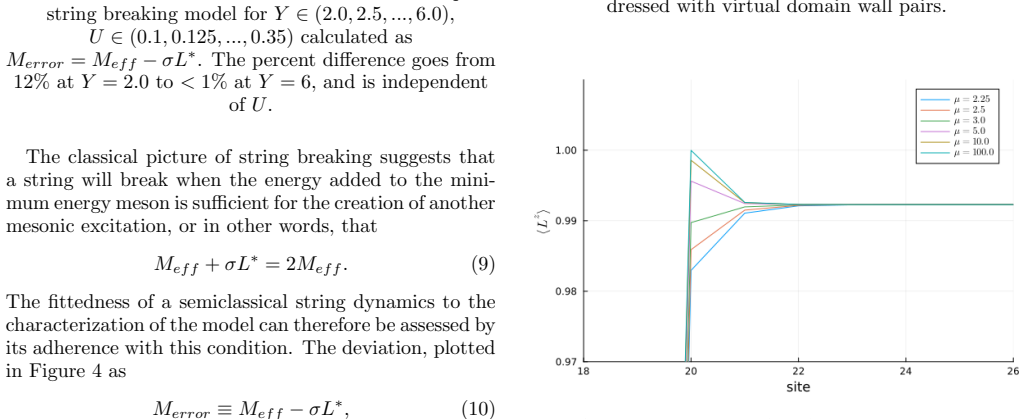
- Adiabatically reducing the chemical potential after preparing a string state produces a smoother, more natural string profile with a small energy correction, enabling preparation of string initial states for real-time evolution.
- The measured effective tension exceeds the microscopic U/2, showing the string is dressed by virtual domain-wall pairs and carries a measurable matter density along its interior.
Where Pith is reading between the lines
- A testable extension would be to repeat the same pinning protocol with larger electric-field truncations (e.g., m_max=2) and check whether the rescaled potential collapse and the M_eff vs sigma L* convergence persist, which would indicate a generic compact-gauge phenomenon rather than an accident of the qutrit truncation.
- The adiabatic removal protocol could be converted into a dynamical diagnostic: prepare a dressed string, quench the chemical potential off, and measure the survival probability of the one-string sector; the fragmentation timescale should be controlled by M_eff - sigma L*.
- Because the chemical potential term has the same form as a fixed dipole E dot p interaction, the protocol doubles as a tunable way to measure the model's response to static external charges, something the fixed-charge insertion approach cannot provide.
- The single-example adiabatic check leaves open whether the string branch remains connected to a true eigenstate as mu -> 0; if it does not, the inferred quantities at strong pinning should be interpreted as properties of the pinned system rather than of the bare model.
Editorial analysis
A structured set of objections, weighed in public.
Referee Report
Summary. The paper studies a spin-1 truncation of the 1+1D compact Abelian Higgs model (CAHM) on a chain of qutrit sites, with Hamiltonian Eq. (1). It projects onto a two-domain-wall string subspace to obtain the effective string Hamiltonian Eq. (4), whose exact eigenbasis Eq. (5) is taken from Ref. [29]. Using DMRG with a strong local chemical potential μ=100 applied to two sites, the authors construct string states of length L, extract a saturating linear potential V(L), and fit a string tension σ and breaking length L*. A single-site chemical potential defines a localized meson energy M_eff, which is compared both to the finite-volume mass gap Δm and to σL*. The paper claims: (i) the model exhibits string-meson modes with a universal linear potential over the parameter range U∈[0.1,0.35], Y∈[2.0,6.0]; (ii) σ, L*, and M_eff can be extracted as physical model parameters; and (iii) adiabatic removal of the chemical potential shows the string state is stable and intrinsic, with a semiclassical breaking condition M_eff ≈ σL* becoming exact at large Y.
Significance. If the central claims are substantiated, the paper provides a practical tensor-network method for extracting static string and meson parameters in a lattice gauge theory that is accessible to qutrit quantum simulators. The comparison with the exact high-Y eigenbasis of Ref. [29], the use of independent DMRG observables (M_eff vs. Δm vs. σL*), and the idea of using an adiabatic μ-ramp as a stability check are genuine strengths. However, the numerical evidence is not yet sufficient to support the strong claims of universality and intrinsic string stability: the adiabatic continuation is shown for only one parameter point, and no DMRG convergence or error estimates are reported.
major comments (4)
- [Sec. III C, Figs. 5-6] The adiabatic-continuation argument is the only evidence that μ=100 measurements reflect the unperturbed CAHM rather than the pinning term. It is demonstrated for one point only (U=0.25, Y=6.0, L=16, μ lowered to 2.25). No μ-scan of σ, L*, or M_eff is shown for other U,Y,L, and no overlap or energy-gap argument establishes that the string branch remains connected to an eigenstate of H(μ=0). The abstract's 'characterization of string stability' and the conclusion's 'adiabatically weakened well below the energy scale' are therefore overstatements relative to the data. A systematic μ-dependence study, or at minimum several representative parameter points with the μ→low limit, is required before the extracted parameters can be claimed as intrinsic.
- [Sec. III A, Eq. (8)] The 'universal rescaling' is not a parameter-free test. Since σ and L* are fitted independently for each potential curve, plotting V/(2σL*) against L/L* will collapse any piecewise-linear potential with a knee, by construction. The collapse in Fig. 2 therefore does not by itself establish universality across the (U,Y) plane. The authors should provide a stronger test, e.g. comparing the fitted σ with the microscopic value U/2 (including dressing corrections), checking whether L* follows M_eff/σ without additional fitting, or showing that a single global fit with common functional forms describes all curves with residuals.
- [Sec. III, Figs. 2-4 and Appendix B] The manuscript reports no DMRG bond dimension, truncation error, number of sweeps, convergence criterion, or error bars on the fitted σ, L*, M_eff, or the fit coefficients in Table I. The M_error trend from 12% at Y=2 to <1% at Y=6 is quoted without uncertainties, so it is impossible to assess whether the deviation is significant. Given the use of a very strong local term (μ=100) and the metastability discussed in Sec. III C, convergence tests and fit uncertainties are essential. This is a load-bearing gap for the quantitative claims (σ, L*, M_eff, Y-scaling exponents).
- [Sec. III B / Appendix B, Eqs. (B2)-(B3)] The inverse-power-law corrections M_eff/Δm ≈ 1+1.22Y^{-1.5} and M_σ/M_eff ≈ 1-1.41Y^{-2.5} are presented as universal, but the text admits 'some dependence on U' and no measure of the U-variation or fit uncertainty is given. If the U-dependence is comparable to the claimed corrections, the leading-order exponents are not established. Please quantify the U-dependence, e.g. by quoting the spread of fitted coefficients across U, or by fitting all U jointly with a U-dependent amplitude.
minor comments (5)
- [Sec. II A] Typo: 'Y− → ∞' should be 'Y → ∞'.
- [Sec. I] Typo: 'ar lattice systems' should be 'lattice systems'.
- [Sec. III B] 'vacuum-substracted' should be 'vacuum-subtracted'; 'fittedness' is awkward and should be rephrased.
- [Appendix A] Figs. 7 and 8 show smooth parameter trends but no error bars or fit residuals; adding these would make the appendix more useful.
- [Sec. II B, Eq. (7)] The notation for the chemical potential term is clear, but the footnote explaining the dipole E·p analogy would be easier to read as a parenthetical in the main text.
Circularity Check
Universality collapse in Eq. (8) is partly built from fit-derived σ and L*; central σ/M_eff measurements remain independent DMRG observables.
specific steps
-
fitted input called prediction
[Section III A, Eq. (8) (also Fig. 2 caption)]
"Each sample is fit with a continuous, piecewise linear function, yielding the string tension σ as the slope of the first segment and the breaking length L* as the position of the knee. ... Rescaling the potentials and the lengths using the relations below shows the striking universality of this linear potential model over the chosen parameter space. V≡V /(2σL*), L≡L/L* (8)"
The dimensionless coordinates in Eq. (8) are defined with the same σ and L* that were obtained by fitting each V(L) to a continuous piecewise-linear function (slope σ, knee L*). Under this rescaling, the fitted form maps by construction to V~ = (1/2)L~ for L~ ≤ 1 and then a flat plateau, so all curves collapse regardless of U and Y. Thus the 'striking universality' restates the assumed two-segment fit rather than testing it against an independent scale. This does not invalidate the separately extracted σ, L*, M_eff, but it makes the universality observation partly tautological.
full rationale
The paper's central extraction of physical parameters is not circular: σ comes from the slope of the un-rescaled string potential V(L; U, Y), M_eff comes from a separate single-site localized-excitation DMRG calculation, and Δm comes from a projected finite-volume mass gap. The comparison M_error = M_eff − σL* is a genuine test between independent observables, not a fit of one quantity to another. The self-citations ([19], [24], [26], [27], [28]) are used for model context and prior implementations, not as load-bearing uniqueness arguments or to forbid alternatives. The only concrete circularity is the universality collapse in Eq. (8). Because σ and L* are fitted per sample and then used to define the rescaled axes, the collapse is partly forced by construction. This affects a supporting 'universality' claim, not the primary string-tension/meson-mass measurements. The adiabatic μ-removal evidence is limited to a single example (U=0.25, Y=6.0, L=16, μ lowered to 2.25), but the paper explicitly acknowledges the limitation: the 1.5% energy shift 'could become relevant for precision study of the avoided crossing.' That is a stated caveat rather than a hidden circular step. Overall, the central derivation is self-contained, with only a mild fitted-parameter circularity in the rescaling presentation.
Axiom & Free-Parameter Ledger
free parameters (4)
- Local chemical potential strength μ for string/meson state preparation =
μ = 100 (strong); one adiabatic run reduced to μ = 2.25
- String tension σ(U,Y) =
Varies; shown in Fig. 7, not tabulated
- Breaking length L*(U,Y) =
Varies; shown in Fig. 8, not tabulated
- Leading correction coefficients in M_eff/Δm and M_σ/M_eff fits =
a=1.22, b=-1.41 with exponents -1.5/-2.5
axioms (4)
- domain assumption Spin-1 truncation (mmax=1) faithfully represents the low-energy sector of CAHM in the studied parameter regime.
- domain assumption The two-domain-wall projection yields the effective string Hamiltonian Eq. (4), and the Surace–Lerose Bessel basis diagonalizes it.
- domain assumption DMRG on ~100 sites with no reported bond dimension/truncation error yields converged ground and low-lying states for all reported (U,Y,L).
- ad hoc to paper Adiabatic DMRG continuation in μ tracks the physical string branch rather than a metastable artifact.
read the original abstract
While real-time simulation of Quantum Chromodynamics remains technologically out of reach, simplified models for studying elements of QCD phenomenology abound. This work presents a simple model, a spin-1 truncation of the Compact Abelian Higgs Model simulated on qutrit sites, in which confinement and string breaking is accessible to current simulation methods. In the low-energy regime of 1+1D scalar electrodynamics, the heavy modes are integrated out, producing a spin chain effective Hamiltonian in which Gauss' law is implicitly satisfied. We study the spectrum of string-like excitations using DMRG methods on the order of 100 sites. We demonstrate that an added, local chemical potential, playing a role analogous to external charges, permits parameter-dependent measurements of physical features of interest like the string tension and effective meson mass. Varying the chemical potential also permits a characterization of string stability not assessed in prior studies of confining lattice models.
Figures




Reference graph
Works this paper leans on
-
[1]
Andersson, G
B. Andersson, G. Gustafson, G. Ingelman, and T. Sj¨ ostrand, Physics Reports97, 31 (1983)
1983
-
[2]
Sj¨ ostrand, S
T. Sj¨ ostrand, S. Mrenna, and P. Skands, Journal of High Energy Physics2006, 026 (2006)
2006
-
[3]
Bierlichet al., SciPost Physics Codebases , 8 (2022), arXiv:2203.11601 [hep-ph]
C. Bierlichet al., SciPost Physics Codebases , 8 (2022), arXiv:2203.11601 [hep-ph]
Pith/arXiv arXiv 2022
-
[4]
M. C. Ba˜ nuls and K. Cichy, Reports on Progress in Physics83, 024401 (2020), arXiv:1910.00257 [hep-lat]
Pith/arXiv arXiv 2020
-
[5]
S. K¨ uhn, E. Zohar, J. I. Cirac, and M. C. Ba˜ nuls, Journal of High Energy Physics2015, 130 (2015), arXiv:1505.04441 [quant-ph]
Pith/arXiv arXiv 2015
-
[6]
R. C. Farrell, M. Illa, A. N. Ciavarella, and M. J. Savage, Physical Review D109, 114510 (2024), arXiv:2401.08044 [quant-ph]
Pith/arXiv arXiv 2024
-
[7]
A. De, A. Lerose, D. Luo, F. M. Surace, A. Schuckert, E. R. Bennewitz, B. Ware, W. Morong, K. S. Collins, Z. Davoudi, A. V. Gorshkov, O. Katz, and C. Mon- roe, arXiv preprint (2024), 10.48550/arXiv.2410.13815, preprint, arXiv:2410.13815 [quant-ph], arXiv:2410.13815 [quant-ph]
-
[8]
Y. Liu, W.-Y. Zhang, Z.-H. Zhu, M.-G. He, Z.-S. Yuan, and J.-W. Pan, Physical Review Letters135(2025), 10.1103/PhysRevLett.135.101902
-
[9]
A. N. Ciavarella, arXiv preprint (2024), 10.48550/arXiv.2411.05915, preprint, arXiv:2411.05915 [quant-ph], arXiv:2411.05915 [quant-ph]
-
[10]
Mildenberger, W
J. Mildenberger, W. Mruczkiewicz, J. C. Halimeh, Z. Jiang, and P. Hauke, Nature Physics21, 312 (2025)
2025
-
[11]
Realizing string breaking dynamics in aZ 2 lattice gauge theory on quantum hardware,
C. Alexandrou, A. Athenodorou, K. Blekos, G. Polykratis, and S. K¨ uhn, “Realizing string breaking dynamics in aZ 2 lattice gauge theory on quantum hardware,” (2025), arXiv:2504.13760 [hep-lat]
Pith/arXiv arXiv 2025
-
[12]
T. A. Cochran, B. Jobst, E. Rosenberg, Y. D. Lensky, G. Gyawali, N. Eassa, M. Will, D. Abanin, R. Acharya, L. Aghababaie Beni, and et al., Nature642, 315 (2025)
2025
-
[13]
Gonzalez-Cuadra, M
D. Gonzalez-Cuadra, M. Hamdan, T. V. Zache, B. Braverman, M. Kornjaca, A. Lukin, S. H. Cantu, F. Liu, S.-T. Wang, A. Keesling, M. D. Lukin, P. Zoller, and A. Bylinskii, Nature642, 321 (2025)
2025
- [14]
-
[15]
J. Cobos, J. Fraxanet, C. Benito, F. di Marcanto- nio, P. Rivero, K. Kap´ as, M. A. Werner, ¨O. Leg- eza, A. Bermudez, and E. Rico, “Real-Time Dynam- ics in a (2+1)-D Gauge Theory: The Stringy Nature on a Superconducting Quantum Simulator,” (2025), arXiv:2507.08088 [quant-ph]
Pith/arXiv arXiv 2025
-
[16]
String Breaking Dynamics and Glueball Formation in a 2 + 1D Lattice Gauge Theory,
K. Xu, U. Borla, S. Moroz, and J. C. Halimeh, “String Breaking Dynamics and Glueball Formation in a 2 + 1D Lattice Gauge Theory,” (2025), arXiv:2507.01950 [hep- lat]
Pith/arXiv arXiv 2025
-
[17]
U. Borla, J. J. Osborne, S. Moroz, and J. C. Halimeh, (2025), arXiv:2501.17929 [quant-ph]
Pith/arXiv arXiv 2025
- [18]
-
[19]
B. Senseman, Z. Ozzello, K. Heitritter, Y. Meurice, and S. Mrenna, (2026), preprint, arXiv:2212.02476v3 [quant- ph], arXiv:2212.02476v3 [quant-ph]
arXiv 2026
-
[20]
Vovrosh and J
J. Vovrosh and J. Knolle, Scientific Reports11, 11577 (2021)
2021
-
[21]
Calabrese and J
P. Calabrese and J. Cardy, Journal of Statistical Mechan- ics: Theory and Experiment2005, P04010 (2005)
2005
-
[22]
Kormos, M
M. Kormos, M. Collura, G. Tak´ acs, and P. Calabrese, Nature Physics13, 246 (2017)
2017
-
[23]
F. M. Surace, A. Lerose, O. Katz, E. R. Bennewitz, A. Schuckert, D. Luo, A. De, B. Ware, W. Morong, K. Collins, C. Monroe, Z. Davoudi, and A. V. Gorshkov, PRX Quantum7, 020331 (2026)
2026
-
[24]
Y. Meurice, J. Corona, S. Cantu, F. Liu, S. Wang, K. Heitritter, S. Mrenna, J. Zhang, and S.-W. Tsai, inProceedings of the 40th International Symposium on Lattice Field Theory (LATTICE2023), PoS, Vol. LAT- TICE2023 (2023) p. 235, arXiv:2312.17201 [hep-lat]
Pith/arXiv arXiv 2023
-
[25]
Schollw¨ ock, Annals of Physics326, 96 (2011)
U. Schollw¨ ock, Annals of Physics326, 96 (2011)
2011
-
[26]
Meurice, Physical Review D104, 094513 (2021), arXiv:2107.11366 [quant-ph]
Y. Meurice, Physical Review D104, 094513 (2021), arXiv:2107.11366 [quant-ph]
Pith/arXiv arXiv 2021
-
[27]
Zhang, J
J. Zhang, J. Unmuth-Yockey, J. Zeiher, A. Bazavov, S.- W. Tsai, and Y. Meurice, Physical Review Letters121, 223201 (2018)
2018
-
[28]
Hybrid analog-digital simulation of the abelian higgs model,
M. Asaduzzaman, R. W. Parker, N. Goss, A. I. Mo- hamed, M. Neiderbach, Z. Ozzello, R. K. Naik, A. F. Kemper, I. Siddiqi, Y. Meurice, and M. S. Blok, “Hybrid analog-digital simulation of the abelian higgs model,” (2026), also available as hep-lat, arXiv:2603.12391 [quant-ph]
arXiv 2026
-
[29]
F. Surace and A. Lerose, New J. Phys.23, 062001 (2021), arXiv:2011.10583 [cond-mat]
Pith/arXiv arXiv 2021
-
[30]
Investigating two-dimensional adjoint qcd on the lattice,
G. Bergner, “Investigating two-dimensional adjoint qcd on the lattice,” Talk presented at XVII Conference on Quark Confinement and the Hadron Spectrum (QCHS 2026), Wroc law, Poland (2026), presentation slides
2026
-
[31]
Crippa, K
A. Crippa, K. Jansen, and E. Rinaldi, Communications Physics9, 45 (2026)
2026
-
[32]
Buyens, J
B. Buyens, J. Haegeman, H. Verschelde, F. Verstraete, and K. Van Acoleyen, Physical Review X6, 041040 (2016). 7 Appendix A: String Excitation Calculations in DMRG FIG. 7: String tensionσforY∈(2.0,2.5, ...,6.0), U∈(0.1,0.125, ...,0.35) calculated from the slope of the potential FIG. 8: Breaking lengthL ∗ forY∈(2.0,2.5, ...,6.0), U∈(0.1,0.125, ...,0.35) cal...
2016
discussion (0)
Sign in with ORCID, Apple, or X to comment. Anyone can read and Pith papers without signing in.