REVIEW 3 major objections 4 minor 1 references
The superconducting state of bilayer nickelate La3Ni2O7 is reached through a direct structural transition at about 10 GPa, from a polar charge-ordered orthorhombic phase into a tilt-free tetragonal lattice.
Reviewed by Pith at T0; open to challenge. T0 means a machine referee read the full paper against a public rubric. the ladder, T0–T4 →
T0 review · deepseek-v4-flash
2026-08-01 04:43 UTC pith:QDC7DJIV
load-bearing objection Solid structural work that kills Fmmm and Amam at 300 K, but the 9 K 'direct Am2m→I4/mmm' and its coincidence with superconductivity are partly inferred, not observed. the 3 major comments →
Single-crystal structural phase diagram of stoichiometric bilayer nickelate La3Ni2O7 under hydrostatic pressure
The pith
A machine-rendered reading of the paper's core claim, the machinery that carries it, and where it could break.
Core claim
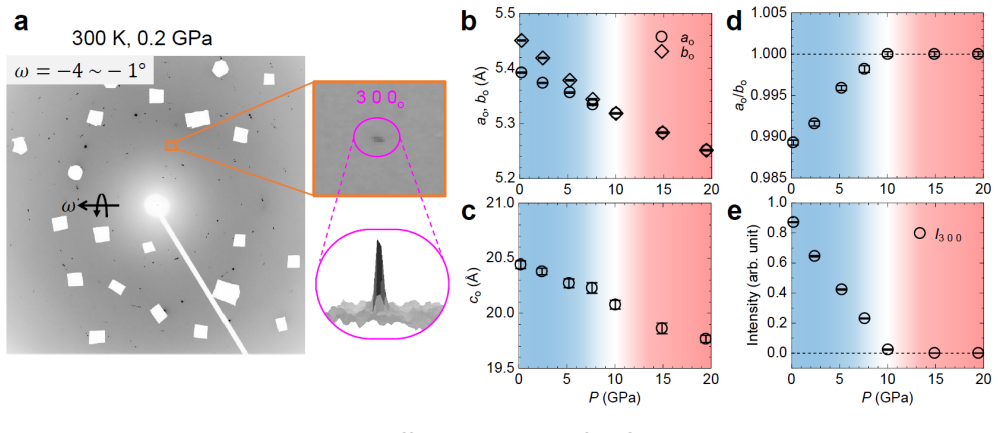
On its own terms, the paper claims to resolve a controversy about the crystal structure of pressurized La3Ni2O7. At ambient pressure the compound adopts the polar orthorhombic space group Am2m, in which charge order makes the two nickel sites inequivalent and the NiO6 octahedra tilt. As pressure rises at both 9 K and 300 K, reflections from orthorhombic twin domains merge, the orthorhombic distortion ao/bo approaches 1, and a weak glide-forbidden reflection that directly marks the charge order (the 300o reflection) fades linearly and vanishes at the same pressure. The paper concludes that Am2m transforms directly into tetragonal I4/mmm near 10 GPa, with no detectable Amam intermediate and no
What carries the argument
The load-bearing object is the sequence of crystal space groups and the specific reflection that distinguishes them. Am2m and Amam differ only by an a-glide symmetry: a reflection like 300o is allowed in Am2m (charge order) but forbidden in Amam. Tracking that reflection under helium pressure, together with the lattice-parameter ratio ao/bo, shows the charge-order signal and the orthorhombic distortion disappearing at the same pressure, directly into I4/mmm. The I4/mmm phase is the one with no octahedral tilting and no charge order, giving linear interlayer Ni–O–Ni bonds.
Load-bearing premise
The claim that charge order survives up to the transition at 9 K rests on extrapolating the ambient-pressure assignment and the 300 K data, because the low-temperature diffraction geometry could not see the reflections that distinguish charge-ordered Am2m from tilt-only Amam.
What would settle it
A single low-temperature h0l diffraction measurement between 7 and 13 GPa: if a glide-forbidden Am2m reflection such as 300o is still present at 9 K where the lattice is already tetragonal, the direct transition and its coincidence with charge-order collapse are disproved.
If this is right
- If correct, the superconducting phase of stoichiometric La3Ni2O7 is a centrosymmetric tetragonal lattice with linear interlayer Ni–O–Ni bonds, so theories of the pairing must start from that geometry.
- The previously proposed orthorhombic Fmmm and Amam phases would be artefacts of non-hydrostatic conditions, powder averaging, or oxygen off-stoichiometry in other samples.
- The collapse of the charge-order reflection at the same pressure as the lattice symmetry change ties the electronic charge-order instability directly to the structural transition.
- Because the tetragonal phase exists at pressures and temperatures outside the superconducting dome, the structural transition cannot be the sole condition for superconductivity; additional electronic or magnetic degrees of freedom are required.
- The direct Am2m to I4/mmm path means there is no tilt-only Amam regime to search for a distinct density-wave phase between the charge-ordered and superconducting states.
Where Pith is reading between the lines
- A natural testable extension: collect h0l-plane diffraction at 9 K across the 7–13 GPa range to confirm that charge order vanishes exactly at the low-temperature phase boundary, rather than being inferred from 300 K data.
- If charge-order collapse is the electronic event that tracks superconductivity, then chemical substitutions or strain that suppress bond disproportionation at lower pressure might be expected to raise the onset of superconductivity or change Tc.
- The same hydrostatic single-crystal protocol applied to other bilayer or trilayer nickelates could reveal whether a tilt-free high-pressure phase is a common structural precondition across nickelate superconductors.
Editorial analysis
A structured set of objections, weighed in public.
Referee Report
Summary. The paper reports single-crystal X-ray diffraction measurements of stoichiometric bilayer La3Ni2O7 under quasi-hydrostatic helium pressure, covering 0.2–19.5 GPa and 9–300 K. The authors find that the ambient-pressure polar orthorhombic Am2m phase persists at low pressure and transforms directly to a tetragonal I4/mmm phase near 10 GPa, with the charge-order-sensitive 300o reflection disappearing at the same pressure as the orthorhombic distortion at 300 K. They conclude that the previously proposed orthorhombic Amam and Fmmm phases are not present, and that the structural transition coincides with the onset of bulk superconductivity, thereby establishing a structural framework for the superconducting state.
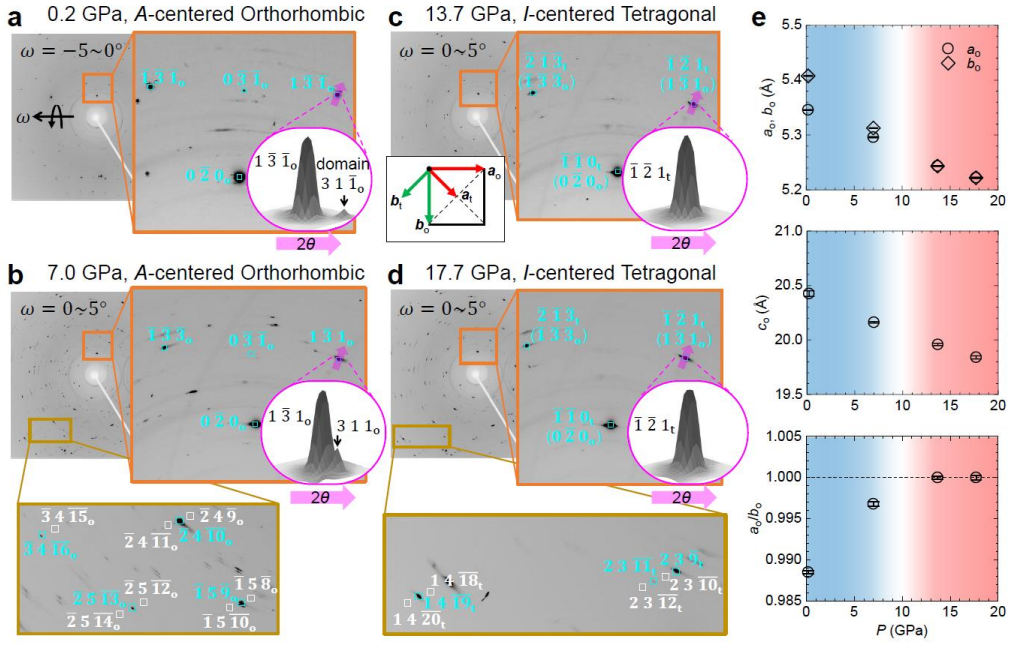
Significance. If the central claims hold, the paper would resolve a major controversy in the nickelate superconductor field by showing that the superconducting state of stoichiometric La3Ni2O7 has tilt-free, centrosymmetric I4/mmm symmetry with linear Ni–O–Ni bonds, reached directly from the charge-ordered polar Am2m phase. The strongest evidence is direct observation of extinction-rule violations: reflections with mixed odd/even indices at 7.0 GPa rule out Fmmm, and the h0l: h-odd 300o reflection at 300 K/0.2 GPa rules out Amam in the low-pressure phase. The use of a high-quality stoichiometric single crystal, helium as the pressure medium, and consistent same-batch samples for transport are notable strengths. The main weakness is that the low-temperature portion of the phase diagram is inferred rather than directly observed, as detailed below.
major comments (3)
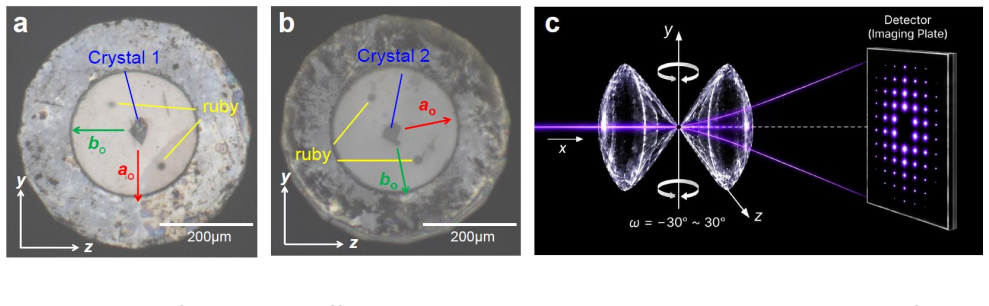
- [Relationship between charge order and superconductivity / Fig. 3e] The central claim of a 'direct transition from the charge-ordered Am2m phase to the tetragonal I4/mmm phase near 10 GPa' is directly demonstrated only at 300 K. At 9 K, the transition is bracketed between 7.0 and 13.7 GPa (Fig. 3e), and the Crystal 1 geometry (X-rays along c*, ω = ±30°) provides no access to h0l reflections. Thus Am2m cannot be distinguished from Amam at low temperature, as the authors themselves state: 'it remains unclear from the Crystal 1 measurements whether the charge order observed at ambient pressure persists or is suppressed'. The low-temperature labels below ~10 GPa in Fig. 1d are therefore carried over from the ambient-pressure assignment and from the 300 K Crystal 2 data, not from direct 9 K observation. The conclusion that the superconducting phase is reached directly from charge-ordered Am2m, without an Amam intermediate, is not established at the temperatur
- [Abstract and Fig. 1d] The claimed coincidence of the structural transition with the onset of bulk superconductivity at ~10 GPa is an inference, not a measurement in this work. The superconducting transition temperatures shown in Fig. 1d are taken from Ref. 40, measured on a different crystal from the same growth batch, and the structural transition at 9 K is only bracketed between 7.0 and 13.7 GPa. There are no transport data on the same crystal in the same DAC, and no structural data at the superconducting onset temperature (~68 K). The vertical boundary at ~10 GPa is an interpolation between the room-temperature transition (Fig. 4) and the 9-K bracket. The abstract and conclusion should explicitly state that the structural transition occurs in the same pressure range as superconductivity, not that it 'coincides' with it.
- [Fig. 4d,e and 'direct transition' at 300 K] At 300 K, the evidence for a direct Am2m→I4/mmm transition without an intermediate Amam phase rests on the simultaneous disappearance of the 300o reflection and the orthorhombic distortion. The authors describe the transformation as 'more consistent with a first-order structural transition' despite continuous evolution of lattice parameters and intensity. The number of pressure points in the critical region and their spacing are not given; if the pressure steps are coarse, a narrow Amam window (where tilting persists but charge order has vanished) could be missed. Please report the pressure increments, error bars on the transition pressure, and the criterion used to define the disappearance of the 300o reflection. This would strengthen the claim of a direct transition even at 300 K.
minor comments (4)
- [Fig. 3 caption] The collection order of the datasets is described as (a), (c), (d), and (b). It would be clearer to state this explicitly in the main text as well, since the appearance of additional domains in (b) is attributed to pressure cycling through the tetragonal phase.
- [Methods, helium loading] The phrase 'helium precompressed to 200 MPa' is correct but could be confusing; consider stating '0.2 GPa' for consistency with the pressures quoted elsewhere.
- [Fig. 3c inset] The transformation equations use 'at' and 'bt' with a subscript t, but the text uses 'aₜ' and 'bₜ'. Please unify the notation.
- [Supplementary Figure S2] The statement that the systematic appearance and disappearance of h0l: h odd reflections demonstrate they are intrinsic, not multiple-scattering artifacts, would be more convincing if the pressure dependence of all such reflections were shown, not just the 300o reflection.
Circularity Check
No substantive circularity; central structural transition is directly measured, with minor reliance on same-group companion data for the superconductivity coincidence.
full rationale
The paper derives no structural result from its own claimed conclusions; the Am2m-to-I4/mmm transition at 300 K is directly evidenced by the observed disappearance of the a-glide-forbidden 300o reflection and the merging of orthorhombic lattice parameters. The low-temperature phase boundary is less direct: Crystal 1 geometry cannot distinguish Am2m from Amam, and the authors explicitly state 'it remains unclear from the Crystal 1 measurements whether the charge order observed at ambient pressure persists or is suppressed.' This is an acknowledged interpolation, not a circular definition. The coincidence with bulk superconductivity is imported from companion transport data in Ref. [40] on crystals from the same growth batch, but this is an external cross-experiment comparison, not a fitted parameter renamed as a prediction. The self-citations to Refs. [33] and [40] support the ambient-pressure assignment and the transport Tc, yet the structural phase boundary itself is independently measured here. Thus there is no circular step, only an inference gap between the bracketed 9 K transition and the claimed coincidence near 10 GPa.
Axiom & Free-Parameter Ledger
free parameters (1)
- Transition pressure Pc (≈10 GPa) =
~10 GPa (300 K); bracketed 7.0–13.7 GPa at 9 K
axioms (6)
- domain assumption Ruby fluorescence pressure scale (IPPS-Ruby2020, Shen et al.) with Ragan temperature correction reliably reports sample pressure at 9–300 K.
- domain assumption Helium medium remains hydrostatic (or quasi-hydrostatic) down to 9 K and up to 17.7–19.5 GPa.
- domain assumption The crystals are stoichiometric, polymorph-free, and representative of the superconducting batch characterized by transport in Ref [40].
- domain assumption The 300o reflection is an intrinsic a-glide violation (charge-order marker) rather than multiple scattering or a minority-phase superstructure.
- domain assumption The ambient-pressure Am2m assignment from prior work (Ref [33], overlapping authors) is correct.
- domain assumption Kinematic diffraction: the integrated intensity of 300o is proportional to the squared structure factor without extinction/absorption corrections.
Cite this review
Pith. "Pith review of Single-crystal structural phase diagram of stoichiometric bilayer nickelate La3Ni2O7 under hydrostatic pressure." pith.science (2026). https://pith.science/paper/QDC7DJIV
@misc{pith2026260727607,
  author       = {Pith},
  title        = {Pith review of: Single-crystal structural phase diagram of stoichiometric bilayer nickelate La3Ni2O7 under hydrostatic pressure},
  year         = {2026},
  howpublished = {\url{https://pith.science/paper/QDC7DJIV}},
  note         = {Machine review of arXiv:2607.27607}
}
read the original abstract
The bilayer nickelate La3Ni2O7 has attracted intense interest following the discovery of high-temperature superconductivity under pressure, representing the first nickelate superconductor realized in bulk form. However, the crystal structure of the superconducting phase remains under active discussion, complicating efforts to establish its microscopic origin. Here we resolve these structural controversies by establishing a definitive pressure-temperature phase diagram, including the superconducting region of stoichiometric La3Ni2O7 single crystals under hydrostatic conditions using helium as the pressure-transmitting medium. At ambient pressure, La3Ni2O7 adopts a polar orthorhombic Am2m structure characterized by charge order between inequivalent Ni sites and NiO6 octahedral tilting. Upon compression, the system undergoes a direct transition from the charge-ordered Am2m phase to the tetragonal I4/mmm phase near 10 GPa, coinciding with the onset of bulk superconductivity. These results establish the intrinsic structural evolution of La3Ni2O7 and provide a structural framework for microscopic theories of nickelate superconductivity.
Figures
Reference graph
Works this paper leans on
-
[1]
Liu, Z., Nakajima, M., Kriener, M., Kitou, S., Lyu, X., Terakura, C., Karube, K., Yip, K
1. Liu, Z., Nakajima, M., Kriener, M., Kitou, S., Lyu, X., Terakura, C., Karube, K., Yip, K. M., Lazar, S., Nakanishi, N., Shimada, K., Kikkawa, A., Fujishiro, Y ., Yu, X., Arima, T., Tokura, Y. & Taguchi, Y . Density wave phases, anisotropic transport, and Planckian dissipation in single crystals of the superconductor La3Ni2O7. arXiv:2607.26990
discussion (0)
Sign in with ORCID, Apple, or X to comment. Anyone can read and Pith papers without signing in.