REVIEW 4 major objections 7 minor 49 references
LabEvolver claims that a training-free dual-loop architecture lets wet-lab robots learn from their own completed experiments, cutting pH-regulation completion time by 48.2% and raising cumulative success on a long-horizon embodied benchmark
Reviewed by Pith at T0; open to challenge. T0 means a machine referee read the full paper against a public rubric. the ladder, T0–T4 →
T0 review · deepseek-v4-flash
2026-08-03 01:38 UTC pith:W5O7CXLV
load-bearing objection Plausible and internally consistent dual-loop design with real wet-lab hardware, but the headline physical gains are single-run means and should not be taken as established yet. the 4 major comments →
LabEvolver: Training-Free Experience Evolution for Safe and Grounded Wet-Lab Agents
The pith
A machine-rendered reading of the paper's core claim, the machinery that carries it, and where it could break.
Core claim
LabEvolver establishes that a wet-lab agent can carry out long-horizon solution preparation safely by maintaining a hierarchical laboratory state — embodiment, environment, multimodal observations — grounding each proposed action in that state through a three-layer safety gate, and then distilling completed trajectories into state-paired skill, strategy, and safety experience that makes later trials faster and more successful. The headline evidence is physical: on a solution-preparation robot, pH 5 regulation completion time fell 48.2% and safety-gate intercepts fell 60.0% relative to a reasoning-and-acting baseline, with mean reagent additions dropping from 5.67 to 2.33. On a long-horizon e
What carries the argument
The load-bearing device is the nested dual-loop architecture. The inner trial loop couples the Observer, which reconstructs the hierarchical state st=(At,Et,Ot) — embodiment, environment, multimodal observations; the Operator, which grounds the goal into parameterized LabSkill actions (a three-level action interface of atomic actions, digital tools, and semantic skills); and a tri-layer safety gate Γ(st,at)=Γintf∧Γproc∧Γphys that blocks malformed, procedurally inconsistent, or physically infeasible actions before dispatch. The outer loop's Strategist distills each completed trajectory into e=(eskill,estrategy,esafety), merges these into a memory bank via Add/Update/Upvote/Downvote with a for
Load-bearing premise
If the Observer's automatic reconstruction of the laboratory state is inaccurate in a way the safety gate does not catch, the claimed closed-loop safety and experience-reuse gains degrade — and the main text defers the Observer's robustness analysis to the supplement.
What would settle it
Control experiment: on the long-horizon benchmark, replace the state-paired experience fragments with keyword-matched or randomly selected fragments of equal size; if cumulative within-20-step success does not fall below LabEvolver's, then state-paired distillation is not the driver. On the physical robot, deliberately perturb the Observer's reported object poses or pH readings after each action; if the tri-layer gate does not increase its intercept rate, the gate is not checking against the true world.
If this is right
- Repeated wet-lab trials get faster and leaner without fine-tuning: mean reagent additions drop from 5.67 to 2.33 and completion time from about 26 to 13 minutes in pH-5 regulation.
- Perceptual feedback can be converted into reusable control parameters: after self-exploration, pouring reaches 41 of 43 locked-parameter validation trials within ±0.2 g across target masses and liquids.
- Strategy-level experience transfers to new target conditions: pH 6 and pH 9 goals are reached with few operations, and coupled pH–EC regulation reduces additions from 21 to 11 and completion time by 55% when task-relevant history is available.
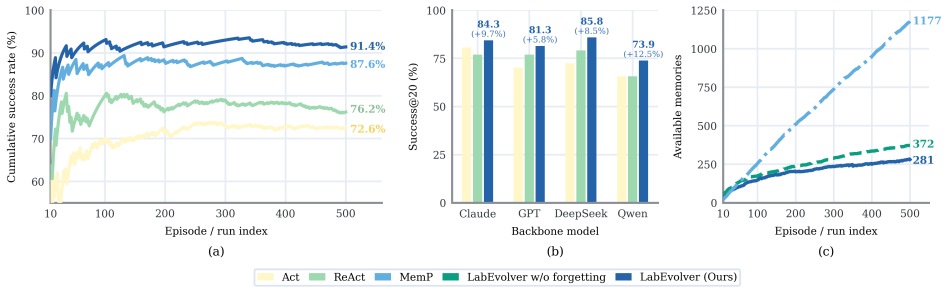
- The gain is not tied to one underlying model: on a long-horizon benchmark, every tested language-model backbone improves with accumulated experience, with larger gains for budget-constrained models.
- Experience accumulation stays bounded: after 500 continual tasks the memory bank holds about 281 records with forgetting, versus 1177 for a procedural-memory baseline.
Where Pith is reading between the lines
- The paper leaves implicit that the same dual-loop recipe could generalize to other closed-loop experiments — synthesis, crystallization, cell culture — wherever a state can be reconstructed and safety rules authored; the main new cost per domain is the action library and rule set.
- The state-paired indexing principle suggests a general memory-design rule: index agent experience by the physical conditions under which it was valid, not by task keywords. Testing this separation (state-paired vs. keyword retrieval) would isolate what drives the reported gains.
- A natural robustness extension is to expose the Observer's state-estimation uncertainty to the safety gate, so that the agent falls back to conservative actions when perception is unreliable — a safeguard the paper does not address.
- Because the reported benefits are largest for weaker planners, a testable prediction follows: on tasks with very strong planners, experience retrieval should matter mainly for rare or safety-critical edge cases, not for routine steps.
Editorial analysis
A structured set of objections, weighed in public.
Referee Report
Summary. The paper proposes LabEvolver, a training-free dual-loop framework for autonomous wet-lab agents. An inner trial loop maintains a hierarchical laboratory state (Agent, Environment, Observation), plans with an LLM-based Operator over a hand-designed LabSkill action hierarchy, and validates each action with a tri-layer runtime safety gate. An outer evolution loop uses a Strategist module to distill completed trajectories into state-paired skill, strategy, and safety experience, stored in a bounded memory bank with Add/Update/Upvote/Downvote operations and Ebbinghaus-style forgetting. The paper reports real-world robotic results for pouring, pH regulation, and coupled pH-EC regulation, claiming a 48.2% reduction in pH-regulation completion time and a 60.0% reduction in safety-gate intercepts versus ReAct/Inner-only baselines. It also reports ALFWorld cumulative Success@20 of 91.4% versus 76.2% for ReAct over 500 continual tasks. The central claim is that test-time experience evolution improves long-horizon decision-making, execution efficiency, and safety without updating model weights.
Significance. The ALFWorld evaluation is the strongest part of the paper: a 500-task continual stream with cumulative Success@20 of 91.4% versus 76.2% for ReAct, consistent gains across four backbone models, and a bounded memory bank (372 or 281 entries at episode 500 versus 1177 for MemP). The pouring study also includes repeated trials and reports transfer over 43 locked-parameter validation trials with a trial-weighted MAE of 0.081 g. These results provide credible evidence for the outer-loop memory contribution in a symbolic, privileged-state setting. The wet-lab results, however, are not statistically grounded: Table 2 has one physical run per condition, and the safety and perception analyses are repeatedly deferred to a supplementary document that is not included in the submission. The dual-loop architecture is a reasonable integration of known self-evolution ideas (ReAct-style planning, Voyager-like experience memory, Reflexion-style reflection), and the state-paired safety/strategy memory is a useful design choice, but the paper's central claim of safe and grounded real-world improvement is not yet established at the reported evidence level. If the real-world effects are reproducible, th
major comments (4)
- [§4.4, Table 2] Every cell in Table 2 is a single physical run, with no repeats, seeds, or confidence intervals. The headline 48.2% completion-time reduction is computed from three trials per method (ReAct: 1875/706/2068 s; LabEvolver: 652/609/1145 s), and the 60.0% gate-intercept reduction is 5 versus 2 total intercepts across three backbones. With n=3, a single trial change moves these percentages substantially; the wet-lab evidence cannot support the abstract's feasibility/safety claims as stated. Please report multiple runs per condition with dispersion measures, or explicitly reframe the wet-lab results as single-case demonstrations. This is the load-bearing evidence for real-world safety and efficiency, so the comparison needs to be adequately powered.
- [§3.1, State Initialization] The Observer's hierarchical state st=(At,Et,Ot) underpins state-conditioned planning, the tri-layer safety gate Γ(st,at), and the outer loop's state-paired experience retrieval. The paper states that 'further robustness analysis of the Observer is provided in the supplementary document', but no supplementary document accompanies this submission. Perception accuracy for object segmentation/localization, balance readings, and pH-meter readings, and the effect of perception errors on the safety gate, are load-bearing for the grounding and safety claims. This evidence needs to appear in the main text or in a supplement made available for review; otherwise the inner loop is asserted rather than demonstrated.
- [§3.1–§3.2] Core algorithmic content is repeatedly deferred: LabSkill hierarchy details, the concrete definitions of Γintf/Γproc/Γphys, the Strategist's Maintain operations (Add/Update/Upvote/Downvote, thresholds, Ebbinghaus decay, top-K retrieval) are all referred to the 'supplementary document'. The main text therefore does not contain enough information to reproduce or audit the safety gate or the memory system. These mechanisms are not peripheral; they are the paper's technical contribution. Please include the algorithmic definitions and the safety-rule coverage analysis in the reviewable manuscript.
- [§4.2, Figure 4a; Abstract] The ALFWorld experiments are well powered but exercise only the outer loop in a symbolic simulator where state is privileged and there is no safety gate. They cannot substantiate the wet-lab safety/efficiency claims. The paper mostly respects this distinction, but the abstract's joint statement—'reducing pH-regulation completion time and safety-gate intercepts... On ALFWorld... showing generality beyond wet-lab settings'—can be read as one combined validation. Please make explicit in the abstract and conclusion that real-world safety/efficiency claims rest entirely on the single-run Table 2 experiments, and that ALFWorld supports only the generality of the outer-loop memory mechanism.
minor comments (7)
- [Table 2] The 'Act' rows list 'No' under Succ., yet Add. and Gate are still reported. It would be clearer to state that Act failed and explain why its Add./Gate counts are reported, or mark them as not applicable. Also, the Table 2 column header 'Succ.' should explicitly define the success criterion for pH regulation (e.g., final pH within [4.5,5.5]?).
- [Figure 6] The gray hatched regions are described in the caption as conditions where target mass approaches test-tube capacity, but there is no legend or explicit threshold. Please mark the capacity constraint directly on the axes or add a note in the figure.
- [Figure 5] The yellow boxes indicating instruments manipulated by the arm are hard to see in grayscale print. Use arrows or numbered callouts instead of color alone.
- [§1, §5] The term 'training-free' is used throughout, but the outer loop updates a memory bank across trials and the pouring skill is tuned over 40 self-exploration trials. Clarify that 'training-free' means no gradient/weight updates, not no cross-trial adaptation, to avoid confusion.
- [§3.2, Experience maintenance] The Ebbinghaus-style forgetting mechanism is described only briefly. The decay rate and score thresholds are free parameters; at minimum, give their values and a sensitivity check, or state that the main results are insensitive to them.
- [§4.3, Table 1] LabEvolver's pouring controller is optimized over 40 self-exploration trials, while the fixed and adaptive PD baselines are manually tuned. This is the intended comparison, but the text should acknowledge that LabEvolver receives a substantial trial budget that the baselines do not, so the comparison is between 'with evolution' and 'without evolution', not between equal-budget controllers.
- [§5, Conclusion] The conclusion candidly notes that reliance on human-designed LabSkills and safety rules may limit adaptation to unseen operations. This limitation is central enough that it should be discussed earlier, with a concrete statement of which actions and failure modes the current LabSkill/safety-rule set covers.
Circularity Check
No circular derivation: LabEvolver's gains are measured on external benchmarks and physical outcomes; experience reuse is the mechanism under test, not an input disguised as a result.
full rationale
The paper does not derive its headline results from its own assumptions or definitions. The central mechanism—the outer evolution loop distilling completed trajectories into reusable experience and the inner loop retrieving that experience—is the method being evaluated, not a hidden input. On ALFWorld, success is measured on external task streams (valid_unseen tasks and shuffled train tasks), and the reported 91.4% cumulative Success@20 is an empirical outcome relative to ReAct and other baselines. In the wet-lab experiments, pH-regulation completion time, safety-gate intercepts, and pouring MAE are measured physical outcomes, not quantities reconstructed from the framework's definitions. No load-bearing step uses a parameter fitted to the target metric and then re-predicts that metric. The paper contains no author self-citations used as evidence; references are to external prior work. The only self-referential element is that LabEvolver learns from its own prior episodes, which is precisely the proposed learn-by-doing behavior and is not circular reasoning. Concerns about single wet-lab trials or missing supplementary robustness analyses are statistical-evidence limitations, not circularity. Overall, the derivation chain is self-contained against external benchmarks and physical measurement, so the circularity score is 0.
Axiom & Free-Parameter Ledger
free parameters (2)
- Pouring controller gains (kp, kd, pre_stop) =
evolved over 40 self-exploration trials on 20g water; per-target values in supplementary
- Memory maintenance hyperparameters (Ebbinghaus decay rate, Upvote/Downvote thresholds, top-K retrieval K)
axioms (5)
- domain assumption RGB-D scene understanding and runtime sensor feedback yield accurate and sufficiently complete state estimates s_t (Observer robustness).
- ad hoc to paper Hand-designed LabSkill action hierarchy and tri-layer safety rules cover all relevant actions and failure modes in the tested tasks.
- domain assumption Frozen LLM backbones (e.g., DeepSeek-V4-Pro) can, given retrieved experience and LabSkill context, produce executable plans that match the physical state.
- domain assumption ALFWorld train split treated as a continual task stream measures cross-task experience evolution without leakage or task-order artifacts.
- domain assumption Success in wet-lab tasks is correctly determined by instrument readings (balance, pH/EC meters) with negligible measurement error.
invented entities (3)
-
Strategist experience bank M with Add/Update/Upvote/Downvote and Ebbinghaus forgetting
independent evidence
-
LabSkill three-level action interface (atomic/digital/semantic)
independent evidence
-
Tri-layer Runtime Safety Gate Γ (intf, proc, phys)
independent evidence
read the original abstract
We introduce LabEvolver, a training-free framework that equips safe and grounded wet-lab agents with episodic memory from execution experience. LabEvolver couples a state-grounded inner trial loop for adaptive perception, online planning, and safety validation with an outer evolution loop that distills completed trajectories into reusable skill, strategy, and safety experience. On robotic solution-preparation tasks, LabEvolver demonstrates real-world feasibility, reducing pH-regulation completion time and safety-gate intercepts by 48.2% and 60.0%, respectively. On ALFWorld, it further improves cumulative success rate within 20 steps from 76.2% with ReAct to 91.4% over 500 continual tasks, showing generality beyond wet-lab settings. These results support learn-by-doing experience evolution as a feasible path toward closed-loop automated scientific discovery. The project page is available at https://andygao6186.github.io/LabEvolver/.
Figures




Reference graph
Works this paper leans on
-
[1]
Position: Autonomous scientific discov- ery needs embodied experimentation with learnability
Yihang Chen, Zhongwei Yu, Yang Li, Xingyu Lu, Qiang Li, Hongxia Yu, and Jun Wang. Position: Autonomous scientific discov- ery needs embodied experimentation with learnability. TechRxiv preprint, 2026. URL https://www.techrxiv.org/doi/abs/ 10.36227/techrxiv.177100993.33363174/v1. https://doi.org/10.36227/techrxiv.177100993. 33363174/v1
arXiv 2026
-
[2]
The automation of science.Science, 324(5923):85–89, 2009
Ross D King, Jem Rowland, Stephen G Oliver, Michael Young, Wayne Aubrey, Emma Byrne, MariaLiakata,MagdalenaMarkham,PinarPir, Larisa N Soldatova, et al. The automation of science.Science, 324(5923):85–89, 2009
2009
-
[3]
Self-driving laboratory for accel- erated discovery of thin-film materials.Science Advances, 6(20):eaaz8867, 2020
Benjamin P MacLeod, Fraser GL Parlane, Thomas D Morrissey, Florian Häse, Loïc M Roch, Kevan E Dettelbach, Raphaell Moreira, Lars PE Yunker, Michael B Rooney, Joseph R Deeth, et al. Self-driving laboratory for accel- erated discovery of thin-film materials.Science Advances, 6(20):eaaz8867, 2020
2020
-
[4]
A mobile robotic chemist.Nature, 583(7815):237–241, 2020
Benjamin Burger, Phillip M Maffettone, Vladimir V Gusev, Catherine M Aitchison, Yang Bai, Xiaoyan Wang, Xiaobo Li, Ben M Alston, Buyi Li, Rob Clowes, et al. A mobile robotic chemist.Nature, 583(7815):237–241, 2020
2020
-
[5]
An au- tonomouslaboratoryfortheacceleratedsynthe- sis of novel materials.Nature, 624(7990):86–91, 2023
Nathan J Szymanski, Bernardus Rendy, Yuxing Fei, Rishi E Kumar, Tanjin He, David Milsted, Matthew J McDermott, Max Gallant, Ekin Do- gus Cubuk, Amil Merchant, et al. An au- tonomouslaboratoryfortheacceleratedsynthe- sis of novel materials.Nature, 624(7990):86–91, 2023
2023
-
[6]
Organic synthesis in a modular robotic system driven by a chemical programming lan- guage.Science, 363(6423):eaav2211, 2019
Sebastian Steiner, Jakob Wolf, Stefan Glatzel, Anna Andreou, Jarosław M Granda, Gra- ham Keenan, Trevor Hinkley, Gerardo Aragon- Camarasa, Philip J Kitson, Davide Angelone, et al. Organic synthesis in a modular robotic system driven by a chemical programming lan- guage.Science, 363(6423):eaav2211, 2019
2019
-
[7]
Roch, Florian Hase, Christoph Kreis- beck, Teresa Tamayo-Mendoza, Lars P
Loic M. Roch, Florian Hase, Christoph Kreis- beck, Teresa Tamayo-Mendoza, Lars P. E. Yunker, Jason E. Hein, and Alán Aspuru- Guzik. ChemOS: Orchestrating autonomous experimentation.Science Robotics, 3(19): eaat5559, 2018. doi: 10.1126/scirobotics. aat5559
-
[8]
Autonomous chemical re- search with large language models.Nature, 624 (7992):570–578, 2023
Daniil A Boiko, Robert MacKnight, Ben Kline, and Gabe Gomes. Autonomous chemical re- search with large language models.Nature, 624 (7992):570–578, 2023
2023
-
[9]
Bran, Sam Cox, Oliver Schilter, Carlo Baldassari, Andrew D White, and Philippe Schwaller
Andres M. Bran, Sam Cox, Oliver Schilter, Carlo Baldassari, Andrew D White, and Philippe Schwaller. Augmenting large language models with chemistry tools.Nature machine intelligence, 6(5):525–535, 2024
2024
-
[10]
9 Biomars: A multi-agent robotic system for au- tonomous biological experiments, 2025
Yibo Qiu, Zan Huang, Zhiyu Wang, Handi Liu, Yiling Qiao, Yifeng Hu, Shu’ang Sun, Hangke Peng, Ronald X Xu, and Mingzhai Sun. 9 Biomars: A multi-agent robotic system for au- tonomous biological experiments, 2025. URL https://arxiv.org/abs/2507.01485
Pith/arXiv arXiv 2025
-
[11]
Large language models for chemistry robotics
Naruki Yoshikawa, Marta Skreta, Kourosh Darvish, Sebastian Arellano-Rubach, Zhi Ji, Lasse Bjørn Kristensen, Andrew Zou Li, Yuchi Zhao, Haoping Xu, Artur Kuramshin, et al. Large language models for chemistry robotics. Autonomous Robots, 47(8):1057–1086, 2023
2023
-
[12]
Rt-2: Vision-language-action mod- els transfer web knowledge to robotic control,
Anthony Brohan, Noah Brown, Justice Car- bajal, Yevgen Chebotar, Xi Chen, Krzysztof Choromanski, Tianli Ding, Danny Driess, Avinava Dubey, Chelsea Finn, Pete Flo- rence, Chuyuan Fu, Montse Gonzalez Are- nas, Keerthana Gopalakrishnan, Kehang Han, Karol Hausman, Alexander Herzog, Jasmine Hsu, Brian Ichter, Alex Irpan, Nikhil Joshi, Ryan Julian, Dmitry Kalas...
-
[13]
Openvla: An open-source vision- language-action model, 2024
Moo Jin Kim, Karl Pertsch, Siddharth Karam- cheti, Ted Xiao, Ashwin Balakrishna, Suraj Nair, Rafael Rafailov, Ethan Foster, Grace Lam, Pannag Sanketi, Quan Vuong, Thomas Kollar, Benjamin Burchfiel, Russ Tedrake, Dorsa Sadigh, Sergey Levine, Percy Liang, and Chelsea Finn. Openvla: An open-source vision- language-action model, 2024. URL https:// arxiv.org/a...
Pith/arXiv arXiv 2024
-
[14]
Roboagent: Generalization and efficiency in robot manipulation via seman- tic augmentations and action chunking
Homanga Bharadhwaj, Jay Vakil, Mohit Sharma, Abhinav Gupta, Shubham Tulsiani, and Vikash Kumar. Roboagent: Generalization and efficiency in robot manipulation via seman- tic augmentations and action chunking. In2024 IEEE International Conference on Robotics and Automation (ICRA), pages 4788–4795. IEEE, 2024
2024
-
[15]
Organa: A robotic assis- tant for automated chemistry experimentation and characterization.Matter, 8(2), 2025
Kourosh Darvish, Marta Skreta, Yuchi Zhao, Naruki Yoshikawa, Sagnik Som, Miroslav Bog- danovic,YangCao,HanHao,HaopingXu,Alán Aspuru-Guzik, et al. Organa: A robotic assis- tant for automated chemistry experimentation and characterization.Matter, 8(2), 2025
2025
-
[16]
Labvla: Grounding vision-language- action models in scientific laboratories, 2026
Baochang Ren, Xinjie Liu, Xi Chen, Yanshuo Liu, Chenxi Li, Daqi Gao, Zeqin Su, Jin- tao Xing, Zirui Xue, Rui Li, Xiangyu Zhao, Shuofei Qiao, Minting Pan, Wangmeng Zuo, Lei Bai, Dongzhan Zhou, Ningyu Zhang, and Hua- jun Chen. Labvla: Grounding vision-language- action models in scientific laboratories, 2026. URL https://arxiv.org/abs/2606.13578
Pith/arXiv arXiv 2026
-
[17]
Robo- culture: A robotics platform for automated biological experimentation, 2025
Kevin Angers, Kourosh Darvish, Naruki Yoshikawa, Sargol Okhovatian, Dawn Ban- nerman, Ilya Yakavets, Florian Shkurti, Alán Aspuru-Guzik, and Milica Radisic. Robo- culture: A robotics platform for automated biological experimentation, 2025. URL https://arxiv.org/abs/2505.14941
Pith/arXiv arXiv 2025
-
[18]
Reflexion: Language agents with verbal reinforcement learning.Advances in neural information processing systems, 36:8634–8652, 2023
Noah Shinn, Federico Cassano, Ashwin Gopinath, Karthik Narasimhan, and Shunyu Yao. Reflexion: Language agents with verbal reinforcement learning.Advances in neural information processing systems, 36:8634–8652, 2023
2023
-
[19]
Expel: Llm agents are experiential learners
Andrew Zhao, Daniel Huang, Quentin Xu, Matthieu Lin, Yong-Jin Liu, and Gao Huang. Expel: Llm agents are experiential learners. In Proceedings of the AAAI Conference on Artifi- cial Intelligence,volume38,pages19632–19642, 2024
2024
-
[20]
Voyager: An open-ended embodied agent with large lan- guage models, 2023
Guanzhi Wang, Yuqi Xie, Yunfan Jiang, Ajay Mandlekar, Chaowei Xiao, Yuke Zhu, Linxi Fan, and Anima Anandkumar. Voyager: An open-ended embodied agent with large lan- guage models, 2023. URL https://arxiv.org/ abs/2305.16291
Pith/arXiv arXiv 2023
-
[21]
Alfworld: Aligning text and embodied environments for interactive learning, 2021
Mohit Shridhar, Xingdi Yuan, Marc-Alexandre Côté, Yonatan Bisk, Adam Trischler, and Matthew Hausknecht. Alfworld: Aligning text and embodied environments for interactive learning, 2021. URL https://arxiv.org/abs/ 2010.03768
Pith/arXiv arXiv 2021
-
[22]
Michael Ahn, Anthony Brohan, Noah Brown, Yevgen Chebotar, Omar Cortes, Byron David, Chelsea Finn, Chuyuan Fu, Keerthana Gopalakrishnan, Karol Hausman, et al. Do as i can, not as i say: Grounding language in robotic affordances.arXiv preprint arXiv:2204.01691, 2022. 10
Pith/arXiv arXiv 2022
-
[23]
Code as policies: Language model programs for embodied control
JackyLiang,WenlongHuang,FeiXia,PengXu, Karol Hausman, Brian Ichter, Pete Florence, and Andy Zeng. Code as policies: Language model programs for embodied control. In2023 IEEE International conference on robotics and automation (ICRA), pages 9493–9500. IEEE, 2023
2023
-
[24]
Progprompt: Generating situated robot task plans using large language models, 2022
Ishika Singh, Valts Blukis, Arsalan Mousa- vian, Ankit Goyal, Danfei Xu, Jonathan Trem- blay, Dieter Fox, Jesse Thomason, and Animesh Garg. Progprompt: Generating situated robot task plans using large language models, 2022. URL https://arxiv.org/abs/2209.11302
Pith/arXiv arXiv 2022
-
[25]
Palm-e: An embodied multimodal language model.arXiv preprint arXiv:2303.03378, 2023
Danny Driess, Fei Xia, Mehdi SM Sajjadi, Corey Lynch, Aakanksha Chowdhery, Brian Ichter, Ayzaan Wahid, Jonathan Tompson, Quan Vuong, Tianhe Yu, et al. Palm-e: An embodied multimodal language model.arXiv preprint arXiv:2303.03378, 2023
Pith/arXiv arXiv 2023
-
[26]
Rt-1: Robotics transformer for real- worldcontrolatscale,2023
Anthony Brohan, Noah Brown, Justice Carba- jal, Yevgen Chebotar, Joseph Dabis, Chelsea Finn, Keerthana Gopalakrishnan, Karol Haus- man, Alex Herzog, Jasmine Hsu, Julian Ibarz, Brian Ichter, Alex Irpan, Tomas Jackson, Sally Jesmonth, Nikhil J Joshi, Ryan Julian, Dmitry Kalashnikov, Yuheng Kuang, Isabel Leal, Kuang-Huei Lee, Sergey Levine, Yao Lu, Utsav Mal...
Pith/arXiv arXiv 2023
-
[27]
Open x-embodiment: Robotic learning datasets and rt-x models: Open x-embodiment collaboration
Abby O’Neill, Abdul Rehman, Abhiram Mad- dukuri, Abhishek Gupta, Abhishek Padalkar, Abraham Lee, Acorn Pooley, Agrim Gupta, Ajay Mandlekar, Ajinkya Jain, et al. Open x-embodiment: Robotic learning datasets and rt-x models: Open x-embodiment collaboration
-
[28]
Droid: A large-scale in-the-wild robot manipulation dataset.arXiv preprint arXiv:2403.12945, 2024
Alexander Khazatsky, Karl Pertsch, Suraj Nair, Ashwin Balakrishna, Sudeep Dasari, Siddharth Karamcheti, Soroush Nasiriany, Mohan Kumar Srirama, Lawrence Yunliang Chen, Kirsty El- lis, et al. Droid: A large-scale in-the-wild robot manipulation dataset.arXiv preprint arXiv:2403.12945, 2024
Pith/arXiv arXiv 2024
-
[29]
In2024 IEEE International Conference on Robotics and Automation (ICRA), pages 6892–
-
[30]
Self-refine: Iterative refine- ment with self-feedback.Advances in neural in- formation processing systems, 36:46534–46594, 2023
Aman Madaan, Niket Tandon, Prakhar Gupta, Skyler Hallinan, Luyu Gao, Sarah Wiegreffe, Uri Alon, Nouha Dziri, Shrimai Prabhumoye, Yiming Yang, et al. Self-refine: Iterative refine- ment with self-feedback.Advances in neural in- formation processing systems, 36:46534–46594, 2023
2023
-
[31]
URL https://arxiv.org/abs/2410.24164
Kevin Black, Noah Brown, Danny Driess, Ad- nan Esmail, Michael Equi, Chelsea Finn, Nic- colo Fusai, Lachy Groom, Karol Hausman, Brian Ichter, Szymon Jakubczak, Tim Jones, Liyiming Ke, Sergey Levine, Adrian Li-Bell, Mohith Mothukuri, Suraj Nair, Karl Pertsch, Lucy Xiaoyang Shi, James Tanner, Quan Vuong, Anna Walling, Haohuan Wang, and Ury Zhilinsky.π 0: A ...
Pith/arXiv arXiv 2026
-
[32]
Empowering large language model agents through action learning,
Haiteng Zhao, Chang Ma, Guoyin Wang, Jing Su, Lingpeng Kong, Jingjing Xu, Zhi-Hong Deng, and Hongxia Yang. Empowering large language model agents through action learning,
-
[33]
Memp: Ex- ploring agent procedural memory
Runnan Fang, Yuan Liang, Xiaobin Wang, Jia- longWu,ShuofeiQiao,PengjunXie,FeiHuang, Huajun Chen, and Ningyu Zhang. Memp: Ex- ploring agent procedural memory. InFindings of the Association for Computational Linguis- tics: ACL 2026, pages 17490–17502, 2026
2026
-
[34]
Skillrl: Evolving agents via recursive skill- augmented reinforcement learning, 2026
Peng Xia, Jianwen Chen, Hanyang Wang, Ji- aqi Liu, Kaide Zeng, Yu Wang, Siwei Han, Yiyang Zhou, Xujiang Zhao, Haifeng Chen, Zeyu Zheng, Cihang Xie, and Huaxiu Yao. Skillrl: Evolving agents via recursive skill- augmented reinforcement learning, 2026. URL https://arxiv.org/abs/2602.08234
Pith/arXiv arXiv 2026
-
[35]
Trace2skill: Distill trajectory-local lessons into 11 transferable agent skills, 2026
Jingwei Ni, Yihao Liu, Xinpeng Liu, Yutao Sun, Mengyu Zhou, Pengyu Cheng, Dexin Wang, Er- chao Zhao, Xiaoxi Jiang, and Guanjun Jiang. Trace2skill: Distill trajectory-local lessons into 11 transferable agent skills, 2026. URL https: //arxiv.org/abs/2603.25158
Pith/arXiv arXiv 2026
-
[36]
G-memory: Tracing hierarchical memory for multi-agent systems.Advances in Neural Information Pro- cessing Systems, 38:12988–13018, 2026
Guibin Zhang, Muxin Fu, Kun Wang, Frank Wan, Miao Yu, and Shuicheng Yan. G-memory: Tracing hierarchical memory for multi-agent systems.Advances in Neural Information Pro- cessing Systems, 38:12988–13018, 2026
2026
-
[37]
Elite: Experiential learning and intent-aware transfer for self-improving embodied agents, 2026
BingqingWei,ZhongyuXia,DingaiLiu,Xiaoyu Zhou, Zhiwei Lin, and Yongtao Wang. Elite: Experiential learning and intent-aware transfer for self-improving embodied agents, 2026. URL https://arxiv.org/abs/2603.24018
arXiv 2026
-
[38]
Roboclaw: An agentic framework for scalable long-horizon robotic tasks, 2026
Ruiying Li, Yunlang Zhou, YuYao Zhu, Kylin Chen, Jingyuan Wang, Sukai Wang, Kongtao Hu, Minhui Yu, Bowen Jiang, Zhan Su, Ji- ayao Ma, Xin He, Yongjian Shen, Yang Yang, Guanghui Ren, Maoqing Yao, Wenhao Wang, and Yao Mu. Roboclaw: An agentic framework for scalable long-horizon robotic tasks, 2026. URL https://arxiv.org/abs/2603.11558
arXiv 2026
-
[39]
Em- bodiskill: Skill-aware reflection for self-evolving embodiedagents,2026
Ruofei Ju, Xinrui Wang, Xin Ding, Yifan Yang, Hao Wu, Shiqi Jiang, Qianxi Zhang, Hao Wen, Xiangyu Li, Weijun Wang, Kun Li, Yunxin Liu, Haipeng Dai, Wei Wang, and Ting Cao. Em- bodiskill: Skill-aware reflection for self-evolving embodiedagents,2026. URLhttps://arxiv.org/ abs/2605.10332
Pith/arXiv arXiv 2026
-
[40]
When search becomes mem- ory: Turning robot design trials into transfer- able skills, 2026
Yunfei Wang, Xiaohao Xu, Yang Li, and Xi- aonan Huang. When search becomes mem- ory: Turning robot design trials into transfer- able skills, 2026. URL https://arxiv.org/abs/ 2605.25832
Pith/arXiv arXiv 2026
-
[41]
Teachers Col- lege, Columbia University, New York, 1913
Hermann Ebbinghaus.Memory: A Contribu- tion to Experimental Psychology. Teachers Col- lege, Columbia University, New York, 1913. Original work published 1885
1913
-
[42]
Abot- claw: A foundation for persistent, cooperative, and self-evolving robotic agents, 2026
Dongjie Huo, Haoyun Liu, Guoqing Liu, Dekang Qi, Zhiming Sun, Maoguo Gao, Jianxin He, Yandan Yang, Xinyuan Chang, Feng Xiong, Xing Wei, Zhiheng Ma, and Mu Xu. Abot- claw: A foundation for persistent, cooperative, and self-evolving robotic agents, 2026. URL https://arxiv.org/abs/2604.10096
Pith/arXiv arXiv 2026
-
[43]
Claude Sonnet 4.6 system card
Anthropic. Claude Sonnet 4.6 system card. https://www.anthropic.com/system- cards, 2026. Accessed: 2026-07-28
2026
-
[44]
Qwen3.5: Towards native multi- modal agents
Qwen Team. Qwen3.5: Towards native multi- modal agents. https://qwen.ai/blog?id=qwen3. 5, February 2026. Model card: https:// huggingface.co/Qwen/Qwen3.5-35B-A3B; Ac- cessed: 2026-07-28
2026
-
[45]
Anyi Xu, Bangcai Lin, Bing Xue, Bingx- uan Wang, Bingzheng Xu, Bochao Wu, Bowei Zhang, Chaofan Lin, Chen Dong, Chenchen Ling, et al. Deepseek-v4: Towards highly effi- cient million-token context intelligence.arXiv preprint arXiv:2606.19348, 2026
arXiv 2026
-
[46]
React: Synergizing reasoning and acting in language models
Shunyu Yao, Jeffrey Zhao, Dian Yu, Izhak Shafran, Karthik R Narasimhan, and Yuan Cao. React: Synergizing reasoning and acting in language models. InNeurIPS 2022 Foundation Models for Decision Making Workshop, 2022. 12
2022
-
[48]
GPT-5 system card
OpenAI. GPT-5 system card. https://openai. com/index/gpt-5-system-card/, 2025. Ac- cessed: 2026-07-28
2025
-
[2023]
URL https://arxiv.org/abs/2307.15818
-
[2024]
URL https://arxiv.org/abs/2402.15809
discussion (0)
Sign in with ORCID, Apple, or X to comment. Anyone can read and Pith papers without signing in.