REVIEW 4 major objections 6 minor 88 references
The paper establishes that an EOS-based Grüneisen function, built only from static energy-volume data, near-equilibrium elastic constants, and the infinite-compression limit, predicts finite-temperature bulk-modulus softening without fittin
Reviewed by Pith at T0; open to challenge. T0 means a machine referee read the full paper against a public rubric. the ladder, T0–T4 →
T0 review · deepseek-v4-flash
2026-08-01 01:04 UTC pith:M3RE6KL5
load-bearing objection Solid, honest paper: the no-thermal-fit EOS-based Grüneisen construction delivers on its modest claim, but the imposed t(V) form and closed data are the real soft spots. the 4 major comments →
Finite-temperature bulk moduli from an EOS-based Gr\"uneisen function
The pith
A machine-rendered reading of the paper's core claim, the machinery that carries it, and where it could break.
Core claim
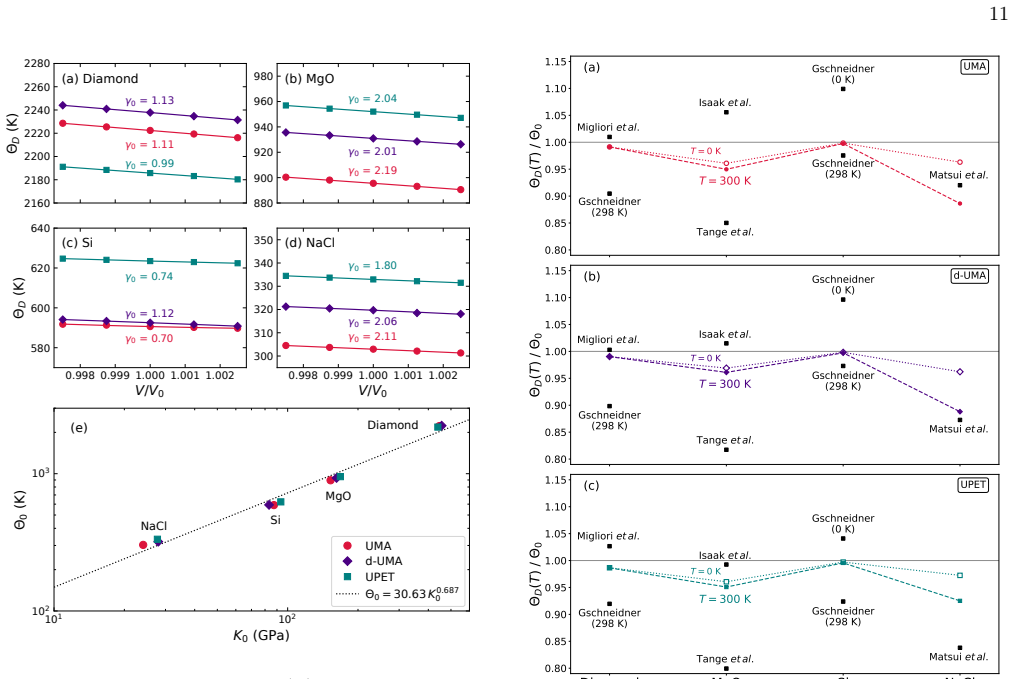
The central claim is that the volume-dependent Grüneisen parameter can be constructed analytically from static-lattice information alone: the static energy–volume curve supplies pressure and bulk-modulus derivatives, near-equilibrium elastic tensors supply Debye temperatures that anchor the equilibrium Grüneisen value, and an infinite-compression constraint fixes the asymptotic limit. With those inputs, the resulting γ(V) has no free thermal parameters, and the Mie–Grüneisen–Debye thermal pressure then yields adiabatic and isothermal bulk moduli as predictions. For the four test solids, the computed bulk moduli soften with temperature in the same way as experiment, and the room-temperature s
What carries the argument
The central object is the generalized EOS-based Grüneisen relation (Eq. 1), which expresses γ(V) in terms of static pressure, bulk modulus, and its pressure derivative, together with an auxiliary index t(V) that interpolates between known constant-t limits. The paper fixes t(V) through a lowest-order truncation t(V)=t0−t1(V/V0)^{1/3} with t0=5/2, anchors the equilibrium value to an elasticity-derived Debye Grüneisen parameter, and applies a constant asymptotic shift where needed. This construction makes γ(V) fully determined by static EOS data and near-equilibrium elastic constants. The quantity that carries the thermal prediction is q(V)=d ln γ/d ln V, which enters the bulk-modulus expressi
Load-bearing premise
The load-bearing assumption is that the auxiliary Grüneisen variable t(V) follows a simple linear-in-(V/V0)^{1/3} form pinned to t0=5/2 at infinite compression; the paper does not derive this shape for diamond, MgO, Si, or NaCl, and its own results show that q(V) is highly sensitive to the analytic EOS, so a real material whose t(V) curves differently would break the thermal-softening prediction.
What would settle it
Compute the exact Grüneisen function γ(V) for MgO by quasiharmonic lattice dynamics over a moderate volume range, convert it to the implied t(V) via Eq. (1), and compare with the linear truncation t(V)=t0−t1(V/V0)^{1/3}. If the implied q(V)=d ln γ/d ln V differs substantially from the EOS-based q(V) under the same Vinet and AP2 fits, the truncation rather than the physics is carrying the predicted softening.
If this is right
- Finite-temperature bulk moduli can be predicted from static energy–volume data and elastic tensors at a few near-equilibrium volumes, without thermal data, AIMD sampling, or phonon calculations.
- The room-temperature softening ratio KT(RT)/K0 for diamond, MgO, Si, and NaCl falls on the same scale as values from AIMD, quasiharmonic, and experimental references, confirming that the leading thermal softening is captured.
- The effective equilibrium Grüneisen index varies strongly across materials and can fall outside the conventional constant-t range, so no single constant-t prescription can be universal.
- The Vinet-versus-AP2 choice affects q(V) noticeably even when γ(V) curves look similar, so the analytic EOS form is a genuine source of uncertainty in thermoelastic predictions.
- The framework can serve as a diagnostic: when a machine-learning potential or DFT functional gives poor static EOS or elastic data, the predicted thermal softening exposes it before expensive finite-temperature simulations are run.
Where Pith is reading between the lines
- Editorial extension: because the construction needs only static EOS data and near-equilibrium elastic tensors, it should transfer directly to DFT-based workflows, making it a practical low-cost screening tool for newly synthesized or hypothetical materials where thermal data do not exist.
- Editorial extension: experimental determinations of q (from ultrasonic or shock-compression data) would provide a sharper test of the Vinet-versus-AP2 choice than bulk-modulus curves alone, since the paper shows q is the most EOS-sensitive quantity.
- Editorial extension: a natural stress-test is to apply the same construction to a strongly anharmonic solid, such as a BCC transition metal, where the quasiharmonic Mie–Grüneisen–Debye cap is expected to break down; the failure mode would define the practical validity boundary of the framework.
- Editorial extension: the mismatch between predicted and measured softening could be reinterpreted as a fingerprint of static-description errors and used to guide iterative retraining of universal machine-learning potentials, going beyond the paper's stated diagnostic goal.
Editorial analysis
A structured set of objections, weighed in public.
Referee Report
Summary. The paper develops an EOS-based construction of the volume-dependent Grüneisen function γ(V) within the Burakovsky–Preston framework, using a lowest-order truncation t(V)=t0−t1(V/V0)^{1/3} with t0=5/2 fixed by an infinite-compression argument, t1 determined by an elasticity-derived equilibrium Grüneisen parameter γ0, and an EOS-dependent asymptotic shift s. Static energy–volume data from MLIPs (UMA, d-UMA, UPET) are fit to Vinet or AP2 EOSs; Debye temperatures from the Christoffel equation anchor γ0. The resulting γ(V) is used in a Mie–Grüneisen–Debye model to predict K_T(T), K_S(T), and dK/dT for diamond, MgO, Si, and NaCl, compared with experiment without fitting thermal data. The paper reports reasonable qualitative agreement and material/potential/EOS-dependent quantitative agreement, and concludes that the construction captures the leading thermal softening without thermal fitting.
Significance. If the claim holds, the value is methodological: a simple, inexpensive, non-thermal-fitting route from static EOS and near-equilibrium elasticity to finite-temperature bulk moduli. This is potentially useful for screening machine-learning interatomic potentials and for materials lacking thermal data. Strengths: the framework is internally coherent; the workflow is specified in sufficient detail to be reproducible (including fitting weights, convergence checks, and code-level descriptions); the no-thermal-fitting property is structurally true, as thermal data enter only as comparison targets; the paper is transparent about limitations (quasiharmonic level, EOS sensitivity, t(V) truncation) and tests four materials with multiple potentials and two EOSs. The main risk is whether the imposed t(V) form and the EOS-dependent asymptotic shift are sufficiently justified to sustain the strong conclusion that the agreement demonstrates a robust EOS-based prediction rather than a favorable interpolation.
major comments (4)
- [Sec. II.A, Eq. (2)] The central load-bearing assumption is the linear-in-V^{1/3} truncation t(V)=t0−t1(V/V0)^{1/3} with t0=5/2. This form is adopted from Ref. 4's suggested expansion and its validity for diamond, MgO, Si, and NaCl is not established. The paper notes that higher-order terms would be non-unique and would require additional constraints, but no independent validation of the truncation is provided. Since q(V) is the most sensitive quantity in Eq. (21) and Fig. 7 shows substantial EOS dependence in q(V), the agreement in Figs. 4–6 could depend on the chosen interpolation rather than being a robust consequence of the EOS construction. An independent check against phonon- or MD-derived γ(V) or q(V) for at least one material, or a sensitivity analysis of the truncation, is needed to validate the central claim. This is a validation gap rather than an internal inconsistency.
- [Sec. II.A, Eq. (3)] The asymptotic shift s is EOS-dependent (s=1/3 for Vinet, s=0 for AP2) and is imposed rather than derived for these materials. The paper acknowledges that EOS forms with γ^EOS_inf substantially exceeding γ_inf require scrutiny, but the impact of this shift on finite-temperature predictions is not quantified separately from other EOS effects. Since the shift is constant in γ, it does not enter q(V), but it does change γ(V) and hence the thermal pressure and K_S in Eq. (21). The paper shows UPET(Vinet) and UPET(AP2) differ (e.g., MgO in Fig. 4), but does not isolate how much of that difference comes from the shift versus the EOS shape. A decomposition would help assess whether the asymptotic constraint is doing accepted physical work or merely adjusting the baseline.
- [Sec. III, Fig. 7 and Eq. (8)] The equilibrium anchoring γ0 is obtained from elastic Debye temperatures via Eq. (9). Figure 7 shows that the constructed γ values are systematically above representative experimental estimates for all four materials, with the offset largely inherited from γ0 at V0. This systematic offset in γ, combined with the unvalidated t(V) form, weakens the claim that the construction 'captures the leading thermal-softening behavior' in a predictive sense: the thermal softening in K(T) is mediated by γ(V) (Eqs. 21–22), and if γ is systematically high, the agreement in dK/dT may benefit from compensating errors (e.g., the quasiharmonic Debye model underestimating anharmonic softening). The paper notes this qualitatively, but the central claim would be strengthened by a quantitative discussion of how sensitive the K(T) predictions are to the γ0 offset and the t(V) truncation.
- [Sec. II.B, Eq. (24)] The Wachtman form is used to fit the calculated K(T) curves and to evaluate dK/dT analytically. This is clearly presented as an auxiliary interpolation, which is acceptable. However, in Fig. 4 the experimental comparisons in the bottom row are analytic derivatives of experimental fits to the same form, while the calculated curves are derivatives of fits to Eq. (24) of the Mie–Grüneisen points. Systematic fitting errors (e.g., the form being imperfect at low or high T) could bias the comparison. A direct numerical derivative of the raw calculated points, or a statement of fit residuals, would make the claimed agreement in dK/dT more robust.
minor comments (6)
- [Sec. II.A, after Eq. (4)] The statement 't_1^AP2 ≈ t_1^Vinet + 1 whenever the Vinet and AP2 fits yield close values of K'_0' could be derived explicitly from Eq. (4) with s_Vinet=1/3 and s_AP2=0; as written it is somewhat abrupt.
- [Sec. II.A, Eq. (9)] The constrained quadratic fit is stated to give virtually the same γ0 as the linear fit, but no numbers or a figure showing the difference is provided. A sentence with typical γ0 differences would be helpful.
- [Sec. II.C, Fig. 2] The caption states that zero-point-corrected experimental reference values are taken from Ref. 42, but the reader has to infer what zero-point correction is applied. A brief note in the text or caption would clarify the reference baseline.
- [Sec. III, Fig. 4 caption] The caption is dense and combines many references with descriptions of curves. Consider separating the experimental parametrization description into a table or a separate paragraph, since the current caption is hard to parse.
- [Sec. III, Fig. 6] The conclusion that all four present values for NaCl lie below the experimental estimate indicates an overestimate of softening, but the figure symbol legend is not explicit. Adding distinct markers or labels for 'present' vs 'literature' values would improve readability.
- [Sec. II.C, Eq. (15)] The weighting wi = exp(−βΔEi)/Σ_j exp(−βΔEj) with β=40 eV^{−1} is described, but the choice of β is not justified beyond 'in all fits'. A brief statement that results are insensitive to β over a reasonable range would be useful.
Circularity Check
No significant circularity: finite-temperature bulk moduli are genuine predictions from static EOS input plus elasticity-derived Debye anchoring; no thermal data enter the construction.
full rationale
The derivation chain is self-contained and non-circular. The inputs are static energy-volume fits to Vinet/AP2 EOS forms, near-equilibrium elastic Debye temperatures from which gamma_0 is extracted, and the infinite-compression constraint. Equation (4) fixes t1 by requiring gamma(V0)=gamma0, but gamma0 is an input anchor, not a claimed prediction. The finite-temperature bulk moduli are then evaluated from the Mie-Gruneisen-Debye formulas (Eqs. 17-23) along the P=0 path, with no parameter adjusted to thermal data; experimental K(T) and dK/dT enter only in Sec. III as comparison benchmarks. The Wachtman parametrization Eq. (24) is explicitly post hoc: 'This auxiliary parametrization is used only for interpolation and analytic evaluation of temperature derivatives; it does not enter the construction of gamma(V) or the Mie-Gruneisen-Debye prediction.' The main model assumption is the linear t(V) truncation, which the paper itself flags as an adoption rather than a derivation: 'Although a unique functional form for t(V) in Eq. (1) is not known a priori, Ref. 4 suggests an analytic structure in which t is expanded in powers of V^{1/3}' and 'Higher-order terms would provide additional flexibility, but their coefficients would not be uniquely determined...' This transparency makes it a validation/robustness gap, not a circular step; the paper also discloses the EOS sensitivity of q(V) in Fig. 7 and does not claim to predict q independently. Self-citations [54,55] are only motivational for the dispersion-correction variant and carry no load in the central derivation. No prediction reduces to its inputs by construction.
Axiom & Free-Parameter Ledger
free parameters (5)
- t0 (asymptotic truncation constant) =
5/2 (fixed, not fitted)
- Asymptotic shift s =
1/3 (Vinet), 0 (AP2)
- EOS parameters {V0, K0, K0'} =
per material and potential (Table S1)
- Equilibrium Grüneisen parameter γ0 =
per material and potential (Fig. 8)
- Elastic-fit weighting constants β and λ =
β=40 eV^-1, λ=0.5
axioms (5)
- domain assumption Mie-Grüneisen-Debye thermal model (Eqs. 17-23) gives an adequate account of finite-temperature bulk moduli.
- domain assumption Burakovsky-Preston generalized EOS Grüneisen relation (Eq. 1) is valid.
- ad hoc to paper The linear-in-V^{1/3} truncation t(V)=t0 - t1(V/V0)^{1/3} with t0=5/2 is sufficient.
- domain assumption Debye temperature from average acoustic sound velocity represents the vibrational spectrum.
- domain assumption Static EOS extrapolations to infinite compression and γ∞=1/2 apply.
read the original abstract
An equation-of-state (EOS)-based construction of the Gr\"uneisen function is developed and assessed through predictions of finite-temperature bulk moduli. In this approach, the volume dependence of the Gr\"uneisen function is expressed analytically in terms of static EOS information, anchored by Debye temperatures obtained from elastic data sampled near equilibrium, and constrained by the infinite-compression limit. The resulting form requires as material-specific input only static energy-volume data and near-equilibrium elastic properties, with no parameters adjusted to thermal data. Within a Mie--Gr\"uneisen--Debye framework, the approach is examined for diamond, magnesium oxide, silicon, and sodium chloride, chosen to span a broad range of stiffness, using machine-learning interatomic potentials from the Universal Models for Atoms (UMA) and Universal Point Edge Transformer (UPET) families, together with a dispersion-corrected variant of UMA. The calculated bulk moduli reproduce the expected experimental softening trends and capture the overall scale of the bulk-modulus temperature derivatives, although the level of quantitative agreement depends on the material, the underlying interatomic potential, and the selected analytic EOS form. These results show that an EOS-based construction of the Gr\"uneisen function can capture the leading thermal-softening behavior of bulk moduli without fitting to thermal data. The observed sensitivity to the underlying static description further suggests that the framework may help identify deficiencies relevant to thermoelastic transferability and thereby inform future training and validation strategies for universal machine-learning interatomic potentials.
Figures



Reference graph
Works this paper leans on
-
[1]
Fully relax the structure (cell and ionic degrees of freedom) to obtain the equilibrium configuration
-
[2]
(6) and (7), respectively]
Generate the static energy–volume data and fit them separately to the Vinet and AP2 EOS forms [Eqs. (6) and (7), respectively]
-
[3]
The static energy–volume data are fitted indepen- dently to the Vinet [22] and AP2 [23] forms
For comparison with the conventional constant-trelations, the effective equilibrium index is de- fined as teff,0 ≡t(V 0)−3s,(5) which givesγ 0 =K ′ 0/2−1/6−t eff,0 /3. The static energy–volume data are fitted indepen- dently to the Vinet [22] and AP2 [23] forms. The Vinet energy expression is given by Es(V) =E 0 + 9K0V0 η2 h 1 + (η(1−x)−1)e η(1−x) i (6) w...
-
[4]
Thus, for materials withK′ 0 close to 4, the choice of asymptotic shift becomes ambiguous within the Birch– Murnaghan framework
AtK ′ 0 = 4, however, the third-order term vanishes and BM3 reduces to BM2, for whichγEOS ∞ = 1ands= −1/2. Thus, for materials withK′ 0 close to 4, the choice of asymptotic shift becomes ambiguous within the Birch– Murnaghan framework. The parametert 1 is determined by imposing the equi- librium anchoring conditionγ(V 0) =γ 0, whereγ 0 de- notes the Grüne...
-
[5]
Computet 1 from Eq. (4)
-
[6]
For five volumes in the vicinity of the equilibrium volume: (a) Obtain the elastic stiffness tensor by fitting the strain–energy data [Eq. (13)]. (b) Solve the Christoffel equation [Eq. (12)] to ob- tain the three acoustic phase velocities. (c) Evaluate the average sound velocity from Eq. (11). (d) Compute the Debye temperature using Eq. (10)
-
[7]
Extractγ 0 from the constrained fit in Eq. (9)
-
[8]
(3), usings= 1/3for the Vinet EOS ands= 0for the AP2 EOS
Constructγ(V)from Eq. (3), usings= 1/3for the Vinet EOS ands= 0for the AP2 EOS. B. Calculation of finite-temperature bulk moduli A Mie–Grüneisen EOS is employed with a Debye ther- mal term [1] P(V, T) =P s(V) +γ(V) ED(V, T) V ,(17) where ED(V, T) =N kB 9 8 ΘD + 3T D3 ΘD T (18) is the Debye vibrational internal energy (including the zero-point term), withD...
-
[9]
(2) witht 0 = 5/2
Evaluatet(V)from Eq. (2) witht 0 = 5/2
-
[10]
Evaluateγ EOS(V)using Eq. (1)
-
[11]
Y. Kono, T. Irifune, Y. Higo, T. Inoue, and A. Barn- hoorn, P–V–T relation of MgO derived by simultaneous elastic wave velocity and in situ X-ray measurements: A new pressure scale for the mantle transition region, Phys. Earth Planet. Inter.183, 196 (2010)
2010
-
[12]
Tange, Y
Y. Tange, Y. Nishihara, and T. Tsuchiya, Unified anal- yses for P-V-T equation of state of MgO: A solution for pressure-scale problems in high P-T experiments, J. Geo- phys. Res.114(2009). 14
2009
-
[13]
V. N. Zharkov and V. A. Kalinin,Equations of State for Solids at High Pressures and Temperatures(Consultants Bureau, New York, 1971)
1971
-
[14]
O. L. Anderson,Equations of State of Solids for Geo- physics and Ceramic Science(Oxford University Press, New York, 1995)
1995
-
[15]
F. D. Stacey and A. Hodgkinson, Thermodynamics with the Grüneisen parameter: Fundamentals and applica- tions to high-pressure physics and geophysics, Phys. Earth Planet. Inter.286, 42 (2019)
2019
-
[16]
Burakovsky and D
L. Burakovsky and D. L. Preston, Analytic model of the Grüneisen parameter all densities, J. Phys. Chem. Solids 65, 1581 (2004)
2004
-
[17]
J. C. Slater,Introduction to Chemical Physics(McGraw– Hill, New York, 1939)
1939
-
[18]
Dugdale and D
J. Dugdale and D. MacDonald, The thermal expansion of solids, Phys. Rev.89, 832 (1953)
1953
-
[19]
V. Y. Vashchenko and V. N. Zubarev, Grüneisen parame- ter at high pressures, Fizika Tverdogo Tela5, 886 (1963), [Sov. Phys. Solid State5(1963) 653–657]
1963
-
[20]
Stacey,The Grüneisenparameter at high pressure: a molecular dynamical study, Phys
M.A.Barton andF.D. Stacey,The Grüneisenparameter at high pressure: a molecular dynamical study, Phys. Earth Planet. Inter.39, 167 (1985)
1985
-
[21]
F. D. Stacey, Theory of thermal and elastic properties of the lower mantle and core, Phys. Earth Planet. Inter.89, 219 (1995)
1995
-
[22]
R. D. Irvine and F. D. Stacey, Pressure dependence of thethermalGrüneisenparameter, withapplicationtothe Earth’s lower mantle and outer core, Phys. Earth Planet. Inter.11, 157 (1975)
1975
-
[23]
W. B. Holzapfel, Equations of state for solids un- der strong compression, High Pressure Research16, 81 (1998)
1998
-
[24]
A. R. Oganov and P. I. Dorogokupets, All-electron and pseudopotential study of MgO: Equation of state, anhar- monicity, and stability, Phys. Rev. B67, 224110 (2003)
2003
-
[25]
D. G. Isaak, O. L. Anderson, and T. Goto, Measured elastic moduli of single-crystal MgO up to 1800 K, Phys. Chem. Minerals16, 704 (1989)
1989
-
[26]
Matsui, Y
M. Matsui, Y. Higo, Y. Okamoto, T. Irifune, and K.- I. Funakoshi, Simultaneous sound velocity and density measurements of NaCl at high temperatures and pres- sures: Application as a primary pressure standard, Am. Mineral.97, 1670 (2012)
2012
-
[27]
Dewaele, F
A. Dewaele, F. Datchi, P. Loubeyre, and M. Mezouar, High pressure–high temperature equations of state of neon and diamond, Phys. Rev. B77, 094106 (2008)
2008
-
[28]
K. A. Gschneidner, Jr., Physical properties and interrela- tionships of metallic and semimetallic elements, inSolid State Physics, Vol. 16, edited by F. Seitz and D. Turnbull (Academic Press, 1964) pp. 275–426
1964
-
[29]
W. B. Gauster, Low-temperature Grüneisen parameters for silicon and aluminum, Phys. Rev. B4, 1288 (1971)
1971
-
[30]
Anzellini, M
S. Anzellini, M. T. Wharmby, F. Miozzi, A. Kleppe, D. Daisenberger, and H. Wilhelm, Quasi-hydrostatic equation of state of silicon up to 1 megabar at ambient temperature, Sci. Rep.9, 15537 (2019)
2019
-
[31]
Burakovsky, D
L. Burakovsky, D. L. Preston, and Y. Wang, Cold shear modulus and Grüneisen parameter at all densities, Solid State Commun.132, 151 (2004)
2004
-
[32]
yieldsγ EOS ∞ = 4/3and hences=−5/6forK ′ 0 ̸=
-
[33]
B. M. Wood, M. Dzamba, X. Fu, M. Gao, M. Shuaibi, L. Barroso-Luque, K. Abdelmaqsoud, V. Gharakhanyan, J. R. Kitchin, D. S. Levine, K. Michel, A. Sriram, T. Co- hen, A. Das, A. Rizvi, S. J. Sahoo, Z. W. Ulissi, and C. L. Zitnick, UMA: A family of universal models for atoms (2025), arXiv:2506.23971
arXiv 2025
-
[34]
F. Bigi, P. Pegolo, A. Mazitov, and M. Ceriotti, Pushing the limits of unconstrained machine-learned interatomic potentials (2026), arXiv:2601.16195 [physics.chem-ph]
Pith/arXiv arXiv 2026
-
[35]
Vinet, J
P. Vinet, J. H. Rose, J. Ferrante, and J. R. Smith, Uni- versal features of the equation of state of solids, Phys. Rev. B35, 1945 (1987)
1945
-
[36]
M. I. Aroyo, A. Kirov, C. Capillas, J. M. Perez-Mato, and H. Wondratschek, Bilbao Crystallographic Server. II. Representations of crystallographic point groups and space groups, Acta Crystallogr. A62, 115 (2006)
2006
-
[37]
Zhang, R
S. Zhang, R. Paul, S. X. Hu, and M. A. Morales, Toward an accurate equation of state and B1–B2 phase bound- ary for magnesium oxide up to terapascal pressures and electron-volt temperatures, Phys. Rev. B107, 224109 (2023)
2023
-
[38]
B. B. Karki, L. Stixrude, and R. M. Wentzcovitch, High- pressure elastic properties of major materials of Earth’s mantle from first principles, Reviews of Geophysics39, 507 (2001)
2001
-
[39]
M. J. Gillan, D. Alfè, J. Brodholt, L. Vocadlo, and G. D. Price, First-principles modelling of Earth and planetary materials at high pressures and temperatures, Rep. Prog. Phys.69, 2365 (2006)
2006
-
[40]
R. M. Wentzcovitch, Z. Wu, and P. Carrier, First princi- ples quasiharmonic thermoelasticity of mantle minerals, Rev. Mineral. Geochem.71, 99 (2010)
2010
-
[41]
W. B. Holzapfel, M. Hartwig, and W. Sievers, Equations of state for Cu, Ag, and Au for wide ranges in temper- ature and pressure up to 500 GPa and above, J. Phys. Chem. Ref. Data30, 515 (2001)
2001
-
[42]
P. I. Dorogokupets and A. R. Oganov, Ruby, metals, and MgOas alternative pressure scales: A semiempirical de- scription of shock-wave, ultrasonic, x-ray, and thermo- chemical data at high temperatures and pressures, Phys. Rev. B75, 024115 (2007)
2007
-
[43]
For comparison, ener- gies, atomic forces, and stress tensors were evaluated 6 using two universal MLIP frameworks
as the workflow engine. For comparison, ener- gies, atomic forces, and stress tensors were evaluated 6 using two universal MLIP frameworks. First, calcu- lations were performed with the FAIRChem library (fairchem-core, v2.12.0) [44], through its ASE interface (FAIRChemCalculator), employing the Universal Mod- els for Atoms (UMA) with the pretrained checkp...
2000
-
[44]
Holzapfel, Physics of solids under strong compression, Rep
W. Holzapfel, Physics of solids under strong compression, Rep. Prog. Phys.59, 29 (1996)
1996
-
[45]
Birch, Finite elastic strain of cubic crystals, Phys
F. Birch, Finite elastic strain of cubic crystals, Phys. Rev. 71, 809 (1947)
1947
-
[46]
S1–S12), (iii) fit parameters for the adiabatic and isothermal bulk moduli (Table S2), and (iv) parameterizations of experimental bulk-modulus data (Table S3)
See Supplemental Material at [URL to be inserted by publisher] for diamond, MgO, Si, and NaCl: (i) Vinet and AP2 static-EOS fit parameters (Table S1), (ii) cal- culated strain–energy data, opposite-strain-symmetrized fitting targets, and weighted quadratic fits at the five sampled volumes (Figs. S1–S12), (iii) fit parameters for the adiabatic and isotherm...
-
[47]
Grimvall,Thermophysical Properties of Materials(El- sevier, 1999)
G. Grimvall,Thermophysical Properties of Materials(El- sevier, 1999)
1999
-
[48]
M. J. P. Musgrave,Crystal Acoustics: Introduction to the Study of Elastic Waves and Vibrations in Crystals (Holden-Day, San Francisco, 1970)
1970
-
[49]
Mouhat and F.-X
F. Mouhat and F.-X. Coudert, Necessary and sufficient elastic stability conditions in various crystal systems, Phys. Rev. B90, 224104 (2014)
2014
-
[50]
J. A. Nelder and R. Mead, A simplex method for function minimization, The Computer Journal7, 308 (1965)
1965
-
[51]
J. B. Wachtman, W. E. Tefft, D. G. Lam, and C. S. Ap- stein, Exponential temperature dependence of Young’s modulus for several oxides, Phys. Rev.122, 1754 (1961)
1961
-
[52]
O. L. Anderson, Derivation of Wachtman’s equation for the temperature dependence of elastic moduli of oxide compounds, Phys. Rev.144, 553 (1966)
1966
-
[53]
M. L. Nandanpawar and S. Rajagopalan, Wachtman’s equation and temperature dependence of bulk moduli in solids, J. Appl. Phys.49, 3976 (1978)
1978
-
[54]
A. D. Kaplan and J. P. Perdew, Laplacian-level meta- generalized gradient approximation for solid and liquid metals, Phys. Rev. Mater.6, 083803 (2022)
2022
-
[55]
A. H. Larsen, J. J. Mortensen, J. Blomqvist, I. E. Castelli, R. Christensen, M. Dułak, J. Friis, M. N. Groves, B. Hammer, C. Hargus,et al., The atomic sim- ulation environment–a Python library for working with atoms,J.Phys.: Condens.Matter29,273002(2017),web page:https://wiki.fysik.dtu.dk/ase
2017
-
[56]
FAIRChem,https://github.com/facebookresearch/ fairchem
-
[57]
X. Fu, B. M. Wood, L. Barroso-Luque, D. S. Levine, M. Gao, M. Dzamba, and C. L. Zitnick, Learning smooth and expressive interatomic potentials for physical prop- erty prediction, inProceedings of the 42nd Interna- tional Conference on Machine Learning (ICML), Pro- ceedings of Machine Learning Research, Vol. 267 (2025) pp. 17875–17893
2025
-
[58]
C. Malosso, F. Bigi, P. Pegolo, J. W. Abbott, P. Loche, M. Rossi, M. Ceriotti, and A. Mazitov, High-quality, high-information datasets for universal atomistic ma- chine learning (2026), arXiv:2603.02089 [cond-mat.mtrl- sci]
arXiv 2026
-
[59]
J. P. Perdew, K. Burke, and M. Ernzerhof, Generalized gradient approximation made simple, Phys. Rev. Lett. 15 77, 3865 (1996)
1996
-
[60]
J. W. Furness, A. D. Kaplan, J. Ning, J. P. Perdew, and J. Sun, Accurate and numerically efficient r2SCAN meta- generalizedgradientapproximation,J.Phys.Chem.Lett. 11, 8208 (2020)
2020
-
[61]
G. I. Csonka, J. P. Perdew, A. Ruzsinszky, P. H. T. Philipsen, S. Lebègue, J. Paier, O. A. Vydrov, and J. G. Ángyán, Assessing the performance of recent density functionals for bulk solids, Phys. Rev. B79, 155107 (2009)
2009
-
[62]
Schlipf, M
M. Schlipf, M. Betzinger, C. Friedrich, M. Ležaić, and S. Blügel, HSE hybrid functional within the FLAPW method and its application to GdN, Phys. Rev. B84, 125142 (2011)
2011
-
[63]
J. Harl, L. Schimka, and G. Kresse, Assessing the qual- ity of the random phase approximation for lattice con- stants and atomization energies of solids, Phys. Rev. B 81, 115126 (2010)
2010
-
[64]
F. Tran, J. Stelzl, and P. Blaha, Rungs 1 to 4 of DFT Jacob’s ladder: Extensive test on the lattice constant, bulk modulus, and cohesive energy of solids, J. Chem. Phys.144(2016)
2016
-
[65]
Z. Wu, R. M. Wentzcovitch, K. Umemoto, B. Li, K. Hi- rose, and J.-C. Zheng, Pressure-volume-temperature re- lations in MgO: An ultrahigh pressure-temperature scale for planetary sciences applications, J. Geophys. Res. Solid Earth113(2008)
2008
-
[66]
Güler-Kılıç and Ç
S. Güler-Kılıç and Ç. Kılıç, Crystal and electronic structure of BiTeI, AuTeI, and PdTeI compounds: A dispersion-corrected density-functional study, Phys. Rev. B91, 245204 (2015)
2015
-
[67]
Kılıç and S
Ç. Kılıç and S. Güler-Kılıç, Combining graph deep learn- ing and London dispersion interatomic potentials: A case study on pnictogen chalcohalides, J. Chem. Phys.161, 174106 (2024)
2024
-
[68]
Ehlert, Simple DFT-D3: Library first implementation of the D3 dispersion correction, J
S. Ehlert, Simple DFT-D3: Library first implementation of the D3 dispersion correction, J. Open Source Softw.9, 7169 (2024)
2024
-
[69]
Grimme, S
S. Grimme, S. Ehrlich, and L. Goerigk, Effect of the damping function in dispersion corrected density func- tional theory, J. Comput. Chem.32, 1456 (2011)
2011
-
[70]
Echeverri Restrepo and P
S. Echeverri Restrepo and P. Andric, ABC-FIRE: Ac- celerated bias-corrected fast inertial relaxation engine, Comput. Mater. Sci.218, 111978 (2023)
2023
-
[71]
Guénolé, W
J. Guénolé, W. G. Nöhring, A. Vaid, F. Houllé, Z. Xie, A. Prakash, and E. Bitzek, Assessment and optimization of the fast inertial relaxation engine (FIRE) for energy minimization in atomistic simulations and its implemen- tation in LAMMPS, Comput. Mater. Sci.175, 109584 (2020)
2020
-
[72]
Bitzek, P
E. Bitzek, P. Koskinen, F. Gähler, M. Moseler, and P. Gumbsch, Structural relaxation made simple, Phys. Rev. Lett.97, 170201 (2006)
2006
-
[73]
Migliori, H
A. Migliori, H. Ledbetter, R. G. Leisure, C. Pantea, and J. B. Betts, Diamond’s elastic stiffnesses from 322 K to 10 K, J. Appl. Phys.104, 053512 (2008)
2008
-
[74]
E. S. Zouboulis, M. Grimsditch, A. K. Ramdas, and S. Rodriguez, Temperature dependence of the elastic moduli of diamond: A Brillouin-scattering study, Phys. Rev. B57, 2889 (1998)
1998
-
[75]
S. V. Sinogeikin, J. M. Jackson, B. O’Neill, J. W. Palko, and J. D. Bass, Compact high-temperature cell for Bril- louin scattering measurements, Rev. Sci. Instrum.71, 201 (2000)
2000
-
[76]
Spetzler, C
H. Spetzler, C. Sammis, and R. O’Connell, Equation of state of NaCl: Ultrasonic measurements to 8 kbar and 800°C and static lattice theory, J. Phys. Chem. Solids 33, 1727 (1972)
1972
-
[77]
D. Fan, S. Fu, J. Yang, S. N. Tkachev, V. B. Prakapenka, and J.-F. Lin, Elasticity of single-crystal periclase at high pressure and temperature: The effect of iron on the elasticity and seismic parameters of ferropericlase in the lower mantle, Am. Mineral.104, 262 (2019)
2019
-
[78]
S. Ono, J. P. Brodholt, D. Alfè, M. Alfredsson, and G. D. Price, Ab initio molecular dynamics simulations for ther- mal equation of state of B2-type NaCl, J. Appl. Phys. 103, 023510 (2008)
2008
-
[79]
Malica and A
C. Malica and A. D. Corso, Quasi-harmonic temperature dependent elastic constants: applications to silicon, alu- minum, and silver, J. Phys.: Condens. Matter32, 315902 (2020)
2020
-
[80]
Strachan, T
A. Strachan, T. Çağin, and W. A. Goddard III, Phase diagram of MgO from density-functional theory and molecular-dynamics simulations, Phys. Rev. B60, 15084 (1999)
1999
discussion (0)
Sign in with ORCID, Apple, or X to comment. Anyone can read and Pith papers without signing in.