REVIEW 3 major objections 5 minor 64 references
Randomized Projection with Clipping achieves minimax-optimal sparse-vector mean estimation under LDP while providing the first worst-case poisoning bound.
Reviewed by Pith at T0; open to challenge. T0 means a machine referee read the full paper against a public rubric. the ladder, T0–T4 →
T0 review · deepseek-v4-flash
2026-08-01 00:53 UTC pith:G7QGGUX3
load-bearing objection RPC gives a clean bias-corrected sparse-projections estimator and the first poisoning bound for sparse LDP, but the main theorem's α bound is proved for R=√(2m), not the stated R=√m. the 3 major comments →
Robust Estimation of Sparse Numerical Vectors under Local Differential Privacy
The pith
A machine-rendered reading of the paper's core claim, the machinery that carries it, and where it could break.
Core claim
The central claim is that clipping a random projection can be debiased exactly, and this exact debiasing is what buys robustness without losing statistical efficiency. For each user i, the server sends a uniform binary vector S_i ∈ {−1,1}^d; the user computes u_i = Clip(⟨x_i, S_i⟩, R) with R = ⌈√m⌉, then applies a finite-range unbiased ε-LDP randomizer to u_i/R and scales the result by R. The paper derives a closed-form expression for the bias of the clipped projection in terms of clipped sums of independent symmetric ±1 variables, and defines α = 1 / (1 − E[Clip(U, −R+1, R+1)]) so that (α/n) Σ Y_i S_i is unbiased for every coordinate when the data are m-sparse with entries in {−1, 1}. This
What carries the argument
Randomized Projection with Clipping (RPC): each user projects its m-sparse ±1 vector onto a random binary vector, clips the scalar projection to [−R, R] with R ≈ √m, and applies a finite-range unbiased ε-LDP randomizer. The load-bearing identity is the exact bias formula for the clipped projection: for coordinate j, the bias depends only on the clipped sum of m−1 independent symmetric ±1 variables, so a single correction factor α = 1 / (1 − E[Clip(U, −R+1, R+1)]) restores unbiasedness for every coordinate. Because the correction is exact rather than a bound, the clipping threshold can be made small without a bias–variance tradeoff; this simultaneously reduces the LDP noise (variance scales a
Load-bearing premise
The entire unbiasedness argument, and therefore both the minimax-optimality claim and the poisoning bound, rests on every user's vector being exactly m-sparse with nonzero entries in {−1, 1}; the paper's own Remark 1 concedes that when users have unequal item counts and m is not known, padding changes the problem and the resulting truncation bias is unanalyzed, and the continuous-value extension requires a known norm bound β (Assumption 1), which the experiments set from the
What would settle it
Compute E[Clip(U, −R+1, R+1)] by brute force for U equal to the sum of m−1 independent symmetric ±1 variables for, say, m = 5 and R = 2, and compare with formula (13)'s α; any mismatch invalidates Lemma 2 and cascades to Theorems 1–2. Alternatively, run RPC on clean synthetic data with m-sparse ±1 vectors and check that the empirical ℓ1 error at ε = O(1) tracks d√(m/(nε²)); an extra √m or √d factor would contradict the claimed minimax rate.
If this is right
- On clean data, RPC achieves O(d√(m/(nε²))) ℓ1 error, matching the minimax lower bound for m-sparse mean estimation under LDP, so robustifying does not sacrifice asymptotic accuracy.
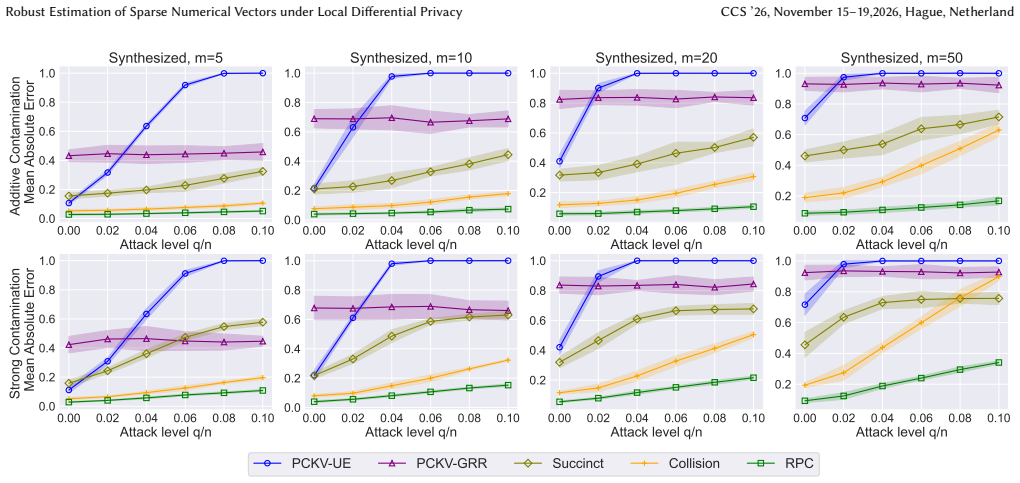
- It provides the first worst-case upper bound on ℓ1 error for sparse multi-item LDP under poisoning: with q corrupted users, the error is bounded by O(d√(m/(nε²)) + q√(dm ln n)/(nε)) under strong contamination, giving a concrete security guarantee independent of attack strategy.
- When m = 1, the strong-contamination bound reduces to the established single-item robust LDP result, showing RPC generalizes the previously solved case.
- Because the bias correction is exact, clipping thresholds in LDP estimators no longer need to balance bias against variance; this suggests the same technique could improve other clipping-based private estimation pipelines.
- For continuous values in [−1,1] with known norm bound β, the paper derives explicit error bounds (e.g., O(dβ√(m ln n/(nε²)) + d√(m/n) + qβ√(dm ln² n)/(nε))) and characterizes when direct estimation beats randomized rounding to ±1, namely when β√ln n < 1.
Where Pith is reading between the lines
- A natural extension not explored in the paper: tune R adaptively per coordinate or per dataset while retaining the exact-bias correction, potentially improving constant factors without breaking unbiasedness.
- The paper's padding argument for unequal item counts changes the problem and leaves truncation bias unanalyzed; a practical next step would be a private procedure that estimates the effective sparsity m before choosing R, which would make the method deployment-ready for heterogeneous user data.
- The √ln n gap between additive and strong contamination bounds suggests a server-side diagnostic: if realized error under attack matches the additive-contamination rate rather than the strong-contamination rate, large-scale coordinated corruption may be absent, while a jump to the √ln n rate signals targeted manipulation.
- RPC's communication cost is O(1) when the underlying randomizer is binary, so the robustness guarantee is compatible with very low communication overhead—an advantage that may matter more than statistical efficiency in bandwidth-limited federated systems.
Editorial analysis
A structured set of objections, weighed in public.
Referee Report
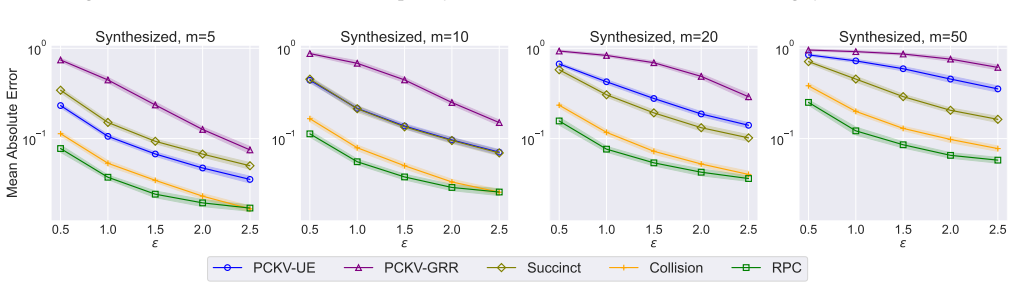
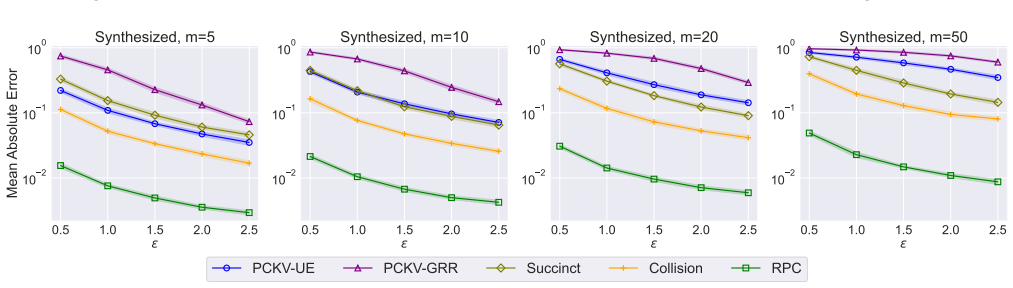
Summary. The paper proposes Randomized Projection with Clipping (RPC) for mean estimation of m-sparse vectors under ε-LDP. Each user projects its vector onto a server-generated random sign vector, clips the projection to a threshold R, and applies an unbiased LDP randomizer; the server aggregates and multiplies by an exactly computed bias-correction factor α. The main claims are: (i) in a trusted environment the clean-data ℓ1 error is O(d√(m/(nε²))), matching the known minimax rate; (ii) under poisoning with up to q corrupted users, the first worst-case upper bounds are O(d√(m/(nε²)) + q√(dm)/(nε)) under additive contamination and O(d√(m/(nε²)) + q√(dm ln n)/(nε)) under strong contamination; (iii) an extension to general numerical values in [−1,1] is given under an ℓ2-norm bound assumption on the user vectors. Experiments on synthetic and real data compare RPC with PCKV, the Succinct mechanism, and Collision, both with and without attacks.
Significance. If the technical gaps are repaired, this would be a genuinely useful contribution: it is the first poisoning upper bound for sparse multi-item LDP mean estimation, and it achieves this without sacrificing the minimax-optimal clean-data rate. The bias-correction formula is exact, depends only on m and R, and involves no data-dependent fitting; the error bounds are genuine worst-case upper bounds rather than heuristic defenses. The paper also provides code artifacts. The core algebra in Lemmas 1–2 and the general proof strategy in Theorems 1–2 are plausible. The main weakness is a concrete proof-theorem mismatch in the choice of R, plus some modeling inconsistencies in the additive-contamination proof and a missing discussion of the known-β requirement in the continuous-value extension.
major comments (3)
- [§5.1, Corollary 1; Appendix E.2; Appendix F after (90)] The theorems are stated with R=⌈√m⌉, but the only proof that α is O(1) is in Appendix E.2, where the choice is R=⌈√(2m)⌉. For R=⌈√m⌉, the same Hoeffding bound gives E[Clip]≤2e^{-1/2}≈1.213, which does not even imply the denominator 1−E[Clip] in (62) is positive. Since α multiplies both the clean error in Theorem 1 and the attack term in Theorem 2, the stated rates are not proven for the stated R. This is not a mere typo: the exact parameter in the statement and the parameter in the proof differ. Fix by restating all results with R=⌈√(2m)⌉ (the asymptotic rates are unchanged, as R=Θ(√m)), or by adding a valid tail bound for R=⌈√m⌉.
- [Appendix F, additive contamination model; §3.2] The proof of the additive-contamination half says 'C is randomly selected from all samples', but Section 3.2 defines additive contamination as 'the set C of corrupted users are fixed in advance'. The removal of the C(n,q) factor should be justified by the fact that C is fixed independently of the random S_i, so no union over C is needed; the random-selection wording is a different model. Also, the definition of Z in (18) quantifies over any set of up to q differences, which is the strong-contamination adversary; please align the definition of Z with the additive model or explain that the bound is uniform over fixed C.
- [§6, Assumption 1; §8.2 continuous-value experiment] The direct extension depends on β being known: Theorem 3 and 4 set R=β√(m ln n)+1 and the bias bound (24) contains β. The experiments set β=0.3 because the synthetic values are N(0,0.2²) truncated, but the paper does not discuss how a server would choose β when it is unknown, nor the effect of misspecifying β. This limits the direct method's practical applicability; please state explicitly that β is a known input and discuss estimation or the indirect method as the alternative.
minor comments (5)
- [Appendix A, Eq. (41)] E[W] should be Var(W) (or E[W²]); the Laplace mechanism has zero mean.
- [Appendix F, Eq. (89)] The first term in the displayed bound is missing a cε factor; from (80) and (88) both the q√(d ln n) and d√q terms carry cε. The subsequent equation (90) has the cε in the right place, but (89) should be corrected to avoid confusion.
- [Appendix E.1, around (65)] The notation y_{1:n} is used but y_i is never defined; it should be u_i = Clip(⟨x_i,S_i⟩,R).
- [§5.1, Figure 2 and Corollary 1] The statement that 'the optimal R is close to √m in general' is supported only by Figure 2 for d=20, n=1000, m=10. Please state this as a heuristic or provide an asymptotic justification.
- [Remark 7 / Table 1] The claim that the RPC bound is 'tighter' than Collision's bound is not uniform in all parameters: comparing q√(dm) with m(d√q+q√d) favors RPC for small q and large d, but not necessarily when m is large relative to d. Please specify the regime of parameters in which (19) dominates (21).
Circularity Check
No circularity: bias-correction alpha is derived exactly from the Rademacher projection distribution; the error bounds are genuine worst-case guarantees rather than fitted predictions.
full rationale
The paper's central derivation is self-contained rather than circular. The correction factor alpha in Eq. (13) is the exact reciprocal of 1 - E[Clip(U_ij, -R+1, R+1)] where U_ij is a sum of m-1 independent Rademacher variables; Lemma 2's proof (Appendix D, Eqs. (60)-(63)) computes this expectation from the binomial weights C(m-1,l)2^{-(m-1)}, so no parameter is fitted to data and then reported as a prediction. Theorem 1's clean-data bound is a genuine unbiasedness-plus-variance decomposition, and Theorem 2's attack term is a worst-case Hoeffding/union-bound argument. In the continuous-value extension, Assumption 1's beta enters an explicit bias bound 2exp(-(R-1)^2/(2m beta^2)), and choosing R = beta sqrt(m ln n)+1 makes the bias O(1/n) analytically, not by tuning to the dataset. Minor self-citations ([47], [57], [58]) appear only as background or as the independent published minimax lower bound; they do not supply the derivation's intermediate steps. The flagged mismatch between R=ceil(sqrt(m)) in Corollary 1/Theorem 2 and the alpha-bound proved only for R=ceil(sqrt(2m)) in Appendix E.2 -- with Appendix F simply asserting 'With R=sqrt(m), alpha is upper bounded by a constant' -- is a genuine proof/verification gap, but not circularity: alpha is still a deterministic function of (m,R), so the final rate does not reduce by construction to a fitted input. Similarly, Remark 1's admission that truncation bias for unknown m 'have not been analyzed' is an acknowledged limitation, not a disguised re-use of the target result. No circular step can be exhibited from the paper's equations.
Axiom & Free-Parameter Ledger
free parameters (2)
- R (clipping threshold) =
√m (binary case); β√(m ln n)+1 (continuous case)
- β (energy bound coefficient) =
0.3 in experiments
axioms (5)
- domain assumption Each user vector is exactly m-sparse with nonzero entries in {−1,1} (X defined in Eq. 6).
- domain assumption Q is unbiased and satisfies ε-LDP for inputs in [−1,1], with finite cε and Vε=O(1/ε²).
- domain assumption Adversarial outputs are constrained to the honest output space Y.
- ad hoc to paper For general values, Σ_j x_ij² ≤ mβ² for known β (Assumption 1).
- standard math Hoeffding's inequality and standard concentration for Rademacher sums.
read the original abstract
Local differential privacy (LDP) protocols are vulnerable to poisoning attacks. Existing research have proposed efficient defense strategies for single-item users. However, in practice, a user may possess multiple items. The defense against poisoning attacks for multi-item users is challenging, because due to larger output spaces, the adversary can conduct more powerful attacks without being detected. In this paper, we address the robust sparse vector mean estimation problem, in which each user has a vector with $m$ nonzero coordinates. We propose Randomized Projection with Clipping (RPC). Firstly, the server sends a random binary vector to each user. The user then projects its local data on the vector, and clip the value to restrict the attacker's capability. To handle clipping bias, we propose a correction method based on a careful analysis that gives an exact expression of the bias. As a result, bias-variance tradeoff is no longer needed, thus the clipping threshold can be further reduced to shrink the output space and enhance robustness. We provide a rigorous theoretical guarantee of the estimation error under all possible attacks. Numerical experiments show that under trusted environments, our new method achieves comparable or better performance than existing methods, indicating that our method is already an efficient estimator in its own right. Under untrusted environments, our method is also significantly more robust to poisoning attacks.
Figures





Reference graph
Works this paper leans on
-
[1]
[n. d.]. Amazon - Ratings (Beauty Products). https://www.kaggle.com/datasets/skillsmuggler/amazon-ratings
-
[2]
[n. d.]. Clothing Fit Dataset for Size Recommendation. https://www.kaggle.com/datasets/rmisra/clothing-fit-dataset-for-size- recommendation
-
[3]
[n. d.]. Movie Rating Data. https://www.kaggle.com/datasets/ashukr/movie- rating-data
-
[4]
[n. d.]. Women’s E-Commerce Clothing Reviews. https://www.kaggle.com/datasets/nicapotato/womens-ecommerce-clothing- reviews/data
-
[5]
Jayadev Acharya, Ziteng Sun, and Huanyu Zhang. 2019. Hadamard response: Estimating distributions privately, efficiently, and with little communication. In The 22nd International Conference on Artificial Intelligence and Statistics. PMLR, 1120–1129
2019
-
[6]
Galen Andrew, Om Thakkar, Brendan McMahan, and Swaroop Ramaswamy
-
[7]
Hilal Asi, Vitaly Feldman, Jelani Nelson, Huy Nguyen, and Kunal Talwar. 2024. Fast optimal locally private mean estimation via random projections.Advances in Neural Information Processing Systems36 (2024)
2024
-
[8]
Hilal Asi, Vitaly Feldman, and Kunal Talwar. 2022. Optimal algorithms for mean estimation under local differential privacy. InInternational Conference on Machine Learning. PMLR, 1046–1056
2022
-
[9]
Raef Bassily and Adam Smith. 2015. Local, private, efficient protocols for succinct histograms. InProceedings of the forty-seventh annual ACM symposium on Theory of computing. 127–135
2015
-
[10]
Abhishek Bhowmick, John Duchi, Julien Freudiger, Gaurav Kapoor, and Ryan Rogers. 2018. Protection against reconstruction and its applications in private federated learning.arXiv preprint arXiv:1812.00984(2018)
Pith/arXiv arXiv 2018
-
[11]
Dan Boneh, Elette Boyle, Henry Corrigan-Gibbs, Niv Gilboa, and Yuval Ishai
-
[12]
Stéphane Boucheron, Gábor Lugosi, and Olivier Bousquet. 2003. Concentration inequalities. InSummer school on machine learning. Springer, 208–240
2003
-
[13]
In2021 IEEE Symposium on Security and Privacy (SP)
Lightweight techniques for private heavy hitters. In2021 IEEE Symposium on Security and Privacy (SP). IEEE, 762–776
-
[14]
Wei-Ning Chen, Peter Kairouz, and Ayfer Özgür. 2022. Breaking the communication-privacy-accuracy trilemma.IEEE Transactions on Information Theory69, 2 (2022), 1261–1281
2022
-
[15]
Xiaoyu Cao, Jinyuan Jia, and Neil Zhenqiang Gong. 2021. Data poisoning at- tacks to local differential privacy protocols. In30th USENIX Security Symposium (USENIX Security 21). 947–964
2021
-
[16]
2023.Algorithmic high-dimensional robust statistics
Ilias Diakonikolas and Daniel M Kane. 2023.Algorithmic high-dimensional robust statistics. Cambridge university press
2023
-
[17]
Albert Cheu, Adam Smith, and Jonathan Ullman. 2021. Manipulation attacks in local differential privacy. In2021 IEEE Symposium on Security and Privacy (SP). IEEE, 883–900
2021
-
[18]
Wei Dong, Qiyao Luo, Giulia Fanti, Elaine Shi, and Ke Yi. 2024. Almost instance- optimal clipping for summation problems in the shuffle model of differential privacy. InProceedings of the 2024 on ACM SIGSAC Conference on Computer and Communications Security. 1939–1953
2024
-
[19]
Bolin Ding, Janardhan Kulkarni, and Sergey Yekhanin. 2017. Collecting telemetry data privately.Advances in Neural Information Processing Systems30 (2017)
2017
-
[20]
John C Duchi, Michael I Jordan, and Martin J Wainwright. 2018. Minimax optimal procedures for locally private estimation.J. Amer. Statist. Assoc.113, 521 (2018), 182–201
2018
-
[21]
John C Duchi, Michael I Jordan, and Martin J Wainwright. 2013. Local privacy and statistical minimax rates. In2013 IEEE 54th annual symposium on foundations of computer science. IEEE, 429–438
2013
-
[22]
Úlfar Erlingsson, Vitaly Feldman, Ilya Mironov, Ananth Raghunathan, Kunal Talwar, and Abhradeep Thakurta. 2019. Amplification by shuffling: From local to central differential privacy via anonymity. InProceedings of the Thirtieth Annual ACM-SIAM Symposium on Discrete Algorithms. SIAM, 2468–2479
2019
-
[23]
Cynthia Dwork, Frank McSherry, Kobbi Nissim, and Adam Smith. 2006. Cali- brating noise to sensitivity in private data analysis. InTheory of Cryptography: Third Theory of Cryptography Conference, TCC 2006, New York, NY, USA, March 4-7, 2006. Proceedings 3. Springer, 265–284
2006
-
[24]
Huiyu Fang, Liquan Chen, and Suhui Liu. 2025. Further Study on Frequency Estimation under Local Differential Privacy. In34th USENIX Security Symposium (USENIX Security 25)
2025
-
[25]
Úlfar Erlingsson, Vasyl Pihur, and Aleksandra Korolova. 2014. Rappor: Random- ized aggregatable privacy-preserving ordinal response. InProceedings of the 2014 ACM SIGSAC conference on computer and communications security. 1054–1067
2014
-
[26]
Vitaly Feldman, Audra McMillan, and Kunal Talwar. 2023. Stronger privacy amplification by shuffling for rényi and approximate differential privacy. In Proceedings of the 2023 Annual ACM-SIAM Symposium on Discrete Algorithms (SODA). SIAM, 4966–4981
2023
-
[27]
Vitaly Feldman, Audra McMillan, and Kunal Talwar. 2022. Hiding among the clones: A simple and nearly optimal analysis of privacy amplification by shuffling. In2021 IEEE 62nd Annual Symposium on Foundations of Computer Science (FOCS). IEEE, 954–964
2022
-
[28]
Kai Huang, Gaoya Ouyang, Qingqing Ye, Haibo Hu, Bolong Zheng, Xi Zhao, Ruiyuan Zhang, and Xiaofang Zhou. 2024. LDPGuard: Defenses against data poisoning attacks to local differential privacy protocols.IEEE Transactions on Knowledge and Data Engineering(2024)
2024
-
[29]
Xiaolan Gu, Ming Li, Yueqiang Cheng, Li Xiong, and Yang Cao. 2020. PCKV: Locally differentially private correlated Key-Value data collection with optimized utility. In29th USENIX security symposium (USENIX security 20). 967–984
2020
-
[30]
Jinyuan Jia and Neil Zhenqiang Gong. 2019. Calibrate: Frequency estimation and heavy hitter identification with local differential privacy via incorporating prior knowledge. InIEEE INFOCOM 2019-IEEE Conference on Computer Communications. IEEE, 2008–2016
2019
-
[31]
Ziyue Huang, Yuting Liang, and Ke Yi. 2021. Instance-optimal mean estimation under differential privacy.Advances in Neural Information Processing Systems34 (2021), 25993–26004
2021
-
[32]
Jakub Konečn `y, H Brendan McMahan, Felix X Yu, Peter Richtárik, Ananda Theertha Suresh, and Dave Bacon. 2016. Federated learning: Strategies for improving communication efficiency.arXiv preprint arXiv:1610.05492(2016)
Pith/arXiv arXiv 2016
-
[33]
Shiva Prasad Kasiviswanathan, Homin K Lee, Kobbi Nissim, Sofya Raskhodnikova, and Adam Smith. 2011. What can we learn privately?SIAM J. Comput.40, 3 (2011), 793–826
2011
-
[34]
Xiaoguang Li, Zitao Li, Ninghui Li, and Wenhai Sun. 2024. On the robustness of ldp protocols for numerical attributes under data poisoning attacks.arXiv preprint arXiv:2403.19510(2024)
Pith/arXiv arXiv 2024
-
[35]
Xiaoguang Li, Ninghui Li, Wenhai Sun, Neil Zhenqiang Gong, and Hui Li. 2023. Fine-grained poisoning attack to local differential privacy protocols for mean and variance estimation. In32nd USENIX Security Symposium (USENIX Security 23). 1739–1756
2023
-
[36]
Thông T Nguyên, Xiaokui Xiao, Yin Yang, Siu Cheung Hui, Hyejin Shin, and Junbum Shin. 2016. Collecting and analyzing data from smart device users with local differential privacy.arXiv preprint arXiv:1606.05053(2016)
Pith/arXiv arXiv 2016
-
[37]
Zitao Li, Tianhao Wang, Milan Lopuhaä-Zwakenberg, Ninghui Li, and Boris Škoric. 2020. Estimating numerical distributions under local differential privacy. InProceedings of the 2020 ACM SIGMOD International Conference on Management of Data. 621–635
2020
-
[38]
2018.Robust learning: Information theory and algorithms
Jacob Steinhardt. 2018.Robust learning: Information theory and algorithms. Stan- ford University
2018
-
[39]
Zhan Qin, Yin Yang, Ting Yu, Issa Khalil, Xiaokui Xiao, and Kui Ren. 2016. Heavy hitter estimation over set-valued data with local differential privacy. In Proceedings of the 2016 ACM SIGSAC conference on computer and communications security. 192–203
2016
-
[40]
2017.Learning with privacy at scale
Apple Differential Privacy Team. 2017.Learning with privacy at scale. Technical Report
2017
-
[41]
Xinyue Sun, Qingqing Ye, Haibo Hu, Jiawei Duan, Tianyu Wo, Jie Xu, and Renyu Yang. 2024. LDPRecover: Recovering frequencies from poisoning attacks against local differential privacy. In2024 IEEE 40th International Conference on Data Engineering (ICDE)
2024
-
[42]
Wei Tong, Haoyu Chen, Jiacheng Niu, and Sheng Zhong. 2024. Data Poisoning Attacks to Locally Differentially Private Frequent Itemset Mining Protocols. In Proceedings of the 2024 on ACM SIGSAC Conference on Computer and Communi- cations Security. 3555–3569
2024
-
[43]
Kurt Thomas, Damon McCoy, Chris Grier, Alek Kolcz, and Vern Paxson. 2013. Trafficking Fraudulent Accounts: The Role of the Underground Market in Twitter Spam and Abuse. In22nd USENIX Security Symposium (USENIX Security 13). 195–210
2013
-
[44]
Ning Wang, Xiaokui Xiao, Yin Yang, Jun Zhao, Siu Cheung Hui, Hyejin Shin, Junbum Shin, and Ge Yu. 2019. Collecting and analyzing multidimensional data with local differential privacy. In2019 IEEE 35th International Conference on Data Engineering (ICDE). IEEE, 638–649
2019
-
[45]
Di Wang and Jinhui Xu. 2019. On sparse linear regression in the local differential privacy model. InInternational Conference on Machine Learning. PMLR, 6628– 6637
2019
-
[46]
Shaowei Wang, Liusheng Huang, Pengzhan Wang, Yiwen Nie, Hongli Xu, Wei Yang, Xiang-Yang Li, and Chunming Qiao. 2016. Mutual information optimally local private discrete distribution estimation.arXiv preprint arXiv:1607.08025 (2016)
Pith/arXiv arXiv 2016
-
[47]
Shaowei Wang, Liusheng Huang, Yiwen Nie, Pengzhan Wang, Hongli Xu, and Wei Yang. 2018. Privset: Set-valued data analyses with locale differential privacy. InIEEE INFOCOM 2018-IEEE Conference on Computer Communications. IEEE, 1088–1096. Robust Estimation of Sparse Numerical Vectors under Local Differential Privacy CCS ’26, November 15–19,2026, Hague, Netherland
2018
-
[48]
Tianhao Wang, Jeremiah Blocki, Ninghui Li, and Somesh Jha. 2017. Locally differentially private protocols for frequency estimation. In26th USENIX Security Symposium (USENIX Security 17). 729–745
2017
-
[49]
Shaowei Wang, Shiyu Yu, Xiaojun Ren, Jin Li, Yuntong Li, Wei Yang, and Hongyang Yan. 2023. Differentially Private Numerical Vector Analyses in the Local and Shuffle Model.IEEE Transactions on Dependable and Secure Computing (2023)
2023
-
[50]
Tianhao Wang, Milan Lopuhaä-Zwakenberg, Zitao Li, Boris Skoric, and Ninghui Li. 2019. Locally differentially private frequency estimation with consistency. arXiv preprint arXiv:1905.08320(2019)
Pith/arXiv arXiv 2019
-
[51]
Tianhao Wang, Ninghui Li, and Somesh Jha. 2018. Locally differentially private frequent itemset mining. In2018 IEEE Symposium on Security and Privacy (SP). IEEE, 127–143
2018
-
[52]
Yongji Wu, Xiaoyu Cao, Jinyuan Jia, and Neil Zhenqiang Gong. 2022. Poisoning attacks to local differential privacy protocols for Key-Value data. In31st USENIX Security Symposium (USENIX Security 22). 519–536
2022
-
[53]
Stanley L Warner. 1965. Randomized response: A survey technique for eliminating evasive answer bias.Journal of the American statistical association60, 309 (1965), 63–69
1965
-
[54]
Qingqing Ye, Haibo Hu, Xiaofeng Meng, and Huadi Zheng. 2019. PrivKV: Key- value data collection with local differential privacy. In2019 IEEE Symposium on Security and Privacy (SP). IEEE, 317–331
2019
-
[55]
Min Ye and Alexander Barg. 2018. Optimal schemes for discrete distribution estimation under locally differential privacy.IEEE Transactions on Information Theory64, 8 (2018), 5662–5676
2018
-
[56]
Xinwei Zhang, Xiangyi Chen, Mingyi Hong, Zhiwei Steven Wu, and Jinfeng Yi
-
[57]
Qingqing Ye, Haibo Hu, Xiaofeng Meng, Huadi Zheng, Kai Huang, Chengfang Fang, and Jie Shi. 2021. PrivKVM*: Revisiting key-value statistics estimation with local differential privacy.IEEE Transactions on Dependable and Secure Computing 20, 1 (2021), 17–35
2021
-
[58]
Puning Zhao, Zhikun Zhang, Jiawei Dong, Jiafei Wu, Shaowei Wang, Zhe Liu, and Yunjun Gao. 2025. An Attack-Agnostic Defense Framework Against Manipulation Attacks under Local Differential Privacy. In2025 IEEE Symposium on Security and Privacy (SP). IEEE Computer Society, 3858–3876
2025
-
[59]
Puning Zhao, Zhikun Zhang, Bo Sun, Li Shen, Liang Zhang, Shaowei Wang, and Zhe Liu. 2026. Consistent estimation of numerical distributions under local differential privacy by wavelet expansion. In2026 IEEE Symposium on Security and Privacy (SP). IEEE, 3243–3261
2026
-
[60]
Puning Zhao, Qingqing Ye, Shaowei Wang, Jun Feng, Sheng Yue, Zhen Chen, and Xiaochun Cao. 2026. Sparse Estimation Under Local Differential Privacy at All Privacy Levels. In2026 IEEE Symposium on Security and Privacy (SP). IEEE, 2250–2268
2026
-
[63]
Mingxun Zhou, Tianhao Wang, TH Hubert Chan, Giulia Fanti, and Elaine Shi
-
[64]
1 𝑛 𝑛∑︁ 𝑖=1 𝑢𝑖 S𝑖 # =E
Locally differentially private sparse vector aggregation. In2022 IEEE Symposium on Security and Privacy (SP). IEEE, 422–439. A Discussions of Randomizers Here we analyze the values of𝑐𝜖 and𝑉𝜖 of randomizers listed in Section 2.2. Recall that𝑐𝜖 and𝑉𝜖 are defined in (2) and (3), respec- tively. Laplace mechanism [21].Recall that𝑌=𝑢+𝑊 , with𝑊 following Lapla...
2026
-
[2021]
Differentially private learning with adaptive clipping.Advances in Neural Information Processing Systems34 (2021), 17455–17466
2021
-
[2022]
InInternational Conference on Machine Learning, ICML 2022
Understanding clipping for federated learning: Convergence and client- level differential privacy. InInternational Conference on Machine Learning, ICML 2022
2022
discussion (0)
Sign in with ORCID, Apple, or X to comment. Anyone can read and Pith papers without signing in.