REVIEW 3 major objections 6 minor 46 references
EEG-EditBench: Probing Visual Information in EEG-Image Retrieval Models with Controlled Image Edits
T0 review · 3 major / 6 minor · reviewed 2026-08-01 · deepseek-v4-flash
Pith's one-line read A model that scores high on standard EEG-to-image retrieval can still fail to distinguish the viewed image from controlled edits of that image, and fine-grained attribute edits are the hardest to catch.
desk verdict Genuinely useful controlled-edit benchmark for EEG-image retrieval, with a solid central finding, but the family-level difficulty hierarchy is not yet artifact-controlled. read the letter →
The pith
A machine-rendered reading of the paper's core claim, the machinery that carries it, and where it could break.
The reading
What carries the argument
The central object is EEG-EditBench itself: 2,137 edited variants of 200 source images, organized into four edit families (object identity, attribute, background, removal), with each edit reviewed by independent human judges. Evaluation uses two controlled scores: per-family two-alternative forced choice (does the source image outscore one edited variant?) and edit-pool Top-1 (does the source image outrank all edited variants derived from it?). A null-edit control, where the editor is asked to reproduce the image without semantic change, provides a reference for image-generation artifacts.
What would settle it
Curate a new set of edits where every family is matched on measured visual distance (for example, small identity flips versus large color changes) and check whether attribute edits still underperform identity edits; if the gap collapses, the hierarchy is an artifact of edit magnitude. A second check is to record EEG from subjects who view the edited images and compare human discrimination accuracy with model 2AFC accuracy.
Extended reading notes
Core claim
The paper's central discovery is that a model's ability to retrieve a viewed image from 200 unrelated concepts is not evidence about its ability to distinguish that image from controlled variants of the same scene. Across eight models, standard 200-way Top-1 ranges from 19.5% to 75.2%, while edit-pool Top-1 (ranking the source above all its same-source edits) falls to 14.0%–46.3%. Per-family two-alternative forced choice shows object identity and removal edits are handled well (79.1%–95.6% and 83.6%–97.7% respectively), background edits are middling, and attribute edits are hardest (55.8%–80.5%). The authors interpret the pattern as showing that current EEG-image representations preserve coa
Load-bearing premise
The load-bearing premise is that each retained edit changes only the intended visual factor (identity, attribute, background, or removal) and preserves everything else; if regeneration artifacts co-vary with edit family, the observed difficulty hierarchy could come from the editor rather than from what the EEG-image model preserves.
Editorial extensions
If this is right
- High 200-way retrieval accuracy can coexist with poor fine-grained edit discrimination, so published retrieval scores should not be read as evidence about which visual details are encoded.
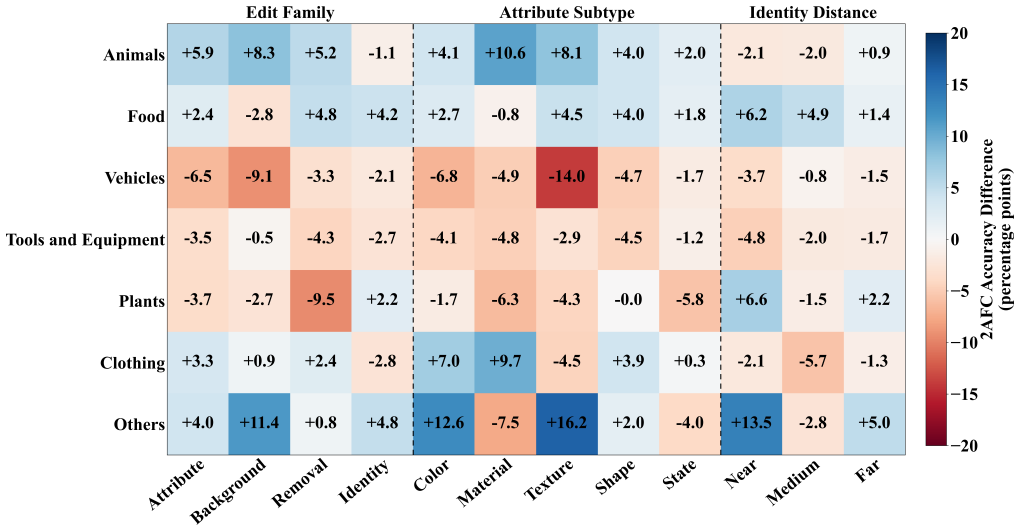
- Across all eight evaluated models, object identity and object presence are distinguished more reliably than attributes; within attributes, shape or size edits are the hardest and color edits the easiest.
- Semantic proximity drives identity-edit difficulty: far replacements are easier to detect than near or medium ones.
- The same attribute edit varies in difficulty across object categories, so a model's visual sensitivity is not uniform over content.
- Edited variants can serve as structured hard negatives for training EEG-image models that retain more precise and interpretable visual information.
Reading between the lines
- Because the paper's own null-edit control shows that regeneration alone changes image representations enough for models to notice, part of the edit-difficulty hierarchy may be driven by editor artifacts rather than by the targeted visual factor; a direct test is to build edits matched on measured visual distance across families and see whether the attribute gap persists.
- The paper notes that edited images have no corresponding EEG recordings, so the benchmark tests the complete retrieval system, not the brain's response to edited stimuli; collecting such recordings would connect the hierarchy to human visual discriminability.
- If the attribute-blindness pattern generalizes, the most practical next step is not more of the same retrieval training but objective functions that force attribute-level discrimination, evaluated by whether edit-pool scores improve.
- Mismatched-EEG baselines reveal that models also rely on image-side priors independent of the neural signal, so future edit-based benchmarks should routinely report such baselines before interpreting pairwise scores as evidence about brain alignment.
Editorial analysis
A structured set of objections, weighed in public.
Referee Report
Summary. The paper introduces EEG-EditBench, a benchmark for probing which visual information EEG-to-image retrieval models actually use. Starting from the 200 THINGS-EEG2 test images, the authors use InternVL3.5 plus FLUX.2 to generate 2,137 human-reviewed controlled edits in four families (object identity, attribute, background, object removal) and evaluate eight recent EEG decoding models with their native similarity functions. The central claim is that high standard 200-way retrieval accuracy does not imply the ability to distinguish the viewed image from its controlled edits, and that across models object identity and removal edits are easier than fine-grained attribute edits. The benchmark also reports source-category effects and target-concept alignment, and supplies code and data.
Significance. If the central claim holds, this is a useful and timely benchmark: it identifies a blind spot in standard EEG-to-image retrieval evaluation and offers a public, reproducible tool for measuring it. The manuscript is strong in execution in several ways: eight independently reproduced models are evaluated under a common protocol; the edit-generation pipeline is clearly documented; human quality control is used; and the supplementary material includes multiple validity controls (mismatched-EEG pairing gains, null-edit comparisons, distance balancing, aggregation sensitivity). These controls are a real strength and make the benchmark substantially more credible than a simple collection of generated edits. However, the factor-level interpretation, especially the headline 'attribute changes are hardest' result, is not yet established to the standard the paper aims for because the generation-artifact control is not broken down by edit family.
major comments (3)
- [§S5.2, Table S12] The load-bearing factor-level claim in the Abstract and §4 ('fine-grained attribute changes presenting the greatest challenge') requires that the 2AFC gap between edit families reflects the intended visual factor rather than editor artifacts. The paper's own null-edit control shows that models can separate originals from no-op FLUX.2 regenerations by 49.8–78.1% (Table S12), and the null-vs-semantic control is reported only as an overall micro-average over all 2,137 edits, not per family. If the regeneration-artifact signal is stronger for identity/removal edits than for attribute edits, the observed hierarchy would be an artifact of the editing pipeline. Please report the null-over-semantic 2AFC (and ideally the original-over-null 2AFC) separately for identity, attribute, background, and removal edits, with confidence intervals, and state whether the family ranking survives when both can
- [Fig. 5 and §S6.1, Table S14] Distance balancing addresses visual edit magnitude but does not establish factor-level validity. Figure 5 shows that attribute and background edits have the smallest OpenCLIP cosine shifts while identity and removal edits have the largest, so the family hierarchy co-varies with edit magnitude. Table S14 shows that distance balancing reduces but does not eliminate the identity/removal-vs-attribute gaps. However, visual distance is not equivalent to artifact prevalence or to the specific 'original vs generated' signal detected in Table S12. The fact that the attribute-vs-background gap is close to zero for ATM after balancing, while the identity-vs-attribute gap remains positive in most models, leaves room for artifact-driven explanations. A per-family null-vs-semantic comparison, or a distance- and artifact-matched subset analysis, is needed before the 'attribute changes are hardest' conc
- [§S2.3 and Table S12] The human QC excludes obvious artifacts and disqualifies edits that change unrelated content, but the large original-over-null 2AFC values (up to 78.1% for Brain-HIVE) show that models detect subtle regeneration differences even in human-approved no-op edits. This is not a flaw by itself, but it means the benchmark's 'valid edited image' status is not sufficient to guarantee that an edit changes only the target factor. The paper should state explicitly what the accepted non-target variation is, and should provide per-family statistics on visual distance, null-edit sensitivity, and any artifact-related metadata (e.g., reviewer flags). This would let readers assess whether the family hierarchy is robust to the editor's uncontrolled variation.
minor comments (6)
- [§5 (Discussion)] The text says 'attribute changes are consistently more difficult than changes in object identity or presence' but does not mention that background edits sit between them in most models and that the ordering between background and attribute is not uniform (e.g., ATM). Please soften or qualify the sentence to match Table 1.
- [Fig. 5] The figure uses a dashed line for the cross-concept reference and shaded IQR, but the boxplots are not described in the caption (whisker definition, outliers). Adding this information would improve reproducibility of the plot's interpretation.
- [Table S14] The column headers are split across two lines and the dagger/plus symbols are not defined. Please define 'Background−Attribute' notation in the caption and clarify the units.
- [§S3.2] The text says Brain-HIVE 'visual caches are isolated by seed because its VAE branch includes stochastic sampling.' It would be helpful to state whether the SynCLR and CLIP branches are deterministic and cached across seeds, since this affects the meaning of seed variance.
- [Global] Some references have future-venue placeholders (e.g., Jo et al. 2026, Zheng et al. 2026) that may not be finalized by the time of publication; please update them. Also, the dataset URL in the abstract appears as a GitHub repository; include a versioned DOI or archive identifier for long-term accessibility.
- [§1 and Fig. 1] The phrase 'controlled edits' is used consistently, but the paper does not quantitatively verify factor purity beyond human review and CLIP distance. A short sentence in §3 acknowledging the limitations of human review for subtle attribute edits would help set expectations.
Circularity Check
No circularity: the benchmark evaluates on held-out edits with model-native similarity; no prediction reduces to a fit or self-citation chain.
full rationale
The paper's chain is benchmark construction plus empirical evaluation, not a derivation. The evaluated scores (EP-Top1, 2AFC) are defined from each model's own EEG-image similarity on 2,137 quality-controlled edits that are 'used only for final testing' and never enter training. The central claim—that standard 200-way retrieval does not guarantee edit discrimination—is an observed difference between two externally computed metrics, not a reduction. The paper explicitly leaves each model's scoring function unchanged and only swaps candidate images, so no metric is defined in terms of its own target. The auxiliary CLIP-distance analysis and distance-balanced control use OpenCLIP ViT-L/14, which overlaps with the visual backbone of NICE and MB2C, but this is a potential confound/validity issue rather than circularity: the 2AFC scores themselves are computed with the models' native scores, and the distance-balancing is a sensitivity check. The only self-citations (ATS, CognitionCapturer/CognitionCapturer Pro) appear as related-work mentions or as one of the eight evaluated models; no load-bearing premise is justified solely by these citations. No uniqueness theorem, ansatz, or fitted parameter is imported from the authors' prior work. Accordingly, no circular step can be quoted or reduced to an equation identity.
Assumptions & free parameters
assumptions (5)
- domain assumption THINGS-EEG2 EEG recordings and the averaging of 80 repetitions per concept produce one query embedding that faithfully represents the neural response to the viewed image.
- domain assumption Retained edits differ from their source image only in the intended visual factor; human binary review plus CLIP-distance checks certify this confinement.
- domain assumption OpenCLIP ViT-L/14 cosine distance is a valid, model-independent measure of visual edit magnitude.
- domain assumption The eight reproduced models faithfully implement the configurations of their original papers.
- domain assumption The 200 THINGS-EEG2 test concepts, one image each, are representative of the objects they name.
Cite this review
Pith. "Pith review of EEG-EditBench: Probing Visual Information in EEG-Image Retrieval Models with Controlled Image Edits." pith.science (2026). https://pith.science/paper/5VHG3JA7
@misc{pith2026260727857,
  author       = {Pith},
  title        = {Pith review of: EEG-EditBench: Probing Visual Information in EEG-Image Retrieval Models with Controlled Image Edits},
  year         = {2026},
  howpublished = {\url{https://pith.science/paper/5VHG3JA7}},
  note         = {Machine review of arXiv:2607.27857}
}
read the original abstract
Recent EEG-to-image retrieval models have achieved strong performance in identifying viewed images from semantically diverse candidates. Yet such success does not reveal what visual information supports the match. A model may readily identify a cheetah among tools, plants, and vehicles, but can it still distinguish the viewed cheetah from the same scene with the cheetah replaced by a dog? Motivated by this question, we introduce EEG-EditBench, a diagnostic benchmark that examines this question through controlled edits of object identity, attributes, background, and object presence. Built from the 200 THINGS-EEG2 test images, EEG-EditBench contains 2,137 quality-controlled edits and evaluates eight representative EEG visual decoding models. Our results show that strong standard retrieval does not consistently transfer to edit-based evaluation, with fine-grained attribute changes presenting the greatest challenge. EEG-EditBench reveals model behavior hidden by aggregate retrieval accuracy and provides a controlled basis for studying what visual information EEG-image models preserve. The code and complete dataset are publicly available.
Figures


Figures from the paper (3 more)


Reference graph
Works this paper leans on
-
[1]
Nature Neuroscience , volume =
Decoding the Visual and Subjective Contents of the Human Brain , author =. Nature Neuroscience , volume =. 2005 , doi =
2005
-
[2]
Nature , volume =
Identifying Natural Images from Human Brain Activity , author =. Nature , volume =. 2008 , doi =
2008
-
[3]
Neuron , volume =
Bayesian Reconstruction of Natural Images from Human Brain Activity , author =. Neuron , volume =. 2009 , doi =
2009
-
[4]
Scientific Reports , volume =
Comparison of Deep Neural Networks to Spatio-Temporal Cortical Dynamics of Human Visual Object Recognition Reveals Hierarchical Correspondence , author =. Scientific Reports , volume =. 2016 , doi =
2016
-
[5]
and Hebart, Martin N
Grootswagers, Tijl and Zhou, Ivy and Robinson, Amanda K. and Hebart, Martin N. and Carlson, Thomas A. , journal =. Human. 2022 , doi =
2022
-
[6]
and Dwivedi, Kshitij and Roig, Gemma and Cichy, Radoslaw Martin , journal =
Gifford, Alessandro T. and Dwivedi, Kshitij and Roig, Gemma and Cichy, Radoslaw Martin , journal =. A Large and Rich. 2022 , doi =
2022
-
[7]
Decoding Natural Images from
Song, Yonghao and Liu, Bingchuan and Li, Xiang and Shi, Nanlin and Wang, Yijun and Gao, Xiaorong , booktitle =. Decoding Natural Images from
-
[8]
Visual Decoding and Reconstruction via
Li, Dongyang and Wei, Chen and Li, Shiying and Zou, Jiachen and Qin, Haoyang and Liu, Quanying , booktitle =. Visual Decoding and Reconstruction via
Show all 46 references
-
[9]
2024 , doi =
Wei, Yayun and Cao, Lei and Li, Hao and Dong, Yilin , booktitle =. 2024 , doi =
2024
-
[10]
2024 , publisher =
Bai, Yunpeng and Wang, Xintao and Cao, Yan-Pei and Ge, Yixiao and Yuan, Chun and Shan, Ying , booktitle =. 2024 , publisher =
2024
-
[11]
Proceedings of the IEEE/CVF Conference on Computer Vision and Pattern Recognition , pages =
Bridging the Vision-Brain Gap with an Uncertainty-Aware Blur Prior , author =. Proceedings of the IEEE/CVF Conference on Computer Vision and Pattern Recognition , pages =
-
[12]
2026 , doi =
Jo, Sangmin and Jeong, Wootaek and Heo, Da-Woon and Hwang, Yoohwan and Suk, Heung-Il , journal =. 2026 , doi =
2026
-
[13]
The Fourteenth International Conference on Learning Representations , year =
Learning Brain Representation with Hierarchical Visual Embeddings , author =. The Fourteenth International Conference on Learning Representations , year =
-
[14]
Leveraging Visual Blur Perception Characteristics for
Liu, Wenchao and Li, Hongwei and Xu, Zhouyang and Ma, Lin and Li, Haifeng , journal =. Leveraging Visual Blur Perception Characteristics for. 2026 , doi =
2026
-
[15]
Shrinking the Teacher: An Adaptive Teaching Paradigm for Asymmetric
Wu, Lukun and Li, Jie and Ren, Ziqi and Zhang, Kaifan and Gao, Xinbo , journal =. Shrinking the Teacher: An Adaptive Teaching Paradigm for Asymmetric. 2026 , doi =
2026
-
[16]
2026 , doi =
Zhang, Wenjiang and Wang, Sifeng and Su, Yuwei and Li, Xinyu and Zhang, Chen and Zhong, Suyu , journal =. 2026 , doi =
2026
-
[17]
Lawrence and Girshick, Ross , booktitle =
Johnson, Justin and Hariharan, Bharath and van der Maaten, Laurens and Fei-Fei, Li and Zitnick, C. Lawrence and Girshick, Ross , booktitle =. 2017 , doi =
2017
-
[18]
Beyond Accuracy: Behavioral Testing of
Ribeiro, Marco Tulio and Wu, Tongshuang and Guestrin, Carlos and Singh, Sameer , booktitle =. Beyond Accuracy: Behavioral Testing of. 2020 , doi =
2020
-
[19]
Proceedings of the 55th Annual Meeting of the Association for Computational Linguistics (Volume 1: Long Papers) , pages =
Shekhar, Ravi and Pezzelle, Sandro and Klimovich, Yauhen and Herbelot, Aur. Proceedings of the 55th Annual Meeting of the Association for Computational Linguistics (Volume 1: Long Papers) , pages =. 2017 , doi =
2017
-
[20]
2022 , doi =
Parcalabescu, Letitia and Cafagna, Michele and Muradjan, Lilitta and Frank, Anette and Calixto, Iacer and Gatt, Albert , booktitle =. 2022 , doi =
2022
-
[21]
2207.00221 , archivePrefix =
Zhao, Tiancheng and Zhang, Tianqi and Zhu, Mingwei and Shen, Haozhan and Lee, Kyusong and Lu, Xiaopeng and Yin, Jianwei , year =. 2207.00221 , archivePrefix =
-
[22]
2022 , doi =
Thrush, Tristan and Jiang, Ryan and Bartolo, Max and Singh, Amanpreet and Williams, Adina and Kiela, Douwe and Ross, Candace , booktitle =. 2022 , doi =
2022
-
[23]
The Eleventh International Conference on Learning Representations , year =
When and Why Vision-Language Models Behave like Bags-of-Words, and What to Do About It? , author =. The Eleventh International Conference on Learning Representations , year =
-
[24]
Ma, Zixian and Hong, Jerry and Gul, Mustafa Omer and Gandhi, Mona and Gao, Irena and Krishna, Ranjay , booktitle =
-
[25]
Hsieh, Cheng-Yu and Zhang, Jieyu and Ma, Zixian and Kembhavi, Aniruddha and Krishna, Ranjay , booktitle =
-
[26]
Proceedings of the IEEE/CVF Conference on Computer Vision and Pattern Recognition , pages =
Imagen Editor and EditBench: Advancing and Evaluating Text-Guided Image Inpainting , author =. Proceedings of the IEEE/CVF Conference on Computer Vision and Pattern Recognition , pages =
-
[27]
Zhang, Kai and Mo, Lingbo and Chen, Wenhu and Sun, Huan and Su, Yu , booktitle =
-
[28]
Ma, Yiwei and Ji, Jiayi and Ye, Ke and Lin, Weihuang and Wang, Zhibin and Zheng, Yonghan and Zhou, Qiang and Sun, Xiaoshuai and Ji, Rongrong , booktitle =
-
[29]
The Thirty-Eighth Conference on Neural Information Processing Systems Datasets and Benchmarks Track , year =
Benchmarking Counterfactual Image Generation , author =. The Thirty-Eighth Conference on Neural Information Processing Systems Datasets and Benchmarks Track , year =
-
[30]
and Dickter, Adam H
Hebart, Martin N. and Dickter, Adam H. and Kidder, Alexis and Kwok, Wan Y. and Corriveau, Anna and Van Wicklin, Caitlin and Baker, Chris I. , journal =. 2019 , doi =
2019
-
[31]
Proceedings of the 38th International Conference on Machine Learning , series =
Learning Transferable Visual Models from Natural Language Supervision , author =. Proceedings of the 38th International Conference on Machine Learning , series =. 2021 , publisher =
2021
-
[32]
Proceedings of the IEEE/CVF Conference on Computer Vision and Pattern Recognition , pages =
Reproducible Scaling Laws for Contrastive Language-Image Learning , author =. Proceedings of the IEEE/CVF Conference on Computer Vision and Pattern Recognition , pages =
-
[33]
Multivariate Pattern Analysis for
Guggenmos, Matthias and Sterzer, Philipp and Cichy, Radoslaw Martin , journal =. Multivariate Pattern Analysis for. 2018 , doi =
2018
-
[34]
and Suppes, Patrick , journal =
Kaneshiro, Blair and Perreau Guimaraes, Marcos and Kim, Hyung-Suk and Norcia, Anthony M. and Suppes, Patrick , journal =. A Representational Similarity Analysis of the Dynamics of Object Processing Using Single-Trial. 2015 , doi =
2015
-
[35]
IEEE Transactions on Pattern Analysis and Machine Intelligence , volume =
Decoding Visual Neural Representations by Multimodal Learning of Brain-Visual-Linguistic Features , author =. IEEE Transactions on Pattern Analysis and Machine Intelligence , volume =. 2023 , doi =
2023
-
[36]
Learning Robust Deep Visual Representations from
Singh, Prajwal and Dalal, Dwip and Vashishtha, Gautam and Miyapuram, Krishna and Raman, Shanmuganathan , booktitle =. Learning Robust Deep Visual Representations from. 2024 , doi =
2024
-
[37]
Ju, Xuan and Zeng, Ailing and Bian, Yuxuan and Liu, Shaoteng and Xu, Qiang , booktitle =
-
[38]
Hui, Mude and Yang, Siwei and Zhao, Bingchen and Shi, Yichun and Wang, Heng and Wang, Peng and Zhou, Yuyin and Xie, Cihang , booktitle =
-
[39]
Yu, Qifan and Chow, Wei and Yue, Zhongqi and Pan, Kaihang and Wu, Yang and Wan, Xiaoyang and Li, Juncheng and Tang, Siliang and Zhang, Hanwang and Zhuang, Yueting , booktitle =
-
[40]
Proceedings of the AAAI Conference on Artificial Intelligence , number=
Cognitioncapturer: Decoding visual stimuli from human eeg signal with multimodal information , author=. Proceedings of the AAAI Conference on Artificial Intelligence , number=
-
[41]
arXiv preprint arXiv:2603.12722 , year=
CognitionCapturerPro: Towards High-Fidelity Visual Decoding from EEG/MEG via Multi-modal Information and Asymmetric Alignment , author=. arXiv preprint arXiv:2603.12722 , year=
-
[42]
Wang, Weiyun and others , journal =
-
[43]
2026 , howpublished =
2026
-
[44]
Proceedings of the IEEE/CVF International Conference on Computer Vision , pages=
Exploring the Visual Feature Space for Multimodal Neural Decoding , author=. Proceedings of the IEEE/CVF International Conference on Computer Vision , pages=
-
[45]
Proceedings of the AAAI Conference on Artificial Intelligence , number=
Multigranular Evaluation for Brain Visual Decoding , author=. Proceedings of the AAAI Conference on Artificial Intelligence , number=. 2026 , doi=
2026
-
[46]
and St-Yves, Ghislain and Breedlove, Jesse and Kay, Kendrick and Naselaris, Thomas , booktitle=
Kneeland, Reese and Scotti, Paul S. and St-Yves, Ghislain and Breedlove, Jesse and Kay, Kendrick and Naselaris, Thomas , booktitle=
Reviewed August 1, 2026 · model on record in the stance chip above.
Discussion (0). Sign in to comment.