REVIEW 3 major objections 4 minor 39 references
Orca treats continuous-time causal reasoning as learning maps between function spaces, enabling dose-response and counterfactual queries on irregularly sampled trajectories.
Reviewed by Pith at T0; open to challenge. T0 means a machine referee read the full paper against a public rubric. the ladder, T0–T4 →
T0 review · deepseek-v4-flash
2026-08-01 00:00 UTC pith:EMFGQR57
load-bearing objection A candid, well-scoped framework paper that combines neural operators with causal semantics; the main risk is the acknowledged but unproven identifiability assumption, so treat as conditional. the 3 major comments →
Orca: Neural Operators for Causal Reasoning in Continuous Time
The pith
A machine-rendered reading of the paper's core claim, the machinery that carries it, and where it could break.
Core claim
Orca's central claim is that neural operators are the natural mechanism class for continuous-time causal models. Each node's value is a function of time, and each mechanism is a learned forward operator that maps the past trajectories of its parent nodes, plus a latent noise function, to the node's value at a query time. Because parents are read strictly from the past, cyclic dependencies become acyclic when unrolled in time. Under additive noise the latent noise is recovered as a residual; under non-additive noise the paper couples observed subjects to sampled noise trajectories by rank-based optimal transport and reuses the coupled noise for counterfactuals. The paper demonstrates on synth
What carries the argument
The load-bearing object is the forward operator F_v, which computes node v's value at time t from the past histories of its parents and the current noise, implementing the temporal priority principle. Orca instantiates it with a deep-set operator: a shared embedding network maps each past parent measurement to a vector, the vectors are summed with quadrature weights (the time span each measurement stands for), and a decoder outputs the node value at the query time. The quadrature weighting turns the sum into an integral estimate, making predictions resolution-consistent and letting a model trained on one grid evaluate on another. For non-additive noise, an optimal-transport coupling between
Load-bearing premise
Even when the directed causal graph is correct, the learned operator's parameterization must mirror the true mechanism closely enough, because a good predictive fit does not by itself certify a correct causal or counterfactual decomposition.
What would settle it
Simulate a continuous-time system with a known graph and a true mechanism deliberately outside the deep-set operator class (for example, with strong non-smooth interactions or noise that enters non-monotonically), fit Orca on dense irregular samples, and check whether the estimated dose-response curve converges to ground truth under grid refinement while the training loss stays near zero. If the two diverge—training loss falling but causal error not—the central claim that predictive fit supports causal inference in this setting is falsified.
If this is right
- Causal conclusions from irregularly sampled longitudinal data need not be tied to a fixed time grid; a model trained at one resolution can answer queries at a finer or coarser resolution.
- Feedback loops can be accommodated without instantaneous circularity by reading parents only from the past, so cyclic graphs become acyclic along time.
- Latent noise functions, once inferred, support subject-level counterfactual trajectories rather than only average treatment effects.
- In the fixed-kernel variant, the learned mechanism is an interpretable function of time lag, directly readable as the effect of a cause from τ time units ago.
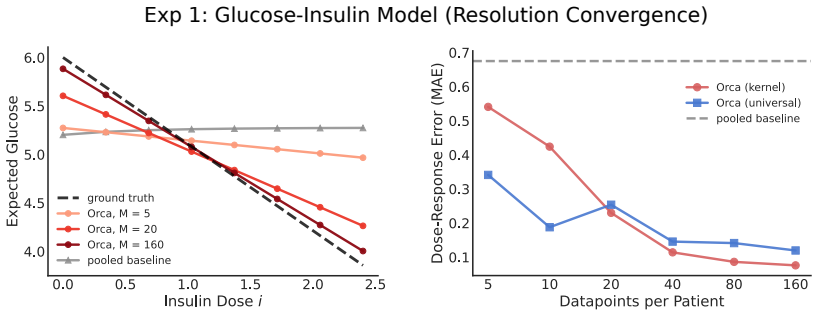
- As measurements become denser, interventional estimates converge to the continuous-time ground truth, while grid-tied or causally blind baselines stay biased at every density.
Where Pith is reading between the lines
- If the framework scales beyond synthetic examples, it suggests a general recipe for any domain—pharmacology, climate, epidemiology—where data arrive as irregularly sampled trajectories with a known causal graph: estimate mechanisms as operators, then answer interventions by simulating the intervened graph.
- The paper's own limitation statement implies a concrete diagnostic: compare predictive loss against causal validation error on a held-out interventional distribution; if training loss drops while causal error does not, the parameterization is misspecified.
- The non-additive noise coupling is only sketched; a natural test is to apply it to generative models with non-monotone or non-persistent noise and see whether counterfactual accuracy degrades as the true noise becomes less rank-like.
- One could extend the construction from functions of time to space-time fields, as the paper notes, which would make the same operator semantics applicable to spatio-temporal causal queries.
Editorial analysis
A structured set of objections, weighed in public.
Referee Report
Summary. The paper introduces Orca, a framework for causal reasoning over continuous-time processes observed at irregular time points. Each node of a causal graph is a function of time, and each mechanism is a learned neural operator mapping parent histories to node values, with latent noise treated as a function. The authors formalize a cyclic continuous-time generative model, a deep-set-style operator architecture with quadrature weighting for resolution consistency, and interventional and counterfactual inference via simulation. They demonstrate the approach on two synthetic experiments: a glucose–insulin model with a confounder and cycle, testing dose–response convergence under varying sampling density, and a tumor-growth model with non-additive latent noise, testing individual counterfactuals. The paper is candid about limitations, including the assumption of a known graph and the lack of a guarantee that predictive fit certifies a correct causal decomposition.
Significance. If the central claims hold, Orca would be a meaningful step toward causal inference for continuous-time, irregularly sampled, cyclic systems, connecting neural operator learning with structural causal modeling. The paper's strengths include a clean formal model (Equations 4–5), a concrete architecture with a clear resolution-consistency motivation, fully reproducible synthetic experiments with code, and an unusually candid limitations section. The universal-approximation arguments are used appropriately as motivation rather than as identifiability theorems. However, the significance is tempered by the fact that causal correctness is established only under favorable parameterizations, and the general non-additive method is explicitly a sketch. The contribution is therefore best read as a framework proposal with proof-of-concept evidence, not as a validated general method for causal effect estimation or counterfactual reasoning.
major comments (3)
- [Assumptions and Limitations] The load-bearing identifiability gap is acknowledged but not resolved. The paper states in Limitations that 'even with the correct graph, predictive fit does not certify a causal decomposition: the parameterization must mirror the true mechanism, or causal estimates can be badly biased while the training loss barely moves.' This directly affects the central claim that Orca 'supports causal effect estimation, counterfactual reasoning, and the learning of mechanistic functions.' Equation (5) trains only on observational MSE; there is no theorem or formal condition under which minimizing this loss yields correct interventional or counterfactual distributions under distribution shift. The universal approximation results cited concern representation capacity, not whether the empirical-risk minimizer recovers the correct mechanism. I would like the authors to either prove such a condition for
- [Learning Distributions over Functions / Experiment 2] The non-additive noise coupling procedure is explicitly a heuristic, and Experiment 2 does not demonstrate the general deep-set operator in this setting. The algorithm in 'Learning Distributions over Functions' uses optimal transport on rank trajectories, but no consistency, identifiability, or even convergence result is given for this coupling. In Appendix B, the tumor model is fit as a parametric ODE with the Gompertz form assumed known in advance (Equation 6) and only four constants learned, not as the universal deep-set operator described in Section 'Our Method'. Thus the claimed general non-additive capability — the main innovation over additive residuals — is not actually exercised by the experiment. The authors should either implement and test the deep-set operator on a non-additive mechanism, or clearly state that the non-additive method is only demonstrated for a parametric, nea
- [Semantics / Resolution Consistency] The resolution-invariance claim is established only informally. In 'Semantics', the continuous-time model is defined as the weak limit of grid-based distributions as the grid is refined, with the caveat that 'avoiding pathological cases remains the modeler's responsibility.' In 'Resolution Consistency', convergence of the quadrature-weighted sum to an integral under mesh refinement is invoked for predictions. However, the paper does not prove that the interventional distributions computed by simulating the learned operator converge as the grid refines, nor that the quadrature error stays controlled when the operator is composed with downstream causal queries. Since the central selling point is that Orca decouples causal conclusions from the sampling grid, this is a load-bearing gap. A formal statement with sufficient regularity conditions on the mechanisms and noise processes, at least f
minor comments (4)
- [Notation, Equations (1)-(2)] In the illustrative example, Brownian motion is written as a term added to the trajectory, but in the formal model (Equation 4) the noise enters as an increment at each time point. The relationship between these two uses of Brownian motion could be clarified, particularly whether the equations are interpreted in an Itô or pathwise sense.
- [Figure 3 caption] The caption describes the neural operator baseline as 'no causal graph (no age)', but the method is better characterized as 'causally blind' rather than 'no graph', since it still uses an operator. Minor wording issue.
- [Section 'Data and Objective'] The notation S_i^v(t) is defined informally as 'the part of X that the mechanism is allowed to see.' It would be helpful to state explicitly that X includes subject index, node index, time, and value, and that the history set is finite because measurements are finite.
- [Appendix B] The statement that the learned sensitivity slope is 'close to the true noise scale (w≈0.5 against σ=0.55)' is presented without error bars or a sensitivity analysis. Given that this parameter directly controls counterfactual divergence, reporting its variability across random seeds would strengthen the result.
Circularity Check
No significant circularity: causal queries are evaluated by simulating the fitted mechanisms under held-out interventions, not by fitting the query targets.
full rationale
The derivation chain is self-contained. Orca defines each node value as x_v(t) = F_v(H_v(t), N_v(t), t) and fits F_v by minimizing subject-normalized MSE on observational tuples (Eq. 5). Causal queries are then obtained by replacing a node's mechanism with an intervention and pushing the noise distribution through the intervened model; the interventional and counterfactual targets are never part of the training loss. The dose-response curves and treatment effects are therefore not fit targets renamed as predictions. The kernel variant is explicitly an ansatz ('we already knew that the true mechanism is an exponential kernel acting on exercise with age added on top, and we built that form into the model'), and the paper also evaluates a universal deep-set operator, so the central claim does not reduce to the kernel ansatz. The non-additive noise coupling uses residuals only as a rank-based heuristic to select noise trajectories via optimal transport, then re-simulates counterfactuals with the coupled noise; this is an abduction heuristic, not a derivation that equates the prediction to its inputs. The only self-citation (Aalaila et al. 2026) appears in a related-work list and is not load-bearing. The Limitations candidly state the load-bearing assumption that parameterization must mirror the true mechanism; that is a correctness risk, not circularity.
Axiom & Free-Parameter Ledger
free parameters (3)
- Learned operator parameters θ (network weights of Kθ1, ρθ2, φθ1, ρθ2) =
optimized by MSE; not enumerated
- Optimal-transport coupling hyperparameters (K, rank grid, Sinkhorn regularization) =
K=2000; 13 time points; entropic OT
- Learned tumor-model constants, including sensitivity slope w =
w≈0.5 (vs. true σ=0.55)
axioms (6)
- domain assumption The directed causal graph G is known and causally sufficient
- domain assumption Mechanisms remain invariant under the considered interventions
- domain assumption Additive noise (Eq. 4) or, for non-additive case, known noise model plus monotonicity/rank coupling
- ad hoc to paper Parameterization must mirror the true mechanism
- standard math DeepSets representation theorem and MIONet universal approximation hold for the chosen operators
- domain assumption Sufficient regularity of mechanisms and noise for weak convergence and quadrature
read the original abstract
Structural causal models are the standard language for reasoning about interventions and counterfactuals, but they describe static variables, typically measured once, and usually forbid cyclic dependencies. Many systems we care about, such as patients, climates, and economies, instead evolve continuously in time, are observed at irregular time points, and contain feedback loops. We argue that neural operator learning provides a natural foundation for causal reasoning in this setting, and propose Orca, a framework in which each node of the causal graph is a function of time and each mechanism is a learned map between function spaces. We extend existing neural operator architectures to express causal mechanisms: a mechanism computes the function value of a node from its parent nodes by taking several parent functions as input, respects the arrow of time, and treats latent exogenous noise as a function that can be inferred and reused for counterfactuals. We formalize the model class and demonstrate counterfactual reasoning on synthetic continuous-time examples. Code is available at https://github.com/gerritgr/orca
Figures



Reference graph
Works this paper leans on
-
[1]
Pearl, Judea , title =
-
[2]
Elements of Causal Inference: Foundations and Learning Algorithms , publisher =
Peters, Jonas and Janzing, Dominik and Sch. Elements of Causal Inference: Foundations and Learning Algorithms , publisher =
-
[3]
SIAM Journal on Scientific Computing , volume=
MIONet: Learning multiple-input operators via tensor product , author=. SIAM Journal on Scientific Computing , volume=. 2022 , publisher=
2022
-
[4]
International Conference on Learning Representations , year =
Li, Zongyi and Kovachki, Nikola and Azizzadenesheli, Kamyar and Liu, Burigede and Bhattacharya, Kaushik and Stuart, Andrew and Anandkumar, Anima , title =. International Conference on Learning Representations , year =
-
[5]
Advances in Neural Information Processing Systems , volume=
A measure-theoretic axiomatisation of causality , author=. Advances in Neural Information Processing Systems , volume=
-
[6]
Ness, Robert Osazuwa and Paneri, Kaushal and Vitek, Olga , journal =. 2019 , title =. doi:10.48550/arxiv.1911.02175 , eprint =
work page internal anchor Pith review Pith/arXiv arXiv doi:10.48550/arxiv.1911.02175 2019
-
[7]
Paluš, Milan and Krakovská, Anna and Jakubík, Jozef and Chvosteková, Martina , journal =. 2018 , title =. doi:10.1063/1.5019944 , pmid =
-
[8]
Scientific Reports , volume=
Chaotic and complex dynamics expose the limits of counterfactual reasoning , author=. Scientific Reports , volume=. 2026 , publisher=
2026
-
[9]
International Conference on Machine Learning , pages=
Counterfactual off-policy evaluation with gumbel-max structural causal models , author=. International Conference on Machine Learning , pages=. 2019 , organization=
2019
-
[10]
Journal of Machine Learning Research , volume =
Kovachki, Nikola and Li, Zongyi and Liu, Burigede and Azizzadenesheli, Kamyar and Bhattacharya, Kaushik and Stuart, Andrew and Anandkumar, Anima , title =. Journal of Machine Learning Research , volume =
-
[11]
Nature Machine Intelligence , volume =
Lu, Lu and Jin, Pengzhan and Pang, Guofei and Zhang, Zhongqiang and Karniadakis, George Em , title =. Nature Machine Intelligence , volume =
-
[12]
Nature Reviews Physics , volume =
Azizzadenesheli, Kamyar and Kovachki, Nikola and Li, Zongyi and Liu-Schiaffini, Miguel and Kossaifi, Jean and Anandkumar, Anima , title =. Nature Reviews Physics , volume =
-
[13]
Econometrica , volume=
Nonparametric estimation of nonadditive random functions , author=. Econometrica , volume=. 2003 , publisher=
2003
-
[14]
Econometrica , volume=
An IV model of quantile treatment effects , author=. Econometrica , volume=. 2005 , publisher=
2005
-
[15]
Journal of Machine Learning Research , volume=
Causal discovery from heterogeneous/nonstationary data , author=. Journal of Machine Learning Research , volume=
-
[16]
arXiv preprint arXiv:2003.03485 , year=
Neural operator: Graph kernel network for partial differential equations , author=. arXiv preprint arXiv:2003.03485 , year=
Pith/arXiv arXiv 2003
-
[17]
Nature machine intelligence , volume=
Learning nonlinear operators via DeepONet based on the universal approximation theorem of operators , author=. Nature machine intelligence , volume=. 2021 , publisher=
2021
-
[18]
Advances in Neural Information Processing Systems , volume=
Stochastic process learning via operator flow matching , author=. Advances in Neural Information Processing Systems , volume=
-
[19]
arXiv preprint arXiv:2607.12140 , year=
Causal Graphs, Markov Properties and Do-calculus for Stochastic Differential Equations , author=. arXiv preprint arXiv:2607.12140 , year=
-
[20]
arXiv preprint arXiv:2404.02986 , year=
Universal functional regression with neural operator flows , author=. arXiv preprint arXiv:2404.02986 , year=
-
[21]
arXiv preprint arXiv:2507.12144 , year =
Bonev, Boris and Kurth, Thorsten and Mardani, Morteza and others , title =. arXiv preprint arXiv:2507.12144 , year =
-
[22]
Rubanova, Yulia and Chen, Ricky T. Q. and Duvenaud, David , title =. Advances in Neural Information Processing Systems , year =
-
[23]
Chen, Ricky T. Q. and Rubanova, Yulia and Bettencourt, Jesse and Duvenaud, David , title =. Advances in Neural Information Processing Systems , year =
-
[24]
Toward Causal Representation Learning , journal =
Sch. Toward Causal Representation Learning , journal =
-
[25]
Learning Semilinear Neural Operators: A Unified Recursive Framework for Prediction and Data Assimilation , booktitle =
Ben. Learning Semilinear Neural Operators: A Unified Recursive Framework for Prediction and Data Assimilation , booktitle =
-
[26]
and Smola, Alexander J
Zaheer, Manzil and Kottur, Satwik and Ravanbakhsh, Siamak and Poczos, Barnabas and Salakhutdinov, Russ R. and Smola, Alexander J. , title =. Advances in Neural Information Processing Systems , year =
-
[27]
Nature Communications , volume =
Runge, Jakob and Bathiany, Sebastian and Bollt, Erik and others , title =. Nature Communications , volume =
-
[28]
Bongers, Stephan and Blom, Tineke and Mooij, Joris M. , title =. arXiv preprint arXiv:1803.08784 , year =
-
[29]
Boeken, Philip and Mooij, Joris M. , title =. arXiv preprint arXiv:2406.01161 , year =
-
[30]
Electronic Journal of Probability , volume =
Sokol, Alexander and Hansen, Niels Richard , title =. Electronic Journal of Probability , volume =
-
[31]
Probabilistic and Causal Inference: The Works of Judea Pearl , pages =
Peters, Jonas and Bauer, Stefan and Pfister, Niklas , title =. Probabilistic and Causal Inference: The Works of Judea Pearl , pages =
-
[32]
and Weichwald, Sebastian and Bongers, Stephan and Mooij, Joris M
Rubenstein, Paul K. and Weichwald, Sebastian and Bongers, Stephan and Mooij, Joris M. and Janzing, Dominik and Grosse-Wentrup, Moritz and Sch. Causal Consistency of Structural Equation Models , booktitle =
-
[33]
and Peters, Jonas , title =
Christiansen, Rune and Baumann, Matthias and Kuemmerle, Tobias and Mahecha, Miguel D. and Peters, Jonas , title =. Journal of the American Statistical Association , volume =
-
[34]
and Luo, Xihaier and Yoo, Shinjae and Kallus, Nathan , title =
Oprescu, Miruna and Park, David K. and Luo, Xihaier and Yoo, Shinjae and Kallus, Nathan , title =. arXiv preprint arXiv:2502.05295 , year =
-
[35]
Signature Kernel Conditional Independence Tests in Causal Discovery for Stochastic Processes , journal =
Manten, Georg and Casolo, Cecilia and Ferrucci, Emilio and Mogensen, S. Signature Kernel Conditional Independence Tests in Causal Discovery for Stochastic Processes , journal =
-
[36]
Reisach, Alexander G. and Su. The Case for Time in Causal. arXiv preprint arXiv:2501.19311 , year =
-
[37]
Peculiarities of Counterfactual Point Process Generation , booktitle =
Gro. Peculiarities of Counterfactual Point Process Generation , booktitle =
-
[38]
Advances in Neural Information Processing Systems , volume=
Integrating Markov processes with structural causal modeling enables counterfactual inference in complex systems , author=. Advances in Neural Information Processing Systems , volume=
-
[39]
Nature Machine Intelligence , pages=
Principled approaches for extending neural architectures to function spaces for operator learning , author=. Nature Machine Intelligence , pages=. 2026 , publisher=
2026
discussion (0)
Sign in with ORCID, Apple, or X to comment. Anyone can read and Pith papers without signing in.