REVIEW 6 minor 75 references
SciSchema.org: A Multidisciplinary Collection of Schemas for Structured Scientific Process Descriptions
T0 review · 0 major / 6 minor · reviewed 2026-07-31 · grok-4.5
Pith's one-line read Sixteen expert-curated schemas turn prose-bound scientific methods into comparable, machine-checkable process descriptions across five domains.
desk verdict Solid first-release Data Descriptor: 16 dual-format process schemas with real HITL provenance; utility is prospective, not proven. read the letter →
The pith
A machine-rendered reading of the paper's core claim, the machinery that carries it, and where it could break.
The reading
What carries the argument
Human-in-the-loop scientific schema mining: language models generate candidate typed schemas from a short domain specification, then iteratively revise them against curated and expanded paper batches under periodic expert feedback; domain experts finally rate Stage-3 candidates and construct a master schema by selecting, editing, or merging preferred outputs.
What would settle it
Blinded extraction or annotation trials on held-out papers: measure agreement and completeness when humans or extractors populate the released master schemas versus fully hand-built gold schemas or versus raw Stage-3 model candidates, and check whether higher expert Likert scores predict higher population quality.
Extended reading notes
Core claim
The first SciSchema.org release is a documented, multidisciplinary set of 16 community expert-annotated scientific-process schemas, dual-encoded as JSON Schema and SHACL, produced by a staged human-in-the-loop language-model schema-mining workflow and checked for structure, provenance, expert preference, and syntactic conformance, and intended as reusable targets for annotation, metadata enrichment, knowledge graphs, information extraction, semantic publishing, and cross-study comparison.
Load-bearing premise
That experts merging model-proposed fields from roughly sixty papers per process produce field lists and nesting that are scientifically adequate community standards, even without a separate test of how well people or tools can fill those schemas from real papers.
Editorial extensions
If this is right
- Method- and process-specific search can surface papers organized by shared attributes rather than full-text alone.
- JSON Schema files can validate records, drive forms, and constrain extraction outputs; SHACL files can validate RDF process graphs and link into knowledge-graph templates.
- Instantiated records can make unreported versus inapplicable fields visible, exposing reporting gaps without claiming to fix reproducibility.
- The same field inventory supports cross-study comparison tables and machine-assisted or automated lab pipelines that need explicit inputs, parameters, and outputs.
- Future community work can map these schemas onto domain vocabularies and repository profiles once the structural layer exists.
Reading between the lines
- If the dual-format masters become default targets for extraction benchmarks, process-level F1 and gap-detection metrics could become as routine as entity extraction scores.
- Shallow computational workflows were screened out because they yield few recurring fields; that selection rule may systematically under-represent pure software pipelines until schema depth criteria are relaxed.
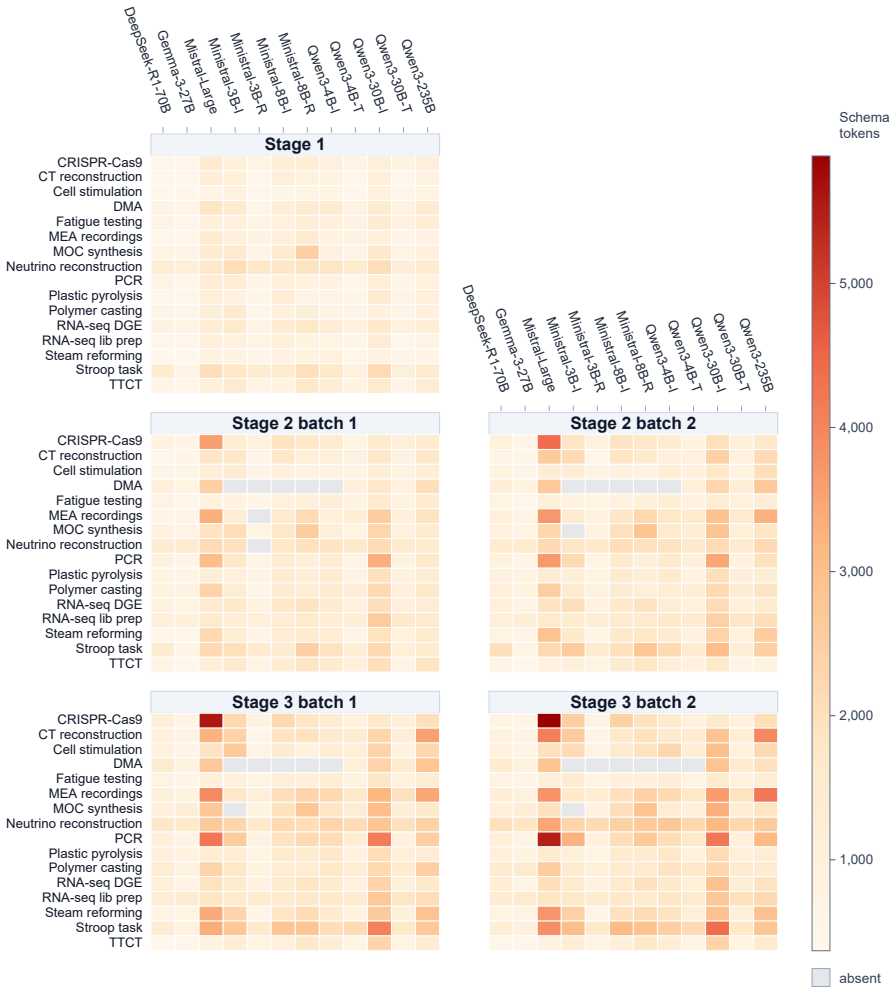
- Instruction-tuned models tended to expand more than reasoning-oriented ones in this workflow, suggesting extraction-target design may favor breadth-oriented generators when experts will prune later.
- Without populated multi-paper corpora released alongside the schemas, adoption may lag until someone ships open annotated instances for at least one high-traffic process such as PCR or fatigue testing.
Editorial analysis
A structured set of objections, weighed in public.
Referee Report
Summary. This Data Descriptor presents the first SciSchema.org release: 16 expert-annotated scientific-process schemas across Biology & Biotechnology, Materials & Chemistry, Imaging & Measurement, Physics, and Psychology. Each schema defines reusable fields (inputs, materials, instruments/software, parameters, conditions, steps, measurements, provenance) in dual JSON Schema and SHACL/Notation3 form. Schemas were produced via a documented three-stage human-in-the-loop workflow (schema-miner v3.2.5) in which twelve LLMs generated candidates from process specifications and paper corpora (~10 curated then ~50+ expanded papers), with periodic expert feedback, followed by expert construction of master schemas from Stage-3 candidates. The Zenodo archive includes master schemas, intermediate trajectories, feedback records, source-paper metadata, community materials, and analysis scripts. Technical validation covers input heterogeneity, feedback coverage, stage-wise growth in schema tokens/properties/leaves/depth, expert Likert ratings versus master-source selection (Spearman ρ=0.76), and full Draft 2020-12 / SHACL meta-validation.
Significance. If the resource is as documented, it supplies a concrete, reusable process-metadata layer that scholarly infrastructures largely lack, with dual machine-actionable formats suited to record validation, schema-guided IE, ORKG templates, and KG integration. Strengths include open dual-format masters, inspectable HITL provenance (stage outputs, feedback TSVs, metadata.csv), multi-model trajectories, syntactic conformance checks, and explicit prospective framing of reuse in Usage Notes. For cs.DL / scientific data venues, a multidisciplinary first release with community formation, selection criteria, and reproducible analysis scripts is a solid contribution even without external utility benchmarks.
minor comments (6)
- [Background & Summary; Usage Notes] Background & Usage Notes: State more explicitly that scientific adequacy rests on single-expert (or small-team) consolidation per process and that external utility tests (e.g., blinded IE F1, multi-annotator IAA on populated records, or comparison to fully manual gold schemas) are out of scope for this first release. This matches the paper’s actual claim but would reduce over-reading of “community standards.”
- [Methods (Master-schema construction and publication)] Methods, master-schema construction: Clarify how disagreements were handled when multiple experts contributed to one process (e.g., Catalytic Pyrolysis, Solvent Casting, Electrical Cell Stimulation) versus single-expert processes—consensus rule, lead editor, or merge protocol.
- [Data Overview; Figure 3] Figure 3 / Data Overview: Point readers to the exact tabular file in paper-analysis/ (or Zenodo path) that lists per-schema depth, total properties, and leaf counts so the scatter overview is fully reproducible from the text alone.
- [Technical Validation (Master expert-annotated schemas)] Technical Validation, Figure 9: Briefly note that the rating↔selection association is partly by design of the curation step (experts rate then choose/edit preferred candidates), so ρ=0.76 is consistency evidence rather than independent predictive validation.
- [Data Records; Table 1] Data Records: A one-line machine-readable process inventory (slug, domain, ORKG template ID, schema $id) alongside Table 1 would ease bulk reuse; Table 1 already helps but is prose-bound.
- [Methods (Process screening and selection)] Minor consistency: abstract and opening say “16 expert-annotated schemas” while Methods describe provisional acceptance of 18 with 16 confirming—fine, but a short clause on the two non-proceeding processes would close the loop.
Circularity Check
No significant circularity: Data Descriptor releases constructed schemas via documented HITL workflow, not a derivation or prediction chain.
full rationale
SciSchema.org is a cs.DL Data Descriptor whose central claim is the release of 16 expert-annotated dual-format process schemas plus provenance materials, produced by a three-stage human-in-the-loop LLM schema-mining workflow and checked for structure, expert review, and JSON Schema/SHACL syntactic conformance. There is no first-principles derivation, fitted physical law, uniqueness theorem, or quantitative prediction whose output reduces to its inputs by construction. Self-citations to schema-miner [61, 62] document the open tool used to generate candidates; they do not smuggle an ansatz or forbid alternatives. Expert Likert ratings of Stage-3 candidates and subsequent master-schema selection (Figure 9, Spearman ρ=0.76) are the same curation act reported transparently, not an independent forecast presented as validation of a forced result. Usage Notes frame IE, forms, and KG integration as prospective capabilities. No circular step meets the quote-and-exhibit bar; score 0 with empty steps is the honest finding.
Assumptions & free parameters
free parameters (3)
- Curated vs expanded corpus sizes (~10 and ~50+ papers per process) =
~10 curated; ~50+ expanded (varies by process)
- Five-point Likert master-schema ratings and multi-source merge policy =
1–5 scale; 55.2% ratings ≥4 reported
- Process inclusion thresholds (>~15 years literature; high property granularity) =
18 provisionally accepted → 16 confirmed
assumptions (5)
- domain assumption Recurring process attributes reported across a mature literature can be abstracted into reusable schema fields that support comparison and IE.
- domain assumption Domain experts can judge terminology, grouping, coverage, and scientific adequacy of candidate schemas well enough to define community master schemas.
- domain assumption JSON Schema Draft 2020-12 and SHACL/Notation3 can encode the same process-level content for document and KG ecosystems.
- ad hoc to paper Periodic expert feedback between paper batches is sufficient relative to per-paper feedback given modern LLM instruction following.
- standard math Standard JSON parsing, Draft 2020-12 meta-schema validation, RDFLib parse, and pySHACL shape-graph checks establish syntactic release quality.
invented entities (2)
-
SciSchema.org schema collection (first release, 16 process schemas)
independent evidence
-
Per-process master schemas (e.g., CRISPR-Cas9, catalytic pyrolysis, neutrino event reconstruction)
Cite this review
Pith. "Pith review of SciSchema.org: A Multidisciplinary Collection of Schemas for Structured Scientific Process Descriptions." pith.science (2026). https://pith.science/paper/ZR7HR62Z
@misc{pith2026260727955,
  author       = {Pith},
  title        = {Pith review of: SciSchema.org: A Multidisciplinary Collection of Schemas for Structured Scientific Process Descriptions},
  year         = {2026},
  howpublished = {\url{https://pith.science/paper/ZR7HR62Z}},
  note         = {Machine review of arXiv:2607.27955}
}
read the original abstract
Scientific processes are often described in heterogeneous article discourse, with details needed for comparison, reproducibility, reuse, and automation dispersed across prose, tables, figures, protocols, and supplementary files. We present the first release of SciSchema.org, a multidisciplinary collection of 16 expert-annotated schemas spanning Biology & Biotechnology, Materials & Chemistry, Imaging & Measurement, Physics, and Psychology. Each schema defines reusable fields for describing process instances, including inputs, outputs, materials, instruments or software, parameters, conditions, procedural steps, measurements, and provenance-related information. The schemas were created through a human-in-the-loop schema-mining workflow in which large language models generated candidate structures from process specifications, scientific articles, and expert feedback, followed by domain-expert construction of final master schemas. The dataset contains final schemas in JSON Schema and SHACL formats, intermediate model-generated schemas, expert-feedback records, source-paper metadata, community-development materials, and analysis scripts. Technical validation assessed schema structure, development provenance, expert review, and syntactic conformance. The collection supports structured annotation, metadata enrichment, scientific knowledge graphs, information extraction, semantic publishing, and cross-study comparison.
Figures


Figures from the paper (6 more)




Reference graph
Works this paper leans on
-
[1]
The dataverse network®: An open-source application for sharing, dis- covering and preserving data.D-Lib Magazine17(2011)
Magazine, D.-L. The dataverse network®: An open-source application for sharing, dis- covering and preserving data.D-Lib Magazine17(2011)
2011
-
[2]
Datacite-a global registration agency for research data
Brase, J. Datacite-a global registration agency for research data. In2009 fourth inter- national conference on cooperation and promotion of information resources in science and technology, 257–261 (IEEE, 2009). 25
2009
-
[3]
& Feeney, P
Hendricks, G., Tkaczyk, D., Lin, J. & Feeney, P. Crossref: The sustainable source of community-owned scholarly metadata.Quantitative Science Studies1, 414–427 (2020)
2020
-
[4]
Knoth, P.et al.Core: A global aggregation service for open access papers.Scientific Data 10, 366 (2023)
2023
- [5]
-
[6]
& Shotton, D
Peroni, S. & Shotton, D. Opencitations, an infrastructure organization for open scholarship. Quantitative Science Studies1, 428–444 (2020)
2020
-
[7]
& Smith, T
Manghi, P., Bolikowski, L., Manola, N., Schirrwagen, J. & Smith, T. Openaireplus: the european scholarly communication data infrastructure.D-Lib Magazine18(2012)
2012
-
[8]
Report, European Commission, Directorate-General for Research and Innovation, Luxembourg (2016)
Ayris, P.et al.Realising the European Open Science Cloud: First Report and Recom- mendations of the Commission High Level Expert Group on the European Open Science Cloud. Report, European Commission, Directorate-General for Research and Innovation, Luxembourg (2016)
2016
Show all 75 references
-
[9]
Arxiv at 20.Nature476, 145–147 (2011)
Ginsparg, P. Arxiv at 20.Nature476, 145–147 (2011)
2011
-
[10]
InHandbook on Neurosymbolic AI and Knowledge Graphs, 385–420 (SAGE Publications 1 Oliver’s Yard, 55 City Road, London, EC1Y 1SP, 2025)
Auer, S.et al.Open research knowledge graph: a large-scale neuro-symbolic knowledge organization system. InHandbook on Neurosymbolic AI and Knowledge Graphs, 385–420 (SAGE Publications 1 Oliver’s Yard, 55 City Road, London, EC1Y 1SP, 2025)
2025
-
[11]
D.et al.The fair guiding principles for scientific data management and stewardship.Scientific data3, 1–9 (2016)
Wilkinson, M. D.et al.The fair guiding principles for scientific data management and stewardship.Scientific data3, 1–9 (2016)
2016
-
[12]
M.et al.Shared metadata for data-centric materials science.Scientific Data10, 626 (2023)
Ghiringhelli, L. M.et al.Shared metadata for data-centric materials science.Scientific Data10, 626 (2023)
2023
-
[13]
Auer, S.et al.Improving access to scientific literature with knowledge graphs.Bibliothek Forschung und Praxis44, 516–529 (2020)
2020
-
[14]
1,500 scientists lift the lid on reproducibility (2016)
Baker, M. 1,500 scientists lift the lid on reproducibility (2016)
2016
-
[15]
& Boutron, I
Kapp, P., Esmail, L., Ghosn, L., Ravaud, P. & Boutron, I. Transparency and reporting characteristics of covid-19 randomized controlled trials.BMC medicine20, 363 (2022)
2022
-
[16]
& Zare, R
Metzger, N. & Zare, R. N. Interdisciplinary research: From belief to reality (1999)
1999
-
[17]
The Human Genome Project (2025)
National Human Genome Research Institute. The Human Genome Project (2025). URL https://www.genome.gov/human-genome-project. Last updated March 19, 2025; accessed July 1, 2026
2025
-
[18]
Jumper, J.et al.Highly accurate protein structure prediction with alphafold.nature596, 583–589 (2021). 26
2021
-
[19]
Tunyasuvunakool, K.et al.Highly accurate protein structure prediction for the human proteome.Nature596, 590–596 (2021)
2021
-
[20]
The Higgs Boson: A Landmark Discovery (2012)
ATLAS Experiment. The Higgs Boson: A Landmark Discovery (2012). URLhttps: //atlas.cern/Discover/Physics/Higgs. Higgs boson discovery announced July 4, 2012. Accessed July 2, 2026
2012
-
[21]
P.et al.Observation of gravitational waves from a binary black hole merger
Abbott, B. P.et al.Observation of gravitational waves from a binary black hole merger. Physical review letters116, 061102 (2016)
2016
-
[22]
Eger, S.et al.Transforming science with large language models: A survey on ai-assisted scientific discovery, experimentation, content generation, and evaluation.arXiv preprint arXiv:2502.05151(2025)
2025
-
[23]
Zhang, Y.et al.Exploring the role of large language models in the scientific method: from hypothesis to discovery.npj Artificial Intelligence1, 14 (2025)
2025
-
[24]
InProceedings of the 2025 Conference on Empirical Methods in Natural Language Processing, 17744–17761 (2025)
Zheng, T.et al.From automation to autonomy: A survey on large language models in scientific discovery. InProceedings of the 2025 Conference on Empirical Methods in Natural Language Processing, 17744–17761 (2025)
2025
-
[25]
Hillson, N.et al.Building a global alliance of biofoundries.Nature communications10, 2040 (2019)
-
[26]
Mehr, S. H. M., Craven, M., Leonov, A. I., Keenan, G. & Cronin, L. A universal system for digitization and automatic execution of the chemical synthesis literature.Science370, 101–108 (2020)
2020
-
[27]
A., MacKnight, R., Kline, B
Boiko, D. A., MacKnight, R., Kline, B. & Gomes, G. Autonomous chemical research with large language models.Nature624, 570–578 (2023)
2023
-
[28]
Tom, G.et al.Self-driving laboratories for chemistry and materials science.Chemical Reviews124, 9633–9732 (2024)
2024
-
[29]
B.et al.Science acceleration and accessibility with self-driving labs.Nature Communications16, 3856 (2025)
Canty, R. B.et al.Science acceleration and accessibility with self-driving labs.Nature Communications16, 3856 (2025)
2025
-
[30]
UNESCO Recommendation on Open Science.https://www.unesco.org/en/ open-science/about(2023)
UNESCO. UNESCO Recommendation on Open Science.https://www.unesco.org/en/ open-science/about(2023). Last updated 21 September 2023; accessed 3 July 2026
2023
-
[31]
Recommendation of the council concerning access to research data from public funding
OECD. Recommendation of the council concerning access to research data from public funding. OECD Legal Instruments, OECD/LEGAL/0347 (2021). URLhttps://legali nstruments.oecd.org/en/instruments/OECD-LEGAL-0347. Adopted 14 December 2006; amended 20 January 2021; accessed 3 July 2026
2021
-
[32]
Ensuring free, immediate, and equitable access to federally funded research
Nelson, A. Ensuring free, immediate, and equitable access to federally funded research. Memorandum for the Heads of Executive Departments and Agencies (2022). URLhttps: //bidenwhitehouse.archives.gov/wp-content/uploads/2022/08/08-2022-OSTP-Pub lic-Access-Memo.pdf. Accessed 3 J...
2022
-
[33]
Data management & sharing policy overview
National Institutes of Health. Data management & sharing policy overview. NIH Grants & Funding (2023). URLhttps://grants.nih.gov/policy-and-compliance/policy -topics/sharing-policies/dms/policy-overview. Policy effective 25 January 2023; accessed 3 July 2026
2023
-
[34]
State council releases regulation on scientific data management
State Council of the People’s Republic of China. State council releases regulation on scientific data management. English.gov.cn; Xinhua (2018). URLhttps://english.ww w.gov.cn/policies/latest_releases/2018/04/02/content_281476099479814.htm. Accessed 3 July 2026
2018
-
[35]
National policy on promoting open access to publicly funded scholarly publications and scientific data
Integrated Innovation Strategy Promotion Council. National policy on promoting open access to publicly funded scholarly publications and scientific data. Provisional translation, Cabinet Office, Government of Japan (2024). URLhttps://www8.cao.go.jp/cstp/oa_2 40216_en.pdf. Acce...
2024
-
[36]
JST policy on open access to research publications and research data management
Japan Science and Technology Agency. JST policy on open access to research publications and research data management. Provisional translation (2025). URLhttps://www.jst. go.jp/EN/about/openscience/policy_openscience_en_r7.pdf. Originally issued 1 April 2017; revised 1 April 20...
2025
-
[37]
Tri-agency research data management policy
Canadian Institutes of Health Research, Natural Sciences and Engineering Research Coun- cil of Canada & Social Sciences and Humanities Research Council of Canada. Tri-agency research data management policy. Government of Canada, Science.gc.ca (2021). URL https://science.gc.ca/...
2021
-
[38]
NHMRC and MRFF open science policy
National Health and Medical Research Council & Medical Research Future Fund. NHMRC and MRFF open science policy. National Health and Medical Research Council (2025). URLhttps://www.nhmrc.gov.au/about-us/resources/nhmrc-and-mrff-open-scien ce-policy. Accessed 3 July 2026
2025
-
[39]
A european strategy for data
European Commission. A european strategy for data. Shaping Europe’s Digital Future (2026). URLhttps://digital-strategy.ec.europa.eu/en/policies/strategy-data. Last updated 22 June 2026; accessed 3 July 2026
2026
-
[40]
Regulation (EU) 2022/868 of the european parliament and of the council of 30 may 2022 on european data governance and amending regulation (EU) 2018/1724 (Data Governance Act)
European Parliament and Council of the European Union. Regulation (EU) 2022/868 of the european parliament and of the council of 30 may 2022 on european data governance and amending regulation (EU) 2018/1724 (Data Governance Act). Official Journal of the European Union, L 152,...
2022
-
[41]
European Parliament and Council of the European Union. Regulation (EU) 2023/2854 of the european parliament and of the council of 13 december 2023 on harmonised rules on fair access to and use of data and amending regulation (EU) 2017/2394 and directive (EU) 2020/1828 (Data Ac...
2023
-
[42]
European Parliament and Council of the European Union. Regulation (EU) 2024/903 of the european parliament and of the council of 13 march 2024 laying down measures for a high level of public sector interoperability across the union (Interoperable Europe Act). Official Journal ...
2024
-
[43]
V., Brickley, D
Guha, R. V., Brickley, D. & Macbeth, S. Schema.org: evolution of structured data on the web.Communications of the ACM59, 44–51 (2016)
2016
-
[44]
Gray, A. J. G., Castro, L. J., Juty, N. & Goble, C. Schema.org for scientific data. In Artificial Intelligence for Science, chap. 27, 495–514 (World Scientific, 2023)
2023
-
[45]
J., Goble, C
Gray, A. J., Goble, C. A., Jimenez, R. C.et al.Bioschemas: From potato salad to protein annotation.ISWC (posters, demos & industry tracks)2017(2017)
2017
-
[46]
Bioschemas: Improving life sciences discoverability on the web
Bioschemas Community. Bioschemas: Improving life sciences discoverability on the web. Online (2015). Accessed: 2025-06-12. Available: https://bioschemas.org/
2015
-
[47]
Nishio, K.et al.A digital laboratory with a modular measurement system and standardized data format.Digital Discovery4, 1734–1742 (2025)
2025
-
[48]
& Velterop, J
Groth, P., Gibson, A. & Velterop, J. The anatomy of a nanopublication.Information services and use30, 51–56 (2010)
2010
-
[49]
In2018 IEEE 14th International Conference on e-Science (e-Science), 83–92 (IEEE, 2018)
Kuhn, T.et al.Nanopublications: a growing resource of provenance-centric scientific linked data. In2018 IEEE 14th International Conference on e-Science (e-Science), 83–92 (IEEE, 2018)
2018
-
[50]
Ashburner, M.et al.Gene ontology: tool for the unification of biology.Nature genetics 25, 25–29 (2000)
2000
-
[51]
& Hastings, J
Neuhaus, F. & Hastings, J. Ontology development is consensus creation, not (merely) representation.Applied Ontology17, 495–513 (2022)
2022
-
[52]
Matentzoglu, N.et al.Ontology development kit: a toolkit for building, maintaining and standardizing biomedical ontologies.Database2022, baac087 (2022)
2022
-
[53]
Amershi, S., Cakmak, M., Knox, W. B. & Kulesza, T. Power to the people: The role of humans in interactive machine learning.AI magazine35, 105–120 (2014)
2014
-
[54]
L., Hogan, A
Martinez-Rodriguez, J. L., Hogan, A. & Lopez-Arevalo, I. Information extraction meets the semantic web: a survey.Semantic Web11, 255–335 (2020)
2020
-
[55]
& Auer, S
Shamsabadi, M., D’Souza, J. & Auer, S. Large language models for scientific information extraction: An empirical study for virology. In Graham, Y. & Purver, M. (eds.)Findings 29 of the Association for Computational Linguistics: EACL 2024, 374–392 (Association for Computational...
2024
-
[56]
Dagdelen, J.et al.Structured information extraction from scientific text with large lan- guage models.Nature communications15, 1418 (2024)
2024
-
[57]
D’Souza, J.et al.Mining for species, locations, habitats, and ecosystems from scientific papers in invasion biology: A large-scale exploratory study with large language models. In Basile, V.et al.(eds.)Proceedings of the 1st Workshop on Ecology, Environment, and Nat- ural Lang...
2025
-
[58]
Mior, M. J. Large language models for json schema discovery.arXiv preprint arXiv:2407.03286(2024)
2024 arXiv
-
[59]
& Simperl, E
Zhang, B., He, Y., Pintscher, L., Mero˜ no-Pe˜ nuela, A. & Simperl, E. Schema genera- tion for large knowledge graphs using large language models. In Christodoulopoulos, C., Chakraborty, T., Rose, C. & Peng, V. (eds.)Findings of the Association for Computa- tional Linguistics:...
2025
-
[60]
& Paton, N
Wu, Z., Chen, J. & Paton, N. W. Schema inference for tabular data repositories using large language models.arXiv preprint arXiv:2509.04632(2025)
2025 arXiv
-
[61]
InEuropean Semantic Web Conference, 244– 261 (Springer, 2025)
Sadruddin, S.et al.Llms4schemadiscovery: A human-in-the-loop workflow for scientific schema mining with large language models. InEuropean Semantic Web Conference, 244– 261 (Springer, 2025)
2025
-
[62]
Sadruddin, S.et al.Schema-miner pro: Agentic ai for ontology grounding over llm- discovered scientific schemas in a human-in-the-loop workflow.Semantic Web17(2026)
2026
-
[63]
George, S. M. Atomic layer deposition: an overview.Chemical reviews110, 111–131 (2010)
2010
-
[64]
R., Goulas, A
van Ommen, J. R., Goulas, A. & Puurunen, R. L. Atomic layer deposition.Kirk-Othmer Encyclopedia of Chemical Technology1–42 (2021)
2021
-
[65]
Kessels, E.et al.Atomic layer deposition.Nature Reviews Methods Primers5, 66 (2025)
2025
-
[66]
W.et al.Scaling instruction-finetuned language models.Journal of Machine Learning Research25, 1–53 (2024)
Chung, H. W.et al.Scaling instruction-finetuned language models.Journal of Machine Learning Research25, 1–53 (2024)
2024
-
[67]
Guo, D.et al.Deepseek-r1: Incentivizing reasoning capability in llms via reinforcement learning.arXiv preprint arXiv:2501.12948(2025)
2025 arXiv
-
[68]
Hoffmann, J.et al.Training compute-optimal large language models.arXiv preprint arXiv:2203.1555610(2022). 30
2022 arXiv
-
[69]
H.et al.Ministral 3.arXiv preprint arXiv:2601.08584(2026)
Liu, A. H.et al.Ministral 3.arXiv preprint arXiv:2601.08584(2026)
2026 arXiv
-
[70]
Qwen3 technical report (2025)
Team, Q. Qwen3 technical report (2025). URLhttps://arxiv.org/abs/2505.09388. 2505.09388
2025 arXiv
-
[71]
Gemma 3 (2025)
Team, G. Gemma 3 (2025). URLhttps://goo.gle/Gemma3Report
2025
-
[72]
Zenodo (2026)
D’Souza, J.et al.SciSchema.org: First Release Dataset. Zenodo (2026). URLhttps: //doi.org/10.5281/zenodo.21254268. Dataset
2026 doi
-
[73]
URLhttps://github.com/RDFLib/rdflib
Krech, D.et al.RDFLib (2026). URLhttps://github.com/RDFLib/rdflib. Software
2026
-
[74]
& Car, N
Sommer, A. & Car, N. pySHACL (2026). URLhttps://github.com/RDFLib/pySHACL. Software, Apache License 2.0
2026
-
[75]
& Kunkel, J
Doosthosseini, A., Decker, J., Nolte, H. & Kunkel, J. Saia: A seamless slurm-native solution for hpc-based services.The Journal of Supercomputing82, 403 (2026). 31
2026
Reviewed July 31, 2026 · model on record in the stance chip above.
Discussion (0). Continue with ORCID to comment.