REVIEW 3 major objections 6 minor 21 references
Video diffusion can fix sparse temporal artifacts by treating its own failed reconstructions as the bad samples and training only on the worst frames.
Reviewed by Pith at T0; open to challenge. T0 means a machine referee read the full paper against a public rubric. the ladder, T0–T4 →
T0 review · grok-4.5
2026-07-31 19:08 UTC pith:YNVNO3AJ
load-bearing objection Solid systems recipe: online reconstruction-rollout negatives plus contiguous high-MSE window DPO, with real gains and a clean gradient fix; the MSE-to-perception link is assumed, not shown. the 3 major comments →
Temporal Concentration from Rollout Errors: Implicit Preference Optimization for Text-to-Video Diffusion
The pith
A machine-rendered reading of the paper's core claim, the machinery that carries it, and where it could break.
Core claim
The authors establish that preferred/dispreferred pairs built online from a real video versus the policy’s own noised-then-denoised reconstruction, with DPO restricted to the contiguous latent window of highest reconstruction error, yield stronger authenticity and temporal coherence than standard and dense DPO baselines—without human labels or reward models.
What carries the argument
concentrated Implicit Preference Optimization (cIPO): build an implicit pair (clean latent vs. online reconstruction, with first-frame anchoring), score contiguous windows by average latent MSE, keep only the max-error window, and run a DPO-style loss on that window with a winner-preservation penalty so preferred clean segments are not degraded.
Load-bearing premise
Latent reconstruction error is a good enough stand-in for the sparse perceptual failures people actually notice, so picking the highest-error window trains the right frames.
What would settle it
If, on the same MotionBench and WISA setups, concentrating DPO on max-MSE windows fails to beat uniform supervision and online GT-DPO on Forensic/OmniAID authenticity and VBench temporal metrics—or if high-MSE windows systematically miss human-visible artifacts—the central claim fails.
If this is right
- Preference alignment for video can drop human annotations and external reward models by using the policy’s own rollout reconstruction drift as the signal.
- Uniform-in-time preference losses waste capacity; restricting updates to short high-error segments should raise training efficiency on sparse artifacts.
- Moderate forward-noise starting steps produce more informative negatives than full T2V sampling or heuristic degradations, at lower sampling cost.
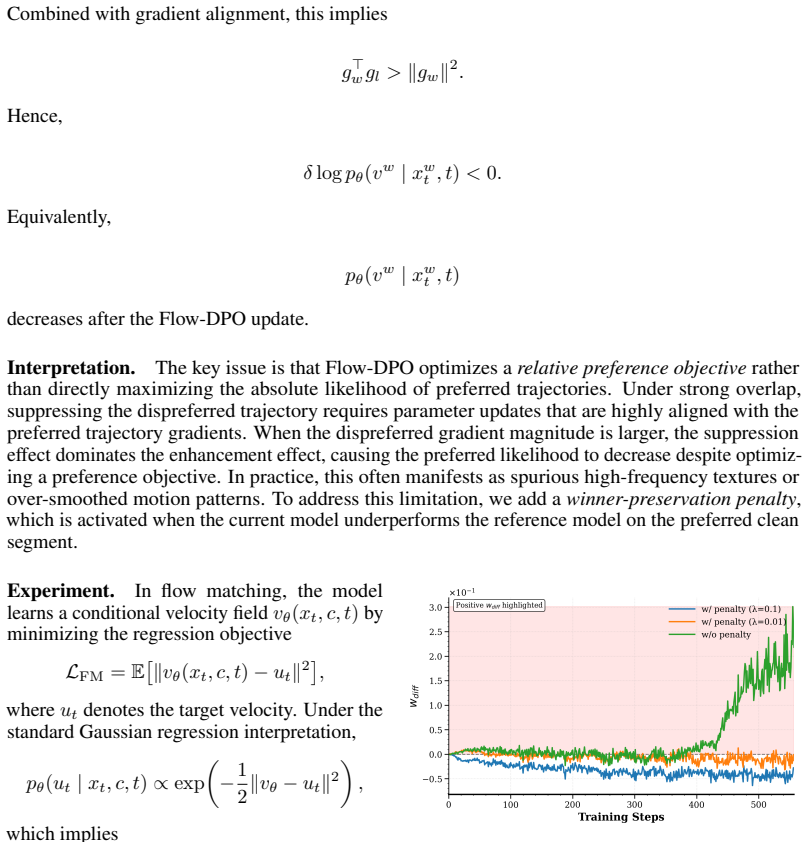
- A winner-preservation term on preferred clean segments is needed when preferred and dispreferred trajectories are similar, or preferred likelihood can fall during DPO.
Where Pith is reading between the lines
- The same reconstruction-error windowing idea could guide test-time compute: spend more denoising steps only on predicted hard segments.
- If latent MSE misses semantic failures, swapping the window score for a lightweight perceptual or motion metric would be a direct next experiment.
- Implicit rollout preferences may transfer to other sequential generators (audio, long-form video, world models) where errors accumulate over steps rather than pixels alone.
Editorial analysis
A structured set of objections, weighed in public.
Referee Report
Summary. The paper proposes concentrated Implicit Preference Optimization (cIPO), a post-training method for text-to-video diffusion models. It constructs implicit preference pairs by noising a real video latent and rolling out the policy’s reverse process, treating the clean latent as preferred and the reconstruction as dispreferred (Eqs. 1–3), with clean first-frame anchoring (Eq. 4). Preference optimization is then restricted to the contiguous latent window of highest average frame-wise MSE between preferred and anchored negative (Eqs. 5–8), and trained with a DPO-style objective plus a winner-preservation ReLU term (Eqs. 9–11; App. A). Experiments on MotionBench and WISA with Wan-VACE (LoRA) report gains over offline/online DPO and DenseDPO on Forensic-Chat, OmniAID-Dino, VBench axes, ablations of negative sources and concentration (Table 3), noise-start sensitivity (Fig. 6), and a six-criterion human majority-vote study (Table 4).
Significance. If the claims hold, cIPO offers a practical annotation- and reward-model-free route to video preference alignment that is explicitly rollout-aware and targets temporally sparse artifacts—an important and under-served failure mode relative to image DPO. Strengths include a clearly specified latent-space pipeline, rollout pseudocode (Alg. 1), a gradient-motivated winner-preservation regularizer with supporting analysis and a small diagnostic plot (App. A, Fig. 8), systematic ablations of negative construction and concentration (Table 3), and external metrics plus human votes rather than optimizing the leaderboard metric in a closed loop. The combination of online reconstruction negatives with contiguous high-error windows is a concrete, reusable design that could influence subsequent video preference work even if some design choices need tighter validation.
major comments (3)
- [§3.2 Eqs. (5)–(8); Table 3; §5] §3.2 Eqs. (5)–(8) and the central “temporal concentration” claim: d_τ is pure latent L2 and a* = argmax D(a) is never shown to select segments that humans (or external detectors) flag as flicker, motion collapse, or structural failure. Tables 1–3 and Table 4 only report end-to-end quality after training; Limitations §5 admits the proxy gap. Without a correlation study (high-D windows vs. human-marked bad segments) or a control that applies the same DPO budget to random or lowest-error windows of length K, the gains from “+ conc.” in Table 3 could reflect extra optimization focus or regularization rather than correct temporal credit assignment. This link is load-bearing for the paper’s second claimed contribution and should be tested before the concentration story is accepted.
- [§4.2 Tables 1–2; §4.4 Table 3] Tables 1–2 vs. the DPO (On, GT) baseline: the text argues that gains over online GT pairs (Forensic 0.830→0.876, OmniAID 0.486→0.524 on MotionBench) show benefit beyond “real video as positive.” That comparison still confounds reconstruction-based negatives, first-frame anchoring (Eq. 4), the winner-preservation term (Eq. 11), and concentration. A factorial or leave-one-component-out ablation that isolates concentration given fixed reconstruction negatives (and conversely) is needed to support the claim that temporally concentrated optimization, not the implicit pair construction alone, drives the reported authenticity lift.
- [§4.1; Table 3] §4.1 and Table 3: all main results use a single backbone (Wan-VACE), low resolution (240×416), and LoRA. Efficiency claims for reconstruction negatives (fewer denoise steps) are plausible but reported only as single-round sampling time, not full wall-clock or quality-matched training curves against DenseDPO/reward DPO under equal compute. At least one additional architecture or a higher-resolution sanity check, plus matched GPU-hour learning curves, would substantially strengthen external validity of the “consistently enhances” claim.
minor comments (6)
- [§4.1; Eq. (11)] Notation inconsistency: §4.1 states “We set Δ = 0.1 to perform regularization” while Eq. (11) uses λ for the ReLU coefficient; align symbol and state the value used in all tables.
- [Fig. 4; §3.2] Fig. 4 caption and body say the process is in latent space while illustrative frames are RGB; a brief note that d_τ is computed on VAE latents (not decoded pixels) would avoid ambiguity.
- [§2.1] Related work cites [15, 15, 16, …] with a duplicated reference number; clean the bibliography keys.
- [§3.2; Fig. 6] Window length K is a free parameter (Eq. 6) but no sensitivity or default is reported alongside the noise-start study in Fig. 6; a short K sweep belongs in the appendix.
- [Table 3] Table 3 “Temporal” slightly drops for Noise+conc. (0.966→0.961) while Overall rises; one sentence interpreting this trade-off would help readers.
- [Appendix B] Human study (App. B, Table 4): report number of samples, annotators, and agreement (e.g., Fleiss’ κ), not only majority-vote percentages.
Circularity Check
No circular derivation: cIPO is an algorithmic training design evaluated on external metrics, not a first-principles prediction forced by its inputs.
full rationale
The paper’s load-bearing chain is methodological, not predictive-by-construction. Implicit pairs are defined as real latent z0 versus the policy’s online noised-then-denoised reconstruction (Eqs. 1–3), and temporal concentration selects the contiguous window of highest frame-wise latent MSE (Eqs. 5–8). That design uses reconstruction error as a training proxy; it does not fit a parameter to the leaderboard metrics and then re-report those metrics as a forced “prediction.” The optimization objective is a DPO-style loss on diffusion reconstruction gaps (Eqs. 9–11), with an optional winner-preservation term motivated by a gradient analysis (Appendix A), not by circular self-definition of the claimed gains. Reported results (Tables 1–3, human majority votes in Table 4) use external authenticity and motion benchmarks (Forensic-Chat, OmniAID-Dino, VBench) and human criteria that are not identical to the latent-MSE window selector or the training loss. Related-work citations (Flow-DPO, DenseDPO, Smaug, etc.) supply baselines and a regularizer motif; none import a uniqueness theorem or ansatz that forces the central claim. The admitted proxy gap (Limitations §5)—that latent MSE may not equal perceptual failure—is a validity/correctness risk, not circularity: end-to-end improvements are still independently measured. No step reduces a claimed prediction to its fitted input by construction.
Axiom & Free-Parameter Ledger
free parameters (4)
- noise starting index s =
moderate (e.g. ~10–20 steps in analysis)
- temporal window length K
- preference sharpness β and winner-preservation λ =
Δ=0.1 (regularization); β unspecified numerically
- LoRA fine-tune hyperparameters =
lr=5e-6, resolution=240×416
axioms (5)
- domain assumption Standard reverse diffusion / flow matching training and DPO-style pairwise logistic preference loss transfer to video latents.
- ad hoc to paper Discrepancy between ideal denoising back to a real video and the policy’s actual multi-step rollout is a valid implicit preference signal (real ≻ reconstruction).
- ad hoc to paper Latent-frame MSE aggregates identify perceptually failure-prone contiguous segments better than uniform supervision.
- ad hoc to paper Clean first-frame anchoring of the negative latent reduces structure collapse without invalidating the preference pair.
- domain assumption External automatic metrics (Forensic-Chat, OmniAID-Dino, VBench) and majority-vote human criteria track the authenticity/temporal improvements claimed.
invented entities (2)
-
concentrated Implicit Preference Optimization (cIPO) pipeline
no independent evidence
-
implicit preference pair (y+=z0, y−=reconstruction from z_ts)
no independent evidence
read the original abstract
Recent advances in preference alignment for diffusion-based video generation, particularly via Direct Preference Optimization (DPO), have significantly improved visual quality. However, temporally sparse artifacts such as motion collapse, object flickering, and color oversaturation remain a major barrier to perceptual realism. Existing methods struggle with these issues due to two key limitations: (1) the preference attribution bottleneck, where offline human annotations are costly and fail to accurately capture learning dynamics, while online reward signals are rollout-aware but often unstable and biased; and (2) temporal credit misallocation, where uniformly applied supervision cannot effectively target the brief segments in which artifacts occur. To address these challenges, we propose concentrated Implicit Preference Optimization (cIPO), a post-training framework for video diffusion models. cIPO derives implicit preference signals directly from the denoising process: given a real video, the model adds forward noise and reconstructs it via iterative denoising, treating the original as the preferred sample and the reconstruction as the dispreferred one. This formulation captures inference-time errors without requiring human annotations or external reward models. Moreover, frame-level discrepancies between original and reconstructed videos reveal when failures occur. cIPO leverages this by computing temporal reconstruction errors and concentrating optimization on high-error segments, enabling more precise correction of failure-prone regions. Extensive experiments demonstrate that cIPO consistently enhances video authenticity and temporal coherence across multiple datasets, highlighting the effectiveness and efficiency of implicit preference with temporally concentrated optimization.
Figures


Reference graph
Works this paper leans on
-
[1]
Realdpo: Real or not real, that is the preference.arXiv preprint arXiv:2510.14955, 2025
Guo Cheng, Danni Yang, Ziqi Huang, Jianlou Si, Chenyang Si, and Ziwei Liu. Realdpo: Real or not real, that is the preference.arXiv preprint arXiv:2510.14955, 2025
arXiv 2025
-
[2]
Haoran Cheng, Qide Dong, Liang Peng, Zhizhou Sha, Weiguo Feng, Jinghui Xie, Zhao Song, Shilei Wen, Xiaofei He, and Boxi Wu. Discriminator-free direct preference optimization for video diffusion.arXiv preprint arXiv:2504.08542, 2025
Pith/arXiv arXiv 2025
-
[3]
Yuncheng Guo, Junyan Ye, Chenjue Zhang, Hengrui Kang, Haohuan Fu, Conghui He, and Weijia Li. Omniaid: Decoupling semantic and artifacts for universal ai-generated image detection in the wild.arXiv preprint arXiv:2511.08423, 2025
Pith/arXiv arXiv 2025
-
[4]
Motionbench: Benchmarking and improving fine-grained video motion understanding for vision language models
Wenyi Hong, Yean Cheng, Zhuoyi Yang, Weihan Wang, Lefan Wang, Xiaotao Gu, Shiyu Huang, Yuxiao Dong, and Jie Tang. Motionbench: Benchmarking and improving fine-grained video motion understanding for vision language models. InProceedings of the Computer Vision and Pattern Recognition Conference, pages 8450–8460, 2025
2025
-
[5]
Lora: Low-rank adaptation of large language models.Iclr, 1(2):3, 2022
Edward J Hu, Yelong Shen, Phillip Wallis, Zeyuan Allen-Zhu, Yuanzhi Li, Shean Wang, Liang Wang, Weizhu Chen, et al. Lora: Low-rank adaptation of large language models.Iclr, 1(2):3, 2022
2022
-
[6]
Vbench: Comprehensive benchmark suite for video generative models
Ziqi Huang, Yinan He, Jiashuo Yu, Fan Zhang, Chenyang Si, Yuming Jiang, Yuanhan Zhang, Tianxing Wu, Qingyang Jin, Nattapol Chanpaisit, et al. Vbench: Comprehensive benchmark suite for video generative models. InProceedings of the IEEE/CVF Conference on Computer Vision and Pattern Recognition, pages 21807–21818, 2024
2024
-
[7]
Zitong Huang, Kaidong Zhang, Yukang Ding, Chao Gao, Rui Ding, Ying Chen, and Wangmeng Zuo. Mind the generative details: Direct localized detail preference optimization for video diffusion models.arXiv preprint arXiv:2601.04068, 2026
Pith/arXiv arXiv 2026
-
[8]
Vace: All-in- one video creation and editing
Zeyinzi Jiang, Zhen Han, Chaojie Mao, Jingfeng Zhang, Yulin Pan, and Yu Liu. Vace: All-in- one video creation and editing. InProceedings of the IEEE/CVF International Conference on Computer Vision, pages 17191–17202, 2025
2025
-
[9]
Kaiqing Lin, Zhiyuan Yan, Ruoxin Chen, Junyan Ye, Ke-Yue Zhang, Yue Zhou, Peng Jin, Bin Li, Taiping Yao, and Shouhong Ding. Seeing before reasoning: A unified framework for generalizable and explainable fake image detection.arXiv preprint arXiv:2509.25502, 2025
arXiv 2025
-
[10]
Flow matching for generative modeling
Yaron Lipman, Ricky TQ Chen, Heli Ben-Hamu, Maximilian Nickel, and Matthew Le. Flow matching for generative modeling. InThe Eleventh International Conference on Learning Representations, 2022
2022
-
[11]
Improving video generation with human feedback
Jie Liu, Gongye Liu, Jiajun Liang, Ziyang Yuan, Xiaokun Liu, Mingwu Zheng, Xiele Wu, Qiulin Wang, Menghan Xia, Xintao Wang, et al. Improving video generation with human feedback. InThe Thirty-ninth Annual Conference on Neural Information Processing Systems, 2025
2025
-
[12]
Arka Pal, Deep Karkhanis, Samuel Dooley, Manley Roberts, Siddartha Naidu, and Colin White. Smaug: Fixing failure modes of preference optimisation with dpo-positive.arXiv preprint arXiv:2402.13228, 2024
Pith/arXiv arXiv 2024
-
[13]
Score-based generative modeling through stochastic differential equations
Yang Song, Jascha Sohl-Dickstein, Diederik P Kingma, Abhishek Kumar, Stefano Ermon, and Ben Poole. Score-based generative modeling through stochastic differential equations. In International Conference on Learning Representations, 2020
2020
-
[14]
Wisa: World simulator assistant for physics-aware text-to-video generation
Jing Wang, Ao Ma, Ke Cao, Jun Zheng, Jiasong Feng, Zhanjie Zhang, Wanyuan Pang, and Xiaodan Liang. Wisa: World simulator assistant for physics-aware text-to-video generation. In The Thirty-ninth Annual Conference on Neural Information Processing Systems, 2025
2025
-
[15]
Yibin Wang, Zhiyu Tan, Junyan Wang, Xiaomeng Yang, Cheng Jin, and Hao Li. Lift: Leveraging human feedback for text-to-video model alignment.arXiv preprint arXiv:2412.04814, 2024. 10
Pith/arXiv arXiv 2024
-
[16]
Yibin Wang, Yuhang Zang, Hao Li, Cheng Jin, and Jiaqi Wang. Unified reward model for multimodal understanding and generation.arXiv preprint arXiv:2503.05236, 2025
Pith/arXiv arXiv 2025
-
[17]
Densedpo: Fine-grained temporal preference optimization for video diffusion models
Ziyi Wu, Anil Kag, Ivan Skorokhodov, Willi Menapace, Ashkan Mirzaei, Igor Gilitschenski, Sergey Tulyakov, and Aliaksandr Siarohin. Densedpo: Fine-grained temporal preference optimization for video diffusion models. InThe Thirty-ninth Annual Conference on Neural Information Processing Systems, 2025
2025
-
[18]
Dlfr-vae: Dynamic latent frame rate vae for video generation
Zhihang Yuan, Siyuan Wang, Yuzhang Shang, Hanling Zhang, Tongcheng Fang, Rui Xie, Shengen Yan, Guohao Dai, and Yu Wang. Dlfr-vae: Dynamic latent frame rate vae for video generation. InProceedings of the 33rd ACM International Conference on Multimedia, pages 10388–10397, 2025
2025
-
[19]
Dlfr-gen: Diffusion-based video generation with dynamic latent frame rate
Zhihang Yuan, Rui Xie, Yuzhang Shang, Hanling Zhang, Siyuan Wang, Shengen Yan, Guohao Dai, and Yu Wang. Dlfr-gen: Diffusion-based video generation with dynamic latent frame rate. InProceedings of the IEEE/CVF International Conference on Computer Vision (ICCV), pages 16410–16419, October 2025
2025
-
[20]
Vgdfr: Diffusion-based video generation with dynamic latent frame rate
Zhihang Yuan, Rui Xie, Yuzhang Shang, Hanling Zhang, Siyuan Wang, Shengen Yan, Guohao Dai, and Yu Wang. Vgdfr: Diffusion-based video generation with dynamic latent frame rate. arXiv preprint arXiv:2504.12259, 2025
Pith/arXiv arXiv 2025
-
[21]
Onlinevpo: Align video diffusion model with online video-centric preference optimization
Jiacheng Zhang, Jie Wu, Weifeng Chen, Yatai Ji, Xuefeng Xiao, Weilin Huang, and Kai Han. Onlinevpo: Align video diffusion model with online video-centric preference optimization. arXiv preprint arXiv:2412.15159, 2024. A Analysis of Gradient Degeneration with Near-Identical Pairs The design of winner-preservation penalty is primarily motivated by a key fai...
arXiv 2024
discussion (0)
Sign in with ORCID, Apple, or X to comment. Anyone can read and Pith papers without signing in.