REVIEW 3 major objections 5 minor 50 references
Farmland segmentation fails when the current image lacks the evidence; an agent that queries extra time and space on demand is more stable.
Reviewed by Pith at T0; open to challenge. T0 means a machine referee read the full paper against a public rubric. the ladder, T0–T4 →
T0 review · grok-4.5
2026-07-31 15:16 UTC pith:2IK325ND
load-bearing objection Solid ag-RS agent paper with a real benchmark and clear end-to-end gains; the information-gain story is weaker than the leaderboard because ambiguity localization is only middling. the 3 major comments →
Think with Extra-Image: A Farmland Segmentation Agent Driven by Spatio-Temporal Information Gain
The pith
A machine-rendered reading of the paper's core claim, the machinery that carries it, and where it could break.
Core claim
When the current farmland image is incomplete, actively acquiring the missing extra-image evidence that maximizes task-relevant information gain—rather than fusing all available images or only refining inside the image—produces more stable high-resolution farmland masks across regions and under phenological and spatial ambiguity.
What carries the argument
Task-relevant information gain of a query: I(Y; E_q | X) = H(Y|X) − H(Y|X, E_q). FarmSeeker approximates choosing the query with largest gain via ambiguity perception, tool choice (temporal, spatial, or none), collaborative multi-image reasoning, and local mask refinement, trained progressively with task-driven rewards.
Load-bearing premise
The agent must correctly find ambiguous regions and pick the right kind of extra image; if those boxes or tool choices are wrong, the new evidence may not fix the mask and can pass the error downstream.
What would settle it
On the highly ambiguous GSFS-Bench subset, if on-demand FarmSeeker failed to beat both the base single-image segmenter and predefined multi-temporal or spatial fusion on Recall and IoU—or if disabling ambiguity-driven querying erased the gain—the central claim would not hold.
If this is right
- Single-date high-res farmland maps should treat hard parcels as queryable cases, not only as harder pixels for a bigger backbone.
- Indiscriminate stacking of all temporal and spatial neighbors can hurt; matching evidence to the local information gap matters more than image count.
- GSFS-Bench enables measuring not only mask quality but ambiguity perception, tool calling, and multi-image reasoning across global agricultural regions.
- The same agent loop can sit on top of different base segmenters and still lift their masks, so the gain is not locked to one backbone.
- The approach fits offline mapping and omission-sensitive verification more than pure real-time single-pass inference, given the extra compute on ambiguous regions.
Where Pith is reading between the lines
- Other land-cover tasks with strong seasonality or edge truncation (flood mapping, crop type, field boundaries) may need the same on-demand extra-image loop rather than only multi-temporal fusion.
- Raising fine-grained ambiguity localization is the practical bottleneck: coarse boxes may still help, but tighter region models would likely multiply the value of each query.
- If evidence pools are incomplete or misaligned in production archives, the method’s advantage should shrink toward the base segmenter—deployment needs reliable temporal/spatial retrieval, not only a better reasoner.
Editorial analysis
A structured set of objections, weighed in public.
Referee Report
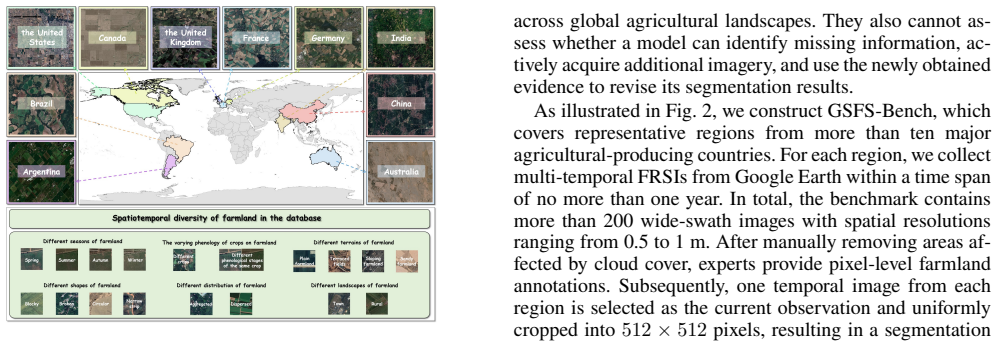
Summary. The paper argues that high-resolution farmland remote sensing segmentation is limited less by representation capacity than by incomplete single-image evidence, and reframes the task as on-demand acquisition of task-relevant extra spatio-temporal information (Eqs. 1–3). It introduces FarmSeeker, an MLLM agent that (i) produces an initial mask with a base segmenter, (ii) localizes ambiguous regions and chooses temporal/spatial/none queries, (iii) retrieves cropped extra-image evidence, and (iv) refines local masks via collaborative reasoning and SAM2. Training uses FM-Seg69K with progressive General FT → Cold-Start FT → GRPO RFT and task-driven rewards. Evaluation is on GSFS-Bench, a new global multi-temporal/spatial queryable FRSI benchmark. Empirically, FarmSeeker improves over strong intra-image baselines in- and cross-region (Table 1), and especially on a 649-sample highly ambiguous subset (Table 2: 83.45/78.62 vs SegEarth-R1 67.34/63.95 Recall/IoU), with ablations of training stages, rewards, and on-demand vs predefined MT/SW/ST acquisition.
Significance. If the results hold, the work is a solid systems and benchmark contribution for agricultural remote sensing: GSFS-Bench enables evaluation of dynamic querying that prior FRSI benchmarks lack, and the closed-loop agent shows consistent correction gains across multiple base segmenters (Table 5) plus stronger robustness under phenological and FOV ambiguity. The on-demand vs predefined fusion comparison (Table 2) is practically useful. Strengths include matched base training for baselines, in-/cross-region tables, progressive-training and reward ablations, multi-backbone generality, and public project page. The information-bottleneck framing is mainly motivational rather than a fitted theory, but the empirical package is substantial for the FRSI segmentation community.
major comments (3)
- [Framework Generality; Table 6; Supp. §4.1(4); Eqs. 1–3] The central paradigm claim is that gains come from identifying information gaps and selecting matching extra-image evidence (Eqs. 1–3; “Think with Extra-Image”). Table 6 and Supp. §4.1(4) report ambiguity-perception F1@0.5 = 60.23% and F1@0.75 = 16.69% (Precision 63.51%, Recall 58.03% at IoU 0.5), and the text notes localization errors can propagate to querying and refinement. Tool-calling (90.79%) and collaborative-reasoning (88.72%) accuracies are measured on matched/constructed regions and do not cover missed or mis-boxed gaps. Please add a load-bearing decomposition: (a) oracle ambiguous boxes + oracle tool type, (b) oracle boxes + predicted tools, (c) predicted boxes as deployed, and report end-to-end IoU/Recall on the full China set and the 649 ambiguous subset. Without this, the mechanism story remains under-anchored relative to the leaderboard claim.
- [Table 2; The Necessity of On-Demand Extra Spatio-Temporal Information Gain] Table 2 shows predefined multi-temporal (+MT) nearly matches FarmSeeker on the full China set (Recall 88.61 vs 88.63; IoU 83.70 vs 84.15), while the large gap appears mainly on the ambiguous subset (78.47/75.61 vs 83.45/78.62). This is compatible with “always fetch multi-temporal crops” explaining much of the average gain, with on-demand selection mattering chiefly in hard cases. Please quantify how often FarmSeeker issues temporal vs spatial vs none queries on China vs ambiguous splits, and report a controlled comparison of on-demand policy vs always-MT restricted to the same retrieved crops/budget so the incremental value of ambiguity-aware selection is isolated from simply having extra temporal images.
- [Supp. §2.1 GSFS-Bench Ambiguity Perception Subset; Table 5] Ambiguity-perception supervision is built from multi-base-model voting (≥3 models wrong, bbox area and ≥30% error filters; Supp. §2.1). That construction correlates labels with failures of the same model family later used as Tp, raising a mild circularity risk for the “ambiguity” notion and for claimed generalization of the RE. Please report (i) agreement of vote-based boxes with independent human ambiguity annotations on a held-out sample, and (ii) whether RE detections transfer when Tp is swapped (as in Table 5) without redefining the ambiguity GT from the new base model’s errors.
minor comments (5)
- [Why Extra-Image…; Eqs. 1–3] Eqs. 1–3 define an ideal query objective that the paper correctly says is not directly optimized. State earlier (Introduction or FarmSeeker Overview) that I(Y;Eq|X) is explanatory and that the learned policy is a supervised/RL proxy, to avoid readers treating q* as an implemented estimator.
- [Abstract; Introduction] Several in-line spacing artifacts appear throughout (“fromaninformationbottleneck”, “spatio-temporalinformationgain”, “ThinkwithIntra-Image”). Clean typesetting before revision.
- [Table 1; Experiments] Table 1 highlights best/second-best but does not report variance or multiple seeds; even a short note on run-to-run stability for FarmSeeker (RFT sampling) would help.
- [Table 7] Inference cost (~23.9 s/image vs 0.3 s for SegEarth-R1, Table 7) is acknowledged; a brief breakdown (ambiguity RE vs query I/O vs SAM2) would clarify optimization targets for offline mapping use cases.
- [GSFS-Bench; Conclusion] Clarify whether GSFS-Bench evidence pools and query APIs will be fully released with the project page, since the benchmark’s value depends on reproducible querying.
Circularity Check
No load-bearing circularity: IB Eqs. 1–3 are explanatory framing (explicitly not optimized), and end-to-end gains are measured against expert GT on GSFS-Bench via standard supervised/RL training.
specific steps
-
other
[Supp. §2.1(2) Ambiguity Perception Subset; main text Table 6 / Supp. §4.1(4)]
"We construct reference ambiguous regions from the complete China subset using a multi-base-model voting mechanism. Specifically, multiple farmland segmentation models are first employed to generate prediction masks, and connected regions jointly mis-segmented by at least three models are identified as candidate ambiguous regions."
Ambiguity-box labels used to train/score the RE are derived from errors of models in the same segmentation family, so intermediate F1@0.5 (60.23%) is partly self-referential to that construction. This is weak label circularity for an auxiliary capability metric only; it does not force the main IoU/Recall leaderboard results, which are scored against independent expert farmland masks.
full rationale
FarmSeeker is an empirical agent/systems paper, not a first-principles derivation that claims to compute a unique physical or information-theoretic quantity from axioms. The information-bottleneck rewrite (I(Y;X,Eq)=I(Y;X)+I(Y;Eq|X); q*=argmax I(Y;Eq|X)) is presented as motivation and an ideal query objective; the paper states outright that Eq. (3) is not a directly computable training target and is only implicitly approximated by a learned policy under task supervision and outcome rewards. Training (General FT → Cold-Start FT → GRPO RFT) uses structured trajectories and rule/LLM-judge rewards for format, box matching, tool type, and regional label accuracy—standard post-training, not fitting a parameter on a quantity and then reporting that same quantity as a prediction. Final claims rest on Recall/IoU versus expert pixel masks on GSFS-Bench and ablations against predefined MT/SW/ST fusion and alternate base segmenters; those metrics are not algebraically identical to the reward terms or to the IB expressions. Self-citations (e.g., FarmSeg-VL, FSVLM, SegEarth-R1 as base tool) supply data or components, not a uniqueness theorem that forces the headline result. Mild non-load-bearing concern: ambiguity-perception training/eval boxes are partly built by multi-base-model voting and collaborative-reasoning rewards use a frozen LLM judge—label-construction choices that can bias intermediate RE metrics, but they do not make end-to-end IoU equal the training objective by construction. Score 1 reflects that minor label-construction entanglement only.
Axiom & Free-Parameter Ledger
free parameters (3)
- GRPO / RFT hyperparameters (lr 5e-6, group size 6, KL 0.05, temp 1.0, top-p 0.9) =
lr=5e-6, group=6, KL=0.05
- Ambiguity candidate filters (bbox area 1e3–1e5 px, ≥30% erroneous pixels, ≥3-model vote) =
area 1000–100000; err ratio ≥30%; vote ≥3
- Reward aggregation weights (unweighted sum of format/recall/efficiency/tool/ans/cot terms) =
uniform sum as in Eqs. 13–15
axioms (5)
- standard math Data processing inequality on Y→X→Z: intra-image transforms cannot create I(Z;Y) beyond I(X;Y).
- domain assumption Task-relevant gain decomposes as I(Y;X,Eq)=I(Y;X)+I(Y;Eq|X), and temporal vs spatial queries address distinct deficiencies.
- domain assumption At inference, multi-temporal and wide-swath evidence pools are available, cloud-cleaned, and accurately georegistered to the query tile.
- ad hoc to paper Regional collaborative decisions from the MLLM plus SAM2 box prompts can be fused into improved pixel masks without full re-segmentation.
- ad hoc to paper LLM-as-judge binary scores (consistency/grammar/trajectory) are a valid proxy for reasoning quality in RFT.
invented entities (3)
-
FarmSeeker agent (RE + Tp/Tq/Ts closed loop)
no independent evidence
-
GSFS-Bench (global queryable FRSI benchmark + ambiguity/tool/reasoning subsets)
no independent evidence
-
FM-Seg69K / progressive training + task-driven rewards (R_det, R_rea)
no independent evidence
read the original abstract
Existing farmland remote sensing image (FRSI) segmentation follows a "Think with Intra-Image" paradigm, assuming that the current image contains sufficient visual evidence for reliable segmentation. Yet farmland appearance varies with phenology and spatial context and is often confused with other land-cover, making instantaneous, local observations inadequate. Thus, segmentation ambiguity stems not only from limited model representation, but more fundamentally from the required spatio-temporal information lying beyond the current image. Based on this insight, we redefine FRSI segmentation from an information bottleneck perspective as a dynamic decision process driven by task-relevant extra spatio-temporal information gain. We further propose FarmSeeker, a dynamic FRSI segmentation agent that identifies ambiguous regions, reasons about their causes, and queries extra spatio-temporal information on demand for accurate segmentation. To evaluate FarmSeeker, we construct GSFS-Bench, the first global-scale, high-resolution FRSI segmentation benchmark that supports reasoning-querying. Experiments show that FarmSeeker achieves more stable segmentation performance than existing methods. The project is publicly available at: https://withoutocean.github.io/FarmSeeker/
Figures



Reference graph
Works this paper leans on
-
[1]
Communication, Simulation, and Intelligent Agents: Implications of Personal Intelligent Machines for Medical Education
Clancey, William J. Communication, Simulation, and Intelligent Agents: Implications of Personal Intelligent Machines for Medical Education. Proceedings of the Eighth International Joint Conference on Artificial Intelligence (IJCAI-83)
-
[2]
Classification Problem Solving
Clancey, William J. Classification Problem Solving. Proceedings of the Fourth National Conference on Artificial Intelligence
-
[3]
, title =
Robinson, Arthur L. , title =. 1980 , doi =. https://science.sciencemag.org/content/208/4447/1019.full.pdf , journal =
1980
-
[4]
New Ways to Make Microcircuits Smaller---Duplicate Entry
Robinson, Arthur L. New Ways to Make Microcircuits Smaller---Duplicate Entry. Science
-
[5]
Clancey and Glenn Rennels , abstract =
Diane Warner Hasling and William J. Clancey and Glenn Rennels , abstract =. Strategic explanations for a diagnostic consultation system , journal =. 1984 , issn =. doi:https://doi.org/10.1016/S0020-7373(84)80003-6 , url =
-
[6]
and Rennels, Glenn R
Hasling, Diane Warner and Clancey, William J. and Rennels, Glenn R. and Test, Thomas. Strategic Explanations in Consultation---Duplicate. The International Journal of Man-Machine Studies
-
[7]
Poligon: A System for Parallel Problem Solving
Rice, James. Poligon: A System for Parallel Problem Solving
-
[8]
Transfer of Rule-Based Expertise through a Tutorial Dialogue
Clancey, William J. Transfer of Rule-Based Expertise through a Tutorial Dialogue
-
[9]
The Engineering of Qualitative Models
Clancey, William J. The Engineering of Qualitative Models
-
[10]
2023 , eprint=
Attention Is All You Need , author=. 2023 , eprint=
2023
-
[11]
Pluto: The 'Other' Red Planet
NASA. Pluto: The 'Other' Red Planet
-
[12]
IEEE Geoscience and Remote Sensing Magazine , year=
A comprehensive review of agricultural parcel and boundary delineation from remote sensing images: Recent progress and future perspectives , author=. IEEE Geoscience and Remote Sensing Magazine , year=
-
[13]
Computers and Electronics in Agriculture , volume=
A comprehensive survey on segmentation-enabled precision agriculture: Methodologies, applications, and the road to agriculture 5.0 , author=. Computers and Electronics in Agriculture , volume=. 2026 , publisher=
2026
-
[14]
2026 , eprint=
Vision-Language Semantic Grounding for Multi-Domain Crop-Weed Segmentation , author=. 2026 , eprint=
2026
-
[15]
Advances in Neural Information Processing Systems , year =
Zhang, Zhiwei and Ye, Zi and Wen, Yibin and Yuan, Shuai and Fu, Haohuan and Huang, Jianxi and Zheng, Juepeng , title =. Advances in Neural Information Processing Systems , year =
-
[16]
Proceedings of the IEEE/CVF Conference on Computer Vision and Pattern Recognition , pages =
Zhu, Hao and Zhu, Yan and Xiao, Jiayu and Xiao, Tianxiang and Ma, Yike and Zhang, Yucheng and Dai, Feng , title =. Proceedings of the IEEE/CVF Conference on Computer Vision and Pattern Recognition , pages =
-
[17]
Proceedings of the IEEE/CVF Conference on Computer Vision and Pattern Recognition , pages =
Muhawenayo, Gedeon and Robinson, Caleb and Khanal, Subash and Fang, Zhanpei and Corley, Isaac and Wollam, Alexander and Gao, Tianyi and Strnad, Leonard and Avery, Ryan and Estes, Lyndon and T. Proceedings of the IEEE/CVF Conference on Computer Vision and Pattern Recognition , pages =
-
[18]
Journal of Remote Sensing , volume=
A global review of monitoring cropland abandonment using remote sensing: Temporal--spatial patterns, causes, ecological effects, and future prospects , author=. Journal of Remote Sensing , volume=. 2025 , publisher=
2025
-
[19]
IEEE Transactions on Geoscience and Remote Sensing , volume=
Joint Learning for Feature Reconstruction and Prediction in Agricultural Semantic Segmentation From Incomplete Satellite Image Time Series , author=. IEEE Transactions on Geoscience and Remote Sensing , volume=. 2025 , publisher=
2025
-
[20]
IEEE Transactions on Geoscience and Remote Sensing , volume=
A CNN-Transformer Hybrid Network With Boundary Guidance for Mapping Cropland Field Parcels From High-Resolution Remote Sensing Imagery , author=. IEEE Transactions on Geoscience and Remote Sensing , volume=. 2026 , publisher=
2026
-
[21]
Remote Sensing of Environment , volume=
Unveiling year-round cropland cover by soil-specific spectral unmixing of Landsat and Sentinel-2 time series , author=. Remote Sensing of Environment , volume=. 2025 , publisher=
2025
-
[22]
ISPRS Journal of Photogrammetry and Remote Sensing , volume=
A weakly supervised approach for large-scale agricultural parcel extraction from VHR imagery via foundation models and adaptive noise correction , author=. ISPRS Journal of Photogrammetry and Remote Sensing , volume=. 2026 , publisher=
2026
-
[23]
Mehmet Ozgur Turkoglu and Selene Ledain and Jeffrey Zweidler and Thomas Lauber and Helge Aasen , year=. T^. 2506.12885 , archivePrefix=
-
[24]
2025 , eprint=
Designing Domain-Specific Agents via Hierarchical Task Abstraction Mechanism , author=. 2025 , eprint=
2025
-
[25]
Proceedings of the AAAI Conference on Artificial Intelligence , volume =
Yao, Liang and Liu, Fan and Lu, Hongbo and Zhang, Chuanyi and Min, Rui and Xu, Shengxiang and Di, Shimin and Peng, Pai , title =. Proceedings of the AAAI Conference on Artificial Intelligence , volume =. 2026 , doi =
2026
-
[26]
arXiv preprint arXiv:2604.07765 , year =
Yao, Liang and Xu, Shengxiang and Liu, Fan and Zhang, Chuanyi and Yao, Bishun and Min, Rui and Li, Yongjun and Ouyang, Chaoqian and Di, Shimin and Zhang, Min-Ling , title =. arXiv preprint arXiv:2604.07765 , year =
-
[27]
The Fourteenth International Conference on Learning Representations , year=
DeepEyes: Incentivizing ''Thinking with Images'' via Reinforcement Learning , author=. The Fourteenth International Conference on Learning Representations , year=
-
[28]
Proceedings of the IEEE/CVF Conference on Computer Vision and Pattern Recognition , pages=
Zoomearth: Active perception for ultra-high-resolution geospatial vision-language tasks , author=. Proceedings of the IEEE/CVF Conference on Computer Vision and Pattern Recognition , pages=
-
[29]
Proceedings of the IEEE/CVF Conference on Computer Vision and Pattern Recognition , pages=
Asking like Socrates: Socrates helps VLMs understand remote sensing images , author=. Proceedings of the IEEE/CVF Conference on Computer Vision and Pattern Recognition , pages=
-
[30]
2000 , eprint=
The information bottleneck method , author=. 2000 , eprint=
2000
-
[31]
IEEE Transactions on Pattern Analysis and Machine Intelligence , volume=
A survey on information bottleneck , author=. IEEE Transactions on Pattern Analysis and Machine Intelligence , volume=. 2024 , publisher=
2024
-
[32]
Earth System Science Data , volume=
A large-scale image--text dataset benchmark for farmland segmentation , author=. Earth System Science Data , volume=. 2025 , publisher=
2025
-
[33]
2025 , eprint=
SegEarth-R1: Geospatial Pixel Reasoning via Large Language Model , author=. 2025 , eprint=
2025
-
[34]
2025 , eprint=
A Large-Scale Referring Remote Sensing Image Segmentation Dataset and Benchmark , author=. 2025 , eprint=
2025
-
[35]
2025 , eprint=
WeThink: Toward General-purpose Vision-Language Reasoning via Reinforcement Learning , author=. 2025 , eprint=
2025
-
[36]
IEEE transactions on geoscience and remote sensing , volume=
Rsvg: Exploring data and models for visual grounding on remote sensing data , author=. IEEE transactions on geoscience and remote sensing , volume=. 2023 , publisher=
2023
-
[37]
2026 , eprint=
ChemDFM-R: A Chemical Reasoning LLM Enhanced with Atomized Chemical Knowledge , author=. 2026 , eprint=
2026
-
[38]
Nature , volume=
DeepSeek-R1 incentivizes reasoning in LLMs through reinforcement learning , author=. Nature , volume=. 2025 , publisher=
2025
-
[39]
European conference on computer vision , pages=
End-to-end object detection with transformers , author=. European conference on computer vision , pages=. 2020 , organization=
2020
-
[40]
Proceedings of the European conference on computer vision (ECCV) , pages=
Encoder-decoder with atrous separable convolution for semantic image segmentation , author=. Proceedings of the European conference on computer vision (ECCV) , pages=
-
[41]
IEEE Transactions on Intelligent Transportation Systems , volume=
Deep dual-resolution networks for real-time and accurate semantic segmentation of traffic scenes , author=. IEEE Transactions on Intelligent Transportation Systems , volume=. 2022 , publisher=
2022
-
[42]
IEEE Transactions on Circuits and Systems for Video Technology , volume=
DSNet: A novel way to use atrous convolutions in semantic segmentation , author=. IEEE Transactions on Circuits and Systems for Video Technology , volume=. 2024 , publisher=
2024
-
[43]
IEEE Transactions on Geoscience and Remote Sensing , volume=
A comprehensive deep-learning framework for fine-grained farmland mapping from high-resolution images , author=. IEEE Transactions on Geoscience and Remote Sensing , volume=. 2024 , publisher=
2024
-
[44]
2024 , eprint=
LaSagnA: Language-based Segmentation Assistant for Complex Queries , author=. 2024 , eprint=
2024
-
[45]
Proceedings of the IEEE/CVF Conference on Computer Vision and Pattern Recognition , pages=
Pixellm: Pixel reasoning with large multimodal model , author=. Proceedings of the IEEE/CVF Conference on Computer Vision and Pattern Recognition , pages=
-
[46]
IEEE Transactions on Geoscience and Remote Sensing , volume=
FSVLM: A vision-language model for remote sensing farmland segmentation , author=. IEEE Transactions on Geoscience and Remote Sensing , volume=. 2025 , publisher=
2025
-
[47]
2024 , eprint=
Qwen2-VL: Enhancing Vision-Language Model's Perception of the World at Any Resolution , author=. 2024 , eprint=
2024
-
[48]
2024 , eprint=
SAM 2: Segment Anything in Images and Videos , author=. 2024 , eprint=
2024
-
[49]
Remote Sensing of Environment , volume=
AgriFM: A multi-source temporal remote sensing foundation model for Agriculture mapping , author=. Remote Sensing of Environment , volume=. 2026 , publisher=
2026
-
[50]
2025 , eprint=
Qwen2.5-VL Technical Report , author=. 2025 , eprint=
2025
discussion (0)
Sign in with ORCID, Apple, or X to comment. Anyone can read and Pith papers without signing in.