REVIEW 2 major objections 5 minor 84 references
Charge-to-spin conversion in epitaxial and polycrystalline Bi and Bi/Ag layers
T0 review · 2 major / 5 minor · reviewed 2026-07-31 · grok-4.5
Pith's one-line read Silver multiplies bismuth’s spin-orbit torque by more than ten by keeping the bismuth film intact, not by Rashba interface physics.
desk verdict Solid structure–torque map that largely settles the Bi/Ag controversy: Ag works as a diffusion barrier, not a Rashba engine. read the letter →
The pith
A machine-rendered reading of the paper's core claim, the machinery that carries it, and where it could break.
The reading
What carries the argument
Scanning polar MOKE magnetometry of the damping-like effective field, calibrated against the Oersted field and free of magnetothermal artifacts, correlated sample-by-sample with HAADF-STEM, EDX, XRD and ARPES that track whether Bi remains continuous, unalloyed and chemically intact.
What would settle it
Grow a Bi/Ag/FM stack in which Bi is demonstrably continuous and unalloyed, then deliberately destroy only the Bi bulk spin-Hall channel (for example by amorphization or extreme thinning while keeping the Bi/Ag interface) and check whether the large positive damping-like torque disappears; if it survives, the bulk-origin claim fails.
Extended reading notes
Core claim
Inserting an Ag spacer between epitaxial Bi(001) and FeCo or Ni raises the damping-like spin-orbit-torque efficiency by more than an order of magnitude to ~2×10⁵ (ℏ/2e) S/m. The gain comes from preserving the structural and chemical integrity of Bi, which is otherwise destroyed by direct contact with the ferromagnet; it is not produced by enhanced Rashba spin–orbit coupling at the Bi/Ag interface. Bulk spin-Hall generation in intact Bi therefore dominates, giving an effective Bi spin Hall angle of order 1.
Load-bearing premise
The claim that the large torque is bulk-dominated rests on the idea that a heavy oxygen dose mainly removes surface states while leaving bulk generation and spin transparency essentially intact—yet the same oxidation can also degrade interface transparency, so the residual signal is not a clean bulk-only number.
Editorial extensions
If this is right
- Bi-based SOT devices need a chemically inert, spin-transparent spacer (Ag works; Cu and Al do not) rather than direct FM contact.
- Literature scatter in Bi and Bi/Ag spin-to-charge efficiencies is largely explained by uncontrolled dewetting, alloying and oxidation, not by intrinsic material differences.
- Polycrystalline or rough Bi films deliver substantially lower torque than epitaxial Bi(001), so crystalline quality is a first-order design variable.
- An effective Bi spin Hall angle near 1 becomes a realistic target once structural integrity is secured, comparable to the best topological-insulator reports.
- Stacking order matters: depositing Bi on Ni can preserve integrity where depositing Ni on Bi does not.
Reading between the lines
- Any future claim of giant interfacial REE in Bi/Ag must first prove, with cross-sectional chemistry, that Bi has not simply been rescued from degradation.
- The same integrity-first logic likely applies to other low-melting, surfactant-prone spin-orbit metals (e.g., pure Sb or Bi-rich alloys) whose reported torques are equally scattered.
- If Ag’s only essential role is diffusion blocking, thinner or discontinuous Ag, or alternative inert barriers with still longer spin diffusion length, should recover the same bulk Bi torque.
- Harmonic Hall methods on Bi stacks will continue to mis-estimate damping-like torque unless magnetothermal and magnon backgrounds are independently subtracted or MOKE-style checks are added.
Signed reviews
Editorial analysis
A structured set of objections, weighed in public.
Referee Report
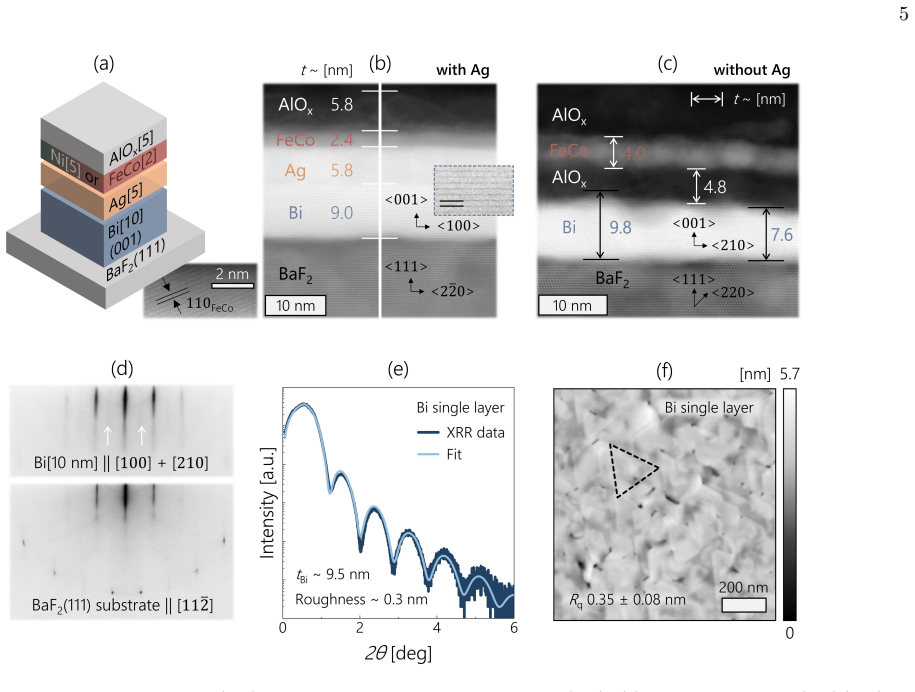
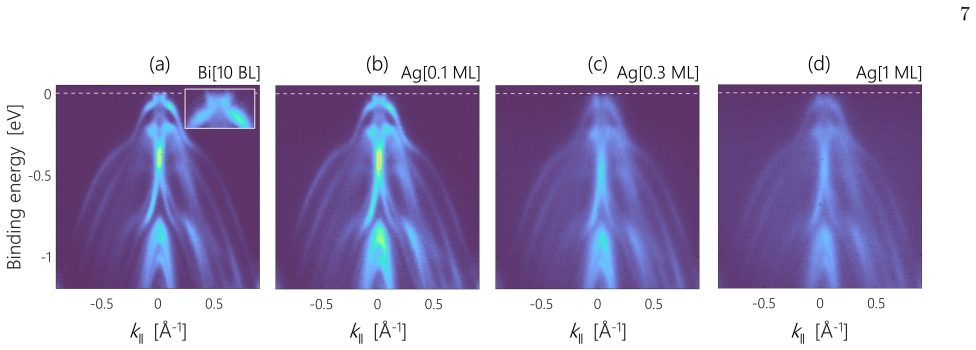
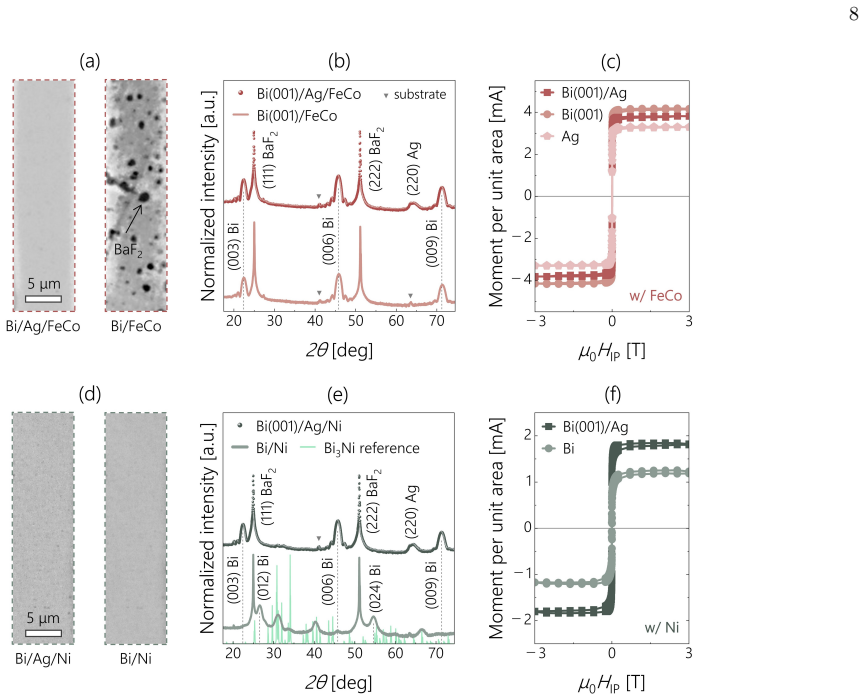
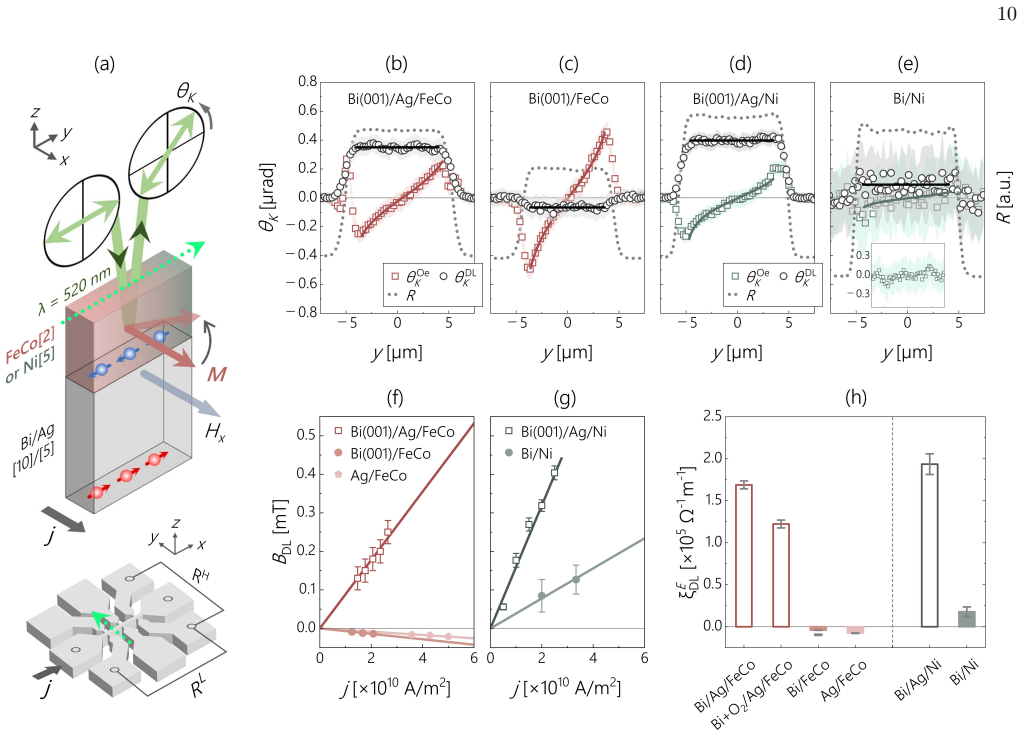
Summary. The manuscript investigates charge-to-spin conversion in epitaxial Bi(001), polycrystalline Bi, and Bi(012)-textured magnetic heterostructures, with and without Ag (and Cu/Al) spacers, using polar MOKE magnetometry of the damping-like SOT together with HAADF-STEM/EDX, XRD, RHEED, AFM, ARPES, SQUID, and harmonic Hall comparisons. The central claim is that inserting an Ag spacer between Bi(001) and FeCo or Ni raises the effective spin Hall conductivity by more than an order of magnitude to ≈(1.7–1.9)×10⁵ S/m, matching bulk Bi theory, because Ag preserves the structural and chemical integrity of Bi rather than because of a dominant Rashba–Edelstein contribution at Bi/Ag. Supporting strands include solid-state dewetting/oxidation/alloying without Ag, failure of Cu/Al spacers, a ~60% drop for polycrystalline Bi, ARPES showing no ordered BiAg₂ or enhanced Rashba splitting, residual torque after a 360 L O₂ dose that destroys Bi(001) surface states, and a sizable positive SOT in inverted Ni/Bi(012) that is unchanged by adding Ag on top. An effective Bi spin Hall angle of order 1 is extracted using the conductivity of a Bi single layer.
Significance. If the result holds, the work supplies a coherent structural explanation for the long-standing scatter in Bi and Bi/Ag spin–charge interconversion efficiencies and supplies concrete growth/design rules (Ag as a chemically inert, spin-transparent diffusion barrier; preference for epitaxial Bi integrity) for Bi-based SOT devices. Strengths include orthogonal probes on the same device set, E-field-normalized ξᴱ_DL that avoids dubious current partitioning, explicit comparison of MOKE versus harmonic Hall (including magnetothermal/magnonic artifacts), and ARPES that directly tests the BiAg₂ scenario. The correlation of atomic-scale integrity with torque magnitude is a clear advance over prior spin-pumping and THz studies that often lacked depth-sensitive structural characterization.
major comments (2)
- [Sec. III.D.2, IV.C] Sec. III.D.2 and IV.B–C: The 360 L O₂ experiment is presented as evidence for bulk-dominated generation (28% drop, residual ξᴱ_DL ≈ 1.22×10⁵ S/m). The manuscript correctly notes that oxidation can also reduce interface spin transparency, so the residual cannot cleanly partition surface versus bulk. For the SHA estimate ξ^{j}_Bi_DL = ξᴱ_DL/σ_Bi ≈ 0.78–1.2, please state more explicitly in the main text (not only SM/discussion) that σ_Bi is taken from a separate AlOₓ-capped Bi(001) single layer and that the quoted SHA is therefore an effective lower-bound figure of merit, not an intrinsic bulk SHA after interface transparency correction. A short sensitivity check (range of σ_Bi or parallel-resistor bounds) would make the claim robust without changing the integrity-not-Rashba conclusion.
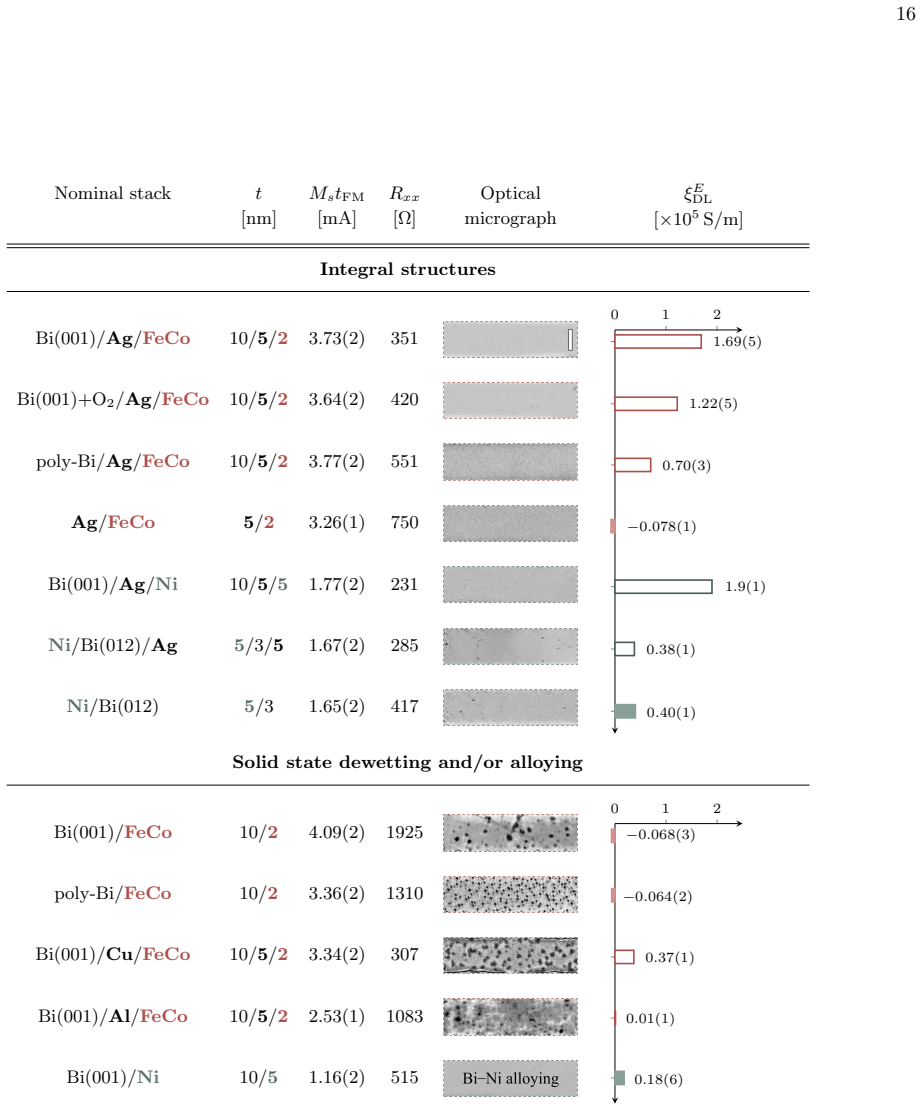
- [Sec. III.D, Figs. 4 and 6] Body text vs. figure numbering: In Sec. III.D the MOKE line scans, B_DL(j) plots, and ξᴱ_DL bar chart are repeatedly cited as “Figures 6(b–h)” and “Fig. 6”, yet the corresponding caption is FIG. 4 and the summary table is FIG. 6. This mis-citation makes the central SOT data hard to locate and must be corrected before publication; it is load-bearing for readability of the main result.
minor comments (5)
- [Abstract, Sec. IV.C, Sec. V] Abstract and Sec. V state an effective Bi spin Hall angle of “approximately 1”; Sec. IV.C gives both 1.2±0.2 (average of FeCo/Ni) and 0.78±0.03 (oxidized). Align the abstract wording with the more conservative oxidized lower bound or quote the range.
- [Fig. 6] Fig. 6 summary table: the optical micrographs are useful but low-resolution in the manuscript rendering; ensure final production quality so that pinholes versus continuous films remain distinguishable.
- [Sec. III.E.2] Sec. III.E.2: The statement that a spin diffusion length ≪ 3 nm in Bi(012) cannot be excluded is appropriate; a brief citation or estimate of λ_sf from related Bi literature would help the reader judge whether the null effect of the top Ag layer is expected.
- Typographical consistency: “Bi 0.9Sb0.1” vs “Bi0.9Sb0.1”, “¯h/2e” formatting, and occasional missing spaces before units appear in several places; a copy-edit pass is warranted.
- [Sec. III.D] Note 4 of the SM is cited for the MOKE–HHR discrepancy; a one-sentence quantitative summary (e.g., factor of misestimation) in the main text would help readers who do not open the SM.
Circularity Check
No significant circularity: experimental SOT efficiencies are measured and calibrated independently, not forced by fit or self-citation.
full rationale
This is a measurement-and-structure paper. Damping-like efficiencies ξ^E_DL are obtained from polar MOKE Kerr profiles whose magneto-optical constant is calibrated to the analytically known Oersted-field geometry (Biot–Savart), then combined with independently measured M_s t_FM and applied E; nothing in that chain is defined in terms of the claimed bulk Bi SHC or SHA. Structural integrity arguments rest on STEM/EDX, XRD, optical microscopy, and ARPES performed on the same stacks, not on a uniqueness theorem or ansatz imported from the authors. Comparison of the resulting ~2×10^5 (ℏ/2e) S/m and effective SHA≈1 to external bulk Bi theory (Guo; Şahin–Flatté; Qu–Tatara) and to prior Bi/Ag and BiSb reports is ordinary benchmarking. Self-citations (group MOKE methodology; prior Bi0.9Sb0.1 SOT work) supply technique and context only; they do not force the Bi/Ag integrity-not-Rashba conclusion. The O2-dose residual-torque argument is one supporting strand and is presented with its own caveats (possible spin-transparency loss), not as a definitional partition. No fitted parameter is renamed a prediction; no central claim reduces by construction to its inputs.
Assumptions & free parameters
free parameters (2)
- σ_Bi (electrical conductivity of Bi used for SHA) =
1.57×10⁵ S/m (ρ_Bi = 635 μΩ cm)
- Effective Ni thickness after Bi–Ni alloying =
t_Ni ≲ 3.3 nm (Ms); ~1.4 nm (AHE scaling)
assumptions (5)
- domain assumption Damping-like effective field B_DL = B_DL σ×m and polar MOKE first-harmonic isolation of out-of-plane tilts correctly quantify DL-SOT free of magnetothermal/magnon artifacts at the stated drive.
- domain assumption Oersted-field profile (Biot–Savart thin-strip formula) provides an absolute calibration of Kerr rotation to effective field identical for DL and Oe contributions.
- domain assumption Ag does not itself generate significant DL-SOT (negligible SHA), so large positive torque in Bi/Ag/FM is attributed to Bi (plus possible residual interface effects).
- ad hoc to paper Oxygen dose of 360 L destroys Bi(001) surface states (per prior ARPES) while leaving bulk Bi structurally intact enough that residual torque is bulk-dominated.
- domain assumption Theoretical bulk SHC of Bi is in the (0.9–2.1)×10⁵ (ℏ/2e) S/m range (Guo, Şahin–Flatté, Qu–Tatara).
Cite this review
Pith. "Pith review of Charge-to-spin conversion in epitaxial and polycrystalline Bi and Bi/Ag layers." pith.science (2026). https://pith.science/paper/K7L6CKFJ
@misc{pith2026260728310,
  author       = {Pith},
  title        = {Pith review of: Charge-to-spin conversion in epitaxial and polycrystalline Bi and Bi/Ag layers},
  year         = {2026},
  howpublished = {\url{https://pith.science/paper/K7L6CKFJ}},
  note         = {Machine review of arXiv:2607.28310}
}
abstract
Bi is predicted to be an efficient generator of spin-orbit torques (SOTs), with charge-to-spin conversion efficiency comparable to those of prototypical heavy metals, such as Ta, W, and Pt. However, experimental reports provide widely scattered interconversion efficiencies, while the origin of the large conversion signal in Bi/Ag bilayers remains controversial. Here, we investigate charge-to-spin conversion in epitaxial and polycrystalline Bi-based magnetic heterostructures by measuring the damping-like SOT using magneto-optic Kerr effect magnetometry, complemented by structural and spectroscopic analyses and harmonic Hall resistance measurements. We show that inserting an Ag spacer between Bi(001) and metallic ferromagnets (FeCo or Ni) enhances the SOT efficiency by more than one order of magnitude, reaching an effective spin Hall conductivity of approximately $2 \times 10^5 (\hbar/2e)$ S/m, in excellent agreement with theoretical expectations for bulk Bi. This enhancement can be consistently explained by the preservation of the structural and chemical integrity of Bi, otherwise compromised by the direct deposition of a ferromagnetic overlayer, rather than by Rashba spin-orbit coupling at the Bi/Ag interface. Comparative studies across epitaxial, polycrystalline, and intentionally surface-oxidized Bi films, beyond oxygen doses known to destroy Bi(001) surface states, reveal that structural disorder has a negative impact on the SOT efficiency and indicate a dominant bulk contribution to spin-current generation in Bi/Ag heterostructures, yielding an effective Bi spin Hall angle of approximately 1. By establishing a direct correlation between atomic-scale integrity and charge-to-spin conversion, this study provides design principles to improve the reliability of Bi-based SOT devices and offers a robust framework for interpreting spin-charge interconversion in Bi and Bi/Ag systems.
Figures
Figures from the paper (3 more)
Reference graph
Works this paper leans on
-
[1]
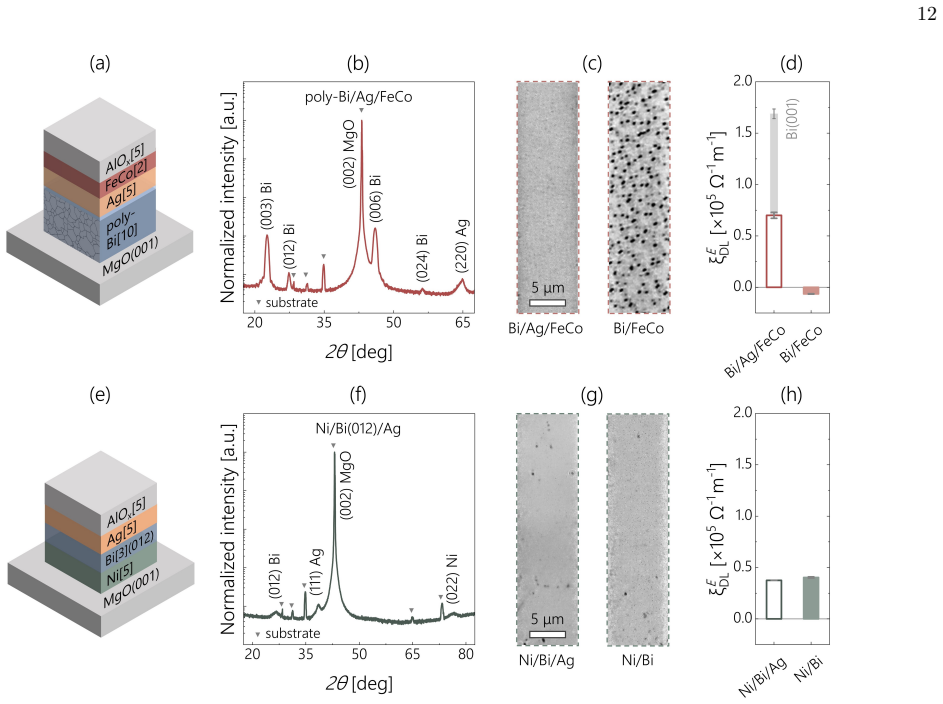
SOT efficiencies and comparison with literature Figures 6(f) and 6(g) show the estimated damping-like effective field as a function of the total current density for FeCo- and Ni-based samples, respectively. To compare the strength of the damping-like SOT across different samples, we quantified the damping-like SOT efficiency with respect to the electric f...
-
[2]
This experiment is inspired by ARPES measurements [ 53], which show that the surface state band of Bi(001) vanishes beyond an O 2 exposure of 4 .5 L
Influence of Bi surface oxidation To assess the role of the Bi/Ag interfacial quality in gen- erating and transmitting a spin current, we intentionally degraded the Bi(001) surface prior to Ag deposition by ex- posing it to an oxygen partial pressure of 1 .6 × 10−6 mbar for 5 min, corresponding to a total oxygen dose of 360 Langmuirs (L). This experiment ...
-
[3]
In both cases, similar to the scenario without any spacer, the Bi layer exhibits significant discontinuity {see Fig
Cu and Al spacers Notably, we find that replacing Ag with alternative metallic spacers, such as Cu or Al, does not preserve the structural integrity of the Bi(001) film. In both cases, similar to the scenario without any spacer, the Bi layer exhibits significant discontinuity {see Fig. S8(b) within the Supplemental Material [ 54]}. In Bi(001)/Cu/FeCo, EDX...
-
[4]
Poly-Bi/Ag/FeCo heterostructure In the former heterostructure − hereafter referred to as poly-Bi/Ag/FeCo − Bi grown on MgO(001) forms a polycrystalline film, composed of a mixture of (001) and (012)-oriented crystallites, as shown in the XRD θ/2θ scan in Fig. 5(b). Although the Ag(110) texture is re- tained, the Laue oscillations associated with the (003)...
-
[5]
Ni/Bi(012)/Ag heterostructure The XRD pattern of the second heterostruc- ture − hereafter referred to as Ni/Bi(012)/Ag − exhibits distinct reflections from the (022) crystal planes of Ni, the (012) planes of Bi, and the (111) planes of Ag, indicating that Bi is (012)-textured, as shown in Fig. 5(f). This crystallographic alignment between Bi(012) and Ag(1...
1925
-
[6]
Manchon, J
A. Manchon, J. ˇZelezn´ y, I. M. Miron, T. Jungwirth, J. Sinova, A. Thiaville, K. Garello, and P. Gambardella, Current-induced spin-orbit torques in ferromagnetic and antiferromagnetic systems, Rev. Mod. Phys.91, 035004 (2019)
2019
-
[7]
Krizakova, M
V. Krizakova, M. Perumkunnil, S. Couet, P. Gambardella, and K. Garello, Spin-orbit torque switching of magnetic tunnel junctions for memory applications, J. Magn. Magn. Mater.562, 169692 (2022)
2022
-
[8]
Sinova, S
J. Sinova, S. O. Valenzuela, J. Wunderlich, C. H. Back, and T. Jungwirth, Spin Hall effects, Rev. Mod. Phys.87, 1213 (2015)
2015
Show all 84 references
-
[9]
Bihlmayer, P
G. Bihlmayer, P. No¨ el, D. Vyalikh, E. V. Chulkov, and A. Manchon, Rashba-like physics in condensed matter, Nat. Rev. Phys.4, 642 (2022)
2022
-
[10]
Gambardella and I
P. Gambardella and I. M. Miron, Current-induced spin– orbit torques, Phil. Trans. R. Soc. A369, 3175 (2011)
2011
-
[11]
R. B. Atencia, A. Agarwal, and D. Culcer, Orbital angular momentum of Bloch electrons: equilibrium formulation, magneto-electric phenomena, and the orbital Hall effect, Adv. Phys.: X9, 2371972 (2024)
2024
-
[12]
D. Jo, D. Go, G.-M. Choi, and H.-W. Lee, Spintronics meets orbitronics: Emergence of orbital angular momen- tum in solids, npj Spintronics2, 19 (2024)
2024
-
[13]
Hofmann, The surfaces of bismuth: Structural and electronic properties, Prog
P. Hofmann, The surfaces of bismuth: Structural and electronic properties, Prog. Surf. Sci.81, 191 (2006)
2006
-
[14]
Guo, Anisotropic spin Hall and spin Nernst effects in bismuth semimetal, J
G.-Y. Guo, Anisotropic spin Hall and spin Nernst effects in bismuth semimetal, J. Magn. Magn. Mater.563, 169949 (2022)
2022
-
[15]
S ¸ahin and M
C. S ¸ahin and M. E. Flatt´ e, Tunable Giant Spin Hall Con- ductivities in a Strong Spin-Orbit Semimetal: Bi1−xSbx, Phys. Rev. Lett.114, 107201 (2015)
2015
-
[16]
Qu and G
G. Qu and G. Tatara, Intrinsic orbital and spin Hall effect in bismuth semimetal, Phys. Rev. B107, 214421 (2023)
2023
-
[17]
D. Hou, Z. Qiu, K. Harii, Y. Kajiwara, K. Uchida, Y. Fu- jikawa, H. Nakayama, T. Yoshino, T. An, K. Ando, X. Jin, and E. Saitoh, Interface induced inverse spin Hall effect in bismuth/permalloy bilayer, Appl. Phys. Lett.101, 042403 (2012)
2012
-
[18]
Emoto, Y
H. Emoto, Y. Ando, E. Shikoh, Y. Fuseya, T. Shinjo, and M. Shiraishi, Conversion of pure spin current to charge current in amorphous bismuth, J. Appl. Phys. 115, 17C507 (2014)
2014
-
[19]
Zhang, M
W. Zhang, M. B. Jungfleisch, W. Jiang, J. E. Pearson, and A. Hoffmann, Spin pumping and inverse Rashba- Edelstein effect in NiFe/Ag/Bi and NiFe/Ag/Sb, J. Appl. Phys.117, 17C727 (2015)
2015
-
[20]
Sangiao, J
S. Sangiao, J. M. De Teresa, L. Morellon, I. Lucas, M. C. Martinez-Velarte, and M. Viret, Control of the spin to charge conversion using the inverse Rashba-Edelstein ef- fect, Appl. Phys. Lett.106, 172403 (2015)
2015
-
[21]
Nomura, T
A. Nomura, T. Tashiro, H. Nakayama, and K. Ando, Tem- perature dependence of inverse Rashba-Edelstein effect at metallic interface, Appl. Phys. Lett.106, 212403 (2015)
2015
-
[22]
D. Yue, W. Lin, J. Li, X. Jin, and C. L. Chien, Spin-to- Charge Conversion in Bi Films and Bi/Ag Bilayers, Phys. Rev. Lett.121, 037201 (2018)
2018
-
[23]
Emoto, Y
H. Emoto, Y. Ando, G. Eguchi, R. Ohshima, E. Shikoh, Y. Fuseya, T. Shinjo, and M. Shiraishi, Transport and spin conversion of multicarriers in semimetal bismuth, Phys. Rev. B93, 174428 (2016)
2016
-
[24]
D. Yue, W. Lin, and C. L. Chien, Negligible spin–charge conversion in Bi films and Bi/Ag(Cu) bilayers, APL Mater. 9, 050904 (2021)
2021
-
[25]
Kim, H.-W
S. Kim, H.-W. Lee, and G.-M. Choi, Giant Spin-Orbit Torque in Sputter-Deposited Bi Films, Adv. Sci.10, 2303831 (2023)
2023
-
[26]
Z. Chi, G. Qu, Y.-C. Lau, M. Kawaguchi, J. Fujimoto, K. Takanashi, M. Ogata, and M. Hayashi, Spin Hall effect driven by the spin magnetic moment current in Dirac materials, Phys. Rev. B105, 214419 (2022)
2022
-
[27]
Chi, Y.-C
Z. Chi, Y.-C. Lau, X. Xu, T. Ohkubo, K. Hono, and M. Hayashi, The spin Hall effect of Bi-Sb alloys driven by thermally excited Dirac-like electrons, Sci. Adv.6, eaay2324 (2020)
2020
-
[28]
Binda, S
F. Binda, S. Fedel, S. F. Alvarado, P. No¨ el, and P. Gam- bardella, Spin–Orbit Torques and Spin Hall Magnetoresis- tance Generated by Twin-Free and Amorphous Bi 0.9Sb0.1 Topological Insulator Films, Adv. Mater.35, 2304905 (2023)
2023
-
[29]
Y. Ou, W. Y´ anez-Parre˜ no, Y.-S. Huang, S. Ghosh, C. S ¸ahin, M. Stanley, S. Santhosh, S. Islam, A. Richardella, K. A. Mkhoyan, M. E. Flatt´ e, and S. N., Spin Hall Conductivity in Bi 1–xSbx as an Experimental Test of Bulk-Boundary Correspondence, Nano Lett.25, 8775–8781 (2025)
2025
-
[30]
J. C. R. S´ anchez, L. Vila, G. Desfonds, S. Gambarelli, J. P. Attan´ e, J. M. D. Teresa, C. Mag´ en, and A. Fert, Spin-to-charge conversion using Rashba coupling at the interface between non-magnetic materials, Nat. Commun. 18 4, 2944 (2013)
2013
-
[31]
Liang, T
H.-L. Liang, T. C. Chuang, D. Qu, C. C. Chiang, M.-H. Lee, Y. S. Chen, J. G. Lin, M.-W. Chu, C. L. Chien, and S.-Y. Huang, Anisotropic spin-to-charge conversion in bismuth, Phys. Rev. B106, L201304 (2022)
2022
-
[32]
Fukumoto, R
N. Fukumoto, R. Ohshima, M. Aoki, Y. Fuseya, M. Mat- sushima, E. Shigematsu, T. Shinjo, Y. Ando, S. Sakamoto, M. Shiga, S. Miwa, and M. Shiraishi, Observation of large spin conversion anisotropy in bismuth, Proc. Natl. Acad. Sci. U.S.A.120, e2215030120 (2023)
2023
-
[33]
Marcano, S
N. Marcano, S. Sangiao, C. Mag´ en, L. Morell´ on, M. R. Ibarra, M. Plaza, L. P´ erez, and J. M. De Teresa, Role of the surface states in the magnetotransport properties of ultrathin bismuth films, Phys. Rev. B82, 125326 (2010)
2010
-
[34]
Zucchetti, M.-T
C. Zucchetti, M.-T. Dau, F. Bottegoni, C. Vergnaud, T. Guillet, A. Marty, C. Beign´ e, S. Gambarelli, A. Picone, A. Calloni, G. Bussetti, A. Brambilla, L. Du` o, F. Ciccacci, P. K. Das, J. Fujii, I. Vobornik, M. Finazzi, and M. Jamet, Tuning spin-charge interconversion with qu...
2018
-
[35]
H. J. Zhang, S. Yamamoto, B. Gu, H. Li, M. Maekawa, Y. Fukaya, and A. Kawasuso, Charge-to-Spin Conversion and Spin Diffusion in Bi/Ag Bilayers Observed by Spin- Polarized Positron Beam, Phys. Rev. Lett.114, 166602 (2015)
2015
-
[36]
M. B. Jungfleisch, W. Zhang, J. Sklenar, W. Jiang, J. E. Pearson, J. B. Ketterson, and A. Hoffmann, Interface- driven spin-torque ferromagnetic resonance by Rashba coupling at the interface between nonmagnetic materials, Phys. Rev. B93, 224419 (2016)
2016
-
[37]
Nakayama, Y
H. Nakayama, Y. Kanno, H. An, T. Tashiro, S. Haku, A. Nomura, and K. Ando, Rashba-Edelstein Magnetore- sistance in Metallic Heterostructures, Phys. Rev. Lett. 117, 116602 (2016)
2016
-
[38]
M. B. Jungfleisch, Q. Zhang, W. Zhang, J. E. Pearson, R. D. Schaller, H. Wen, and A. Hoffmann, Control of Terahertz Emission by Ultrafast Spin-Charge Current Conversion at Rashba Interfaces, Phys. Rev. Lett.120, 207207 (2018)
2018
-
[39]
C. Zhou, Y. P. Liu, Z. Wang, S. J. Ma, M. W. Jia, R. Q. Wu, L. Zhou, W. Zhang, M. K. Liu, Y. Z. Wu, and J. Qi, Broadband Terahertz Generation via the Interface Inverse Rashba-Edelstein Effect, Phys. Rev. Lett.121, 086801 (2018)
2018
-
[40]
Matsushima, Y
M. Matsushima, Y. Ando, S. Dushenko, R. Ohshima, R. Kumamoto, T. Shinjo, and M. Shiraishi, Quantitative investigation of the inverse Rashba-Edelstein effect in Bi/Ag and Ag/Bi on YIG, Appl. Phys. Lett.110, 072404 (2017)
2017
-
[41]
J. Shen, Z. Feng, P. Xu, D. Hou, Y. Gao, and X. Jin, Spin-to-Charge Conversion in Ag/Bi Bilayer Revisited, Phys. Rev. Lett.126, 197201 (2021)
2021
-
[42]
Cheng, B
J. Cheng, B. F. Miao, Z. Liu, M. Yang, K. He, Y. L. Zeng, H. Niu, X. Yang, Z. Q. Wang, X. H. Hong, S. J. Fu, L. Sun, Y. Liu, Y. Z. Wu, Z. Yuan, and H. F. Ding, Coherent Picture on the Pure Spin Transport between Ag/Bi and Ferromagnets, Phys. Rev. Lett.129, 097203 (2022)
2022
-
[43]
K. Ueda, Y. Hadate, K. Suzuki, and H. Asano, Fabrication of high-quality epitaxial Bi1-xSbx films by two-step growth using molecular beam epitaxy, Thin Solid Films713, 138361 (2020)
2020
-
[44]
S. K. Mahatha, P. M. Sheverdyaeva, C. Carbone, and P. Moras, Ag growth on the Ag 2Bi Rashba alloy, Surf. Sci.723, 122125 (2022)
2022
-
[45]
Binda, C
F. Binda, C. O. Avci, S. F. Alvarado, P. No¨ el, C.-H. Lam- bert, and P. Gambardella, Spin-orbit torques and mag- netotransport properties of α−Sn and β−Sn heterostruc- tures, Phys. Rev. B103, 224428 (2021)
2021
-
[46]
Niimi, Y
Y. Niimi, Y. Kawanishi, D. H. Wei, C. Deranlot, H. X. Yang, M. Chshiev, T. Valet, A. Fert, and Y. Otani, Giant Spin Hall Effect Induced by Skew Scattering from Bismuth Impurities inside Thin Film CuBi Alloys, Phys. Rev. Lett. 109, 156602 (2012)
2012
-
[47]
Vaughan, N
M. Vaughan, N. Satchell, M. Ali, C. J. Kinane, G. B. G. Stenning, S. Langridge, and G. Burnell, Origin of super- conductivity at nickel-bismuth interfaces, Phys. Rev. Res. 2, 013270 (2020)
2020
-
[48]
Kumari, S.-J
L. Kumari, S.-J. Lin, J.-H. Lin, Y.-R. Ma, P.-C. Lee, and Y. Liou, Effects of deposition temperature and thick- ness on the structural properties of thermal evaporated bismuth thin films, Appl. Surf. Sci.253, 5931 (2007)
2007
-
[49]
Wang, Y.-X
N. Wang, Y.-X. Dai, T.-L. Wang, H.-Z. Yang, and Y. Qi, Investigation of growth characteristics and semimetal- semiconductor transition of polycrystalline bismuth thin films, IUCrJ7, 49 (2020)
2020
-
[50]
Karbivskyy, V
V. Karbivskyy, V. Zaika, L. Karbivska, N. Kurgan, and N. Zueva, Structural and Physical Properties of Ultrathin Bismuth Films, Prog. Phys. Met.22, 539 (2021)
2021
-
[51]
Yaginuma, T
S. Yaginuma, T. Nagao, J. Sadowski, M. Saito, K. Na- gaoka, Y. Fujikawa, T. Sakurai, and T. Nakayama, Origin of flat morphology and high crystallinity of ultrathin bismuth films, Surf. Sci.601, 3593 (2007)
2007
-
[52]
Wansorra and W
C. Wansorra and W. Donner, Retarded solid state dewet- ting of thin bismuth films with oxide capping layer, J. Vac. Sci. Technol. A39, 043412 (2021)
2021
-
[53]
Kumar, M
K. Kumar, M. Kavuri, and P. Swaminathan, Effect of nanoparticles on the dewetting of bismuth films, Surf. Eng.37, 406 (2021)
2021
-
[54]
Wansorra, E
C. Wansorra, E. Bruder, and W. Donner, Atomistic view onto solid state dewetting: Thin bismuth films with and without strain gradient, Acta Mater.200, 455 (2020)
2020
-
[55]
E. S. Walker, S. Muschinske, C. J. Brennan, S. R. Na, T. Trivedi, S. D. March, Y. Sun, T. Yang, A. Yau, D. Jung, A. F. Briggs, E. M. Krivoy, M. L. Lee, K. M. Liechti, E. T. Yu, D. Akinwande, and S. R. Bank, Composition- dependent structural transition in epitaxial Bi1−xSbx thi...
2019
-
[56]
M. A. Khaled, L. Cancellara, S. Fekraoui, R. Daubriac, F. Bertran, C. Bigi, Q. Gravelier, R. Monflier, A. Arnoult, C. Durand, and S. R. Plissard, Large-Scale Epitaxial In- tegration of Single-Crystalline BiSb Topological Insulator on GaAs (111)A, ACS Appl. Electron. Mater.6, 3...
2024
-
[57]
No¨ el, E
P. No¨ el, E. Karadˇ za, R. Schlitz, P. Welter, C.-H. Lambert, L. Nessi, F. Binda, C. L. Degen, and P. Gambardella, Estimation of spin-orbit torques in the presence of current- induced magnon creation and annihilation, Phys. Rev. B 111, 144409 (2025)
2025
-
[58]
Z. Liu, Y. Chen, J. Analytis, S. Mo, D. Lu, R. Moore, I. Fisher, Z. Hussain, and Z. Shen, Robust topological surface state against direct surface contamination, Phys. E Low Dimens. Syst. Nanostruct.44, 891 (2012)
2012
-
[59]
See Supplemental Material at http://link.aps.org/supplemental/10.1103/ghsn-9thc for additional structural, magnetic, and SOT characteriza- 19 tion
-
[60]
X. Fan, H. Celik, J. Wu, C. Ni, K.-J. Lee, V. O. Lorenz, and J. Q. Xiao, Quantifying interface and bulk contri- butions to spin–orbit torque in magnetic bilayers, Nat. Commun.5, 3042 (2014)
2014
-
[61]
Montazeri, P
M. Montazeri, P. Upadhyaya, M. C. Onbasli, G. Yu, K. L. Wong, M. Lang, Y. Fan, X. Li, P. K. Amiri, R. N. Schwartz, C. A. Ross, and K. L. Wang, Magneto-optical investigation of spin–orbit torques in metallic and insu- lating magnetic heterostructures, Nat. Commun.6, 8958 (2015)
2015
-
[62]
Garello, I
K. Garello, I. M. Miron, C. O. Avci, F. Freimuth, Y. Mokrousov, S. Bl¨ ugel, S. Auffret, O. Boulle, G. Gaudin, and P. Gambardella, Symmetry and magnitude of spin– orbit torques in ferromagnetic heterostructures., Nat. Nan- otech.8, 587 (2013)
2013
-
[63]
T. J. Silva, C. S. Lee, T. M. Crawford, and C. T. Rogers, Inductive measurement of ultrafast magnetization dynam- ics in thin-film Permalloy, J. Appl. Phys.85, 7849 (1999)
1999
-
[64]
Hayashi, J
M. Hayashi, J. Kim, M. Yamanouchi, and H. Ohno, Quan- titative characterization of the spin-orbit torque using harmonic Hall voltage measurements, Phys. Rev. B89, 144425 (2014)
2014
-
[65]
Stamm, C
C. Stamm, C. Murer, M. Berritta, J. Feng, M. Gabureac, P. M. Oppeneer, and P. Gambardella, Magneto-Optical Detection of the Spin Hall Effect in Pt and W Thin Films, Phys. Rev. Lett.119, 087203 (2017)
2017
-
[66]
Y. M. Mos, A. C. Vermeulen, C. J. N. Buisman, and J. Weijma, X-Ray Diffraction of Iron Containing Samples: The Importance of a Suitable Configuration, Geomicrobiol. J.35, 511 (2018)
2018
-
[67]
C. R. Ast, J. Henk, A. Ernst, L. Moreschini, M. C. Falub, D. Pacil´ e, P. Bruno, K. Kern, and M. Grioni, Giant Spin Splitting through Surface Alloying, Phys. Rev. Lett.98, 186807 (2007)
2007
-
[68]
M. P. Seah and W. A. Dench, Quantitative electron spec- troscopy of surfaces: A standard data base for electron inelastic mean free paths in solids, Surf. Interface Anal. 1, 2 (1979)
1979
-
[69]
Hirahara, K
T. Hirahara, K. Miyamoto, I. Matsuda, T. Kadono, A. Kimura, T. Nagao, G. Bihlmayer, E. V. Chulkov, S. Qiao, K. Shimada, H. Namatame, M. Taniguchi, and S. Hasegawa, Direct observation of spin splitting in bis- muth surface states, Phys. Rev. B76, 153305 (2007)
2007
-
[70]
G. Bian, T. Miller, and T.-C. Chiang, Electronic struc- ture and surface-mediated metastability of Bi films on Si(111)-7 × 7 studied by angle-resolved photoemission spectroscopy, Phys. Rev. B80, 245407 (2009)
2009
-
[71]
J. M. D. Coey,Magnetism and Magnetic Materials(Cam- bridge University Press, Cambridge, 2010)
2010
-
[72]
C. O. Avci, K. Garello, M. Gabureac, A. Ghosh, A. Fuhrer, S. F. Alvarado, and P. Gambardella, Inter- play of spin-orbit torque and thermoelectric effects in ferromagnet/normal-metal bilayers, Phys. Rev. B90, 224427 (2014)
2014
-
[73]
No¨ el, R
P. No¨ el, R. Schlitz, E. Karadˇ za, C.-H. Lambert, L. Nessi, F. Binda, and P. Gambardella, Nonlinear Longitudi- nal and Transverse Magnetoresistances due to Current- Induced Magnon Creation-Annihilation Processes, Phys. Rev. Lett.134, 146701 (2025)
2025
-
[74]
Behnia and H
K. Behnia and H. Aubin, Nernst effect in metals and superconductors: a review of concepts and experiments, Rep. Prog. Phys.79, 046502 (2016)
2016
-
[75]
Niimi, H
Y. Niimi, H. Suzuki, Y. Kawanishi, Y. Omori, T. Valet, A. Fert, and Y. Otani, Extrinsic spin Hall effects measured with lateral spin valve structures, Phys. Rev. B89, 054401 (2014)
2014
-
[76]
Tatsuoka, M
K. Tatsuoka, M. Aoki, M. Funato, R. Ohshima, Y. Ando, and M. Shiraishi, Investigation of spin-orbit torque effi- ciency in CuBi alloys, Phys. Rev. B110, 094419 (2024)
2024
-
[77]
H. An, Y. Kageyama, Y. Kanno, N. Enishi, and K. Ando, Spin–torque generator engineered by natural oxidation of Cu, Nat. Commun.7, 13069 (2016)
2016
-
[78]
Idzuchi, Y
H. Idzuchi, Y. Fukuma, and Y. Otani, Spin transport in non-magnetic nano-structures induced by non-local spin injection, Physica E: Low-dimens. Syst. Nanostruct.68, 239 (2015)
2015
-
[79]
Tatsuoka, N
K. Tatsuoka, N. Fukumoto, S. Sakamoto, S. Miwa, Y. Fuseya, J. Fujimoto, R. Ohshima, J. Puebla, Y. Ando, and M. Shiraishi, Temperature dependence of charge-to- spin conversion in a rhombohedral (110) bismuth thin film, Phys. Rev. B113, 134422 (2026)
2026
-
[80]
Isshiki, P
H. Isshiki, P. Muduli, J. Kim, K. Kondou, and Y. Otani, Phenomenological model for the direct and inverse Edel- stein effects, Phys. Rev. B102, 184411 (2020)
2020
-
[81]
S. Xiao, D. Wei, and X. Jin, Bi(111) Thin Film with Insulating Interior but Metallic Surfaces, Phys. Rev. Lett. 109, 166805 (2012)
2012
-
[82]
Hirahara, T
T. Hirahara, T. Shirai, T. Hajiri, M. Matsunami, K. Tanaka, S. Kimura, S. Hasegawa, and K. Kobayashi, Role of Quantum and Surface-State Effects in the Bulk Fermi-Level Position of Ultrathin Bi Films, Phys. Rev. Lett.115, 106803 (2015)
2015
-
[83]
Bonell, M
F. Bonell, M. Goto, G. Sauthier, J. F. Sierra, A. I. Figueroa, M. V. Costache, S. Miwa, Y. Suzuki, and S. O. Valenzuela, Control of Spin–Orbit Torques by Interface Engineering in Topological Insulator Heterostructures, Nano Lett.20, 5893 (2020)
2020
-
[84]
F. Nasr, F. Binda, C.-H. Lambert, G. Sala, P. No¨ el, and P. Gambardella, Spin–orbit torques and magnetization switching in Gd/Fe multilayers generated by current in- jection in NiCu alloys, Appl. Phys. Lett.123, 262403 (2023)
2023
Reviewed July 31, 2026 · model on record in the stance chip above.
Discussion (0). Continue with ORCID to comment.