REVIEW 3 major objections 7 minor 53 references
Today’s pathology MLLMs name categories better than they ground, count, spatialize, or refuse when the view is insufficient.
Reviewed by Pith at T0; open to challenge. T0 means a machine referee read the full paper against a public rubric. the ladder, T0–T4 →
T0 review · grok-4.5
2026-07-31 11:23 UTC pith:XZIHKSAM
load-bearing objection Solid dual-FOV vision-anchored pathology benchmark with a clear empirical punch: models name categories better than they ground, count, spatialize, or refuse under insufficient FOV. the 3 major comments →
PathView-Bench: Can Multimodal Large Language Models Achieve Fine-grained Multiscale Understanding of Pathology Images?
The pith
A machine-rendered reading of the paper's core claim, the machinery that carries it, and where it could break.
Core claim
Even advanced general-purpose, medical-domain, and pathology-oriented MLLMs have substantial limits on fine-grained multiscale pathology vision: they are stronger at naming visual categories than at grounding, counting, spatially organizing evidence, or judging when the current field of view is insufficient, and correct high-level slide answers can mask those failures on the same slides.
What carries the argument
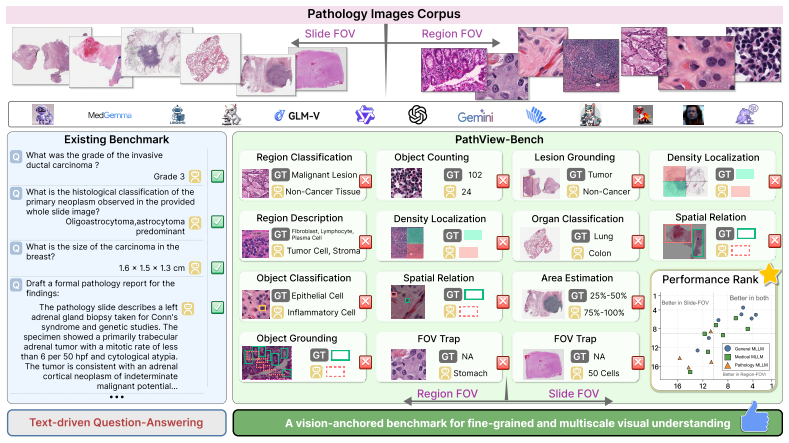
PathView-Bench: an auditable conversion of public human-supervised pathology labels and spatial annotations into dual-scale (Region-FOV / Slide-FOV) deterministic VQA targets with programmatic metrics, including FOV-trap insufficiency judgments.
Load-bearing premise
The paper assumes that rule-based conversion of messy public annotations into fixed boxes, counts, areas, quadrants, and “insufficient information” answers is a clean enough stand-in for the visual operations pathology reasoning actually needs.
What would settle it
If strong models, evaluated under the same frozen protocol, scored highly on grounding, counting, density/spatial tasks, and FOV traps—and still did so on slides where they already answer external whole-slide QA correctly—the claimed gap between high-level answers and basic multiscale visual understanding would not hold.
If this is right
- Pathology MLLM leaderboards that only score diagnoses, captions, or reports will overstate readiness for evidence-based use.
- Training and interfaces must preserve coordinate-level and multiscale spatial evidence, not only global slide semantics.
- Refusal behavior should be judged by whether it tracks observability at the current field of view, not by overall refusal rate.
- Structured annotation-derived targets are usable supervision: a PathView-tuned baseline improves grounding-sensitive behavior under the same protocol.
- Future clinical extensions can keep this vision core while adding workflow and longitudinal context around it.
Where Pith is reading between the lines
- Interactive whole-slide agents that claim to navigate and cite evidence will need the same grounding/counting/sufficiency checks, or they risk fluent but unanchored trajectories.
- Feature-only slide pipelines may systematically underperform pixel-coordinate tasks unless they regain explicit spatial binding.
- Benchmark designers in other multiscale imaging domains could reuse the FOV-trap idea: ask a question that is answerable only at the other scale and score calibrated insufficiency.
- If public-annotation conversion noise is non-trivial, hybrid expert audits on a stratified subset would be the direct way to bound how much of the measured gap is construction artifact.
Editorial analysis
A structured set of objections, weighed in public.
Referee Report
Summary. The manuscript introduces PathView-Bench, a vision-anchored VQA benchmark for fine-grained multiscale pathology understanding. From 23 public datasets with human labels and spatial annotations, the authors construct 14 deterministic tasks over Region-FOV and Slide-FOV (61,673 images; 308,070 samples; 28 organs), covering localization, recognition, counting, area/density estimation, spatial relation, and FOV-trap insufficiency judgment, scored with task-native metrics rather than LLM-as-judge. Zero-shot evaluation of 18 general, medical, and pathology MLLMs (Table 3), refusal/trap analysis (Figure 4), a matched-slide conditioning study against SlideBench/WSI-VQA success (Figure 5), and a PathView-tuned Qwen3-VL-8B baseline support the claim that current models are stronger at category naming than at grounding, quantification, spatial organization, or evidence-sufficiency judgment, and that correct high-level WSI QA does not reliably imply success on matched basic visual operations.
Significance. The work addresses a real and timely gap: pathology MLLM benchmarks largely score diagnostic answers, captions, or reports and can reward text priors without verifying multiscale visual grounding. Dual-FOV organization, FOV traps, programmatic annotation-derived targets, and the matched-slide analysis are concrete methodological contributions that make evidence-grounded failure modes measurable and comparable. Strengths include the scale and organ coverage of the resource, avoidance of LLM-as-judge scoring, explicit leakage-aware splitting, and a learnability check via the tuned baseline. If the conversion protocol is as clean as claimed, PathView-Bench is a useful standard for developing and auditing pathology MLLMs beyond answer plausibility.
major comments (3)
- [§3.2 Standardized Protocol] §3.2 (standardization, QC, and task construction): The central claim rests on rule-based conversion of heterogeneous public annotations into deterministic VQA targets (119→44 labels; 26 formats→boxes; area/count/quadrant/distance rules; FOV-trap labels). The protocol description and manual review of “representative” samples are reassuring but incomplete for a load-bearing assumption. Please report quantitative QC outcomes: fraction of records removed by each filter, unresolved-label rates, expert agreement or dual-review rate on the label map, and a small expert audit of answerability/observability on held-out converted items (especially Object Counting, Area Estimation, Density Localization, and FOV traps). Without these numbers, it remains hard to bound how much measured model failure is construction noise versus true visual deficit.
- [Table 3; §4.3 Main Results] Table 3 and §4.3: Several pathology-oriented systems (notably SlideChat and WSI-LLaVA) score at or near floor on many Region-FOV tasks (e.g., RCL/OCL/DLO/SPR = 0 for SlideChat). The text notes that feature-based WSI interfaces may discard pixel-level coordinates, but the main table still ranks these models alongside pixel-input MLLMs on grounding/counting metrics. This confounds interface mismatch with the claimed fine-grained understanding gap. Please either (i) restrict Region-FOV pixel tasks to models with native image/coordinate I/O and report WSI-feature models only on Slide-FOV tasks they support, or (ii) add an explicit “interface-inapplicable” mask and recompute category-level conclusions so the headline limitation is not inflated by unsupported input formats.
- [Figure 5; §4.3] Figure 5 / matched-slide analysis: The conditional result—that external WSI-QA success does not imply PathView visual competence on the same slides—is one of the paper’s strongest claims, but denominators are not stated. Report per-task and per-model counts of matched slides/questions retained after conditioning on external correctness, confidence intervals or variability across models, and how SlideBench vs WSI-VQA items were aligned to specific PathView tasks (LGD/ARE/DLO/OCL). If some bars rest on very small matched sets, the macro-average “correct high-level answers do not imply basic visual understanding” conclusion needs to be qualified.
minor comments (7)
- [Abstract / Title] Abstract in the submission header uses “PathVU” while the title and body use “PathView-Bench.” Harmonize the benchmark name everywhere.
- [Table 1] Table 1 column “All-WSI Source” and checkmarks are dense; a short footnote defining each binary column would improve readability.
- [§4.2 Implementation Details] §4.2: State clearly whether prompts, decoding settings, and coordinate post-processing scripts will be released with the benchmark splits so the 18-model comparison is fully reproducible.
- [Figure 4] Figure 4 refusal heatmap: define RFT/SFT in the main caption (they appear only briefly in the text) and state how “refusal” was detected across APIs versus open models.
- [Table 3] Object Counting MAE values span very different scales (best frozen ~16.8 vs random 482); consider also reporting normalized MAE or median absolute error so cross-model comparison is less dominated by heavy tails.
- [Figures 2 and 5] Minor typographical issues: “B enchmar k”, “T a sk”, and similar spaced tokens in Figure 2; “bo x” in Figure 5; ensure vector text is clean in the camera-ready figures.
- [§5 Limitations and Future Work] §5 Limitations appropriately scopes clinical claims; a one-sentence statement on intended data license/access for the assembled 23-source benchmark would help adopters.
Circularity Check
No significant circularity: PathView-Bench is an external empirical benchmark with annotation-derived targets and zero-shot model evaluation.
full rationale
This paper does not claim a first-principles derivation or a forced prediction from fitted parameters. Its load-bearing claims are empirical: frozen general/medical/pathology MLLMs are weak on grounding, counting, spatial organization, and FOV-sufficiency relative to category naming (Table 3, Fig. 4), and correct external WSI-QA answers on matched slides do not imply success on PathView visual operations (Fig. 5). Task targets are built by deterministic conversion of human-supervised labels and spatial annotations from 23 public datasets (§3.2), with programmatic metrics (Dice, accuracy, F1, MAE, entity recall, SRR)—not LLM-as-judge and not self-defined from model outputs. Train/val/test splits (7:1:2) with group-wise leakage control keep evaluation external to the models under test. The PathView-tuned Qwen3-VL-8B baseline is trained on the benchmark train split and reported only as evidence that the targets supply learnable grounding signal; it is not used to manufacture the main limitation claims about frozen models. No self-definitional loop, fitted-input-as-prediction, load-bearing self-citation uniqueness chain, or renaming of a known result as a derived law appears in the derivation chain. Score 0 is appropriate.
Axiom & Free-Parameter Ledger
free parameters (4)
- Train/val/test split ratio 7:1:2 =
7:1:2
- Area-estimation discretization bins =
4 intervals over effective tissue area
- QC and answerability filter thresholds =
dataset-specific predefined thresholds (not fully enumerated numerically)
- PathView-tuned baseline training hyperparameters =
1 epoch, batch 16, lr 5e-5, Qwen3-VL-8B LoRA
axioms (5)
- domain assumption Diagnostic pathology visual reasoning depends on both macro slide organization and high-resolution local morphology, so separate Slide-FOV and Region-FOV evaluations are necessary.
- domain assumption Human-supervised labels and spatial annotations in 23 public datasets, after expert vocabulary mapping to 44 standard labels and conversion of 26 annotation formats to boxes, are reliable enough supervision for scoring visual understanding.
- domain assumption If a target is not observable at the current field of view, the uniquely correct behavior is an insufficiency/refusal option rather than a guessed organ, count, or diagnosis.
- ad hoc to paper Task-native automatic metrics (Dice, accuracy, F1, MAE, entity recall, SRR) without LLM-as-judge are adequate to compare MLLM fine-grained visual competence.
- ad hoc to paper Grouping-key dataset splits sufficiently control leakage across related patches/slides/tasks.
invented entities (2)
-
PathView-Bench dual-FOV task suite (including FOV traps)
no independent evidence
-
44-label standardized pathology vocabulary
no independent evidence
read the original abstract
Multimodal large language models (MLLMs) are increasingly used to analyze pathology images. However, dominant multimodal benchmarks in pathology mainly score final diagnostic answers, captions, or reports. These evaluations provide limited insight into whether a model understands the multiscale visual content needed for pathology reasoning and decision-making. We introduce PathVU, a vision-anchored benchmark for fine-grained and multiscale visual understanding in computational pathology. Built from 23 public pathology imaging datasets with human-supervised labels and spatial annotations, PathVU evaluates MLLM understanding in two fields of view: Region FOV for high-resolution local regions and Slide FOV for macro whole-slide views. By converting raw annotations into deterministic task targets, PathVU enables programmatic scoring of region localization, visual recognition, quantity estimation, spatial reasoning, and insufficient-context judgment. The benchmark contains 14 VQA-style tasks, 61,673 images, and 308,070 samples across 28 organs and 7,253,526 annotations. Evaluating 18 representative general-purpose, medical-domain, and pathology-oriented MLLMs, we observe substantial limitations even in advanced models on fine-grained visual tasks across multiscale pathology images. PathVU provides a reproducible basis for developing and evaluating pathology MLLMs with explicit multiscale visual understanding.
Figures


Reference graph
Works this paper leans on
-
[1]
Image analysis and machine learning in digital pathology: Challenges and opportunities.Medical image analysis, 33:170–175, 2016
Anant Madabhushi and George Lee. Image analysis and machine learning in digital pathology: Challenges and opportunities.Medical image analysis, 33:170–175, 2016
2016
-
[2]
Digital pathology and artificial intelligence.The lancet oncology, 20(5):e253–e261, 2019
Muhammad Khalid Khan Niazi, Anil V Parwani, and Metin N Gurcan. Digital pathology and artificial intelligence.The lancet oncology, 20(5):e253–e261, 2019
2019
-
[3]
Clinical-grade computational pathology using weakly supervised deep learning on whole slide images.Nature medicine, 25(8):1301–1309, 2019
Gabriele Campanella, Matthew G Hanna, Luke Geneslaw, Allen Miraflor, Vitor Werneck Krauss Silva, Klaus J Busam, Edi Brogi, Victor E Reuter, David S Klimstra, and Thomas J Fuchs. Clinical-grade computational pathology using weakly supervised deep learning on whole slide images.Nature medicine, 25(8):1301–1309, 2019
2019
-
[4]
Data-efficient and weakly supervised computational pathology on whole-slide images.Nature biomedical engineering, 5(6):555–570, 2021
Ming Y Lu, Drew FK Williamson, Tiffany Y Chen, Richard J Chen, Matteo Barbieri, and Faisal Mahmood. Data-efficient and weakly supervised computational pathology on whole-slide images.Nature biomedical engineering, 5(6):555–570, 2021
2021
-
[5]
Feature re-embedding: Towards foundation model-level performance in computational pathology
Wenhao Tang, Fengtao Zhou, Sheng Huang, Xiang Zhu, Yi Zhang, and Bo Liu. Feature re-embedding: Towards foundation model-level performance in computational pathology. InProceedings of the IEEE/CVF conference on computer vision and pattern recognition, pages 11343–11352, 2024
2024
-
[6]
M4: Multi-proxy multi-gate mixture of experts network for multiple instance learning in histopathology image analysis.Medical Image Analysis, 103:103561, 2025
Junyu Li, Ye Zhang, Wen Shu, Xiaobing Feng, Yingchun Wang, Pengju Yan, Xiaolin Li, Chulin Sha, and Min He. M4: Multi-proxy multi-gate mixture of experts network for multiple instance learning in histopathology image analysis.Medical Image Analysis, 103:103561, 2025
2025
-
[7]
Smmile enables accurate spatial quantification in digital pathology using multiple-instance learning.Nature Cancer, pages 1–17, 2025
Zeyu Gao, Anyu Mao, Yuxing Dong, Hannah Clayton, Jialun Wu, Jiashuai Liu, ChunBao Wang, Kai He, Tieliang Gong, Chen Li, et al. Smmile enables accurate spatial quantification in digital pathology using multiple-instance learning.Nature Cancer, pages 1–17, 2025
2025
-
[8]
A pathology foundation model for cancer diagnosis and prognosis prediction.Nature, 634(8035):970–978, 2024
Xiyue Wang, Junhan Zhao, Eliana Marostica, Wei Yuan, Jietian Jin, Jiayu Zhang, Ruijiang Li, Hongping Tang, Kanran Wang, Yu Li, et al. A pathology foundation model for cancer diagnosis and prognosis prediction.Nature, 634(8035):970–978, 2024
2024
-
[9]
A vision–language foundation model for precision oncology.Nature, 638(8051):769–778, 2025
Jinxi Xiang, Xiyue Wang, Xiaoming Zhang, Yinghua Xi, Feyisope Eweje, Yijiang Chen, Yuchen Li, Colin Bergstrom, Matthew Gopaulchan, Ted Kim, et al. A vision–language foundation model for precision oncology.Nature, 638(8051):769–778, 2025
2025
-
[10]
A generalizable pathology foundation model using a unified knowledge distillation pretraining framework.Nature Biomedical Engineering, pages 1–20, 2025
Jiabo Ma, Zhengrui Guo, Fengtao Zhou, Yihui Wang, Yingxue Xu, Jinbang Li, Fang Yan, Yu Cai, Zhengjie Zhu, Cheng Jin, et al. A generalizable pathology foundation model using a unified knowledge distillation pretraining framework.Nature Biomedical Engineering, pages 1–20, 2025
2025
-
[11]
Pathasst: A generative foundation ai assistant towards artificial general intelligence of pathology
Yuxuan Sun, Chenglu Zhu, Sunyi Zheng, Kai Zhang, Lin Sun, Zhongyi Shui, Yunlong Zhang, Honglin Li, and Lin Yang. Pathasst: A generative foundation ai assistant towards artificial general intelligence of pathology. InProceedings of the AAAI Conference on Artificial Intelligence, volume 38, pages 5034–5042, 2024
2024
-
[12]
Quilt-llava: Visual instruction tuning by extracting localized narratives from open-source histopathology videos
Mehmet Saygin Seyfioglu, Wisdom O Ikezogwo, Fatemeh Ghezloo, Ranjay Krishna, and Linda Shapiro. Quilt-llava: Visual instruction tuning by extracting localized narratives from open-source histopathology videos. InProceedings of the IEEE/CVF Conference on Computer Vision and Pattern Recognition, pages 13183–13192, 2024
2024
-
[13]
Cpath-omni: A unified multimodal foundation model for patch and whole slide image analysis in computational pathology
Yuxuan Sun, Yixuan Si, Chenglu Zhu, Xuan Gong, Kai Zhang, Pingyi Chen, Ye Zhang, Zhongyi Shui, Tao Lin, and Lin Yang. Cpath-omni: A unified multimodal foundation model for patch and whole slide image analysis in computational pathology. InProceedings of the IEEE/CVF Conference on Computer Vision and Pattern Recognition, pages 10360–10371, 2025
2025
-
[14]
Patho-agenticrag: towards multimodal agentic retrieval-augmented generation for pathology vlms via reinforcement learning
Wenchuan Zhang, Jingru Guo, Hengzhe Zhang, Penghao Zhang, Jie Chen, Shuwan Zhang, Zhang Zhang, Yuhao Yi, and Hong Bu. Patho-agenticrag: towards multimodal agentic retrieval-augmented generation for pathology vlms via reinforcement learning. InProceedings of the AAAI Conference on Artificial Intelligence, volume 40, pages 29921–29929, 2026
2026
-
[15]
Wsicaption: Multiple instance generation of pathology reports for gigapixel whole-slide images
Pingyi Chen, Honglin Li, Chenglu Zhu, Sunyi Zheng, Zhongyi Shui, and Lin Yang. Wsicaption: Multiple instance generation of pathology reports for gigapixel whole-slide images. InInternational Conference on Medical Image Computing and Computer-Assisted Intervention, pages 546–556. Springer, 2024
2024
-
[16]
Histgen: Histopathol- ogy report generation via local-global feature encoding and cross-modal context interaction
Zhengrui Guo, Jiabo Ma, Yingxue Xu, Yihui Wang, Liansheng Wang, and Hao Chen. Histgen: Histopathol- ogy report generation via local-global feature encoding and cross-modal context interaction. InInterna- tional Conference on Medical Image Computing and Computer-Assisted Intervention, pages 189–199. Springer, 2024. 10
2024
-
[17]
Generating der- matopathology reports from gigapixel whole slide images with histogpt.Nature communications, 16(1): 4886, 2025
Manuel Tran, Paul Schmidle, Ruifeng Ray Guo, Sophia J Wagner, Valentin Koch, Valerio Lupperger, Brenna Novotny, Dennis H Murphree, Heather D Hardway, Marina D’Amato, et al. Generating der- matopathology reports from gigapixel whole slide images with histogpt.Nature communications, 16(1): 4886, 2025
2025
-
[18]
Rundong Wang, Wei Ba, Ying Zhou, Yingtai Li, Bowen Liu, Baizhi Wang, Yuhao Wang, Zhidong Yang, Kun Zhang, Rui Yan, et al. Qcagent: An agentic framework for quality-controllable pathology report generation from whole slide image.arXiv preprint arXiv:2603.01647, 2026
arXiv 2026
-
[19]
Slidechat: A large vision-language assistant for whole-slide pathology image understanding
Ying Chen, Guoan Wang, Yuanfeng Ji, Yanjun Li, Jin Ye, Tianbin Li, Ming Hu, Rongshan Yu, Yu Qiao, and Junjun He. Slidechat: A large vision-language assistant for whole-slide pathology image understanding. In Proceedings of the Computer Vision and Pattern Recognition Conference, pages 5134–5143, 2025
2025
-
[20]
Wsi-llava: A multimodal large language model for whole slide image
Yuci Liang, Xinheng Lyu, Wenting Chen, Meidan Ding, Jipeng Zhang, Xiangjian He, Song Wu, Xiaohan Xing, Sen Yang, Xiyue Wang, et al. Wsi-llava: A multimodal large language model for whole slide image. InProceedings of the IEEE/CVF International Conference on Computer Vision, pages 22718–22727, 2025
2025
-
[21]
Yuxuan Sun, Yixuan Si, Chenglu Zhu, Kai Zhang, Zhongyi Shui, Bowen Ding, Tao Lin, and Lin Yang. Cpathagent: An agent-based foundation model for interpretable high-resolution pathology image analysis mimicking pathologists’ diagnostic logic.arXiv preprint arXiv:2505.20510, 2025
arXiv 2025
-
[22]
Thomas A Buckley, Kian R Weihrauch, Katherine Latham, Andrew Z Zhou, Padmini A Manrai, and Arjun K Manrai. Navigating gigapixel pathology images with large multimodal models.arXiv preprint arXiv:2511.19652, 2025
Pith/arXiv arXiv 2025
-
[23]
Sheng Wang, Ruiming Wu, Charles Herndon, Yihang Liu, Shunsuke Koga, Jeanne Shen, and Zhi Huang. Pathology-cot: Learning visual chain-of-thought agent from expert whole slide image diagnosis behavior. arXiv preprint arXiv:2510.04587, 2025
arXiv 2025
-
[24]
Jingyun Chen, Linghan Cai, Zhikang Wang, Yi Huang, Songhan Jiang, Shenjin Huang, Hongpeng Wang, and Yongbing Zhang. Pathagent: Toward interpretable analysis of whole-slide pathology images via large language model-based agentic reasoning.arXiv preprint arXiv:2511.17052, 2025
arXiv 2025
-
[25]
Shengyi Hua, Jianfeng Wu, Tianle Shen, Kangzhe Hu, Zhongzhen Huang, Shujuan Ni, Zhihong Zhang, Yuan Li, Zhe Wang, and Xiaofan Zhang. Pathfound: An agentic multimodal model activating evidence- seeking pathological diagnosis.arXiv preprint arXiv:2512.23545, 2025
arXiv 2025
-
[26]
Patho-r1: A multimodal reinforcement learning-based pathology expert reasoner
Wenchuan Zhang, Penghao Zhang, Jingru Guo, Tao Cheng, Jie Chen, Shuwan Zhang, Zhang Zhang, Yuhao Yi, and Hong Bu. Patho-r1: A multimodal reinforcement learning-based pathology expert reasoner. In Proceedings of the AAAI Conference on Artificial Intelligence, volume 40, pages 28418–28426, 2026
2026
-
[27]
Songhan Jiang, Fengchun Liu, Ziyue Wang, Linghan Cai, and Yongbing Zhang. Pathreasoner-r1: Instilling structured reasoning into pathology vision-language model via knowledge-guided policy optimization. arXiv preprint arXiv:2601.21617, 2026
arXiv 2026
-
[28]
Xinheng Lyu, Yuci Liang, Wenting Chen, Meidan Ding, Jiaqi Yang, Guolin Huang, Daokun Zhang, Xiangjian He, and Linlin Shen. Wsi-agents: A collaborative multi-agent system for multi-modal whole slide image analysis.arXiv preprint arXiv:2507.14680, 2025
Pith/arXiv arXiv 2025
-
[29]
Xuehai He, Yichen Zhang, Luntian Mou, Eric Xing, and Pengtao Xie. Pathvqa: 30000+ questions for medical visual question answering.arXiv preprint arXiv:2003.10286, 2020
Pith/arXiv arXiv 2003
-
[30]
Pathmmu: A massive multimodal expert-level benchmark for understanding and reasoning in pathology
Yuxuan Sun, Hao Wu, Chenglu Zhu, Sunyi Zheng, Qizi Chen, Kai Zhang, Yunlong Zhang, Dan Wan, Xiaoxiao Lan, Mengyue Zheng, et al. Pathmmu: A massive multimodal expert-level benchmark for understanding and reasoning in pathology. InEuropean Conference on Computer Vision, pages 56–73. Springer, 2024
2024
-
[31]
Wsi-vqa: Interpreting whole slide images by generative visual question answering
Pingyi Chen, Chenglu Zhu, Sunyi Zheng, Honglin Li, and Lin Yang. Wsi-vqa: Interpreting whole slide images by generative visual question answering. InEuropean Conference on Computer Vision, pages 401–417. Springer, 2024
2024
-
[32]
Micro-bench: A microscopy benchmark for vision-language understanding.Advances in Neural Information Processing Systems, 37:30670–30685, 2024
Alejandro Lozano, Jeffrey Nirschl, James Burgess, Sanket R Gupte, Yuhui Zhang, Alyssa Unell, and Serena Yeung-Levy. Micro-bench: A microscopy benchmark for vision-language understanding.Advances in Neural Information Processing Systems, 37:30670–30685, 2024
2024
-
[33]
Pathbench: Advancing the benchmark of large multimodal models for pathology image understanding at patch and whole slide level.IEEE Transactions on Medical Imaging, 2025
Yuxuan Sun, Hao Wu, Chenglu Zhu, Yixuan Si, Qizi Chen, Yunlong Zhang, Kai Zhang, Jingxiong Li, Jiatong Cai, Yuhan Wang, et al. Pathbench: Advancing the benchmark of large multimodal models for pathology image understanding at patch and whole slide level.IEEE Transactions on Medical Imaging, 2025. 11
2025
-
[34]
Pathvg: A new benchmark and dataset for pathology visual grounding
Chunlin Zhong, Shuang Hao, Junhua Wu, Xiaona Chang, Jiwei Jiang, Xiu Nie, He Tang, and Xiang Bai. Pathvg: A new benchmark and dataset for pathology visual grounding. InInternational Conference on Medical Image Computing and Computer-Assisted Intervention, pages 454–463. Springer, 2025
2025
-
[35]
Quilt-1m: One million image-text pairs for histopathology.Advances in neural information processing systems, 36:37995–38017, 2023
Wisdom Ikezogwo, Saygin Seyfioglu, Fatemeh Ghezloo, Dylan Geva, Fatwir Sheikh Mohammed, Pa- van Kumar Anand, Ranjay Krishna, and Linda Shapiro. Quilt-1m: One million image-text pairs for histopathology.Advances in neural information processing systems, 36:37995–38017, 2023
2023
-
[36]
Pathgen-1.6 m: 1.6 million pathology image-text pairs generation through multi-agent collaboration
Yuxuan Sun, Yunlong Zhang, Yixuan Si, Chenglu Zhu, Kai Zhang, Zhongyi Shui, Jingxiong Li, Xuan Gong, Xinheng Lyu, Tao Lin, et al. Pathgen-1.6 m: 1.6 million pathology image-text pairs generation through multi-agent collaboration. InThe Thirteenth International Conference on Learning Representations, 2024
2024
-
[37]
Mirage the illusion of visual understanding.arXiv preprint arXiv:2603.21687, 2026
Mohammad Asadi, Jack W O’Sullivan, Fang Cao, Tahoura Nedaee, Kamyar Fardi, Fei-Fei Li, Ehsan Adeli, and Euan Ashley. Mirage the illusion of visual understanding.arXiv preprint arXiv:2603.21687, 2026
arXiv 2026
-
[38]
Gpt-4o system card.arXiv preprint arXiv:2410.21276, 2024
Aaron Hurst, Adam Lerer, Adam P Goucher, Adam Perelman, Aditya Ramesh, Aidan Clark, AJ Ostrow, Akila Welihinda, Alan Hayes, Alec Radford, et al. Gpt-4o system card.arXiv preprint arXiv:2410.21276, 2024
Pith/arXiv arXiv 2024
-
[39]
Qwen3-vl technical report.arXiv preprint arXiv:2511.21631, 2025
Shuai Bai, Yuxuan Cai, Ruizhe Chen, Keqin Chen, Xionghui Chen, Zesen Cheng, Lianghao Deng, Wei Ding, Chang Gao, Chunjiang Ge, et al. Qwen3-vl technical report.arXiv preprint arXiv:2511.21631, 2025
Pith/arXiv arXiv 2025
-
[40]
Gheorghe Comanici, Eric Bieber, Mike Schaekermann, Ice Pasupat, Noveen Sachdeva, Inderjit Dhillon, Marcel Blistein, Ori Ram, Dan Zhang, Evan Rosen, et al. Gemini 2.5: Pushing the frontier with ad- vanced reasoning, multimodality, long context, and next generation agentic capabilities.arXiv preprint arXiv:2507.06261, 2025
Pith/arXiv arXiv 2025
-
[41]
Med-flamingo: a multimodal medical few-shot learner
Michael Moor, Qian Huang, Shirley Wu, Michihiro Yasunaga, Yash Dalmia, Jure Leskovec, Cyril Zakka, Eduardo Pontes Reis, and Pranav Rajpurkar. Med-flamingo: a multimodal medical few-shot learner. In Machine learning for health (ML4H), pages 353–367. PMLR, 2023
2023
-
[42]
Llava-med: Training a large language-and-vision assistant for biomedicine in one day.Advances in Neural Information Processing Systems, 36:28541–28564, 2023
Chunyuan Li, Cliff Wong, Sheng Zhang, Naoto Usuyama, Haotian Liu, Jianwei Yang, Tristan Nau- mann, Hoifung Poon, and Jianfeng Gao. Llava-med: Training a large language-and-vision assistant for biomedicine in one day.Advances in Neural Information Processing Systems, 36:28541–28564, 2023
2023
-
[43]
Towards generalist biomedical ai.Nejm Ai, 1(3): AIoa2300138, 2024
Tao Tu, Shekoofeh Azizi, Danny Driess, Mike Schaekermann, Mohamed Amin, Pi-Chuan Chang, Andrew Carroll, Charles Lau, Ryutaro Tanno, Ira Ktena, et al. Towards generalist biomedical ai.Nejm Ai, 1(3): AIoa2300138, 2024
2024
-
[44]
Towards injecting medical visual knowledge into multimodal llms at scale
Junying Chen, Chi Gui, Ruyi Ouyang, Anningzhe Gao, Shunian Chen, Guiming Hardy Chen, Xidong Wang, Zhenyang Cai, Ke Ji, Xiang Wan, et al. Towards injecting medical visual knowledge into multimodal llms at scale. InProceedings of the 2024 conference on empirical methods in natural language processing, pages 7346–7370, 2024
2024
-
[45]
Weiwen Xu, Hou Pong Chan, Long Li, Mahani Aljunied, Ruifeng Yuan, Jianyu Wang, Chenghao Xiao, Guizhen Chen, Chaoqun Liu, Zhaodonghui Li, et al. Lingshu: A generalist foundation model for unified multimodal medical understanding and reasoning.arXiv preprint arXiv:2506.07044, 2025
Pith/arXiv arXiv 2025
-
[46]
Deep learning in histopathology: the path to the clinic.Nature medicine, 27(5):775–784, 2021
Jeroen Van der Laak, Geert Litjens, and Francesco Ciompi. Deep learning in histopathology: the path to the clinic.Nature medicine, 27(5):775–784, 2021
2021
-
[47]
Openai gpt-5 system card.arXiv preprint arXiv:2601.03267, 2025
Aaditya Singh, Adam Fry, Adam Perelman, Adam Tart, Adi Ganesh, Ahmed El-Kishky, Aidan McLaugh- lin, Aiden Low, AJ Ostrow, Akhila Ananthram, et al. Openai gpt-5 system card.arXiv preprint arXiv:2601.03267, 2025
Pith/arXiv arXiv 2025
-
[48]
Jinguo Zhu, Weiyun Wang, Zhe Chen, Zhaoyang Liu, Shenglong Ye, Lixin Gu, Hao Tian, Yuchen Duan, Weijie Su, Jie Shao, et al. Internvl3: Exploring advanced training and test-time recipes for open-source multimodal models.arXiv preprint arXiv:2504.10479, 2025
Pith/arXiv arXiv 2025
-
[49]
Weiyun Wang, Zhangwei Gao, Lixin Gu, Hengjun Pu, Long Cui, Xingguang Wei, Zhaoyang Liu, Linglin Jing, Shenglong Ye, Jie Shao, et al. Internvl3. 5: Advancing open-source multimodal models in versatility, reasoning, and efficiency.arXiv preprint arXiv:2508.18265, 2025
Pith/arXiv arXiv 2025
-
[50]
Wenyi Hong, Wenmeng Yu, Xiaotao Gu, Guo Wang, Guobing Gan, Haomiao Tang, Jiale Cheng, Ji Qi, Junhui Ji, Lihang Pan, et al. Glm-4.5 v and glm-4.1 v-thinking: Towards versatile multimodal reasoning with scalable reinforcement learning.arXiv preprint arXiv:2507.01006, 2025. 12
Pith/arXiv arXiv 2025
-
[51]
Andrew Sellergren, Sahar Kazemzadeh, Tiam Jaroensri, Atilla Kiraly, Madeleine Traverse, Timo Kohlberger, Shawn Xu, Fayaz Jamil, Cían Hughes, Charles Lau, et al. Medgemma technical report. arXiv preprint arXiv:2507.05201, 2025
Pith/arXiv arXiv 2025
-
[52]
Medgemma 1.5 technical report.arXiv preprint arXiv:2604.05081, 2026
Andrew Sellergren, Chufan Gao, Fereshteh Mahvar, Timo Kohlberger, Fayaz Jamil, Madeleine Traverse, Alberto Tono, Bashir Sadjad, Lin Yang, Charles Lau, et al. Medgemma 1.5 technical report.arXiv preprint arXiv:2604.05081, 2026
Pith/arXiv arXiv 2026
-
[53]
Swift: a scalable lightweight infrastructure for fine-tuning
Yuze Zhao, Jintao Huang, Jinghan Hu, Xingjun Wang, Yunlin Mao, Daoze Zhang, Zeyinzi Jiang, Zhikai Wu, Baole Ai, Ang Wang, et al. Swift: a scalable lightweight infrastructure for fine-tuning. InProceedings of the AAAI Conference on Artificial Intelligence, volume 39, pages 29733–29735, 2025. 13
2025
discussion (0)
Sign in with ORCID, Apple, or X to comment. Anyone can read and Pith papers without signing in.