REVIEW 3 major objections 6 minor 70 references
Segment-level thermal sensitivity analysis for exo-Earth coronagraphy with segmented space telescopes
T0 review · 3 major / 6 minor · reviewed 2026-07-31 · grok-4.5
Pith's one-line read Segment thermal tolerances for exo-Earth coronagraphs must be non-uniform, and outer segments loosen as segment count rises.
desk verdict Solid HWO-facing error-budget paper: real per-segment thermal maps and architecture trades from known tools, not a methods breakthrough. read the letter →
The pith
A machine-rendered reading of the paper's core claim, the machinery that carries it, and where it could break.
The reading
What carries the argument
The PASTIS contrast matrix (a quadratic map from segment-level thermal-mode amplitudes to average dark-hole contrast) inverted under equal contrast allocation for static µk, then scaled and fed as open-loop drift variance Q into a Cramér–Rao batch estimator that yields closed-loop residual variance and optimal wavefront-sensing exposure.
What would settle it
Run end-to-end Monte Carlo with a non-diagonal thermo-mechanical covariance that couples neighboring segments through the backplane; if the realized dark-hole contrast stability then systematically misses 10^-11 when the paper’s per-segment allocations are applied, the independence-based budget is wrong.
Extended reading notes
Core claim
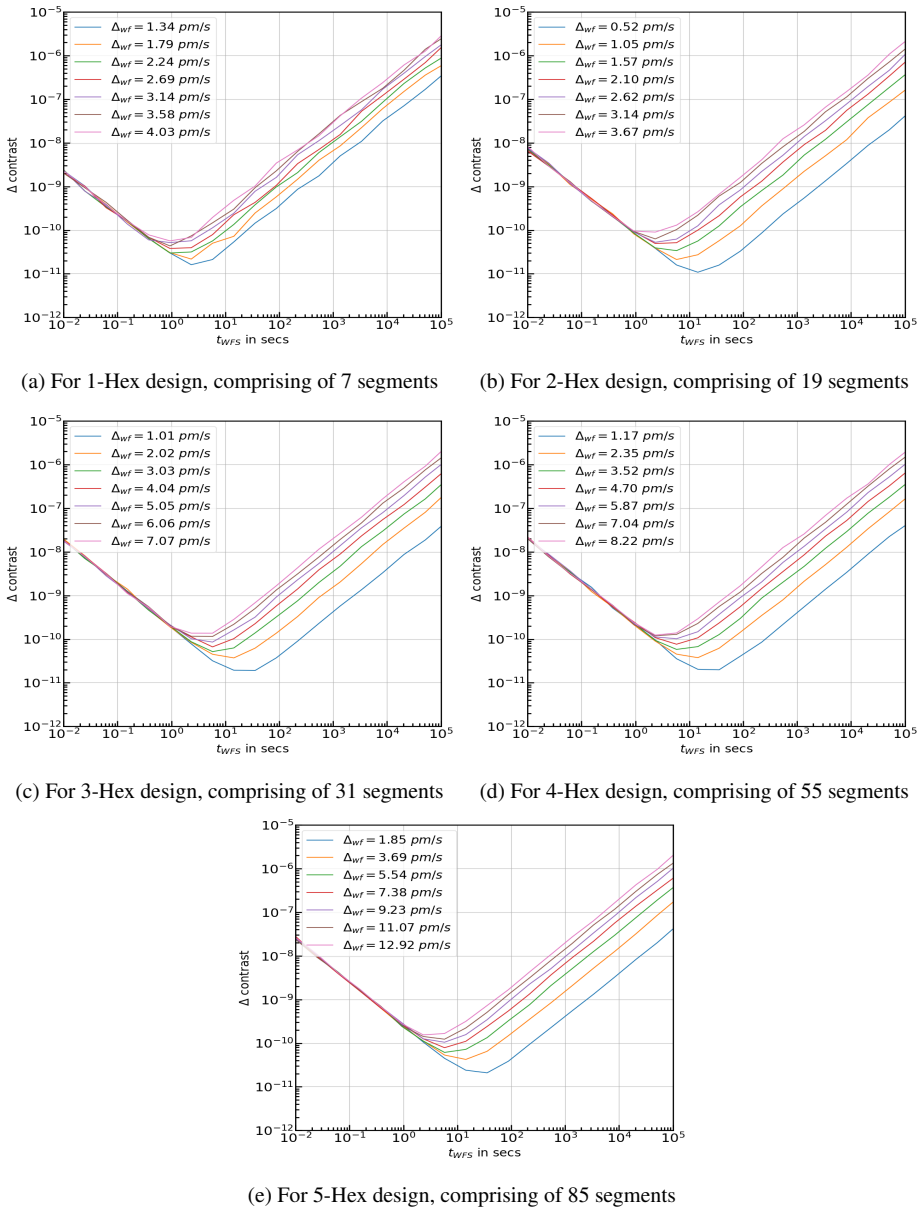
For the family of ~6 m off-axis hexagonal primary designs studied, the static and dynamic thermal tolerances needed to hold spatially averaged dark-hole contrast stability of 10^-11 are non-uniform across the pupil because of the apodizer, and with rising segment number the outer segments become less tightly constrained, with largest allowable open-loop drifts of order 1–2 pm/s and architecture-dependent optimal sensing times.
Load-bearing premise
Temperature-driven errors on different segments are treated as statistically independent for each thermal mode, so the contrast budget can be split segment by segment on a diagonal covariance.
Editorial extensions
If this is right
- Primary-mirror segment count and coronagraph apodizer must be co-designed; relaxing outer-ring thermo-mechanical requirements is a direct payoff of heavier outer apodization.
- Error budgets can quote ring-dependent mK and pm/s numbers rather than a single telescope-wide thermal floor.
- Larger individual segments buy shorter optimal wavefront-sensing times at the cost of tighter per-segment static limits.
- Closed-loop control can be used to populate frequency-binned contrast tables (static below ~0.01 Hz, drift-scaled above) for mission thermal-control specs.
Reading between the lines
- If real pad-heating modes are strongly spatially correlated, the next practical step is an eigenmode PASTIS budget on the full covariance rather than per-segment diagonals.
- The same static-to-dynamic pipeline could be re-run for pie-wedge or keystone segmentations once matching finite-element thermal maps exist.
- Architectures that push more light blockage to the outer rings may buy cheaper outer-segment thermal control at the expense of throughput, a trade the paper’s maps already quantify.
Editorial analysis
A structured set of objections, weighed in public.
Referee Report
Summary. The manuscript derives segment-level static and dynamic thermal stability requirements for off-axis ~6 m segmented primary mirrors with SCDA APLC designs, targeting a spatially averaged dark-hole contrast stability of 10^-11. Using L3Harris finite-element models of picometer-scale surface response to 1 mK pad heating as the aberration basis, the authors build PASTIS contrast sensitivity matrices and invert them (Eq. 12) under equal contrast allocation and diagonal segment covariance to obtain non-uniform static surface and temperature tolerances. They then scale those maps into open-loop drift variances and apply the Pogorelyuk et al. batch-estimation / Cramér–Rao procedure to bound closed-loop residuals and optimal wavefront-sensing times. The main empirical results are apodization-driven non-uniform tolerances (outer rings looser), progressive outer-segment relaxation with more/smaller segments, and largest allowable open-loop drifts of order ~1–2 pm/s with architecture-dependent optimal WFS times (e.g. ~40 s for 5-Hex), plus an illustrative contrast error-budget table for the 5-Hex case.
Significance. This is a useful systems-engineering contribution for Habitable Worlds Observatory / ULTRA-class ultra-stable telescope planning. It connects realistic segment thermo-mechanical FEMs to coronagraph contrast via published PASTIS and information-theoretic closed-loop tools, produces comparative architecture guidance across five SCDA geometries, and releases a public ULTRA Python package that supports re-execution. The non-uniform, apodization-tied tolerance maps and the segment-size vs. WFS-time trade-offs are concrete, falsifiable design inputs rather than generic picometer slogans. Within the stated linear steady-state regime the methodology is coherent; Monte Carlo checks (Table 2) recover the target mean contrast allocation. Absolute hardware claims are limited by idealized Dn=0 sensing and permission-gated FEMs, but the relative SCDA trends that form the central claim are well supported.
major comments (3)
- [§4.2, Fig. 6] §4.2 and Fig. 6: The comparative claim of ~1–2 pm/s open-loop drift across all SCDA designs rests on a coarse Q-scaling grid and a deliberate choice of the orange curves so that all architectures reach roughly similar closed-loop contrast (~1–2×10^-11), not necessarily the exact target. For 2-Hex the authors explicitly discard a tighter scale that hits 10^-11. Please state more precisely how the quoted mean Δ_wf values are selected for cross-architecture comparison, and either (a) report the Q that achieves 10^-11 for each design on a common grid or (b) clearly label the quoted drifts as approximate, equal-contrast operating points rather than unique lower bounds.
- [§3.1, Eqs. 10–12] §3.1 after Eq. 10 and the dynamic path: Static allocation and the subsequent Q maps assume mutually uncorrelated segment errors per FEM mode (diagonal Ca) and omit FEM-mode coupling. This is disclosed and is a reasonable comparative baseline, but the central per-segment µk and pm/s maps are load-bearing outputs. Please add a short quantitative bound or sensitivity test (even a simple two-segment correlation or eigen-mode sketch) showing how much the inner/outer tolerance pattern would shift under plausible pad/backplane coupling, or explicitly scope the budgets as uncorrelated-mode design guidance only.
- [§4.2] §4.2: Dynamic results are reported for a single scene (V-band, 5th-magnitude star, Dn=0). Photon-noise-limited left side of the Fig. 6 curves and the optimal WFS times depend directly on flux and noise. A brief sensitivity check (e.g. one fainter magnitude or a non-zero Dn floor) is needed to show whether the architecture ranking and ~40 s / ~1–2 pm/s conclusions are robust, or to mark them as bright-star, read-noise-free lower bounds on allowable drift.
minor comments (6)
- [Table 1] Table 1 header says “Left/Right” but the rendered table shows only ring-averaged pm values; clarify caption vs. body and ensure the Faceplates-Silvered mode is identified consistently with Fig. 1 labels.
- [Fig. 3, §3.2] Fig. 3 bottom: reported DH floor ~4×10^-11 while the text discusses designs optimized below 10^-10 and tolerancing to 10^-11 stability; a one-sentence reconciliation of design floor vs. stability allocation would help.
- [§3.1] Eq. 4–7: indexing of thermal modes Hl vs. the five FEM labels in Fig. 1 could be tabulated once so readers can map matrix blocks to physical load cases.
- [Abstract, §5] Abstract and §5: “100 parts per trillion” and 10^-10 / 10^-11 are used nearby; keep contrast units consistent (raw contrast vs. ppt) on first use.
- Minor typos: “close-loop” → “closed-loop” throughout; “Faceplates Silvered” capitalization; arXiv-style reference formatting is uneven in the reference list.
- [Data, Materials, and Code Availability] Data availability: FEMs are permission-gated; state clearly which numerical products (PASTIS matrices, tolerance maps) are in the public ULTRA repo versus what requires vendor approval.
Circularity Check
No significant circularity: tolerances are inverted contrast-budget outputs from external FEMs and published operators, not identities forced by fit or definition.
full rationale
The load-bearing chain is: (i) L3Harris FEMs map 1 mK pad gradients to segment surface modes; (ii) PASTIS builds M from diffractive propagation of those modes through SCDA APLC pupils and inverts a stated mean-contrast target (c=10^-11) via Eq. 12 to static µ_k; (iii) scaled µ maps supply open-loop Q for the Pogorelyuk batch estimator, which is iterated until closed-loop contrast meets the same target, yielding ~1–2 pm/s drifts and architecture-dependent WFS times. The target contrast is an external mission requirement, not a quantity fitted from the same data being predicted. MC checks (Table 2) recover the allocated contrast and are validation, not a tautology. Author-overlapping citations (PASTIS, batch estimation, SCDA, ULTRA) supply tools and aperture/mask designs; they do not force the non-uniform apodization-driven maps or the comparative segment-number trends by construction. Diagonal-Ca independence is an explicit modeling choice, not a circular step. Score 1 only for routine method self-citation that is not load-bearing on the numerical claims.
Assumptions & free parameters
free parameters (5)
- Target mean DH contrast stability c = 10^-11 =
10^-11
- Equal contrast weight per thermal mode and segment (uniform allocation) =
equal 1/(n_seg*L) share
- Open-loop drift variance scale Q (Δ_wfs grid) =
~1–2 pm/s mean class; design-dependent Δ_wfs
- WFS stellar scene (V-band, 5th magnitude, Dn=0) =
m_V=5, Dn=0
- Analysis wavelength 500 nm =
500 nm
assumptions (7)
- domain assumption Small-phase linear coronagraph model: after a nominal DH, mean DH contrast is c0 + a^T M a (cross term absent or absorbed for symmetric/statistical mean case).
- domain assumption Per FEM mode, segment errors are uncorrelated (diagonal Ca); FEM-mode coupling neglected.
- domain assumption Open-loop modal coefficients follow Brownian motion with increment covariance Q; closed-loop residual variance P+Q in steady state.
- domain assumption Image-plane field remains linear in closed-loop coefficients, E = G ε_CL + E0, with Fisher information from the stated photon+noise model.
- domain assumption L3Harris PMSA FEMs (1 mK axial pad gradients → pm-class surface maps) faithfully represent the dominant segment thermal surface response to be budgeted.
- domain assumption SCDA APLC designs (binary apodizer, FPM, Lyot) and ~6 m inscribed hex apertures are the relevant optical plants for HWO-like trades.
- standard math Standard linear algebra / statistical optics identities underlying PASTIS matrix elements and trace formulas.
Cite this review
Pith. "Pith review of Segment-level thermal sensitivity analysis for exo-Earth coronagraphy with segmented space telescopes." pith.science (2026). https://pith.science/paper/23ET5FFV
@misc{pith2026260728393,
  author       = {Pith},
  title        = {Pith review of: Segment-level thermal sensitivity analysis for exo-Earth coronagraphy with segmented space telescopes},
  year         = {2026},
  howpublished = {\url{https://pith.science/paper/23ET5FFV}},
  note         = {Machine review of arXiv:2607.28393}
}
read the original abstract
Direct imaging and characterization of Earth-like planets require ultra-stable wavefronts to achieve a starlight suppression level of 100 parts per trillion (ppt) in the coronagraphic dark region of the host star. Thermal drifts in the telescope may affect the wavefront stability. In this context, we present a segment-level thermal stability error budget for segmented space telescopes crucial to Earth-like planet detection and specify requirements for an ultra-stable telescope. Our study utilizes multiple segmented primary mirror architectures, each with their respective apodizer solution developed by the Segmented Coronagraph Design & Analysis research team at the Space Telescope Science Institute, tailored to an off-axis ~6 m-aperture space telescope design. Using a detailed finite element model provided by L3Harris Technologies, we relate the temperature gradient at the location of the primary mirror to wavefront variations on each segment. We allocate both static and dynamic thermal tolerances for each segment using the Pair-based Analytical model for Segmented Telescope Imaging from Space sensitivity approach, and a batch-estimation algorithm respectively. Our analysis shows a non-uniform tolerance allocation across all segments of the primary mirror, as a result of apodization, and generally, with an increase in segment numbers, the tolerances for outer segments become less stringent. We observe trade-offs between segment size, tolerance relaxation and optimal wavefront sensing time to achieve a desired dark-hole contrast.
Figures


Figures from the paper (7 more)




Reference graph
Works this paper leans on
-
[1]
UV/Optical/IR Space Telescopes and Instruments: Innovative Technologies and Concepts VIII , volume=
The large UV/optical/infrared surveyor (LUVOIR): decadal mission concept design update , author=. UV/Optical/IR Space Telescopes and Instruments: Innovative Technologies and Concepts VIII , volume=. 2017 , organization=
2017
-
[2]
UV/Optical/IR Space Telescopes and Instruments: Innovative Technologies and Concepts VIII , volume=
The effects of space telescope primary mirror segment errors on coronagraph instrument performance , author=. UV/Optical/IR Space Telescopes and Instruments: Innovative Technologies and Concepts VIII , volume=. 2017 , organization=
2017
-
[3]
Space Telescopes and Instrumentation 2014: Optical, Infrared, and Millimeter Wave , volume=
High contrast imaging with an arbitrary aperture: active correction of aperture discontinuities: fundamental limits and practical trade-offs , author=. Space Telescopes and Instrumentation 2014: Optical, Infrared, and Millimeter Wave , volume=. 2014 , organization=
2014
-
[4]
Optical Engineering , volume=
Space telescope sensitivity and controls for exoplanet imaging , author=. Optical Engineering , volume=. 2012 , publisher=
2012
-
[5]
UV/Optical/IR Space Telescopes and Instruments: Innovative Technologies and Concepts IX , volume=
Large ultra-stable telescope system study , author=. UV/Optical/IR Space Telescopes and Instruments: Innovative Technologies and Concepts IX , volume=. 2019 , organization=
2019
-
[6]
UV/Optical/IR Space Telescopes and Instruments: Innovative Technologies and Concepts IX , volume=
Picometer level spatial metrology for next generation telescopes , author=. UV/Optical/IR Space Telescopes and Instruments: Innovative Technologies and Concepts IX , volume=. 2019 , organization=
2019
-
[7]
Applied optics , volume=
Measurement of picometer-scale mirror dynamics , author=. Applied optics , volume=. 2017 , publisher=
2017
-
[8]
Space Science Reviews , volume=
The james webb space telescope , author=. Space Science Reviews , volume=. 2006 , publisher=
2006
Show all 70 references
-
[9]
arXiv preprint arXiv:1503.03757 , year=
Wide-field infrarred survey telescope-astrophysics focused telescope assets WFIRST-AFTA 2015 report , author=. arXiv preprint arXiv:1503.03757 , year=
2015 arXiv
-
[10]
Space telescopes and instrumentation 2016: Optical, infrared, and millimeter wave , volume=
The Habitable Exoplanet (HabEx) Imaging Mission: preliminary science drivers and technical requirements , author=. Space telescopes and instrumentation 2016: Optical, infrared, and millimeter wave , volume=. 2016 , organization=
2016
-
[11]
arXiv preprint arXiv:1912.06219 , year=
The LUVOIR mission concept study final report , author=. arXiv preprint arXiv:1912.06219 , year=
1912 arXiv
-
[12]
Coyle and J
Iva Laginja and Lucie Leboulleux and Laurent Pueyo and Rémi Soummer and Jean-François Sauvage and Laurent Mugnier and Laura E. Coyle and J. Scott Knight and Kathryn St. Laurent and Emiel H. Por and James Noss , title =. Techniques and Instrumentation for Detection of Exoplanet...
2019
-
[13]
Journal of Astronomical Telescopes, Instruments, and Systems , volume=
Analytical tolerancing of segmented telescope co-phasing for exo-Earth high-contrast imaging , author=. Journal of Astronomical Telescopes, Instruments, and Systems , volume=. 2021 , publisher=
2021
-
[14]
Journal of Astronomical Telescopes, Instruments, and Systems , volume=
Pair-based Analytical model for Segmented Telescopes Imaging from Space for sensitivity analysis , author=. Journal of Astronomical Telescopes, Instruments, and Systems , volume=. 2018 , publisher=
2018
-
[15]
The Astrophysical Journal Supplement Series , volume=
Information-theoretical limits of recursive estimation and closed-loop control in high-contrast imaging , author=. The Astrophysical Journal Supplement Series , volume=. 2021 , publisher=
2021
-
[16]
The Astrophysical Journal , volume=
High-contrast imaging from space: speckle nulling in a low-aberration regime , author=. The Astrophysical Journal , volume=. 2006 , publisher=
2006
-
[17]
Journal of Astronomical Telescopes, Instruments, and Systems , volume=
Advanced wavefront reconstruction methods for segmented Extremely Large Telescope pupils using pyramid sensors , author=. Journal of Astronomical Telescopes, Instruments, and Systems , volume=. 2018 , publisher=
2018
-
[18]
Scandinavian Actuarial Journal , volume=
A contribution to the theory of statistical estimation , author=. Scandinavian Actuarial Journal , volume=. 1946 , publisher=
1946
-
[19]
Breakthroughs in statistics , pages=
Information and the accuracy attainable in the estimation of statistical parameters , author=. Breakthroughs in statistics , pages=. 1992 , publisher=
1992
-
[20]
Techniques and Instrumentation for Detection of Exoplanets V , volume=
Pair-wise, deformable mirror, image plane-based diversity electric field estimation for high contrast coronagraphy , author=. Techniques and Instrumentation for Detection of Exoplanets V , volume=. 2011 , organization=
2011
-
[21]
Adaptive Optics Systems II , volume=
Laboratory test of application of electric field conjugation image-sharpening to ground-based adaptive optics , author=. Adaptive Optics Systems II , volume=. 2010 , organization=
2010
-
[22]
Contrast based tolerancing of space telescopes foe exoEarth imaging , school =
Laginja, Iva , year =. Contrast based tolerancing of space telescopes foe exoEarth imaging , school =
-
[23]
2010 , publisher=
Direct imaging of exoplanets , author=. 2010 , publisher=
2010
-
[24]
UV/Optical/IR Space Telescopes and Instruments: Innovative Technologies and Concepts VIII , volume=
LUVOIR backplane thermal architecture development through the composite CTE sensitivity study , author=. UV/Optical/IR Space Telescopes and Instruments: Innovative Technologies and Concepts VIII , volume=. 2017 , organization=
2017
-
[25]
Coyle, Laura and Knight, Scott and Barto, Allison and Allard, Cody and Lipscy, Sarah and East, Matthew and Wells, Conrad and Havey, Keith and Sullivan, Chris and Allen, Lynn and Arenberg, Jonathan and Grumman, Northrop and Lawton, Todd and Patton, Kevin and Hellekson, Bob and ...
-
[26]
Performance evaluation, aberration sensitivity analysis and exoplanet detection simulations , author=
The LUVOIR Extreme Coronagraph for Living Planetary Systems (ECLIPS) II. Performance evaluation, aberration sensitivity analysis and exoplanet detection simulations , author=. Techniques and Instrumentation for Detection of Exoplanets IX , volume=. 2019 , organization=
2019
-
[27]
Engineering specifications for large aperture
Stahl, H Philip and Postman, Marc and Smith, W Scott , booktitle=. Engineering specifications for large aperture. 2013 , organization=
2013
-
[28]
Techniques and Instrumentation for Detection of Exoplanets VII , volume=
Preliminary analysis of effect of random segment errors on coronagraph performance , author=. Techniques and Instrumentation for Detection of Exoplanets VII , volume=. 2015 , organization=
2015
-
[29]
Journal of Modern Optics , volume=
Zernike polynomials: a guide , author=. Journal of Modern Optics , volume=. 2011 , publisher=
2011
-
[30]
2021 , url =
Pathways to Discovery in Astronomy and Astrophysics for the 2020s , author =. 2021 , url =
2021
-
[31]
Applied optics , volume=
Optimal dark hole generation via two deformable mirrors with stroke minimization , author=. Applied optics , volume=. 2009 , publisher=
2009
-
[32]
Journal of Astronomical Telescopes, Instruments, and Systems , volume=
Methods and limitations of focal plane sensing, estimation, and control in high-contrast imaging , author=. Journal of Astronomical Telescopes, Instruments, and Systems , volume=. 2015 , publisher=
2015
-
[33]
Space Telescopes and Instrumentation 2018: Optical, Infrared, and Millimeter Wave , volume=
Edge sensor concept for segment stabilization , author=. Space Telescopes and Instrumentation 2018: Optical, Infrared, and Millimeter Wave , volume=. 2018 , organization=
2018
-
[34]
Space Telescopes and Instrumentation 2022: Optical, Infrared, and Millimeter Wave , volume=
APLC-Optimization: an apodized pupil Lyot coronagraph design survey toolkit , author=. Space Telescopes and Instrumentation 2022: Optical, Infrared, and Millimeter Wave , volume=. 2022 , organization=
2022
-
[35]
Journal of Astronomical Telescopes, Instruments, and Systems , volume=
Method for deriving optical telescope performance specifications for Earth-detecting coronagraphs , author=. Journal of Astronomical Telescopes, Instruments, and Systems , volume=. 2020 , publisher=
2020
-
[36]
Journal of Astronomical Telescopes, Instruments, and Systems , volume=
Spatial linear dark field control: stabilizing deep contrast for exoplanet imaging using bright speckles , author=. Journal of Astronomical Telescopes, Instruments, and Systems , volume=. 2017 , publisher=
2017
-
[37]
Concurrent operation with stroke minimization , author=
Low-order wavefront control using a Zernike sensor through Lyot coronagraphs for exoplanet imaging-II. Concurrent operation with stroke minimization , author=. Astronomy & Astrophysics , volume=. 2023 , publisher=
2023
-
[38]
Techniques and Instrumentation for Detection of Exoplanets X , volume=
Dark zone maintenance results for segmented aperture wavefront error drift in a high contrast space coronagraph , author=. Techniques and Instrumentation for Detection of Exoplanets X , volume=. 2021 , organization=
2021
-
[39]
Journal of Astronomical Telescopes, Instruments, and Systems , volume=
Coronagraphic detection of Earth-like planets with large, actively controlled space telescopes , author=. Journal of Astronomical Telescopes, Instruments, and Systems , volume=. 2022 , publisher=
2022
-
[40]
Space Telescopes and Instrumentation 2022: Optical, Infrared, and Millimeter Wave , volume=
Segment-level thermal sensitivity analysis for exo-Earth imaging , author=. Space Telescopes and Instrumentation 2022: Optical, Infrared, and Millimeter Wave , volume=. 2022 , organization=
2022
-
[41]
0) of the core package , author=
The Astropy Project: sustaining and growing a community-oriented open-source project and the latest major release (v5. 0) of the core package , author=. The Astrophysical Journal , volume=. 2022 , publisher=
2022
-
[42]
Adaptive Optics Systems VI , volume=
High Contrast Imaging for Python (HCIPy): an open-source adaptive optics and coronagraph simulator , author=. Adaptive Optics Systems VI , volume=. 2018 , organization=
2018
-
[43]
Nature , volume=
Array programming with NumPy , author=. Nature , volume=. 2020 , publisher=
2020
-
[44]
Computing in science & engineering , volume=
Matplotlib: A 2D graphics environment , author=. Computing in science & engineering , volume=. 2007 , publisher=
2007
-
[45]
Zimmerman, Neil and Bogat, Ell , howpublished =
-
[46]
Nature methods , volume=
SciPy 1.0: fundamental algorithms for scientific computing in Python , author=. Nature methods , volume=. 2020 , publisher=
2020
-
[47]
Python for high performance and scientific computing , volume=
pandas: a foundational Python library for data analysis and statistics , author=. Python for high performance and scientific computing , volume=. 2011 , publisher=
2011
-
[48]
arXiv preprint arXiv:2402.12414 , year=
Nasa exoplanet exploration program (exep) mission star list for the habitable worlds observatory (2023) , author=. arXiv preprint arXiv:2402.12414 , year=
2023 arXiv
-
[49]
and Soummer, Remi and N'Diaye, Mamadou and Flamary, Remi, and Nickson, Bryony, and Glazer, Kelsey and Noss, James and Perrin, Marshall , howpublished =
Por, Emiel and Laurent, Kathryn St. and Soummer, Remi and N'Diaye, Mamadou and Flamary, Remi, and Nickson, Bryony, and Glazer, Kelsey and Noss, James and Perrin, Marshall , howpublished =
-
[50]
The Astrophysical Journal , volume=
Apodized pupil Lyot coronagraphs for arbitrary telescope apertures , author=. The Astrophysical Journal , volume=. 2004 , publisher=
2004
-
[51]
Apodized pupil Lyot coronagraphs for arbitrary apertures. V. Hybrid shaped pupil designs for imaging Earth-like planets with future space observatories , author=. The Astrophysical Journal , volume=. 2016 , publisher=
2016
-
[52]
Journal of Astronomical Telescopes, Instruments, and Systems , volume=
Analytical performance model and error budget for the Roman coronagraph instrument , author=. Journal of Astronomical Telescopes, Instruments, and Systems , volume=. 2023 , publisher=
2023
-
[53]
Space Telescopes and Instrumentation 2024: Optical, Infrared, and Millimeter Wave , volume=
Achieved maturation of key component-level technologies to enable large, segmented apertures in an ultra-stable optical architecture , author=. Space Telescopes and Instrumentation 2024: Optical, Infrared, and Millimeter Wave , volume=. 2024 , organization=
2024
-
[54]
Space Telescopes and Instrumentation 2022: Optical, Infrared, and Millimeter Wave , volume=
Achieved technology maturation of key component-level technologies for ultra-stable optical systems , author=. Space Telescopes and Instrumentation 2022: Optical, Infrared, and Millimeter Wave , volume=. 2022 , organization=
2022
-
[55]
Space Telescopes and Instrumentation 2024: Optical, Infrared, and Millimeter Wave , volume=
The Habitable Worlds Observatory engineering view: status, plans, and opportunities , author=. Space Telescopes and Instrumentation 2024: Optical, Infrared, and Millimeter Wave , volume=. 2024 , organization=
2024
-
[56]
Astronomical Optics: Design, Manufacture, and Test of Space and Ground Systems III , volume=
Technology maturation of key component-level technologies for ultra-stable optical systems , author=. Astronomical Optics: Design, Manufacture, and Test of Space and Ground Systems III , volume=. 2021 , organization=
2021
-
[57]
Journal of Astronomical Telescopes, Instruments, and Systems , volume=
End-to-end numerical modeling of the Roman Space Telescope coronagraph , author=. Journal of Astronomical Telescopes, Instruments, and Systems , volume=. 2023 , publisher=
2023
-
[58]
Journal of Astronomical Telescopes, Instruments, and Systems , volume=
Wavefront sensing and control in space-based coronagraph instruments using Zernike’s phase-contrast method , author=. Journal of Astronomical Telescopes, Instruments, and Systems , volume=. 2020 , publisher=
2020
-
[59]
Journal of Astronomical Telescopes, Instruments, and Systems , volume=
Microelectromechanical deformable mirror development for high-contrast imaging, part 2: the impact of quantization errors on coronagraph image contrast , author=. Journal of Astronomical Telescopes, Instruments, and Systems , volume=. 2020 , publisher=
2020
-
[60]
The Astrophysical Journal , volume=
Maximizing the ExoEarth candidate yield from a future direct imaging mission , author=. The Astrophysical Journal , volume=. 2014 , publisher=
2014
-
[61]
Journal of Astronomical Telescopes, Instruments, and Systems , volume=
ExoEarth yield landscape for future direct imaging space telescopes , author=. Journal of Astronomical Telescopes, Instruments, and Systems , volume=. 2019 , publisher=
2019
-
[62]
Journal of Astronomical Telescopes, Instruments, and Systems , volume=
Paths to robust exoplanet science yield margin for the Habitable Worlds Observatory , author=. Journal of Astronomical Telescopes, Instruments, and Systems , volume=. 2024 , publisher=
2024
-
[63]
Journal of Astronomical Telescopes, Instruments, and Systems , volume=
High-order wavefront sensing and control for the Roman Coronagraph Instrument (CGI): architecture and measured performance , author=. Journal of Astronomical Telescopes, Instruments, and Systems , volume=. 2025 , publisher=
2025
-
[64]
Journal of Astronomical Telescopes, Instruments, and Systems , volume=
Exoplanet detection techniques for direct imaging dark zone maintenance datasets , author=. Journal of Astronomical Telescopes, Instruments, and Systems , volume=. 2024 , publisher=
2024
-
[65]
Journal of Astronomical Telescopes, Instruments, and Systems , volume=
Implementation of a dark zone maintenance algorithm for speckle drift correction in a high contrast space coronagraph , author=. Journal of Astronomical Telescopes, Instruments, and Systems , volume=. 2022 , publisher=
2022
-
[66]
Astronomy & Astrophysics , volume=
Wavefront tolerances of space-based segmented telescopes at very high contrast: Experimental validation , author=. Astronomy & Astrophysics , volume=. 2022 , publisher=
2022
-
[67]
System-level demonstration of the apodized pupil Lyot coronagraph with a segmented aperture in air , author=
High-contrast imager for complex aperture telescopes (HiCAT): 11. System-level demonstration of the apodized pupil Lyot coronagraph with a segmented aperture in air , author=. Space Telescopes and Instrumentation 2024: Optical, Infrared, and Millimeter Wave , volume=. 2024 , o...
2024
-
[68]
Journal of Astronomical Telescopes, Instruments, and Systems , volume=
Current laboratory performance of starlight suppression systems and potential pathways to desired Habitable Worlds Observatory exoplanet science capabilities , author=. Journal of Astronomical Telescopes, Instruments, and Systems , volume=. 2024 , publisher=
2024
-
[69]
Journal of Astronomical Telescopes, Instruments, and Systems , volume=
Incorporating wavefront error, wavefront sensing and control, and sensitivities into exposure time calculations for future space missions with the error budget software , author=. Journal of Astronomical Telescopes, Instruments, and Systems , volume=. 2026 , publisher=
2026
-
[70]
Techniques and Instrumentation for Detection of Exoplanets IX , volume=
Testbed demonstration of high-contrast coronagraph imaging in search for Earth-like exoplanets , author=. Techniques and Instrumentation for Detection of Exoplanets IX , volume=. 2019 , organization=
2019
Reviewed July 31, 2026 · model on record in the stance chip above.
Discussion (0). Sign in to comment.