REVIEW 3 major objections 5 minor 80 references
Carrollian conformal families miss an independent K0 descendant chain; including it yields positive-mass Casimir sectors and two-point functions fixed only up to arbitrary invariants.
Reviewed by Pith at T0; open to challenge. T0 means a machine referee read the full paper against a public rubric. the ladder, T0–T4 →
T0 review · grok-4.5
2026-07-31 08:34 UTC pith:PDJSEIXX
load-bearing objection Solid representation-theory paper: it fills a real gap left by [P0,K0]=0, builds the completed 2D/3D modules cleanly, and classifies two-points; the massive-holography reading is provisional on the pairing choice. the 3 major comments →
Missing Descendants in the Carrollian Conformal Family
The pith
A machine-rendered reading of the paper's core claim, the machinery that carries it, and where it could break.
Core claim
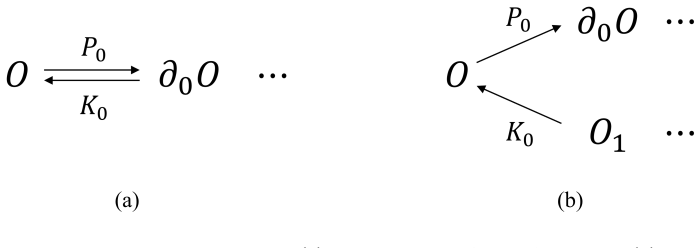
Because [P0,K0]=0, the standard translation-generated Carrollian conformal family does not contain the independent chain that K0 lowers successively to the primary. Including that chain (and all its translation descendants) produces complete local operators O_Delta(u,z;beta,kappa) in 2D and O_Delta,l(u,za;beta_a,kappa) in 3D whose orbits admit C2=m^2=kappa rho-beta^2 (or kappa rho-beta_vec^2) >0 and whose global two-point functions are fixed only up to arbitrary functions of Carrollian invariants.
What carries the argument
The complete generating operators O_Delta(beta,kappa) and O_Delta,l(beta_a,kappa) that simultaneously resum the boost multiplet and the independent K0 chain; after translation they furnish differential realizations whose orbits and Casimirs organize both the representation theory and the two-point Ward identities.
Load-bearing premise
The bulk-inspired anti-Hermitian pairing that includes the kappa measure is assumed to be the correct physical inner product, fixing reality of the labels, principal-series dimensions, dual orbits and the claim that nonzero boost charge at kappa=0 gives null states.
What would settle it
Construct an explicit free or interacting Carrollian field theory that realizes a kappa eq0 orbit with C2>0 and compute its two-point function; if the correlator is forced to a constant (or vanishes) rather than retaining an arbitrary function of the predicted invariants, or if no positive-mass sector appears, the completeness claim fails.
If this is right
- Sectors with C2=m^2>0 become available as boundary representations for massive particles in flat holography.
- Two-point functions of kappa eq0 operators retain arbitrary functions of Carrollian invariants on both magnetic and electric branches, so dynamics must fix what symmetry leaves free.
- Conjugate pairs at kappa=0 with nonzero boost charge have vanishing two-point functions and are therefore null in the adopted pairing.
- Mixed kappa configurations admit only magnetic non-contact solutions; contact support collapses them to the pure kappa=0 sector.
- Real blow-ups of point support in 3D retain angular data that can cancel spin selection rules otherwise forced by ordinary delta functions.
Where Pith is reading between the lines
- An explicit bulk-to-boundary dictionary mapping Poincaré massive states onto the (beta,kappa) labels would turn the Casimir identification into a concrete holographic map for massive hard particles.
- Higher-point crossing or an OPE that mixes different kappa orbits could constrain or eliminate the arbitrary invariant functions left by global symmetry.
- If the physical boundary pairing differs from the bulk-inspired L2 measure, the null-state and duality statements at kappa=0 would need re-derivation before those orbits can be discarded.
Editorial analysis
A structured set of objections, weighed in public.
Referee Report
Summary. The paper observes that the Carrollian relation [P^0,K^0]=0 implies K^0 annihilates all temporal-translation descendants of a primary, so the usual translation-generated conformal family omits an independent chain that K^0 lowers successively to the primary. It constructs the completed local modules in 2D and 3D by adjoining that chain and all of its translation descendants, packages them as generating operators O_Δ(u,z;β,κ) and O_Δ,l(u,z_a;β_a,κ), derives the differential actions (2.24)/(2.63), classifies orbits, and checks quadratic (and higher) Casimirs. Global two-point Ward identities are then solved for the three κ-orbit configurations, yielding magnetic non-contact and electric contact branches whose kinematics, supports, and selection rules are fixed while arbitrary functions of Carrollian invariants remain. Sectors with C_2=κρ−β^2 (2D) or κρ−β⃗^2 (3D) positive are proposed as candidates for massive states in flat holography.
Significance. If correct, the work closes a genuine structural gap in Carrollian conformal representation theory: the split between translation and K^0 descendant notions is forced by the algebra and had not been systematically completed in the local-operator language used for flat holography. The explicit differential realizations, finite transformations (Tables 1–2), Casimir checks, and case-by-case two-point solutions are concrete and reusable. The observation that global Carrollian symmetry leaves arbitrary functions of invariants (unlike ordinary CFT) is cleanly demonstrated. The C_2>0 sectors supply a natural algebraic home for massive boundary data, even though the holographic dictionary itself is deferred. Strengths include algebraically closed differential operators, invariant Casimir verifications, and exhaustive orbit-by-orbit Ward analysis without fitted parameters.
major comments (3)
- [§2.2.2, §2.3.2, Discussion] Secs. 2.2.2 and 2.3.2: Reality of (β,κ), principal-series values of Δ, dual labels, and the null-state claim for κ=0 with nonzero boost charge all rest on the anti-Hermitian convention G†=−G together with a formal L^2 pairing that includes dκ (eqs. after (2.26) and (2.64)). The algebra alone does not select this pairing; it is motivated by bulk Poincaré unitarity. The Discussion correctly notes that algebraic Hermiticity does not yield a positive Hilbert space, yet the abstract and orbit analysis still treat duals and null states as established. Either derive the pairing from a boundary inner product, or clearly quarantine every claim that depends on it (dual dimensions, vanishing two-point norms, delta-function normalization) as pairing-dependent.
- [§2.2.2 (2.48), §2.3.2 (2.84), §4] Eqs. (2.48) and (2.84): For κ≠0 the Pauli–Lubanski (2D) and quartic (3D) Casimirs contain derivative terms, so the orbit representations are reducible. The paper records this fact but supplies no further decomposition, no complete set of labels, and no statement of which subsectors can carry a positive-definite form. Because the C_2>0 “massive” interpretation lives precisely in these reducible sectors, the claim that they “may describe massive states” remains schematic until at least one irreducible component is isolated or an additional physical criterion is imposed.
- [Abstract, §2.3.2 (2.86), §4] Abstract and eq. (2.86): The identification C_2=m^2 is presented as a holographic motivation, yet the explicit dictionary is cited only as work in progress [60]. Within this manuscript the equality is an interpretive axiom, not a derived result. Soften the abstract wording to match the body (“candidate sectors for a massive dictionary”) and avoid stating m^2=C_2 as an established fact of the representation theory developed here.
minor comments (5)
- [§2.1, Figure 1] Figure 1 is conceptually helpful but low-resolution in the text rendering; a sharper schematic of the two descendant directions would aid readers unfamiliar with the split.
- [§3.2.1–3.2.2] The blow-up contact solutions (3.31), (3.39) are carefully distinguished from ordinary point-supported distributions, yet a short remark on when a physical correlator should be regarded as living on the blown-up space would prevent mis-application.
- [§3] Notation: the same symbol G is used for the two-point function and for a generic generator; a distinct correlator symbol (e.g. 𝒢) would reduce momentary ambiguity in §3.
- [References, §4] Reference [60] is listed as “Work in progress” with no public identifier; if unavailable at submission, flag every forward reference so the present paper is self-contained.
- [§3 title, §2.2.2] Typos/style: “F unctions” in the §3 title; occasional missing spaces before citations; “CarrCFT” introduced without expansion on first use in §2.2.2.
Circularity Check
No significant circularity: modules, orbits, Casimirs, and Ward solutions are built from the algebra, not from fitted inputs or self-defining claims.
full rationale
The paper’s load-bearing chain is algebraic and self-contained. It starts from the Carrollian conformal commutators (notably [P0,K0]=0 in (2.9) and (2.49)), introduces an independent K0 chain by definition of the missing descendants (2.6)–(2.8), packages boost and K0 labels into generating operators, obtains local differential realizations via BCH ((2.24), (2.63)), computes Casimirs and orbits from those realizations, and solves global two-point Ward identities, leaving arbitrary functions of Carrollian invariants. Nothing in that chain is a fit renamed as a prediction, a uniqueness theorem imported from the same authors to forbid alternatives, or a quantity defined in terms of the claimed output. Self-citations (prior Carrollian/BMS representation literature and the companion “work in progress” [60] for a massive dictionary) supply context and a deferred interpretation of C2>0 sectors; they are not used to identify the main equations with their inputs. The anti-Hermitian L2 pairing that fixes reality/duals is an assumption about the physical inner product, not a circular reduction. Score 0 is therefore appropriate.
Axiom & Free-Parameter Ledger
axioms (5)
- domain assumption 2D and 3D Carrollian conformal algebras with [P0,K0]=0 and the remaining commutators as in (2.9) and (2.49).
- domain assumption Anti-Hermitian convention G^dagger=-G inherited from unitary bulk Poincare, with formal L2 pairings including d kappa (or without it on kappa=0).
- standard math Baker-Campbell-Hausdorff translation of origin actions yields the local differential representation on the enlarged space including representation labels.
- domain assumption Global vacuum invariance implies (D_G,1 + D_G,2)G=0 Ward identities that constrain two-point functions including distributional support.
- ad hoc to paper Quadratic Casimir eigenvalue C2 can be identified with mass-squared m^2 for holographic interpretation when positive.
invented entities (3)
-
Independent K0 descendant chain O_n with [K0,O_n]=O_{n-1} and complete family including all translation descendants
no independent evidence
-
Continuous generating operators O_Delta(beta,kappa) / O_Delta,l(beta_a,kappa) and local fields on enlarged space (u,z;beta,kappa)
no independent evidence
-
Blow-up contact correlator branches retaining S^1 angular data at coincident points
no independent evidence
read the original abstract
In the Carrollian conformal algebra, the relation $[P^0,K^0]=0$ implies that $K^0$ annihilates all operators generated from a primary by temporal translation $P^0$. The standard conformal family defined by translation descendants does not contain the independent descendant chain that $K^0$ lowers successively to the primary. We construct the complete Carrollian conformal representation by including this chain together with all of its translation descendants. We derived the corresponding local operators, orbit structures, and checked their Casimirs in 2D and 3D. For each orbit configuration, the global two-point Ward identities fix the kinematic factors and selection rules for both magnetic non-contact branches and electric contact branches. Unlike ordinary conformal symmetry, Carrollian conformal symmetry generally determines the correlators only up to arbitrary functions of Carrollian invariants rather than constants. The complete representation contains sectors with $\mathcal{C}_2=m^2=\kappa\rho-\beta^2>0$ for 2D and $\mathcal{C}_2=m^2=\kappa\rho-\vec{\beta}^{\,2}>0$ for 3D, which may describe massive states in flat holography.
Figures

Reference graph
Works this paper leans on
-
[1]
Levy-Leblond,Une nouvelle limite non-relativiste du groupe de poincar´ e,Ann
J. Levy-Leblond,Une nouvelle limite non-relativiste du groupe de poincar´ e,Ann. l’IHP Phys. Th´ eor.3(1965)
1965
-
[2]
Sen Gupta,On an Analogue of the Galileo Group,Nuovo Cim.44(1966) 512
V. Sen Gupta,On an Analogue of the Galileo Group,Nuovo Cim.44(1966) 512
1966
-
[3]
Bacry and J
H. Bacry and J. Levy-Leblond,Possible kinematics,J. Math. Phys.9(1968) 1605
1968
-
[4]
C. Duval, G.W. Gibbons, P.A. Horvathy and P.M. Zhang,Carroll versus Newton and Galilei: two dual non-Einsteinian concepts of time,Class. Quant. Grav.31(2014) 085016 [1402.0657]
Pith/arXiv arXiv 2014
-
[5]
J. de Boer, J. Hartong, N.A. Obers, W. Sybesma and S. Vandoren,Carroll stories,JHEP09 (2023) 148 [2307.06827]
Pith/arXiv arXiv 2023
-
[6]
L. Ciambelli and P. Jai-akson,Foundations of Carrollian geometry,Phys. Rept.1188(2026) 1 [2510.21651]
Pith/arXiv arXiv 2026
-
[7]
A. Bagchi, A. Mehra and P. Nandi,Field Theories with Conformal Carrollian Symmetry, JHEP05(2019) 108 [1901.10147]
Pith/arXiv arXiv 2019
-
[8]
N. Gupta and N.V. Suryanarayana,Constructing Carrollian CFTs,JHEP03(2021) 194 [2001.03056]
Pith/arXiv arXiv 2021
-
[9]
P.-x. Hao, W. Song, X. Xie and Y. Zhong,BMS-invariant free scalar model,Phys. Rev. D 105(2022) 125005 [2111.04701]. 37
Pith/arXiv arXiv 2022
-
[10]
P.-X. Hao, W. Song, Z. Xiao and X. Xie,BMS-invariant free fermion models,Phys. Rev. D 109(2024) 025002 [2211.06927]
Pith/arXiv arXiv 2024
-
[11]
C. Duval, G.W. Gibbons and P.A. Horvathy,Conformal Carroll groups,J. Phys. A47(2014) 335204 [1403.4213]
Pith/arXiv arXiv 2014
-
[12]
B. Chen, R. Liu, H. Sun and Y.-f. Zheng,Constructing Carrollian field theories from null reduction,JHEP11(2023) 170 [2301.06011]
Pith/arXiv arXiv 2023
-
[13]
E. Bergshoeff, J. Gomis and G. Longhi,Dynamics of Carroll Particles,Class. Quant. Grav. 31(2014) 205009 [1405.2264]
Pith/arXiv arXiv 2014
-
[14]
R. Casalbuoni, D. Dominici and J. Gomis,Two interacting conformal Carroll particles,Phys. Rev. D108(2023) 086005 [2306.02614]
Pith/arXiv arXiv 2023
-
[15]
J. Figueroa-O’Farrill, A. P´ erez and S. Prohazka,Carroll/fracton particles and their correspondence,JHEP06(2023) 207 [2305.06730]
Pith/arXiv arXiv 2023
-
[16]
J. Figueroa-O’Farrill, A. P´ erez and S. Prohazka,Quantum Carroll/fracton particles,JHEP 10(2023) 041 [2307.05674]
Pith/arXiv arXiv 2023
-
[17]
B. Chen, R. Liu and Y.-f. Zheng,On Higher-dimensional Carrollian and Galilean Conformal Field Theories,SciPost Phys.14(2023) 088 [2112.10514]
Pith/arXiv arXiv 2023
-
[18]
A. Bagchi, P. Dhivakar and S. Dutta,AdS Witten diagrams to Carrollian correlators,JHEP 04(2023) 135 [2303.07388]
Pith/arXiv arXiv 2023
-
[19]
J. Salzer,An embedding space approach to Carrollian CFT correlators for flat space holography,JHEP10(2023) 084 [2304.08292]
Pith/arXiv arXiv 2023
-
[20]
J. Cotler, K. Jensen, S. Prohazka, A. Raz, M. Riegler and J. Salzer,Quantizing Carrollian field theories,JHEP10(2024) 049 [2407.11971]
Pith/arXiv arXiv 2024
-
[21]
L. Ciambelli and C. Marteau,Carrollian conservation laws and Ricci-flat gravity,Class. Quant. Grav.36(2019) 085004 [1810.11037]
Pith/arXiv arXiv 2019
-
[22]
L. Donnay and C. Marteau,Carrollian Physics at the Black Hole Horizon,Class. Quant. Grav.36(2019) 165002 [1903.09654]
Pith/arXiv arXiv 2019
-
[23]
A. Bagchi, R. Basu, A. Mehra and P. Nandi,Field Theories on Null Manifolds,JHEP02 (2020) 141 [1912.09388]
Pith/arXiv arXiv 2020
-
[24]
Bondi, M.G.J
H. Bondi, M.G.J. van der Burg and A.W.K. Metzner,Gravitational waves in general relativity. 7. Waves from axisymmetric isolated systems,Proc. Roy. Soc. Lond. A269(1962) 21. 38
1962
-
[25]
Sachs,Gravitational waves in general relativity
R.K. Sachs,Gravitational waves in general relativity. 8. Waves in asymptotically flat space-times,Proc. Roy. Soc. Lond. A270(1962) 103
1962
-
[26]
G. Barnich and C. Troessaert,Aspects of the BMS/CFT correspondence,JHEP05(2010) 062 [1001.1541]
Pith/arXiv arXiv 2010
-
[27]
G. Barnich and C. Troessaert,BMS charge algebra,JHEP12(2011) 105 [1106.0213]
Pith/arXiv arXiv 2011
-
[28]
C. Duval, G.W. Gibbons and P.A. Horvathy,Conformal Carroll groups and BMS symmetry, Class. Quant. Grav.31(2014) 092001 [1402.5894]
Pith/arXiv arXiv 2014
-
[29]
H. Afshar, X. Bekaert and M. Najafizadeh,Classification of conformal carroll algebras,JHEP 12(2024) 148 [2409.19953]
Pith/arXiv arXiv 2024
-
[30]
W.-B. Liu and J. Long,Symmetry group at future null infinity: Scalar theory,Phys. Rev. D 107(2023) 126002 [2210.00516]
Pith/arXiv arXiv 2023
-
[31]
W.-B. Liu and J. Long,Symmetry group at future null infinity II: Vector theory,JHEP07 (2023) 152 [2304.08347]
Pith/arXiv arXiv 2023
-
[32]
W.-B. Liu and J. Long,Symmetry group at future null infinity III: Gravitational theory, JHEP10(2023) 117 [2307.01068]
Pith/arXiv arXiv 2023
-
[33]
A. Bagchi, A. Banerjee, P. Dhivakar, S. Mondal and A. Shukla,The Carrollian kaleidoscope, Eur. Phys. J. C86(2026) 429 [2506.16164]
Pith/arXiv arXiv 2026
-
[34]
Ruzziconi,Carrollian physics and holography,Phys
R. Ruzziconi,Carrollian physics and holography,Phys. Rept.1182(2026) 1 [2602.02644]
arXiv 2026
-
[35]
A. Bagchi,Correspondence between Asymptotically Flat Spacetimes and Nonrelativistic Conformal Field Theories,Phys. Rev. Lett.105(2010) 171601 [1006.3354]
Pith/arXiv arXiv 2010
-
[36]
G. Barnich and G. Compere,Classical central extension for asymptotic symmetries at null infinity in three spacetime dimensions,Class. Quant. Grav.24(2007) F15 [gr-qc/0610130]
Pith/arXiv arXiv 2007
-
[37]
G. Barnich, A. Gomberoff and H.A. Gonzalez,The Flat limit of three dimensional asymptotically anti-de Sitter spacetimes,Phys. Rev. D86(2012) 024020 [1204.3288]
Pith/arXiv arXiv 2012
-
[38]
A. Bagchi, S. Detournay and D. Grumiller,Flat-Space Chiral Gravity,Phys. Rev. Lett.109 (2012) 151301 [1208.1658]
Pith/arXiv arXiv 2012
-
[39]
A. Bagchi and R. Fareghbal,BMS/GCA Redux: Towards Flatspace Holography from Non-Relativistic Symmetries,JHEP10(2012) 092 [1203.5795]
Pith/arXiv arXiv 2012
-
[40]
A. Bagchi, M. Gary and Zodinmawia,Bondi-Metzner-Sachs bootstrap,Phys. Rev. D96 (2017) 025007 [1612.01730]. 39
Pith/arXiv arXiv 2017
-
[41]
A. Bagchi, M. Gary and Zodinmawia,The nuts and bolts of the BMS Bootstrap,Class. Quant. Grav.34(2017) 174002 [1705.05890]
Pith/arXiv arXiv 2017
-
[42]
B. Chen, P.-X. Hao, R. Liu and Z.-F. Yu,On Galilean conformal bootstrap,JHEP06(2021) 112 [2011.11092]
Pith/arXiv arXiv 2021
-
[43]
B. Chen, P.-x. Hao, R. Liu and Z.-f. Yu,On Galilean conformal bootstrap. Part II.ξ= 0 sector,JHEP12(2022) 019 [2207.01474]
Pith/arXiv arXiv 2022
-
[44]
R. Liu, W.-J. Ma, H. Zheng and Y.-f. Zheng,Carrollian holography with agentic AI: Real mass is imaginary,2606.05401
-
[45]
G. Barnich and B. Oblak,Notes on the BMS group in three dimensions: I. Induced representations,JHEP06(2014) 129 [1403.5803]
Pith/arXiv arXiv 2014
-
[46]
G. Barnich and B. Oblak,Notes on the BMS group in three dimensions: II. Coadjoint representation,JHEP03(2015) 033 [1502.00010]
Pith/arXiv arXiv 2015
-
[47]
A. Bagchi, R. Basu, A. Kakkar and A. Mehra,Flat Holography: Aspects of the dual field theory,JHEP12(2016) 147 [1609.06203]
Pith/arXiv arXiv 2016
-
[48]
Saha,Carrollian approach to 1 + 3D flat holography,JHEP06(2023) 051 [2304.02696]
A. Saha,Carrollian approach to 1 + 3D flat holography,JHEP06(2023) 051 [2304.02696]
Pith/arXiv arXiv 2023
-
[49]
Strominger,On BMS Invariance of Gravitational Scattering,JHEP07(2014) 152 [1312.2229]
A. Strominger,On BMS Invariance of Gravitational Scattering,JHEP07(2014) 152 [1312.2229]
Pith/arXiv arXiv 2014
-
[50]
T. He, V. Lysov, P. Mitra and A. Strominger,BMS supertranslations and Weinberg’s soft graviton theorem,JHEP05(2015) 151 [1401.7026]
Pith/arXiv arXiv 2015
-
[51]
A. Bagchi, S. Banerjee, R. Basu and S. Dutta,Scattering Amplitudes: Celestial and Carrollian,Phys. Rev. Lett.128(2022) 241601 [2202.08438]
Pith/arXiv arXiv 2022
-
[52]
L. Mason, R. Ruzziconi and A. Yelleshpur Srikant,Carrollian amplitudes and celestial symmetries,JHEP05(2024) 012 [2312.10138]
Pith/arXiv arXiv 2024
-
[53]
W.-B. Liu, J. Long, H.-Y. Xiao and J.-L. Yang,On the definition of Carrollian amplitudes in general dimensions,JHEP11(2024) 027 [2407.20816]
Pith/arXiv arXiv 2024
-
[54]
R. Ruzziconi and A. Saha,Holographic Carrollian currents for massless scattering,JHEP01 (2025) 169 [2411.04902]
Pith/arXiv arXiv 2025
-
[55]
A. Fiorucci, S. Pekar, P. Marios Petropoulos and M. Vilatte,Carrollian-Holographic Derivation of Gravitational Flux-Balance Laws,Phys. Rev. Lett.135(2025) 261602 [2505.00077]. 40
arXiv 2025
-
[56]
K. Nguyen and J. Salzer,Operator product expansion in Carrollian CFT,JHEP07(2025) 193 [2503.15607]
Pith/arXiv arXiv 2025
-
[57]
H. Kulkarni, R. Ruzziconi and A. Yelleshpur Srikant,On Carrollian and celestial correlators in general dimensions,JHEP10(2025) 187 [2508.06602]
Pith/arXiv arXiv 2025
-
[58]
R. Marotta, A. Shekar and M. Verma,Carrollian Conformal Theories in Momentum Space, 2512.06881
-
[59]
X. Bekaert, A. Campoleoni, S. Pekar and S.I.A. Raj,Flat from AdS: in any dimension and for any spin,2606.03955
-
[60]
Work in progress
Y. fan Zheng, “Work in progress.” 2026
2026
-
[61]
Y.-f. Zheng,Supersymmetric BMS 4 algebras revisited: electric/magnetic superalgebras and free field realization,JHEP12(2025) 076 [2508.17925]
arXiv 2025
-
[62]
S. Pasterski and S.-H. Shao,Conformal basis for flat space amplitudes,Phys. Rev. D96 (2017) 065022 [1705.01027]
Pith/arXiv arXiv 2017
-
[63]
D. Karateev, P. Kravchuk and D. Simmons-Duffin,Harmonic Analysis and Mean Field Theory,JHEP10(2019) 217 [1809.05111]
Pith/arXiv arXiv 2019
-
[64]
L. Donnay, S. Pasterski and A. Puhm,Asymptotic Symmetries and Celestial CFT,JHEP09 (2020) 176 [2005.08990]
Pith/arXiv arXiv 2020
-
[65]
M. Pate, A.-M. Raclariu, A. Strominger and E.Y. Yuan,Celestial operator products of gluons and gravitons,Rev. Math. Phys.33(2021) 2140003 [1910.07424]
Pith/arXiv arXiv 2021
-
[66]
S. Chakrabortty, S. Hegde and A. Maurya,Differential representation for Carrollian correlators,JHEP08(2025) 126 [2411.09641]
Pith/arXiv arXiv 2025
-
[67]
I. Surubaru and B. Zhu,Carrollian amplitudes and holographic correlators in AdS3/CFT2, Phys. Rev. D112(2025) 026023 [2504.07650]
Pith/arXiv arXiv 2025
- [68]
-
[69]
A. Bagchi, P. Chakraborty, S. Chakrabortty, S. Fredenhagen, D. Grumiller and P. Pandit, Boundary Carrollian Conformal Field Theories and Open Null Strings,Phys. Rev. Lett.134 (2025) 071604 [2409.01094]
Pith/arXiv arXiv 2025
-
[70]
Y.-f. Zheng and B. Chen,Structure of Carrollian (conformal) superalgebra,JHEP08(2025) 111 [2503.22160]. 41
Pith/arXiv arXiv 2025
-
[71]
L. Buzaglo, X. He, T.A. Pham, H. Tan, G.S. Vishwa and K. Zhao,On the boundary Carrollian conformal algebra,Lett. Math. Phys.116(2026) 86 [2508.21603]
Pith/arXiv arXiv 2026
-
[72]
S. Pasterski, A. Puhm and E. Trevisani,Celestial diamonds: conformal multiplets in celestial CFT,JHEP11(2021) 072 [2105.03516]
Pith/arXiv arXiv 2021
-
[73]
S. Fredenhagen, S. Prohazka and R. Tiefenbacher,Carrollian quantum states and flat space holography,2604.22745
-
[74]
A. Lipstein, R. Ruzziconi and A. Yelleshpur Srikant,Towards a flat space Carrollian hologram from AdS4/CFT3,JHEP06(2025) 073 [2504.10291]
Pith/arXiv arXiv 2025
-
[75]
M. Ammon, F. Capone and C. Sieling,Flat holography & holographic renormalization: scalar field,JHEP07(2026) 124 [2512.14818]
Pith/arXiv arXiv 2026
-
[76]
S. Pasterski, S.-H. Shao and A. Strominger,Flat Space Amplitudes and Conformal Symmetry of the Celestial Sphere,Phys. Rev. D96(2017) 065026 [1701.00049]
Pith/arXiv arXiv 2017
-
[77]
Y.T.A. Law and M. Zlotnikov,Massive Spinning Bosons on the Celestial Sphere,JHEP06 (2020) 079 [2004.04309]
Pith/arXiv arXiv 2020
-
[78]
Narayanan,Massive Celestial Fermions,JHEP12(2020) 074 [2009.03883]
S.A. Narayanan,Massive Celestial Fermions,JHEP12(2020) 074 [2009.03883]
Pith/arXiv arXiv 2020
-
[79]
E. Have, K. Nguyen, S. Prohazka and J. Salzer,Massive carrollian fields at timelike infinity, JHEP07(2024) 054 [2402.05190]
Pith/arXiv arXiv 2024
-
[80]
M. Campiglia and A. Laddha,Asymptotic symmetries of gravity and soft theorems for massive particles,JHEP12(2015) 094 [1509.01406]. 42
Pith/arXiv arXiv 2015
discussion (0)
Sign in with ORCID, Apple, or X to comment. Anyone can read and Pith papers without signing in.