REVIEW 4 major objections 3 minor 36 references
The paper claims that live retrieval of a small ontology slice, injected into an LLM extraction prompt, keeps a 9B local model aligned to a formal schema while cutting prompt overhead by about 94 percent, and that layered zero-inference ded
Reviewed by Pith at T0; open to challenge. T0 means a machine referee read the full paper against a public rubric. the ladder, T0–T4 →
T0 review · deepseek-v4-flash
2026-08-03 00:44 UTC pith:JOK7SFW6
load-bearing objection Solid engineering report, but the headline numbers are development-corpus fits, not predictions. the 4 major comments →
An Ontology-Guided, Deduplication-Aware Extraction Layer for Knowledge Graph Construction from Heterogeneous Documents
The pith
A machine-rendered reading of the paper's core claim, the machinery that carries it, and where it could break.
Core claim
Ontology grounding at extraction time, implemented as live vector retrieval of relevant classes and predicates from a graph database and injection of only those into the prompt, replaces static domain catalog slices and cuts catalog prompt overhead by roughly 94 percent. Combined with a five-stage refinement pipeline (deterministic cleaning, cross-chunk merging, quality-gated relationship second pass, six rule-based deduplication algorithms, and an embedding-based resolution engine whose hard-conflict guard no similarity score can override), search recall rises from roughly 70 to 95 percent while maintaining zero false merges. The paper also demonstrates that per-page OCR classification rout
What carries the argument
The load-bearing mechanism is ontology-guided retrieval: a content sample is split into overlapping windows, embedded, and used to query a vector index over ontology class and predicate definitions; candidates are scored by cosine similarity penalized by PageRank centrality, thresholded at 0.72, and trimmed to a token budget, then injected into the extraction prompt. Five refinements close precision gaps: term vectors alongside prose vectors, one-hop subclass expansion for high-confidence classes, full-text predicate search, density-ranked paragraph windows, and subclass-aware predicate matching. On the deduplication side, the pivotal design is the hard-conflict guard: two entities carrying
Load-bearing premise
The headline recall and zero-false-merge numbers are measured on two synthetic development documents with all thresholds tuned on them, so the load-bearing assumption is that behavior transfers to real production document streams.
What would settle it
Take a held-out set of real documents from the same domain with hand-built ground truth, run the pipeline with all thresholds frozen, and measure recall and count false merges; if recall falls well below 95 percent or any false merge appears, the zero-false-merge guarantee and the transferability premise fail.
If this is right
- A small, locally hosted 9B model can achieve ontology-aligned extraction and high search recall when prompted with a dynamically retrieved ontology slice, without relying on cloud-scale models.
- Reclaiming roughly 10,500 tokens per extraction call from a ~11,200-token static catalog allows more source text to fit in a 32K-token window, reducing chunk fragmentation and cross-chunk merge errors.
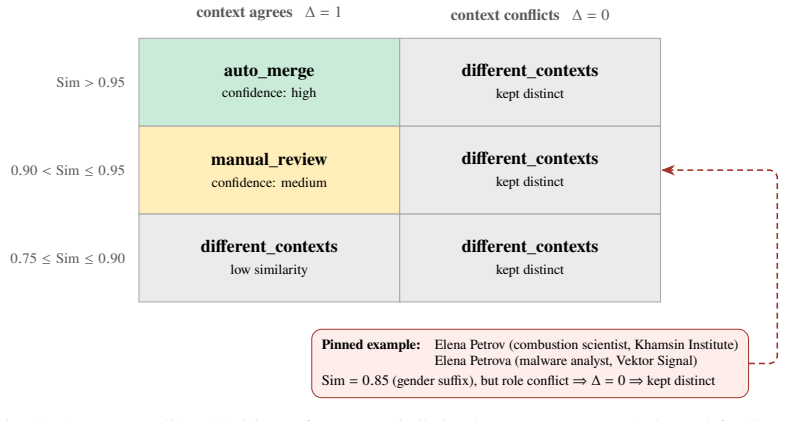
- The hard-conflict guard, combined with context-validated deduplication, makes the reported zero-false-merge result a property of the architecture rather than a lucky threshold choice.
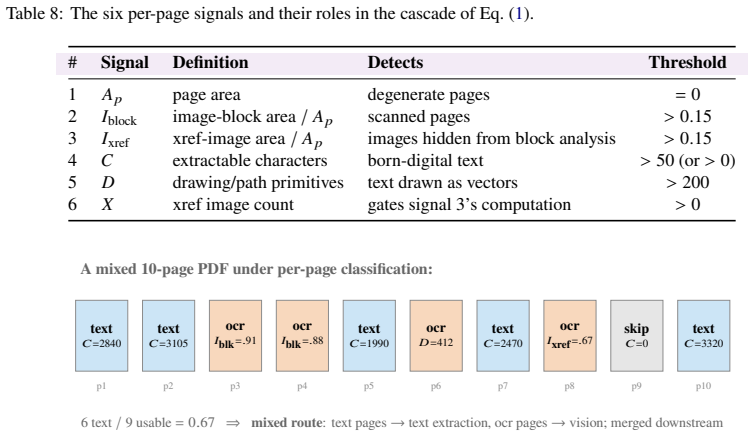
- Per-page OCR classification eliminates the information loss of binary text-or-OCR routing for mixed documents, a common real-world case.
- Each pipeline stage addresses a distinct quality-defect class, so components can be adopted independently by other extraction systems.
Where Pith is reading between the lines
- The retrieval recipe (term vectors, subclass expansion, density-ranked windows, and subclass-aware predicate matching) is a general pattern for any embedding-based retrieval over a hierarchical schema, not only for intelligence documents.
- The paper implicitly suggests that conservative synonym snapping (a 0.80 cosine floor) is the right trade-off to avoid semantic magnets; this is a testable hypothesis for other ontology-grounded extraction tasks.
- The 58.8 percent OCR recall ceiling on the naval document suggests that the binding constraint for long-tail vocabulary is the vision model's reading ability, not the ontology layer; better OCR or multi-pass union would likely be the next gain.
- If the architecture generalizes, it offers a template for compliance monitoring and investigative journalism: any governed-schema document stream becomes a queryable graph with auditable merge decisions.
Editorial analysis
A structured set of objections, weighed in public.
Referee Report
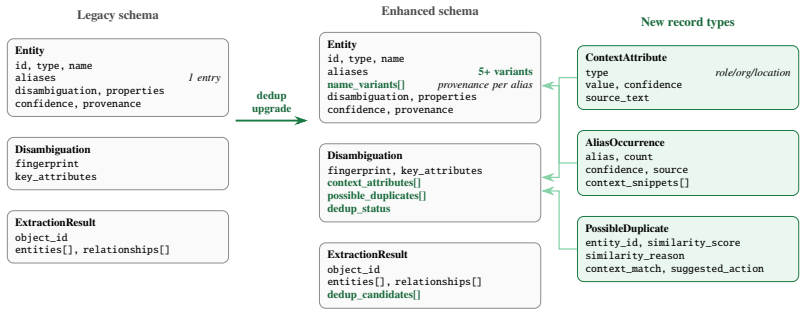
Summary. The paper presents a production extraction layer for ontology-aligned knowledge graph construction from heterogeneous documents. The system consumes Kafka metadata, routes PDF/spreadsheet/Office/image content through format-specific handlers, performs two-phase LLM extraction with a locally hosted 4-bit Qwen3.5-9B model, and applies a five-stage refinement pipeline including deterministic cleaning, cross-chunk merging, a relationship second pass, six zero-inference deduplication algorithms, and an embedding-based resolution stage with a hard-conflict guard. The distinguishing component is ontology-guided extraction: a Neo4j ontology slice is retrieved live by embedding similarity and injected into the extraction prompt, reducing catalog overhead by roughly 94% relative to static domain slices. The paper reports that this design improves search recall from about 70% to 95% with no false merges, documents seven classes of upstream quality defects and their fixes, and includes an OCR stress test on a synthetic naval document plus a small public benchmark campaign comparing the local model to a cloud model.
Significance. If the reported gains hold beyond the development corpus, the paper makes a useful engineering contribution: live ontology retrieval for extraction-time grounding, a layered rule-based plus embedding deduplication pipeline with a hard-conflict guard, per-page OCR classification, and a detailed threshold reference (Appendix A) that goes beyond most systems papers. The honest documentation of seven real pipeline bugs and their fixes is a strength, as is the explicit listing of hand-tuned thresholds. However, the headline quantitative claims are not backed by independent validation: the evaluations use single synthetic development documents, thresholds are tuned on those same documents, no significance testing or confidence intervals appear, and the code/data are proprietary. The paper itself (Section 9, Section 12) acknowledges these limitations, but the abstract and conclusion present the numbers without those caveats, which is a serious mismatch between evidence and claim.
major comments (4)
- [§8.1, Table 17; §9; §12] The headline claim of search recall improving from roughly 70% to 95% rests on a single 45-page synthetic document (IR-001.pdf). Section 9 concedes that all thresholds (0.72 retrieval floor, 0.80 expansion trigger, similarity-scorer weights, indicator lists) were tuned on the development corpus, and Section 12 states the corpora are synthetic and cannot be redistributed. Table 17 does not describe the query set, the ground-truth duplicate pairs, or the exact protocol used to measure recall. As it stands, the reported improvement is a retrospective fit to the development document, not a predictive result. The authors should either provide a held-out evaluation with multiple documents and significance testing, or sharply qualify the claim in the abstract and Section 1 to 'on a development document.'
- [§6.2.4, §7.3.7, §8.1 Table 17] The claim of 'zero false merges' is not supported by the evidence. Section 7.3.7 documents 79 false-positive merge candidates produced by the abbreviation check, fixed only after evaluation; Table 16 shows 79 false-positive dedup candidates before the fix, while Table 17 reports false positives as 0/0. The corpus, being synthetic and lacking independent hard-negative labels, cannot substantiate a zero-false-merge guarantee. The claim should be reworded to 'no false merges observed in the two synthetic test documents after applying the fixes,' not presented as a general property of the system.
- [§4, Table 2; §4.1 Tables 4–5] The 94% catalog-overhead reduction is measured on a single 'representative document' (Table 2), with no distribution, sample size, or variance. Similarly, the retrieval refinements in Tables 4 and 5 are illustrated on one document/passage each. Without a corpus-level evaluation, the 94% figure is anecdotal. Please provide either a multi-document measurement with error bars or change the abstract and Section 1 to 'about 94% on a representative document.'
- [§8.2, §8.3, §9] The OCR ablation (10-page JFS document, chunk sizes 5 and 2) is a single run on one synthetic document, and the benchmark campaign (Section 8.3) uses samples of n=8–50 with the authors' own caveat that results are 'directional rather than statistically significant.' Despite this, the conclusion states that the pipeline 'tripled relationship coverage' and 'cut hallucinated entities from 174 to zero.' These are not robust claims in their current form. The authors should present the OCR and benchmark results as illustrative case studies and remove the generalizing language from the conclusion, or carry out the multi-pass and multi-document evaluation outlined in Table 20.
minor comments (3)
- [§8.1, Table 17] The row 'Graph false merges prevented: 0 → 4–8 per document' is ambiguous: before deduplication, zero false merges were 'prevented' because no deduplication existed; after deduplication, the claim is that 4–8 were prevented. Clarify the direction of the metric and reconcile with the 79 false-positive candidates reported in Table 16.
- [§3.2] The text says 'four domain-informed checks' but the list has four items; this is fine, but check 4's threshold of 'more than 30%' and 'fewer than 6 distinct types' should appear in Appendix A's threshold table for completeness.
- [§4.1] The phrase 'five systematic precision gaps' appears in the text, but the subsequent list and table contain G1–G5; this is internally consistent, but the introductory sentence says 'five' while Table 3 has five rows — good. However, Section 4.1 introduces 'five' and then Section 4 mentions 'four retrieval refinements' in the conclusion; please make the count consistent ('four' in the conclusion should be 'five' if G1–G5 are counted).
Circularity Check
Headline recall and zero-false-merge claims are retrospective fits on the development corpus; public benchmarks provide only partial independent support.
specific steps
-
fitted input called prediction
[Section 1.1; Section 8.1 (Table 17); Section 9; Section 12]
"‘This methodology improved search recall from approximately 70% to 95% while maintaining a zero false-positive rate.’ ‘the similarity-scorer weights, retrieval thresholds (0.72 floor, 0.80 expansion trigger), and indicator-word lists are heuristics tuned on the development corpus; they have not been learned from labelled data and may not transfer across domains without re-tuning.’ ‘The evaluation corpora are synthetic intelligence-style documents created for system development.’"
The headline 70→95% recall and zero-false-merge claims are measured on the same two synthetic documents on which every threshold (0.72 retrieval floor, 0.80 expansion trigger, similarity weights, indicator lists) was tuned. The evaluation set is the tuning set, so the improvement is a retrospective fit rather than an out-of-sample result. Section 9 concedes no significance testing and that the values may not transfer; Section 12 says the corpora are synthetic and non-redistributable, removing an external check. The strongest empirical claim therefore reduces to a measure of its own fitting inputs.
-
fitted input called prediction
[Section 4.1]
"‘operational evaluation on intelligence-domain documents exposed five systematic precision gaps ... Each gap traces to one design decision in the baseline retriever, and each admits a targeted refinement ... Measured Effect. The refinements change which classes reach the prompt, and the change is visible immediately on real documents.’"
The G1–G5 retrieval refinements were designed after observing failures on the evaluation documents, and their reported effect (e.g., Table 5: baseline ‘3 predicates’ vs refined ‘68’) is measured on those same documents. This is iterative tuning on the test set presented as a measured improvement; the gain is partly engineered into the metric rather than independently predicted. It is secondary to the headline recall claim but shows the same tuning/evaluation overlap.
full rationale
Most of the paper is a system description with engineering heuristics; there is no formal derivation whose conclusion is assumed as an input. The standard methods (Jaro-Winkler, Double Metaphone, FAISS, RAG, entity-resolution blocking) are cited externally, not self-cited, and no uniqueness/ansatz is smuggled in via the authors' prior work. The load-bearing circularity is empirical: the headline recall improvement and zero-false-merge claim are measured on two synthetic development documents after all retrieval/merging thresholds were tuned on that same corpus. The paper states this plainly in Section 9 and Appendix A, and it also says the corpora are synthetic and cannot be redistributed (Section 12). So the 70→95% recall number is a retrospective fit, not a prediction with independent support. The public benchmark campaign (Section 8.3) is less circular and provides some independent calibration, but it does not support the headline recall/overhead/zero-false-merge claims. Hence score 6: one or more central 'results' reduce to fits on their own inputs, but the architecture retains independent content and the paper is transparent about the limitation.
Axiom & Free-Parameter Ledger
free parameters (9)
- PageRank penalty λ =
0.4
- Retrieval cosine floor =
0.72
- Subclass expansion trigger/score =
0.80 / 0.78
- Predicate embedding snap floor =
0.80
- Source-text variant miner threshold τ =
0.85
- Context-aware dedup thresholds =
0.75 (candidate), 0.95 (auto-merge), 0.90–0.95 (review)
- Embedding resolution thresholds =
0.85 auto-merge, 0.60–0.85 review, 0.50 codename
- Similarity composite weights =
w=(0.30,0.25,0.20,0.15,0.10)
- OCR page classifier thresholds =
image coverage >0.15, chars >50, drawing >200, route ratios 0.80/0.20
axioms (4)
- domain assumption A curated ontology graph with class/predicate definitions and precomputed embeddings is available and maintained.
- domain assumption The locally hosted 9B model (Qwen3.5-9B-AWQ-4bit) is capable of following ontology-guided extraction prompts well enough for production; the benchmark shows it trails Gemini by ~6 points on entity spans.
- domain assumption The hard-conflict guard on discriminator attributes (DOB, nationality, ID) is a sufficient anti-merge safeguard; i.e., extracted discriminator values are accurate.
- standard math Standard similarity and retrieval primitives (Jaro–Winkler, Double Metaphone, Ratcliff/Obershelp, PageRank, FAISS) behave as documented.
read the original abstract
Large language models extract entities and relationships from unstructured documents fluently but inconsistently: type vocabularies fracture across documents, the same person surfaces under several name variants, relationships duplicate, and distinct individuals who share a name risk silent conflation. This paper presents the design, implementation, and empirical refinement of a production extraction layer that converts a live document stream into a validated knowledge graph aligned to a formal ontology. The system consumes document metadata from Kafka, routes PDF, spreadsheet, Office, and image content through handlers built for each format, and extracts entities and relationships in two passes using a locally hosted Qwen3.5-9B model tuned on the ontology. Its distinguishing component is ontology-guided extraction: the relevant slice of a curated ontology is retrieved live from a graph database by embedding similarity and injected into the extraction prompt, reducing catalog overhead by about 94 percent relative to static domain slices. Extracted results then pass through a refinement pipeline of five stages: deterministic cleaning, merging across chunks, a second pass for relationships, six deduplication algorithms that require no model inference, and an embedding resolution subsystem whose conflict guard no similarity score can override. Evaluation on intelligence corpora improved search recall from roughly 70 to 95 percent with no false merges, and corrected seven classes of silent quality defect, ranging from a bug that truncated source text by a single character to the systematic duplication of entities that carried title prefixes.
Figures






Reference graph
Works this paper leans on
-
[1]
Kreps, J., Narkhede, N., & Rao, J. (2011). Kafka: A distributed messaging system for log processing. InProceedings of the NetDB(Vol. 11, pp. 1–7)
2011
-
[2]
InProceedingsofthe29thSymposiumonOperatingSystemsPrinciples(SOSP)(pp.611–626)
Kwon,W.,Li,Z.,Zhuang,S.,Sheng,Y.,Zheng,L.,Yu,C.H.,Gonzalez,J.,Zhang,H.,&Stoica, I.(2023).EfficientmemorymanagementforlargelanguagemodelservingwithPagedAttention. InProceedingsofthe29thSymposiumonOperatingSystemsPrinciples(SOSP)(pp.611–626)
2023
-
[3]
Pan,S.,Luo,L.,Wang,Y.,Chen,C.,Wang,J.,&Wu,X.(2024).Unifyinglargelanguagemodels and knowledge graphs: A roadmap.IEEE Transactions on Knowledge and Data Engineering, 36(7), 3580–3599
2024
-
[4]
Zhu, Y., Wang, X., Chen, J., Qiao, S., Ou, Y., Yao, Y., Deng, S., Chen, H., & Zhang, N. (2024). LLMs for knowledge graph construction and reasoning: Recent capabilities and future opportunities.World Wide Web,27(5), 58
2024
-
[5]
(2024).Pydantic(Version 2) [Computer software].https://github.com/ pydantic/pydantic
Colvin, S. (2024).Pydantic(Version 2) [Computer software].https://github.com/ pydantic/pydantic
2024
-
[6]
Lewis, P., Perez, E., Piktus, A., Petroni, F., Karpukhin, V., Goyal, N., Küttler, H., Lewis, M., Yih, W., Rocktäschel, T., Riedel, S., & Kiela, D. (2020). Retrieval-augmented generation for knowledge-intensive NLP tasks. InAdvances in Neural Information Processing Systems(Vol. 33, pp. 9459–9474)
2020
-
[7]
Christophides, V., Efthymiou, V., Palpanas, T., Papadakis, G., & Stefanidis, K. (2020). An overview of end-to-end entity resolution for big data.ACM Computing Surveys,53(6), 1–42
2020
-
[8]
Papadakis,G.,Skoutas,D.,Thanos,E.,&Palpanas,T.(2020).Blockingandfilteringtechniques for entity resolution: A survey.ACM Computing Surveys,53(2), 1–42
2020
-
[9]
W., & Metzener, D
Ratcliff, J. W., & Metzener, D. E. (1988). Pattern matching: The gestalt approach.Dr. Dobb’s Journal,13(7), 46–51
1988
-
[10]
Knight, K., & Graehl, J. (1998). Machine transliteration.Computational Linguistics,24(4), 599–612
1998
-
[11]
N., Kaiser, Ł., & Polosukhin,I.(2017).Attentionisallyouneed.InAdvancesinNeuralInformationProcessing Systems(Vol
Vaswani, A., Shazeer, N., Parmar, N., Uszkoreit, J., Jones, L., Gomez, A. N., Kaiser, Ł., & Polosukhin,I.(2017).Attentionisallyouneed.InAdvancesinNeuralInformationProcessing Systems(Vol. 30). 41
2017
-
[12]
B., Mann, B., Ryder, N., Subbiah, M., Kaplan, J., Dhariwal, P., Neelakantan, A., Shyam, P., Sastry, G., Askell, A., et al
Brown, T. B., Mann, B., Ryder, N., Subbiah, M., Kaplan, J., Dhariwal, P., Neelakantan, A., Shyam, P., Sastry, G., Askell, A., et al. (2020). Language models are few-shot learners. In Advances in Neural Information Processing Systems(Vol. 33, pp. 1877–1901)
2020
-
[13]
Wei, X., Cui, X., Cheng, N., Wang, X., Zhang, X., Huang, S., Xie, P., Xu, J., Chen, Y., Zhang, M., Jiang, Y., & Han, W. (2023). ChatIE: Zero-shot information extraction via chatting with ChatGPT.arXiv.https://arxiv.org/abs/2302.10205
Pith/arXiv arXiv 2023
-
[14]
Wang, S., Sun, X., Li, X., Ouyang, R., Wu, F., Zhang, T., Li, J., & Wang, G. (2025). GPT-NER:Namedentityrecognitionvialargelanguagemodels.InFindingsoftheAssociation for Computational Linguistics: NAACL 2025(pp. 4257–4275)
2025
-
[15]
InFindings of the Association for Computational Linguistics: EMNLP 2021(pp
HuguetCabot,P.-L.,&Navigli,R.(2021).REBEL:Relationextractionbyend-to-endlanguage generation. InFindings of the Association for Computational Linguistics: EMNLP 2021(pp. 2370–2381)
2021
-
[16]
Wadhwa, S., Amir, S., & Wallace, B. (2023). Revisiting relation extraction in the era of large language models. InProceedings of the 61st Annual Meeting of the Association for Computational Linguistics (ACL)(pp. 15566–15589)
2023
-
[17]
Gruber, T. R. (1993). A translation approach to portable ontology specifications.Knowledge Acquisition,5(2), 199–220
1993
-
[18]
Stanford Digital Library Technologies Project
Page,L.(1998).ThePageRankcitationranking: Bringingordertotheweb(TechnicalReport). Stanford Digital Library Technologies Project
1998
-
[19]
P., & Sunter, A
Fellegi, I. P., & Sunter, A. B. (1969). A theory for record linkage.Journal of the American Statistical Association,64(328), 1183–1210
1969
-
[20]
K., Ipeirotis, P
Elmagarmid, A. K., Ipeirotis, P. G., & Verykios, V. S. (2007). Duplicate record detection: A survey.IEEE Transactions on Knowledge and Data Engineering,19(1), 1–16
2007
-
[21]
Mudgal, S., Li, H., Rekatsinas, T., Doan, A., Park, Y., Krishnan, G., Deep, R., Arcaute, E., & Raghavendra, V. (2018). Deep learning for entity matching: A design space exploration. In Proceedings of the 2018 International Conference on Management of Data (SIGMOD)(pp. 19–34)
2018
-
[22]
Brunner, U., & Stockinger, K. (2020). Entity matching with transformer architectures: A step forward in data integration. InProceedings of the 23rd International Conference on Extending Database Technology (EDBT)(pp. 463–473)
2020
-
[23]
InSixth IEEE International Conference on Data Mining Workshops (ICDM)(pp
Christen,P.(2006).Acomparisonofpersonalnamematching: Techniquesandpracticalissues. InSixth IEEE International Conference on Data Mining Workshops (ICDM)(pp. 290–294)
2006
-
[24]
Cohen, W., Ravikumar, P., & Fienberg, S. (2003). A comparison of string distance metrics for name-matching tasks. InProceedings of the IJCAI-2003 Workshop on Information Integration on the Web (IIWeb)(pp. 73–78)
2003
-
[25]
Navarro, G. (2001). A guided tour to approximate string matching.ACM Computing Surveys, 33(1), 31–88
2001
-
[26]
Winkler, W. E. (1990). String comparator metrics and enhanced decision rules in the Fellegi–Sunter model of record linkage. InProceedings of the Section on Survey Research Methods, American Statistical Association(pp. 354–359)
1990
-
[27]
Philips, L. (2000). The double metaphone search algorithm.C/C++ Users Journal,18(6), 38–43
2000
-
[28]
T., Condon, S
Freeman, A. T., Condon, S. L., & Ackerman, C. M. (2006). Cross linguistic name matching in English and Arabic. InProceedings of the Human Language Technology Conference of the NAACL(pp. 471–478)
2006
-
[29]
Shen,W.,Wang,J.,&Han,J.(2015).Entitylinkingwithaknowledgebase: Issues,techniques, and solutions.IEEE Transactions on Knowledge and Data Engineering,27(2), 443–460. 42
2015
-
[30]
Cucerzan, S. (2007). Large-scale named entity disambiguation based on Wikipedia data. InProceedings of the 2007 Joint Conference on Empirical Methods in Natural Language Processing and Computational Natural Language Learning (EMNLP-CoNLL)(pp. 708–716)
2007
-
[31]
Reimers, N., & Gurevych, I. (2019). Sentence-BERT: Sentence embeddings using Siamese BERT-networks. InProceedings of the 2019 Conference on Empirical Methods in Natural Language Processing and the 9th International Joint Conference on Natural Language Processing (EMNLP-IJCNLP)(pp. 3982–3992)
2019
-
[32]
Artifex Software.(2024).PyMuPDFdocumentation.https://pymupdf.readthedocs.io/
2024
-
[33]
Johnson, J., Douze, M., & Jégou, H. (2019). Billion-scale similarity search with GPUs.IEEE Transactions on Big Data,7(3), 535–547
2019
-
[34]
F., Lin, K., Hewitt, J., Paranjape, A., Bevilacqua, M., Petroni, F., & Liang, P
Liu, N. F., Lin, K., Hewitt, J., Paranjape, A., Bevilacqua, M., Petroni, F., & Liang, P. (2024). Lost in the middle: How language models use long contexts.Transactions of the Association for Computational Linguistics,12, 157–173
2024
-
[35]
Yang,A.,Li,A.,Yang,B.,Zhang,B.,Hui,B.,Zheng,B.,...&Qiu,Z.(2025).Qwen3technical report.arXiv.https://arxiv.org/abs/2505.09388
Pith/arXiv arXiv 2025
-
[36]
vaguely related
Wang, G., Koshy, J., Subramanian, S., Paramasivam, K., Zadeh, M., Narkhede, N., Rao, J., Kreps, J., & Stein, J. (2015). Building a replicated logging system with Apache Kafka. Proceedings of the VLDB Endowment,8(12), 1654–1655. A Threshold reference Table 22 consolidates every tunable threshold in the extraction and resolution pipeline, the subsystem it g...
2015
discussion (0)
Sign in with ORCID, Apple, or X to comment. Anyone can read and Pith papers without signing in.