REVIEW 3 major objections 4 minor 65 references
Gaussian-augmented bosonic matrix-product states: theory and applications
T0 review · 3 major / 4 minor · reviewed 2026-08-03 · deepseek-v4-flash
Pith's one-line read The paper introduces Gaussian-augmented bosonic matrix-product states, a single ansatz that contains all pure Gaussian states and all finite-dimensional matrix-product states, with closed-form transfer matrices and exact parent Hamiltonians
desk verdict The GA-BMPS ansatz and parent Hamiltonians are worth taking seriously, but the transfer-matrix calculus misses complex conjugation and thus fails for the complex parameters the paper allows. read the letter →
The pith
A machine-rendered reading of the paper's core claim, the machinery that carries it, and where it could break.
The reading
What carries the argument
The GA-BMPS ansatz (Definition 1): a matrix-product state over the infinite Fock space whose auxiliary-space matrices sandwich exponentials K⊗(a†)^2 and L⊗a†, with an optional passive linear-optical unitary across all modes. Its two workhorses are the closed-form transfer matrix E, which turns contraction of an infinite-dimensional tensor network into a finite matrix calculation, and the Wronskian-based single-mode operators Q and F_j: Q annihilates exactly the local basis {|e_j⟩}, and F_j sends |e_k⟩ to δ_{jk}|0⟩. Together these construct the parent Hamiltonian h0+hR with kernel equal to the desired local MPS subspace.
What would settle it
Pick a single-mode family of photon-added squeezed coherent states with degenerate squeezing parameters so that the Wronskian Δ(z) has zeros, construct Q by Lemma 3, and compute dim ker Q on the Fock-space domain. If for any parameter choice dim ker Q exceeds the number n of local states, ker(h0+hR) is larger than the target subspace W and the parent-Hamiltonian construction is not exact.
Extended reading notes
Core claim
The central claim is that a bosonic MPS generated by exponentials of matrix-valued quadratic and linear terms—V e^{K⊗(a†)^2} e^{L⊗a†}|0⟩, followed by a passive linear-optical unitary—forms a self-contained framework. For commuting K and L, the transfer matrix collapses to a closed-form Gaussian integral, E = (V⊗V) Δ^{1/2} exp(Δ(K⊗L^2 + L⊗L + L^2⊗K)) with Δ = (1−4K⊗K)^{-1}, so norms and local observables are evaluated exactly without truncating Fock space. The same family admits exact parent Hamiltonians: Wronskian-built annihilation-operator polynomials Q and interpolation operators F_j give a positive local term whose kernel is exactly the local subspace of the state. Numerical tests show t
Load-bearing premise
The exact parent-Hamiltonian construction relies on the chosen local photon-added squeezed states being linearly independent and on the Wronskian-built operator Q having kernel exactly their span on the whole relevant Fock-space domain; if that kernel is larger, the parent Hamiltonian acquires extra ground states.
Editorial extensions
If this is right
- Every pure Gaussian state and every finite-dimensional MPS is a subfamily, so the ansatz interpolates between the two standard variational tools for bosons.
- Norm, local polynomial observables, and Gaussian-unitary operators have closed-form transfer matrices, allowing variational optimization in the full Fock space without a hard occupation cutoff.
- Every BMPS—and every GA-BMPS obtained by a passive unitary—is the exact ground state of a frustration-free parent Hamiltonian whose terms are simple functions of a and a†; locality survives when the passive unitary is a finite-depth local Gaussian circuit.
- Numerical results show on-site squeezing lowers the variational energy in the lattice φ^4_2 model and that the parent-Hamiltonian construction is practical, recovering a target D=2 MPS to numerical precision.
- The same tensor-network structure extends to multiple boson species per site, mixed spin-boson chains, and—formally—higher-dimensional bosonic tensor networks.
Reading between the lines
- The closed-form transfer matrix should make the ansatz compatible with gradient-based time-evolution methods, such as a time-dependent variational principle, giving a truncation-free route to dynamics that the paper leaves as future work.
- The linear-independence and kernel assumptions behind the Wronskian construction could be monitored numerically as a conditioning diagnostic; singular Wronskians would signal parameter regions where the parent Hamiltonian may acquire extra ground states.
- The coexistence of Gaussian and MPS subfamilies suggests the ansatz could support a bosonic analogue of injectivity-based phase classification, where the overlap matrix of photon-added squeezed states plays the role of the physical inner product.
- A concrete testable extension is to benchmark GA-BMPS against standard truncated-tensor-network calculations for Bose-Hubbard chains at high filling, where truncation artifacts are most severe and the advantage of exact expectation values should be largest.
Editorial analysis
A structured set of objections, weighed in public.
Referee Report
Summary. The paper introduces a variational family for one-dimensional bosonic systems, the Gaussian-augmented bosonic matrix-product states (GA-BMPS). A GA-BMPS is built from a finite-dimensional auxiliary space and site operators of the form V e^{K\otimes(a^\dagger)^2} e^{L\otimes a^\dagger} applied to the Fock vacuum, optionally followed by a passive Gaussian unitary. The authors claim three properties: (i) the family contains all pure Gaussian states and finite-dimensional MPS; (ii) expectation values can be computed efficiently through a closed-form transfer-matrix calculus (Propositions 1-3); and (iii) exact parent Hamiltonians can be constructed as simple functions of the canonical operators (Section IV). They also present variational tests for the lattice phi^4 model and a parent-Hamiltonian recovery example (Section V). The paper is clearly written, the algebraic framework is appealing, and the parent-Hamiltonian construction is systematic and independent of the transfer-matrix calculus.
Significance. If correct, the GA-BMPS ansatz would be a useful truncation-free variational family that unifies Gaussian states and finite-dimensional MPS, with a rare combination of closed-form contractions and exact parent Hamiltonians. The parent-Hamiltonian construction via ambient annihilators and check operators is particularly interesting and goes beyond the standard finite-dimensional projector construction. However, the central computational claim (ii) is not supported as written because the transfer-matrix formulas omit the complex conjugation on the bra side. This error affects Propositions 1-3 and therefore the numerical section, although the Appendix C algebra is repairable by conjugating the left tensor factor. The claimed variational results in Section V appear to require the corrected (conjugated) transfer matrices, which are not stated in the text. The contribution is potentially valuable, but the manuscript needs a substantial, focused revision of the transfer-matrix calculus before the main claims can be accepted.
major comments (3)
- [Section III.C, Eqs. (33)-(34), Propositions 1-3] Equation (33) defines E = \sum_n A_n \otimes A_n and Eq. (34) evaluates it as V \otimes V E(L\otimes 1, K\otimes 1, 1\otimes K, 1\otimes L). For complex tensors, this is the bilinear transfer matrix, not the quantum one: the bra tensor must be the entrywise conjugate \overline{A_n}. For |\Psi\rangle = \sum_n Tr(BA_n)|n\rangle, the norm is \sum_n |Tr(BA_n)|^2, whereas the paper computes \sum_n Tr(BA_n)^2. The failure is already visible for D=1, K=0, L=1+i: Eq. (34) gives e^{\ell^2}=e^{2i}, while the correct norm is e^{|\ell|^2}=e^2, as stated in Eq. (9). Propositions 2 and 3 inherit the same defect. The Appendix C calculus can be repaired by setting P=\overline{L}\otimes 1, Q=\overline{K}\otimes 1, R=1\otimes K, S=1\otimes L, with conjugate sources; nevertheless, claim (ii) is unsupported as written.
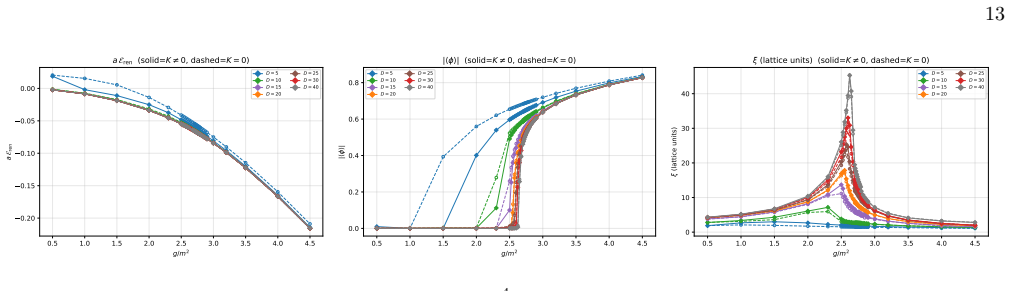
- [Section V, Fig. 1 and Table I] The numerical results are described as being obtained from 'the dominant fixed points of the transfer operator' defined in Section III.C. If that operator is the unconjugated one of Eq. (33), the minimized functional is not the physical energy; it can be complex and is not bounded below, so the reported variational energies and parameter recovery do not follow from the paper's formulas. Either the implementation used the corrected conjugated transfer matrices, in which case those formulas must be given in the main text, or the numerics are not evidence for the physical variational claim. The text should also reconcile this with Eq. (9), which explicitly gives the correct conjugated norm for the D=1 case.
- [Section II.B and Eq. (17)] The finite-MPS transfer-matrix review also writes E = \sum_i A^i \otimes A^i without conjugation. Unless the tensors are assumed real, the standard expression is E = \sum_i \overline{A^i} \otimes A^i. This notational omission is the root cause of the error in Propositions 1-3. Please correct the convention throughout the manuscript and state it explicitly, since Definition 1 and Example 5 use complex V,K,L.
minor comments (4)
- [Appendix E, Lemma 3] The step 'Consequently, dim ker Q \le n' deserves one clarifying sentence: an entire Bargmann-space function is determined by its germ at z_0 by the identity theorem, so local ODE uniqueness at a regular point bounds the global kernel even when the Wronskian has zeros. The claim itself appears sound.
- [Section III.C, Eq. (35)] The O-transfer matrix should also be written with a conjugated bra: E_O = \sum_{i,j} \langle i|O|j\rangle \overline{A_i} \otimes A_j, and the source-derivative identities in Proposition 2 should be updated accordingly.
- [Section III.F, Eq. (52)] For the multimode factorization E = E_1 \cdots E_M, please specify that after the conjugation fix each E_\nu is built from \overline{V}, \overline{K}_\nu, \overline{L}_\nu on the bra side. The current notation is ambiguous about the ordering of bra and ket factors.
- [Section V] The target V in Example 5 is complex, but L-BFGS-B is a real-variable solver. Please state how the complex parameters were encoded (e.g., real and imaginary parts) and how automatic differentiation through the fixed-point calculation handles complex variables, so the numerical procedure is reproducible.
Circularity Check
No significant circularity: the central derivations are self-contained calculations from Definition 1, and the numerical benchmarks are either external or explicit self-consistency tests.
full rationale
The paper's main claims (transfer-matrix formulas, parent-Hamiltonian construction, representation equivalences) are derived directly from Definition 1 using the CCR algebra, coherent-state resolutions of the identity, and explicit Wronskian/ODE arguments in Appendices C and E. These are computations from stated assumptions, not predictions that secretly coincide with fitted inputs. The parent Hamiltonian construction is an existence result: given a target BMPS, the operators Q and F_j are constructed so that ker h = W by proof (Lemmas 3, 4 and Proposition 6), not by fitting a parameter to data and then calling it a prediction. The numerical recovery in Section V B is explicitly framed as a self-consistency test on a Hamiltonian built from the target state ('It is therefore expected that if one starts from such a parent Hamiltonian H, the BMPS should be able to variationally find the ground state of H'), so it is not a circular derivation. The phi^4 benchmark is an external Hamiltonian whose energies are minimized variationally, providing independent content. Citations to prior work, including works by the authors, are contextual (standard MPS theory, Gaussian states) and are not used as a uniqueness theorem to force the ansatz. The skeptic's objection about the missing complex conjugation in E = sum A_n ⊗ A_n (Sec. III C) is a mathematical correctness concern for complex tensors, not a circularity: the formula still derives from the stated definition rather than assuming the conclusion. Hence no load-bearing circular step is present.
Assumptions & free parameters
assumptions (5)
- standard math Bosonic Fock space representation and canonical commutation relations [a_i,a†_j]=δ_ij 1
- standard math Bloch–Messiah decomposition of Gaussian unitaries
- domain assumption Linear independence of the local photon-added squeezed states and Wronskian construction of the ambient annihilator Q
- domain assumption Convergence condition ρ(K)<1/2 for absolute convergence of the transfer-matrix series
- domain assumption Existence of a common dense domain for the unbounded operators appearing in parent Hamiltonians
Cite this review
Pith. "Pith review of Gaussian-augmented bosonic matrix-product states: theory and applications." pith.science (2026). https://pith.science/paper/HXCAPXSB
@misc{pith2026260728753,
  author       = {Pith},
  title        = {Pith review of: Gaussian-augmented bosonic matrix-product states: theory and applications},
  year         = {2026},
  howpublished = {\url{https://pith.science/paper/HXCAPXSB}},
  note         = {Machine review of arXiv:2607.28753}
}
read the original abstract
We propose and analyze the structure of a family of bosonic quantum many-body states that have the following features: (i) they include all pure Gaussian states and finite-dimensional matrix-product states as subclasses; (ii) their expectation values can be efficiently computed, allowing them to be used, among other things, for variational calculations; (iii) they admit exact parent Hamiltonians expressed as simple functions of the bosonic creation and annihilation operators.
Figures
Reference graph
Works this paper leans on
-
[1]
Single-mode Gaussian states Two particularly important families of single-mode Gaussian states arecoherent statesandsqueezed states, |α⟩=D(α)|0⟩, D(α) =e αa†−α∗a, |ζ⟩=S(ζ)|0⟩, S(ζ) =e 1 2(ζ∗a2−ζ(a†)2), (5) defined forα,ζ∈C. Up to a global phase, any single- mode Gaussian unitary can be written as UG =D(α)S(ζ)e −iθa†a (6) and hence any pure Gaussian state,...
-
[2]
andℓ=α− 2κα∗. The unnormalized squeezed coherent state|κ,ℓ⟩ has squared norm ⟨κ,ℓ|κ,ℓ⟩= 1√ 1−4|κ| 2 exp ( |ℓ|2 +κℓ 2 +κℓ2 1−4|κ| 2 ) .(9) Given single-mode Gaussian states, we can define the so-calledphoton-addedGaussian states |n,κ,ℓ⟩ := (a†)neκ(a†)2+ℓa† |0⟩,(10) where the photon addition is also unnormalized for con- venience. For fixedκandℓ, states wit...
-
[3]
Multimode Gaussian states A pure multimode Gaussian state is likewise ob- tained by applying a Gaussian unitary to the multi- mode vacuum. By the Bloch-Messiah decomposition (Appendix A), every such state can be written, up to a global phase, as |ΨN G⟩=U N⨂ j=1 [ Dj(αj)Sj(ζj)|0⟩j ] ,(11) whereUis a passive linear-optical unitary of the form U :=e i ∑ j,k ...
-
[4]
(34) Here∆ 1/2 denotes the principal matrix square root
Then the transfer matrixEis given by E= V⊗VE( L,K,K,L), E≡E( L,K,K,L) = ∆ 1 2e∆ ( K⊗L 2+L⊗L+L 2 ⊗K ) , ∆ = ( 1⊗1−4 K⊗K )−1 . (34) Here∆ 1/2 denotes the principal matrix square root. The proof involves straightforward but somewhat tedious algebraic manipulation involving the CCR algebra (Ap- pendix C). Next, the expectation value of local observables in st...
-
[5]
Writingc j :=V jj, we obtain |ψ⟩= D∑ j=1 cj|ℓj⟩,|ℓ j⟩ :=e ℓja† |0⟩,(75) where the coherent states are unnormalized
Single mode After absorbing the boundary matrix intoV, the single-mode state is |ψ⟩= TrD [ VeK⊗(a†)2 eL⊗a†] |0⟩.(73) Example 2(Superposition of coherent states).LetK= 0 and L= diag(ℓ 1,...,ℓ D), V∈M D(C),(74) where theℓ j are distinct. Writingc j :=V jj, we obtain |ψ⟩= D∑ j=1 cj|ℓj⟩,|ℓ j⟩ :=e ℓja† |0⟩,(75) where the coherent states are unnormalized. The a...
-
[6]
For this, we first set up the notation to make the pre- scription manifest
Multimode BMPS The extension from single-mode to full BMPS overN sites is straightforward with some minor modifications. For this, we first set up the notation to make the pre- scription manifest. Write the BMPS in the photon-added form |ψN⟩= d∑ I1,...,IN=1 Tr ( BAI1···A IN ) |I1···I N⟩,(96) where the one-site states{|I⟩} d I=1 are linearly indepen- dent....
-
[7]
Hartmann, F
M. Hartmann, F. Brand˜ ao, and M. Plenio, Quantum many-body phenomena in coupled cavity arrays, Laser & Photonics Reviews2, 527 (2008)
2008
-
[8]
Bloch, J
I. Bloch, J. Dalibard, and W. Zwerger, Many-body physics with ultracold gases, Rev. Mod. Phys.80, 885 (2008)
2008
Show all 65 references
-
[9]
Jaksch, C
D. Jaksch, C. Bruder, J. I. Cirac, C. W. Gardiner, and P. Zoller, Cold bosonic atoms in optical lattices, Physical Review Letters81, 3108 (1998), arXiv:cond- mat/9805329
1998
-
[10]
M. P. A. Fisher, P. B. Weichman, G. Grinstein, and D. S. Fisher, Boson localization and the superfluid-insulator transition, Physical Review B40, 546 (1989)
1989
-
[11]
M. A. Cazalilla, R. Citro, T. Giamarchi, E. Orignac, and M. Rigol, One dimensional bosons: From condensed mat- ter systems to ultracold gases, Rev. Mod. Phys.83, 1405 (2011)
2011
-
[12]
Lewenstein, A
M. Lewenstein, A. Sanpera, and V. Ahufinger,Ultracold Atoms in Optical Lattices: Simulating quantum many- body systems(OUP Oxford, 2012)
2012
-
[13]
Fabre and N
C. Fabre and N. Treps, Modes and states in quantum optics, Rev. Mod. Phys.92, 035005 (2020)
2020
-
[14]
E. P. Gross, Structure of a quantized vortex in boson systems, Il Nuovo Cimento (1955-1965)20, 454 (1961)
1955
-
[15]
Glimm and A
J. Glimm and A. Jaffe, Aλϕ 4 quantum field theory with- out cutoffs. i, Phys. Rev.176, 1945 (1968)
1945
-
[16]
D. M. Ceperley, Path integrals in the theory of condensed helium, Rev. Mod. Phys.67, 279 (1995). 15
1995
-
[17]
J. L. DuBois and H. R. Glyde, Bose-einstein condensation in trapped bosons: A variational monte carlo analysis, Phys. Rev. A63, 023602 (2001)
2001
-
[18]
Flottat, F
T. Flottat, F. H´ ebert, V. G. Rousseau, R. T. Scalet- tar, and G. G. Batrouni, Bosonic kondo-hubbard model, Phys. Rev. B92, 035101 (2015)
2015
-
[19]
Bosetti, B
P. Bosetti, B. De Palma, and M. Guagnelli, Monte carlo determination of the critical coupling inϕ 4 2 theory, Phys. Rev. D92, 034509 (2015)
2015
-
[20]
Bronzin, B
S. Bronzin, B. De Palma, and M. Guagnelli, New monte carlo determination of the critical coupling inϕ 4 2 theory, Phys. Rev. D99, 034508 (2019)
2019
-
[21]
Hackl, T
L. Hackl, T. Guaita, T. Shi, J. Haegeman, E. Demler, and J. I. Cirac, Geometry of variational methods: dy- namics of closed quantum systems, SciPost Physics9, 048 (2020)
2020
-
[22]
L. P. Pitaevskii, Vortex lines in an imperfect bose gas, Sov. Phys. JETP13, 451 (1961)
1961
-
[23]
Dalfovo, S
F. Dalfovo, S. Giorgini, L. P. Pitaevskii, and S. Stringari, Theory of bose-einstein condensation in trapped gases, Rev. Mod. Phys.71, 463 (1999)
1999
-
[24]
Pethick and H
C. Pethick and H. Smith,Bose-Einstein Condensation in Dilute Gases(Cambridge University Press, 2008)
2008
-
[25]
D. S. Rokhsar and B. G. Kotliar, Gutzwiller projection for bosons, Phys. Rev. B44, 10328 (1991)
1991
-
[26]
T. Shi, E. Demler, and J. I. Cirac, Variational study of fermionic and bosonic systems with non-Gaussian states: Theory and applications, Annals of Physics390, 245 (2018), 1707.05902
2018 arXiv
-
[27]
Guaita, L
T. Guaita, L. Hackl, T. Shi, C. Hubig, E. Demler, and J. I. Cirac, Gaussian time-dependent variational principle for the bose-hubbard model, Phys. Rev. B100, 094529 (2019)
2019
-
[28]
J. C. Bridgeman and C. T. Chubb, Hand-waving and in- terpretive dance: An introductory course on tensor net- works, Journal of Physics A: Mathematical and Theoret- ical50, 223001 (2017), arXiv:1603.03039 [quant-ph]
2017 arXiv
-
[29]
T. Qian, J. J. Fernandez-Melgarejo, D. Zueco, and J. Molina-Vilaplana, Non-gaussian variational wavefunc- tions for interacting bosons on the lattice, Physical Re- view B107, 035121 (2023)
2023
-
[30]
Weedbrook, S
C. Weedbrook, S. Pirandola, R. Garc´ ıa-Patr´ on, N. J. Cerf, T. C. Ralph, J. H. Shapiro, and S. Lloyd, Gaussian quantum information, Rev. Mod. Phys.84, 621 (2012)
2012
-
[31]
J. I. Cirac, D. P´ erez-Garc´ ıa, N. Schuch, and F. Ver- straete, Matrix product states and projected entangled pair states: Concepts, symmetries, theorems, Rev. Mod. Phys.93, 045003 (2021)
2021
-
[32]
Perez-Garcia, F
D. Perez-Garcia, F. Verstraete, M. M. Wolf, and J. I. Cirac, Matrix product state representations, arXiv preprint quant-ph/0608197 (2006)
2006 arXiv
-
[33]
Verstraete, V
F. Verstraete, V. Murg, and J. I. Cirac, Matrix prod- uct states, projected entangled pair states, and varia- tional renormalization group methods for quantum spin systems, Advances in Physics57, 143 (2008)
2008
-
[34]
Or´ us, A practical introduction to tensor networks: Matrix product states and projected entangled pair states, Annals of physics349, 117 (2014)
R. Or´ us, A practical introduction to tensor networks: Matrix product states and projected entangled pair states, Annals of physics349, 117 (2014)
2014
-
[35]
Brockt, F
C. Brockt, F. Dorfner, L. Vidmar, F. Heidrich-Meisner, and E. Jeckelmann, Matrix-product-state method with a dynamical local basis optimization for bosonic systems out of equilibrium, Physical Review B92, 241106 (2015), arXiv:1508.00694 [cond-mat.str-el]
2015 arXiv
-
[36]
S. R. White, Density matrix formulation for quantum renormalization groups, Physical Review Letters69, 2863 (1992)
1992
-
[37]
Verstraete, D
F. Verstraete, D. Porras, and J. I. Cirac, Density matrix renormalization group and periodic boundary conditions: A quantum information perspective, Phys. Rev. Lett.93, 227205 (2004)
2004
-
[38]
Schollw¨ ock, The density-matrix renormalization group in the age of matrix product states, Annals of Physics 326, 96 (2011), arXiv:1008.3477 [cond-mat.str-el]
U. Schollw¨ ock, The density-matrix renormalization group in the age of matrix product states, Annals of Physics 326, 96 (2011), arXiv:1008.3477 [cond-mat.str-el]
2011 arXiv
-
[39]
Vidal, Efficient simulation of one-dimensional quan- tum many-body systems, Physical Review Letters93, 040502 (2004)
G. Vidal, Efficient simulation of one-dimensional quan- tum many-body systems, Physical Review Letters93, 040502 (2004)
2004
-
[40]
variational method for speed or performance and focus primarily on the physical results that can be extracted from the ansatz
were restricted to small bond dimensionsD. variational method for speed or performance and focus primarily on the physical results that can be extracted from the ansatz. The results shown here should be viewed as the baseline that is expected to improve with better schemes. Be...
-
[41]
Jeckelmann and S
E. Jeckelmann and S. R. White, Density-matrix renormalization-group study of the polaron problem in the Holstein model, Physical Review B57, 6376 (1998), arXiv:cond-mat/9710058
1998 arXiv
-
[42]
Zhang, E
C. Zhang, E. Jeckelmann, and S. R. White, Density ma- trix approach to local hilbert space reduction, Phys. Rev. Lett.80, 2661 (1998)
1998
-
[43]
Stolpp, T
J. Stolpp, T. K¨ ohler, E. Jeckelmann, S. Paeckel, and F. Heidrich-Meisner, Comparative study of state-of-the- art matrix-product-state methods for lattice bosons, Computer Physics Communications269, 108106 (2021)
2021
-
[44]
C. Guo, A. Weichselbaum, J. von Delft, and M. Vojta, Critical and strong-coupling phases in one- and two-bath spin-boson models, Phys. Rev. Lett.108, 160401 (2012)
2012
-
[45]
Iblisdir, R
S. Iblisdir, R. Or´ us, and J. I. Latorre, Matrix product states algorithms and continuous systems, Phys. Rev. B 75, 104305 (2007)
2007
-
[46]
Schuch, M
N. Schuch, M. M. Wolf, and J. I. Cirac, Gaussian matrix product states, inQuantum Information and Many Body Quantum Systems, edited by M. Ericsson and S. Mon- tangero (Edizioni della Normale, Pisa, 2008) pp. 129–142, arXiv:1201.3945 [quant-ph]
2008 arXiv
-
[47]
M. F. Frenzel and M. B. Plenio, Matrix product state rep- resentation without explicit local hilbert space truncation with applications to the sub-ohmic spin-boson model, New Journal of Physics15, 073046 (2013)
2013
-
[48]
A. B. Michelsen, F. K. Marqversen, and M. Kasto- ryano, Functional matrix product state simulation of continuous variable quantum circuits, arXiv preprint arXiv:2504.05860 (2025)
2025
-
[49]
R. A. Janik, Exact bosonic matrix product states (and holography), Journal of High Energy Physics2019, 1 (2019)
2019
-
[50]
Chen, Z.-C
X. Chen, Z.-C. Gu, and X.-G. Wen, Complete classifi- cation of one-dimensional gapped quantum phases in in- teracting spin systems, Physical Review B84, 235128 (2011)
2011
-
[51]
Schuch, D
N. Schuch, D. Perez-Garcia, and J. I. Cirac, Classify- ing quantum phases using matrix product states and projected entangled pair states, Physical Review B84, 165139 (2011)
2011
-
[52]
Pollmann, E
F. Pollmann, E. Berg, A. M. Turner, and M. Os- hikawa, Symmetry protection of topological phases in one-dimensional quantum spin systems, Physical Review B85, 075125 (2012)
2012
-
[53]
Fannes, B
M. Fannes, B. Nachtergaele, and R. F. Werner, Finitely correlated states on quantum spin chains, Communica- tions in Mathematical Physics144, 443 (1992). 16
1992
-
[54]
Ohata, Monte carlo study of schwinger model without the sign problem, Journal of High Energy Physics2023, 7 (2023)
H. Ohata, Monte carlo study of schwinger model without the sign problem, Journal of High Energy Physics2023, 7 (2023)
2023
-
[55]
Glimm and A
J. Glimm and A. Jaffe, Theλϕ 4 quantum field theory without cutoffs: Ii. the field operators and the approxi- mate vacuum, Annals of Mathematics91, 362 (1970)
1970
-
[56]
Glimm, A
J. Glimm, A. Jaffe, and T. Spencer, Phase transitions forϕ 4 2 quantum fields, Communications in Mathematical Physics45, 203 (1975)
1975
-
[57]
Rychkov and L
S. Rychkov and L. G. Vitale, Hamiltonian truncation study of theφ 4 theory in two dimensions, Phys. Rev. D91, 085011 (2015)
2015
-
[58]
Vanhecke, J
B. Vanhecke, J. Haegeman, K. Van Acoleyen, L. Vander- straeten, and F. Verstraete, Scaling hypothesis for matrix product states, Phys. Rev. Lett.123, 250604 (2019)
2019
-
[59]
Milsted, J
A. Milsted, J. Haegeman, and T. J. Osborne, Matrix product states and variational methods applied to critical quantum field theory, Phys. Rev. D88, 085030 (2013)
2013
-
[60]
Delcamp and A
C. Delcamp and A. Tilloy, Computing the renormaliza- tion group flow of two-dimensionalϕ 4 theory with tensor networks, Phys. Rev. Res.2, 033278 (2020)
2020
-
[61]
Tilloy, Some progress on the use of the varia- tional method in quantum field theory, arXiv preprint arXiv:2604.10284 (2026)
A. Tilloy, Some progress on the use of the varia- tional method in quantum field theory, arXiv preprint arXiv:2604.10284 (2026)
2026 arXiv
-
[62]
Br¨ auer and K
ˇS. Br¨ auer and K. Mølmer, Symmetry-resolved parent hamiltonians for entangled bosonic cat resources, arXiv preprint arXiv:2607.02997 (2026)
2026 arXiv
-
[63]
S. L. Braunstein, Squeezing as an irreducible resource, Phys. Rev. A71, 055801 (2005)
2005
-
[64]
B. C. Hall,Quantum Theory for Mathematicians, Grad- uate Texts in Mathematics No. 267 (Springer New York)
-
[65]
R. A. Horn and C. R. Johnson,Matrix Analysis(Cam- bridge University Press, 1985). Appendix A: F rom the symplectic Bloch-Messiah decomposition to Gaussian unitaries Here we review the decomposition of Gaussian uni- taries used in Sec. II from the symplectic Bloch-Messiah decom...
1985
Reviewed August 3, 2026 · model on record in the stance chip above.
Discussion (0). Continue with ORCID to comment.