REVIEW 5 major objections 5 minor 84 references
A deepfake detector can stay accurate on unseen forgeries and honest about uncertainty by training its confidence estimate to mirror how strongly three complementary evidence streams disagree.
Reviewed by Pith at T0; open to challenge. T0 means a machine referee read the full paper against a public rubric. the ladder, T0–T4 →
T0 review · deepseek-v4-flash
2026-08-03 00:25 UTC pith:3P7WL66E
load-bearing objection A serious method paper with a clean disagreement-calibration idea and the right evaluation targets, held back by missing error bars, quoted baselines, no code or supplement, and an unproven causal story for the structural stream. the 5 major comments →
Uncertainty-Aware Deepfake Detection via Multi-View Structural Learning
The pith
A machine-rendered reading of the paper's core claim, the machinery that carries it, and where it could break.
Core claim
DISCERN's central claim is that predictive uncertainty in deepfake detection should be an observed property of the evidence—how much independent evidence streams conflict—rather than an internal state of a single network. The system computes per-stream Dirichlet distributions over the fake/real hypothesis, measures pairwise cosine disagreement d between the streams' predicted class probabilities, detaches d from the computation graph, and applies a binary cross-entropy loss that pulls the fused evidential uncertainty u toward d. Because each stream is also supervised individually, the disagreement reflects genuine stream-level reasoning. The paper reports that this disagreement-aware calibra
What carries the argument
The load-bearing mechanism is Inter-Branch Disagreement Calibration (IBDC), defined in Eq. 8–9: pairwise cosine disagreement d between the Dirichlet means of the three streams is treated as a probability target, detached, and matched to the fused epistemic uncertainty u via binary cross-entropy. Supporting machinery includes the structural stream (Eq. 3–4), where four sub-domains (identity, structural, noise, spectral) each learn a real-conditioned and a fake-conditioned structural-equation model, and the manipulation signal is the reconstruction-residual gap Δr_g between the two; and confidence-modulated evidential fusion (Eq. 5–6), which down-weights weak streams without removing them. IBD
Load-bearing premise
The structural stream's manipulation signal is assumed to capture genuine dependency shifts between features that transfer across datasets, rather than being just another class-conditional distance in feature space.
What would settle it
Replace the class-conditioned structural-equation models with two plain class-conditional regressors that receive the same feature vector with its coordinates permuted per sample (destroying any cross-feature dependency while preserving marginal statistics), and drop the DAG acyclicity and sparsity penalties. If cross-dataset AUC on Celeb-DF-v3 and DFDC does not drop materially and ECE does not worsen, then the structural stream is reading marginal feature statistics, not dependency structure, and the causal/structural claim collapses.
If this is right
- Confidence becomes operationally usable: on Celeb-DF-v2, a 10% abstention budget lifts video-level AUC from 95.72 to 97.94, a 2.22-point gain versus 0.69 for the strongest softmax-margin baseline.
- Reenactment-style forgeries—NeuralTextures (+1.7 AUC) and Face2Face (+0.5)—benefit most, consistent with these manipulations breaking expression–action-unit coherence that the semantic and structural streams track.
- Calibration degrades gracefully under real-world corruption: DISCERN achieves the best mean AUC (90.93%) under noise, blur, JPEG, brightness, and contrast, with the largest margins on JPEG compression and blur, where local visual cues are unreliable.
- The framework is cheap to deploy: only 3.2M parameters are trainable over a frozen CLIP backbone, so the gains do not come from a larger model.
- Removing IBDC cuts AUC by 2.54 points and multiplies ECE by 3.9×, showing that disagreement calibration, not just additional features, is what delivers the calibration improvement.
Where Pith is reading between the lines
- If IBDC is the true driver, the same disagreement-calibration recipe should transfer to other multi-view forensic tasks—for example, audio deepfake detection with speech, prosody, and spectral streams—where inter-stream conflict is a natural uncertainty signal.
- A testable consequence of the framing is that any single-stream detector with post-hoc temperature scaling cannot match the selective-prediction gains of an explicitly disagreement-calibrated system; an experiment comparing temperature-scaled CLIP adapters against DISCERN under equal abstention budgets would sharpen this.
- The learned structural-equation adjacency matrices are offered as interpretable outputs; one extension is to check whether the real-conditioned graphs reproduce known facial-action-unit dependencies from the training domain, which would indirectly validate that the SEMs encode genuine facial structure rather than arbitrary correlations.
- The approach's boundary condition is the quality of the semantic feature extractor: since the consistency predicates rely on estimated action units, pose, and geometry, a different estimator (or one degraded by extreme poses) could break the semantic stream, an untested robustness limit.
Editorial analysis
A structured set of objections, weighed in public.
Referee Report
Summary. The manuscript proposes DISCERN, a three-stream deepfake detector trained on FaceForensics++ (c23). A frozen CLIP visual encoder is combined with a semantic stream of FACS-grounded predicates and a structural stream that compares reconstruction residuals of class-conditioned structural equation models. The three evidence streams are fused in an evidential (Dirichlet) framework, with the proposed Inter-Branch Disagreement Calibration (IBDC) training the fused uncertainty to match pairwise disagreement among stream predictions. The paper reports cross-dataset AUC, ECE, E-AURC, robustness to corruptions, and ablations, claiming state-of-the-art generalization and calibration.
Significance. The problem addressed is important: deepfake detectors need calibrated uncertainty under distribution shift, not only high AUC. The multi-view disagreement mechanism is a plausible and technically coherent way to obtain such uncertainty, and the evaluation spans five cross-dataset benchmarks plus corruption and ablation studies—more thorough than many papers in this area. If the empirical claims are confirmed, the method would be a useful step toward trustworthy deepfake detection. The central design (IBDC, evidential fusion, and complementary streams) is not circular and is grounded in existing uncertainty and multi-view literature. However, the empirical support as presented is not yet strong enough: baseline comparisons are mostly quoted rather than reproduced, no variance estimates are reported for headline numbers, and the structural stream's claimed causal/dependency interpretation is not isolated by the ablations.
major comments (5)
- [Section 4.3, Tables 3–4] The state-of-the-art comparisons are against AUCs quoted from original papers, not baselines retrained under the identical protocol. Preprocessing, frame sampling, and aggregation differ across papers; a 1–2 AUC gap is within such protocol variation. In addition, the text claims best video-level AUC on "three of five (CDFv3, DFDCP, DFD)", but Table 4 shows LAA-Net (98.4) and P&P (96.5) outperform DISCERN (93.96) on DFD. The actual best video-level datasets are CDFv3 and DFDCP only. Please retrain a common set of baselines under the same DeepfakeBench pipeline, or substantially temper the comparison claims.
- [Section 4.1, Tables 2–5] Headline metrics are reported as point estimates even though the text states that "headline numbers are averaged over three random seeds". No standard deviations, confidence intervals, or significance tests are provided, so margins such as ECE 0.014 vs. 0.029 in Table 2 and the AUC leads in Tables 3–4 cannot be distinguished from seed noise. Report per-seed statistics with paired significance testing (e.g., DeLong for AUC, paired bootstrap for ECE/E-AURC).
- [Section 3.3, Eqs. (3)–(4)] The structural stream's residual gap Δr_g is claimed to capture "shifts in dependency structure rather than individual feature values" and manipulation-specific dependency shifts. No identifiability or causal analysis is given. For flexible SEMs, the squared residual difference is just a deterministic function of u_g and is equivalent to a class-conditional feature score. The method may still work, but the paper does not establish that the structural stream contributes dependency information. A direct control—replacing the SEMs with same-capacity regressors without the DAG constraint, and reporting whether learned adjacencies transfer across datasets—is needed to support the interpretation.
- [Section 4.6, Table 7] The ablation removes the structural stream and observes a 2.10 AUC drop and a 3.4× ECE increase on CDFv2. Because the structural stream adds parameters, input features, and an extra loss term, the ablation does not test whether gains come from dependency modeling; it only tests the presence of an extra stream. A parameter-matched control (e.g., an MLP on the same u_g without the SEM/DAG loss) is required before attributing the improvement to structural dependencies.
- [Section 4.4, Table 5] The "cross-manipulation generalization" evaluation is performed on the four FF++ manipulation subsets (DF, F2F, FS, NT). Since training is on FF++ c23, which contains all four manipulation types, this is an in-domain per-category breakdown, not a test of generalization to unseen manipulations. The claim that DISCERN "generalizes across forgery families rather than specializing to a single one" is therefore not supported by this experiment. Use held-out manipulation types in training, or reframe the section as per-manipulation performance.
minor comments (5)
- [Section 4.6, Table 7] The column headers "Con" and "Cau" are not defined in the main text; the text refers to "symbolic" and "structural" streams. Please align the table headers with the component names used in Section 3.
- [Section 3.2 vs. 3.3] Section 3.2 says the CLIP backbone is frozen, while Section 3.3 says the LayerNorm parameters are trained. Clarify which parameters of the backbone are trainable.
- [Section 3.5, Eq. (12)] The loss weights λ_kl, λ_avu, λ_aux, λ_ibdc, λ_dag, λ_div, and λ_rec are not specified. Please report numerical values or the selection procedure in the main text.
- [Table 2] There are formatting errors in the table, e.g., "0.0200.033" for DISCERN DFD and "0.0302.11" for Effort DFD. Add the missing spaces/column separators.
- [Supplementary sections 6.A–6.C] The full lists of semantic predicates, frequency features, and structural sub-domain definitions are deferred to a supplementary that is not included in the manuscript. These definitions are needed to assess the method's scope and should be available or summarized in the main text.
Circularity Check
Minor by-construction demonstration of the IBDC disagreement-uncertainty link; central cross-dataset results remain independent.
specific steps
-
self definitional
[Sec. 3.4.1 (Eq. 9) and Sec. 4.7 (Fig. 4 analysis)]
"Libdc = −d log u − (1−d) log(1−u) ... This behavior is consistent with the calibration and selective-prediction results in Table 2, demonstrating that IBDC effectively links inter-stream disagreement to predictive uncertainty."
In Eq. 9, u is trained to match the pairwise disagreement d via binary cross-entropy (d is detached; gradients flow only through u). The Fig. 4 analysis then presents low u when streams agree and high u when they disagree as a 'demonstration' of IBDC. Since the loss explicitly enforces u ≈ d, this correlation is true by construction; it is a restatement of the training objective, not an independent empirical finding. The headline cross-dataset AUC/ECE/E-AURC results, however, are evaluated on held-out benchmarks and do not reduce to this objective, so the circularity is local rather than load-bearing for the main claims.
full rationale
The derivation chain is largely self-contained. The proposed components—visual/semantic/structural streams and IBDC—are training objectives and architectural choices, not results derived from the targets they are used to predict. Cross-dataset generalization, calibration, and selective prediction are measured on held-out benchmarks (CDFv2/3, DFDC, DFDCP, DFD) after training on FF++ c23, so the SOTA claims do not reduce to fitted inputs. The structural-stream residual gap in Eqs. 3–4 is a class-conditional reconstruction feature; whether it 'captures dependency structure' is an interpretability claim, not a circular derivation. Self-citations appear frequently in related work and baselines, but none is load-bearing: the core method rests on external components (CLIP, EDL, DAGMA) and external benchmark comparisons. The one minor by-construction element is the Fig. 4 illustration that uncertainty tracks disagreement; Eq. 9 explicitly trains u to match d, so that illustration only restates the loss. This does not affect the independent empirical evaluation, hence the low score.
Axiom & Free-Parameter Ledger
free parameters (4)
- Loss weights λ_kl, λ_avu, λ_aux, λ_ibdc, λ_dag, λ_div, λ_rec
- Learnable temperature τ in confidence-modulated fusion
- Semantic predicate subset size =
18 of 28 candidates
- Structural sub-domain partition =
id, struc, noise, spect
axioms (5)
- domain assumption Frozen CLIP ViT-L/14 features transfer to deepfake forensics across datasets
- domain assumption LibreFace/FACS semantic descriptors and predicates are accurate enough to expose manipulation inconsistencies
- ad hoc to paper Residual gap between class-conditioned SEM reconstructions identifies manipulation-specific dependency shifts
- standard math DAGMA acyclicity and sparsity penalties yield valid class-conditioned DAGs
- domain assumption FF++ c23 is a sufficient training distribution for the cross-dataset claims
read the original abstract
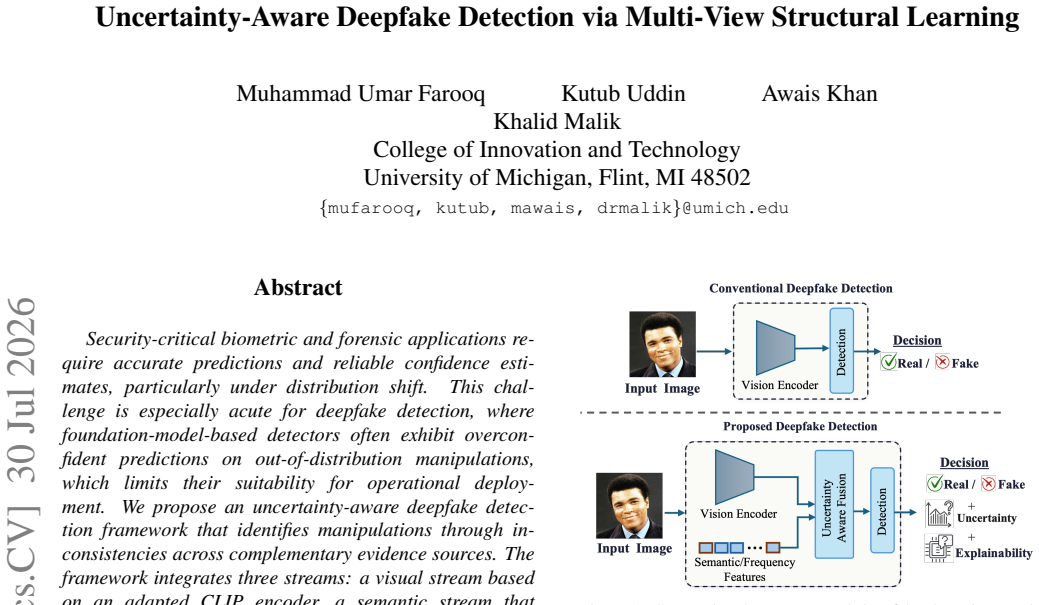
Security-critical biometric and forensic applications require accurate predictions and reliable confidence estimates, particularly under distribution shift. This challenge is especially acute for deepfake detection, where foundation-model-based detectors often exhibit overconfident predictions on out-of-distribution manipulations, which limits their suitability for operational deployment. We propose an uncertainty-aware deepfake detection framework that identifies manipulations through inconsistencies across complementary evidence sources. The framework integrates three streams: a visual stream based on an adapted CLIP encoder, a semantic stream that models consistency among facial attributes through differentiable constraints, and a structural stream that captures class-dependent dependency patterns between semantic and forensic features. To effectively combine these signals, we introduce Inter-Branch Disagreement Calibration (IBDC), a disagreement-aware uncertainty modeling mechanism that links predictive uncertainty to conflicts among evidence streams. Extensive cross-dataset experiments using FaceForensics++ as the training source demonstrate that the proposed framework achieves state-of-the-art generalization across multiple out-of-distribution benchmarks while consistently improving calibration and selective prediction performance. These results show that combining complementary evidence with disagreement-aware uncertainty provides a robust foundation for trustworthy and well-calibrated deepfake detection under distribution shift.
Figures


Reference graph
Works this paper leans on
-
[1]
FaceForen- sics++: Learning to detect manipulated facial images
Andreas R ¨ossler, Davide Cozzolino, Luisa Verdoliva, Chris- tian Riess, Justus Thies, and Matthias Nießner. FaceForen- sics++: Learning to detect manipulated facial images. In IEEE/CVF International Conference on Computer Vision (ICCV), pages 1–11, 2019
2019
-
[2]
The DeepFake Detection Challenge (DFDC) dataset.arXiv preprint arXiv:2006.07397, 2020
Brian Dolhansky, Joanna Bitton, Ben Pflaum, Jikuo Lu, Russ Howes, Menglin Wang, and Cristian Canton Ferrer. The DeepFake Detection Challenge (DFDC) dataset.arXiv preprint arXiv:2006.07397, 2020
Pith/arXiv arXiv 2006
-
[3]
Celeb-DF: A large-scale challenging dataset for DeepFake forensics
Yuezun Li, Xin Yang, Pu Sun, Honggang Qi, and Siwei Lyu. Celeb-DF: A large-scale challenging dataset for DeepFake forensics. InIEEE/CVF Conference on Computer Vision and Pattern Recognition (CVPR), pages 3207–3216, 2020
2020
-
[4]
A re- view of deepfake and its detection: from generative adver- sarial networks to diffusion models.International Journal of Intelligent Systems, 2025(1):9987535, 2025
Baoping Liu, Bo Liu, Tianqing Zhu, and Ming Ding. A re- view of deepfake and its detection: from generative adver- sarial networks to diffusion models.International Journal of Intelligent Systems, 2025(1):9987535, 2025
2025
-
[5]
Awais Khan, Khalid Mahmood Malik, James Ryan, and Mikul Saravanan. Battling voice spoofing: a review, com- parative analysis, and generalizability evaluation of state-of- the-art voice spoofing counter measures.Artificial Intelli- gence Review, 2023
2023
-
[6]
DiffSwap: High-fidelity and con- trollable face swapping via 3d-aware masked diffusion
Wenliang Zhao, Yongming Rao, Weikang Shi, Zuyan Liu, Jie Zhou, and Jiwen Lu. DiffSwap: High-fidelity and con- trollable face swapping via 3d-aware masked diffusion. In Proceedings of the IEEE/CVF Conference on Computer Vi- sion and Pattern Recognition (CVPR), pages 8568–8577, 2023
2023
-
[7]
Counter- act against gan-based attacks: A collaborative learning ap- proach for anti-forensic detection.Applied Soft Computing, 153:111287, 2024
Kutub Uddin, Tae Hyun Jeong, and Byung Tae Oh. Counter- act against gan-based attacks: A collaborative learning ap- proach for anti-forensic detection.Applied Soft Computing, 153:111287, 2024
2024
-
[8]
DF40: Toward next-generation deepfake detection
Zhiyuan Yan, Taiping Yao, Shen Chen, Yandan Zhao, Xinghe Fu, Junwei Zhu, Donghao Luo, Chengjie Wang, Shouhong Ding, Yunsheng Wu, and Li Yuan. DF40: Toward next-generation deepfake detection. InAdvances in Neural Information Processing Systems (NeurIPS), 2024
2024
-
[9]
Psa-net: Parallel stacked aggregation network for secure voice bio- metrics in iot-enabled consumer devices.IEEE Transactions on Consumer Electronics, 2026
Awais Khan, Ijaz Ul Haq, and Khalid M Malik. Psa-net: Parallel stacked aggregation network for secure voice bio- metrics in iot-enabled consumer devices.IEEE Transactions on Consumer Electronics, 2026
2026
-
[10]
Nusrat Tasnim, Kutub Uddin, and Khalid Mahmood Malik. Ai-generated image detection: An empirical study and future research directions.arXiv preprint arXiv:2511.02791, 2025
arXiv 2025
-
[11]
Trace: Training-free partial audio deepfake detection via em- bedding trajectory analysis of speech foundation models
Muhammad Umar Farooq, Kutub Uddin, Khalid Malik, et al. Trace: Training-free partial audio deepfake detection via em- bedding trajectory analysis of speech foundation models. In Proceedings of the IEEE/CVF Conference on Computer Vi- sion and Pattern Recognition, pages 7405–7414, 2026
2026
-
[12]
Deepfake detection that generalizes across benchmarks
Andrii Yermakov, Jan Cech, Jiri Matas, and Mario Fritz. Deepfake detection that generalizes across benchmarks. In Proceedings of the IEEE/CVF Winter Conference on Appli- cations of Computer Vision, pages 773–783, 2026
2026
-
[13]
Dual-branch gated fusion for open-set audio deepfake source tracing
Awais Khan, Kutub Uddin, and Khalid Malik. Dual-branch gated fusion for open-set audio deepfake source tracing. arXiv preprint arXiv:2606.10223, 2026
Pith/arXiv arXiv 2026
-
[14]
Face2parts: Exploring coarse-to-fine inter-regional facial de- pendencies for generalized deepfake detection.IEEE Access, 14:55111–55125, 2026
Kutub Uddin, Nusrat Tasnim, and Byung Tae Oh. Face2parts: Exploring coarse-to-fine inter-regional facial de- pendencies for generalized deepfake detection.IEEE Access, 14:55111–55125, 2026
2026
-
[15]
A robust open-set multi-instance learning for defending adversarial attacks in digital image.IEEE Trans- actions on Information Forensics and Security, 19:2098– 2111, 2023
Kutub Uddin, Yoonmo Yang, Tae Hyun Jeong, and Byung Tae Oh. A robust open-set multi-instance learning for defending adversarial attacks in digital image.IEEE Trans- actions on Information Forensics and Security, 19:2098– 2111, 2023
2098
-
[16]
Deepfake video detection: challenges and opportunities.Artificial Intelligence Review, 57(6):159, 2024
Achhardeep Kaur, Azadeh Noori Hoshyar, Vidya Saikrishna, Selena Firmin, and Feng Xia. Deepfake video detection: challenges and opportunities.Artificial Intelligence Review, 57(6):159, 2024
2024
-
[17]
Transferable adversarial attacks on audio deepfake detection
Muhammad Umar Farooq, Awais Khan, Kutub Uddin, and Khalid Mahmood Malik. Transferable adversarial attacks on audio deepfake detection. InProceedings of the Win- ter Conference on Applications of Computer Vision, pages 1640–1649, 2025
2025
-
[18]
Guard: Generative unmasking and adversarial-resistant deepfake detection using multi-model knowledge distillation.Authorea Preprints, 2025
Kutub Uddin, Nusrat Tasnim, Muhammad Saad Saeed, and Khalid Mahmood Malik. Guard: Generative unmasking and adversarial-resistant deepfake detection using multi-model knowledge distillation.Authorea Preprints, 2025
2025
-
[19]
Detecting deep- fakes with self-blended images
Kaede Shiohara and Toshihiko Yamasaki. Detecting deep- fakes with self-blended images. InIEEE/CVF Conference on Computer Vision and Pattern Recognition (CVPR), pages 18720–18729, 2022
2022
-
[20]
FreqBlender: Enhancing DeepFake de- tection by blending frequency knowledge
Hanzhe Li, Jiaran Zhou, Yuezun Li, Baoyuan Wu, Bin Li, and Junyu Dong. FreqBlender: Enhancing DeepFake de- tection by blending frequency knowledge. InAdvances in Neural Information Processing Systems (NeurIPS), 2024
2024
-
[21]
Multi-scale spatial frequency interaction variance perception model for deepfake face detection.Jour- nal of Visual Communication and Image Representation, page 104719, 2026
Yihang Wang, Shouxin Liu, Xudong Chen, Seok Tae Kim, and Xiaowei Li. Multi-scale spatial frequency interaction variance perception model for deepfake face detection.Jour- nal of Visual Communication and Image Representation, page 104719, 2026. Accepted at the IEEE/IAPR International Joint Conference on Biometrics (IJCB 2026)
2026
-
[22]
Advbench: A comprehensive benchmark of adversarial attacks on deepfake detectors in real-world consumer applications.Authorea Preprints, 2025
Kutub Uddin, Muhammad Umar Farooq, Awais Khan, Muhammad Saad Saeed, Ijaz Ul Haq, Nusrat Tasnim, and Khalid Mahmood Malik. Advbench: A comprehensive benchmark of adversarial attacks on deepfake detectors in real-world consumer applications.Authorea Preprints, 2025
2025
-
[23]
Multiple contexts and frequencies aggregation network for deepfake detection.PLoS One, 21(1):e0337409, 2026
Zifeng Li, Wenzhong Tang, Shijun Gao, Yanyang Wang, and Shuai Wang. Multiple contexts and frequencies aggregation network for deepfake detection.PLoS One, 21(1):e0337409, 2026
2026
-
[24]
Wenbo Xu, Wei Lu, Xiangyang Luo, and Jiantao Zhou. Mare: Multimodal alignment and reinforcement for explain- able deepfake detection via vision-language models.arXiv preprint arXiv:2601.20433, 2026
arXiv 2026
-
[25]
Nusrat Tasnim, Khalid Malik, et al. Grex-bench: Bench- marking generalization, robustness, and explainability in ai- generated image detection.https://doi.org/10.21203/rs.3.rs- 8633550/v1, 2026
-
[26]
Analysis of generative adversarial network targeting anti-forensic in jpeg compressed domain
Kutub Uddin, Yoonmo Yang, and Byung Tae Oh. Analysis of generative adversarial network targeting anti-forensic in jpeg compressed domain. InInternational Workshop on Ad- vanced Imaging Technology (IWAIT) 2021, volume 11766, pages 627–631. SPIE, 2021
2021
-
[27]
Ucf: Uncovering common features for generalizable deep- fake detection
Zhiyuan Yan, Yong Zhang, Yanbo Fan, and Baoyuan Wu. Ucf: Uncovering common features for generalizable deep- fake detection. InProceedings of the IEEE/CVF Interna- tional Conference on Computer Vision (ICCV), 2023
2023
-
[28]
Transcending forgery specificity with latent space augmentation for generalizable deepfake detection
Zhiyuan Yan, Yuhao Luo, Siwei Lyu, Qingshan Liu, and Baoyuan Wu. Transcending forgery specificity with latent space augmentation for generalizable deepfake detection. In Proceedings of the IEEE/CVF Conference on Computer Vi- sion and Pattern Recognition (CVPR), 2024
2024
-
[29]
Lips don’t lie: A generalisable and robust approach to face forgery detection
Alexandros Haliassos, Konstantinos V ougioukas, Stavros Petridis, and Maja Pantic. Lips don’t lie: A generalisable and robust approach to face forgery detection. InProceed- ings of the IEEE/CVF Conference on Computer Vision and Pattern Recognition (CVPR), 2021
2021
-
[30]
Omnidf: A unified model for uni- modal and multimodal deepfake detection
Muhammad Saad Saeed. Omnidf: A unified model for uni- modal and multimodal deepfake detection. Master’s thesis, University of Michigan-Flint, 2026
2026
-
[31]
Kutub Uddin, Muhammad Umar Farooq, Awais Khan, and Khalid Mahmood Malik. Adversarial attacks on audio deep- fake detection: A benchmark and comparative study.arXiv preprint arXiv:2509.07132, 2025
Pith/arXiv arXiv 2025
-
[32]
Exploring temporal coherence for more gen- eral video face forgery detection
Yinglin Zheng, Jianmin Bao, Dong Chen, Ming Zeng, and Fang Wen. Exploring temporal coherence for more gen- eral video face forgery detection. InProceedings of the IEEE/CVF International Conference on Computer Vision (ICCV), 2021
2021
-
[33]
Gener- alizing face forgery detection with high-frequency features
Yuchen Luo, Yong Zhang, Junchi Yan, and Wei Liu. Gener- alizing face forgery detection with high-frequency features. InIEEE/CVF Conference on Computer Vision and Pattern Recognition (CVPR), pages 16317–16326, 2021
2021
-
[34]
Thinking in frequency: Face forgery detection by mining frequency-aware clues
Yuyang Qian, Guojun Yin, Lu Sheng, Zixuan Chen, and Jing Shao. Thinking in frequency: Face forgery detection by mining frequency-aware clues. InEuropean Conference on Computer Vision (ECCV), pages 86–103, 2020
2020
-
[35]
Frame-to-utterance convergence: A spectra-temporal ap- proach for unified spoofing detection
Awais Khan, Khalid Mahmood Malik, and Shah Nawaz. Frame-to-utterance convergence: A spectra-temporal ap- proach for unified spoofing detection. InICASSP 2024-2024 IEEE International Conference on Acoustics, Speech and Signal Processing (ICASSP), pages 10761–10765. IEEE, 2024
2024
-
[36]
Sheild: A secure and highly enhanced integrated learning for robust deepfake detection against adversarial attacks
Kutub Uddin, Awais Khan, Muhammad Umar Farooq, and Khalid Mahmood Malik. Sheild: A secure and highly enhanced integrated learning for robust deepfake detection against adversarial attacks. InProceedings of the IEEE/CVF International Conference on Computer Vision, pages 1502– 1511, 2025
2025
-
[37]
Face X-Ray for more general face forgery detection
Lingzhi Li, Jianmin Bao, Ting Zhang, Hao Yang, Dong Chen, Fang Wen, and Baining Guo. Face X-Ray for more general face forgery detection. InIEEE/CVF Conference on Computer Vision and Pattern Recognition (CVPR), pages 5001–5010, 2020
2020
-
[38]
Muhammad Umar Farooq, Ali Javed, Khalid Mahmood Ma- lik, and Muhammad Anas Raza. A lightweight and in- terpretable deepfakes detection framework.arXiv preprint arXiv:2501.11927, 2025
Pith/arXiv arXiv 2025
-
[39]
Can we leave deepfake data behind in training deepfake detector? InAdvances in Neural Information Processing Systems (NeurIPS), 2024
Jikang Cheng, Zhiyuan Yan, Ying Zhang, Yuhao Luo, Zhongyuan Wang, and Chen Li. Can we leave deepfake data behind in training deepfake detector? InAdvances in Neural Information Processing Systems (NeurIPS), 2024
2024
-
[40]
Muhammad Saad Saeed, Ijaz Ul Haq, and Khalid Malik. Re- alism to deception: Investigating deepfake detectors against face enhancement.arXiv preprint arXiv:2509.07178, 2025
Pith/arXiv arXiv 2025
-
[41]
Generalized deepfake detection using identity, behavioral, and geometric signatures.IEEE Transactions on Computational Social Systems, 2025
Muhammad Umar Farooq, Awais Khan, Ijaz Ul Haq, and Khalid Mahmood Malik. Generalized deepfake detection using identity, behavioral, and geometric signatures.IEEE Transactions on Computational Social Systems, 2025
2025
-
[42]
Spotnet: A spoofing-aware transformer network for effective synthetic speech detection
Awais Khan and Khalid Mahmood Malik. Spotnet: A spoofing-aware transformer network for effective synthetic speech detection. InProceedings of the 2nd ACM Interna- tional Workshop on Multimedia AI against Disinformation, pages 10–18, 2023
2023
-
[43]
Toward realigning automatic speaker veri- fication in the era of covid-19.Sensors, 22(7):2638, 2022
Awais Khan, Ali Javed, Khalid Mahmood Malik, Muham- mad Anas Raza, James Ryan, Abdul Khader Jilani Saudagar, and Hafiz Malik. Toward realigning automatic speaker veri- fication in the era of covid-19.Sensors, 22(7):2638, 2022
2022
-
[44]
Domain-adaptive repre- sentation learning for multimodal deepfake detection.IEEE Transactions on Computational Social Systems, 2025
Ijaz Ul Haq and Khalid M Malik. Domain-adaptive repre- sentation learning for multimodal deepfake detection.IEEE Transactions on Computational Social Systems, 2025
2025
-
[45]
Ruleboost: A neuro-symbolic framework for robust deepfake detection
Muhammad Anas Raza, Khalid Mahmood Malik, and Ijaz Ul Haq. Ruleboost: A neuro-symbolic framework for robust deepfake detection. In2024 IEEE International Joint Con- ference on Biometrics (IJCB), pages 1–10. IEEE, 2024
2024
-
[46]
Aunet: Learning relations between action units for face forgery detection
Weiming Bai, Yufan Liu, Zhipeng Zhang, Bing Li, and Weiming Hu. Aunet: Learning relations between action units for face forgery detection. InProceedings of the IEEE/CVF Conference on Computer Vision and Pattern Recognition (CVPR), 2023. Accepted at the IEEE/IAPR International Joint Conference on Biometrics (IJCB 2026)
2023
-
[47]
To- wards reliable deepfake detection from uncertainty calibra- tion perspective.Visual Intelligence, 3(1):28, 2025
Xiaoxu Jin, Weinan Guan, Wei Wang, and Jing Dong. To- wards reliable deepfake detection from uncertainty calibra- tion perspective.Visual Intelligence, 3(1):28, 2025
2025
-
[48]
Learning transferable vi- sual models from natural language supervision
Alec Radford, Jong Wook Kim, Chris Hallacy, Aditya Ramesh, Gabriel Goh, Sandhini Agarwal, Girish Sastry, Amanda Askell, Pamela Mishkin, Jack Clark, Gretchen Krueger, and Ilya Sutskever. Learning transferable vi- sual models from natural language supervision. InInter- national Conference on Machine Learning (ICML), pages 8748–8763, 2021
2021
-
[49]
Nusrat Tasnim, Kutub Uddin, and Khalid Malik. Diversity matters: Dataset diversification and dual-branch network for generalized ai-generated image detection.arXiv preprint arXiv:2603.27800, 2026
arXiv 2026
-
[50]
Clipping the deception: Adapting vision-language models for univer- sal deepfake detection
Sohail Ahmed Khan and Duc-Tien Dang-Nguyen. Clipping the deception: Adapting vision-language models for univer- sal deepfake detection. InProceedings of the International Conference on Multimedia Retrieval (ICMR), 2024
2024
-
[51]
Forensics adapter: Adapting clip for generalizable face forgery detection
Xinjie Cui, Yuezun Li, Delong Luo, Jiaran Zhou, and Junyu Dong. Forensics adapter: Adapting clip for generalizable face forgery detection. InProceedings of the IEEE/CVF Conference on Computer Vision and Pattern Recognition (CVPR), 2025
2025
-
[52]
Towards more general video-based deep- fake detection through facial component guided adaptation for foundation model
Yue Lin et al. Towards more general video-based deep- fake detection through facial component guided adaptation for foundation model. InAdvances in Neural Information Processing Systems (NeurIPS), 2024
2024
-
[53]
Exploring unbiased deepfake detection via token-level shuffling and mixing
Zhiyuan Yan et al. Exploring unbiased deepfake detection via token-level shuffling and mixing. InAdvances in Neural Information Processing Systems (NeurIPS), 2024
2024
-
[54]
Orthogonal subspace decomposition for generalizable ai-generated image detection
Zhiyuan Yan et al. Orthogonal subspace decomposition for generalizable ai-generated image detection. InAdvances in Neural Information Processing Systems (NeurIPS), 2024
2024
-
[55]
Kutub Uddin, Nusrat Tasnim, Awais Khan, Moham- mad Umar Farooq, and Khalid Malik. Do transforma- tions reveal the truth? generative residual learning for generalized ai-generated image detection.arXiv preprint arXiv:2607.08674, 2026
Pith/arXiv arXiv 2026
-
[56]
Securing voice biometrics: One-shot learning approach for audio deepfake detection
Awais Khan and Khalid Mahmood Malik. Securing voice biometrics: One-shot learning approach for audio deepfake detection. In2023 IEEE international workshop on informa- tion forensics and security (WIFS), pages 1–6. IEEE, 2023
2023
-
[57]
Standing on the shoulders of giants: Reprogramming visual-language model for general deepfake detection
Kaede Bhattacharya et al. Standing on the shoulders of giants: Reprogramming visual-language model for general deepfake detection. InProceedings of the AAAI Conference on Artificial Intelligence, 2024
2024
-
[58]
Choose your expert: Uncertainty-guided expert selec- tion for continual deepfake detection
Xueyi Zhang, Peiyin Zhu, Jinping Sui, Xiaoda Yang, Ji- ahe Tian, Mingrui Lao, Siqi Cai, Yanming Guo, and Jun Tang. Choose your expert: Uncertainty-guided expert selec- tion for continual deepfake detection. InProceedings of the 33rd ACM International Conference on Multimedia, pages 11502–11511, 2025
2025
-
[59]
Evi- dential deep learning to quantify classification uncertainty
Murat Sensoy, Lance Kaplan, and Melih Kandemir. Evi- dential deep learning to quantify classification uncertainty. InAdvances in Neural Information Processing Systems (NeurIPS), 2018
2018
-
[61]
Trusted multi-view classification with dynamic evi- dential fusion.IEEE Transactions on Pattern Analysis and Machine Intelligence, 45(2):2551–2566, 2022
Zongbo Han, Changqing Zhang, Huazhu Fu, and Joey Tianyi Zhou. Trusted multi-view classification with dynamic evi- dential fusion.IEEE Transactions on Pattern Analysis and Machine Intelligence, 45(2):2551–2566, 2022
2022
-
[62]
Reliable conflictive multi-view learning
Cai Xu, Jiajun Si, Ziyu Guan, Wei Zhao, Yue Wu, and Xiyue Gao. Reliable conflictive multi-view learning. InProceed- ings of the AAAI Conference on Artificial Intelligence, vol- ume 38, pages 16129–16137, 2024
2024
-
[63]
Toward causal representation learning.Pro- ceedings of the IEEE, 109(5):612–634, 2021
Bernhard Sch ¨olkopf, Francesco Locatello, Stefan Bauer, Nan Rosemary Ke, Nal Kalchbrenner, Anirudh Goyal, and Yoshua Bengio. Toward causal representation learning.Pro- ceedings of the IEEE, 109(5):612–634, 2021
2021
-
[64]
DAGMA: Learning DAGs via M-matrices and a log- determinant acyclicity characterization
Kevin Bello, Bryon Aragam, and Pradeep Ravikumar. DAGMA: Learning DAGs via M-matrices and a log- determinant acyclicity characterization. InAdvances in Neu- ral Information Processing Systems (NeurIPS), volume 35, 2022
2022
-
[65]
Friesen.Facial Action Coding System: A Technique for the Measurement of Facial Move- ment
Paul Ekman and Wallace V . Friesen.Facial Action Coding System: A Technique for the Measurement of Facial Move- ment. Consulting Psychologists Press, Palo Alto, CA, 1978
1978
-
[66]
Evi- dential deep learning to quantify classification uncertainty
Murat Sensoy, Lance Kaplan, and Melih Kandemir. Evi- dential deep learning to quantify classification uncertainty. InAdvances in Neural Information Processing Systems (NeurIPS), volume 31, pages 3179–3189, 2018
2018
-
[67]
Trusted multi-view classification
Zongbo Han, Changqing Zhang, Huazhu Fu, and Joey Tianyi Zhou. Trusted multi-view classification. InInternational Conference on Learning Representations (ICLR), 2021
2021
-
[68]
Libreface: An open-source toolkit for deep facial expression analysis
Di Chang, Yufeng Yin, Zongjian Li, Minh Tran, and Mo- hammad Soleymani. Libreface: An open-source toolkit for deep facial expression analysis. InProceedings of the IEEE/CVF Winter Conference on Applications of Computer Vision (WACV), pages 8205–8215, 2024
2024
-
[69]
Face x-ray for more gen- eral face forgery detection
Lingzhi Li, Jianmin Bao, Ting Zhang, Hao Yang, Dong Chen, Fang Wen, and Baining Guo. Face x-ray for more gen- eral face forgery detection. InProceedings of the IEEE/CVF Conference on Computer Vision and Pattern Recognition (CVPR), 2020
2020
-
[70]
Rich models for steganal- ysis of digital images.IEEE Transactions on Information Forensics and Security, 7(3):868–882, 2012
Jessica Fridrich and Jan Kodovsky. Rich models for steganal- ysis of digital images.IEEE Transactions on Information Forensics and Security, 7(3):868–882, 2012
2012
-
[71]
Watch your up-convolution: Cnn based generative deep neural net- works are failing to reproduce spectral distributions
Ricard Durall, Margret Keuper, and Janis Keuper. Watch your up-convolution: Cnn based generative deep neural net- works are failing to reproduce spectral distributions. InPro- ceedings of the IEEE/CVF Conference on Computer Vision and Pattern Recognition (CVPR), 2020
2020
-
[72]
Leveraging fre- quency analysis for deep fake image recognition
Joel Frank, Thorsten Eisenhofer, Lea Sch ¨onherr, Asja Fis- cher, Dorothea Kolossa, and Thorsten Holz. Leveraging fre- quency analysis for deep fake image recognition. InInterna- tional Conference on Machine Learning (ICML), 2020. Accepted at the IEEE/IAPR International Joint Conference on Biometrics (IJCB 2026)
2020
-
[73]
Improving model calibration with accuracy versus uncertainty optimization
Ranganath Krishnan and Omesh Tickoo. Improving model calibration with accuracy versus uncertainty optimization. InAdvances in Neural Information Processing Systems (NeurIPS), 2020
2020
-
[74]
Towards more general video-based deepfake detection through facial component guided adaptation for foundation model
Yue-Hua Han, Tai-Ming Huang, Kai-Lung Hua, and Jun- Cheng Chen. Towards more general video-based deepfake detection through facial component guided adaptation for foundation model. InProceedings of the IEEE/CVF Confer- ence on Computer Vision and Pattern Recognition (CVPR), pages 22995–23005, 2025
2025
-
[75]
FSFM: A generalizable face se- curity foundation model via self-supervised facial represen- tation learning
Gaojian Wang, Feng Lin, Tong Wu, Zhenguang Liu, Zhongjie Ba, and Kui Ren. FSFM: A generalizable face se- curity foundation model via self-supervised facial represen- tation learning. InProceedings of the IEEE/CVF Conference on Computer Vision and Pattern Recognition (CVPR), pages 24364–24376, 2025
2025
-
[76]
Orthogonal subspace decomposi- tion for generalizable AI-generated image detection
Zhiyuan Yan, Jiangming Wang, Peng Jin, Ke-Yue Zhang, Chengchun Liu, Shen Chen, Taiping Yao, Shouhong Ding, Baoyuan Wu, and Li Yuan. Orthogonal subspace decomposi- tion for generalizable AI-generated image detection. InPro- ceedings of the International Conference on Machine Learn- ing (ICML), 2025
2025
-
[77]
Yuezun Li, Delong Zhu, Xinjie Cui, and Siwei Lyu. Celeb-DF++: A large-scale challenging video deepfake benchmark for generalizable forensics.arXiv preprint arXiv:2507.18015, 2025
Pith/arXiv arXiv 2025
-
[78]
The deepfake detec- tion challenge (DFDC) preview dataset.arXiv preprint arXiv:1910.08854, 2019
Brian Dolhansky, Russ Howes, Ben Pflaum, Nicole Baram, and Cristian Canton Ferrer. The deepfake detec- tion challenge (DFDC) preview dataset.arXiv preprint arXiv:1910.08854, 2019
Pith/arXiv arXiv 1910
-
[79]
Contributing data to deepfake detection research.https : / / research
Nick Dufour and Andrew Gully. Contributing data to deepfake detection research.https : / / research . google / blog / contributing - data - to - deepfake - detection - research/,
-
[80]
DeepfakeBench: A comprehensive bench- mark of deepfake detection
Zhiyuan Yan, Yong Zhang, Xinhang Yuan, Siwei Lyu, and Baoyuan Wu. DeepfakeBench: A comprehensive bench- mark of deepfake detection. InAdvances in Neural Infor- mation Processing Systems (NeurIPS) Datasets and Bench- marks Track, 2023
2023
-
[81]
Spatial- phase shallow learning: rethinking face forgery detection in frequency domain
Honggu Liu, Xiaodan Li, Wenbo Zhou, Yuefeng Chen, Yuan He, Hui Xue, Weiming Zhang, and Nenghai Yu. Spatial- phase shallow learning: rethinking face forgery detection in frequency domain. InProceedings of the IEEE/CVF con- ference on computer vision and pattern recognition, pages 772–781, 2021
2021
discussion (0)
Sign in with ORCID, Apple, or X to comment. Anyone can read and Pith papers without signing in.