REVIEW 3 major objections 5 minor 49 references
This paper claims that off-the-shelf vision-language models, with no task- or robot-specific training, can coordinate a heterogeneous team of two drones and a mobile manipulator through unknown environments to execute ambiguous instructions
Reviewed by Pith at T0; open to challenge. T0 means a machine referee read the full paper against a public rubric. the ladder, T0–T4 →
T0 review · deepseek-v4-flash
2026-08-04 03:09 UTC pith:KLSSFVFI
load-bearing objection A solid integration of known ideas into a zero-shot heterogeneous multi-robot loop, but the headline success numbers rely on the system's own VLM to call mission complete. the 3 major comments →
D-VLC: Decentralized Vision-Language Collaboration for Heterogeneous Embodied Multi-Robot Systems in Unknown Environments
The pith
A machine-rendered reading of the paper's core claim, the machinery that carries it, and where it could break.
Core claim
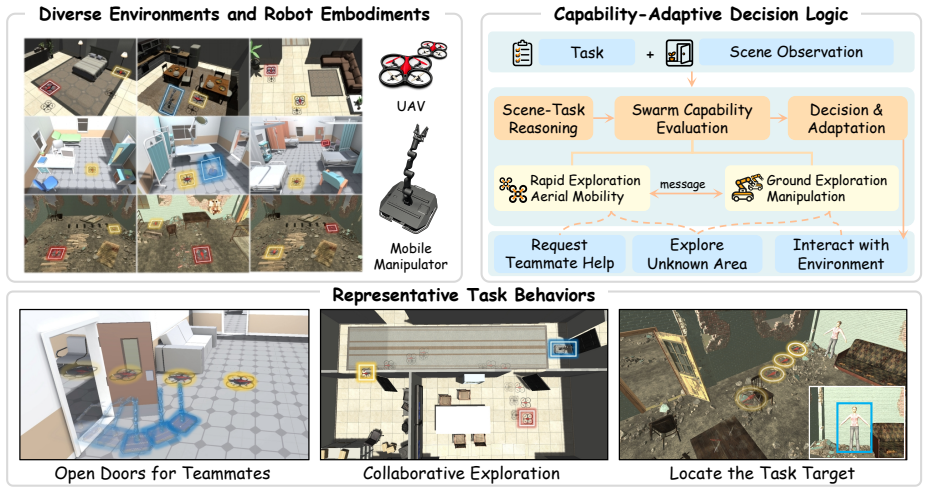
The central claim is that decentralized asynchronous vision-language reasoning, mediated by a compact shared spatial memory, is sufficient to turn general-purpose VLMs into cooperative embodied agents for heterogeneous teams. Concretely, the paper argues that two aerial robots and one mobile manipulator, without task-specific training, can interpret ambiguous instructions, visually ground objects and doors, request capability-appropriate assistance, and decide when the whole task is finished. The evidence is simulated trials in home, hospital, and post-disaster scenes, where the D-VLC pipeline achieves success rates of 76.7% to 90.0% across different VLMs and reduces completion time by up to
What carries the argument
The load-bearing interface is a bounded 640x480 mini-map that fuses geometry, room semantics, robot positions, exploration candidates, and teammate goals into a single VLM-readable image. This mini-map, together with a structured action interface and capability-conditioned prompts, lets the VLM choose exploration targets, ground task objects, and request help without shipping long raw sensor streams to the model. The second key piece is the decentralized perception-reasoning-action loop, where each robot independently runs its own VLM decision cycle and asynchronously broadcasts only compact updates; this replaces synchronized centralized rounds with local, event-driven collaboration.
Load-bearing premise
The reported success rates assume that the VLM's own judgment that the task is complete—via the mission-termination check in Algorithm 1—is a reliable measure of real task completion; if that check prematurely concludes success, the 70%-90% figures would overstate what the robots actually accomplished.
What would settle it
Replay the recorded trials (or replay the logs) with an independent judge who verifies from ground-truth simulator state or human review that every named target was actually found and all required manipulation was actually completed. If a substantial share of trials that D-VLC marked 'task_over=true' fail that external check, the central success-rate claim collapses.
If this is right
- If the framework is right, natural-language instructions can directly drive heterogeneous robot teams in novel environments, removing the need to program task logic in advance.
- VLM-driven teams can execute multi-target tasks that require physical interaction (like opening doors) in addition to search, because capability-aware assistance redirects infeasible actions to the right teammate.
- The same pipeline works across different general-purpose VLMs without re-training, so progress in off-the-shelf vision-language models should translate directly into improved multi-robot teams.
- Task- and capability-conditioned exploration can cut wasted movement: the mobile manipulator's decision burden dropped substantially relative to a geometry-only baseline, letting the slow robot focus on interaction-dependent subtasks.
Where Pith is reading between the lines
- The reported success rates are likely optimistic because task completion is judged by the system's own VLM-based termination check; an independent oracle or human verification of recorded trials would be needed to confirm that targets were genuinely found and doors actually opened.
- The mini-map abstraction suggests a broader design pattern: compress the world into a small shared visual state for the VLM rather than feeding raw sensor data, a principle that could extend to bandwidth-limited or long-horizon embodied tasks.
- The reliability-efficiency tradeoff across VLM backbones (some use fewer high-level decisions yet barely shorten wall-clock time) implies that backbone choice for deployment should be driven by application-specific costs, not solely by success rate.
- The paper leaves direct measurements of communication bandwidth and memory savings to future work, so the claimed 'lightweight' sharing benefits remain plausible but unquantified under packet loss or larger teams.
Editorial analysis
A structured set of objections, weighed in public.
Referee Report
Summary. The paper proposes D-VLC, a decentralized framework for heterogeneous multi-robot teams (two UAVs and one mobile manipulator) executing ambiguous natural-language instructions in unknown environments. Each robot runs an independent VLM-based perception–reasoning–action loop (Eqs. (4)–(7)) using a bounded shared mini-map, geometric and semantic exploration candidates, capability-aware assistance requests, and learning-free low-level motion experts. Task initialization uses a one-time shared leader–follower consensus stage, while online execution is asynchronous and decentralized. Experiments in Unity/ROS across three task–scene pairs with five VLM backbones report success rates of 76.7–90.0% versus 66.7% for a geometric greedy baseline, with completion-time reductions of up to 55.8%. The paper also includes a capability-coverage table and qualitative diagnostics for relation-based grasping and clock reading.
Significance. If the empirical claims hold, D-VLC would be a valuable step toward zero-shot, VLM-driven heterogeneous coordination without task- or robot-specific training. The architecture has several genuine strengths: a clean separation between VLM high-level decisions and learning-free experts, a bounded spatial memory that does not grow with scene complexity, asynchronous information exchange, and system-level evaluation across multiple VLM backbones. The paper is also unusually explicit about its own limitations (e.g., no direct communication-bandwidth measurements, one shared initialization stage, single greedy baseline). The central quantitative claim, however, currently rests on a success criterion that is assessed by the system itself, and the reported differences are not supported by confidence intervals or significance tests. These issues must be addressed before the headline results can be regarded as established.
major comments (3)
- [Experiments — Experimental Setup and Evaluation Protocol; Algorithm 1; Appendix 'Mission-Termination Judgement'] The success metric is self-assessed. The protocol states 'A trial succeeds only if every requested target is found and all required access or manipulation is completed,' but the only completion check in the system is Algorithm 1 line 15, CHECKDONE, implemented by the PROMPT_TYPE_TASK_OVER_PREDICTION prompt. That prompt takes key_action_history and my_current_observation, both produced by the same VLM pipeline. A false-positive detection from DETECTOBJ or the multi-view verification prompt can be written into key_action_history and propagate directly to task_over=true. The failure-analysis section explicitly says trial records 'were not uniformly annotated at that level,' and no independent oracle, simulator ground-truth check, or post-hoc human verification is described anywhere in the paper. Since CT and step statistics are computed only over successful trials, premature self-terminatio
- [Table 1 and 'Cross-Scenario Task Execution'] The quantitative evidence is statistically weak as reported. SR is a point estimate from 30 trials per method with no confidence intervals or significance tests; for example, 26/30 vs. 20/30 (86.7% vs. 66.7%) is not self-evidently significant with n=30. CT differences are also reported as point means with large standard deviations (e.g., Gemini-3.5-Flash: 368.5±88.7 s vs. Greedy: 377.2±196.2 s, ΔCT 2.3%). The caption says 'three task–scene pairs and 30 trials per method,' which is ambiguous: if this means 30 trials total across three scenarios, that is only 10 per scenario per method and the SR estimates are very noisy. Clarify the per-scenario/per-pair trial count and provide confidence intervals or a significance test for the SR and CT comparisons.
- [Component Analysis and Ablation Study, Table 3, Figure 5] The section titled 'Ablation Study' does not provide quantitative ablation results. Table 2 is a qualitative capability checklist rather than an experimental comparison, and Table 3/Figure 5 report only pass/fail symbols (✓/×) for three diagnostic tasks without success rates, trial counts, or statistical support. The text states that the framework 'successfully grounds targets and generates executable actions' and that these results 'demonstrate that existing methods lack essential components,' but the evidence is anecdotal. The paper already acknowledges that controlled component ablations are future work; the text should be revised to avoid claiming necessity of components on the basis of the current qualitative diagnostics.
minor comments (5)
- [Experimental Setup] The 'run budget' in the success criterion is not given a numerical value. Please state the time or step budget per scenario, or point to the supplementary material where it is specified.
- [Table 1] Please report the number of successful trials per method alongside SR, since CT and step statistics are computed over successful trials only. Currently the reader cannot tell how many trials each mean is based on.
- [Prompt Design and Implementation] The appendix notes a fallback to text-only requests when image encoding fails. If this fallback occurred in any reported trial, it should be disclosed per method/backbone, since it weakens the claim of VLM-based visual grounding.
- [Figure 5] The diagnostic tasks (appearance grasping, relational grasping, clock reading) are described only by cartoon-like vignettes in the figure. Please add a short description of the experimental setup for each task, including the number of trials and the criterion for a '✓'.
- [Overall] The paper would benefit from a reproducibility statement indicating whether code, prompts, and the full set of trial records will be released. The appendix provides detailed prompts, which is good, but no pointer to code or data is given.
Circularity Check
Headline success-rate and completion-time metrics are decided by the system's own mission-termination VLM, not by an external oracle.
specific steps
-
self definitional
[Algorithm 1 line 15; Experiments: 'Experimental Setup and Evaluation Protocol'; Appendix: 'Mission-Termination Judgement']
"Algorithm 1: ... 15: f tc ← CHECKDONE(T o, G, Hi,t+1) ... 'A trial succeeds only if every requested target is found and all required access or manipulation is completed within the run budget.' ... 'Set task_over to true if overall_task has been completed.'"
Algorithm 1 line 15 calls CHECKDONE, a VLM prompt returning task_over from key_action_history and my_current_observation—both artifacts of the same VLM detection/summarization pipeline. A trial 'succeeds' only when this self-check says task_over=true; no external oracle or ground-truth verification is described, and the paper concedes trial records 'were not uniformly annotated at that level.' A false-positive detection propagates into key_action_history and can terminate the mission early. Since SR is defined by this check and CT is averaged over successful trials only, such premature termination inflates both the headline >70% SR and the 55.8% CT reduction. The central quantitative claim therefore reduces, by construction, to the system's own completion judgment.
full rationale
The paper's algorithmic derivation is otherwise self-contained: Eqs. (6)–(10) separate VLM decisions from learning-free experts, the geometric candidate extraction is a standard frontier-style procedure, no parameter is fitted to the reported success rates, and the self-citations used for low-level planners are not load-bearing for the central generalization claim. The single circular structure is in the evaluation: 'success' is not independently verified but is decided by the system's own mission-termination VLM. A false-positive detection is written into key_action_history, and CHECKDONE is instructed to set task_over=true based on that history and a self-summarized observation. Because SR is defined through this check and CT is computed only on successful trials, a premature or hallucinated termination directly inflates both headline numbers. The paper's admission that trial records were not uniformly annotated confirms the absence of an external label. This is partial circularity in the headline metric (score 6), not a fully circular derivation: the robots do execute real exploration and manipulation, and the greedy baseline uses the same self-assessed criterion, so the relative comparison retains some independent content.
Axiom & Free-Parameter Ledger
free parameters (5)
- Gap-size thresholds g_min and g_max =
unspecified
- Ray-extension factor alpha =
unspecified
- Geometry filtering thresholds tau_w, tau_c, tau_p, tau_m, tau_dist =
unspecified
- Mini-map resolution 640x480 =
640x480
- Run budget =
not stated
axioms (6)
- domain assumption Off-the-shelf VLMs reliably parse text+image prompts into valid JSON decisions and select IDs from the provided candidate set.
- domain assumption The rendered 640x480 mini-map is a sufficient visual input for spatial reasoning.
- domain assumption Simulation in Unity with ROS1 and fixed initial poses represents unknown-environment deployment.
- ad hoc to paper Hand-written capability descriptions S_all accurately capture robot abilities.
- ad hoc to paper Hand-set thresholds and prompt rules are adequate across environments.
- standard math Morphological segmentation produces room-like regions useful for semantic labeling.
read the original abstract
Multi-robot systems, particularly heterogeneous robot swarms, can improve the efficiency of complex task execution through parallel collaboration and complementary capabilities. However, conventional rule-based methods rely on predefined task models and specialized decision making programs, making it difficult to understand complex semantic instructions and coordinate heterogeneous robots. LLMs introduce strong language understanding and task reasoning capabilities, allowing multi-robot systems to interpret instructions, decompose tasks, and assign roles according to task semantics. VLMs further incorporate visual perception, enabling robots to reason about objects, regions, and spatial relationships in physical environments. Nevertheless, existing LLM/VLM based methods often depend on known maps, centralized and synchronized decision making, limiting their generalization to heterogeneous robots and unseen tasks. We therefore propose a framework that combines decentralized asynchronous reasoning, lightweight information sharing, capability aware collaboration, and a unified action interface, enabling general purpose VLMs to generate robot specific actions executed by learning free experts without task or robot specific training. Experiments across diverse scenarios and multiple VLMs show success rates above 70\%, with completion time reduced by up to 55.8\% relative to the geometric greedy baseline.
Figures


Reference graph
Works this paper leans on
-
[1]
a long and narrow area,
Infers the area's general shape from its `dimensions`(e.g., "a long and narrow area," "a square-shaped area"). ,→ ,→
-
[2]
a sofa facing a television,
Where logical, **briefly infers simple spatial relationships** between objects to aid in reasoning (e.g., "a sofa facing a television," "six chairs arranged around a large table"). ,→ ,→ ,→ ,→ - **Exclusion**: The description **must not** under any circumstances include the specific`x,y` coordinate data of the objects. ,→ ,→ - **Requirement**: This field ...
-
[3]
,→ ,→ - **Classify as "Office" if:**
**Supporting Evidence**: The presence of a `'whiteboard'`or`'projector'`strongly supports this classification. ,→ ,→ - **Classify as "Office" if:**
-
[4]
Xu, W.; Cai, Y .; He, D.; Lin, J.; and Zhang, F
TopAY: Efficient Trajectory Planning for Differen- tial Drive Mobile Manipulators via Topological Paths Search and Arc Length-Yaw Parameterization.arXiv preprint arXiv:2507.02761. Xu, W.; Cai, Y .; He, D.; Lin, J.; and Zhang, F. 2022. Fast- lio2: Fast direct lidar-inertial odometry.IEEE Transactions on Robotics, 38(4): 2053–2073. Yin, L.; Ren, Y .; Zhu, F...
arXiv 2022
-
[5]
If no target is clearly better, select the valid target that is not in`teammate_ids`and is closest to the yellow cross or red circle. ,→ ,→
-
[6]
explore_area_id
Special case: if the number of`candidate_ids`is smaller than the current number of robots, a target contained in`teammate_ids`may be selected. ,→ ,→ ,→ Step 4. Validate Before Output -`explore_area_id`must belong to`candidate_ids`. - Do not output any number outside`candidate_ids`. Output only strict JSON and minimize reasoning time: { "explore_area_id": ...
-
[8]
**Primary Criterion**: The area **lacks** personal, long-term work equipment like `'computer'`or`'laptop'`. ,→ ,→
-
[9]
,→ ,→ ,→
**Secondary Criterion**: The central furniture supports group activities, such as a large`'table'`surrounded by multiple `'chair'`s. ,→ ,→ ,→
-
[11]
**Primary Criterion**: The area contains one or more devices indicating individual work, such as`'computer'`or`'laptop'`. ,→ ,→
-
[12]
,→ ,→ ,→
**Secondary Criterion**: Furniture consists of individual`'desk'`s, or if a shared table is used, the presence of personal devices defines its function as a workspace. ,→ ,→ ,→
-
[13]
when in doubt
**Supporting Evidence**: The presence of `'file cabinet'`s or`'bookshelf'`s supports this classification. ,→ ,→ --- Task-Relevant Room or Object Selection Purpose.This prompt acts as a conservative semantic router. Given the overall mission and accumulated seman- tic observations, it selects a directly relevant room, selects a directly relevant object, or...
-
[14]
You must automatically identify the primary objects involved in the task, as well as any necessary supporting items or tools, and decompose the task into specific subtasks
Requirement Enumeration: After receiving a task, you must first identify **all physical prerequisites** required to complete it. You must automatically identify the primary objects involved in the task, as well as any necessary supporting items or tools, and decompose the task into specific subtasks. ,→ ,→ ,→ ,→ ,→ ,→
-
[15]
,→ ,→ ,→ You must not decompose the task into operations that cannot be completed by the current robot swarm, namely actions outside`function`
Capability Boundaries: You need to understand the capabilities and limitations of each robot based on `swarm_situations`, and you may only output operations listed in`function`. ,→ ,→ ,→ You must not decompose the task into operations that cannot be completed by the current robot swarm, namely actions outside`function`. ,→ ,→ The final task decomposition ...
-
[16]
,→ ,→ ,→ # Constraints
Feedback Consideration: Incorporate the feedback information in `task_chat`and appropriately revise the task decomposition while satisfying the previous requirements. ,→ ,→ ,→ # Constraints
-
[17]
It is strictly prohibited to decompose the task into searching for raw materials or fictional and nonexistent objects
Finished Products and Supplies: The target objects must be common real-world items typically found in household environments. It is strictly prohibited to decompose the task into searching for raw materials or fictional and nonexistent objects. ,→ ,→ ,→ ,→
-
[18]
Each subtask must include both a **specific operation, such as searching or interaction**, and a **specific object**
Formatting Requirements: The output should consist of multiple subtasks. Each subtask must include both a **specific operation, such as searching or interaction**, and a **specific object**. The Role does not need to be included. ,→ ,→ ,→ ,→
-
[19]
task_assign
Length Limit: The output must be strictly limited to no more than 25 words.,→ # Example The following is an example output: { "task_assign": "Find the sofa, find the clock, find the file folder and pick it up",→ } # Output Format (Strict JSON) The generated output must follow this format: { "task_assign": "" } UA V Follower Review Purpose.The UA V followe...
-
[20]
Logic Review: Review only the latest proposal submitted by the leader in`task_assign_chat`.,→ Do not review any previous proposals again. Do not evaluate whether previous feedback was correct.,→ You may only report new issues that have never appeared in the conversation history.,→ If an issue has already appeared in previous feedback, do not report it aga...
-
[21]
,→ ,→ ,→ ,→ ,→ If the current robot swarm is unable to complete any task decomposed in the latest proposal, you must reject the proposal and suggest modifying the operation
Capability Boundaries: You need to use`swarm_situations`to understand which operations each robot is capable of performing and review whether the proposal contains any operations that the current robot swarm cannot perform, namely actions outside `function`. ,→ ,→ ,→ ,→ ,→ If the current robot swarm is unable to complete any task decomposed in the latest ...
-
[27]
task_done
No Repeated Feedback: If the feedback has already appeared in `task_assign_chat`, do not provide it again. Instead, set`task_done`to true. ,→ ,→ # Output Format (Strict JSON) The generated output must strictly follow this format: { "task_done": true/false, "task_assign_feedback": "" } Mobile-Manipulator Follower Review Purpose.The mobile-manipulator varia...
-
[28]
Logic Review: Review only the latest proposal submitted by the leader in`task_assign_chat`.,→ Do not review any previous proposals again. Do not evaluate whether previous feedback was correct.,→ You may only report new issues that have never appeared in the feedback history.,→ If an issue has already appeared in previous feedback, do not report it again, ...
-
[29]
Capability Boundaries: Use`swarm_situations`to understand the operations that each robot is capable of performing, and review whether the proposal contains any operations that the current robot swarm cannot perform, namely actions outside`function`. ,→ ,→ ,→ ,→ If the current robot swarm is unable to complete any task decomposed in the latest proposal, yo...
-
[30]
In the current round, you may only report issues that have never appeared in the feedback history
Historical Deduplication: Read all existing feedback in`task_assign_chat`. In the current round, you may only report issues that have never appeared in the feedback history. ,→ ,→ If the current issue is semantically identical or similar to any previous feedback, it must be treated as already reported, even if it is phrased differently or described in gre...
-
[31]
Do not mention your role
Feedback: If you approve the proposal, set`task_done`to true and leave`task_assign_feedback`empty.,→ If you identify an omission, set`task_done`to false and explain the reason for rejection in `task_assign_feedback`. Do not mention your role. ,→ ,→ ,→ # Constraints
-
[32]
Do not request low-level execution details such as grasping poses, placement positions, button-pressing procedures, or navigation paths
Common-Sense Completion: Common-sense reasoning may only be used to determine whether robot capabilities match the proposed operations. Do not request low-level execution details such as grasping poses, placement positions, button-pressing procedures, or navigation paths. ,→ ,→ ,→ ,→ ,→
-
[33]
Decomposing tasks into raw materials is strictly prohibited
No Fabrication: The task may only involve searching for real, finished household items. Decomposing tasks into raw materials is strictly prohibited. ,→ ,→
-
[34]
Length Limit: The output content must be strictly limited to no more than 25 words.,→
-
[35]
task_done
No Repeated Feedback: If the feedback has already appeared in `task_assign_chat`, do not provide it again. Instead, set`task_done`to true. ,→ ,→ # Output Format (Strict JSON) The generated output must strictly follow this format: { "task_done": true, "task_assign_feedback": "" } Local Exploration and Visual Interaction Exploration-Target Selection from th...
-
[36]
Make the decision in the following order: Step 1
Do not output any number outside`candidate_ids`. Make the decision in the following order: Step 1. Identify Candidate Targets Identify the clearly visible numbered green squares in the image whose IDs belong to`candidate_ids`.,→ Step 2. Read Teammate Targets Directly read`teammate_ids`from the input JSON. These IDs represent the teammates' exploration tar...
-
[37]
Prefer a target located in the same room or the same connected pink region as the yellow cross or red circle. ,→ ,→
-
[38]
Prefer a target that is close to the yellow cross or red circle and allows further expansion into unknown areas. ,→ ,→
-
[39]
Avoid targets contained in`teammate_ids`
-
[40]
Avoid targets that are clearly close to a purple cross, and avoid targets in the direction of a blue or cyan circle whenever possible. ,→ ,→
-
[43]
The door panel substantially covers the doorway or passage opening.,→
-
[44]
The door is closed or nearly closed
-
[45]
The doorway cannot currently be passed through directly.,→
-
[46]
need_operate
A robotic arm or robot action, such as pushing, pulling, or pressing a button, is required to open it. ,→ ,→ If the scene behind the door is visible on either the left or right side of the door panel rather than a wall, return`false`, even if the door panel is still visible. ,→ ,→ ,→ If the door panel has rotated open, the room or corridor behind the door...
-
[47]
3 rooms arranged west-to-east
Spatial layout: Describe area topology using cardinal directions (e.g., "3 rooms arranged west-to-east") ,→ ,→
-
[48]
kitchen with stove/sink
Room semantics: For each area, mention 1-2 key objects and inferred room type (e.g., "kitchen with stove/sink") ,→ ,→
-
[49]
Current state: Your location's room type
-
[50]
Task-relevant history: Only actions directly related to the overall_task from chat_key_action_history ,→ ,→
-
[51]
key_action_history
Based on the input information, determine whether there are any task-related objects or scenes,→ Rules: - Strictly <=60 words (count precisely) - Pure text only -- no titles, bullets, or formatting - !!!Prioritize task-related information; Retain as much "key_action_history" information as possible!!! ,→ ,→ - Use natural, concise English - Determine wheth...
-
[52]
,→ ,→ ,→
Determine whether`overall_task`has been completed based on the records in`key_action_history`and the current scene observed in `my_current_observation`. ,→ ,→ ,→
-
[53]
Determine the value of`task_over`: - Set`task_over`to`true`if`overall_task`has been completed.,→ - Set`task_over`to`false`if`overall_task`has not been completed.,→
-
[54]
task_over
Briefly explain the decision in`task_over_reason` using fewer than 10 English words.,→ Output only strict JSON. Do not output any additional text:,→ { "task_over": true, "task_over_reason": "" }
-
[2024]
Scalable multi-robot collaboration with large lan- guage models: Centralized or decentralized systems? In 2024 IEEE International Conference on Robotics and Au- tomation (ICRA), 4311–4317. Chung, S.-J.; Paranjape, A. A.; Dames, P.; Shen, S.; and Ku- mar, V . 2018. A survey on aerial swarm robotics.IEEE Transactions on robotics, 34(4): 837–855. Debie, E.; ...
arXiv 2024
-
[2025]
In2025 IEEE Inter- national Conference on Robotics and Automation (ICRA), 10208–10214
Coherent: Collaboration of heterogeneous multi-robot system with large language models. In2025 IEEE Inter- national Conference on Robotics and Automation (ICRA), 10208–10214. Liu, X.; Li, X.; Guo, D.; Tan, S.; Liu, H.; and Sun, F. 2022. Embodied Multi-Agent Task Planning From Ambiguous In- struction. InRobotics: Science and Systems, 1–14. Ma, Y .; Du, L.;...
Pith/arXiv arXiv 2022
-
[2026]
Kang, L.; Song, X.; Zhou, H.; Qin, Y .; Yang, J.; Liu, X.; Torr, P.; Bai, L.; and Yin, Z
GoalVLM: VLM-driven Object Goal Navigation for Multi-Agent System.arXiv preprint arXiv:2603.18210. Kang, L.; Song, X.; Zhou, H.; Qin, Y .; Yang, J.; Liu, X.; Torr, P.; Bai, L.; and Yin, Z. 2026. VIKI-R: Coordinating Embod- ied Multi-Agent Cooperation via Reinforcement Learning. Advances in Neural Information Processing Systems, 38. Kannan, S. S.; Venkates...
arXiv 2026
-
[2183]
areas": [ {
PMLR. Appendix Geometric Exploration Candidate Extraction This appendix details the computation of the geometric ex- ploration candidatesK i,t used in the mini-map memory. In the implementation, these candidates are stored asdoorob- jects. However, they should not be interpreted as semantic doors or physically operable doors. Instead, they correspond to g...
discussion (0)
Sign in with ORCID, Apple, or X to comment. Anyone can read and Pith papers without signing in.