REVIEW 4 major objections 5 minor 26 references
On a 1383 kg vehicle, airborne pitch correction is physically capped at roughly 9–13°/s by wheel angular momentum, not motor torque; jump safety must therefore be enforced before takeoff by shaping speed into a certified window.
Reviewed by Pith at T0; open to challenge. T0 means a machine referee read the full paper against a public rubric. the ladder, T0–T4 →
T0 review · deepseek-v4-flash
2026-08-03 15:25 UTC pith:RPKAGMX4
load-bearing objection Momentum-budget ceiling is the real contribution; the 'certified' set is calibration-dependent but the paper is honest and deserves serious peer review. the 4 major comments →
DART: Dual-Axis Airborne Reachability-Gated Torque-Reaction for Off-Road Vehicle Jumps
The pith
A machine-rendered reading of the paper's core claim, the machinery that carries it, and where it could break.
Core claim
The central discovery is a hard physical ceiling: total chassis-plus-wheel angular momentum is conserved in flight, so the wheels—not motor torque—limit attitude correction. On the 1383 kg platform, the nose-up drive budget ΣI_i(ω_max−ω_i0)/I_yy is about 9–13°/s, the braking/reverse budget about twice that, and the drivetrain hard limit still only 16–18°/s. Theorem 1 makes the impossibility explicit: a takeoff pitch-rate error beyond that directional budget cannot be brought into the landing window in flight. The constructive response is a closed-form certified feasible takeoff set (Theorem 3), whose speed projection yields the pre-takeoff go/no-go gate and speed-shaping law (Corollary 5), m
What carries the argument
The load-bearing identity is the pitch-axis projection of angular-momentum conservation, I_yy Δω_θ = Σ I_i Δω_i, evaluated at the wheel-speed bounds. Theorem 1 turns this into directional budgets B↑ and B↓—the angular momentum already stored in the wheels, divided by body pitch inertia—and proves any required correction beyond them is impossible. Theorem 3's null-then-correct construction then checks, in closed form, whether the takeoff state can null the rate error and still have enough directional margin and flight time D(T_c, B_r) to reach the landing pitch; membership in that certified set F is the conservative go/no-go condition. Corollary 5 back-propagates F onto the speed axis as v_ma
Load-bearing premise
The certified takeoff set F is built on assumption A3 that the airborne center of mass follows a point-mass ballistic arc with known landing geometry and flight time; the paper reports in Section V-A4 that this point-mass model underpredicts measured range by about 39% at 28 m/s, requiring per-geometry calibration—so if that discrepancy or landing-surface estimation error is representative, the certified speed window is not certified for an uncalibrated vehicle.
What would settle it
In a free-flight test with wheels initially at rest, command full drive torque and measure the body pitch-rate change at the instant the wheels hit the drivetrain hard limit; the paper's parameters predict about 21.7°/s from rest and 16–18°/s at typical takeoff wheel speeds. If a measured rate well above that is achieved, the claimed angular-momentum ceiling is wrong. Alternatively, inject a takeoff pitch rate of −40°/s on a 1383 kg platform and see whether any controller can land within the terminal window |ω_θ(T)−ω_target|≤ω̅_θ; if yes, Theorem 1's impossibility bound fails.
If this is right
- Any jump whose takeoff pitch-rate disturbance exceeds the directional wheel-momentum budget is physically unrecoverable in flight; the only option is to shape or refuse the takeoff before launch.
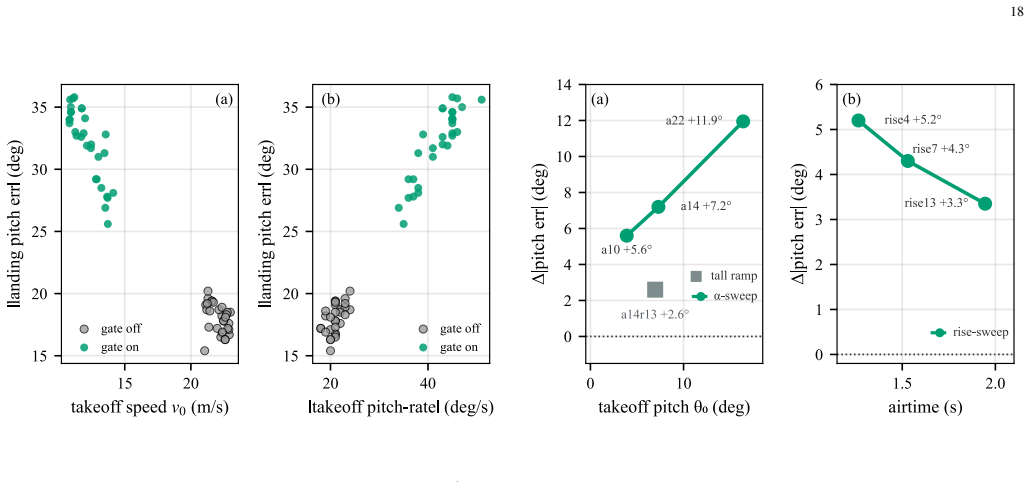
- Slowing a steep-lip approach to the certified speed window reduced touchdown speed by 36% and raised on-target landings from 0/30 to 30/30 in the evaluated scenario, while the empty-window branch stopped the vehicle before the lip.
- When the takeoff state is inside the budget, all tested control laws perform alike; the airborne law matters only for over-budget disturbances.
- On banked run-ups, the dual-axis law with the roll latch holds median pitch error at or below 2° across tested cross-slopes, with the largest baseline separation at 12°.
- The momentum budget scales inversely with vehicle mass (B∝1/m at fixed wheel hardware), so heavier vehicles have even less airborne authority and depend more on pre-takeoff gating.
Where Pith is reading between the lines
- If the certified set is applied outside calibrated geometry, the paper's own point-mass translation error (≈39% range underprediction at 28 m/s) means the 'certified' speed window is only as good as the per-geometry calibration; a robust deployment would need to estimate that error and erode F by an uncertainty ball.
- The budget formula gives a design lever: raising wheel inertia or wheel-speed envelope, or lowering body pitch inertia, directly raises the 9–13°/s ceiling—though at fixed footprint B∝1/m, so mass growth tightens it.
- The same conservation argument should transfer to any independently driven, steered wheeled vehicle, so a small-scale instrumented RC platform could measure the budget before full-scale hardware, and the paper's two-sided prediction (convergence inside the budget, separation outside) is testable there.
- A practical consequence of the yaw-leak analysis is that any roll-correction law that dithers in and out of engagement can accumulate same-sign yaw impulses; the per-flight latch is one remedy, but yaw-loop phase compensation would be the natural next control layer.
Editorial analysis
A structured set of objections, weighed in public.
Referee Report
Summary. The paper proposes DART, a cross-phase controller for high-speed off-road vehicle jumps. The core theoretical contribution is a wheel angular-momentum budget (Theorem 1) showing that the recoverable in-flight body pitch-rate change is bounded by wheel spin-speed limits, not motor torque: for a 1383 kg platform this gives roughly 9–13 deg/s nose-up under drive and about twice that with braking. Since takeoff disturbances beyond this budget are physically unrecoverable, the paper back-propagates the landing constraint through the airborne dynamics to construct a closed-form certified feasible takeoff set F (Theorems 2–3, Corollaries 4–5, Propositions 1–2). This set is deployed as a pre-takeoff speed gate and speed-shaping law, together with an in-flight dual-axis torque-reaction controller with a per-flight roll latch. The approach is evaluated in BeamNG.tech simulation: the airborne law outperforms RW-PD and TOBB on over-budget pitch-rate entries and banked run-ups, and the speed regulator reduces touchdown speed by 36% and raises on-target landings from 0/30 to 30/30 in a steep-lip scenario.
Significance. If the results hold, Theorem 1 is a valuable and general physical insight: it formalizes why large takeoff pitch-rate disturbances cannot be rescued by any airborne actuator in a wheeled vehicle, and it correctly identifies the pre-takeoff phase as the only place where decisive leverage exists. The closed-form certificate is a useful sufficient condition for the reduced double-integrator model, and the extensive simulation suite—including paired same-tick protocols, ablations, gain sweeps, and robustness tests—is a strength. The paper is also commendably transparent about limitations: it explicitly reports the ballistic model underprediction, the single certified-boundary miss, the one-dimensional nature of the deployed gate, and the fact that all results are simulation-only. The main weakness is that the word 'certified' is used more strongly than the implementation and model fidelity support.
major comments (4)
- [§V-A4, §III-C (Prop. 1, Thm. 3)] The point-mass ballistic model underpredicts measured BeamNG range by ≈39% at 28 m/s, and the gap length is calibrated per launch geometry. Because the flight time T(v0) enters the certificate of Theorem 3 and the speed window of Proposition 1, the 'closed-form certified feasible-takeoff set' is not a predictive certificate for unseen geometry without recalibration. A 39% range error can correspond to much larger flight-time errors than the 0.3 s that already produced a certified miss in §V-A3. The sufficiency claim of F is conditional on an accurate T; the paper should either bound the T error and erode F accordingly, or explicitly frame the contribution as a model-in-the-loop certificate requiring per-geometry calibration.
- [§V-A3 (certified-boundary grid)] The certificate accepts 62 of 125 jumps and 61 land clean; the single miss is attributed to a replicate whose flight ran 0.3 s longer than its cell siblings. If membership was evaluated with the measured takeoff state but a wrong (nominal) flight time, then the certificate is not robust to T estimation error. If the actual T was used, then a state passing the certificate failed to land clean, which contradicts the sufficiency guarantee of Theorem 3. The paper should clarify which T was used and, if necessary, add a margin on T so that the certificate is truly conservative in the deployed simulator.
- [§III-E, §V-B4, Cor. 5] The end-to-end go/no-go gate implements only the speed-window projection [v_min, v_crit], not full-state membership in F. The gate-on takeoff states in §V-B4 remain over the pitch-rate budget (median |ω_θ0| = 43 deg/s vs. B ≈ 9–13 deg/s), so they are outside the certified set. The abstract's claim that DART 'supplies a conservative go/no-go condition' is therefore not supported by the deployed system: the gate reduces impact energy but does not certify attitude feasibility. This is a load-bearing gap between the theoretical contribution and its headline deployment, and the paper's own statement that 'online full-state F membership is future work' should be reflected in the contributions and abstract.
- [§III-B, §IV-A, §V-A3] The budget calculation in Eq. (10) uses the nominal wheel inertia I_w = 1.2 kg m², while the momentum-exchange probe reports an effective per-corner spin inertia of 0.83–0.98 kg m². These values are numerically inconsistent: using 0.9 kg m² with the stated 1200-rpm sustained envelope gives a nose-up budget of roughly 7–8 deg/s at typical takeoff wheel speeds, below the 9–13 deg/s headline. The paper should state which inertia is used in the headline numbers and reconcile the nominal and effective values, since the quantitative ceiling is a central claim.
minor comments (5)
- [Abstract] Suggest adding a qualifier such as 'under the reduced model' or 'after calibration' to 'closed-form certified feasible-takeoff set' to match the implementation described in the body.
- [Table III] The term 'DART pool' is not defined in the table or text; clarify that it combines two 30-jump runs and the 'floor' is the same-law replicate gap.
- [§III-F] The heading-trim parameters (yaw deadband 2°, gain 0.55, steer cap 0.45) are introduced but not evaluated in the results; a sentence mapping them to an experiment would help.
- [§IV-A] The choice of the latch threshold φ_on = 8° and deadband φ_db = 2° is stated but not justified; a brief rationale (e.g., below the observed roll disturbance levels) would be useful.
- [§V-B4] The end-to-end experiment reports 'on-target' landings but not 'safe-land' counts; since the gate-on median pitch error is 32.8° (close to the 35° crash-avoidance bound), readers should be told how many gate-on landings meet the full safe-land criterion.
Circularity Check
Core momentum-budget derivation is self-contained; only the ballistic certificate inherits calibration dependence, which the paper discloses, and no self-citation loop is load-bearing.
specific steps
-
fitted input called prediction
[V-A4 Ballistic Speed Window and No-Go Branch]
"Because the point-mass model underpredicts the measured range by ≈39% at 28 m/s, the gap length is calibrated per launch geometry. Fixed-state ladders yield 0/14 clean landings for a 33 m gap on the 8° launch and 0/14 for a 54 m gap on the longer-range 12° launch. The resulting v_min ≈ 36.1m/s exceeds v_crit = 11m/s, so the certified speed set is empty."
The certified takeoff set F and its speed projection [v_min, v_crit] are presented as the closed-form certificate back-propagated from the landing constraint, but Proposition 1's flight-time function T(v) and the landing crossing use A3 point-mass ballistic translation. The section reports that this model underpredicts measured BeamNG range by ≈39% at 28 m/s, and the response is to calibrate gap length per geometry. The go/no-go outcome in this section is therefore a property of the calibration (gap length chosen so the point-mass model yields an empty window), not an out-of-sample prediction of an uncalibrated certificate. The central Theorem 1 budget is unaffected; the circularity is limited to the certified speed-window component of the claimed closed-form certificate.
full rationale
Circularity analysis: (1) Theorem 1, the paper's headline impossibility bound, is derived from angular-momentum conservation (Eq. 2), measured wheel inertias and speed bounds, and reads directly as B = Σ I_i Δω_i / I_yy. It is not fitted to the headline 9–13°/s figure: the measured budget tests in V-A2 show onset where the formula predicts, and the hard-limit calibration measures 16–18°/s independently. No self-definitional or fitted-input-called-prediction issue attaches to the core authority claim. (2) The certified takeoff set F and speed window [v_min, v_crit] are where the paper's own text reduces a 'closed-form certified' claim to a per-geometry calibration: V-A4 states the point-mass model underpredicts range by ≈39% at 28 m/s, so gap length is calibrated per launch geometry. The empty-window go/no-go demonstration is thus partly an artifact of the calibrated gap, and Theorem 3's sensitivity to T (shown in the single certified-boundary miss) means the 39% range error could shift states across the F boundary on unseen geometry. This is a genuine but partial circularity, and it is prominently disclosed by the authors. (3) No load-bearing self-citation chain is used: citations to AGRO [1], Kim [23], and Pokhrel [2] supply the sinδ/cosδ Jacobian and prior in-air control concepts, but DART's momentum budget, null-then-correct certificate, and roll latch are derived internally from stated assumptions A1–A5, not imported from an author-stacked uniqueness theorem. (4) The end-to-end 36% touchdown-speed reduction and 0/30→30/30 on-target result are explicitly described as properties of this experiment's calibration (V-B4): 'The 36% figure is accordingly a property of this experiment's calibration... rather than a general constant.' The paper frames this honestly as a demonstration of a fitted configuration, not as an out-of-sample prediction. (5) The yaw-leak projection (Eq. 8), roll latch (Eq. 9), and regime map are contingency claims consistent with the momentum analysis but are not derived by circular fit. Overall: one partial circularity in the certified speed-window component, honestly reported, with the central authority derivation independent. Score 2 is proportionate.
Axiom & Free-Parameter Ledger
free parameters (7)
- sustained wheel-speed envelope ω_max/ω_min =
±1200 rpm (hard limit measured at 2105 rpm)
- effective per-wheel torque bound τ_max =
≈1200 N·m
- critical takeoff speed v_crit =
11 m/s
- braking-specific force a_brake =
4 m/s²
- controller gains and latch thresholds =
K_θ, K_φ, K_d; φ_on=8°, φ_db=2°
- effective per-corner spin inertia =
0.83–0.98 kg·m²
- empty-window gap lengths =
33 m and 54 m
axioms (7)
- domain assumption Rigid-body pitch/roll modeled as a double integrator driven by wheel-reaction torque (A1)
- domain assumption Conservation of chassis-plus-wheel angular momentum in flight (A2)
- domain assumption Point-mass ballistic translation with known landing geometry (A3)
- domain assumption Wheel speed bounded by [ω_min, ω_max], sustained envelope symmetric at ±1200 rpm (A4)
- domain assumption No longitudinal slip at lip departure (A5)
- domain assumption Landing terminal set C_L and suspension tolerances are known at planning resolution
- domain assumption BeamNG.tech soft-body simulation is a faithful full-scale vehicle model
read the original abstract
Traversing crests, ledges, and ditches at high speed often launches vehicles into the air, and a mishandled landing presents a substantial crash hazard. We show that the airborne phase is barely controllable: on a 1383 kg platform the wheel angular-momentum budget caps the recoverable pitch-rate change at roughly $9$-$13^\circ$/s in the tighter nose-up direction under drive at typical takeoff wheel speeds, and at about twice that in the reverse-inclusive braking direction; driving the wheels to their drivetrain hard limit raises the measured nose-up ceiling to only $16$-$18^\circ$/s. Takeoff pitch-rate disturbances beyond this directional budget are physically unrecoverable in flight, so the decisive leverage lies before takeoff. DART (Dual-Axis Airborne Reachability-Gated Torque-Reaction) back-propagates the landing constraint into a closed-form certified feasible-takeoff set, which supplies a conservative go/no-go condition and a pre-takeoff speed-shaping law. In flight, DART regulates pitch and roll via steer-resolved wheel-reaction torque, governed by a per-flight roll latch derived from the yaw-coupling analysis. In deterministic full-scale simulation in BeamNG.tech, a calibrated pre-takeoff speed regulator reduces touchdown speed by 36% and raises on-target landings from 0/30 to 30/30. Under the same steep-lip approach the airborne law completes 29/30 safe landings under crash-avoidance bounds versus 0/30 for reaction-wheel-style PD (RW-PD) and time-optimal bang-bang (TOBB). On banked run-ups DART holds the median pitch error at or below $2^\circ$ at every cross-slope, with the largest baseline separation at $\gamma=12^\circ$. Across disturbance regimes, the latch preserves pitch-only allocation on low-disturbance entries and enables dual-axis control when roll becomes binding. All results are from simulation; hardware validation remains open.
Figures


Reference graph
Works this paper leans on
-
[1]
Dynamics and aerial attitude control for rapid emergency deployment of the agile ground robot AGRO,
D. J. Gonzalez, M. C. Lesak, A. H. Rodriguez, J. A. Cymerman, and C. M. Korpela, “Dynamics and aerial attitude control for rapid emergency deployment of the agile ground robot AGRO,” inIEEE/RSJ IROS, 2020, pp. 2577–2584
2020
-
[2]
Dom, cars don’t fly!—Or do they? In-air vehicle maneuver for high-speed off-road navigation,
A. Pokhrel, A. Datar, and X. Xiao, “Dom, cars don’t fly!—Or do they? In-air vehicle maneuver for high-speed off-road navigation,” in IEEE/RSJ IROS, 2025, pp. 21325–21332
2025
-
[3]
Control system for vehicle powertrain during off-road jumping,
Ford Global Technologies, LLC, “Control system for vehicle powertrain during off-road jumping,” U.S. Patent 12 233 882 B2, Feb. 25, 2025
2025
-
[4]
Aggressive driving with model predictive path integral control,
G. Williams, P. Drews, B. Goldfain, J. M. Rehg, and E. A. Theodorou, “Aggressive driving with model predictive path integral control,” inIEEE ICRA, 2016, pp. 1433–1440. 20
2016
-
[5]
Information-theoretic model predictive control: Theory and applications to autonomous driving,
G. Williams, P. Drews, B. Goldfain, J. M. Rehg, and E. A. Theodorou, “Information-theoretic model predictive control: Theory and applications to autonomous driving,”IEEE Trans. Robot., vol. 34, no. 6, pp. 1603– 1622, 2018
2018
-
[6]
Learning terrain-aware kin- odynamic model for autonomous off-road rally driving with model predictive path integral control,
H. Lee, T. Kim, J. Mun, and W. Lee, “Learning terrain-aware kin- odynamic model for autonomous off-road rally driving with model predictive path integral control,”IEEE Robot. Autom. Lett., vol. 8, no. 11, pp. 7663–7670, 2023
2023
-
[7]
Learning when to jump for off-road navigation,
Z. Zhaoet al., “Learning when to jump for off-road navigation,” in Robotics: Science and Systems, 2026
2026
-
[8]
Robust model predictive path integral control: Analysis and perfor- mance guarantees,
M. S. Gandhi, B. Vlahov, J. Gibson, G. Williams, and E. A. Theodorou, “Robust model predictive path integral control: Analysis and perfor- mance guarantees,”IEEE Robot. Autom. Lett., vol. 6, no. 2, pp. 1423– 1430, 2021
2021
-
[9]
Learning- based model predictive control: Toward safe learning in control,
L. Hewing, K. P. Wabersich, M. Menner, and M. N. Zeilinger, “Learning- based model predictive control: Toward safe learning in control,”Annu. Rev. Control Robot. Auton. Syst., vol. 3, pp. 269–296, 2020
2020
-
[10]
A time-dependent Hamilton-Jacobi formulation of reachable sets for continuous dynamic games,
I. M. Mitchell, A. M. Bayen, and C. J. Tomlin, “A time-dependent Hamilton-Jacobi formulation of reachable sets for continuous dynamic games,”IEEE Trans. Autom. Control, vol. 50, no. 7, pp. 947–957, 2005
2005
-
[11]
Hamilton-Jacobi reachability: A brief overview and recent advances,
S. Bansal, M. Chen, S. Herbert, and C. J. Tomlin, “Hamilton-Jacobi reachability: A brief overview and recent advances,” inIEEE Conf. Decision and Control (CDC), 2017, pp. 2242–2253
2017
-
[12]
Hamilton-Jacobi reachability: Some recent theoretical advances and applications in unmanned airspace manage- ment,
M. Chen and C. J. Tomlin, “Hamilton-Jacobi reachability: Some recent theoretical advances and applications in unmanned airspace manage- ment,”Annu. Rev. Control Robot. Auton. Syst., vol. 1, pp. 333–358, 2018
2018
-
[13]
Control barrier functions: Theory and applications,
A. D. Ames, S. Coogan, M. Egerstedt, G. Notomista, K. Sreenath, and P. Tabuada, “Control barrier functions: Theory and applications,” in European Control Conf. (ECC), 2019, pp. 3420–3431
2019
-
[14]
J. R. Wertz, Ed.,Spacecraft Attitude Determination and Control. Dor- drecht, The Netherlands: D. Reidel, 1978
1978
-
[15]
The Cubli: A cube that can jump up and balance,
M. Gajamohan, M. Merz, I. Thommen, and R. D’Andrea, “The Cubli: A cube that can jump up and balance,” inIEEE/RSJ IROS, 2012, pp. 3722–3727
2012
-
[16]
Tail-assisted pitch control in lizards, robots and dinosaurs,
T. Libbyet al., “Tail-assisted pitch control in lizards, robots and dinosaurs,”Nature, vol. 481, no. 7380, pp. 181–184, 2012
2012
-
[17]
A nonlinear feedback controller for aerial self-righting by a tailed robot,
E. Chang-Siu, T. Libby, M. Brown, R. J. Full, and M. Tomizuka, “A nonlinear feedback controller for aerial self-righting by a tailed robot,” inIEEE ICRA, 2013, pp. 32–39
2013
-
[18]
A dynamical explanation of the falling cat phenomenon,
T. R. Kane and M. P. Scher, “A dynamical explanation of the falling cat phenomenon,”Int. J. Solids Struct., vol. 5, no. 7, pp. 663–670, 1969
1969
-
[19]
Online planning for au- tonomous running jumps over obstacles in high-speed quadrupeds,
H.-W. Park, P. M. Wensing, and S. Kim, “Online planning for au- tonomous running jumps over obstacles in high-speed quadrupeds,” in Robotics: Science and Systems, 2015
2015
-
[20]
Optimized jumping on the MIT Cheetah 3 robot,
Q. Nguyen, M. J. Powell, B. Katz, J. Di Carlo, and S. Kim, “Optimized jumping on the MIT Cheetah 3 robot,” inIEEE ICRA, 2019, pp. 7448– 7454
2019
-
[21]
Mini Cheetah: A platform for pushing the limits of dynamic quadruped control,
B. Katz, J. Di Carlo, and S. Kim, “Mini Cheetah: A platform for pushing the limits of dynamic quadruped control,” inIEEE ICRA, 2019, pp. 6295–6301
2019
-
[22]
Online trajectory optimization for dynamic aerial motions of a quadruped robot,
M. Chignoli and S. Kim, “Online trajectory optimization for dynamic aerial motions of a quadruped robot,” inIEEE ICRA, 2021, pp. 7693– 7699
2021
-
[23]
Comparing feedback linearization and adaptive backstepping control for airborne orientation of agile ground robots using wheel reaction torque,
J. Kim, D. J. Gonzalez, and C. M. Korpela, “Comparing feedback linearization and adaptive backstepping control for airborne orientation of agile ground robots using wheel reaction torque,” inAmer. Control Conf. (ACC), 2021, pp. 26–31
2021
-
[24]
Torque vectoring for utility vehicles,
Polaris Industries Inc., “Torque vectoring for utility vehicles,” U.S. Patent 11 981 873 B2, May 14, 2024
2024
-
[25]
BeamNG GmbH,BeamNG.tech, version 0.38.3.0, Bremen, Germany, Dec. 2025. [Online]. Available: https://www.beamng.tech/
2025
-
[26]
Learning to drift with individual wheel drive: Maneuvering autonomous vehicle at the handling limits,
Y . Zhou, Y . Lu, B. Yang, J. Li, and Y . Mo, “Learning to drift with individual wheel drive: Maneuvering autonomous vehicle at the handling limits,”IEEE Robot. Autom. Lett., vol. 10, no. 10, pp. 9589–9596, 2025
2025
discussion (0)
Sign in with ORCID, Apple, or X to comment. Anyone can read and Pith papers without signing in.