REVIEW 4 major objections 6 minor 40 references
Adding textual reasoning to a driving model before trajectory prediction improves waypoint accuracy by about 24%.
Reviewed by Pith at T0; open to challenge. T0 means a machine referee read the full paper against a public rubric. the ladder, T0–T4 →
T0 review · deepseek-v4-flash
2026-08-03 14:34 UTC pith:YB6M2KFT
load-bearing objection Plausible framework and useful decoder idea, but the 24% reasoning-claim is confounded and the tables disagree on baseline sizes. the 4 major comments →
Outcome-Guided Distillation: A Teacher-Student Framework to Advance VLM Reasoning in Autonomous Driving
The pith
A machine-rendered reading of the paper's core claim, the machinery that carries it, and where it could break.
Core claim
On its own terms, the paper's central claim is that reasoning text is a causal driver of waypoint prediction, not a byproduct: 'Utilizing inference with reasoning text results in a 24% improvement compared to inference without it.' The discovery is that this improvement can be obtained without any chain-of-thought labels—only the standard ground-truth waypoints—by having the teacher model generate a forward explanation, a backward justification conditioned on the expert outcome, and a reflective refinement, then distilling those explanations into a compact student that reasons zero-shot. The paper further claims that a decoupled decoder (a lightweight VLM plus a GRU head, trained with a wors
What carries the argument
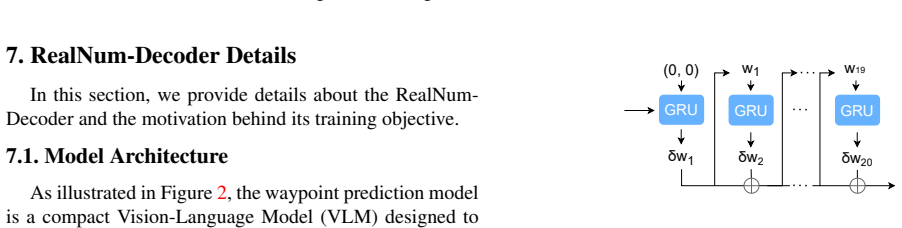
Reflective reasoning—a two-pass, outcome-conditioned generation loop in which the teacher first explains the scene bottom-up, then justifies the ground-truth trajectory top-down, then summarizes both into a refined explanation. This produces training data for token-level and embedding-level distillation into an 8B student. The student's reasoning text is then consumed by the RealNum-Decoder, a 1B vision-language model with a frozen vision encoder and a GRU waypoint head, trained with a tolerance-weighted worst-axis displacement loss derived from the benchmark's trust-region scoring.
Load-bearing premise
The 24% improvement attributed to reasoning assumes that the full method and the 'Direct Prediction' baseline differ only in whether reasoning text is present, but the full method also adds a separate 1B decoder VLM, so the marginal contribution of the text itself is not isolated.
What would settle it
Run the RealNum-Decoder (the same 1B VLM + GRU) with the student's reasoning input removed or replaced by a fixed placeholder, keeping every other architectural detail identical to the full method. If RFS/ADE do not degrade by roughly 24% relative to 7.240/3.231, the paper's central causal claim about reasoning text is unsupported.
If this is right
- If reasoning text is genuinely causal, then explicitly injecting language-level rationales into trajectory predictors is a viable axis for improving robustness, not just for explanation.
- The label-free reflective loop suggests chain-of-thought style training can be bootstrapped from outcome labels (ground-truth actions) that are already standard in driving datasets, removing the human annotation bottleneck.
- Distillation preserves most of a 78B teacher's performance in a 9B system (8B student + 1B decoder) with roughly 7x faster token generation, making reasoning-augmented driving closer to real-time deployment.
- Freezing the vision encoder avoids catastrophic forgetting and outperforms full fine-tuning, indicating that pre-trained visual world knowledge is a resource to preserve rather than overwrite.
- A specialized waypoint decoder that regresses continuous coordinates from reasoning text beats both text-tokenized coordinates and direct dense prediction, establishing a division of labor between linguistic reasoning and geometric regression.
Where Pith is reading between the lines
- The strongest version of the 24% claim is not directly tested: the comparison pairs the full method (student + separate decoder) against Direct Prediction (student + GRU without the decoder VLM), so the decoder itself is a confound. A targeted ablation that feeds the same decoder the same inputs with reasoning text removed would sharpen the causal claim.
- The reflective-reasoning trick may generalize beyond driving: any sequential decision task with an observable expert outcome and a vision-language backbone could bootstrap rationales without human labels, and the decoupled 'verbalize then regress' pattern may help other continuous-control settings where text tokens are numerically weak.
- The paper's own qualitative example hints that reflective reasoning funnels attention to task-critical visual evidence (the lane-split sign) that single-pass CoT misses; this suggests an outcome-conditioned training signal might be a way to combat hallucination and topic drift in general VLM reasoning.
Editorial analysis
A structured set of objections, weighed in public.
Referee Report
Summary. The paper proposes a teacher-student framework for integrating VLM reasoning into end-to-end driving. A 78B teacher generates 'reflective reasoning' conditioned on ground-truth waypoints, a distilled 8B student learns to reproduce this reasoning, and a separate 1B RealNum-Decoder converts the reasoning text into continuous waypoints. Experiments on the Waymo E2E dataset report RFS 7.240 for the full method, and the paper attributes a ~24% improvement over a 'Direct Prediction' baseline to the presence of reasoning.
Significance. The framework addresses three genuine problems: avoiding costly CoT labels, numerical precision in VLM trajectory prediction, and catastrophic forgetting in fine-tuned vision encoders. The internal ablations (reflective vs standard CoT; frozen vs fine-tuned ViT; text-based vs decoupled decoder) are informative and support several architectural contributions. However, the central quantitative claim that reasoning text causally improves planning by ~24% is not supported by the presented comparison because the 'Direct Prediction' baseline differs in architecture and parameter count, not only in reasoning. If the missing identical-model ablation is supplied and the claim holds, the contribution would be significant.
major comments (4)
- [Abstract; §4.2, Table 2] The 24% reasoning-contribution claim is confounded. 'Our Method' is an 8B student plus a 1B RealNum-Decoder, while 'Direct Prediction' is an 8B model with a GRU and no 1B decoder. These differ in capacity, training stages, and fusion mechanism, so the RFS gain (7.240 vs 5.849) cannot be attributed to reasoning text. The Abstract's phrase 'identical non-reasoning model' is inaccurate. Please add an ablation in which the same RealNum-Decoder is trained and evaluated with identical inputs but with the reasoning text removed (e.g., empty reasoning sequence), and use that as the basis for the reasoning contribution claim.
- [Table 2 vs Table 4] The model scale for Direct Prediction is inconsistent: Table 2 lists 'Direct Prediction 8B', while Table 4 lists 'Direct Prediction (1B)' under baselines. Similarly, Finetuned ViT appears as 8B+1B in Table 2 but '1B' in Table 4. Please reconcile these numbers and state the exact parameter count and architecture for every evaluated model, since the size differences directly affect the interpretation of the comparisons.
- [§4.2; Table 2] No measure of variability is reported. All RFS/ADE values appear to come from a single run, and several differences are small (e.g., 6.536 vs 6.554 vs 7.240). Without multiple seeds, confidence intervals, or significance tests, the reported margins, especially the 24% claim, are not established. Please report mean and variance over at least three runs, or state the evaluation protocol that makes single runs meaningful.
- [§3.2; §4.2, Table 2] The distillation's success is assessed only via downstream waypoint RFS, not by the fidelity of the student's generated reasoning to the teacher's. Since the reasoning text is the proposed causal mechanism, please compare the student's reasoning to the teacher's (e.g., automatic similarity metrics, human evaluation, or an ablation in which the RealNum-Decoder consumes teacher-generated reasoning instead of student-generated reasoning). This would also clarify whether the small RFS drop from 7.639 to 7.240 reflects distillation loss.
minor comments (6)
- [§3.3(b)] Typo: 'ditilled reasoning' should be 'distilled reasoning'.
- [§4.3] Typo: 'towarding' should be 'toward'.
- [§7.2] Typo: 'trajecotory' should be 'trajectory'.
- [References] References [20] and [21] point to the same URL. References [13], [15], and [25] are informal blog posts; consider replacing with peer-reviewed or official sources for claims about LLM numerical reasoning.
- [§4.3; Table 3] The end-to-end latency of the full system (student autoregressive reasoning + decoder) is not reported; only per-token student speed and decoder fixed latency are given. Reporting total inference time would make the deployability claim more concrete.
- [§4.2] The 'outperforms reasoning-based baselines' claim would be stronger if at least one external recent CoT driving baseline (e.g., DriveCoT) were included, rather than only internal variants.
Circularity Check
No circular derivation; the 24% reasoning-attribution claim is confounded but not circular.
full rationale
The paper's core loop is not circular. The teacher generates reflective reasoning using ground-truth waypoints (Sec. 3.1), but the student is distilled to produce reasoning from inputs only, and the RealNum-Decoder predicts waypoints without access to ground truth at inference (Sec. 3.2-3.3). Thus the reasoning text is not, by construction, the target waypoint being predicted; it is a learned intermediate representation. No equation in the paper equates the reasoning with the outcome. The central empirical claim, however, has a validity problem that is not a circularity problem: the Abstract states 'adding reasoning improves performance by nearly 24% compared to an identical non-reasoning model,' but Table 2 compares 'Our Method' (8B+1B, student VLM + 1B RealNum-Decoder) to 'Direct Prediction' (8B, GRU decoder, no 1B VLM). These differ in model capacity and architecture, not only in the presence of reasoning. The paper's own baseline description says Direct Prediction 'isolates the performance impact of the reasoning component itself,' but no ablation feeds the RealNum-Decoder the same inputs without reasoning text, so the 24% gain may be attributable to added decoder capacity. Table 4 also labels 'Direct Prediction (1B)', conflicting with Table 2's '8B'. These are experimental confounds and missing-support issues, not by-construction reductions. The only self-citation, [9], appears in related work and is not load-bearing; no uniqueness theorem or ansatz is smuggled in via self-citation. Accordingly, the circularity score is minimal, reflecting no circular derivation despite the confounded headline comparison.
Axiom & Free-Parameter Ledger
free parameters (3)
- λ_logit, λ_embed (distillation loss weights)
- Per-dataset scaling of tolerance thresholds τ
- Training data subsample (57%) =
57% of 415,663 samples
axioms (5)
- domain assumption RFS trust-region thresholds and speed-scaling reflect driving safety and are a valid objective
- ad hoc to paper The teacher's outcome-conditioned reasoning is causally correct and transferable
- ad hoc to paper The student's decoded reasoning at inference is a faithful substitute for the teacher's outcome-conditioned reasoning
- domain assumption Frozen ViT preserves world knowledge and avoids catastrophic forgetting
- domain assumption Waymo E2E dataset with 57% subsample covers the long-tail distribution
read the original abstract
End-to-end (E2E) autonomous driving aims to learn a direct mapping from visual observations to control actions. However, these E2E models often act as black boxes and struggle with complex scenarios. To address this, recent works incorporate Vision-Language Models (VLMs) to provide explicit reasoning, enhancing both interpretability and driving robustness. These approaches typically rely on pre-generated annotations, which suffer from potentially flawed labels and require costly human labor. In this work, we propose a new framework that integrates structured reasoning and geometric precision through a teacher-student architecture. The teacher model introduces reflective reasoning, where the VLM generates logical explanations and then reflectively refines the reasoning under the supervision of ground-truth action. This enhances zero-shot generalization without intermediate labels. The student model distills the teacher's reasoning capabilities via supervised fine-tuning. We also design a separate waypoint decoder that interprets textual reasoning into continuous trajectories. Our proposed solution integrates two goals: providing explicit reasoning for interpretability and delivering robust and accurate driving performance. It leverages the synergy between these two objectives within a staged inference engine to enhance driving performance and explicitly uses the reasoning to guide driving prediction. Evaluated on Waymo benchmarks, our framework outperforms classical reasoning-based baselines in zero-shot reasoning, waypoint accuracy, and inference efficiency. Our experiments validate this design, demonstrating that the reasoning text makes a significant contribution to driving inference, resulting in around a 24% improvement in performance compared to an identical model that lacks reasoning. Our work advances reasoning-driven autonomous driving toward interpretable and deployable systems.
Figures


Reference graph
Works this paper leans on
-
[1]
Flamingo: a visual language model for few-shot learning.Advances in neural information processing systems, 35:23716–23736,
Jean-Baptiste Alayrac, Jeff Donahue, Pauline Luc, Antoine Miech, Iain Barr, Yana Hasson, Karel Lenc, Arthur Men- sch, Katherine Millican, Malcolm Reynolds, et al. Flamingo: a visual language model for few-shot learning.Advances in neural information processing systems, 35:23716–23736,
-
[2]
Jackel, Mathew Monfort, Urs Muller, Jiakai Zhang, Xin Zhang, Jake Zhao, and Karol Zieba
Mariusz Bojarski, Davide Del Testa, Daniel Dworakowski, Bernhard Firner, Beat Flepp, Prasoon Goyal, Lawrence D. Jackel, Mathew Monfort, Urs Muller, Jiakai Zhang, Xin Zhang, Jake Zhao, and Karol Zieba. End to End Learning for Self-Driving Cars, Apr. 2016. arXiv:1604.07316 [cs]. 1, 2
Pith/arXiv arXiv 2016
-
[3]
Learn- ing to drive from a world on rails
Dian Chen, Vladlen Koltun, and Philipp Kr ¨ahenb¨uhl. Learn- ing to drive from a world on rails. InProceedings of the IEEE/CVF International Conference on Computer Vision, pages 15590–15599, 2021. 2
2021
-
[4]
Learning by cheating
Dian Chen, Brady Zhou, Vladlen Koltun, and Philipp Kr¨ahenb¨uhl. Learning by cheating. InConference on robot learning, pages 66–75. PMLR, 2020. 2
2020
-
[5]
End-to-end Au- tonomous Driving: Challenges and Frontiers, June 2023
Li Chen, Penghao Wu, Kashyap Chitta, Bernhard Jaeger, Andreas Geiger, and Hongyang Li. End-to-end Au- tonomous Driving: Challenges and Frontiers, June 2023. arXiv:2306.16927 [cs]. 1, 2
Pith/arXiv arXiv 2023
-
[6]
NEAT: Neural Attention Fields for End-to-End Autonomous Driving, Sept
Kashyap Chitta, Aditya Prakash, and Andreas Geiger. NEAT: Neural Attention Fields for End-to-End Autonomous Driving, Sept. 2021. 2
2021
-
[7]
TransFuser: Imita- tion with Transformer-Based Sensor Fusion for Autonomous Driving, May 2022
Kashyap Chitta, Aditya Prakash, Bernhard Jaeger, Zehao Yu, Katrin Renz, and Andreas Geiger. TransFuser: Imita- tion with Transformer-Based Sensor Fusion for Autonomous Driving, May 2022. arXiv:2205.15997 [cs]. 2
Pith/arXiv arXiv 2022
-
[8]
End-to-end driving via conditional imitation learning
Felipe Codevilla, Matthias M ¨uller, Antonio L ´opez, Vladlen Koltun, and Alexey Dosovitskiy. End-to-end driving via conditional imitation learning. In2018 IEEE international conference on robotics and automation (ICRA), pages 4693–
-
[9]
Generalizing End-To-End Autonomous Driving In Real-World Environments Using Zero-Shot LLMs, Nov
Zeyu Dong, Yimin Zhu, Yansong Li, Kevin Mahon, and Yu Sun. Generalizing End-To-End Autonomous Driving In Real-World Environments Using Zero-Shot LLMs, Nov
-
[10]
Melody Y Guan, Manas Joglekar, Eric Wallace, Saachi Jain, Boaz Barak, Alec Helyar, Rachel Dias, Andrea Vallone, Hongyu Ren, Jason Wei, et al. Deliberative alignment: Reasoning enables safer language models.arXiv preprint arXiv:2412.16339, 2024. 2
Pith/arXiv arXiv 2024
-
[11]
Planning-oriented Autonomous Driving, Mar
Yihan Hu, Jiazhi Yang, Li Chen, Keyu Li, Chonghao Sima, Xizhou Zhu, Siqi Chai, Senyao Du, Tianwei Lin, Wenhai Wang, Lewei Lu, Xiaosong Jia, Qiang Liu, Jifeng Dai, Yu Qiao, and Hongyang Li. Planning-oriented Autonomous Driving, Mar. 2023. 1, 2
2023
-
[12]
EMMA: End-to-End Multimodal Model for Autonomous Driving, Nov
Jyh-Jing Hwang, Runsheng Xu, Hubert Lin, Wei-Chih Hung, Jingwei Ji, Kristy Choi, Di Huang, Tong He, Paul Covington, Benjamin Sapp, Yin Zhou, James Guo, Dragomir Anguelov, and Mingxing Tan. EMMA: End-to-End Multimodal Model for Autonomous Driving, Nov. 2024. 1, 3
2024
-
[13]
Every repeated LLM call is money on fire, June
Raul Junco. Every repeated LLM call is money on fire, June
-
[14]
End- to-End Deep Learning Model for Steering Angle Control of Autonomous Vehicles
Abida Khanum, Chao-Yang Lee, and Chu-Sing Yang. End- to-End Deep Learning Model for Steering Angle Control of Autonomous Vehicles. In2020 International Symposium on Computer, Consumer and Control (IS3C), pages 189–192, Nov. 2020. 2
2020
-
[15]
Stop calling out your LMM for every sim- ilar question!, July 2023
Dmitry Korzhov. Stop calling out your LMM for every sim- ilar question!, July 2023. 2
2023
-
[16]
Blip-2: Bootstrapping language-image pre-training with frozen image encoders and large language models
Junnan Li, Dongxu Li, Silvio Savarese, and Steven Hoi. Blip-2: Bootstrapping language-image pre-training with frozen image encoders and large language models. InIn- ternational conference on machine learning, pages 19730– 19742. PMLR, 2023. 3
2023
-
[17]
Blip: Bootstrapping language-image pre-training for unified vision-language understanding and generation
Junnan Li, Dongxu Li, Caiming Xiong, and Steven Hoi. Blip: Bootstrapping language-image pre-training for unified vision-language understanding and generation. InInterna- tional conference on machine learning, pages 12888–12900. PMLR, 2022. 3
2022
-
[18]
Improved baselines with visual instruction tuning
Haotian Liu, Chunyuan Li, Yuheng Li, and Yong Jae Lee. Improved baselines with visual instruction tuning. InPro- ceedings of the IEEE/CVF conference on computer vision and pattern recognition, pages 26296–26306, 2024. 3
2024
-
[19]
Visual instruction tuning.Advances in neural information processing systems, 36:34892–34916, 2023
Haotian Liu, Chunyuan Li, Qingyang Wu, and Yong Jae Lee. Visual instruction tuning.Advances in neural information processing systems, 36:34892–34916, 2023. 3
2023
-
[20]
Vision-based end-to-end driving.https: / / waymo
Waymo LLC. Vision-based end-to-end driving.https: / / waymo . com / open / challenges / 2025 / e2e - driving/, 2025. Accessed: 2025-09-16. 6, 1
2025
-
[21]
Vision-based End-to-End Driving – 2025 – Waymo Open Dataset
Waymo LLC. Vision-based End-to-End Driving – 2025 – Waymo Open Dataset. https://waymo.com/open/challenges/2025/e2e-driving/, July 2025. 5, 2
2025
-
[22]
GPT-Driver: Learning to Drive with GPT, Dec
Jiageng Mao, Yuxi Qian, Junjie Ye, Hang Zhao, and Yue Wang. GPT-Driver: Learning to Drive with GPT, Dec. 2023. 1, 2, 3
2023
-
[23]
NuScenes-QA: A Multi-modal Visual Ques- tion Answering Benchmark for Autonomous Driving Sce- nario, Feb
Tianwen Qian, Jingjing Chen, Linhai Zhuo, Yang Jiao, and Yu-Gang Jiang. NuScenes-QA: A Multi-modal Visual Ques- tion Answering Benchmark for Autonomous Driving Sce- nario, Feb. 2024. 2
2024
-
[24]
Qifa Ke and T. Kanade. Robust L 1 Norm Factorization in the Presence of Outliers and Missing Data by Alterna- tive Convex Programming. In2005 IEEE Computer Soci- ety Conference on Computer Vision and Pattern Recogni- tion (CVPR’05), volume 1, pages 739–746, San Diego, CA, USA, 2005. IEEE. 6
2005
-
[25]
Stop Wasting LLM Tokens, Aug
Tobias Schnabel. Stop Wasting LLM Tokens, Aug. 2024. 2
2024
-
[26]
Waslander, Yu Liu, and Hongsheng Li
Hao Shao, Yuxuan Hu, Letian Wang, Steven L. Waslander, Yu Liu, and Hongsheng Li. LMDrive: Closed-Loop End-to- End Driving with Large Language Models, Dec. 2023. 2
2023
-
[27]
Safety-Enhanced Autonomous Driving Us- ing Interpretable Sensor Fusion Transformer, Dec
Hao Shao, Letian Wang, RuoBing Chen, Hongsheng Li, and Yu Liu. Safety-Enhanced Autonomous Driving Us- ing Interpretable Sensor Fusion Transformer, Dec. 2022. arXiv:2207.14024 [cs]. 1, 2
Pith/arXiv arXiv 2022
-
[28]
Waslan- der, Hongsheng Li, and Yu Liu
Hao Shao, Letian Wang, Ruobing Chen, Steven L. Waslan- der, Hongsheng Li, and Yu Liu. ReasonNet: End-to-End Driving with Temporal and Global Reasoning, May 2023. arXiv:2305.10507 [cs]. 1, 2
Pith/arXiv arXiv 2023
-
[29]
End-to-End Steering Angle Prediction for Au- tonomous Car Using Vision Transformer.CommIT (Commu- nication and Information Technology) Journal, 17(2):221– 234, Sept
Ilvico Sonata, Yaya Heryadi, Antoni Wibowo, and Widodo Budiharto. End-to-End Steering Angle Prediction for Au- tonomous Car Using Vision Transformer.CommIT (Commu- nication and Information Technology) Journal, 17(2):221– 234, Sept. 2023. Number: 2. 2
2023
-
[30]
BC Tefft. Car crashes rank among the leading causes of death in the united states–impact speed and a pedestrian’s risk of severe injury or death.Foundation for Traffic Safety: Wash- ington, DC, USA, 2010. 3
2010
-
[31]
DriveVLM: The Convergence of Autonomous Driving and Large Vision-Language Models, June 2024
Xiaoyu Tian, Junru Gu, Bailin Li, Yicheng Liu, Yang Wang, Zhiyong Zhao, Kun Zhan, Peng Jia, Xianpeng Lang, and Hang Zhao. DriveVLM: The Convergence of Autonomous Driving and Large Vision-Language Models, June 2024. 3
2024
-
[32]
DriveCoT: Integrating Chain-of-Thought Reasoning with End-to-End Driving, Mar
Tianqi Wang, Enze Xie, Ruihang Chu, Zhenguo Li, and Ping Luo. DriveCoT: Integrating Chain-of-Thought Reasoning with End-to-End Driving, Mar. 2024. 1, 2
2024
-
[33]
Xuezhi Wang, Jason Wei, Dale Schuurmans, Quoc Le, Ed Chi, Sharan Narang, Aakanksha Chowdhery, and Denny Zhou. Self-consistency improves chain of thought reason- ing in language models.arXiv preprint arXiv:2203.11171,
-
[34]
Chain-of-thought prompting elicits reasoning in large lan- guage models.Advances in neural information processing systems, 35:24824–24837, 2022
Jason Wei, Xuezhi Wang, Dale Schuurmans, Maarten Bosma, Fei Xia, Ed Chi, Quoc V Le, Denny Zhou, et al. Chain-of-thought prompting elicits reasoning in large lan- guage models.Advances in neural information processing systems, 35:24824–24837, 2022. 2
2022
-
[35]
Wong, Zhenguo Li, and Hengshuang Zhao
Zhenhua Xu, Yujia Zhang, Enze Xie, Zhen Zhao, Yong Guo, Kwan-Yee K. Wong, Zhenguo Li, and Hengshuang Zhao. DriveGPT4: Interpretable End-to-end Autonomous Driving via Large Language Model, Oct. 2023. 1, 2
2023
-
[36]
React: Synergizing reasoning and acting in language models
Shunyu Yao, Jeffrey Zhao, Dian Yu, Nan Du, Izhak Shafran, Karthik R Narasimhan, and Yuan Cao. React: Synergizing reasoning and acting in language models. InThe eleventh international conference on learning representations, 2022. 2
2022
-
[37]
RAG- Driver: Generalisable Driving Explanations with Retrieval- Augmented In-Context Learning in Multi-Modal Large Lan- guage Model, May 2024
Jianhao Yuan, Shuyang Sun, Daniel Omeiza, Bo Zhao, Paul Newman, Lars Kunze, and Matthew Gadd. RAG- Driver: Generalisable Driving Explanations with Retrieval- Augmented In-Context Learning in Multi-Modal Large Lan- guage Model, May 2024. 2
2024
-
[38]
Trading inference-time compute for adversarial robustness.arXiv preprint arXiv:2501.18841, 2025
Wojciech Zaremba, Evgenia Nitishinskaya, Boaz Barak, Stephanie Lin, Sam Toyer, Yaodong Yu, Rachel Dias, Eric Wallace, Kai Xiao, Johannes Heidecke, et al. Trading inference-time compute for adversarial robustness.arXiv preprint arXiv:2501.18841, 2025. 2
Pith/arXiv arXiv 2025
-
[39]
Feedback-guided autonomous driving
Jimuyang Zhang, Zanming Huang, Arijit Ray, and Eshed Ohn-Bar. Feedback-guided autonomous driving. InProceed- ings of the IEEE/CVF Conference on Computer Vision and Pattern Recognition, pages 15000–15011, 2024. 3
2024
-
[40]
AD-H: Autonomous Driving with Hierarchical Agents, June 2024
Zaibin Zhang, Shiyu Tang, Yuanhang Zhang, Talas Fu, Yifan Wang, Yang Liu, Dong Wang, Jing Shao, Lijun Wang, and Huchuan Lu. AD-H: Autonomous Driving with Hierarchical Agents, June 2024. 3
2024
discussion (0)
Sign in with ORCID, Apple, or X to comment. Anyone can read and Pith papers without signing in.