REVIEW 3 major objections 6 minor 163 references
The paper claims that a five-parameter analytic temperature law, derived from radiative-advective-diffusive balance, lets a JWST phase curve of WASP-121b be read as a three-dimensional thermal structure.
Reviewed by Pith at T0; open to challenge. T0 means a machine referee read the full paper against a public rubric. the ladder, T0–T4 →
T0 review · deepseek-v4-flash
2026-08-03 14:25 UTC pith:VGQNZWKI
load-bearing objection A genuinely useful analytic 3D temperature parameterization and a clean data-extraction method, with a dynamical interpretation that overshoots what the kinematic model can support. the 3 major comments →
A Physically Driven Parameterisation of Multidimensional Atmospheres: Application to the JWST Phase Curve of WASP-121b
The pith
A machine-rendered reading of the paper's core claim, the machinery that carries it, and where it could break.
Core claim
The central claim is that the three-dimensional temperature field of a strongly irradiated, tidally locked giant planet can be written analytically as the solution of a steady one-dimensional longitudinal balance between Newtonian radiative relaxation, zonal advection, and effective diffusion, with the ratios ε = τ_rad/τ_adv and ψ = τ_rad/τ_diff as control parameters. This closed-form temperature law, combined with a data-driven eclipse-normalisation that reads phase-resolved spectra directly from the time series, lets a Bayesian retrieval recover large-scale thermal structure from a JWST/NIRSpec G395H phase curve. For WASP-121b the retrieval finds a pronounced day–night contrast, dayside an
What carries the argument
The engine is the kinematic energy-balance equation (Eq. 6): ε ∂T/∂θ − ψ ∂²T/∂θ² = T_eq − T, where ε = τ_rad/τ_adv and ψ = τ_rad/τ_diff are the ratios of the radiative relaxation timescale to the advective and effective diffusive timescales. This linear ODE in longitude has a closed-form piecewise solution (Eq. 7) that gives the full T(θ, ϕ, p) field once the substellar and antistellar temperature profiles, T_d(p) and T_n(p), and a longitudinal sharpness parameter α(p) are supplied. The hotspot longitude is defined by ∂T/∂θ = 0 and reduces to θ_h ≈ tan⁻¹(ε/(1+ψ)) in the strong-radiative limit. This single balance is what lets the observable phase-curve morphology be translated into physical
Load-bearing premise
The load-bearing premise, stated in Section 3.1, is that all dynamical transport—including vertical entropy advection—can be folded into a single one-dimensional longitudinal advection–diffusion operator with constant timescales; if vertical or meridional transport contributes significantly, the retrieved ε, ψ, and hotspot offsets are effective quantities and the drag interpretation could be biased.
What would settle it
Generate a synthetic JWST-like phase curve from a general circulation model that includes strong vertical entropy advection, run the same retrieval, and compare the recovered ε(p), ψ(p), and hotspot offsets with the GCM's true values; any systematic mismatch demonstrates that the kinematic operator is absorbing unrepresented transport rather than measuring it.
If this is right
- If the parameterisation is correct, phase-curve retrievals can recover the large-scale 3D thermal structure of hot Jupiters at a fraction of the cost of full GCM-based retrieval, making multidimensional characterisation routine for JWST and Ariel phase curves.
- For WASP-121b, the retrieved structure implies a pressure-dependent dynamical regime: radiation dominates the upper atmosphere while advection and diffusion become progressively more important at depth.
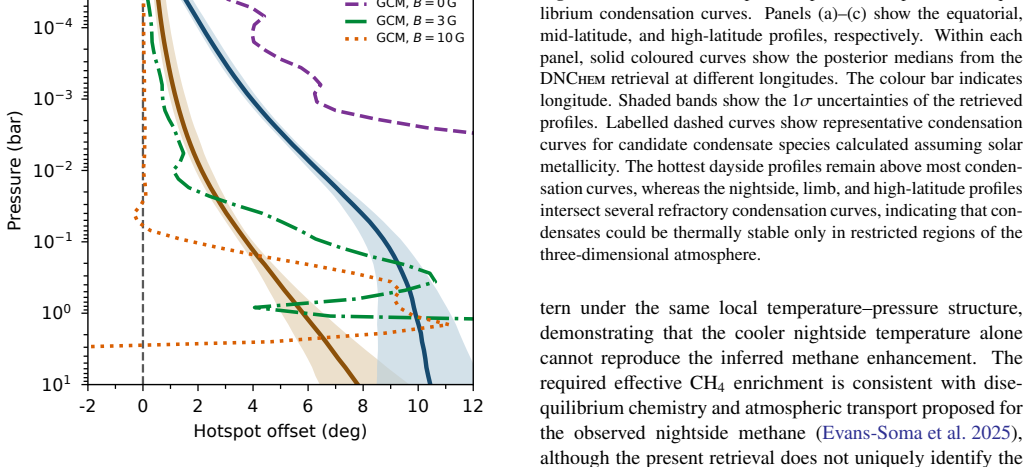
- The small, pressure-dependent hotspot offsets are more consistent with a magnetically damped circulation (3 G case) than a non-magnetic one, although the paper stresses that Rayleigh drag or other damping cannot be excluded.
- The strong Bayesian preference for independent dayside and nightside elemental abundances (ΔlnZ ≈ 65 over shared abundances) indicates that a single globally uniform chemical composition is inadequate within the tested model family, implying real chemical inhomogeneity.
- The retrieved thermal structure implies inhomogeneous cloud condensation conditions, with the cooler nightside and morning limb favouring condensates while the hottest dayside remains largely cloud-free.
Where Pith is reading between the lines
- If the kinematic balance holds, the retrieved vertical profiles of ε(p) and ψ(p) could be mapped onto pressure-dependent zonal wind speeds, giving a direct, testable link between phase-curve retrievals and high-resolution Doppler wind measurements.
- The eclipse-normalisation extraction is model-free at the reduction stage; a natural extension is to feed the same phase-resolved spectra into high-resolution cross-correlation analyses, potentially breaking degeneracies that disk-integrated photometry alone leaves unresolved.
- The recovered day/night chemical contrast is better read as a diagnostic of vertical mixing and chemical quench levels than as a literal elemental abundance discontinuity; coupled kinetic models could test whether nightside vertical transport timescales are short enough to maintain the CH4 excess.
- Because the paper itself notes that 1D-column radiative transfer may bias retrieved gradients, a testable extension is to recompute the favoured WASP-121b model with full 3D radiative transfer and check whether the limb asymmetry and hotspot offsets persist.
Editorial analysis
A structured set of objections, weighed in public.
Referee Report
Summary. The paper presents a framework for extracting and interpreting multidimensional thermal structure from JWST phase curves, applied to the NIRSpec G395H observations of WASP-121b. It combines an 'eclipse normalisation' method that derives phase-resolved spectra by dividing by a stellar template from secondary eclipse, with an analytic 3D temperature parameterisation obtained by reducing the thermodynamic energy equation to a 1D zonal advection–diffusion balance with Newtonian cooling (Eq. 4). The retrieval, run with petitRADTRANS columns and NAUTILUS nested sampling, favours a model with independent dayside and nightside elemental abundances (DNChem). The preferred retrieval shows a strong day–night contrast, dayside and partial nightside thermal inversions, limb temperature asymmetry, and pressure-dependent hotspot offsets increasing from ~4° to ~9°. The authors argue that the confined dayside hot region and small offsets favour a magnetically damped 3 G GCM over a non-magnetic GCM, and that the enhanced nightside CH4 indicates disequilibrium chemistry.
Significance. If the dynamical interpretation survives scrutiny, the framework would be a valuable, computationally efficient tool for multidimensional retrievals. The paper has several concrete strengths: the source code is publicly available, the eclipse-normalised spectra are compared explicitly with standard light-curve fits, the radiative-transfer approximation is benchmarked against PICASO, and the retrieval uses a standard Bayesian framework with quantitative model comparison. The DNChem preference and the nightside CH4 interpretation are interesting and plausibly robust within the tested model family. However, the central dynamical claims rest on interpreting the fitted parameters ε and ψ as physical transport timescales, and that interpretation is not validated. The GCM comparisons are fits rather than predictions, and no test is offered that the retrieved (ε, ψ) correspond to the actual τ_rad/τ_adv and τ_rad/τ_diff in the GCMs. The paper is therefore useful and publishable in principle, but the dynamical conclusions currently outrun the evidence provided.
major comments (3)
- [§3.1, Eq. (4); §4.3, Figs. 11–12; §5.1] The reduction from Eq. (2) to Eq. (4) is a heuristic replacement of the full dynamical transport by a constant-coefficient 1D operator, as the paper itself acknowledges by calling it a 'kinematic model'. But the paper later interprets the fitted ε and ψ as physical timescale ratios and uses them to argue for magnetic drag. Because vertical entropy advection, meridional transport, and thermodynamic feedbacks are absorbed into these effective parameters, the retrieved ε(p), ψ(p) are shape parameters. The paper does not test whether they match the GCM's actual τ_rad/τ_adv and τ_rad/τ_diff. A concrete diagnostic would be to compute these timescale ratios from the GCM wind and radiative fields and compare them with the retrieved profiles, or to run synthetic retrievals on GCM spectra to see whether the true transport timescales are recovered. Without such a test, the magnetic-drag conclusion
- [§3.2, Figs. 5–6] The abstract and §3.2 state that the parameterisation 'reproduces' GCM temperature fields. However, the validation is a least-squares fit of the parameterisation to each GCM field; agreement therefore measures expressive flexibility, not physical fidelity. The paper should either provide an out-of-sample test (e.g., fit one GCM and predict another, or withhold a pressure/longitude region) or compare the fitted (ε, ψ) with independently diagnosed GCM transport timescales. Without this, Figs. 5–6 do not establish that Eq. (4) captures the dynamical content claimed in the title and conclusions.
- [§4.3, Fig. 11] The monotonic increase of ε and ψ with pressure is interpreted as 'dynamical heat redistribution becomes progressively more efficient at depth' (Fig. 11 caption) and as 'radiative relaxation is faster than advective and diffusive transport at low pressures' (§4.3). This attribution is not justified because ε=τ_rad/τ_adv depends on τ_rad, which in real hot-Jupiter atmospheres increases strongly with pressure. The same retrieved ε(p) profile could result from a radiative-timescale gradient with constant advection. Since τ_rad is not independently constrained—it is absorbed into the dimensionless ratios—the pressure dependence in Fig. 11 alone does not constrain the pressure dependence of transport. The text should be revised to treat ε(p), ψ(p) as phenomenological, or the analysis should include an independent radiative-timescale prior or diagnostic.
minor comments (6)
- [Abstract and §3.1] The phrase 'derived from radiative, advective and diffusive energy balance' overstates the status of Eq. (4). The paper itself calls it a kinematic model; the abstract and title should reflect this, e.g., 'inspired by' or 'parameterised following' a simplified energy balance.
- [§3.1, Eqs. (13)–(14)] The text says the hotspot offset is 'well approximated' by tan⁻¹(ε/(1+ψ)) in the strong-radiative regime, but retrieved ε and ψ reach values well above unity at depth. Please state explicitly whether the reported offsets come from the numerical solution of Eq. (14) or from the approximation, and verify the approximation against the full solution at the retrieved parameters.
- [§2.2] The description of the linear detrending step is vague: it should be stated more precisely how the linear function fitted to in-eclipse data is extrapolated to out-of-eclipse phases and propagated into the uncertainties. This is important for reproducing the eclipse-normalisation pipeline.
- [Fig. 3] The bottom panel labelled 'Diff. (σ)' is described as a histogram in the caption but the axes and units are not explained. Please clarify what is plotted.
- [Table 2] The Cloud model is reported with ΔlnZ = −17.05. This is weak-to-moderate evidence and should be described with appropriate caution; the text currently says it is 'disfavoured' without qualifying the strength.
- [References / typesetting] Several instances read 'W ASP-121b' with an unwanted space, and 'JWSTandAriel' is missing a space. Also, the data DOI is given incompletely as 'doi:10.17909' and should be completed.
Circularity Check
Central retrieval is a self-contained inverse analysis; the only circular-adjacent step is the GCM validation being an in-sample fit labelled a reproduction.
specific steps
-
fitted input called prediction
[Section 3.2, Figures 5 and 6]
"Figure 5 presents a validation case where we fit the 3D temperature distribution of a non-grey, cloud-free, drag-free hot Jupiter GCM simulation from Roth et al. (2024). ... Our parameterised model successfully reproduces these key morphological features."
The validation fits the parameterisation's free parameters (Tn, Td, alpha, epsilon, psi) directly to the GCM temperature field, then presents the resulting best fit as 'reproduces' the GCM. Because the same field is used both to determine and to test the parameters, the agreement is an in-sample fit rather than an out-of-sample prediction. This is not load-bearing for the WASP-121b retrieval, which fits the same model to JWST spectra, but the abstract's wording 'the parameterisation reproduces the large-scale thermal structures predicted by GCMs' overstates the evidential value.
full rationale
The central derivation chain is self-contained: the temperature parameterisation is set out as an explicit kinematic equation (Eq. 4), solved analytically (Eqs. 6-12), and then used as a forward model in a Bayesian retrieval against JWST/NIRSpec G395H data. The retrieved parameters (epsilon, psi, Tn, Td, alpha) are fitted to spectra, so statements about the retrieved thermal structure, hotspot offsets, and day/night chemical differences are standard inverse-modelling results, not circular. The comparisons to GCMs are external benchmarks, and the magnetic-drag interpretation is a physical interpretation of those comparisons rather than a forced consequence of the model equations. The only mild circular-adjacent step is the GCM validation being an in-sample fit presented as reproduction; this is a modelling-flexibility test, not a prediction, but it does not affect the independent retrieval conclusions. There is no load-bearing self-citation chain and no uniqueness theorem imported from the authors, so the paper does not exhibit material circularity.
Axiom & Free-Parameter Ledger
free parameters (9)
- Dayside Td(p) profile parameters =
logκ_IR,d ≈ -2.00; logγ_d ≈ 0.53; logγ2,d ≈ -2.60; Tα,d ≈ 0.60; Tβ,d ≈ 1.50
- Nightside Tn(p) profile parameters =
logκ_IR,n ≈ -4.12; logγ_n ≈ -1.53; logγ2,n ≈ -2.98; Tα,n ≈ 0.53; Tβ,n ≈ 0.41
- ε0, ε1 =
-0.981, 1.411
- ψ0, ψ1 =
-0.379, 1.425
- ζα, Δζα =
0.490, 0.203
- γ_lat =
0.223 (DNChem)
- Elemental abundances (DNChem) =
dayside [O/H]=0.62, [C/H]=0.80, [Si/H]=0.88, [M/H]=0.32; nightside [O/H]=0.51, [C/H]=1.00, [Si/H]=1.69, [M/H]=-0.50
- β error scaling =
1.337
- Teff, Kp, Δv =
Teff ≈ 6458 K, Kp ≈ 217.6 km/s, Δv ≈ -89 km/s
axioms (6)
- domain assumption Newtonian cooling approximation (Eq. 3)
- domain assumption Steady-state, no additional sources/sinks (Eq. 2)
- ad hoc to paper Kinematic 1D advection-diffusion parameterization (Eq. 4)
- domain assumption Chemical equilibrium with FastChem (Sec. 3.3)
- domain assumption LTE, no scattering, 1D column radiative transfer (Sec. 3.4)
- domain assumption Photometrically stable star and linear systematics (Sec. 2.2)
read the original abstract
Understanding the multidimensional structure of strongly irradiated exoplanets is essential for interpreting their atmospheric dynamics, chemistry and energy transport, yet current analyses remain limited by the difficulty of extracting reliable phase-resolved spectra and by the lack of physically interpretable parameterisations for retrievals. We combine a data-driven eclipse-normalisation method with an analytical three-dimensional temperature parameterisation derived from radiative, advective and diffusive energy balance and controlled by a few characteristic timescales. Applied to JWST/NIRSpec G395H observations of WASP-121b, the method yields spectra consistent with conventional phase-curve fitting, while the parameterisation reproduces the large-scale thermal structures predicted by general circulation models. The preferred retrieval reveals a pronounced day--night contrast, a dayside thermal inversion extending to both limbs, an inversion over part of the nightside, and limb temperatures differing by several hundred kelvin. Dynamical transport strengthens with pressure, and the hotspot offset increases from $\sim4^\circ$ to $\sim9^\circ$ across the pressures probed by G395H. The confined dayside hot region and the small, pressure-dependent offsets lie closer to the $\sim$3~G GCM than to its non-magnetic counterpart, although Rayleigh drag cannot be excluded. The spectra also favour distinct dayside and nightside chemical states, with more nightside CH$_4$ than the cooler temperatures alone can explain, pointing to disequilibrium chemistry. The retrieved thermal structure further implies an inhomogeneous cloud distribution, with condensation favoured on the nightside and cooler morning limb. The framework provides a computationally efficient, physically interpretable path from spectroscopic phase curves to multidimensional atmospheric structure.
Figures




Reference graph
Works this paper leans on
-
[1]
The high-temperature spectrum of VO
ExoMol line lists - XVIII. The high-temperature spectrum of VO. MNRAS , keywords =. doi:10.1093/mnras/stw1969 , archivePrefix =. 1609.06120 , primaryClass =
-
[2]
The spectrum of Titanium Oxide
ExoMol molecular line lists - XXXIII. The spectrum of Titanium Oxide. MNRAS , keywords =. doi:10.1093/mnras/stz1818 , archivePrefix =. 1905.04587 , primaryClass =
Pith/arXiv arXiv 1905
-
[3]
MoLLIST: Molecular Line Lists, Intensities and Spectra. JQSRT , keywords =. doi:10.1016/j.jqsrt.2019.106687 , adsurl =
arXiv 2019
-
[4]
Improved HCN/HNC linelist, model atmospheres and synthetic spectra for WZ Cas. MNRAS , keywords =. doi:10.1111/j.1365-2966.2005.09960.x , archivePrefix =. astro-ph/0512363 , primaryClass =
arXiv 2005
-
[5]
An improved hot rotation-vibration line list for HCN and HNC
ExoMol line lists - III. An improved hot rotation-vibration line list for HCN and HNC. MNRAS , keywords =. doi:10.1093/mnras/stt2011 , archivePrefix =. 1311.1328 , primaryClass =
-
[6]
Infrared and ultraviolet line list for silicon monoxide ( ^ 28 Si ^ 16 O)
ExoMol line lists - XLIV. Infrared and ultraviolet line list for silicon monoxide ( ^ 28 Si ^ 16 O). MNRAS , keywords =. doi:10.1093/mnras/stab3267 , archivePrefix =. 2111.04859 , primaryClass =
-
[7]
ExoMol molecular line lists - XXXVII. Spectra of acetylene. MNRAS , keywords =. doi:10.1093/mnras/staa229 , archivePrefix =. 2001.04550 , primaryClass =
Pith/arXiv arXiv 2001
-
[8]
An Accurate, Extensive, and Practical Line List of Methane for the HITEMP Database. ApJS , keywords =. doi:10.3847/1538-4365/ab7a1a , archivePrefix =. 2001.05037 , primaryClass =
Pith/arXiv arXiv 2001
-
[9]
A rotation-vibration line list for hot ammonia
ExoMol molecular line lists - XXXV. A rotation-vibration line list for hot ammonia. MNRAS , keywords =. doi:10.1093/mnras/stz2778 , archivePrefix =. 1911.10369 , primaryClass =
Pith/arXiv arXiv 1911
-
[10]
Ro-vibrational molecular line list for CO _ 2
ExoMol line lists - XXXIX. Ro-vibrational molecular line list for CO _ 2. MNRAS , keywords =. doi:10.1093/mnras/staa1874 , archivePrefix =. 2007.02122 , primaryClass =
Pith/arXiv arXiv 2007
-
[11]
JQSRT , year = 2010, month = oct, volume =
HITEMP, the high-temperature molecular spectroscopic database. JQSRT , year = 2010, month = oct, volume =. doi:10.1016/j.jqsrt.2010.05.001 , adsurl =
-
[12]
Rovibrational Line Lists for Nine Isotopologues of the CO Molecule in the X ^ 1 ^ + Ground Electronic State. ApJS , keywords =. doi:10.1088/0067-0049/216/1/15 , adsurl =
-
[13]
pyROX: Rapid Opacity X-sections. arXiv , keywords =. doi:10.48550/arXiv.2510.20870 , archivePrefix =. 2510.20870 , primaryClass =
-
[14]
NAUTILUS: boosting Bayesian importance nested sampling with deep learning. MNRAS , keywords =. doi:10.1093/mnras/stad2441 , archivePrefix =. 2306.16923 , primaryClass =
-
[15]
Transmission Spectra of Three-Dimensional Hot Jupiter Model Atmospheres. ApJ , keywords =. doi:10.1088/0004-637X/709/2/1396 , archivePrefix =. 0912.2350 , primaryClass =
-
[16]
Toward a multidimensional analysis of transmission spectroscopy. III. Modeling 2D effects in retrievals with TauREx. A&A , keywords =. doi:10.1051/0004-6361/202243492 , archivePrefix =. 2207.14247 , primaryClass =
-
[17]
Aura-3D: A Three-dimensional Atmospheric Retrieval Framework for Exoplanet Transmission Spectra. ApJ , keywords =. doi:10.3847/1538-4357/ac7c09 , archivePrefix =. 2201.03532 , primaryClass =
-
[18]
pysynphot: Synthetic photometry software package
-
[19]
Extremely Irradiated Hot Jupiters: Non-oxide Inversions, H ^ - Opacity, and Thermal Dissociation of Molecules. ApJ , keywords =. doi:10.3847/1538-4357/aadd9e , archivePrefix =. 1805.00038 , primaryClass =
-
[20]
gCMCRT: A GPU-accelerated MCRT Code
3D Radiative Transfer for Exoplanet Atmospheres. gCMCRT: A GPU-accelerated MCRT Code. ApJ , keywords =. doi:10.3847/1538-4357/ac61d6 , archivePrefix =. 2110.15640 , primaryClass =
-
[21]
Horizontal and vertical exoplanet thermal structure from a JWST spectroscopic eclipse map. NatAs , keywords =. doi:10.1038/s41550-025-02666-9 , archivePrefix =. 2510.24708 , primaryClass =
-
[22]
A broadband thermal emission spectrum of the ultra-hot Jupiter WASP-18b. Natur , keywords =. doi:10.1038/s41586-023-06230-1 , archivePrefix =. 2301.08192 , primaryClass =
-
[23]
Two-dimensional Eclipse Mapping of the Hot-Jupiter WASP-43b with JWST MIRI/LRS. AJ , keywords =. doi:10.3847/1538-3881/ad434d , archivePrefix =. 2404.16488 , primaryClass =
-
[24]
The Effects of Snowlines on C/O in Planetary Atmospheres. ApJL , keywords =. doi:10.1088/2041-8205/743/1/L16 , archivePrefix =. 1110.5567 , primaryClass =
Pith/arXiv arXiv 2041
-
[25]
Toward Chemical Constraints on Hot Jupiter Migration. ApJL , keywords =. doi:10.1088/2041-8205/794/1/L12 , archivePrefix =. 1408.3668 , primaryClass =
Pith/arXiv arXiv 2041
-
[26]
A New Window into Planet Formation and Migration: Refractory-to-Volatile Elemental Ratios in Ultra-hot Jupiters. ApJ , keywords =. doi:10.3847/1538-4357/abf8a9 , archivePrefix =. 2011.10626 , primaryClass =
Pith/arXiv arXiv 2011
-
[27]
CRIRES ^ + and ESPRESSO Reveal an Atmosphere Enriched in Volatiles Relative to Refractories on the Ultrahot Jupiter WASP-121b. AJ , keywords =. doi:10.3847/1538-3881/ad8b28 , archivePrefix =. 2410.18183 , primaryClass =
-
[28]
Magnetic Effects in Hot Jupiter Atmospheres. ApJ , keywords =. doi:10.1088/0004-637X/794/2/132 , archivePrefix =. 1409.0519 , primaryClass =
-
[29]
Phase-resolving the Absorption Signatures of Water and Carbon Monoxide in the Atmosphere of the Ultra-hot Jupiter WASP-121b with GEMINI-S/IGRINS. PASP , keywords =. doi:10.1088/1538-3873/ad5c9f , archivePrefix =. 2406.09641 , primaryClass =
-
[30]
The Roasting Marshmallows Program with IGRINS on Gemini South. II. WASP-121 b has Superstellar C/O and Refractory-to-volatile Ratios. AJ , keywords =. doi:10.3847/1538-3881/ad8574 , archivePrefix =. 2410.19017 , primaryClass =
-
[31]
An Analysis of Spitzer Phase Curves for WASP-121b and WASP-77Ab. AJ , keywords =. doi:10.3847/1538-3881/adc0a4 , archivePrefix =. 2503.12521 , primaryClass =
-
[32]
Increased Heat Transport in Ultra-hot Jupiter Atmospheres through H _ 2 Dissociation and Recombination. ApJL , keywords =. doi:10.3847/2041-8213/aabcc8 , archivePrefix =. 1802.07725 , primaryClass =
Pith/arXiv arXiv 2041
-
[33]
Modelling the day-night temperature variations of ultra-hot Jupiters: confronting non-grey general circulation models and observations. MNRAS , keywords =. doi:10.1093/mnras/stae050 , archivePrefix =. 2401.03859 , primaryClass =
-
[34]
Detection of OH and Fe in the dayside atmosphere of the hottest ultra-hot Jupiter KELT-9b with SPIRou. A&A , keywords =. doi:10.1051/0004-6361/202555347 , archivePrefix =. 2509.23850 , primaryClass =
-
[35]
doi:10.1093/mnras/staa228 , eprint =
MNRAS , keywords =. doi:10.1093/mnras/staa228 , eprint =
-
[37]
Retrieving Temperatures and Abundances of Exoplanet Atmospheres with High-resolution Cross-correlation Spectroscopy. AJ , keywords =. doi:10.3847/1538-3881/aaffd3 , archivePrefix =. 1811.01681 , primaryClass =
-
[38]
MULTINEST: an efficient and robust Bayesian inference tool for cosmology and particle physics. MNRAS , keywords =. doi:10.1111/j.1365-2966.2009.14548.x , archivePrefix =. 0809.3437 , primaryClass =
arXiv 2009
-
[39]
Nested Sampling. Bayesian Inference and Maximum Entropy Methods in Science and Engineering: 24th International Workshop on Bayesian Inference and Maximum Entropy Methods in Science and Engineering , year = 2004, editor =. doi:10.1063/1.1835238 , adsurl =
-
[40]
X-ray spectral modelling of the AGN obscuring region in the CDFS: Bayesian model selection and catalogue. A&A , keywords =. doi:10.1051/0004-6361/201322971 , archivePrefix =. 1402.0004 , primaryClass =
-
[41]
Quantifying the differences in transmission and emission spectra of hot irradiated gaseous exoplanet atmospheres: A comparison of 1D and 3D modelling using JWST. MNRAS.tmp , keywords =. doi:10.1093/mnras/staf2122 , archivePrefix =. 2511.21454 , primaryClass =
-
[42]
Toward Atmospheric Retrievals of Panchromatic Light Curves: EXPLOR-ing Generalized Inversion Techniques for Transiting Exoplanets with JWST and Ariel. AJ , keywords =. doi:10.3847/1538-3881/ad3032 , archivePrefix =. 2403.02244 , primaryClass =
-
[43]
JWST-TST DREAMS: The Nightside Emission and Chemistry of WASP-17b. ApJL , keywords =. doi:10.3847/2041-8213/ae17ae , archivePrefix =. 2510.06169 , primaryClass =
arXiv 2041
-
[44]
Storms, Variability, and Multiple Equilibria on Hot Jupiters. ApJL , keywords =. doi:10.3847/2041-8213/abfd37 , adsurl =
-
[45]
Three-dimensional radiative-hydrodynamical simulations of the highly irradiated short-period exoplanet HD 189733b. MNRAS , keywords =. doi:10.1093/mnras/stt1509 , archivePrefix =. 1211.1709 , primaryClass =
-
[46]
Atmospheric circulation of tidally locked exoplanets: a suite of benchmark tests for dynamical solvers. MNRAS , keywords =. doi:10.1111/j.1365-2966.2011.18315.x , archivePrefix =. 1010.1257 , primaryClass =
arXiv 2011
-
[47]
Atmospheric Circulation of Hot Jupiters: Coupled Radiative-Dynamical General Circulation Model Simulations of HD 189733b and HD 209458b. ApJ , keywords =. doi:10.1088/0004-637X/699/1/564 , archivePrefix =. 0809.2089 , primaryClass =
Pith/arXiv arXiv 2089
-
[48]
Thermal structure of an exoplanet atmosphere from phase-resolved emission spectroscopy. Sci , keywords =. doi:10.1126/science.1256758 , archivePrefix =. 1410.2241 , primaryClass =
-
[49]
Inverting Phase Functions to Map Exoplanets. ApJL , keywords =. doi:10.1086/588553 , archivePrefix =. 0803.3622 , primaryClass =
-
[50]
A map of the day-night contrast of the extrasolar planet HD 189733b. Natur , keywords =. doi:10.1038/nature05782 , archivePrefix =. 0705.0993 , primaryClass =
-
[51]
Hot Exoplanetary Atmospheres in 3D. RemS , keywords =. doi:10.3390/rs15030635 , archivePrefix =. 2301.12779 , primaryClass =
-
[52]
Handbook of Exoplanets , year = 2018, editor =
Exoplanet Phase Curves: Observations and Theory. Handbook of Exoplanets , year = 2018, editor =. doi:10.1007/978-3-319-55333-7_116 , adsurl =
-
[53]
Exoplanetary Atmospheres: Key Insights, Challenges, and Prospects. ARA&A , keywords =. doi:10.1146/annurev-astro-081817-051846 , archivePrefix =. 1904.03190 , primaryClass =
Pith/arXiv arXiv 1904
-
[54]
A chemical survey of exoplanets with ARIEL. ExA , keywords =. doi:10.1007/s10686-018-9598-x , adsurl =
-
[55]
Strong biases in retrieved atmospheric composition caused by day-night chemical heterogeneities. A&A , keywords =. doi:10.1051/0004-6361/202037678 , archivePrefix =. 2003.05943 , primaryClass =
Pith/arXiv arXiv 2003
-
[56]
A Systematic Retrieval Analysis of Secondary Eclipse Spectra. I. A Comparison of Atmospheric Retrieval Techniques. ApJ , keywords =. doi:10.1088/0004-637X/775/2/137 , archivePrefix =. 1304.5561 , primaryClass =
-
[57]
A Temperature and Abundance Retrieval Method for Exoplanet Atmospheres. ApJ , keywords =. doi:10.1088/0004-637X/707/1/24 , archivePrefix =. 0910.1347 , primaryClass =
-
[58]
On the Absorption and Redistribution of Energy in Irradiated Planets. ApJS , keywords =. doi:10.1086/591964 , archivePrefix =. 0801.2972 , primaryClass =
-
[59]
A More Informative Map: Inverting Thermal Orbital Phase and Eclipse Light Curves of Exoplanets. AJ , keywords =. doi:10.3847/1538-3881/aae57f , archivePrefix =. 1806.05700 , primaryClass =
-
[60]
TRIDENT: A Rapid 3D Radiative-transfer Model for Exoplanet Transmission Spectra. ApJ , keywords =. doi:10.3847/1538-4357/ac47fe , archivePrefix =. 2111.05862 , primaryClass =
-
[61]
2D Retrieval Frameworks for Hot Jupiter Phase Curves. AJ , keywords =. doi:10.3847/1538-3881/aba8f9 , archivePrefix =. 2006.11442 , primaryClass =
Pith/arXiv arXiv 2006
-
[62]
The Impact of Non-uniform Thermal Structure on the Interpretation of Exoplanet Emission Spectra. ApJ , keywords =. doi:10.3847/0004-637X/829/1/52 , archivePrefix =. 1607.03230 , primaryClass =
-
[63]
Why Is it So Cold in Here? Explaining the Cold Temperatures Retrieved from Transmission Spectra of Exoplanet Atmospheres. ApJL , keywords =. doi:10.3847/2041-8213/ab8238 , archivePrefix =. 2003.11548 , primaryClass =
Pith/arXiv arXiv 2041
-
[64]
Toward a More Complex Description of Chemical Profiles in Exoplanet Retrievals: A Two-layer Parameterization. ApJ , keywords =. doi:10.3847/1538-4357/ab4a14 , archivePrefix =. 1903.11180 , primaryClass =
Pith/arXiv arXiv 1903
-
[65]
The cloudy shape of hot Jupiter thermal phase curves. MNRAS , keywords =. doi:10.1093/mnras/staa3418 , archivePrefix =. 2010.06934 , primaryClass =
Pith/arXiv arXiv 2010
-
[66]
A model grid study in support of large-scale observational campaigns
Exoplanet weather and climate regimes with clouds and thermal ionospheres. A model grid study in support of large-scale observational campaigns. A&A , keywords =. doi:10.1051/0004-6361/202243956 , archivePrefix =. 2208.05562 , primaryClass =
-
[67]
Diurnal variations in the stratosphere of the ultrahot giant exoplanet WASP-121b. NatAs , keywords =. doi:10.1038/s41550-021-01592-w , archivePrefix =. 2202.09884 , primaryClass =
-
[68]
Patchy Nightside Clouds on Ultra-hot Jupiters: General Circulation Model Simulations with Radiatively Active Cloud Tracers. ApJ , keywords =. doi:10.3847/1538-4357/ac7723 , archivePrefix =. 2205.07834 , primaryClass =
-
[69]
From thermal dissociation to condensation in the atmospheres of ultra hot Jupiters: WASP-121b in context. A&A , keywords =. doi:10.1051/0004-6361/201833059 , archivePrefix =. 1805.00096 , primaryClass =
-
[70]
Transitions in the Cloud Composition of Hot Jupiters. ApJ , keywords =. doi:10.3847/0004-637X/828/1/22 , archivePrefix =. 1602.03088 , primaryClass =
-
[71]
Temperature Structures Associated with Different Components of the Atmospheric Circulation on Tidally Locked Exoplanets. ApJ , keywords =. doi:10.3847/1538-4357/ac8fed , archivePrefix =. 2204.06503 , primaryClass =
-
[72]
Exoplanet Atmosphere Retrievals in 3D Using Phase Curve Data with ARCiS: Application to WASP-43b. A&A , keywords =. doi:10.1051/0004-6361/202142800 , archivePrefix =. 2206.09738 , primaryClass =
-
[73]
Testing 2D temperature models in Bayesian retrievals of atmospheric properties from hot Jupiter phase curves. MNRAS , keywords =. doi:10.1093/mnras/stad2555 , archivePrefix =. 2305.10249 , primaryClass =
-
[74]
GCM-motivated Multidimensional Temperature Parametrization Scheme for Phase-curve Retrieval. ApJ , keywords =. doi:10.3847/1538-4357/ac5898 , archivePrefix =. 2202.11439 , primaryClass =
-
[75]
A Model for Thermal Phase Variations of Circular and Eccentric Exoplanets. ApJ , keywords =. doi:10.1088/0004-637X/726/2/82 , archivePrefix =. 1011.0428 , primaryClass =
-
[76]
Physically-motivated basis functions for temperature maps of exoplanets. A&A , keywords =. doi:10.1051/0004-6361/202142135 , archivePrefix =. 2110.11837 , primaryClass =
-
[77]
2.5D retrieval of atmospheric properties from exoplanet phase curves: application to WASP-43b observations. MNRAS , keywords =. doi:10.1093/mnras/staa238 , archivePrefix =. 1909.03233 , primaryClass =
Pith/arXiv arXiv 1909
-
[78]
Equatorial Superrotation on Tidally Locked Exoplanets. ApJ , keywords =. doi:10.1088/0004-637X/738/1/71 , archivePrefix =. 1103.3101 , primaryClass =
-
[79]
Towards consistent mapping of distant worlds: secondary-eclipse scanning of the exoplanet HD 189733b. A&A , keywords =. doi:10.1051/0004-6361/201219060 , archivePrefix =. 1202.3829 , primaryClass =
-
[80]
A Two-dimensional Infrared Map of the Extrasolar Planet HD 189733b. ApJL , keywords =. doi:10.1088/2041-8205/747/2/L20 , archivePrefix =. 1202.1883 , primaryClass =
Pith/arXiv arXiv 2041
-
[81]
Atmospheric Dynamics of Hot Giant Planets and Brown Dwarfs. SSRv , keywords =. doi:10.1007/s11214-020-00758-8 , archivePrefix =. 2007.15363 , primaryClass =
Pith/arXiv arXiv 2007
discussion (0)
Sign in with ORCID, Apple, or X to comment. Anyone can read and Pith papers without signing in.