REVIEW 3 major objections 5 minor 73 references
A shared text description plus a soft foreground mask, injected through a hypergraph and a mask-guided part model, gives multi-modal object re-identification its largest gains exactly in the low-light, occluded scenes where prior methods de
Reviewed by Pith at T0; open to challenge. T0 means a machine referee read the full paper against a public rubric. the ladder, T0–T4 →
T0 review · deepseek-v4-flash
2026-08-03 11:36 UTC pith:BFG4C34G
load-bearing objection Solid but incremental multi-modal ReID work with a real reproducibility gap: the fusion weights in Eq. (1) are never given, and the code is not available. the 3 major comments →
Multi-Modal Object Re-Identification with Dual Semantic Guidance and Global-Local Mutual Modulation
The pith
A machine-rendered reading of the paper's core claim, the machinery that carries it, and where it could break.
Core claim
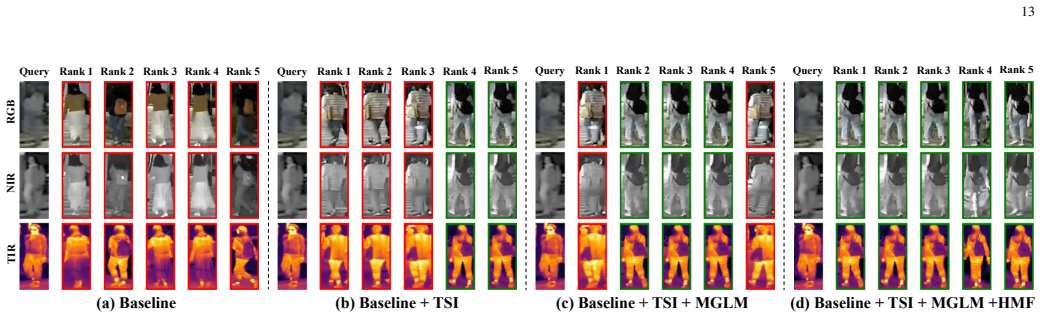
The central claim: cross-modal alignment fails when text priors are per-modality and padding artifacts corrupt the language signal, and when local regions are never matched across spectra. TSI fixes the first: one GPT-4o description from a fused image, PAD tokens masked inside the frozen CLIP text encoder, two GeM pooling branches, and a hypergraph (edges connecting more than two tokens) that exchanges messages with visual tokens. MGLM fixes the second: each modality is cut into k strips, tokens multiplied by a SAM2 soft mask, a global token prepended, and the three modalities encoded jointly per strip. HMF routes strip features through four experts, averages them into a context vector, and
What carries the argument
The load-bearing mechanism is the pairing of two semantic priors — one unified text description (an MLLM generated it once per identity from a YCbCr-fused RGB/NIR/TIR image) and one soft foreground mask (SAM2 on the same fused image) — feeding three lightweight trainable modules. TSI keeps the language signal clean by masking padding tokens inside the frozen CLIP text encoder, distills a multi-granularity text vector with Generalized Mean pooling, and injects it into image tokens via a hypergraph (edges linking more than two nodes, giving higher-order text–visual interaction). MGLM cuts each modality into k horizontal strips, multiplies them by the soft mask, prepends a global token, and enc
Load-bearing premise
Eq. (1) in Section III-A fuses RGB luminance with NIR and TIR using fixed weights α, β, γ, but the values are never stated; Section IV-D-5's Table IX credits the YCbCr-fusion mask with most of the 3 mAP gain over the RGB-only mask, so if those weights are dataset-specific or mis-specified, the reported gains and the method itself would not replicate.
What would settle it
Disclose α, β, γ and re-run the mask-generation comparison of Table IX on MSVR310, where the framework claims its largest margin (64.6% vs 47.0% mAP), sweeping from equal thirds to strongly RGB-dominant weights; if the best results appear only in a narrow, undisclosed range, or if equal thirds match the reported 64.6%, the attribution of the gain to the specific YCbCr fusion scheme is not established.
If this is right
- A multi-modal ReID system can beat prior CLIP-based pipelines by 2.4–17.6 mAP while keeping essentially the same inference cost: 37.91 GFLOPs and 169.4 samples/s on RGBNT201, because the new modules are light relative to the shared encoders.
- The gains hold as inputs degrade: under 50-pixel spatial misalignment of NIR/TIR the method keeps 73.2% mAP (the prior best keeps 72.9%), and under 40% occlusion it keeps 55.2% mAP versus the prior best of 49.0%.
- The learned features transfer across domains: trained on RGBNT100 and tested on MSVR310, the model reaches 29.6% mAP versus 10.5% for the prior method, suggesting the semantic priors generalize rather than memorize.
- The framework does not depend on a specific text generator: swapping GPT-4o for the weaker open-source Qwen-VL costs only 0.8 mAP, so deployment can use cheaper or local models.
Where Pith is reading between the lines
- The paper never gives α, β, γ for the YCbCr fusion in Eq. (1), but its own Table IX shows the choice between equal weights and the undisclosed 'ours' is worth 0.6 mAP on RGBNT201. An obvious extension is to make these weights learnable or sample-adaptive, which would remove the hidden hyperparameter and might further improve robustness under modality failure.
- Because masks and text are generated offline and cached (1.16 MB text + 3.45 MB mask for RGBNT201, 0.0115 s/sample for SAM2), the method's offline preprocessing is cheap; an interesting untested consequence is that the same priors could be regenerated at test time for a known gallery, turning the mask into a test-time regularizer.
- The Qwen-VL robustness result suggests the text acts more as a regularizer than a hard constraint; a testable extension is to replace MLLM text with simple template sentences, which would isolate how much of the gain comes from language semantics versus the structural mask.
- The paper states that the hypergraph sparsity threshold τ=2 is optimal 'across datasets,' but the sweep in Table VII(b) is reported only for RGBNT201; a quick check on MSVR310 and RGBNT100 would settle whether that tuning transfers or needs re-tuning.
Editorial analysis
A structured set of objections, weighed in public.
Referee Report
Summary. The paper proposes DSGM, a multi-modal object ReID framework combining three components: a Text-Semantic Injector (TSI) that uses MLLM-generated unified textual descriptions and a hypergraph network for high-order vision-language interaction; a Masked Global-Local Modulator (MGLM) that applies SAM2-derived soft masks and global context to guide part-level cross-modal alignment; and a Hierarchical MoE Fusion (HMF) with two-stage routing for adaptive multi-spectral aggregation. The method is evaluated on RGBNT201, RGBNT100, and MSVR310, reporting state-of-the-art mAP/Rank-1 results (e.g., 82.6/87.0 on RGBNT201 and 64.6/76.0 on MSVR310). Extensive ablations (Tables III, VI, VII, IX, XI–XVI) and robustness studies under occlusion and misalignment support the design choices.
Significance. If the reported results are reproducible, this is a solid, incremental contribution to multi-modal ReID. The ablation study is unusually thorough, including sensitivity to text-generator quality, cross-dataset transfer, and robustness to pixel misalignment and occlusion. However, the central SOTA claim currently rests on single-run point estimates and on an unspecified fusion-weight equation, which limits the paper's immediate verifiability and statistical credibility.
major comments (3)
- [§III-A, Eq. (1), Table IX] The fixed fusion weights α, β, γ in Eq. (1) are never given numeric values. Table IX shows that the mask-generation strategy moves mAP from 79.6 (RGB) to 82.0 (YCbCr equal weights) to 82.6 (YCbCr Fuse 'Ours'), and the text attributes the 0.6 mAP gain to 'asymmetric RGB-dominant fusion.' Yet no coefficient values or sensitivity sweep are provided, and the claim that this is a 'stable physical prior' conflicts with the claim that the specific assignment matters. Without these numbers, Eq. (1) is un-executable and the central 82.6% mAP result cannot be independently reproduced. The authors should report the exact coefficients and a sensitivity analysis (e.g., a grid sweep with fixed sum) or remove the 'asymmetric' claim.
- [§IV-C, Tables I–II] All results are single-run point estimates without error bars or multi-seed variance. On RGBNT201, the margin over NEXT is only 0.2 mAP (82.6 vs 82.4) and 0.4 Rank-1 (87.0 vs 86.6); without variance estimates, the stated superiority over this close baseline is not statistically grounded. The authors should report mean ± std over at least three seeds for the main comparison tables, or otherwise justify why single-run reporting is sufficient for these margins.
- [§IV-D4, Table VII(e), Algorithm 3] The text states 'we sweep the number of experts k in Table VII(e),' but Table VII(e) is an ablation of horizontal partitions k (2, 4, 8), not the number of MoE experts. Algorithm 3 fixes E=4 and top-K=2, and no ablation of these HMF-specific hyperparameters is provided. This is a missing ablation for a core contribution; the table should be re-labeled and/or an expert-count/top-K sweep added.
minor comments (5)
- [Fig. 3(b)] Typo: 'adult femal' should be 'adult female.'
- [Table VII] The heading '(e) Partitions k' conflicts with the text's 'number of experts k.' Unify notation; k is used both for horizontal strips and MoE experts, which is confusing.
- [Eq. (1)] Specify whether α+β+γ are normalized, and provide the exact YCbCr conversion matrix used (BT.601 vs BT.709). Also clarify whether the fused luminance is clipped or re-scaled before recombination.
- [Algorithm 1] The adjacency H = I(S < τ) with τ=2 is unusual if S is a similarity; clarify whether S is a distance matrix or whether smaller means more similar. The threshold role should be defined precisely.
- [§IV-B] The implementation details state that text generation and training protocols 'follow the settings established in prior works [17], [18]' without specifying prompt templates, text lengths, or exact training schedules; this hampers reproducibility, though the code release upon acceptance mitigates it.
Circularity Check
No significant circularity: benchmark results are measured against external test splits; the only author-overlapping citation ([70]) is non-load-bearing, and the unspecified fusion weights in Eq. (1) are a reproducibility gap, not a circular step.
full rationale
No circular step is exhibited. The paper's central claim (SOTA mAP/Rank-1 on RGBNT201/100 and MSVR310) rests on standard train/test benchmark evaluation against external methods; the reported numbers are measured, not derived from fitted constants. Modules TSI/MGLM/HMF are specified in full (Algorithms 1-3, Eqs. (1)-(22)) with external bases ([44], [47], [48]); the ablations in Tables III/VI/VII are empirical decompositions, not predictions from the same inputs. The sole author-overlapping citation is ref. [70] (STMI, by two current authors), used only for the FLOPs reporting convention in Sec. IV-D.2: 'Following the same reporting convention as existing MLLM-assisted ReID works [17], [18], [70]', so it is non-load-bearing. The real weaknesses are reproducibility/soundness gaps that are not circularity: Eq. (1) defines I_Y_fused = alpha*I_Y_RGB + beta*I_NIR + gamma*I_TIR with 'fixed fusion weights' but never gives numeric values anywhere, and Sec. IV-D.5 simultaneously says 'Our asymmetric RGB-dominant fusion achieves the best results' while calling the same coefficients 'a stable physical prior rather than a sensitive hyperparameter' (quoting a 0.6 mAP gap in Table IX between equal and asymmetric weights). These passages are internally in tension, but they do not reduce a prediction to its input. Hyperparameters (l=2, tau=2, k=4, mask strategy) are validation-selected with ablations shown - standard fitting, not disguised prediction. Cross-dataset (Table XV) and degraded-condition (Tables XI-XIV) evaluations are external falsification tests. Score 2 only notes the minor non-load-bearing self-citation.
Axiom & Free-Parameter Ledger
free parameters (6)
- Fusion weights α,β,γ (Eq. 1) =
not specified
- Hypergraph threshold τ =
2
- GeM branches l =
2
- Horizontal strips k =
4
- MoE experts E and top-K =
E=4, K=2
- RGB-only global token in MGLM =
selected over sum/concat
axioms (3)
- domain assumption MLLM-generated unified text descriptions are semantically consistent across RGB/NIR/TIR
- domain assumption SAM2 soft masks from the YCbCr-fused image provide accurate foreground likelihood
- domain assumption Reported baseline numbers from prior papers are faithfully reproduced and comparable
read the original abstract
Multi-modal object Re-Identification (ReID) aims to retrieve target instances by leveraging complementary information across modalities. However, existing methods suffer from two challenges. First, they often fail to exploit well-aligned and reliable semantic priors, making them vulnerable to background clutter and cross-modal misalignment. On the other hand, they typically rely on holistic feature modeling, overlooking the synergy between global and local representations. To overcome these limitations, we propose a robust multi-modal ReID framework with dual semantic guidance and global-local mutual modulation, which mainly consists of three key components, namely the Text-Semantic Injector (TSI), the Masked Global-Local Modulator (MGLM), and the Hierarchical MoE Fusion (HMF). The TSI enhances semantic awareness by integrating clean and coherent textual features into visual tokens. The MGLM enables part-aware cross-modal interaction through joint guidance from soft masks and global context, improving fine-grained feature alignment. Finally, the HMF adaptively aggregates multi-spectral features under local semantic supervision, yielding discriminative and robust representations. Extensive experiments on three multi-modal ReID benchmarks demonstrate the effectiveness of the proposed method. The code will be made publicly available at https://github.com/zw-absin/DSGM upon acceptance.
Figures



Reference graph
Works this paper leans on
-
[1]
Watching you: Global- guided reciprocal learning for video-based person re-identification,
X. Liu, P. Zhang, C. Yu, H. Lu, and X. Yang, “Watching you: Global- guided reciprocal learning for video-based person re-identification,” in CVPR, 2021
2021
-
[2]
Deeply coupled convolution– transformer with spatial–temporal complementary learning for video- based person re-identification,
X. Liu, C. Yu, P. Zhang, and H. Lu, “Deeply coupled convolution– transformer with spatial–temporal complementary learning for video- based person re-identification,”TNNLS, 2023
2023
-
[3]
Other tokens matter: Exploring global and local features of vision transformers for object re-identification,
Y . Wang, P. Zhang, D. Wang, and H. Lu, “Other tokens matter: Exploring global and local features of vision transformers for object re-identification,”CVIU, 2024
2024
-
[4]
A video is worth three views: Trigeminal transformers for video-based person re- identification,
X. Liu, P. Zhang, C. Yu, X. Qian, X. Yang, and H. Lu, “A video is worth three views: Trigeminal transformers for video-based person re- identification,”TITS, 2024
2024
-
[5]
Tf-clip: Learning text-free clip for video-based person re-identification,
C. Yu, X. Liu, Y . Wang, P. Zhang, and H. Lu, “Tf-clip: Learning text-free clip for video-based person re-identification,” inAAAI, 2024
2024
-
[6]
Context-aided semantic- aware self-alignment for video-based person re-identification,
Z. Ran, Z. Xiao, X. Lu, X. Wei, and W. Liu, “Context-aided semantic- aware self-alignment for video-based person re-identification,”TCSVT, 2025
2025
-
[7]
Joint self-attention and scale- aggregation for self-calibrated deraining network,
C. Wang, Y . Wu, Z. Su, and J. Chen, “Joint self-attention and scale- aggregation for self-calibrated deraining network,” inACM MM, 2020, pp. 2517–2525
2020
-
[8]
Semi-supervised image deraining using knowledge distillation,
X. Cui, C. Wang, D. Ren, Y . Chen, and P. Zhu, “Semi-supervised image deraining using knowledge distillation,”IEEE TCSVT, vol. 32, no. 12, pp. 8327–8341, 2022
2022
-
[9]
Perceplie: A new path to perceptual low-light image enhancement,
C. Wang, C. Yu, J. Mu, and W. Wang, “Perceplie: A new path to perceptual low-light image enhancement,” inACM MM, 2024, pp. 6530– 6539
2024
-
[10]
Correlation matching transformation transformers for uhd image restoration,
C. Wang, J. Pan, W. Wang, G. Fu, S. Liang, M. Wang, X.-M. Wu, and J. Liu, “Correlation matching transformation transformers for uhd image restoration,” inAAAI, vol. 38, no. 6, 2024, pp. 5336–5344
2024
-
[11]
Neural discrimination-prompted transformers for efficient uhd image restoration and enhancement: C. wang et al
C. Wang, J. Pan, L. Wang, W. Wang, and Y . Yang, “Neural discrimination-prompted transformers for efficient uhd image restoration and enhancement: C. wang et al.”IJCV, vol. 134, no. 3, p. 84, 2026
2026
-
[12]
Top-reid: Multi- spectral object re-identification with token permutation,
Y . Wang, X. Liu, P. Zhang, H. Lu, Z. Tu, and H. Lu, “Top-reid: Multi- spectral object re-identification with token permutation,” inAAAI, 2024
2024
-
[13]
Inter-modality simi- larity learning for unsupervised multi-modality person re-identification,
Z. Pang, L. Zhao, Y . Liu, G. Sharma, and C. Wang, “Inter-modality simi- larity learning for unsupervised multi-modality person re-identification,” TCSVT, 2024
2024
-
[14]
Representation selective coupling via token sparsification for multi- spectral object re-identification,
Z. Yu, Z. Huang, M. Hou, J. Pei, Y . Yan, Y . Liu, and D. Sun, “Representation selective coupling via token sparsification for multi- spectral object re-identification,”TCSVT, 2024
2024
-
[15]
Enhanc- ing visible-infrared person re-identification with modality-and instance- aware adaptation learning,
R. Wu, B. Jiao, M. Liu, S. Wang, W. Wang, and P. Wang, “Enhanc- ing visible-infrared person re-identification with modality-and instance- aware adaptation learning,”TCSVT, 2025
2025
-
[16]
Harmonizing metric discrepancy for cross-modal object re-identification,
L. Huang, Y . Chen, L. Liu, J. Zhu, and H. Zeng, “Harmonizing metric discrepancy for cross-modal object re-identification,”TCSVT, 2025
2025
-
[17]
Idea: Inverted text with cooper- ative deformable aggregation for multi-modal object re-identification,
Y . Wang, Y . Lv, P. Zhang, and H. Lu, “Idea: Inverted text with cooper- ative deformable aggregation for multi-modal object re-identification,” CVPR, 2025
2025
-
[18]
Next: Multi-grained mixture of experts via text-modulation for multi-modal object re-id,
S. Li, C. Li, A. Zheng, A. Lu, J. Tang, and J. Ma, “Next: Multi-grained mixture of experts via text-modulation for multi-modal object re-id,” arXiv:2505.20001, 2025
Pith/arXiv arXiv 2025
-
[19]
Magic tokens: Select diverse tokens for multi-modal object re-identification,
P. Zhang, Y . Wang, Y . Liu, Z. Tu, and H. Lu, “Magic tokens: Select diverse tokens for multi-modal object re-identification,” inCVPR, 2024
2024
-
[20]
Deep learning for person re-identification: A survey and outlook,
M. Ye, J. Shen, G. Lin, T. Xiang, L. Shao, and S. C. Hoi, “Deep learning for person re-identification: A survey and outlook,”TPAMI, 2021
2021
-
[21]
Learning transferable visual models from natural language supervision,
A. Radford, J. W. Kim, C. Hallacy, A. Ramesh, G. Goh, S. Agarwal, G. Sastry, A. Askell, P. Mishkin, J. Clarket al., “Learning transferable visual models from natural language supervision,” inICML, 2021
2021
-
[22]
Clip-reid: exploiting vision-language model for image re-identification without concrete text labels,
S. Li, L. Sun, and Q. Li, “Clip-reid: exploiting vision-language model for image re-identification without concrete text labels,” inAAAI, 2023
2023
-
[23]
Icpl-reid: Identity- conditional prompt learning for multi-spectral object re-identification,
S. Li, C. Li, A. Zheng, J. Tang, and B. Luo, “Icpl-reid: Identity- conditional prompt learning for multi-spectral object re-identification,” arXiv:2505.17821, 2025
Pith/arXiv arXiv 2025
-
[24]
Zero-shot composed image retrieval with textual inversion,
A. Baldrati, L. Agnolucci, M. Bertini, and A. Del Bimbo, “Zero-shot composed image retrieval with textual inversion,” inICCV, 2023
2023
-
[25]
Decoupled feature-based mixture of experts for multi-modal object re-identification,
Y . Wang, Y . Liu, A. Zheng, and P. Zhang, “Decoupled feature-based mixture of experts for multi-modal object re-identification,” inAAAI, 2025
2025
-
[26]
Ugg- reid: Uncertainty-guided graph model for multi-modal object re- identification,
X. Wan, A. Zheng, B. Jiang, B. Wang, C. Li, and J. Tang, “Ugg- reid: Uncertainty-guided graph model for multi-modal object re- identification,”arXiv:2507.04638, 2025
arXiv 2025
-
[27]
Robust multi-modality person re-identification,
A. Zheng, Z. Wang, Z. Chen, C. Li, and J. Tang, “Robust multi-modality person re-identification,” inAAAI, 2021
2021
-
[28]
Interact, embed, and enlarge: Boosting modality-specific representations for multi-modal person re-identification,
Z. Wang, C. Li, A. Zheng, R. He, and J. Tang, “Interact, embed, and enlarge: Boosting modality-specific representations for multi-modal person re-identification,” inAAAI, 2022
2022
-
[29]
Multi-spectral vehicle re-identification: A challenge,
H. Li, C. Li, X. Zhu, A. Zheng, and B. Luo, “Multi-spectral vehicle re-identification: A challenge,” inAAAI, 2020
2020
-
[30]
Graph-based progressive fusion network for multi-modality vehicle re-identification,
Q. He, Z. Lu, Z. Wang, and H. Hu, “Graph-based progressive fusion network for multi-modality vehicle re-identification,”T-ITS, 2023
2023
-
[31]
Progressively hybrid transformer for multi-modal vehicle re-identification,
W. Pan, L. Huang, J. Liang, L. Hong, and J. Zhu, “Progressively hybrid transformer for multi-modal vehicle re-identification,”Sensors, 2023
2023
-
[32]
An image is worth 16x16 words: Transformers for image recognition at scale,
A. Dosovitskiy, L. Beyer, A. Kolesnikov, D. Weissenborn, X. Zhai, T. Unterthiner, M. Dehghani, M. Minderer, G. Heigold, S. Gellyet al., “An image is worth 16x16 words: Transformers for image recognition at scale,”arXiv:2010.11929, 2020
Pith/arXiv arXiv 2010
-
[33]
Unicat: Crafting a stronger fusion baseline for multimodal re-identification,
J. Crawford, H. Yin, L. McDermott, and D. Cummings, “Unicat: Crafting a stronger fusion baseline for multimodal re-identification,” arXiv:2310.18812, 2023
Pith/arXiv arXiv 2023
-
[34]
Heterogeneous test-time training for multi-modal person re-identification,
Z. Wang, H. Huang, A. Zheng, and R. He, “Heterogeneous test-time training for multi-modal person re-identification,” inAAAI, 2024
2024
-
[35]
Mam- bapro: Multi-modal object re-identification with mamba aggregation and synergistic prompt,
Y . Wang, X. Liu, T. Yan, Y . Liu, A. Zheng, P. Zhang, and H. Lu, “Mam- bapro: Multi-modal object re-identification with mamba aggregation and synergistic prompt,” inAAAI, 2025
2025
-
[36]
Mask-guided contrastive attention model for person re-identification,
C. Song, Y . Huang, W. Ouyang, and L. Wang, “Mask-guided contrastive attention model for person re-identification,” inCVPR, 2018
2018
-
[37]
A mask based deep ranking neural network for person retrieval,
L. Qi, J. Huo, L. Wang, Y . Shi, and Y . Gao, “A mask based deep ranking neural network for person retrieval,” inICME, 2019
2019
-
[38]
Identity-guided human semantic parsing for person re-identification,
K. Zhu, H. Guo, Z. Liu, M. Tang, and J. Wang, “Identity-guided human semantic parsing for person re-identification,” inECCV, 2020
2020
-
[39]
Profd: Prompt-guided feature disentangling for occluded person re- identification,
C. Cui, S. Huang, W. Song, P. Ding, Z. Min, and D. Wang, “Profd: Prompt-guided feature disentangling for occluded person re- identification,” inACM MM, 2024
2024
-
[40]
Keypoint promptable re-identification,
V . Somers, A. Alahi, and C. D. Vleeschouwer, “Keypoint promptable re-identification,” inECCV, 2024
2024
-
[41]
Pose-skeleton guided cross-attention representation fusion for occluded pedestrian re- identification,
S. Geng, Y . Liu, Z. Wang, G. Yan, Y . Yang, and Y . Guo, “Pose-skeleton guided cross-attention representation fusion for occluded pedestrian re- identification,”TCSVT, 2025
2025
-
[42]
Multiple information prompt learning for cloth-changing person re-identification,
S. Wei, Z. Gao, C. Ma, Y . Zhao, W. Guan, and S. Chen, “Multiple information prompt learning for cloth-changing person re-identification,” TIP, 2025
2025
-
[43]
Multi- prompts learning with cross-modal alignment for attribute-based person re-identification,
Y . Zhai, Y . Zeng, Z. Huang, Z. Qin, X. Jin, and D. Cao, “Multi- prompts learning with cross-modal alignment for attribute-based person re-identification,” inAAAI, 2024
2024
-
[44]
Recommendation ITU-R BT.601: Studio encoding parameters of digital television for standard 4:3 and wide-screen 16:9 aspect ratios,
ITU-R, “Recommendation ITU-R BT.601: Studio encoding parameters of digital television for standard 4:3 and wide-screen 16:9 aspect ratios,” International Telecommunication Union, ITU-R Recommendation, 2007
2007
-
[45]
Sam 2: Segment anything in images and videos,
N. Ravi, V . Gabeur, Y .-T. Hu, R. Hu, C. Ryali, T. Ma, H. Khedr, R. R ¨adle, C. Rolland, L. Gustafson, E. Mintun, J. Pan, K. V . Alwala, N. Carion, C.-Y . Wu, R. Girshick, P. Doll´ar, and C. Feichtenhofer, “Sam 2: Segment anything in images and videos,”arXiv:2408.00714, 2024
Pith/arXiv arXiv 2024
-
[46]
Fine-tuning cnn image retrieval with no human annotation,
F. Radenovi ´c, G. Tolias, and O. Chum, “Fine-tuning cnn image retrieval with no human annotation,”TPAMI, 2018
2018
-
[47]
Hypergraph neural networks,
Y . Feng, H. You, Z. Zhang, R. Ji, and Y . Gao, “Hypergraph neural networks,” inAAAI, 2019
2019
-
[48]
Smartfreeedit: Mask-free spatial-aware image editing with complex instruction understanding,
Q. Sun, J. Luo, D. Zhang, and X. Li, “Smartfreeedit: Mask-free spatial-aware image editing with complex instruction understanding,” arXiv:2504.12704, 2025
arXiv 2025
-
[49]
Attention is all you need,
A. Vaswani, N. Shazeer, N. Parmar, J. Uszkoreit, L. Jones, A. N. Gomez, Ł. Kaiser, and I. Polosukhin, “Attention is all you need,”NeurIPS, 2017
2017
-
[50]
Outrageously large neural networks: The sparsely-gated mixture-of-experts layer,
N. Shazeer, A. Mirhoseini, K. Maziarz, A. Davis, Q. Le, G. Hinton, and J. Dean, “Outrageously large neural networks: The sparsely-gated mixture-of-experts layer,”arXiv:1701.06538, 2017
Pith/arXiv arXiv 2017
-
[51]
Rethinking the inception architecture for computer vision,
C. Szegedy, V . Vanhoucke, S. Ioffe, J. Shlens, and Z. Wojna, “Rethinking the inception architecture for computer vision,” inCVPR, 2016
2016
-
[52]
In defense of the triplet loss for person re-identification,
A. Hermans, L. Beyer, and B. Leibe, “In defense of the triplet loss for person re-identification,”arXiv:1703.07737, 2017
Pith/arXiv arXiv 2017
-
[53]
A. Hurst, A. Lerer, A. P. Goucher, A. Perelman, A. Ramesh, A. Clark, A. Ostrow, A. Welihinda, A. Hayes, A. Radfordet al., “Gpt-4o system card,”arXiv:2410.21276, 2024
Pith/arXiv arXiv 2024
-
[54]
Cross-directional consistency network with adaptive layer normalization for multi-spectral vehicle re-identification and a high-quality benchmark,
A. Zheng, X. Zhu, Z. Ma, C. Li, J. Tang, and J. Ma, “Cross-directional consistency network with adaptive layer normalization for multi-spectral vehicle re-identification and a high-quality benchmark,”Information Fusion, 2023
2023
-
[55]
Omni-scale feature learning for person re-identification,
K. Zhou, Y . Yang, A. Cavallaro, and T. Xiang, “Omni-scale feature learning for person re-identification,” inICCV, 2019
2019
-
[56]
Counterfactual attention learning for fine-grained visual categorization and re-identification,
Y . Rao, G. Chen, J. Lu, and J. Zhou, “Counterfactual attention learning for fine-grained visual categorization and re-identification,” inICCV, 2021. 15
2021
-
[57]
Beyond part models: Person retrieval with refined part pooling (and a strong convolutional baseline),
Y . Sun, L. Zheng, Y . Yang, Q. Tian, and S. Wang, “Beyond part models: Person retrieval with refined part pooling (and a strong convolutional baseline),” inECCV, 2018
2018
-
[58]
Dynamic en- hancement network for partial multi-modality person re-identification,
A. Zheng, Z. He, Z. Wang, C. Li, and J. Tang, “Dynamic en- hancement network for partial multi-modality person re-identification,” arXiv:2305.15762, 2023
Pith/arXiv arXiv 2023
-
[59]
Lrmm: Low rank multi-scale multi-modal fusion for person re-identification based on rgb-ni-ti,
D. Wu, Z. Liu, Z. Chen, S. Gan, K. Tan, Q. Wan, and Y . Wang, “Lrmm: Low rank multi-scale multi-modal fusion for person re-identification based on rgb-ni-ti,”ESWA, 2025
2025
-
[60]
Wtsf-reid: Depth-driven window-oriented token selection and fusion for multi-modality vehicle re-identification with knowledge consistency constraint,
Z. Yu, Z. Huang, M. Hou, Y . Yan, and Y . Liu, “Wtsf-reid: Depth-driven window-oriented token selection and fusion for multi-modality vehicle re-identification with knowledge consistency constraint,”ESWA, 2025
2025
-
[61]
Escaping modal interactions: An efficient desanet for multi-modal object re- identification,
W. Dong, X. Yang, D. Cheng, N. Wang, and X. Gao, “Escaping modal interactions: An efficient desanet for multi-modal object re- identification,”TIP, 2025
2025
-
[62]
Mdreid: Modality- decoupled learning for any-to-any multi-modal object re-identification,
Y . Feng, J. Li, J. Hu, Y . Zhang, L. Tan, and J. Ji, “Mdreid: Modality- decoupled learning for any-to-any multi-modal object re-identification,” inNeurIPS, 2025
2025
-
[63]
Signal: Selective interaction and global- local alignment for multi-modal object re-identification,
Y . Liu, Y . Wang, and P. Zhang, “Signal: Selective interaction and global- local alignment for multi-modal object re-identification,” inAAAI, 2026
2026
-
[64]
Reliable multi-modal object re-identification via modality-aware graph reason- ing,
X. Wan, A. Zheng, Z. Wang, B. Jiang, J. Tang, and J. Ma, “Reliable multi-modal object re-identification via modality-aware graph reason- ing,”TIFS, 2026
2026
-
[65]
Random erasing data augmentation,
Z. Zhong, L. Zheng, G. Kang, S. Li, and Y . Yang, “Random erasing data augmentation,” inAAAI, 2020
2020
-
[66]
Transreid: Transformer-based object re-identification,
S. He, H. Luo, P. Wang, F. Wang, H. Li, and W. Jiang, “Transreid: Transformer-based object re-identification,” inICCV, 2021
2021
-
[67]
Generative and attentive fusion for multi-spectral vehicle re-identification,
J. Guo, X. Zhang, Z. Liu, and Y . Wang, “Generative and attentive fusion for multi-spectral vehicle re-identification,” inICSP, 2022
2022
-
[68]
Graft: Gradual fusion transformer for multimodal re-identification,
H. Yin, J. Li, E. Schiller, L. McDermott, and D. Cummings, “Graft: Gradual fusion transformer for multimodal re-identification,” arXiv:2310.16856, 2023
Pith/arXiv arXiv 2023
-
[69]
Flare- aware cross-modal enhancement network for multi-spectral vehicle re- identification,
A. Zheng, Z. Ma, Y . Sun, Z. Wang, C. Li, and J. Tang, “Flare- aware cross-modal enhancement network for multi-spectral vehicle re- identification,”Information Fusion, 2025
2025
-
[70]
Stmi: Segmentation-guided token modulation with cross- modal hypergraph interaction for multi-modal object re-identification,
X. Xu, Z. Liu, W. Zhou, Y . Gao, J. Cao, Y . Wang, J. Luo, and D. Zhang, “Stmi: Segmentation-guided token modulation with cross- modal hypergraph interaction for multi-modal object re-identification,” inAAAI, 2026
2026
-
[71]
Prompt-based modality alignment for effective multi-modal object re- identification,
S. Zhang, W. Luo, D. Cheng, Y . Xing, G. Liang, P. Wang, and Y . Zhang, “Prompt-based modality alignment for effective multi-modal object re- identification,”TIP, 2025
2025
-
[72]
Visualizing data using t-sne
L. Van der Maaten and G. Hinton, “Visualizing data using t-sne.”JMLR, 2008
2008
-
[73]
J. Bai, S. Bai, S. Yang, S. Wang, S. Tan, P. Wang, J. Lin, C. Zhou, and J. Zhou, “Qwen-vl: A versatile vision-language model for understanding, localization, text reading, and beyond,”arXiv:2308.12966, 2023
Pith/arXiv arXiv 2023
discussion (0)
Sign in with ORCID, Apple, or X to comment. Anyone can read and Pith papers without signing in.