REVIEW 4 major objections 7 minor 49 references
Large language models can be trained to refuse unsolvable problems, cutting futile reasoning from 79% to 1% on hard tasks while preserving accuracy.
Reviewed by Pith at T0; open to challenge. T0 means a machine referee read the full paper against a public rubric. the ladder, T0–T4 →
T0 review · deepseek-v4-flash
2026-08-03 11:32 UTC pith:6J5DUYAK
load-bearing objection A solid empirical diagnosis of futile reasoning and a promising RL fix, but the 'preserved performance' claim is weakened by over-refusal on OOD and an internal inconsistency about vanilla refusal rates. the 4 major comments →
Knowing When to Quit: Diagnosing and Training LLMs to Abort Futile Reasoning
The pith
A machine-rendered reading of the paper's core claim, the machinery that carries it, and where it could break.
Core claim
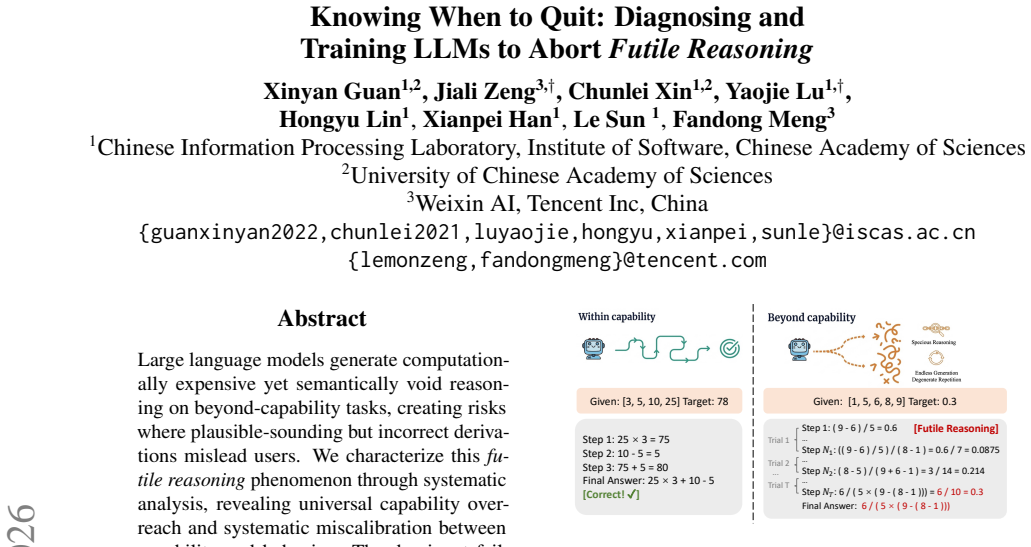
The paper's central claim is that 'futile reasoning'—the generation of superficially valid but incorrect derivations on tasks a model cannot solve—is a distinct, dominant failure mode that can be diagnosed and suppressed by aligning model behavior with its actual capability boundary. The authors establish three phenomena: models uniformly overreach (near-zero refusal even when error rates exceed 65%), the prevalent failure style is 'specious reasoning' that escalates with difficulty, and models are miscalibrated by a roughly 6:1 bias toward over-confidence rather than over-conservatism. They then show that their CaRL method—combining a reward function that ranks refusal above hallucination w
What carries the argument
Futile reasoning is the paper's central object: reasoning traces that look coherent but are mathematically wrong, produced when the model exceeds its capability boundary. The key mechanism is CaRL, which works through two complementary parts. Capability-Calibrated Reward Shaping replaces the usual binary reward with a hierarchy (+1 for correct, 0 for a valid refusal, -1 for incorrect), making refusal strictly better than hallucination. Hindsight Refusal Augmentation addresses the scarcity of refusal examples by taking every incorrect on-policy trajectory and retrofitting it into a refusal response—keeping the reasoning prefix, adding 'Sorry, I don't know', and assigning the refusal reward—so
Load-bearing premise
The load-bearing premise is stated in Section 4.2: 'every failed reasoning attempt implicitly reveals a situation where refusal would have been the appropriate action.' In other words, the method assumes that whenever the current policy produces a wrong answer, the problem is beyond the model's capability and deserves a refusal. If some failures are merely inference-time misses on problems the model can actually solve, this training signal teaches the model to over-refuse.
What would settle it
A direct test: take a CaRL-trained model and a set of problems where the model's failures are known to be solvable (e.g., problems it answers correctly under a different seed or with a few extra reasoning steps, or problems verified solvable by a brute-force solver). Measure how often the trained model now refuses these solvable-but-previously-missed problems. If the refusal rate on that set is high (near the failure rate), the method is teaching over-refusal rather than true capability alignment—the Sudoku accuracy drop on 14B (50.75→44.87) is already suggestive of this.
If this is right
- CaRL-trained models should refuse more on unsolvable queries and produce shorter outputs, cutting compute by roughly one-third on hard reasoning tasks.
- Reliability, defined as correct answers plus half-credit for refusals, rises by 0.13–0.16 points on 8B and 14B models even when accuracy stays flat, meaning the same model is safer to deploy in high-stakes settings.
- The method transfers to out-of-distribution tasks (Sudoku) and to general benchmarks (AIME, GPQA) with less than 2% accuracy change, implying capability-boundary awareness is not just task memorization.
- Standard reward-based RL without hindsight augmentation fails to reduce futile reasoning (futile rate stays above 95% on 8B), implying that dense refusal supervision, not reward shaping alone, is the load-bearing ingredient.
- Larger models benefit more from CaRL (14B futile rate drops to 1.0% vs 7.0% for 8B), suggesting scale amplifies the ability to internalize refusal boundaries.
Where Pith is reading between the lines
- The core training assumption—that every failed attempt is a refusal-worthy failure—may teach over-refusal on solvable problems the model simply missed; the paper's own OOD Sudoku accuracy drop (50.75 to 44.87 on 14B) hints at this risk, and a dedicated evaluation on 'falsely refused but actually solvable' items would quantify it.
- CaRL's reward function treats all refusals as equal (0), so a model could learn to refuse early and cheaply rather than after genuine exploration; ablating on refusal timing or conditioning reward on reasoning effort could distinguish 'knowing when to quit' from 'lazy refusal'.
- The findings suggest a general principle for aligning LLMs: capability boundaries can be learned from the model's own errors by relabeling them as refusals, which might be applicable beyond arithmetic puzzles to knowledge-boundary refusal if the hindsight signal can be made reliable.
- If scaled, the compute savings from aborting futile reasoning could change the economics of test-time scaling, making reasoning models more practical for budget-constrained deployments.
Editorial analysis
A structured set of objections, weighed in public.
Referee Report
Summary. The paper defines and characterizes 'futile reasoning' — long, plausible-looking but incorrect chains produced by LLMs on tasks beyond their capability — using a difficulty-graded Countdown testbed. It reports three phenomena: universal capability overreach (models rarely refuse), specious reasoning as the dominant failure mode, and a capability-behavior misalignment biased toward overconfidence. To address this, the authors propose CaRL, a GRPO-based training method combining reward shaping that ranks refusal above incorrect answers with Hindsight Refusal Augmentation (HRA), which converts every failed rollout into a refusal training example. Experiments on Qwen3-8B/14B report large reductions in futile rate (65.5→7.0% and 78.6→1.0%) while retaining or improving in-distribution accuracy, and a smaller but positive reliability gain on OOD Sudoku and general benchmarks. The central claim is that CaRL achieves capability-aligned behavior without sacrificing utility.
Significance. If the results hold, the paper makes a useful contribution: it provides a clean controlled testbed for studying over-confidence in reasoning models, identifies a concrete failure taxonomy, and proposes a training intervention that appears to substantially reduce hallucinated derivations while keeping task accuracy roughly intact. The authors are appropriately careful to separate reasoning capability from knowledge, and they include OOD and general-task evaluations, which is more than most intervention papers do. The strongest assets are the controlled difficulty design, the explicit refusal-vs-futile metric, and the comparison against Standard RL and RFT baselines, including a cautionary note that RFT's low futile rate on OOD is merely an artifact of near-total refusal. However, the significance is conditional: the central 'without sacrificing utility' claim depends on whether HRA's relabeling of every failed trajectory as refusal-worthy is actually capability-aligned, and the current evidence does not establish that the refused instances are the unsolvable ones. The paper's own OOD accuracy drops and the absence of uncertainty estimates make this a substantive correctness risk rat
major comments (4)
- [§4.2, Eq. (1), Algorithm 1] HRA relabels every r=-1 trajectory as a refusal demonstration (r=0), based on the premise that 'every failed reasoning attempt implicitly reveals a situation where refusal would have been the appropriate action' (§4.2). Since the Countdown training set is generated with golden answers (Appendix A.1), a substantial fraction of failures are likely inference-time misses on queries the model can solve, not evidence of beyond-capability tasks. Training on these relabeled failures teaches the policy to refuse solvable queries. This is exactly the risk visible in Table 1: the 14B OOD Sudoku accuracy drops from 50.75 to 44.87 while refusal rises to 38.87%, and the abstract's 'without sacrificing utility' therefore rests on an untested assumption. The authors should decompose refused/evaluated instances by whether they are truly unsolvable, and/or ablate HRA using only failures on known-unsolvabl
- [§3.4, §4.2] The capability boundary is operationalized circularly. In §3.4 a query is 'solvable' if the model's own sampled accuracy exceeds 0.5; HRA then uses the same model's failures as ground-truth refusal labels. Consequently, the reported 'calibration' improvements may be self-confirming: the model is trained to treat its own failures as refusal-worthy, then evaluated on whether it refuses its own failures. An external criterion (e.g., provable solvability via the golden answer, or an independent solver's success) is needed to show that refusals concentrate on genuinely unsolvable queries rather than on hard-but-solvable ones. Without this, the headline futile-rate reduction does not establish capability-aligned behavior.
- [§3.2, §4.2, Table 1] The text states that 'vanilla models never refuse (0% across all difficulty levels)' and that baseline models exhibit '0% refusal rate' (§3.2, §4.2). Table 1 reports vanilla refusal rates of 13.92% (Qwen3-8B ID), 7.88% (Qwen3-14B ID), 10.62% (8B OOD), and 18.62% (14B OOD). These are not small rounding effects. The contradiction weakens the motivation for HRA (which is justified by the alleged absence of on-policy refusals) and must be reconciled. If 'refusal' is being counted differently in the two places, that definitional difference should be explicit.
- [Table 1, §5.4, Appendix C.1] All headline comparisons are reported as point estimates without error bars, multiple seeds, or significance tests. The paper states that 8 responses per query are averaged, but that does not quantify variation across runs or across query samples. The OOD accuracy drop of 5.9 points for Qwen3-14B, the RFT collapse to 0% accuracy, and the claimed 'preserving performance' are load-bearing; without variance estimates these could be noise. The authors should rerun at least the main comparisons with 3-5 seeds and report means and standard deviations, or provide bootstrap confidence intervals.
minor comments (7)
- [§1] CaRL is spelled 'CARL' once in the introduction; use 'CaRL' consistently.
- [Figure 11 caption] Typo: 'Supicous' should be 'Specious'.
- [§3.1, §3.2, §5.1] Difficulty levels are inconsistent: §3.2 says N=3 to N=8, Figure 2 shows N=3-8, but §5.1 says only N=4,6,8 are generated and Table 2 uses only those. Clarify which difficulty levels were actually evaluated and why N=3 is excluded from training/evaluation.
- [§4.1, Eq. (1)] The detection of a 'valid refusal' is not formalized. Please provide the exact refusal-snippet matching procedure (e.g., regex patterns, threshold on confidence) used in both reward computation and evaluation.
- [§5.2, Table 1] The notation 'RL unk=0' and 'RL unk=0.5' is hard to read; use subscripts or a table column label such as 'RL_unk=0'.
- [§5.5, Table 2] Table 2 reports futile rate and length only for Qwen3-8B. If 14B results differ materially, include them or state why they are omitted.
- [§5.3] The reliability score weights correct=1.0 and refusal=0.5 arbitrarily. Since the paper's central evaluation metric is not parameter-free, a brief sensitivity analysis (e.g., weight 0.25/0.75) would strengthen the conclusions.
Circularity Check
No significant circularity: CaRL's headline reductions are empirical training/evaluation results, not fitted parameters or self-citation chains renamed as predictions.
full rationale
The paper contains no derivation in which a predicted quantity is equal to an input by construction. The central measures are defined independently of the training batches: Futile Rate = Ni/(Ni+Nr) and Reliability = (Nc+0.5Nr)/N are computed on held-out Countdown and OOD Sudoku sets sampled 8 times per query. CaRL's reward shaping (Eq. 1) does encode a preference for refusal over incorrect answers, so a drop in futile rate is expected from the optimization objective, but the reported effect is an empirical outcome on held-out data including an OOD stress test, not a fitted parameter renamed as a prediction. The HRA premise—'every failed reasoning attempt implicitly reveals a situation where refusal would have been the appropriate action'—is a strong assumption, and the paper's own 14B OOD Sudoku accuracy drop (50.75→44.87) plus absence of error bars are legitimate validity concerns, as is the internal inconsistency between the '0% refusal' motivation and Table 1's 13.92%/7.88% vanilla refusal rates. These undermine generalization claims but are not circular reductions. The Reliability metric's 0.5 credit for refusal aligns with the reward hierarchy, so reliability gains should be read as partially reflecting the chosen objective; this is an evaluation-design caveat rather than a circularity because accuracy is also reported and the headline futile-rate reduction is not derived from the metric. The only self-citation (Xin et al. 2025 in §5.6) supports a peripheral layer-localization interpretation and is not load-bearing. No uniqueness theorem, imported ansatz, or definitional equivalence was found.
Axiom & Free-Parameter Ledger
free parameters (3)
- Reward values in Eq. (1) =
+1 / 0 / -1
- Solvability threshold for capability quadrants =
0.5
- Reliability metric weights =
1.0 correct / 0.5 refusal / 0 incorrect
axioms (5)
- domain assumption Countdown and Sudoku instances from reasoning-gym are verifiable and difficulty-graded as intended
- domain assumption Model accuracy over 8 sampled responses estimates true capability
- domain assumption A valid refusal can be reliably detected from explicit refusal snippets
- ad hoc to paper Every failed reasoning trajectory during training is a refusal-worthy outcome
- standard math GRPO with group-relative advantages provides a valid policy optimization objective
invented entities (2)
-
Futile reasoning
no independent evidence
-
Capability boundary
no independent evidence
read the original abstract
Large language models generate computationally expensive yet semantically void reasoning on beyond-capability tasks, creating risks where plausible-sounding but incorrect derivations mislead users. We characterize this \textit{futile reasoning} phenomenon through systematic analysis, revealing universal capability overreach and systematic miscalibration between capability and behavior. The dominant failure mode is specious reasoning, which outputs look superficially valid but contain subtle errors, escalating with task difficulty. To address this, we introduce \textbf{CaRL} (\textbf{Ca}pability-\textbf{a}ligned \textbf{R}einforcement \textbf{L}earning), which aligns model behavior with capability boundaries through reward shaping that incentivizes refusal over futile reasoning and hindsight refusal augmentation that converts failures into refusal supervision. Experiments demonstrate a substantial reduction in futile reasoning while preserving performance across task difficulties, effectively achieving capability-aligned behavior without sacrificing utility. \footnote{https://github.com/icip-cas/Knowing-When-to-Quit}
Figures


Reference graph
Works this paper leans on
-
[1]
Art of Problem Solving . n.d. AIME problems and solutions. https://artofproblemsolving.com/wiki/index.php/AIME_Problems_and_Solutions. Accessed: 2026-01-06
2026
-
[10]
Richard A Davis, Keh-Shin Lii, and Dimitris N Politis. 2011. Remarks on some nonparametric estimates of a density function. In Selected Works of Murray Rosenblatt, pages 95--100. Springer
2011
-
[12]
Jie Huang and Kevin Chen-Chuan Chang. 2023. Towards reasoning in large language models: A survey. In Findings of the association for computational linguistics: ACL 2023, pages 1049--1065
2023
-
[13]
Lei Huang, Weijiang Yu, Weitao Ma, Weihong Zhong, Zhangyin Feng, Haotian Wang, Qianglong Chen, Weihua Peng, Xiaocheng Feng, Bing Qin, and 1 others. 2025 a . A survey on hallucination in large language models: Principles, taxonomy, challenges, and open questions. ACM Transactions on Information Systems, 43(2):1--55
2025
-
[17]
Gautam Siddharth Kashyap, Mark Dras, and Usman Naseem. 2025. Too helpful, too harmless, too honest or just right? In Proceedings of the 2025 Conference on Empirical Methods in Natural Language Processing, pages 29711--29722
2025
-
[23]
OpenAI. 2025. https://arxiv.org/abs/2508.10925 gpt-oss-120b & gpt-oss-20b model card . Preprint, arXiv:2508.10925
Pith/arXiv arXiv 2025
-
[24]
Emanuel Parzen. 1962. On estimation of a probability density function and mode. The annals of mathematical statistics, 33(3):1065--1076
1962
-
[25]
Ethan Perez, Sam Ringer, Kamile Lukosiute, Karina Nguyen, Edwin Chen, Scott Heiner, Craig Pettit, Catherine Olsson, Sandipan Kundu, Saurav Kadavath, and 1 others. 2023. Discovering language model behaviors with model-written evaluations. In Findings of the association for computational linguistics: ACL 2023, pages 13387--13434
2023
-
[26]
David Rein, Betty Li Hou, Asa Cooper Stickland, Jackson Petty, Richard Yuanzhe Pang, Julien Dirani, Julian Michael, and Samuel R Bowman. 2024. Gpqa: A graduate-level google-proof q&a benchmark. In First Conference on Language Modeling
2024
-
[35]
Aho and Jeffrey D
Alfred V. Aho and Jeffrey D. Ullman , title =. 1972
1972
-
[36]
Publications Manual , year = "1983", publisher =
1983
-
[37]
Ashok K. Chandra and Dexter C. Kozen and Larry J. Stockmeyer , year = "1981", title =. doi:10.1145/322234.322243
arXiv 1981
-
[38]
Scalable training of
Andrew, Galen and Gao, Jianfeng , booktitle=. Scalable training of
-
[39]
Dan Gusfield , title =. 1997
1997
-
[40]
Tetreault , title =
Mohammad Sadegh Rasooli and Joel R. Tetreault , title =. Computing Research Repository , volume =. 2015 , url =
2015
-
[41]
A Framework for Learning Predictive Structures from Multiple Tasks and Unlabeled Data , Volume =
Ando, Rie Kubota and Zhang, Tong , Issn =. A Framework for Learning Predictive Structures from Multiple Tasks and Unlabeled Data , Volume =. Journal of Machine Learning Research , Month = dec, Numpages =
-
[42]
arXiv preprint arXiv:2412.21187 , year=
Do not think that much for 2+ 3=? on the overthinking of o1-like llms , author=. arXiv preprint arXiv:2412.21187 , year=
-
[43]
arXiv preprint arXiv:2502.03373 , year=
Demystifying long chain-of-thought reasoning in llms , author=. arXiv preprint arXiv:2502.03373 , year=
-
[44]
arXiv preprint arXiv:2401.13275 , year=
Can AI assistants know what they don't know? , author=. arXiv preprint arXiv:2401.13275 , year=
-
[45]
arXiv preprint arXiv:2207.05221 , year=
Language models (mostly) know what they know , author=. arXiv preprint arXiv:2207.05221 , year=
-
[46]
arXiv preprint arXiv:2512.08093 , year=
Training LLMs for Honesty via Confessions , author=. arXiv preprint arXiv:2512.08093 , year=
-
[47]
arXiv preprint arXiv:2501.09686 , year=
Towards large reasoning models: A survey of reinforced reasoning with large language models , author=. arXiv preprint arXiv:2501.09686 , year=
-
[48]
arXiv preprint arXiv:2402.06196 , year=
Large language models: A survey , author=. arXiv preprint arXiv:2402.06196 , year=
-
[49]
arXiv preprint arXiv:2303.18223 , volume=
A survey of large language models , author=. arXiv preprint arXiv:2303.18223 , volume=
-
[50]
arXiv preprint arXiv:2308.05374 , year=
Trustworthy llms: a survey and guideline for evaluating large language models' alignment , author=. arXiv preprint arXiv:2308.05374 , year=
-
[51]
ACM Transactions on Information Systems , volume=
A survey on hallucination in large language models: Principles, taxonomy, challenges, and open questions , author=. ACM Transactions on Information Systems , volume=. 2025 , publisher=
2025
-
[52]
arXiv preprint arXiv:2405.09589 , year=
A comprehensive survey of hallucination in large language, image, video and audio foundation models , author=. arXiv preprint arXiv:2405.09589 , year=
-
[53]
arXiv preprint arXiv:2205.14334 , year=
Teaching models to express their uncertainty in words , author=. arXiv preprint arXiv:2205.14334 , year=
-
[54]
Selected Works of Murray Rosenblatt , pages=
Remarks on some nonparametric estimates of a density function , author=. Selected Works of Murray Rosenblatt , pages=. 2011 , publisher=
2011
-
[55]
The annals of mathematical statistics , volume=
On estimation of a probability density function and mode , author=. The annals of mathematical statistics , volume=. 1962 , publisher=
1962
-
[56]
arXiv preprint arXiv:2412.19437 , year=
Deepseek-v3 technical report , author=. arXiv preprint arXiv:2412.19437 , year=
-
[57]
arXiv preprint arXiv:2501.12948 , year=
Deepseek-r1: Incentivizing reasoning capability in llms via reinforcement learning , author=. arXiv preprint arXiv:2501.12948 , year=
-
[58]
arXiv preprint arXiv:2509.06948 , year=
Beyond two-stage training: Cooperative sft and rl for llm reasoning , author=. arXiv preprint arXiv:2509.06948 , year=
-
[59]
arXiv preprint arXiv:2504.11468 , year=
Sft or rl? an early investigation into training r1-like reasoning large vision-language models , author=. arXiv preprint arXiv:2504.11468 , year=
-
[60]
arXiv preprint arXiv:2508.11408 , year=
On-policy rl meets off-policy experts: Harmonizing supervised fine-tuning and reinforcement learning via dynamic weighting , author=. arXiv preprint arXiv:2508.11408 , year=
-
[61]
Proceedings of the 2025 Conference on Empirical Methods in Natural Language Processing , pages=
Too Helpful, Too Harmless, Too Honest or Just Right? , author=. Proceedings of the 2025 Conference on Empirical Methods in Natural Language Processing , pages=
2025
-
[62]
arXiv preprint arXiv:2502.06059 , year=
Position: We need an adaptive interpretation of helpful, honest, and harmless principles , author=. arXiv preprint arXiv:2502.06059 , year=
-
[63]
arXiv preprint arXiv:2204.05862 , year=
Training a helpful and harmless assistant with reinforcement learning from human feedback , author=. arXiv preprint arXiv:2204.05862 , year=
-
[64]
arXiv preprint arXiv:2308.04371 , year=
Cumulative reasoning with large language models , author=. arXiv preprint arXiv:2308.04371 , year=
-
[65]
arXiv preprint arXiv:2505.09388 , year=
Qwen3 technical report , author=. arXiv preprint arXiv:2505.09388 , year=
-
[66]
Findings of the association for computational linguistics: ACL 2023 , pages=
Towards reasoning in large language models: A survey , author=. Findings of the association for computational linguistics: ACL 2023 , pages=
2023
-
[67]
arXiv preprint arXiv:2501.17161 , year=
Sft memorizes, rl generalizes: A comparative study of foundation model post-training , author=. arXiv preprint arXiv:2501.17161 , year=
-
[68]
arXiv preprint arXiv:2211.03540 , year=
Measuring progress on scalable oversight for large language models , author=. arXiv preprint arXiv:2211.03540 , year=
-
[69]
Findings of the association for computational linguistics: ACL 2023 , pages=
Discovering language model behaviors with model-written evaluations , author=. Findings of the association for computational linguistics: ACL 2023 , pages=
2023
-
[70]
2025 , eprint=
gpt-oss-120b & gpt-oss-20b Model Card , author=. 2025 , eprint=
2025
-
[71]
2: Pushing the frontier of open large language models , author=
Deepseek-v3. 2: Pushing the frontier of open large language models , author=. arXiv preprint arXiv:2512.02556 , year=
-
[72]
Sparse Latents Steer Retrieval-Augmented Generation
Xin, Chunlei and Zhou, Shuheng and Zhu, Huijia and Wang, Weiqiang and Chen, Xuanang and Guan, Xinyan and Lu, Yaojie and Lin, Hongyu and Han, Xianpei and Sun, Le. Sparse Latents Steer Retrieval-Augmented Generation. Proceedings of the 63rd Annual Meeting of the Association for Computational Linguistics (Volume 1: Long Papers). 2025. doi:10.18653/v1/2025.ac...
-
[73]
arXiv preprint arXiv:2312.04333 , year=
Is bigger and deeper always better? probing llama across scales and layers , author=. arXiv preprint arXiv:2312.04333 , year=
-
[74]
First Conference on Language Modeling , year=
Gpqa: A graduate-level google-proof q&a benchmark , author=. First Conference on Language Modeling , year=
discussion (0)
Sign in with ORCID, Apple, or X to comment. Anyone can read and Pith papers without signing in.