REVIEW 5 minor 71 references
A tau lepton at EeV energy emits a muon pair roughly every six kilometers of rock, making the pair-production process frequent even though its energy loss is negligible.
Reviewed by Pith at T0; open to challenge. T0 means a machine referee read the full paper against a public rubric. the ladder, T0–T4 →
T0 review · deepseek-v4-flash
2026-08-03 10:20 UTC pith:UTYMTXM6
load-bearing objection Careful first calculation of rare tau-transport channels; energy-loss results robust, dimuon signature plausible, a few small cleanups needed.
Rare processes in ultrahigh-energy tau-lepton transport
The pith
A machine-rendered reading of the paper's core claim, the machinery that carries it, and where it could break.
Core claim
The central claim is that two previously unexplored processes in tau-lepton propagation—dimuon production and Primakoff neutral-pion production—have calculable cross sections that, while contributing negligibly to energy loss, make dimuon emission a common occurrence along EeV tau tracks. At Eτ = 10⁹ GeV the tau travels about 50 km before decay, while the interaction length for dimuon emission is roughly 5 km in standard rock, implying O(10) dimuon events per tau. The paper further derives the full 2→4 body phase-space cross section for muon pair production, clarifies a factor-of-four normalization issue in an earlier formalism, and shows that at ZeV energies the weak charged-current convers
What carries the argument
The calculation uses direct integration of the 2→4 (and 2→3 for Primakoff) phase space rather than simplified equivalent-photon approximations. It relies on coherent nuclear scattering through two t-channel photon exchanges, with the nuclear response encoded in a hadronic tensor that includes the nuclear form factor and atomic screening. The cross section is dominated by very small momentum transfers, giving a coherent Z² enhancement. For Primakoff pion production, the πγγ coupling is taken from the axial anomaly in the chiral limit, using the low-energy amplitude without a momentum-dependent form factor.
Load-bearing premise
The Primakoff pion cross section assumes that the low-energy axial-anomaly amplitude for π→γγ remains valid at EeV energies without a momentum-dependent form factor, even though the exchanged photons can carry significant virtuality.
What would settle it
A calculation or measurement of the neutral-pion transition form factor at Q² values typical of the Primakoff process that shows a substantial suppression would lower the predicted pion-production rate; conversely, a dedicated search for the kebab topology in lollipop events—counting muon tracks extending beyond the tau decay vertex—would test the claimed O(10) dimuon emission rate for EeV taus.
If this is right
- EeV taus in rock or water will produce roughly ten muon pairs during their propagation, creating a frequent, potentially identifiable double-track signature.
- The energy-loss contributions of these processes are so small (0.6% and 0.2% of electron pair production at EeV) that they can safely be omitted from lepton-transport simulations.
- Lollipop events—tau decays inside a detector—can be accompanied by muon pairs that continue past the decay vertex, producing a 'kebab' topology; roughly 10–20% of lollipops within a few kilometers may show this feature.
- At ZeV energies, hard photonuclear interactions (inelasticity y > 0.1) dominate tau energy loss, so they must be included in sensitivity estimates for lunar neutrino searches.
- At about 1 ZeV, weak charged-current conversion of tau to neutrino overtakes electron pair production as an energy-loss or flavor-conversion mechanism, changing the expected tau propagation length.
Where Pith is reading between the lines
- The kebab signature, while rare, could serve as a new background or signal channel in dimuon searches at underwater and under-ice telescopes, complementing existing muon-bundle and ditau-bang analyses.
- If the neutral-pion transition form factor suppresses the Primakoff amplitude at the relevant photon virtualities, the pion-production contribution would shrink below the quoted 0.2%, but the dimuon results—which are independent of the pion amplitude—would be unaffected.
- The predicted O(10) dimuon emission rate could be tested with future dense-array detectors, which can resolve lateral separations down to a few meters; a null result would directly constrain the nuclear form-factor treatment used here.
Editorial analysis
A structured set of objections, weighed in public.
Referee Report
Summary. The paper calculates two rare electromagnetic processes in ultrahigh-energy tau-lepton propagation: coherent muon-pair production, tau N -> tau mu+ mu- N, and Primakoff neutral-pion production, tau N -> tau pi0 N. Cross sections are obtained by direct 2-to-4 (and 2-to-3) phase-space integration using the nuclear structure-function formalism of Bulmahn and Reno, with no fitted parameters. The calculation is benchmarked against the known muon-nucleus e+e- pair production cross section of Ref. [57], reproducing it to 0.1%. The central numerical results are that at E_tau = 10^9 GeV the energy-loss contributions of muon-pair and pion production are about 0.6% and 0.2% of the electron-pair production contribution, respectively, so these channels can be neglected in transport simulations. Nevertheless, the dimuon interaction length in standard rock is about 5-6 km, implying that an EeV tau can produce of order ten dimuon events during propagation; the paper discusses their possible signatures as laterally separated tracks or as a 'kebab' topology when the tau decays inside a Cherenkov detector. The paper also comments on hard photonuclear cascades for lunar neutrino searches and on tau-to-nu_tau weak conversion at ZeV energies.
Significance. If the results are correct, the paper fills a gap in tau-transport calculations by quantifying two channels that previous simulations omitted. The central claim that these rare channels are negligible for energy loss is robust: the computed ratios are small, and even an order-of-magnitude error in either cross section would not alter the conclusion. The observational suggestion of kebab events is a new and falsifiable prediction. The calculation is parameter-free and self-contained, and the 0.1% benchmark against a known cross-section is a strong validation. The paper is appropriately cautious about its assumptions, particularly the momentum-independent pi-gamma-gamma form factor used for Primakoff production. The sub-percent energy-loss statements are insensitive to the main modeling uncertainty, which further supports the robustness of the core claims.
minor comments (5)
- [Sec. II.A, around Eq. (2)] The factor-of-four discrepancy with Eq. (A1) of Ref. [57] is described, but the text does not explicitly conclude whether the discrepancy is a typographical error in the published expression or a different phase-space convention. Since the benchmark reproduces the numerical result of Ref. [57] to 0.1%, please state explicitly that Eq. (A1) there contains an errant factor of 4 (or that the present Eq. (2) is the correct normalization), so that future readers are not left with ambiguity.
- [Sec. II.B, around Eq. (11)] The use of the low-energy constant pi-gamma-gamma coupling without a momentum-dependent form factor is stated but not quantitatively justified. I suggest reporting the typical virtuality Q^2 (or the momentum-transfer distribution) for the Primakoff process at the energies shown in Fig. 2 and comparing it with the scale set by, e.g., m_rho, to demonstrate that the form-factor suppression is small. This is a clarification rather than a required correction, because the 0.2% energy-loss ratio would only decrease if a form factor were included.
- [Abstract and Sec. III.B] The interaction length for dimuon emission at E_tau = 10^9 GeV is quoted as 6 km in the abstract and 5 km in the text. Please unify the quote and specify the exact standard-rock composition (density, Z=11, A=22) used to obtain these numerical values.
- [Sec. III.B.2] The estimate that about 10% of lollipop events (or 20% at 10 EeV) will be accompanied by dimuons reaching the detector is stated without showing the calculation. Please spell out the assumptions (production distance, muon range, energy threshold, Poisson probability) so the reader can verify the numbers.
- [Introduction and Sec. III.B] There are a few presentation issues: 'mu N -> mu mu+ mu- N' and 'nu_mu + N -> mu+ c + X' have awkward spacing, and the term 'sugardaddy-like event' is used without definition or a reference to the original definition. These are purely cosmetic.
Circularity Check
No significant circularity: the rare-channel cross sections and energy-loss ratios are derived from standard QED/anomaly amplitudes and validated against an external benchmark, with no fitted parameters or load-bearing self-citation.
full rationale
The paper's central claims, the tau-induced dimuon and Primakoff pion cross sections and their energy-loss contributions, are computed by direct 2→4 phase-space integration using standard QED and the chiral anomaly coupling, with nuclear structure functions taken from the cited literature. The calculation is benchmarked externally: the muon e+e− cross section at E_µ = 10^8 GeV reproduces the published Ref. [57] result within 0.1%, which is an independent numerical consistency check rather than a circular reuse of the target result. No parameter is fitted to the tau muon-pair or Primakoff cross sections, and no claimed prediction is equivalent to an input by construction. The single self-citation, Ref. [61], appears only in the introduction as a phenomenological remark about ditau signatures and is not load-bearing for the derivation. The explicit neglect of a momentum-dependent pion form factor is a stated physics assumption, not a circular argument; at worst it is an uncertainty that would reduce the already-subdominant Primakoff contribution. The comparison ratios (0.6% and 0.2% of electron-pair energy loss) follow from independently computed cross sections and standard energy-loss formulas. The interaction-length and dimuon-event-rate statements are simple consequences of the computed cross sections and standard decay lengths, not redefinitions of fitted inputs. Accordingly, no circular step is present.
Axiom & Free-Parameter Ledger
axioms (5)
- domain assumption The hadronic tensor W^μν = -g^μν F1 + 2p^μ p^ν F2/t with structure functions F1, F2 from Ref. [57] correctly describes coherent nuclear scattering for tau-induced processes.
- domain assumption The low-energy πγγ amplitude Λ = i α/(π fπ) ε^{μνρσ} q_ρ Q_σ is valid without a momentum-dependent form factor for the Primakoff process at EeV energies.
- domain assumption Coherent scattering (Z² enhancement) is the only contribution; incoherent (Z) scattering is neglected.
- domain assumption Tau decay is neglected in the energy-loss calculation.
- domain assumption The equivalent-photon approximation is used only for qualitative interpretation, while actual cross sections are obtained by direct 2→4 phase-space integration.
read the original abstract
In cosmic neutrino observatories, charged-lepton transport is a key input for interpreting observables and reconstructing neutrino events. Charged leptons propagating through matter undergo several energy loss processes, such as electron pair production and photonuclear interaction. In this work, we investigate several rare processes in tau-lepton transport, focusing primarily on muon pair production, $\tau N \to \tau \mu^+\mu^- N$, and Primakoff neutral-pion production, $\tau N \to \tau \pi^0 N$. At EeV energies, we find that the energy loss contributions from muon pair and Primakoff pion production are only $0.6\%$ and $0.2\%$, respectively, of that from electron pair production. Nevertheless, dimuon production may be relevant to tau neutrino searches in underwater and under-ice Cherenkov telescopes. The interaction length for dimuon emission by an EeV tau is only $6~{\rm km}$ in standard rock. Such events may be identified through the lateral separation of dimuon tracks or through a kebab topology if tau decays in the detector.
Figures


Reference graph
Works this paper leans on
-
[1]
The dimuon track event has a distinctive topology with two energetic muons correlated in time and direction
Lateral separation For track events in underwater or under-ice tele- scopes, the interaction vertex may lie either inside or outside the instrumented volume, corresponding to starting and through-going tracks, respectively. The dimuon track event has a distinctive topology with two energetic muons correlated in time and direction. Be- cause two muons are ...
-
[2]
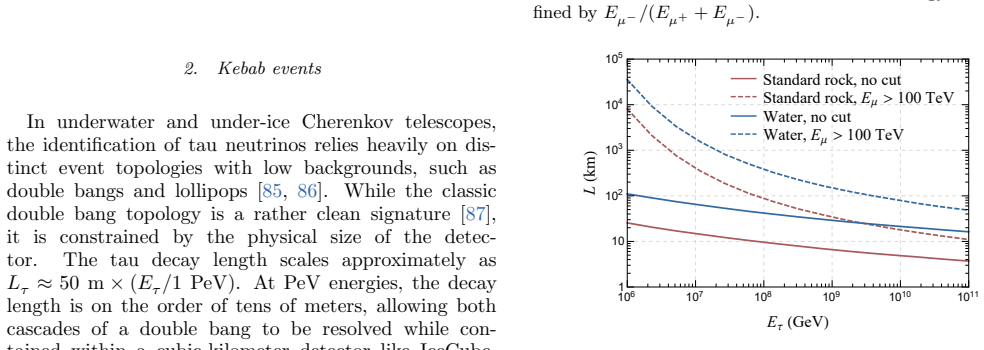
Kebab events In underwater and under-ice Cherenkov telescopes, the identification of tau neutrinos relies heavily on dis- tinct event topologies with low backgrounds, such as double bangs and lollipops [85, 86]. While the classic double bang topology is a rather clean signature [87], it is constrained by the physical size of the detec- tor. The tau decay ...
Pith/arXiv arXiv 2013
-
[5]
Observation of high-energy neutrinos from the Galactic plane,
R. Abbasiet al., “Observation of high-energy neutrinos from the Galactic plane,”Science380(7, 2023) 6652, arXiv:2307.04427. [6]IceCube, R. Abbasiet al., “Observation of high-energy neutrinos from the Galactic plane,” Science380(2023) no. 6652, adc9818,arXiv:2307.04427. [7]IceCube, R. Abbasiet al., “Observation of Seven Astrophysical Tau Neutrino Candidate...
arXiv 2023
-
[13]
Proposal for the High Energy Neutrino Telescope,
T.-Q. Huang, Z. Cao, M. Chen, J. Liu, Z. Wang, X. You, and Y. Qi, “Proposal for the High Energy Neutrino Telescope,” PoSICRC2023(2023) 1080
2023
-
[14]
A proposed deep sea Neutrino Observatory in the Nanhai,
H. Zhang, Y. Cui, Y. Huang, S. Lin, Y. Liu, Z. Qiu, C. Shao, Y. Shi, C. Xie, and L. Yang, “A proposed deep sea Neutrino Observatory in the Nanhai,” Astropart. Phys.171(2025) 103123,arXiv:2408.05122. [15]Baikal-GVD, V. A. Allakhverdyanet al., “Diffuse 8 neutrino flux measurements with the Baikal-GVD neutrino telescope,” Phys. Rev. D107(2023) no. 4, 042005,...
Pith/arXiv arXiv 2025
-
[18]
Sensitivity of a proposed space-based Cherenkov astrophysical-neutrino telescope,
A. Neronov, D. V. Semikoz, L. A. Anchordoqui, J. Adams, and A. V. Olinto, “Sensitivity of a proposed space-based Cherenkov astrophysical-neutrino telescope,” Phys. Rev.D95(2017) no. 2, 023004, arXiv:1606.03629. [19]GRAND, J. ´Alvarez-Mu˜ nizet al., “The Giant Radio Array for Neutrino Detection (GRAND): Science and Design,” Sci. China Phys. Mech. Astron.63...
Pith/arXiv arXiv 2017
-
[20]
Studies of an air-shower imaging system for the detection of ultrahigh-energy neutrinos,
A. N. Otte, “Studies of an air-shower imaging system for the detection of ultrahigh-energy neutrinos,” Phys. Rev.D99(2019) no. 8, 083012,arXiv:1811.09287
Pith/arXiv arXiv 2019
-
[21]
Trinity: An Air-Shower Imaging Instrument to detect Ultrahigh Energy Neutrinos,
A. N. Otte, A. M. Brown, M. Doro, A. Falcone, J. Holder, E. Judd, P. Kaaret, M. Mariotti, K. Murase, and I. Taboada, “Trinity: An Air-Shower Imaging Instrument to detect Ultrahigh Energy Neutrinos,” arXiv:1907.08727. [22]ARA, P. Allisonet al., “Constraints on the diffuse flux of ultrahigh energy neutrinos from four years of Askaryan Radio Array data in tw...
Pith/arXiv arXiv 1907
-
[23]
The Payload for Ultrahigh Energy Observations (PUEO): A White Paper,
Q. Abarret al., “The Payload for Ultrahigh Energy Observations (PUEO): A White Paper,” arXiv:2010.02892
Pith/arXiv arXiv 2010
-
[24]
White Paper: ARIANNA-200 high energy neutrino telescope,
A. Ankeret al., “White Paper: ARIANNA-200 high energy neutrino telescope,”arXiv:2004.09841. [25]POEMMA, A. V. Olintoet al., “The POEMMA (Probe of Extreme Multi-Messenger Astrophysics) observatory,” JCAP06(2021) 007,arXiv:2012.07945. [26]T AMBO, C. A. Arg¨ uelleset al., “TAMBO: A Deep-Valley Neutrino Observatory,”arXiv:2507.08070
Pith/arXiv arXiv 2004
-
[27]
Concept Study for the Beamforming Elevated Array for Cosmic Neutrinos (BEACON),
S. Wisselet al., “Concept Study for the Beamforming Elevated Array for Cosmic Neutrinos (BEACON),” PoS ICRC2019(2020) 1033
2020
-
[28]
Prospects for high-elevation radio detection of>100 PeV tau neutrinos,
S. Wisselet al., “Prospects for high-elevation radio detection of>100 PeV tau neutrinos,” JCAP11(2020) 065,arXiv:2004.12718
Pith/arXiv arXiv 2020
-
[29]
Galactic Bulge VHE tau-neutrino and gamma-ray Monitor with Ashra-1 and NTA detectors,
S. Ogawa and M. Sasaki, “Galactic Bulge VHE tau-neutrino and gamma-ray Monitor with Ashra-1 and NTA detectors,” PoSICRC2021(2021) 970
2021
-
[30]
The Radar Echo Telescope for Neutrinos (RET-N),
K. de Vrieset al., “The Radar Echo Telescope for Neutrinos (RET-N),” PoSICRC2021(2021) 1195
2021
-
[31]
Cosmic neutrinos of ultra-high energies and detection possibility,
V. S. Berezinsky and A. Y. Smirnov, “Cosmic neutrinos of ultra-high energies and detection possibility,” Astrophys. Space Sci.32(1975) 461–482
1975
-
[32]
Observation of UHE interactions neutrinos from outer space,
G. Domokos and S. Kovesi-Domokos, “Observation of UHE interactions neutrinos from outer space,” AIP Conf. Proc.433(1998) no. 1, 390–393, arXiv:hep-ph/9801362
Pith/arXiv arXiv 1998
-
[33]
Observation of ultrahigh-energy neutrino interactions by orbiting detectors,
G. Domokos and S. Kovesi-Domokos, “Observation of ultrahigh-energy neutrino interactions by orbiting detectors,”arXiv:hep-ph/9805221
-
[34]
On the detection of ultrahigh-energy neutrinos with the Auger Observatory,
K. S. Capelle, J. W. Cronin, G. Parente, and E. Zas, “On the detection of ultrahigh-energy neutrinos with the Auger Observatory,” Astropart. Phys.8(1998) 321–328, arXiv:astro-ph/9801313
Pith/arXiv arXiv 1998
-
[35]
Horizontal tau air showers from mountains in deep valley: Traces of UHECR neutrino tau,
D. Fargion, A. Aiello, and R. Conversano, “Horizontal tau air showers from mountains in deep valley: Traces of UHECR neutrino tau,” inProceedings, 26th International Cosmic Ray Conference (ICRC), August 17-25, 1999, Salt Lake City: Invited, Rapporteur, and Highlight Papers, p. 396. 1999. arXiv:astro-ph/9906450.http://krusty.physics. utah.edu/~icrc1999/roo...
Pith/arXiv arXiv 1999
-
[36]
D. Fargion, “Discovering Ultra High Energy Neutrinos by Horizontal and Upward tau Air-Showers: Evidences in Terrestrial Gamma Flashes?,” Astrophys. J.570 (2002) 909–925,arXiv:astro-ph/0002453
Pith/arXiv arXiv 2002
-
[37]
Establishing the GZK cutoff with ultrahigh-energy tau neutrinos,
A. Letessier-Selvon, “Establishing the GZK cutoff with ultrahigh-energy tau neutrinos,” AIP Conf. Proc.566 (2001) no. 1, 157–171,arXiv:astro-ph/0009444
Pith/arXiv arXiv 2001
-
[38]
Observability of earth skimming ultrahigh-energy neutrinos,
J. L. Feng, P. Fisher, F. Wilczek, and T. M. Yu, “Observability of earth skimming ultrahigh-energy neutrinos,” Phys. Rev. Lett.88(2002) 161102, arXiv:hep-ph/0105067
Pith/arXiv arXiv 2002
-
[39]
A. Kusenko and T. J. Weiler, “Neutrino cross-sections at high-energies and the future observations of ultrahigh-energy cosmic rays,” Phys. Rev. Lett.88 (2002) 161101,arXiv:hep-ph/0106071
Pith/arXiv arXiv 2002
-
[40]
Tau neutrinos in the Auger Observatory: A New window to UHECR sources,
X. Bertou, P. Billoir, O. Deligny, C. Lachaud, and A. Letessier-Selvon, “Tau neutrinos in the Auger Observatory: A New window to UHECR sources,” Astropart. Phys.17(2002) 183–193, arXiv:astro-ph/0104452
Pith/arXiv arXiv 2002
-
[41]
Z. Cao, M. A. Huang, P. Sokolsky, and Y. Hu, “Ultra high energyν τ detection using Cosmic Ray Tau Neutrino Telescope used in fluorescence/Cerenkov light detection,” J. Phys.G31(2005) 571–582, arXiv:astro-ph/0411677
Pith/arXiv arXiv 2005
-
[42]
Neutrino detection with inclined air showers,
E. Zas, “Neutrino detection with inclined air showers,” New J. Phys.7(2005) 130,arXiv:astro-ph/0504610
Pith/arXiv arXiv 2005
-
[43]
High-energy neutrino astronomy: Detection methods and first achievements,
B. Baret and V. Van Elewyck, “High-energy neutrino astronomy: Detection methods and first achievements,” Rept. Prog. Phys.74(2011) 046902
2011
-
[44]
Measuring High-Energy Cosmic Particles with the SKA,
T. Huegeet al., “Measuring High-Energy Cosmic Particles with the SKA,”arXiv:2606.28068
-
[45]
Pair Production and Bremsstrahlung of Charged Leptons,
Y.-S. Tsai, “Pair Production and Bremsstrahlung of Charged Leptons,” Rev. Mod. Phys.46(1974) 815. [Erratum: Rev.Mod.Phys. 49, 421–423 (1977)]
1974
-
[46]
MUM: flexible precise Monte Carlo algorithm for muon propagation through thick layers of matter,
I. A. Sokalski, E. V. Bugaev, and S. I. Klimushin, “MUM: flexible precise Monte Carlo algorithm for muon propagation through thick layers of matter,” Phys. Rev. D64(2001) 074015,arXiv:hep-ph/0010322
Pith/arXiv arXiv 2001
-
[47]
PROPOSAL: A tool for propagation of charged leptons,
J.-H. Koehne, K. Frantzen, M. Schmitz, T. Fuchs, W. Rhode, D. Chirkin, and J. B. Tjus, “PROPOSAL: A tool for propagation of charged leptons,” Computer Physics Communications184(2013) no. 9, 2070–2090
2013
-
[48]
TauRunner: A public Python program to propagate neutral and charged leptons,
I. Safa, J. Lazar, A. Pizzuto, O. Vasquez, C. A. Arg¨ uelles, and J. Vandenbroucke, “TauRunner: A public Python program to propagate neutral and charged leptons,” Comput. Phys. Commun.278(2022) 108422, arXiv:2110.14662
Pith/arXiv arXiv 2022
-
[49]
Improvements in charged lepton and photon propagation for the software PROPOSAL,
J.-M. Alameddine, J. Albrecht, H. Dembinski, P. Gutjahr, K.-H. Kampert, W. Rhode, M. Sackel, A. Sandrock, and J. Soedingrekso, “Improvements in charged lepton and photon propagation for the software PROPOSAL,” Comput. Phys. Commun.302(2024) 9 109243,arXiv:2311.13357
Pith/arXiv arXiv 2024
-
[50]
Narrow muon bundles from muon pair production in rock,
V. A. Kudryavtsev, E. V. Korolkova, and N. J. C. Spooner, “Narrow muon bundles from muon pair production in rock,” Phys. Lett. B471(1999) 251–256, arXiv:hep-ph/9911493
Pith/arXiv arXiv 1999
-
[51]
Direct production of muon pairs by high-energy muons,
S. R. Kelner, R. P. Kokoulin, and A. A. Petrukhin, “Direct production of muon pairs by high-energy muons,” Phys. Atom. Nucl.63(2000) 1603–1611
2000
-
[52]
Muon-pair production by atmospheric muons in cosmoALEPH,
F. Maciucet al., “Muon-pair production by atmospheric muons in cosmoALEPH,” Phys. Rev. Lett.96(2006) 021801
2006
-
[53]
Lepton pair production in muon scattering by nucleus,
A. V. Berezhnoy, S. N. Koshkarev, and A. V. Luchinsky, “Lepton pair production in muon scattering by nucleus,”arXiv:0709.0422
-
[54]
Lepton pair production in muon-nucleus scattering,
G. Abbiendi, E. Budassi, C. M. Carloni Calame, A. Gurgone, and F. Piccinini, “Lepton pair production in muon-nucleus scattering,” Phys. Lett. B854(2024) 138720,arXiv:2401.06077
Pith/arXiv arXiv 2024
-
[55]
Electromagnetic Trident Production in Deep InelasticµNScattering,
A. A. Akhundov, D. Y. Bardin, N. D. Gagunashvili, and N. M. Shumeiko, “Electromagnetic Trident Production in Deep InelasticµNScattering,” Sov. J. Nucl. Phys.31(1980) 127
1980
-
[56]
Contribution of Electromagnetic Production of Lepton Pairs to Inclusive Cross-section of Deep Inelasticµp Scattering,
A. A. Akhundov, D. Y. Bardin, and N. M. Shumeiko, “Contribution of Electromagnetic Production of Lepton Pairs to Inclusive Cross-section of Deep Inelasticµp Scattering,” Sov. J. Nucl. Phys.32(1980) 234
1980
-
[57]
Cross sections and energy loss for lepton pair production in muon transport,
A. Bulmahn and M. H. Reno, “Cross sections and energy loss for lepton pair production in muon transport,” Phys. Rev. D79(2009) 053008, arXiv:0812.5008
Pith/arXiv arXiv 2009
-
[58]
A. P. Bulmahn,Lepton pair production in high energy µAscattering: cross sections, energy loss, and applications to underground lepton production. PhD thesis, Iowa U., 2010.https://inspirehep.net/files/ fd079bce29b13f1202430c01271d9054
2010
-
[59]
Secondary atmospheric tau neutrino production,
A. Bulmahn and M. H. Reno, “Secondary atmospheric tau neutrino production,” Phys. Rev. D82(2010) 057302,arXiv:1007.4989
Pith/arXiv arXiv 2010
-
[60]
Muon-induced di-tau production as a probe of new physics,
S. Das, L. Kupari, M. H. Reno, and S. Trojanowski, “Muon-induced di-tau production as a probe of new physics,”arXiv:2606.05406
-
[61]
Double and multiple bangs at tau neutrino telescopes,
G.-y. Huang, “Double and multiple bangs at tau neutrino telescopes,” Eur. Phys. J. C82(2022) no. 12, 1089,arXiv:2207.02222
Pith/arXiv arXiv 2022
-
[62]
Radiation emitted in collisions of very fast electrons,
C. F. von Weizsacker, “Radiation emitted in collisions of very fast electrons,” Z. Phys.88(1934) 612–625
1934
-
[63]
Nature of the high-energy particles of penetrating radiation and status of ionization and radiation formulae,
E. J. Williams, “Nature of the high-energy particles of penetrating radiation and status of ionization and radiation formulae,” Phys. Rev.45(1934) 729–730
1934
-
[64]
D. Ivanov, E. A. Kuraev, A. Schiller, and V. G. Serbo, “Production of e+ e- pairs to all orders in Z alpha for collisions of high-energy muons with heavy nuclei,” Phys. Lett. B442(1998) 453–458, arXiv:hep-ph/9807311
Pith/arXiv arXiv 1998
-
[65]
Electromagnetic pion form-factor and neutral pion decay width,
C. D. Roberts, “Electromagnetic pion form-factor and neutral pion decay width,” Nucl. Phys. A605(1996) 475–495,arXiv:hep-ph/9408233
Pith/arXiv arXiv 1996
-
[66]
The Off-shell axial anomaly via the gamma* pi0 —>gamma transition,
M. R. Frank, K. L. Mitchell, C. D. Roberts, and P. C. Tandy, “The Off-shell axial anomaly via the gamma* pi0 —>gamma transition,” Phys. Lett. B359(1995) 17–22,arXiv:hep-ph/9412219
Pith/arXiv arXiv 1995
-
[67]
Electromagnetic transition form-factors of light mesons,
P. Maris and P. C. Tandy, “Electromagnetic transition form-factors of light mesons,” Phys. Rev. C65(2002) 045211,arXiv:nucl-th/0201017
Pith/arXiv arXiv 2002
-
[68]
Neutrino interactions at ultrahigh-energies,
R. Gandhi, C. Quigg, M. H. Reno, and I. Sarcevic, “Neutrino interactions at ultrahigh-energies,” Phys. Rev. D58(1998) 093009,arXiv:hep-ph/9807264
Pith/arXiv arXiv 1998
-
[69]
Lunar detection of ultra-high-energy cosmic rays and neutrinos with the Square Kilometre Array,
J. Brayet al., “Lunar detection of ultra-high-energy cosmic rays and neutrinos with the Square Kilometre Array,” PoSAASKA14(2015) 144
2015
-
[70]
C. W. James and R. J. Protheroe, “The sensitivity of the next generation of lunar Cherenkov observations to UHE neutrinos and cosmic rays,” Astropart. Phys.30 (2009) 318–332,arXiv:0802.3562
Pith/arXiv arXiv 2009
-
[71]
Signatures of secondary leptons in radio-neutrino detectors in ice,
D. Garc ´ ıa-Fern´ andez, A. Nelles, and C. Glaser, “Signatures of secondary leptons in radio-neutrino detectors in ice,” Phys. Rev. D102(2020) no. 8, 083011,arXiv:2003.13442
Pith/arXiv arXiv 2020
-
[72]
Dimuons in neutrino telescopes: New predictions and first search in IceCube,
B. Zhou and J. F. Beacom, “Dimuons in neutrino telescopes: New predictions and first search in IceCube,” Phys. Rev. D105(2022) no. 9, 093005, arXiv:2110.02974
Pith/arXiv arXiv 2022
-
[73]
Search for charm-quark production via dimuons in neutrino telescopes*,
C. Sun, F. Zhang, F. Hu, D. Xu, and J. Gao, “Search for charm-quark production via dimuons in neutrino telescopes*,” Chin. Phys. C47(2023) no. 2, 023109, arXiv:2201.03580
Pith/arXiv arXiv 2023
-
[74]
C. Ternes, D. A. Fagundes, E. Huayra, and E. G. de Oliveira, “Predictions for dimuon production in high-energy neutrino-proton collisions using the color dipole model,” JHEP05(2025) 025,arXiv:2412.12076
Pith/arXiv arXiv 2025
-
[75]
Atmospheric Trident Production for Probing New Physics,
S.-F. Ge, M. Lindner, and W. Rodejohann, “Atmospheric Trident Production for Probing New Physics,” Phys. Lett. B772(2017) 164–168, arXiv:1702.02617
Pith/arXiv arXiv 2017
-
[76]
W-boson and trident production in TeV–PeV neutrino observatories,
B. Zhou and J. F. Beacom, “W-boson and trident production in TeV–PeV neutrino observatories,” Phys. Rev. D101(2020) no. 3, 036010,arXiv:1910.10720
Pith/arXiv arXiv 2020
-
[77]
Neutrino-nucleus cross sections for W-boson and trident production,
B. Zhou and J. F. Beacom, “Neutrino-nucleus cross sections for W-boson and trident production,” arXiv:1910.08090
Pith/arXiv arXiv 1910
-
[78]
Searches for Long Lived Neutral Particles,
P. Meade, S. Nussinov, M. Papucci, and T. Volansky, “Searches for Long Lived Neutral Particles,” JHEP06 (2010) 029,arXiv:0910.4160. [79]ANT ARES, S. Adri´ an-Mart ´ ınezet al., “A search for Secluded Dark Matter in the Sun with the ANTARES neutrino telescope,” JCAP05(2016) 016, arXiv:1602.07000
Pith/arXiv arXiv 2010
- [80]
-
[81]
Neutrino telescopes as a direct probe of supersymmetry breaking,
I. Albuquerque, G. Burdman, and Z. Chacko, “Neutrino telescopes as a direct probe of supersymmetry breaking,” Phys. Rev. Lett.92(2004) 221802, arXiv:hep-ph/0312197
Pith/arXiv arXiv 2004
-
[82]
Long-lived staus at neutrino telescopes,
M. Ahlers, J. Kersten, and A. Ringwald, “Long-lived staus at neutrino telescopes,” JCAP07(2006) 005, arXiv:hep-ph/0604188
Pith/arXiv arXiv 2006
-
[83]
‘Dark’ Matter Effect as a Novel Solution to the KM3-230213A Puzzle,
P. S. B. Dev, B. Dutta, A. Karthikeyan, W. Maitra, L. E. Strigari, and A. Verma, “‘Dark’ Matter Effect as a Novel Solution to the KM3-230213A Puzzle,” arXiv:2505.22754
-
[84]
Multi-PeV Signals from a New Astrophysical Neutrino Flux Beyond the Glashow Resonance,
M. D. Kistler and R. Laha, “Multi-PeV Signals from a New Astrophysical Neutrino Flux Beyond the Glashow Resonance,” Phys. Rev. Lett.120(2018) no. 24, 241105,arXiv:1605.08781
Pith/arXiv arXiv 2018
-
[85]
Measuring Flavor Ratios of High-Energy Astrophysical Neutrinos,
J. F. Beacom, N. F. Bell, D. Hooper, S. Pakvasa, and T. J. Weiler, “Measuring Flavor Ratios of High-Energy Astrophysical Neutrinos,” Phys. Rev. D68(2003) 093005,arXiv:hep-ph/0307025. [Erratum: Phys.Rev.D 10 72, 019901 (2005)]. [86]IceCube, D. F. Cowen, “Tau neutrinos in IceCube,” J. Phys. Conf. Ser.60(2007) 227–230
Pith/arXiv arXiv 2003
-
[87]
Detecting tau-neutrino oscillations at PeV energies,
J. G. Learned and S. Pakvasa, “Detecting tau-neutrino oscillations at PeV energies,” Astropart. Phys.3(1995) 267–274,arXiv:hep-ph/9405296. [88]IceCube, R. Abbasiet al., “A Search for UHE Tau Neutrinos with IceCube,” Phys. Rev. D86(2012) 022005,arXiv:1202.4564
Pith/arXiv arXiv 1995
-
[89]
Studying low-xstructure function models with astrophysical tau neutrinos,
D. A. Fagundes, R. R. Francisco, and E. G. de Oliveira, “Studying low-xstructure function models with astrophysical tau neutrinos,” Phys. Rev. D100(2019) no. 8, 083020,arXiv:1903.05607
Pith/arXiv arXiv 2019
-
[90]
JaxoDraw: A Graphical user interface for drawing Feynman diagrams. Version 2.0 release notes,
D. Binosi, J. Collins, C. Kaufhold, and L. Theussl, “JaxoDraw: A Graphical user interface for drawing Feynman diagrams. Version 2.0 release notes,” Comput. Phys. Commun.180(2009) 1709–1715, arXiv:0811.4113
Pith/arXiv arXiv 2009
discussion (0)
Sign in with ORCID, Apple, or X to comment. Anyone can read and Pith papers without signing in.