REVIEW 4 major objections 5 minor 12 references
This paper shows that adding a batteryless passive link to a Wi-Fi 8 downlink MU-MIMO system changes the optimal channel-sounding interval, so fixed-period sounding is no longer sufficient.
Reviewed by Pith at T0; open to challenge. T0 means a machine referee read the full paper against a public rubric. the ladder, T0–T4 →
T0 review · deepseek-v4-flash
2026-08-03 09:57 UTC pith:3NW3SYZG
load-bearing objection Clean model and theory, but the headline 53 vs 59 ms shift rests on uncalibrated link functions and no error bars—needs a rework before the numbers are trusted. the 4 major comments →
Data-Driven Batteryless Channel Sounding for Wi-Fi 8-Inspired Downlink MU-MIMO
The pith
A machine-rendered reading of the paper's core claim, the machinery that carries it, and where it could break.
Core claim
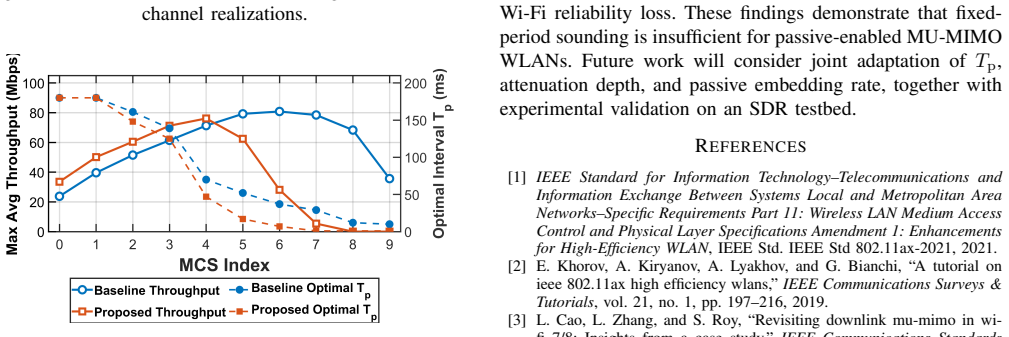
The central discovery is that the passive overlay's attenuation depth and embedding rate interact with CSI aging: the same amplitude distortion that carries passive bits becomes more costly as the precoder ages, so the passive stream can shift the throughput-optimal sounding interval left or right depending on MCS and passive-link parameters. The paper derives a one-step condition: extending the post-sounding stage is beneficial exactly while the next packet's expected throughput exceeds the current cycle average. In the MCS-4 simulation, the passive-enabled optimum drops from 59 ms to 53 ms, because late-cycle packets suffer from both outdated precoding and overlay distortion, while the pas
What carries the argument
The key machinery is the cycle-average aggregate throughput Rsum(p; theta) = (sum of expected delivered Wi-Fi and passive payload bits over p packets) / (T_d + p T_0), together with the one-step difference condition that determines when to stop extending the interval. The Glaze-style amplitude overlay is the central physical ingredient: passive bits are Manchester-encoded into two amplitude states controlled by attenuation depth Delta, and the same scalar factor is applied across all spatial streams so beamforming direction is preserved. The data-driven search evaluates all candidate p values in O(P_max) operations by recursive accumulation of the empirical per-packet throughput averaged ove
Load-bearing premise
The quantitative shift of the optimal interval rests on unvalidated packet-error functions and a single simulated 0.089 m/s indoor channel; if real Wi-Fi 8 and batteryless receivers behave differently, the 53-versus-59 ms shift may not appear.
What would settle it
Measure the optimal post-sounding interval on an SDR testbed with a real Glaze-style envelope detector and a 4-antenna AP, sweeping T_p at MCS 4; if the throughput maximum lands within a few ms of the no-overlay baseline and does not move left, the claimed reshaping of the tradeoff is not supported.
If this is right
- Fixed-period sounding is suboptimal once a passive overlay is present; the optimal post-sounding interval must be re-derived for each MCS and passive configuration.
- At low MCS (0–3) the system is overhead-limited and the optimum sits at the 180 ms upper bound, so long sounding intervals are safe; at MCS 4–9 aging dominates and the optimum shrinks.
- The one-step decision rule holds: keep extending the data stage exactly until the next packet's expected throughput drops below the current cycle average.
- In the MCS-4 simulation, adding the passive overlay moves the optimum from 59 ms to 53 ms, showing the overlay can justify more frequent CSI refresh rather than a constant throughput bonus.
- Estimating the throughput profile from K=30 training realizations yields an optimum within 1 ms of the validation optimum, indicating the profile is smooth enough for practical interval selection.
Where Pith is reading between the lines
- If the unvalidated packet-error and switching-distortion models are replaced by empirical lookup tables from a real 802.11bn-like receiver, the same framework could be recalibrated without changing the optimization machinery.
- The left-shift at MCS 4 suggests an online policy could trigger an extra sounding whenever the observed per-packet throughput of a late packet falls below the running cycle average, rather than on a fixed timer.
- In deployments where passive traffic dominates, tuning the attenuation depth to keep the passive stream robust as CSI ages could preserve long sounding intervals and lower sounding overhead.
- The same one-step condition applies to any periodic overhead-vs-freshness tradeoff, e.g., beam training in mmWave or tracking in massive MIMO, whenever the per-slot goodput is non-increasing with age.
Editorial analysis
A structured set of objections, weighed in public.
Referee Report
Summary. The paper studies a Wi-Fi 8/802.11bn-inspired downlink MU-MIMO system with a Glaze-style batteryless overlay. It formulates a cycle-average throughput objective that includes sounding overhead, CSI aging, Wi-Fi and passive packet errors, and passive embedding feasibility, and then optimizes the post-sounding interval T_p for fixed MCS and passive-overlay parameters. The main numerical claim is that at MCS 4 the passive overlay shortens the optimal post-sounding interval from 59 ms to 53 ms, and that the MCS sweep separates into an overhead-limited low-MCS regime and an aging-limited high-MCS regime. The paper also gives a first-difference characterization of the optimum and a unimodality argument under monotone aging.
Significance. If the numerical result could be trusted, the paper would be a useful extension of prior sounding-interval optimization to passive-enabled MU-MIMO WLANs. The analytical component that is actually shown is mostly sound: the cycle-average formulation in Eq. (25), the one-step condition in Eq. (30), and the unimodality argument under monotone packet-throughput aging are correct. The data-driven search in Algorithm 1 is simple and has linear complexity. However, the load-bearing packet-error functions, the switching-distortion model, the passive scalar-equivalent model, and several key parameters are left unspecified or unvalidated, so the central quantitative claim is currently not reproducible. The paper would be significantly strengthened by specifying the full link-level model, releasing the simulator, and adding a statistical comparison of the baseline and passive optima.
major comments (4)
- [§III-A, Figs. 2–3; Eqs. (14), (15), (19)] The central result—the passive overlay shortens T_p* from 59 ms to 53 ms at MCS 4—is produced by a MATLAB link simulator whose packet-error functions f_W and f_P, the switching-distortion coefficient ξ_W, and the passive-link constants (Δ, R_b, Ω_P, σ_P^2, K_c, T_P^pre) are never specified. The text only says an HE/TGax link-level model is used. No code or data is released. The 6 ms shift is about 10% of the optimum, and no confidence intervals or significance test is provided; the single reported 1 ms training-validation gap at one operating point does not establish that 53 ms and 59 ms are statistically distinguishable. The claimed regime change could be an artifact of the unspecified modeling choices. Please provide the functional forms, all parameter values, a sensitivity analysis around the chosen parameters, and a statistical comparison of the baseline and passive optima.
- [§II-C, Eq. (14)] The Wi-Fi loss induced by amplitude switching is modeled as D_ovl = ξ_W(R_b,m_k) σ_a^2 (S+I), with no derivation. This is not a standard result for amplitude-modulated overlay with coherent reception; it is an added distortion power whose coefficient ξ_W is not defined, tabulated, or calibrated. Because this term is one of the two mechanisms that can make the passive system prefer shorter sounding intervals, the direction and magnitude of the predicted shift are directly controlled by an unvalidated assumption. Please derive D_ovl from a signal model or calibrate ξ_W with link-level measurements; otherwise the conclusion in §III-A cannot be separated from this assumption.
- [§II-C, Eqs. (16)–(19)] The passive link is modeled by a scalar-equivalent channel and envelope detector with γ_P = F_s(1−a_Δ)^2 Ω_P[n]/(R_b σ_P^2) and packet-error function f_P. No justification is given for why the full MU-MIMO waveform can be reduced to a scalar x[n,t], nor are F_s, Ω_P[n], σ_P^2, the passive payload length, or the threshold model defined. The passive throughput contribution D_P in Eq. (23) is load-bearing for the claimed shift, so this lack of specification is not merely cosmetic. Provide the derivation of the scalar-equivalent model and all numerical constants, or replace the passive model with a measured/validated packet-error curve.
- [§II-F, Eq. (35) and §III-A] Eq. (35) gives a necessary condition for a left shift, but the paper does not verify it in simulation. The verbal explanation that the Wi-Fi loss δ_W is strongest at aged CSI is plausible, but Fig. 2 reports only aggregate curves; showing the empirical Δz[n] and the baseline/passive cycle averages near p_B* would directly test Eq. (35). Without such a decomposition, the link between the theoretical condition and the 53 vs 59 ms result remains assertive. Please add a plot or table of E[z_tot[p_B*]] versus Rsum(p_B*−1) for both systems.
minor comments (5)
- [§II-C, Eq. (18)-(21)] Symbols F_s, Ω_P[n], σ_P^2, K_c, T_P^pre, and the passive packet length are not defined. Please define all symbols and give the numerical values used in the simulations.
- [References [11], [12]] The sentence citing [10]–[12] for 'Wi-Fi backscatter and Passive Wi-Fi' includes two references—a 6G C-V2X radio environment map paper and an AI programming-assistants paper—that appear unrelated to backscatter. Please correct the citation list.
- [Table I] The table lists MCS range, sounding overhead, and channel model, but omits the passive overlay parameters Δ and R_b, and the antenna/user configuration is only in the text. All simulation parameters needed to reproduce Figs. 2–4 should be in the table or in a dedicated appendix.
- [Figures 2–4] Fig. 4 is described only qualitatively ('rapidly decreases'). Please report the numerical values for the MCS sweep, and add error bars or shaded confidence bands to Figs. 2 and 3.
- [Algorithm 1] The tie-breaking rule when two values of p give the same maximum is not specified. Since T_p* is reported to the millisecond, please state how ties are resolved.
Circularity Check
No significant circularity: the sounding-interval optimization is a self-contained simulation study; the numerical shift is an output of the model, not an input recycled as a prediction.
full rationale
The paper's derivation chain is not circular. The theoretical analysis in Sec. II-F (Eqs. 28-35) derives the first-order condition for the cycle-average objective and the direction-of-shift condition; these are algebraic equivalences of the definition Rsum(p) = (sum_{n=1}^p E[z_tot[n]])/(d+p), not independent predictions. The numerical result T_p* = 53 ms vs 59 ms (Sec. III-A) is produced by Algorithm 1 maximizing the empirically estimated cycle-average throughput over independent HE/TGax Model-D channel realizations; it is not a fitted parameter renamed as a prediction. The model does contain unquantified link-level functions f_W (Eq. 15), f_P (Eq. 19), and xi_W (Eq. 14), and the 'validation' compares two draws from the same simulator rather than external measurements, making the quantitative result model-conditioned and not independently reproducible from the paper alone. These are validity/reproducibility limitations, not circularity. The self-citations [3], [8], [11] are background references to the authors' prior Wi-Fi sounding work; the passive-overlay mechanism is taken from the external Glaze work [13], and none of the paper's central claims reduces to a self-cited result. Therefore no circular step can be exhibited.
Axiom & Free-Parameter Ledger
free parameters (4)
- Attenuation depth Delta =
not reported
- Passive embedding rate R_b =
not reported
- Switching-distortion coefficient xi_W(Rb, mk) =
unspecified function
- Mobility speed =
0.089 m/s
axioms (6)
- ad hoc to paper Packet-error functions f_W and f_P (Eqs. 15 and 19) accurately capture real Wi-Fi and passive receiver behavior over aged CSI.
- ad hoc to paper Switching distortion is additive as D_ovl = xi_W sigma_a^2 (S+I) in Eq. (14).
- domain assumption HE/TGax link-level model with Model-D fading is a valid proxy for Wi-Fi 8 UHR MU-MIMO behavior.
- domain assumption CSI aging follows a first-order AR model with Jakes autocorrelation (Eq. 6).
- domain assumption Block-diagonalization precoding with compressed beamforming feedback (Eq. 4) approximates the Wi-Fi 8 MU-MIMO precoder.
- ad hoc to paper The scalar-equivalent passive channel and envelope-detection model in Eqs. (16)-(18) is valid.
read the original abstract
Batteryless overlays couple passive throughput to Wi-Fi sounding overhead and channel state information (CSI) aging. This paper investigates channel sounding for ultra-high reliability (UHR) operation in a Wi-Fi 8/IEEE 802.11bn-inspired downlink multi-user multiple-input multiple-output (MU-MIMO) system with a batteryless passive overlay. We optimize the post-sounding transmission interval to maximize the aggregate throughput of the active Wi-Fi and passive links, while jointly accounting for sounding overhead, CSI aging, modulation and coding scheme (MCS), passive attenuation, and passive data rate. A packet-level cross-layer model evaluates the cycle-average throughput, and a data-driven search identifies the optimal interval under different operating conditions. Simulations demonstrate that passive overlay reshapes the conventional sounding tradeoff: depending on the MCS and passive-link configuration, the additional passive throughput may or may not compensate for the associated Wi-Fi reliability loss, causing the optimal interval to shift. The results provide design guidance for reliable and low-power MU-MIMO WLANs.
Figures


Reference graph
Works this paper leans on
-
[2]
A tutorial on ieee 802.11ax high efficiency wlans,
E. Khorov, A. Kiryanov, A. Lyakhov, and G. Bianchi, “A tutorial on ieee 802.11ax high efficiency wlans,”IEEE Communications Surveys & Tutorials, vol. 21, no. 1, pp. 197–216, 2019
2019
-
[3]
Revisiting downlink mu-mimo in wi- fi 7/8: Insights from a case study,
L. Cao, L. Zhang, and S. Roy, “Revisiting downlink mu-mimo in wi- fi 7/8: Insights from a case study,”IEEE Communications Standards Magazine, 2025
2025
-
[4]
What will wi-fi 8 be? a primer on ieee 802.11bn ultra high reliability,
L. Galati Giordano, G. Geraci, M. Carrascosa, and B. Bellalta, “What will wi-fi 8 be? a primer on ieee 802.11bn ultra high reliability,”IEEE Communications Magazine, vol. 62, no. 8, pp. 126–132, 2024
2024
-
[5]
Implementation and eval- uation of ieee 802.11ax channel sounding frame exchange in ns-3,
J. Zhang, S. Avallone, and D. M. Blough, “Implementation and eval- uation of ieee 802.11ax channel sounding frame exchange in ns-3,” in Proceedings of the 2023 Workshop on ns-3, 2023, pp. 10–18
2023
-
[6]
Deepmux: Deep-learning-based channel sounding and resource allocation for ieee 802.11ax,
P. K. Sangdeh and H. Zeng, “Deepmux: Deep-learning-based channel sounding and resource allocation for ieee 802.11ax,”IEEE Journal on Selected Areas in Communications, vol. 39, no. 8, pp. 2333–2346, 2021
2021
-
[7]
Effects of channel aging in massive mimo systems,
K. T. Truong and R. W. Heath, “Effects of channel aging in massive mimo systems,”Journal of Communications and Networks, vol. 15, no. 4, pp. 338–351, 2013
2013
-
[8]
Cross- layer channel sounding optimization towards next-gen wi-fi: From model driven to data driven,
L. Zhang, L. Cao, D. Wei, M. Chen, Z. Chen, and S. Cui, “Cross- layer channel sounding optimization towards next-gen wi-fi: From model driven to data driven,”IEEE Transactions on Wireless Communications, 2025, early access
2025
-
[9]
Ambient backscatter: Wireless communication out of thin air,
V . Liu, A. Parks, V . Talla, S. Gollakota, D. Wetherall, and J. R. Smith, “Ambient backscatter: Wireless communication out of thin air,” inProceedings of the ACM SIGCOMM 2013 Conference, 2013, pp. 39– 50
2013
-
[10]
Wi-fi backscatter: Internet connectivity for rf-powered devices,
B. Kellogg, A. Parks, S. Gollakota, J. R. Smith, and D. Wetherall, “Wi-fi backscatter: Internet connectivity for rf-powered devices,” in Proceedings of the ACM SIGCOMM 2014 Conference, 2014, pp. 607– 618
2014
-
[11]
A lightweight coordinate-conditioned diffusion approach for 6G C-V2X radio environment maps,
L. Cao, Z. Liu, D. Wei, Y . Yang, Y . Pan, and L. Zhang, “A lightweight coordinate-conditioned diffusion approach for 6G C-V2X radio environment maps,” 2025. [Online]. Available: https://arxiv.org/abs/2512.22535
arXiv 2025
-
[12]
The matthew effect of ai program- ming assistants: A hidden bias in software evolution,
F. Gu, Z. Liang, J. Ma, and H. Li, “The matthew effect of ai program- ming assistants: A hidden bias in software evolution,”arXiv preprint arXiv:2509.23261, 2025
arXiv 2025
-
[13]
Glaze: Overlaying occupied spectrum with downlink iot transmissions,
Z. Kapetanovic, A. Saffari, R. Chandra, and J. R. Smith, “Glaze: Overlaying occupied spectrum with downlink iot transmissions,”Pro- ceedings of the ACM on Interactive, Mobile, Wearable and Ubiquitous Technologies, vol. 3, no. 4, 2019
2019
discussion (0)
Sign in with ORCID, Apple, or X to comment. Anyone can read and Pith papers without signing in.