REVIEW 3 major objections 5 minor 26 references
Information limits of photonic lantern wavefront sensing: a Fisher- and quantum-Fisher-information framework and its relation to Fourier-filtering sensitivity limits
T0 review · 3 major / 5 minor · reviewed 2026-08-03 · deepseek-v4-flash
Pith's one-line read A photonic lantern's wavefront-sensing precision is fully set by its per-photon Fisher information and capped by a quantum floor of half a radian per photon.
desk verdict The first Fisher/quantum-Fisher treatment of the lantern WFS is mostly sound and worth engaging: the diagonal-vs-inverse distinction is the real contribution, and the main quantitative caveat is the un-flagged optimistic 'averaged CRLB'. read the letter →
The pith
A machine-rendered reading of the paper's core claim, the machinery that carries it, and where it could break.
The reading
What carries the argument
The per-photon Fisher information matrix F̃_ij = Σ_k (1/p_k)(∂p_k/∂a_i)(∂p_k/∂a_j) built from the normalised port intensities p_k(a), along with its inverse. It is the pullback of the Fisher–Rao metric on the intensity simplex through the lantern map; its diagonal is the published s_γ sensitivity, its inverse diagonal sets the CRLB, and its quantum ceiling is fixed by the pure-state QFI F_Q=4 Cov(Ẑ_i,Ẑ_j) with vanishing mean Uhlmann curvature.
What would settle it
Measure the response matrix of a real photonic lantern across many phase realizations, compute per-frame Fisher matrices and the ensemble-averaged Fisher matrix, and compare the mean of per-frame CRLBs with the diagonal of the inverse averaged Fisher matrix. If the latter is smaller by more than the Jensen gap, the averaged-CRLB claim is falsified.
Extended reading notes
Core claim
The central claim is that the photonic lantern, treated as a deterministic map from aberration coefficients to N output intensities, has its estimator-independent precision governed by the per-photon Fisher information matrix. The Cramér–Rao lower bound for any unbiased estimator scales as N_ph^{-1/2} and is bounded mode-by-mode by the quantum Cramér–Rao bound, corresponding to a sensitivity of β=2, i.e. 1/(2√N_ph) rad rms. Because the phase generators are real and commuting, the mean Uhlmann curvature vanishes, so the multi-parameter quantum bound is jointly saturable: all low-order modes can reach the half-radian-per-photon limit simultaneously with no quantum incompatibility. The paper al
Load-bearing premise
The load-bearing premise is that inverting the ensemble-averaged Fisher information matrix correctly gives the closed-loop sensitivity; since the inverse of an average is not the average of inverses, this can make the reported precision optimistic, and the concrete numbers also rest on a synthetic lantern model rather than a fabricated device.
Editorial extensions
If this is right
- Any unbiased wavefront estimator reading lantern port intensities obeys σ ≥ 1/(2√N_ph) rad per mode; no reconstruction algorithm, learned or otherwise, can beat this floor.
- The s_γ sensitivity used for Fourier-filtering sensors is exactly the diagonal of the per-photon Fisher matrix, so for a mode-mixing lantern it overestimates achievable precision; the full inverse matrix must be used.
- A lantern with N single-mode outputs constrains at most N−1 aberration modes per exposure, so extra ports buy high-order capacity, not low-order precision once the PSF core is sampled.
- The half-radian-per-photon quantum ceiling is jointly attainable for all low-order modes simultaneously, not just one mode at a time, because no quantum incompatibility exists between phase modes.
- The framework yields a device-agnostic metric β on a common 0≤β≤2 scale, making lanterns, pyramid, Zernike and PIAA-ZWFS sensors directly comparable.
Reading between the lines
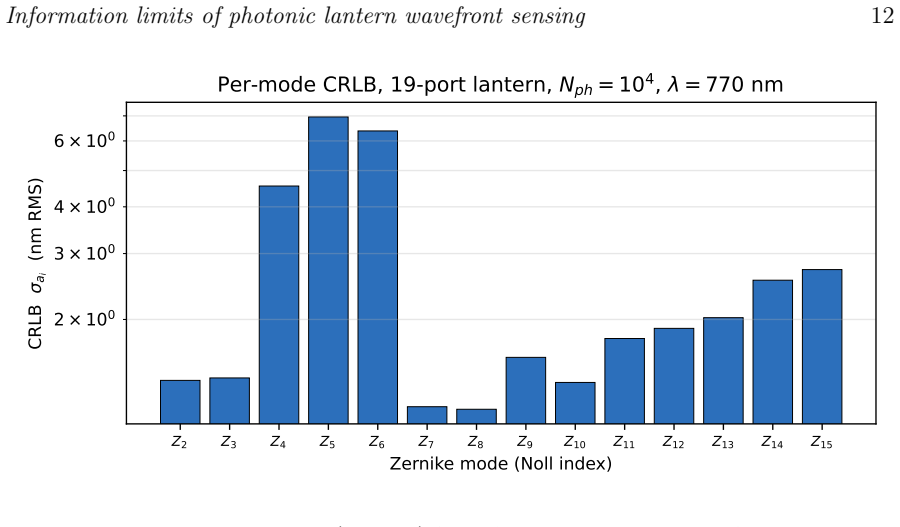
- The paper's averaged CRLB uses the inverse of the ensemble-averaged Fisher matrix, but Jensen's inequality implies the mean of per-frame CRLBs is at least as large; the plotted closed-loop bounds are therefore optimistic as statements about average estimator variance.
- The quantitative β values come from a synthetic Gaussian-receiver lantern model with a specific parity structure; a real fabricated lantern's mode mixing will likely alter even-mode sensitivity, so the numbers should be read as illustrating the framework, not as a device prediction.
- The analysis suggests a natural design criterion: choose the lantern port layout that diagonalizes or concentrates the per-photon Fisher matrix, since off-diagonal information is what pushes the CRLB above the diagonal-only estimate.
- Because the Fisher–Rao view makes sensing precision a geometric property, one could use this metric to optimize port count and geometry for a given set of target Zernike modes before building a device.
Editorial analysis
A structured set of objections, weighed in public.
Referee Report
Summary. The manuscript develops a Fisher-information and Cramér–Rao framework for photonic-lantern wavefront sensing. The lantern is treated as a deterministic map from Zernike coefficients to N port intensities; Poisson and read-noise Fisher information matrices are derived, the CRLB is expressed through the diagonal of the inverse per-photon FIM, and a dimensionless sensitivity β is introduced. The paper then computes the pure-state quantum Fisher information matrix, proves joint saturability of the multi-parameter QCRB via vanishing mean Uhlmann curvature, and establishes exact relations to the Chambouleyron et al. photon-noise sensitivity s_γ and to the Haffert et al. quantum/classical limit. The framework is illustrated with a synthetic Gaussian-receiver lantern model for N=7,19,37,91 ports.
Significance. If the claims hold, the paper provides a useful algorithm-independent benchmark for lantern wavefront sensors and unifies three existing information-theoretic treatments on a common β scale. The exact identity s_γ² = ilde F_ii and the ordering β_i ≤ √η s_γ are clean and correct, and the explicit QFI calculation with the joint-saturability argument is a genuine addition to the literature. The release of the analysis code is a strength. The main reservations concern the handling of the ensemble-averaged CRLB, which is used in all quantitative figures, and an inconsistency in the role of throughput η relative to N_ph; these affect the numerical sensitivity claims and the cross-sensor comparison.
major comments (3)
- [Sec. 3.5, Figs. 1–4] The quantity diag[(E_{a0}[F(a0)])^{-1}] is labelled the 'averaged CRLB' and is used for the curves in Figs. 1, 2 and 4 and for the β_i values in Fig. 3. For a parameter that varies frame to frame, the mean of the per-frame bounds is E_{a0}[(F(a0)^{-1})_{ii}], not [(E_{a0}[F(a0)])^{-1}]_{ii}. By Jensen's inequality (or convexity of the inverse on positive-definite matrices), (E F)^{-1} ⪯ E[F^{-1}], so the plotted 'averaged CRLB' is an optimistic lower bound on the actual mean per-frame variance, and the paper does not disclose the direction or size of the gap. Please either replace it with a Monte Carlo average of per-frame inverse FIMs, or present ar F^{-1} strictly as a design-information measure with the caveat that it understates the true averaged variance, and quantify the discrepancy for the model.
- [Eqs. (3), (8), (10), (12), (18); Table 1] The role of N_ph and throughput η is inconsistent. Eq. (3) calls N_ph 'total detected flux', but then writes µ_k = η N_ph p_k; Eq. (8) has F = η N_ph ilde F; Eq. (10) defines β with a factor √η; yet Eq. (12) and Sect. 5.2 quote the quantum bound σ ≥ 1/(2√N_ph) with no η. Consequently the claimed ceiling β = 2 is only correct if η = 1. If N_ph is the incident photon number, the quantum bound should be 1/(2√(η N_ph)) and the ceiling becomes 2√η; if N_ph is the detected photon number, η should not appear in Eqs. (8) and (10). This ambiguity affects every comparison on the common β ≤ 2 scale and must be resolved before the quantitative claims can be accepted.
- [Sec. 6, Figs. 1–4] All numerical results use a synthetic focal-plane Gaussian-receiver lantern that is explicitly 'not to reproduce a specific fabricated device'. The paper is honest about this, but the captions and conclusion still present the resulting parity structure and port-count saturation as lantern properties. Because a real lantern's inter-modal mixing can change the parity structure (as the paper notes), the reader cannot tell which numerical conclusions are robust. At minimum, the figure captions should state that the plotted curves are model-illustration results, and the discussion should explicitly avoid generalizing the even-mode weakness or the 'saturation at 19 ports' behavior beyond the model.
minor comments (5)
- [Sec. 3.5] The threshold λ_thr = 10^{-6} λ_max is arbitrary. The effective modal capacity M_eff depends on this choice; please either justify it, state the sensitivity of M_eff to the threshold, or present M_eff only as an illustrative convention.
- [Fig. 3] The comparison values for pyramid, Zernike and Shack–Hartmann sensors are shown without derivation or references in the caption. Please state where these values come from or how they were computed, so the comparison is reproducible.
- [Sec. 6] The model parameters (η, λ, aperture diameter, Gaussian receiver width, finite-difference step, N_ph ranges) are not given in the text or captions. The code is released, but the reader should be able to reproduce Figures 1–4 from the description alone.
- [Eq. (16), Appendix B] The notation for s_γ in Eq. (16) is ambiguous in the rendered text; it should be written explicitly as the squared L2 norm ||δI(φ_i)/√I_0||_2². Also, the definition of I_0 as p_k(0) should be stated before Eq. (16), not only in Appendix B.
- [Sec. 4.1] The statement that N_ph is 'total detected flux' is confusing when followed by the throughput factor η. Clarify the bookkeeping of incident versus detected photons, and make the symbols consistent in Eq. (3), Eq. (8), Eq. (10) and Eq. (12).
Circularity Check
No significant circularity: the Fisher/CRLB and quantum-Fisher bounds are computed from the stated device response and standard statistical/quantum identities, not fitted or self-cited into existence.
full rationale
The paper's derivation chain is self-contained and does not reduce any central claim to its own inputs. The Fisher information matrix (Sect. 3.1, Eqs. 4–6) is computed from the explicit Poisson/read-noise measurement model and the device response ∂µ_k/∂a_i; the CRLB (Eq. 7) is the standard matrix inequality. The per-photon factorization (Eq. 8) and the N_ph^{-1/2} scaling (Eq. 9) follow algebraically from µ_k = ηN_ph p_k, with no fitted parameter. The dimensionless sensitivity β_i (Eq. 10) is defined from the inverse FIM, not calibrated to data. The identification of Chambouleyron et al.'s s_gamma with the diagonal FIM (Eq. 17 and Appendix B) is an algebraic equivalence, and the inequality β_i ≤ √η s_gamma (Eq. 18) is a direct matrix inequality; this is a mathematical clarification, not a prediction forced by construction. The quantum bound β = 2 (Eqs. 11–13) is obtained from the standard pure-state quantum Fisher information formula with real commuting phase generators; the cited results of Haffert et al. and Chambouleyron et al. are external works, not self-citations, and Sect. 5.4 explicitly distinguishes adopted scaffolding from new contributions, further reducing any self-citation concern. The only caveats are the ensemble-averaged 'averaged CRLB' in Sect. 3.5 (where Jensen's inequality makes the plotted quantity an optimistic lower bound on the mean per-frame CRLB) and the synthetic Gaussian-receiver lantern model in Sect. 6, which the paper itself labels as illustrative and not a fabricated device. These are statistical-modeling caveats rather than circular reasoning: they do not make a fitted input masquerade as a prediction. The simulation's fitted slope of −0.500 in Fig. 2 is a consistency check of an analytically derived scaling, not an independent prediction. Overall, the central derivation is not circular.
Assumptions & free parameters
free parameters (3)
- Modal capacity threshold lambda_thr =
10^-6 lambda_max
- Synthetic lantern model parameters =
centered hexagonal lattice N in {7,19,37,91}; Gaussian receivers
- Read noise sigma_r =
1 e^-
assumptions (7)
- domain assumption Lantern output amplitudes are overlap integrals of the focal field with back-propagated eigenmodes, giving a deterministic map a -> I (Eq. 2)
- domain assumption Port counts are independent Poisson with means mu_k = eta Nph p_k; read noise is additive Gaussian with variance mu_k + sigma_r^2, with parameter dependence of the variance neglected (Eqs. 3, 6)
- domain assumption Source photons are independent, identically prepared pure coherent states with mean occupancy <<1 per mode per coherence time, so QFI is additive over photons (Sect. 4.1, Appendix A.5)
- domain assumption Zernike modes are orthonormal and zero-mean over a uniformly illuminated pupil, giving Cov(Z_i, Z_j) = delta_ij
- standard math Multi-parameter QCRB is jointly attainable if and only if the mean Uhlmann curvature vanishes (Eq. 14)
- standard math Any classical Fisher matrix satisfies F <= F^Q under data processing
- ad hoc to paper The synthetic Gaussian-receiver lantern model is representative enough to expose scaling and parity structure
Cite this review
Pith. "Pith review of Information limits of photonic lantern wavefront sensing: a Fisher- and quantum-Fisher-information framework and its relation to Fourier-filtering sensitivity limits." pith.science (2026). https://pith.science/paper/QFWD2TYI
@misc{pith2026260729342,
  author       = {Pith},
  title        = {Pith review of: Information limits of photonic lantern wavefront sensing: a Fisher- and quantum-Fisher-information framework and its relation to Fourier-filtering sensitivity limits},
  year         = {2026},
  howpublished = {\url{https://pith.science/paper/QFWD2TYI}},
  note         = {Machine review of arXiv:2607.29342}
}
read the original abstract
The photonic lantern is an all-photonic wavefront sensor native to single-mode-fibre-fed instruments, but its performance is almost always quoted through a specific reconstruction algorithm, obscuring how much wavefront information the device itself encodes. We develop, from first principles, the Fisher-information and Cramer-Rao theory of the photonic-lantern wavefront sensor, benchmark it against the quantum Cramer-Rao bound via an explicit multi-parameter quantum-Fisher-information calculation, and relate it to two established frameworks: the Fourier-filtering noise-propagation model of Chambouleyron et al (2023) and the classical/quantum sensitivity limit of Haffert et al (2023). Treating the lantern as a deterministic map from aberration coefficients to N output intensities, we derive the Poisson and read-noise Fisher information matrices (FIM), the per-mode CRLB, the per- photon Fisher-Rao geometry on the intensity simplex, and a flux- and estimator-independent sensitivity metric beta with quantum ceiling beta = 2. The lantern CRLB scales as N_ph^(-1/2) and is bounded, mode by mode, by the quantum limit of 1/2 rad rms per photon. That multi-parameter bound is jointly saturable: the phase generators are real and commuting, so the mean Uhlmann curvature vanishes and wavefront sensing carries no quantum incompatibility between simultaneously estimated modes, extending Haffert et al's single-mode ceiling to all low-order modes at once. We further show that the photon-noise sensitivity s_gamma of Chambouleyron et al is exactly the diagonal of our per- photon FIM, whereas the CRLB uses the diagonal of its inverse; the two coincide only for a diagonal FIM, so s_gamma is optimistic for a mode-mixing lantern. The framework is device-agnostic: it returns estimator-independent sensitivities comparable on a common beta <= 2 scale with pyramid, Zernike and PIAA-ZWFS sensors.
Figures


Figures from the paper (1 more)

Reference graph
Works this paper leans on
-
[1]
Roddier F (ed) 1999Adaptive Optics in Astronomy(Cambridge University Press)
-
[2]
10) per mode, referenced to the quantum ceilingβ= 2 (Eq
Engler B, Kasper M, Leveratto S, Heritier C T, Bristow P, Verinaud C, Le Louarn M, Nousiainen J, Helin T, Bonse M, Quanz S, Glauser A, Bernard J, Gratadour D REFERENCES14 1 2 3 4 5 6 Zernike radial order n (spatial frequency proxy) 0.0 0.5 1.0 1.5 2.0Photon-noise sensitivity Information per photon vs spatial frequency Ideal / quantum limit Zernike WFS Pyr...
2022
-
[3]
Shack R V and Platt B C 1971Journal of the Optical Society of America61656
-
[4]
Ragazzoni R 1996Journal of Modern Optics43289–293
-
[5]
N’Diaye M, Dohlen K, Fusco T and Paul B 2013Astronomy & Astrophysics555 A94
-
[6]
Guyon O 2005The Astrophysical Journal629592–614
-
[7]
Fauvarque O, Neichel B, Fusco T, Sauvage J F and Girault O 2016Optica31440– 1452
-
[8]
Fauvarque O, Neichel B, Fusco T, Sauvage J F and Girault O 2017Journal of Astronomical Telescopes, Instruments, and Systems3019001
Show all 26 references
-
[9]
Leon-Saval S G, Birks T A, Bland-Hawthorn J and Englund M 2005Optics Letters 302545–2547
-
[10]
Birks T A, Gris-S´ anchez I, Yerolatsitis S, Leon-Saval S G and Thomson R R 2015 Advances in Optics and Photonics7107–167
2015
-
[11]
Sensitivity improves sharply from 7 to 19 ports and saturates thereafter for low-order modes – the per-frame capacity ceilingM eff ≤N−1 of Sect
Bland-Hawthorn J and Kern P 2009Optics Express171880–1884 REFERENCES15 7 19 37 91 Number of lantern ports N 100 101 CRLB a (nm RMS) CRLB vs port count, Nph = 104 Tip Z2 Defocus Z4 Coma Z7 Figure 4.Low-order CRLB versus port count atN ph = 10 4. Sensitivity improves sharply fro...
-
[12]
Jovanovic N, Gatkine P, Anugu Net al.2023Journal of Physics: Photonics5 042501
-
[13]
Norris B R M, Wei J, Betters C H, Wong A and Leon-Saval S G 2020Nature Communications115335
-
[14]
Lin J, Fitzgerald M P, Xin Y, Guyon O, Leon-Saval S, Norris B and Jovanovic N 2022Journal of the Optical Society of America B392643–2656
-
[15]
Lin J, Fitzgerald M P, Xin Y, Guyon O, Leon-Saval S, Norris B and Jovanovic N 2023Journal of the Optical Society of America B403196–3208
-
[16]
Rao C R 1945Bulletin of the Calcutta Mathematical Society3781–91
-
[17]
Cram´ er H 1946Mathematical Methods of Statistics(Princeton University Press)
-
[18]
Kay S M 1993Fundamentals of Statistical Signal Processing: Estimation Theory (Prentice Hall)
-
[19]
Paterson C 2008Journal of Physics: Conference Series139012021
-
[20]
Plantet C, Meimon S, Conan J M and Fusco T 2015Optics Express2328619–28633
-
[21]
Chambouleyron V, Fauvarque O, Plantet C, Sauvage J F, Levraud N, Ciss´ e M, Neichel B and Fusco T 2023Astronomy & Astrophysics670A153 REFERENCES16
-
[22]
7th AO4ELT (Adaptive Optics for Extremely Large Telescopes)arXiv:2310.10889
Haffert S Y, Males J R and Guyon O 2023 Reaching the fundamental sensitivity limit of wavefront sensing on arbitrary apertures with the Phase Induced Amplitude Apodized Zernike Wavefront Sensor (PIAA-ZWFS)Proc. 7th AO4ELT (Adaptive Optics for Extremely Large Telescopes)arXiv:2...
2023 arXiv
-
[23]
Noll R J 1976Journal of the Optical Society of America66207–211
-
[24]
Braunstein S L and Caves C M 1994Physical Review Letters723439–3443
-
[25]
Helstrom C W 1976Quantum Detection and Estimation Theory(Academic Press)
-
[26]
Quantum Fisher information of a photonic phase mode Appendix A.1
Paris M G A 2009International Journal of Quantum Information7125–137 Appendix A. Quantum Fisher information of a photonic phase mode Appendix A.1. Pure-state quantum Fisher information Letρ a =|ψ a⟩⟨ψa|be the (pure) density operator of a single photon in the transverse field, ...
Reviewed August 3, 2026 · model on record in the stance chip above.
Discussion (0). Continue with ORCID to comment.