REVIEW 4 major objections 5 minor 66 references
Qubit loss can be inferred from repeated stabilizer measurements alone, without dedicated leakage-detection hardware, when punctured stabilizer checks anticommute, and inference-based reload matches a noisy LDU baseline on rotated surface c
Reviewed by Pith at T0; open to challenge. T0 means a machine referee read the full paper against a public rubric. the ladder, T0–T4 →
T0 review · deepseek-v4-flash
2026-08-03 03:47 UTC pith:KH56JZC5
load-bearing objection The parity criterion is clean and the low-loss simulation story is believable, but the paper's "exact" loss-inference problem for general codes relies on an unproven converse that is actually false in general. the 4 major comments →
Qubit Loss Inference with Stabilizer Codes without Leakage Detection Units
The pith
A machine-rendered reading of the paper's core claim, the machinery that carries it, and where it could break.
Core claim
The central claim is Corollary 3: if a pair of stabilizer generators has local anticommutation set A_ij with odd intersection with the lost-qubit set L, then L is detectable in principle by repeated syndrome extraction. After puncturing out lost qubits, those checks anticommute, so no state can make both outcomes deterministic; the syndrome record becomes random. The paper defines loss inference as the minimum-weight problem of matching the observed random-check set, relaxes it to set cover, and reports that on rotated surface codes with trapped-ion and neutral-atom circuit-level noise, the inference protocols match or beat a noisy-LDU baseline for per-round loss up to ~5e-4 while eliminatin
What carries the argument
The central object is the punctured-check anticommutation criterion. For stabilizer generators s_i, s_j, define A_ij as the set of qubits where their local Pauli factors anticommute; in a valid code |A_ij| is even. After removing the lost qubits L, the punctured checks anticommute iff |L∩A_ij| is odd. This algebraic parity condition turns a loss event into a physically visible randomness in the syndrome record, and it is the foundation for the loss-inference map R(L), the maximum-likelihood formulation, and the set-cover relaxation. The paper couples this with two heuristics—a greedy set-cover solver and a signature-recall threshold based on the lattice-geometric bound that false-positive si
Load-bearing premise
The load-bearing premise is that a two-qubit gate acting on a lost qubit is non-entangling, so it can be modeled as a Pauli channel on the surviving qubit; if real gates leave residual entanglement, or if loss occurs mid-round or on auxiliary qubits, the punctured-check anticommutation signature changes and the inference guarantees degrade.
What would settle it
On a trapped-ion or neutral-atom platform, deliberately lose one qubit before a two-qubit gate whose partner survives, then perform quantum process tomography on the surviving qubit. If the effective channel has nonzero entanglement with the lost qubit's Hilbert space (fidelity below the Pauli-channel model), rather than a stochastic Pauli map, then the syndrome fingerprint predicted by the punctured-check criterion will not match the observed random-check set, and the inference protocol's stated performance would not transfer.
If this is right
- If the central claim is correct, LDU hardware can be removed from the repeated syndrome-extraction schedule, shortening code cycles and eliminating that source of noise.
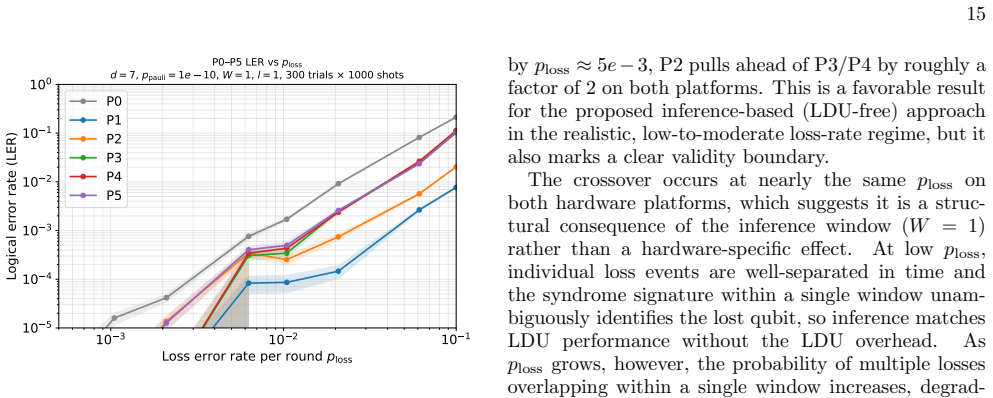
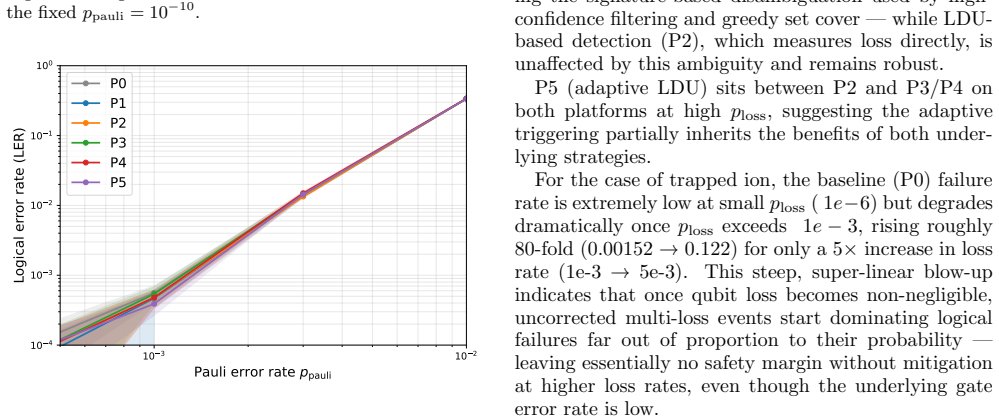
- On rotated surface codes with trapped-ion and neutral-atom noise at per-round loss ≲5e-4, inference-based reload (P3/P4) achieves logical error rates matching or slightly below the noisy-LDU baseline (P2) at lower space-time overhead.
- Because the condition applies to any stabilizer code, any code whose check-interaction graph has the required parity structure can use syndrome-only loss inference; LDPC codes permit linear-time construction and evaluation of R(L).
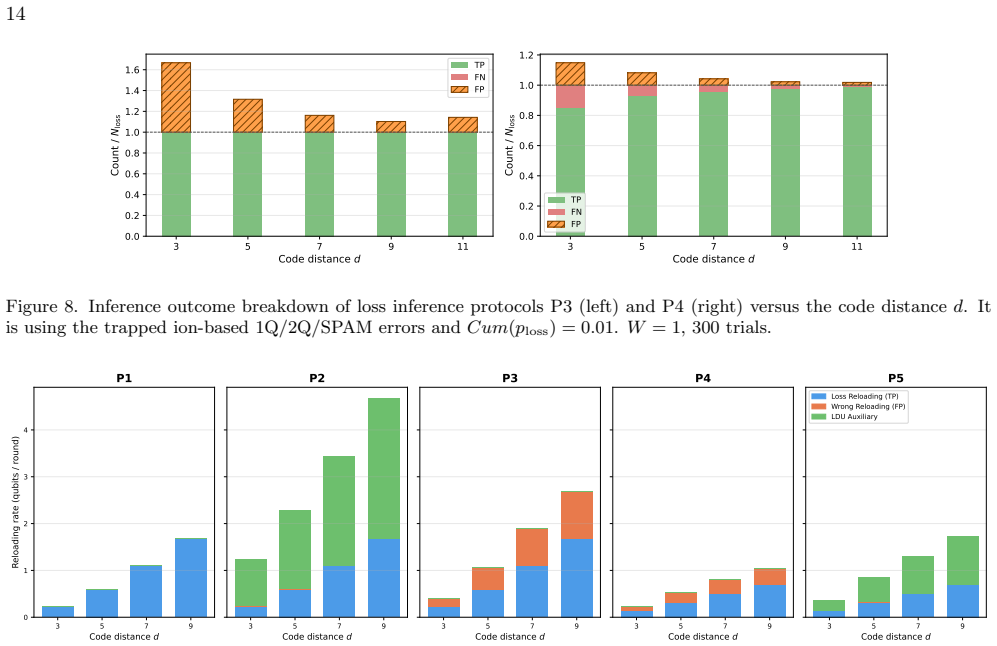
- The cost of inference is false-positive reloads, not LDU auxiliary qubits; in the simulated d=3..9 range, qubit consumption per round is dominated by loss reloads and remains below LDU-based protocols.
- At high loss rates (~5e-3 per round), noisy-LDU detection overtakes inference by roughly a factor of two on both platforms, delimiting the regime where syndrome-only inference is preferable.
Where Pith is reading between the lines
- A natural extension, not tested in the paper, is that the crossover near p_loss ≈ 1e-3 on both platforms is likely determined by the W=1 inference window rather than hardware; a temporal tracker that accumulates evidence across rounds before deciding might extend the regime where inference beats noisy LDU.
- One testable extension is to use the same anticommutation signature to identify auxiliary-qubit loss if state-selective readout is available, by checking whether auxiliary checks turn random.
- The paper's identifiability remark suggests a code-selection metric: maximize the injectivity of the map q ↦ R({q}) over candidate stabilizer codes; codes with larger minimum distinguishing distance between single-loss signatures would need less reloading.
- If the non-entangling assumption fails in a controlled way, the residual operation is still local on the survivor, so a learned local Pauli channel could be absorbed into the inference model rather than invalidating the approach.
Editorial analysis
A structured set of objections, weighed in public.
Referee Report
Summary. The paper proposes that qubit loss locations can be inferred from repeated stabilizer-measurement statistics without leakage-detection units. Under Assumption 1 (non-entangling gates on lost qubits, loss between rounds, data-qubit loss), Theorem 1 and Corollary 3 give a parity condition under which punctured stabilizer checks anticommute and thus produce non-deterministic syndrome outcomes. Based on this criterion, the paper defines an exact maximum-likelihood loss-inference problem in terms of the observed random-check set, relaxes it to minimum set cover with a greedy heuristic, and introduces a signature-recall heuristic with a claimed geometry-derived threshold. The resulting protocols (P3/P4) are evaluated on rotated surface codes under trapped-ion and neutral-atom circuit-level noise. The simulations indicate that inference-based reload matches or slightly exceeds a noisy-LDU baseline for per-round loss rates up to roughly 5e-4, while using fewer auxiliary qubits, with the advantage reversing at higher loss rates.
Significance. If the results hold, this is a conceptually and practically useful contribution: it replaces dedicated LDU hardware with a syndrome-statistics inference procedure in a parameter regime relevant to near-term trapped-ion and neutral-atom platforms. The sufficient-condition core (Corollary 3) is proved cleanly, and the simulations are substantial, using circuit-level noise parameters from recent hardware experiments. The paper is also honest about the heuristic nature of the set-cover relaxation and about ambiguities in loss identification. The main theoretical weakness is that the exact-inference formulation of Sec. V rests on an unproven converse of the detectability criterion, and the simulation comparisons omit some LDU baseline parameters. These issues are local and fixable; the empirical finding that inference-based protocols beat a noisy LDU baseline at low loss rates is likely to survive a carefully parameterized comparison.
major comments (4)
- [Sec. V B, Eq. (4) and Problem 1] The predicted random-check set R(L) is defined by the existence of a witness j with odd |L∩A_ij|. Corollary 3 proves only the forward direction: odd parity implies anticommutation and hence non-deterministic statistics. No argument establishes the converse: that every check whose actual syndrome statistics are random under repeated extraction must belong to R(L). Without this converse, the constraint R(L)=R_obs in Problem 1 is not a faithful model of the post-loss syndrome statistics. In particular, the Pauli channel in Assumption 1 can make a punctured check yield random outcomes even when all parities are even, and the persistence of that randomness across rounds is not analyzed. I recommend either proving the converse under Assumption 1 or explicitly presenting Eq. (4) as a heuristic model and removing 'exact' from Problem 1's title and the surrounding claims.
- [Sec. V A, Eq. (3) and Table IV] The empirical classifier in Eq. (3) is threshold-based and depends on N, W, and tau. The paper acknowledges one degenerate case (q_i=1) but does not show that the classified set R_obs equals the algebraic random-check set for any L. Table IV shows P4 has nonzero false negatives, so the simulations do not enforce R(L)=R_obs; they validate the heuristics subject to classifier errors. The 'exact' maximum-likelihood problem is therefore not actually solved in the numerical experiments, and the text should clearly separate the theoretical exact formulation from the approximate classifier used in practice.
- [Sec. VIII C and Table II] The central quantitative claim that P3/P4 match or beat the noisy-LDU baseline P2 up to ploss ≈ 5e-4 depends on the LDU detection delay d_LDU, the LDU measurement error probability, and the reload latency l. None of these parameters is specified for the simulations in Fig. 12. Without them, the comparison is not reproducible and the crossover at ploss ≈ 1e-3 cannot be attributed to the inference window W=1 rather than to the chosen LDU model. Please report d_LDU, the LDU error rate, and l for each simulation point.
- [Sec. VII B, Eq. (8)] The threshold theta* = 2/3 + delta is described as 'analytically derived' and 'independent of d', but the supporting claims are partly empirical: the bound of 2/3 for removable false positives is verified only for d=3,5,7,9,11, and the assertion of exactly four irreducible pairs regardless of d is not proved. Since P3's precision and the entire high-confidence protocol rest on this threshold, either provide a rigorous combinatorial proof for all relevant lattice sizes or present the threshold as an empirical calibration. The latter would not diminish the simulation results but would require reframing the parameter-free claim.
minor comments (5)
- [Sec. VII B vs Sec. VIII A] Equation (6) defines a recall score |Robs ∩ R̂q| / |R̂q|, but Sec. VIII A refers to it as the 'Jaccard score'. Jaccard similarity would divide by the size of the union. Please correct the terminology.
- [Algorithm 1] The input list includes 'loss pattern L', but the algorithm body never uses L. Either use L to compute R(L) or remove it from the input specification.
- [Sec. V A] The sentence 'A fully deterministic check that flips on every round (q_i=1) would also be classified as random under Eq. (3)' is a caveat that could be moved to a remark, since it highlights a genuine limitation of the one-sided test if such a regime ever arises.
- [Table III footnote] The footnote correctly states that the neutral-atom row combines rates from different experiments. In the abstract and main text, this is described as 'state-of-the-art'; consider softening to 'reported in recent experiments' to avoid implying an end-to-end demonstration.
- [Appendix D 2] There is a typo in the definition of the ground-state qubit: '|m_F=−1/2⟩ ≡ |0⟩' appears twice. One occurrence should refer to |1⟩ or to the opposite m_F value.
Circularity Check
No significant circularity: the detectability criterion and inference framework are derived from Pauli algebra and evaluated against independent simulations, not from fitted inputs or self-citation chains.
full rationale
The central derivation is self-contained. Theorem 1 is an algebraic identity: for commuting stabilizer generators |A_ij| is even, so |A_ij\L| is odd iff |L∩A_ij| is odd; Lemma 1 and Theorem 2 then yield the sufficient detectability condition, with Corollary 3 as a direct corollary. Eq. (4) is not a fitted quantity: it defines the predicted random-check set from the same parity criterion, and Problem 1 uses that definition as the inference target. Any gap between this algebraic model and the threshold-based observed set R_obs is an unproved-converse/correctness limitation, not a circular reduction, and the paper explicitly labels Corollary 3 as only sufficient ('It does not imply unique identification of the loss pattern'). The simulation protocols are evaluated against circuit-level noise models using hardware parameters from independent literature (Table III), and the 'analytically derived' threshold θ* = 2/3 + δ is a geometric bound on single-loss signature overlap, not a parameter fitted to logical error rates; δ = 0.05 is a margin, not a fitted input. The recall(W) formula is explicitly presented as following from the definition of q_i(W) in Eq. (2), so its agreement with Fig. 7 is a self-consistency check rather than a load-bearing external prediction. The self-citations ([35], [45], [64]) concern implementation choices and background, not the load-bearing mathematical premise. The paper also clearly states its limitations: Assumption 1 is an assumption, auxiliary loss is left to future work, the classifier is offline, and the composite noise table is flagged as an optimistic near-term target. No step in the derivation reduces, by the paper's own equations or by self-citation, to its own inputs.
Axiom & Free-Parameter Ledger
free parameters (3)
- tau (random-check threshold) =
0.35
- delta (threshold offset) =
0.05
- W (inference window) =
1
axioms (4)
- domain assumption Assumption 1: gates acting on a lost qubit are non-entangling and affect the surviving qubit as a Pauli channel.
- domain assumption Loss events occur only on data qubits, between syndrome-extraction rounds, and the lost set is fixed during each round.
- domain assumption A check's post-loss randomness is fully characterized by odd parity |L∩A_ij| for some witness j, as in Eq. (4).
- domain assumption The one-sided flip-rate test with threshold tau separates random from deterministic checks; the degenerate q_i=1 case is assumed absent.
read the original abstract
Qubit loss occurs when the physical carrier of a qubit leaves the computational system without directly revealing the event's location. Such errors are a major obstacle to fault-tolerant quantum computation on platforms including photonic, neutral-atom, and trapped-ion systems. Loss locations are commonly identified using additional hardware operations such as leakage-detection units (LDUs), which introduce space-time overhead and may themselves become a source of error. We investigate whether qubit loss on stabilizer codes can instead be inferred from syndrome data obtained through standard repeated stabilizer measurements. Under a non-entangling model for gates involving a lost qubit, we derive a sufficient condition for loss detectability in general stabilizer codes. The condition is based on the emergence of anticommutation between stabilizer checks after their support on the lost qubits is removed. By using that condition, we formulate the exact loss-inference problem using the observed set of non-deterministic checks together with its maximum-likelihood formulation. We then relax the problem to the minimum set cover problem with a greedy heuristic algorithm. We evaluate the resulting inference and loss-correction protocols on the rotated surface code via circuit-level noise simulations for trapped-ion and neutral-atom platforms. On both platforms, inference-based and adaptive protocols reduce the logical error rate relative to a noisy-LDU baseline in the low-to-moderate loss-rate regime relevant to near-term hardware, while requiring fewer space-time overheads.
Figures




Reference graph
Works this paper leans on
-
[1]
Quantum error correction below the surface code threshold.Nature, 638(8052):920–926, 2025
2025
-
[2]
A fault-tolerant neutral-atom archi- tecture for universal quantum computation.Nature, 649(8095):39–46, 2026
Dolev Bluvstein, Alexandra A Geim, Sophie H Li, Si- mon J Evered, J Pablo Bonilla Ataides, Gefen Baranes, Andi Gu, Tom Manovitz, Muqing Xu, Marcin Kali- nowski, et al. A fault-tolerant neutral-atom archi- tecture for universal quantum computation.Nature, 649(8095):39–46, 2026
2026
-
[3]
Optimizing quantum error- correction protocols with erasure qubits.PRX Quan- tum, 6(4):040354, 2025
Shouzhen Gu, Yotam Vaknin, Alex Retzker, and Aleksander Kubica. Optimizing quantum error- correction protocols with erasure qubits.PRX Quan- tum, 6(4):040354, 2025
2025
-
[4]
Surface code with imperfect erasure checks.PRX Quantum, 6(4):040355, 2025
Kathleen Chang, Shraddha Singh, Jahan Claes, Kaavya Sahay, James Teoh, and Shruti Puri. Surface code with imperfect erasure checks.PRX Quantum, 6(4):040355, 2025
2025
-
[5]
California Institute of Technology, 1997
Daniel Gottesman.Stabilizer codes and quantum error correction. California Institute of Technology, 1997
1997
-
[6]
Circuit-based leakage-to-erasure conversion in a neutral-atom quan- tum processor.PRX Quantum, 5(4):040343, 2024
Matthew NH Chow, Vikas Buchemmavari, Sivaprasad Omanakuttan, Bethany J Little, Saurabh Pandey, Ivan H Deutsch, and Yuan-Yu Jau. Circuit-based leakage-to-erasure conversion in a neutral-atom quan- tum processor.PRX Quantum, 5(4):040343, 2024
2024
-
[7]
Quan- tum error correction resilient against atom loss.Quan- tum, 9:1884, 2025
Hugo Perrin, Sven Jandura, and Guido Pupillo. Quan- tum error correction resilient against atom loss.Quan- tum, 9:1884, 2025
2025
-
[8]
Quantifi- cation and characterization of leakage errors.Physical Review A, 97(3):032306, 2018
Christopher J Wood and Jay M Gambetta. Quantifi- cation and characterization of leakage errors.Physical Review A, 97(3):032306, 2018
2018
-
[9]
Quantum error correction with metastable states of trapped ions using erasure conversion.PRX Quantum, 4(2):020358, 2023
Mingyu Kang, Wesley C Campbell, and Kenneth R Brown. Quantum error correction with metastable states of trapped ions using erasure conversion.PRX Quantum, 4(2):020358, 2023
2023
-
[10]
Erasure conversion for fault-tolerant quan- tum computing in alkaline earth rydberg atom arrays
Yue Wu, Shimon Kolkowitz, Shruti Puri, and Jeff D Thompson. Erasure conversion for fault-tolerant quan- tum computing in alkaline earth rydberg atom arrays. Nature communications, 13(1):4657, 2022
2022
-
[11]
Shaw, Richard Bing-Shiun Tsai, Ran Finkelstein, Joonhee Choi, and Manuel Endres
Pascal Scholl, Adam L. Shaw, Richard Bing-Shiun Tsai, Ran Finkelstein, Joonhee Choi, and Manuel Endres. Erasure conversion in a high-fidelity rydberg quantum simulator.Nature, 622(7982):273–278, 2023
2023
-
[12]
Quan- tum error correction of a qubit loss in an addressable atomic system.Physical Review A—Atomic, Molecular, and Optical Physics, 72(5):052318, 2005
Jiri Vala, K Birgitta Whaley, and David S Weiss. Quan- tum error correction of a qubit loss in an addressable atomic system.Physical Review A—Atomic, Molecular, and Optical Physics, 72(5):052318, 2005
2005
-
[13]
Erasure- tolerance scheme for the surface codes on neutral atom quantum computers.IEEE Transactions on Quantum Engineering, 2025
Fumiyoshi Kobayashi and Shota Nagayama. Erasure- tolerance scheme for the surface codes on neutral atom quantum computers.IEEE Transactions on Quantum Engineering, 2025
2025
-
[14]
Protect- ing an optical qubit against photon loss.Physical Review A—Atomic, Molecular, and Optical Physics, 75(4):042316, 2007
Wojciech Wasilewski and Konrad Banaszek. Protect- ing an optical qubit against photon loss.Physical Review A—Atomic, Molecular, and Optical Physics, 75(4):042316, 2007
2007
-
[15]
Codes for the quantum erasure channel.Physical Review A, 56(1):33, 1997
Markus Grassl, Th Beth, and Thomas Pellizzari. Codes for the quantum erasure channel.Physical Review A, 56(1):33, 1997
1997
-
[16]
Fault- tolerance thresholds for the surface code with fabrica- tion errors.Physical Review A, 96(4):042316, 2017
James M Auger, Hussain Anwar, Mercedes Gimeno- Segovia, Thomas M Stace, and Dan E Browne. Fault- tolerance thresholds for the surface code with fabrica- tion errors.Physical Review A, 96(4):042316, 2017
2017
-
[17]
Luci in the surface code with dropouts.Quantum, 9:1936, 2025
Dripto M Debroy, Matt McEwen, Craig Gidney, Noah Shutty, and Adam Zalcman. Luci in the surface code with dropouts.Quantum, 9:1936, 2025
1936
-
[18]
Linear-time max- imum likelihood decoding of surface codes over the quantum erasure channel.Physical Review Research, 2(3):033042, 2020
Nicolas Delfosse and Gilles Z´ emor. Linear-time max- imum likelihood decoding of surface codes over the quantum erasure channel.Physical Review Research, 2(3):033042, 2020
2020
-
[19]
Quantum insertion-deletion channels.arXiv preprint arXiv:1901.00984, 2019
Janet Leahy, Dave Touchette, and Penghui Yao. Quantum insertion-deletion channels.arXiv preprint arXiv:1901.00984, 2019
Pith/arXiv arXiv 1901
-
[20]
Single quan- tum deletion error-correcting codes
Ayumu Nakayama and Manabu Hagiwara. Single quan- tum deletion error-correcting codes. In2020 Interna- tional Symposium on Information Theory and Its Ap- plications (ISITA), pages 329–333. IEEE, 2020
2020
-
[21]
Introduction to quantum deletion error-correcting codes.IEICE Transactions on Funda- 18 mentals of Electronics, Communications and Computer Sciences, 108(3):363–375, 2025
Manabu Hagiwara. Introduction to quantum deletion error-correcting codes.IEICE Transactions on Funda- 18 mentals of Electronics, Communications and Computer Sciences, 108(3):363–375, 2025
2025
-
[22]
Matthew N. H. Chow, Bethany J. Little, and Yuan- Yu Jau. High-fidelity low-loss state detection of alkali- metal atoms in optical tweezer traps.Phys. Rev. A, 108:032407, Sep 2023
2023
-
[23]
William Huie, Lintao Li, Neville Chen, Xiye Hu, Zhub- ing Jia, Won Kyu Calvin Sun, and Jacob P. Covey. Repetitive readout and real-time control of nuclear spin qubits in 171Yb atoms.PRX Quantum, 4:030337, Sep 2023
2023
-
[24]
Experimental deterministic correction of qubit loss.Nature, 585(7824):207–210, 2020
Roman Stricker, Davide Vodola, Alexander Erhard, Lukas Postler, Michael Meth, Martin Ringbauer, Philipp Schindler, Thomas Monz, Markus M¨ uller, and Rainer Blatt. Experimental deterministic correction of qubit loss.Nature, 585(7824):207–210, 2020
2020
-
[25]
A mid-circuit erasure check on a dual-rail cavity qubit using the joint-photon number- splitting regime of circuit qed.npj Quantum Informa- tion, 11(1):1, 2025
Stijn J de Graaf, Sophia H Xue, Benjamin J Chapman, James D Teoh, Takahiro Tsunoda, Patrick Winkel, John WO Garmon, Kathleen M Chang, Luigi Frunzio, Shruti Puri, et al. A mid-circuit erasure check on a dual-rail cavity qubit using the joint-photon number- splitting regime of circuit qed.npj Quantum Informa- tion, 11(1):1, 2025
2025
-
[26]
Leveraging qubit loss detection in fault-tolerant quantum algorithms
Gefen Baranes, Madelyn Cain, J Pablo Bonilla Ataides, Dolev Bluvstein, Josiah Sinclair, Vladan Vuleti´ c, Hengyun Zhou, and Mikhail D Lukin. Leveraging qubit loss detection in fault-tolerant quantum algorithms. Physical Review X, 16(1):011002, 2026
2026
-
[27]
Fault-tolerant quantum computation for local leakage faults.arXiv preprint quant-ph/0511065, 2005
Panos Aliferis and Barbara M Terhal. Fault-tolerant quantum computation for local leakage faults.arXiv preprint quant-ph/0511065, 2005
Pith/arXiv arXiv 2005
-
[28]
Pengyu Liu, Shi Jie Samuel Tan, Eric Huang, Umut A Acar, Hengyun Zhou, and Chen Zhao. Achieving optimal-distance atom-loss correction via pauli enve- lope.arXiv preprint arXiv:2603.04156, 2026
Pith/arXiv arXiv 2026
-
[29]
Yiyi Li, Yicheng Bao, Michael Peper, Chenyuan Li, and Jeff D Thompson. Fast, continuous and coherent atom replacement in a neutral atom qubit array.arXiv preprint arXiv:2506.15633, 2025
Pith/arXiv arXiv 2025
-
[30]
Reducing runtime overhead via use-based mi- gration in neutral atom quantum architectures
Andrew Litteken, Jonathan M Baker, and Frederic T Chong. Reducing runtime overhead via use-based mi- gration in neutral atom quantum architectures. In2022 IEEE International Conference on Quantum Comput- ing and Engineering (QCE), pages 566–576. IEEE, 2022
2022
-
[31]
Stabilizer formalism for operator quantum error correction.Physical review letters, 95(23):230504, 2005
David Poulin. Stabilizer formalism for operator quantum error correction.Physical review letters, 95(23):230504, 2005
2005
-
[32]
Photon sorting, efficient bell measure- ments, and a deterministic controlled-z gate using a passive two-level nonlinearity.Physical Review Letters, 114(17):173603, 2015
TC Ralph, I S¨ ollner, S Mahmoodian, AG White, and P Lodahl. Photon sorting, efficient bell measure- ments, and a deterministic controlled-z gate using a passive two-level nonlinearity.Physical Review Letters, 114(17):173603, 2015
2015
-
[33]
Leakage miti- gation for quantum error correction using a mixed qubit scheme.Physical Review A, 100(3):032325, 2019
Natalie C Brown and Kenneth R Brown. Leakage miti- gation for quantum error correction using a mixed qubit scheme.Physical Review A, 100(3):032325, 2019
2019
-
[34]
Low-distance surface codes under realistic quantum noise.Physical Review A, 90(6):062320, 2014
Yu Tomita and Krysta M Svore. Low-distance surface codes under realistic quantum noise.Physical Review A, 90(6):062320, 2014
2014
-
[35]
Dense packing of the surface code: Code deformation procedures and hook-error-avoiding gate scheduling.Phys
Kohei Fujiu, Shota Nagayama, Shin Nishio, Hideaki Kawaguchi, and Takahiko Satoh. Dense packing of the surface code: Code deformation procedures and hook-error-avoiding gate scheduling.Phys. Rev. A, 113:042412, Apr 2026
2026
-
[36]
No more hooks in the surface code: Distance- preserving syndrome extraction for arbitrary layouts at minimum depth, 2026
Yuga Hirai, Shota Ikari, Yosuke Ueno, and Yasunari Suzuki. No more hooks in the surface code: Distance- preserving syndrome extraction for arbitrary layouts at minimum depth, 2026
2026
-
[37]
Mutually unbiased bases and trinary operator sets for n qutrits.Physical Review A—Atomic, Molecular, and Optical Physics, 70(1):012302, 2004
Jay Lawrence. Mutually unbiased bases and trinary operator sets for n qutrits.Physical Review A—Atomic, Molecular, and Optical Physics, 70(1):012302, 2004
2004
-
[38]
Theory of quantum error-correcting codes.Physical Review A, 55(2):900, 1997
Emanuel Knill and Raymond Laflamme. Theory of quantum error-correcting codes.Physical Review A, 55(2):900, 1997
1997
-
[39]
Error Cor- rection in Dynamical Codes.Quantum, 9:1886, October 2025
Esther Xiaozhen Fu and Daniel Gottesman. Error Cor- rection in Dynamical Codes.Quantum, 9:1886, October 2025
2025
-
[40]
Op- timal resources for topological two-dimensional sta- bilizer codes: Comparative study.Physical Re- view A—Atomic, Molecular, and Optical Physics, 76(1):012305, 2007
H´ ector Bomb ´ ın and Miguel A Martin-Delgado. Op- timal resources for topological two-dimensional sta- bilizer codes: Comparative study.Physical Re- view A—Atomic, Molecular, and Optical Physics, 76(1):012305, 2007
2007
-
[41]
Reducibility among combinatorial problems
Richard M Karp. Reducibility among combinatorial problems. In50 Years of Integer Programming 1958- 2008: from the Early Years to the State-of-the-Art, pages 219–241. Springer, 2009
1958
-
[42]
Set covering by single-branch enumeration with linear-programming subproblems.Operations Research, 19(4):998–1022, 1971
Carlton E Lemke, Harvey M Salkin, and Kurt Spiel- berg. Set covering by single-branch enumeration with linear-programming subproblems.Operations Research, 19(4):998–1022, 1971
1971
-
[43]
A tight analysis of the greedy algorithm for set cover
Petr Slav ´ ık. A tight analysis of the greedy algorithm for set cover. InProceedings of the twenty-eighth annual ACM symposium on Theory of computing, pages 435– 441, 1996
1996
-
[44]
Almost-linear time decoding algorithm for topological codes.Quan- tum, 5:595, 2021
Nicolas Delfosse and Naomi H Nickerson. Almost-linear time decoding algorithm for topological codes.Quan- tum, 5:595, 2021
2021
-
[45]
Multiplexed quantum communication with surface and hypergraph product codes.Quantum, 9:1613, 2025
Shin Nishio, Nicholas Connolly, Nicol` o Lo Piparo, William John Munro, Thomas Rowan Scruby, and Kae Nemoto. Multiplexed quantum communication with surface and hypergraph product codes.Quantum, 9:1613, 2025
2025
-
[46]
Thresholds for topological codes in the presence of loss.Physical review letters, 102(20):200501, 2009
Thomas M Stace, Sean D Barrett, and Andrew C Do- herty. Thresholds for topological codes in the presence of loss.Physical review letters, 102(20):200501, 2009
2009
-
[47]
Fault tolerant quantum computation with very high threshold for loss errors.Physical review letters, 105(20):200502, 2010
Sean D Barrett and Thomas M Stace. Fault tolerant quantum computation with very high threshold for loss errors.Physical review letters, 105(20):200502, 2010
2010
-
[48]
Single-qubit gates with errors at the 10-7 level.Physical Review Letters, 134(23):230601, 2025
Molly C Smith, Aaron D Leu, Koichiro Miyanishi, Mario F Gely, and David M Lucas. Single-qubit gates with errors at the 10-7 level.Physical Review Letters, 134(23):230601, 2025
2025
-
[49]
AC Hughes, R Srinivas, CM L¨ oschnauer, HM Knaack, R Matt, CJ Ballance, M Malinowski, TP Harty, and RT Sutherland. Trapped-ion two-qubit gates with¿ 99.99% fidelity without ground-state cooling.arXiv preprint arXiv:2510.17286, 2025
arXiv 2025
-
[50]
AS Sotirova, JD Leppard, A Vazquez-Brennan, SM De- coppet, F Pokorny, M Malinowski, and CJ Ballance. High-fidelity heralded quantum state preparation and measurement.arXiv preprint arXiv:2409.05805, 2024
Pith/arXiv arXiv 2024
-
[51]
High-fidelity single-qubit gates on neutral atoms in a two-dimensional magic-intensity optical dipole trap array.Physical review letters, 121(24):240501, 2018
Cheng Sheng, Xiaodong He, Peng Xu, Ruijun Guo, 19 Kunpeng Wang, Zongyuan Xiong, Min Liu, Jin Wang, and Mingsheng Zhan. High-fidelity single-qubit gates on neutral atoms in a two-dimensional magic-intensity optical dipole trap array.Physical review letters, 121(24):240501, 2018
2018
-
[52]
Protected quantum gates using qubit doublons in dynamical optical lattices.Nature, 652(8110):609–614, 2026
Yann Kiefer, Zijie Zhu, Lars Fischer, Samuel Jele, Marius G¨ achter, Giacomo Bisson, Konrad Viebahn, and Tilman Esslinger. Protected quantum gates using qubit doublons in dynamical optical lattices.Nature, 652(8110):609–614, 2026
2026
-
[53]
Ultrafast high-fidelity state readout of single neutral atom.Physical review letters, 134(24):240802, 2025
Jian Wang, Dong-Yu Huang, Xiao-Long Zhou, Ze-Min Shen, Si-Jian He, Qi-Yang Huang, Yi-Jia Liu, Chuan- Feng Li, and Guang-Can Guo. Ultrafast high-fidelity state readout of single neutral atom.Physical review letters, 134(24):240802, 2025
2025
-
[54]
Nitish Mehta, James D Teoh, Taewan Noh, Ankur Agrawal, Amos Anderson, Beau Birdsall, Avadh Brahmbhatt, Winfred Byrd, Marc Cacioppo, Anthony Cabrera, et al. Bias-preserving and error-detectable en- tangling operations in a superconducting dual-rail sys- tem.arXiv preprint arXiv:2503.10935, 2025
Pith/arXiv arXiv 2025
-
[55]
Multiparticle en- tanglement of hot trapped ions.Physical Review Let- ters, 82(9):1835, 1999
Klaus Mølmer and Anders Sørensen. Multiparticle en- tanglement of hot trapped ions.Physical Review Let- ters, 82(9):1835, 1999
1999
-
[56]
Lis, Aruku Senoo, William F
Alec Jenkins, Joanna W. Lis, Aruku Senoo, William F. McGrew, and Adam M. Kaufman. Ytterbium nuclear- spin qubits in an optical tweezer array.Phys. Rev. X, 12:021027, May 2022
2022
-
[57]
J. A. Muniz, M. Stone, D. T. Stack, M. Jaffe, J. M. Kindem, L. Wadleigh, E. Zalys-Geller, X. Zhang, C.-A. Chen, M. A. Norcia, J. Epstein, E. Halperin, F. Hum- mel, T. Wilkason, M. Li, K. Barnes, P. Battaglino, T. C. Bohdanowicz, G. Booth, A. Brown, M. O. Brown, W. B. Cairncross, K. Cassella, R. Coxe, D. Crow, M. Feldkamp, C. Griger, A. Heinz, A. M. W. Jon...
2025
-
[58]
Lis, Gaurav M
Aruku Senoo, Alexander Baumg¨ artner, Joanna W. Lis, Gaurav M. Vaidya, Zhongda Zeng, Giuliano Giudici, Hannes Pichler, and Adam M. Kaufman. High-fidelity entanglement and coherent multi-qubit mapping in an atom array, 2025
2025
-
[59]
Burgers, Guido Pupillo, Shruti Puri, and Jeff D
Shuo Ma, Genyue Liu, Pai Peng, Bichen Zhang, Sven Jandura, Jahan Claes, Alex P. Burgers, Guido Pupillo, Shruti Puri, and Jeff D. Thompson. High-fidelity gates and mid-circuit erasure conversion in an atomic qubit. Nature, 622(7982):279–284, Oct 2023
2023
-
[60]
Horvath, Pai Peng, Shuo Ma, Shilin Huang, Shruti Puri, and Jeff D
Bichen Zhang, Genyue Liu, Guillaume Bornet, Sebas- tian P. Horvath, Pai Peng, Shuo Ma, Shilin Huang, Shruti Puri, and Jeff D. Thompson. Logical qubits with erasure conversion using metastable neutral atoms.Na- ture Physics, 22(6):910–916, June 2026
2026
-
[61]
Jaksch, J
D. Jaksch, J. I. Cirac, P. Zoller, S. L. Rolston, R. Cˆ ot´ e, and M. D. Lukin. Fast quantum gates for neutral atoms. Phys. Rev. Lett., 85:2208–2211, Sep 2000
2000
-
[62]
Quantum simulation and computing with rydberg- interacting qubits.A VS Quantum Science, 3(2), 2021
2021
-
[63]
Sur- face code stabilizer measurements for rydberg atoms, 2026
Sven Jandura, Laura Pecorari, and Guido Pupillo. Sur- face code stabilizer measurements for rydberg atoms, 2026
2026
-
[64]
Performance evaluation of quan- tum error correction schemes in dual ytterbium sys- tems
Fumiyoshi Kobayashi, Toshi Kusano, Nicholas Fazio, and Yuma Nakamura. Performance evaluation of quan- tum error correction schemes in dual ytterbium sys- tems. in preparation. Appendix A: Loss-Induced Changes in Hook-Error Propagation In the main text, we focused on the non-deterministic syndrome outcomes induced by punctured stabilizer checks. Qubit loss...
-
[65]
control” and “target
CZ gate via Rydberg blockade Let us first consider a CZ gate of Rydberg blockade on a pair of neutral atoms. This type of atom qubit is often called a Rydberg qubit. Due to the many sub- levels inside an atom, there is a variety of qubit en- codings. Encoding a qubit into the hyperfine structure of the ground states or metastable states is the typi- cal e...
-
[66]
bright” state, while the other, for example|1⟩, remains decoupled from the probe light as the “dark
State-selective readout for auxiliary qubit loss For neutral atom qubits, the qubit state encoded in the hyperfine ground or metastable manifolds is mea- sured through resonance fluorescence state-selectively, called state-selective readout (SSR) [22, 23]. One qubit state, for example|0⟩, is coupled to a cycling transition and scatters many photons as the...
discussion (0)
Sign in with ORCID, Apple, or X to comment. Anyone can read and Pith papers without signing in.