REVIEW 3 major objections 4 minor 42 references
Vibrational spectroscopy identifies the bond asymmetry of hexagonal diamond
T0 review · 3 major / 4 minor · reviewed 2026-08-04 · deepseek-v4-flash
Pith's one-line read Hexagonal diamond's interlayer bond is longer than its intralayer bonds by 24 mÅ, and Raman spectra support it.
desk verdict Zhu's Raman-inversion paper is the strongest entry yet in the HD bond-asymmetry fight: sign is positive, magnitude ~24 mÅ, both recent refinements fail the spectral test, and the only real flaws are the '95%' label and missing raw traces. read the letter →
The pith
A machine-rendered reading of the paper's core claim, the machinery that carries it, and where it could break.
The reading
What carries the argument
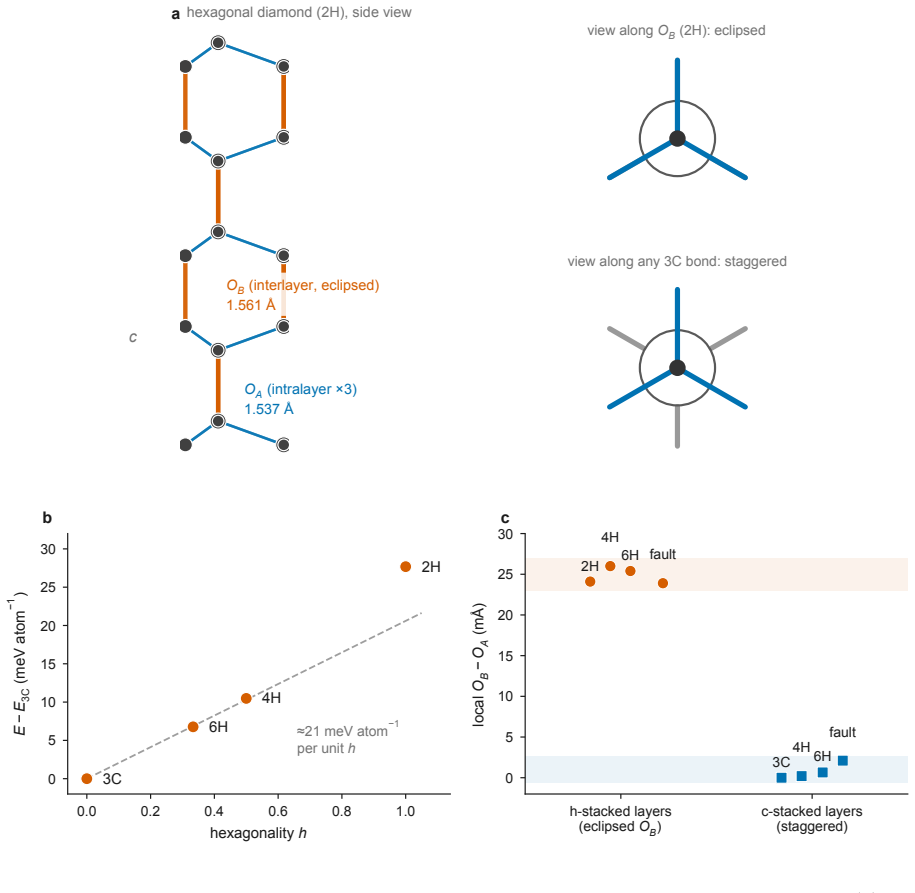
The central object is the zone-center A1g mode, which is essentially the interlayer-bond stretch. Its frequency shifts by about −2,100 cm−1 per ångström of interlayer-bond length, while the two E modes track the intralayer bonds; this sensitivity map converts a measured Raman splitting directly into a bond-length difference. The underlying physical mechanism is the eclipsed conformation of the interlayer bond, which weakens and lengthens it, and the effect is local and transferable across the diamond polytypes examined.
What would settle it
Polarization-resolved Raman on an oriented phase-pure hexagonal-diamond crystal: if the 1,338 cm−1 component shows E1g symmetry and a third band appears near 1,221 cm−1 (E2g), the A1g/E1g assignment and the 24±3 mÅ value are supported; if the 1,338 cm−1 component is A1g, or if a third resolved component emerges in the 1,310/1,338 envelope, the inverted asymmetry shifts and the central claim fails.
Extended reading notes
Core claim
Relaxed hexagonal diamond has a longer interlayer bond: OB − OA = +24 mÅ in both density functionals tested, driven by the eclipsed conformation of the interlayer bond. The same local asymmetry appears in hexagonally stacked layers of other polytypes and disappears at cubic stacking faults. Inverting the phase-pure measured Raman envelope with a DFT-calibrated sensitivity map gives OB − OA = 24±3 mÅ (95% interval), with two independent determinations on other samples giving +33±8 and +60±45 mÅ. The two recent Rietveld structures fail the Raman test on their own samples, and no mechanically viable, diffraction-consistent homogeneous 2H structure reproduces the twinned sample's three Raman ban
Load-bearing premise
The load-bearing premise is that the measured Raman envelope of the phase-pure sample is correctly decomposed into exactly two components at 1,310 and 1,338 cm−1 assigned to A1g and E1g, and that the DFT-computed sensitivity of the A1g frequency to interlayer bond length is accurate enough to convert the 28 cm−1 splitting into a bond-length difference of 24 mÅ.
Editorial extensions
If this is right
- The two recent diffraction refinements of bulk hexagonal diamond are inconsistent with each other, with the Raman spectra measured on their own samples, and with the 2003 refinement; their internal coordinates should be treated with caution.
- Raman spectroscopy, through the A1g mode, can measure the interlayer bond asymmetry to about ±3 mÅ, making it a sharper structural probe on these samples than the available diffraction.
- The 1,529 cm−1 feature cannot be a first-order mode of ideal 2H diamond; the leading explanation is minority sp2 carbon under roughly 1% biaxial strain or with significant disorder.
- The bond asymmetry scales with hexagonality and is erased at cubic stacking faults, so Raman frequencies report the average stacking order within the optical probe volume.
- The 2003 diffraction refinement, though imprecise in its internal coordinate, agrees with theory and with Raman on the sign, axial ratio, bond budget, and bond-strength ordering.
Reading between the lines
- If the calibrated sensitivity map transfers to other materials, the same strategy—using a bright, bond-selective zone-center mode as a 'bond ruler'—could be applied to contested bond-length asymmetries in other tetrahedral polytypes, such as wurtzite boron nitride or silicon carbide polytypes.
- A direct testable extension: measuring the A1g frequency of hexagonal diamond under controlled uniaxial stress should reproduce the predicted ∼−2,100 cm−1/Å shift and the sign inversion near ±1.8% strain.
- The diffraction sensitivity re-analysis implies that preferred orientation may make the internal coordinate of the phase-pure sample underdetermined; re-refining with a more robust texture model could resolve the contradiction from the diffraction side without invoking Raman.
- If the one-phonon density of states indeed terminates at 1,329 cm−1, any future observation of a strong 1,529 cm−1 band in a clean, phase-pure sample would force a reassignment, so the sp2 explanation is falsifiable by cleaner spectroscopy.
Editorial analysis
A structured set of objections, weighed in public.
Referee Report
Summary. The paper uses first-principles lattice dynamics and Raman-spectrum inversion to argue that the intrinsic structure of hexagonal diamond has a long interlayer bond, OB − OA ≈ +24 mÅ, in agreement with an overlooked 2003 Yoshiasa refinement but in conflict with two recent Rietveld refinements (Yang et al., Lai et al.) that give −55 and +183 mÅ, respectively. The authors compute exact phonons for the relaxed, refined, and several constrained structures; benchmark against cubic-diamond T2g and graphite G; show that the A1g mode acts as an interlayer-bond gauge with sensitivity ≈ −2150 cm−1 Å−1; invert the two-component Raman envelope of Lai's phase-pure sample to obtain OB − OA = 24 ± 3 mÅ (95%); and reanalyze Lai's diffraction pattern to argue that it cannot discriminate the DFT-relaxed coordinate. They also attribute the 1529 cm−1 band of Yang's sample to strained/disordered sp2 carbon. The central claim is that vibrational spectroscopy, together with diffraction, selects a small positive bond asymmetry and invalidates both recent refinements.
Significance. If the central conclusion stands, it resolves a high-profile structural controversy in a material of current experimental interest, and it provides a concrete, falsifiable prediction: the A1g–E1g splitting is a linear gauge of the interlayer bond. The paper's computational strengths are substantial: exact phonons at every candidate structure, two independent functionals, benchmarks against known carbon modes, an assignment matrix that tests all six component orderings, a measured-cell consistency check, a diffraction sensitivity analysis on source data, and a fully archived 2,611-file data package with a manifest. The sign and rough magnitude of the asymmetry are supported by multiple lines of evidence (DFT, Yoshiasa diffraction, Goryainov impact-diamond Raman), so the main structural conclusion is defensible. However, the quantitative '24 ± 3 mÅ' headline is conditional on an externally fitted two-component decomposition of a Raman envelope whose raw traces are not deposited, and the inversion is calibrated by the same DFT physics it confirms; these caveats need to be foregrounded.
major comments (3)
- [SI S1 / SI S9] The headline 24 ± 3 mÅ (Eq. S4) is obtained by passing the two fitted components (1,310 and 1,338 cm−1) of Lai et al.'s envelope through the linearized DFT map (Eq. S1). As S9 admits, the underlying Raman traces of Lai et al. are not in any deposited source data, so the two-component decomposition and its covariance cannot be independently checked. The ±3 mÅ budget uses an assumed σ ≈ 3 cm−1 for the splitting; if the envelope contains a third resolved component or if the line-shape model differs, the splitting and hence the inferred asymmetry would shift. The assignment matrix (Table S1) addresses which modes are assigned, but not how many components exist or whether a two-component fit is statistically justified. Since the abstract presents 24 ± 3 mÅ as a primary result, the paper should either obtain and archive the raw traces (or a re-fit of them) or clearly label this value as condit
- [SI S1 Eqs. (1)–(3)] The Raman inversion is not an independent measurement of the bond asymmetry: the sensitivity matrix J and the reference frequencies ω0 are computed by DFT at the DFT-relaxed asymmetric structure, and the measured splitting (28 cm−1) coincides exactly with the calculated E1g − A1g splitting (28 cm−1). The conclusion that the inversion 'gives' 24 ± 3 mÅ therefore largely returns the DFT input through a one-parameter map. The paper's insensitivity to the offset δ is correct, but the J matrix and ω0 carry the DFT physics. The claim should be phrased as a DFT-calibrated consistency check, not as an independent spectroscopic determination. This distinction matters for how a reader weighs the 24 ± 3 mÅ interval against the two recent refinements.
- [Main text, Discussion (ii)] The statement that the two recent refinements are 'inconsistent with ... the earlier refinement, at 2.3σ and 3.0σ' compares z-coordinates using the Yoshiasa σ = 0.008. That σ comes from a two-phase powder refinement with a stated u uncertainty of ±0.008, and the '0.7σ' agreement between Yoshiasa and DFT may be a coincidence of the large uncertainty. This is not an error, but the sigma language suggests a quantitative verdict that is only as strong as the 2003 refinement's error model. The Raman-based rejection of the two recent structures rests on pattern-level discrepancies of 78–350 cm−1, which are far more robust; the sigma phrasing should be softened or its provenance clarified.
minor comments (4)
- [Abstract] The abstract uses '238 mÅ' without defining the unit; define mÅ (10−3 Å) at first use, since many readers will misread it as an SI prefix on Å.
- [Fig. 4 / Table 1] The shaded measured bands in Fig. 4 are described as visual guides with fixed width, which is fine, but the figure would benefit from explicitly marking the Lai measurement window at 1,100 cm−1 so that 'below window' entries (e.g., Lai-Rietveld A1g at 959 cm−1) are visually clear.
- [S5] The intensity ordering argument uses static, non-resonant PBE activities, while both experiments used UV excitation; the text correctly caveats this, but the caveat should be repeated near the sentence excluding the E1g/A1g swap structure, since that exclusion partly rests on equalized activities (98:100:103).
- [S6] The diffraction sensitivity analysis uses a one-parameter March–Dollase texture proxy, not the original spherical-harmonic texture model; this is acknowledged, but the conclusion that the Lai pattern 'does not discriminate' should be stated as a sensitivity result for this proxy model, not as a full reproduction of Lai's refinement.
Circularity Check
No significant circularity: the Raman inversion is a genuine consistency check anchored to an independent DFT sensitivity map, not a definitional reduction of its inputs.
full rationale
The derivation chain is self-contained. The relaxed DFT structure independently predicts OB−OA = +24 mÅ in two functionals (r2SCAN+rVV10 and PBE). The Raman inversion (SI Eq. S1) combines two measured components from Lai et al. (1,310 and 1,338 cm−1) with a DFT sensitivity matrix J benchmarked against external carbon modes (cubic-diamond T2g: 1,325.5 vs 1,332 cm−1; graphite G: 1,567 vs ≈1,580 cm−1) and a bounded nuisance offset δ. The measured splitting of 28 cm−1 coincides with the calculated E1g−A1g splitting of 28, so the inferred asymmetry returns close to the DFT value; this is a non-trivial experimental consistency check, not a tautology, because a different measured splitting would propagate through ∂(OB−OA)/∂(splitting) = 0.41 mÅ/cm−1 to a different asymmetry. Alternative mode assignments are excluded by independent intensity ordering, third-mode constraints, and the resolved Goryainov spectrum, not by assuming the target value. The +33±8 mÅ Goryainov determination shares the same calculated map, as the paper explicitly notes, but it is an independent sample/spectrum; the +60±45 mÅ diffraction determination does not use the map at all. No load-bearing self-citation is present: the cited prior frequency calculations (refs 22–25) are external and the paper treats their agreement as a premise rather than as proof. The main unverifiable input is Lai's two-component fit of one asymmetric envelope, whose raw traces are not deposited (SI S9); this is a reproducibility limitation, not circularity, and the paper parametrizes it with σ≈3 cm−1 and a factor-of-two sensitivity bound.
Assumptions & free parameters
free parameters (3)
- δ (common additive frequency offset) =
prior |δ| ≤ 15 cm−1; +28.7 cm−1 at measured cell
- σ_splitting (component-fit uncertainty) =
3 cm−1 (adopted; doubled to 6 in a sensitivity check)
- Quadratic energy-surface coefficients (kAA, kAB, kBB) =
22,900 / 1,220 / 6,380 meV atom−1 Å−2
assumptions (4)
- domain assumption DFT with r2SCAN+rVV10 and PBE accurately predicts the bond-length asymmetry and phonon frequencies of hexagonal diamond.
- domain assumption Harmonic lattice dynamics, with no anharmonic or resonance corrections, is adequate for comparing calculated and measured Raman shifts.
- domain assumption Published experimental inputs (Rietveld coordinates, lattice constants, fitted Raman components) are accurately reported.
- standard math The linearized two-bond mode map (Eqs. S1–S2) is valid over the inferred range of (OA, OB).
Cite this review
Pith. "Pith review of Vibrational spectroscopy identifies the bond asymmetry of hexagonal diamond." pith.science (2026). https://pith.science/paper/AZ4MN4R2
@misc{pith2026260800138,
  author       = {Pith},
  title        = {Pith review of: Vibrational spectroscopy identifies the bond asymmetry of hexagonal diamond},
  year         = {2026},
  howpublished = {\url{https://pith.science/paper/AZ4MN4R2}},
  note         = {Machine review of arXiv:2608.00138}
}
abstract
Bulk hexagonal diamond has been synthesized by independent routes, but its structure remains contested: the two recent refinements disagree even on the sign of the difference between its two inequivalent bond lengths, 238~m\AA{} apart, and both depart from an earlier 2003 refinement. Here we test the competing structures with first-principles lattice dynamics. Relaxed hexagonal diamond has an interlayer bond \emph{longer} than the intralayer bonds by 24~m\AA{} in both functionals, an effect of its eclipsed conformation that scales with polytype hexagonality. The bright zone-center $A_{1g}$ mode gauges the interlayer bond at $\approx\!-2{,}100$~\icm~\AA$^{-1}$, and neither refined coordinate reproduces the full pattern of measured modes. The only structure matching the twinned sample's three bands requires tens-of-gigapascals confining stress and lattice constants excluded by its own diffraction. Raman spectroscopy and diffraction jointly select a small positive bond asymmetry: inverting the spectrum of the phase-pure sample gives $\OB-\OA=24\pm3$~m\AA{} (95\% interval), and two determinations on separate samples give $+33\pm8$ and $+60\pm45$~m\AA. The 1{,}529~\icm{} feature cannot be assigned to homogeneous ideal 2H diamond, and the local HRTEM observation remains an open puzzle.
Figures


Figures from the paper (2 more)


Reference graph
Works this paper leans on
-
[1]
F. P. Bundy and J. S. Kasper. Hexagonal Diamond—A New Form of Carbon.The Journal of Chemical Physics, 46:3437–3446, 1967. doi: 10.1063/1.1841236
-
[2]
Clifford Frondel and Ursula B. Marvin. Lonsdaleite, a Hexagonal Polymorph of Diamond. Nature, 214:587–589, 1967. doi: 10.1038/214587a0
doi:10.1038/214587a0 1967
-
[3]
Harder than Diamond: Superior Indentation Strength of Wurtzite BN and Lonsdaleite.Physical Review Letters, 102:055503,
Zicheng Pan, Hong Sun, Yi Zhang, and Changfeng Chen. Harder than Diamond: Superior Indentation Strength of Wurtzite BN and Lonsdaleite.Physical Review Letters, 102:055503,
-
[4]
PéterNémeth, LaurenceA.J.Garvie, ToshihiroAoki, NataliaDubrovinskaia, LeonidDubrovin- sky, and Peter R. Buseck. Lonsdaleite is faulted and twinned cubic diamond and does not exist as a discrete material.Nature Communications, 5:5447, 2014. doi: 10.1038/ncomms6447
-
[5]
Christoph G. Salzmann, Benjamin J. Murray, and Jacob J. Shephard. Extent of stacking disorder in diamond.Diamond and Related Materials, 59:69–72, 2015. doi: 10.1016/j.diamond. 2015.09.007
-
[6]
D. Kraus, A. Ravasio, M. Gauthier, D. O. Gericke, J. Vorberger, S. Frydrych, J. Helfrich, L. B. Fletcher, G. Schaumann, B. Nagler, B. Barbrel, B. Bachmann, E. J. Gamboa, S. Göde, E. Granados, G. Gregori, H. J. Lee, P. Neumayer, W. Schumaker, T. Döppner, R. W. Falcone, S. H. Glenzer, and M. Roth. Nanosecond formation of diamond and lonsdaleite by shock com...
-
[7]
Stefan J. Turneaure, Surinder M. Sharma, Travis J. Volz, J. M. Winey, and Yogendra M. Gupta. Transformation of shock-compressed graphite to hexagonal diamond in nanoseconds. Science Advances, 3:eaao3561, 2017. doi: 10.1126/sciadv.aao3561
-
[8]
Synthesis of bulk hexagonal diamond.Nature, 644:370–375, 2025
Liuxiang Yang, Kah Chun Lau, Zhidan Zeng, Dongzhou Zhang, Hu Tang, Bingmin Yan, Guo- liang Niu, Huiyang Gou, Yanping Yang, Wenge Yang, Duan Luo, and Ho kwang Mao. Synthesis of bulk hexagonal diamond.Nature, 644:370–375, 2025. doi: 10.1038/s41586-025-09343-x
Show all 42 references
-
[9]
Gen- eral approach for synthesizing hexagonal diamond by heating post-graphite phases.Nature Materials, 24:513–518, 2025
Desi Chen, Guwen Chen, Long Lv, Jiajun Dong, Yuchen Shang, Xuyuan Hou, Yan Wang, Jianqi Shang, Saisai Wang, Yankun Yin, Ran Liu, Wei Zhang, Zhou Jiang, Yan He, Bingchen 19 He, Chengwen Mao, Shengcai Zhu, Bertil Sundqvist, Bingbing Liu, and Mingguang Yao. Gen- eral approach for...
2025 doi
-
[10]
Direct synthesis of millimeter-sized hexagonal diamond from graphite.Science Bulletin, 70:1257–1263, 2025
Xiaohong Yuan, Guwen Chen, Yong Cheng, Shengcai Zhu, Fuyang Liu, Yujiao Ke, Kuo Hu, Yue Pan, Ming-Sheng Wang, Zhaodong Liu, Hu Tang, and Bingbing Liu. Direct synthesis of millimeter-sized hexagonal diamond from graphite.Science Bulletin, 70:1257–1263, 2025. doi: 10.1016/j.scib...
2025 doi
-
[11]
Bulk hexagonal diamond.Nature, 651:621–625, 2026
Shoulong Lai, Xigui Yang, Jiuyang Shi, Shijie Liu, Ying Guo, Longbin Yan, Jinhao Zang, Zhuangfei Zhang, Qiuhan Jia, Jian Sun, Shaobo Cheng, and Chongxin Shan. Bulk hexagonal diamond.Nature, 651:621–625, 2026. doi: 10.1038/s41586-026-10212-4
2026 doi
-
[12]
Detailed Structures of Hexag- onal Diamond (lonsdaleite) and Wurtzite-type BN.Japanese Journal of Applied Physics, 42: 1694–1704, 2003
Akira Yoshiasa, Yu Murai, Osamu Ohtaka, and Tomoo Katsura. Detailed Structures of Hexag- onal Diamond (lonsdaleite) and Wurtzite-type BN.Japanese Journal of Applied Physics, 42: 1694–1704, 2003. doi: 10.1143/JJAP.42.1694
2003 doi
-
[13]
S. V. Goryainov, A. Yu. Likhacheva, and N. N. Ovsyuk. Raman Scattering in Lons- daleite.Journal of Experimental and Theoretical Physics, 127:20–24, 2018. doi: 10.1134/ S1063776118070051
2018
-
[14]
Accurate and Numerically Efficient r2SCAN Meta-Generalized Gradient Approximation.The Journal of Physical Chemistry Letters, 11:8208–8215, 2020
JamesW.Furness, AaronD.Kaplan, JinliangNing, JohnP.Perdew, andJianweiSun. Accurate and Numerically Efficient r2SCAN Meta-Generalized Gradient Approximation.The Journal of Physical Chemistry Letters, 11:8208–8215, 2020. doi: 10.1021/acs.jpclett.0c02405
2020 doi
-
[15]
Perdew, and Jianwei Sun
Haowei Peng, Zeng-Hui Yang, John P. Perdew, and Jianwei Sun. Versatile van der Waals Density Functional Based on a Meta-Generalized Gradient Approximation.Physical Review X, 6:041005, 2016. doi: 10.1103/PhysRevX.6.041005
2016 doi
-
[16]
Furness, Aaron D
Jinliang Ning, Manish Kothakonda, James W. Furness, Aaron D. Kaplan, Sebastian Ehlert, Jan Gerit Brandenburg, John P. Perdew, and Jianwei Sun. Workhorse minimally empirical dispersion-corrected density functional with tests for weakly bound systems: r2SCAN+rVV10. Physical Revi...
2022 doi
-
[17]
Perdew, Kieron Burke, and Matthias Ernzerhof
John P. Perdew, Kieron Burke, and Matthias Ernzerhof. Generalized Gradient Approximation Made Simple.Physical Review Letters, 77:3865–3868, 1996. doi: 10.1103/PhysRevLett.77.3865
1996 doi
-
[18]
Deringer, Geoffroy Hautier, and Richard Dronskowski
Ryky Nelson, Christina Ertural, Janine George, Volker L. Deringer, Geoffroy Hautier, and Richard Dronskowski. LOBSTER: Local orbital projections, atomic charges, and chemical- bonding analysis from projector-augmented-wave-based density-functional theory.Journal of Computation...
1931 doi
-
[19]
Chin-Yu Yeh, Z. W. Lu, S. Froyen, and Alex Zunger. Zinc-blende–wurtzite polytypism in semiconductors.Physical Review B, 46:10086–10097, 1992. doi: 10.1103/PhysRevB.46.10086. 20
1992 doi
-
[20]
S. A. Solin and A. K. Ramdas. Raman Spectrum of Diamond.Physical Review B, 1:1687–1698,
-
[21]
Ferrari and Denis M
Andrea C. Ferrari and Denis M. Basko. Raman spectroscopy as a versatile tool for studying the properties of graphene.Nature Nanotechnology, 8:235–246, 2013. doi: 10.1038/nnano.2013.46
2013 doi
-
[22]
Diamond polytypes under high pressure: A first-principles study.Computational Materials Science, 98:129–135, 2015
Hui-Juan Cui, Xian-Lei Sheng, Qing-Bo Yan, Zhen-Gang Zhu, Qing-Rong Zheng, and Gang Su. Diamond polytypes under high pressure: A first-principles study.Computational Materials Science, 98:129–135, 2015. doi: 10.1016/j.commatsci.2014.09.050
2015 doi
-
[23]
Flores-Livas, Lauri Lehtovaara, Maximilian Amsler, Stefan Goedecker, Stéphane Pail- hès, Silvana Botti, Alfonso San Miguel, and Miguel A
José A. Flores-Livas, Lauri Lehtovaara, Maximilian Amsler, Stefan Goedecker, Stéphane Pail- hès, Silvana Botti, Alfonso San Miguel, and Miguel A. L. Marques. Raman activity of sp3 carbon allotropes under pressure: A density functional theory study.Physical Review B, 85: 155428...
2012 doi
-
[24]
V. N. Denisov, B. N. Mavrin, N. R. Serebryanaya, G. A. Dubitsky, V. V. Aksenenkov, A. N. Kirichenko, N.V.Kuzmin, B.A.Kulnitskiy, I.A.Perezhogin, andV.D.Blank. First-principles, UV Raman, X-ray diffraction and TEM study of the structure and lattice dynamics of the diamond–lonsd...
2011
-
[25]
Raman investigations and ab initio calculations of natural diamond- lonsdaleite originating from New Caledonia.Chemical Physics, 559:111541, 2022
Yassine El Mendili, Beate Orberger, Daniel Chateigner, Jean-François Bardeau, Stéphanie Gas- coin, and Sébastien Petit. Raman investigations and ab initio calculations of natural diamond- lonsdaleite originating from New Caledonia.Chemical Physics, 559:111541, 2022
2022
-
[26]
Smith, Kit McColl, Martin Hart, Matteo Alvaro, Adrian P
Mara Murri, Rachael L. Smith, Kit McColl, Martin Hart, Matteo Alvaro, Adrian P. Jones, Péter Németh, Christoph G. Salzmann, Furio Corà, Maria C. Domeneghetti, Fabrizio Nestola, Nikolay V. Sobolev, Sergey A. Vishnevsky, Alla M. Logvinova, and Paul F. McMillan. Quan- tifying hex...
2019
-
[27]
K. E. Spear, A. W. Phelps, and W. B. White. Diamond polytypes and their vibrational spectra. Journal of Materials Research, 5:2277–2285, 1990. doi: 10.1557/jmr.1990.2277
1990
-
[28]
T. M. G. Mohiuddin, A. Lombardo, R. R. Nair, A. Bonetti, G. Savini, R. Jalil, N. Bonini, D. M. Basko, C. Galiotis, N. Marzari, K. S. Novoselov, A. K. Geim, and A. C. Ferrari. Uniaxial strain in graphene by Raman spectroscopy: G peak splitting, Grüneisen parameters, and sample ...
2009 doi
-
[29]
Koukaras, John Parthenios, George Kalosakas, Konstantinos Papagelis, and Costas Galiotis
Charalampos Androulidakis, Emmanuel N. Koukaras, John Parthenios, George Kalosakas, Konstantinos Papagelis, and Costas Galiotis. Graphene flakes under controlled biaxial de- formation.Scientific Reports, 5:18219, 2015. doi: 10.1038/srep18219
2015 doi
-
[30]
Nair, Anna Ott, Thanasis Georgiou, Andre K
Jakob Zabel, Rahul R. Nair, Anna Ott, Thanasis Georgiou, Andre K. Geim, Kostya S. Novoselov, and Cinzia Casiraghi. Raman Spectroscopy of Graphene and Bilayer under Bi- axial Strain: Bubbles and Balloons.Nano Letters, 12:617–621, 2012. doi: 10.1021/nl203359n. 21
2012 doi
-
[31]
A. C. Ferrari and J. Robertson. Interpretation of Raman spectra of disordered and amorphous carbon.Physical Review B, 61:14095–14107, 2000. doi: 10.1103/PhysRevB.61.14095
-
[32]
Coherent interfaces govern direct transforma- tion from graphite to diamond.Nature, 607:486–491, 2022
Kun Luo, Bing Liu, Wentao Hu, Xiao Dong, Yanbin Wang, Quan Huang, Yufei Gao, Lei Sun, Zhisheng Zhao, Yingju Wu, Yang Zhang, Mengdong Ma, Xiang-Feng Zhou, Julong He, Dongli Yu, Zhongyuan Liu, Bo Xu, and Yongjun Tian. Coherent interfaces govern direct transforma- tion from graph...
2022 doi
-
[33]
Kresse and J
G. Kresse and J. Furthmüller. Efficient iterative schemes forab initiototal-energy calculations usingaplane-wavebasisset.Physical Review B,54:11169–11186, 1996. doi: 10.1103/PhysRevB. 54.11169
1996 doi
-
[34]
Kresse and J
G. Kresse and J. Furthmüller. Efficiency of ab-initio total energy calculations for metals and semiconductors using a plane-wave basis set.Computational Materials Science, 6:15–50, 1996. doi: 10.1016/0927-0256(96)00008-0
1996 doi
-
[35]
P. E. Blöchl. Projector augmented-wave method.Physical Review B, 50:17953–17979, 1994. doi: 10.1103/PhysRevB.50.17953
1994 doi
-
[36]
Kresse and D
G. Kresse and D. Joubert. From ultrasoft pseudopotentials to the projector augmented-wave method.Physical Review B, 59:1758–1775, 1999. doi: 10.1103/PhysRevB.59.1758
1999 doi
-
[37]
Accurate and Numerically Efficient r2SCAN Meta-Generalized Gradient Approxi- mation
James W. Furness, Aaron D. Kaplan, Jinliang Ning, John P. Perdew, and Jianwei Sun. Cor- rection to “Accurate and Numerically Efficient r2SCAN Meta-Generalized Gradient Approxi- mation”.The Journal of Physical Chemistry Letters, 11:9248–9248, 2020. doi: 10.1021/acs. jpclett.0c03077
2020 doi
-
[38]
First principles phonon calculations in materials science.Scripta Materialia, 108:1–5, 2015
Atsushi Togo and Isao Tanaka. First principles phonon calculations in materials science.Scripta Materialia, 108:1–5, 2015. doi: 10.1016/j.scriptamat.2015.07.021
2015 doi
-
[39]
Implementation strategies in phonopy and phono3py.Journal of Physics: Condensed Matter, 35:353001, 2023
Atsushi Togo, Laurent Chaput, Terumasa Tadano, and Isao Tanaka. Implementation strategies in phonopy and phono3py.Journal of Physics: Condensed Matter, 35:353001, 2023. doi: 10.1088/1361-648X/acd831
2023 doi
-
[40]
W. A. Dollase. Correction of intensities for preferred orientation in powder diffractometry: application of the March model.Journal of Applied Crystallography, 19:267–272, 1986. doi: 10.1107/S0021889886089458. 22 Supplementary Information S1 Raman inversion: model, identifiabi...
1986
-
[1970]
doi: 10.1103/PhysRevB.1.1687
-
[2009]
doi: 10.1103/PhysRevLett.102.055503
Reviewed August 4, 2026 · model on record in the stance chip above.
Discussion (0). Continue with ORCID to comment.