REVIEW 4 major objections 6 minor 12 references
SCOPE, a report-mediated framework, composes anatomy-indexed evidence under whole-volume context, calibrates it with the diagnostic summary, and reaches 85.0 macro AUC on a large chest-CT benchmark.
Reviewed by Pith at T0; open to challenge. T0 means a machine referee read the full paper against a public rubric. the ladder, T0–T4 →
T0 review · deepseek-v4-flash
2026-08-04 00:54 UTC pith:NEW5LUCT
load-bearing objection A well-specified method with a promising internal ablation, but the zero-shot SOTA claim is confounded by a supervised warm-up on the evaluation labels. the 4 major comments →
Semantically Calibrated Evidence Composition for CT Vision-Language Learning
The pith
A machine-rendered reading of the paper's core claim, the machinery that carries it, and where it could break.
Core claim
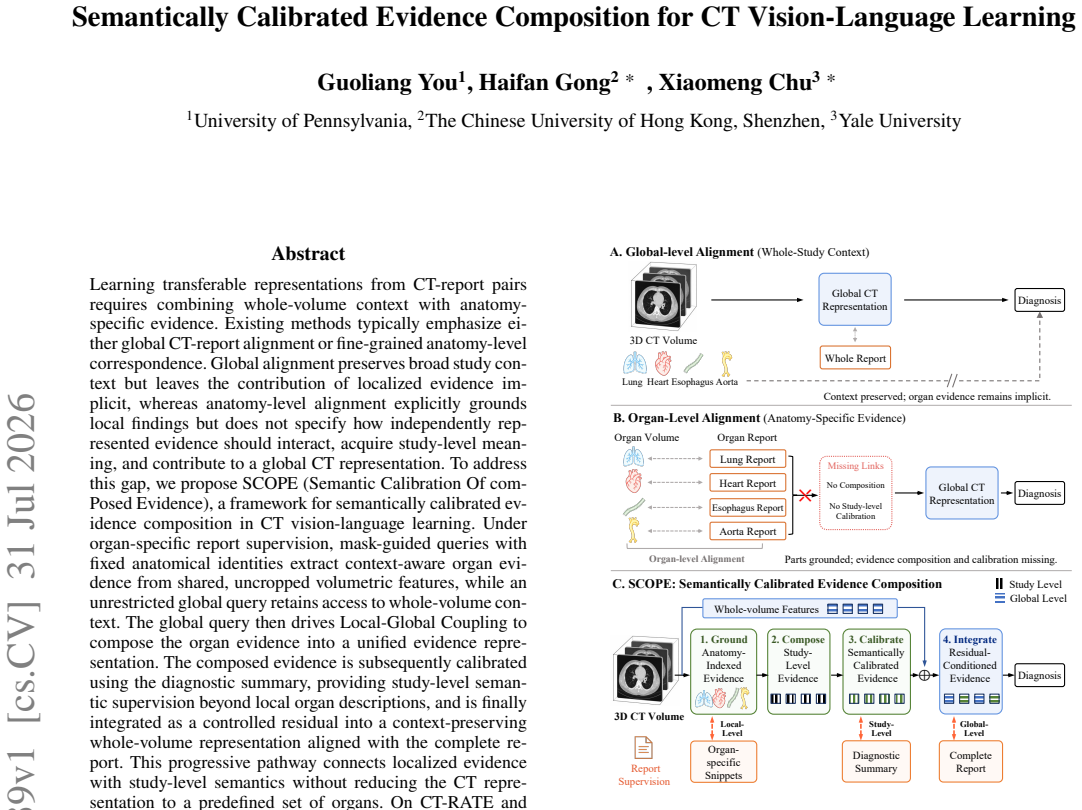
On the paper's own terms, the discovery is that anatomy-indexed evidence — lung, heart, esophagus, aorta — should not be treated as a final representation nor simply summed into a global one. Under organ-specific report supervision, mask-guided queries with fixed anatomical identities read shared, uncropped volumetric features, while an unrestricted global query keeps access to the whole volume. Local-Global Coupling uses the global query as attention query and organ tokens as keys/values to compose study-level evidence; contrastive supervision from the diagnostic summary calibrates that evidence toward study-level semantics; and a learned residual scale integrates it into the direct whole-v
What carries the argument
The load-bearing mechanism is Local-Global Coupling (LGC) — an attention operation whose query is an unrestricted global-query token, whose keys and values are the anatomy-indexed organ tokens, and whose output is composed study-level evidence. Around it sits the mask-guided anatomy-indexed query transformer (which grounds organ tokens in their anatomy via predicted masks and organ-snippet contrastive loss) and the residual integration step z_SCOPE = LN(z_base + gamma * W_e * a_x), which injects the calibrated evidence into the whole-volume base under a learned scale. The diagnostic-summary contrastive loss calibrates a_x so the evidence inherits study-level semantics before it touches the f
Load-bearing premise
The gains depend on the quality and structure of the report-hierarchy supervision: the training set's Findings and Conclusion fields must split cleanly into organ-specific snippets and a diagnostic summary, and every volume must have reliable organ masks; if that parsing or mask supervision is noisy, the grounding and calibration signals misalign and the results may not transfer to datasets lacking such structured annotations.
What would settle it
Retrain the same pipeline on a random sample of 500 volumes whose reports have been independently re-split into organ snippets and a diagnostic summary by a second annotator (or by an LLM parser from free text) while keeping all masks and hyperparameters fixed; if zero-shot AUC moves by more than a point, the structured-report assumption is load-bearing, and if it does not, the claim generalizes beyond the original training benchmark.
If this is right
- If the central claim holds, zero-shot abnormality diagnosis on chest CT can be improved by about 7 AUC points over the previous best without task-specific fine-tuning.
- The frozen-encoder linear-probing results imply the learned representation transfers to external chest-CT data, so downstream models can be built by training a linear head on top.
- Cross-modal retrieval improvements (up to 27.9 Recall points) indicate the representation preserves clinically meaningful image neighborhoods and text-to-volume matching.
- Organ-query tokens encode stronger organ-specific disease semantics than the prior anatomy-level approach, so the framework may be useful for anatomy-grounded explainability and organ-specific screening.
- Because gains extend to the 'Other' group (findings outside the four predefined organs), the residual-conditioned representation does not merely memorize organ queries; it preserves unrestricted whole-volume context.
Where Pith is reading between the lines
- The paper's cumulative ablation credits semantic calibration with only 0.4 AUC; it is an untested inference that this step matters most under distribution shift or when the diagnostic summary is the only study-level text available, as in free-text reports.
- A natural extension, not claimed by the paper, is to replace the four hand-picked organ queries with a learnable anatomy set or to add more organs; the 8.0-point gain on out-of-organ findings suggests the residual path may already handle unseen anatomy, but adding queries could either sharpen or dilute the global context.
- The method's reliance on organ masks and structured reports means the biggest practical payoff would come from coupling it with automatic total-body organ segmentation and LLM-based report structuring; that coupling is not evaluated here.
Editorial analysis
A structured set of objections, weighed in public.
Referee Report
Summary. The paper proposes SCOPE, a CT vision-language pretraining framework that explicitly composes anatomy-indexed evidence and calibrates it toward study-level semantics. A 3D encoder produces whole-volume features; learnable organ queries with fixed anatomical identities attend to the uncropped volume under mask guidance and organ-specific report supervision. A global query is then used in Local-Global Coupling (LGC) over the organ tokens to form a composed evidence representation, which is contrastively calibrated with a diagnostic-summary view and integrated as a residual into the whole-volume representation, with the final representation aligned to the complete report. The authors report zero-shot abnormality diagnosis, frozen-encoder linear probing, and retrieval results on CT-RATE and RadChestCT, claiming SOTA macro AUCs of 85.0 and 72.2, respectively.
Significance. If the comparisons are fair, the paper addresses a real gap in CT vision-language learning: how localized, organ-specific evidence should be composed and calibrated into a global representation. The architecture and losses are specified in enough detail to be reconstructed, and the stage-wise ablation provides a clear test of the proposed pathway. However, the headline zero-shot claim is confounded by a supervised warm-up on the same CT-RATE labels used for evaluation, and all results are single-run point estimates without variance. The core idea is plausible and worth pursuing, but the current evidence does not support the SOTA claims as stated.
major comments (4)
- [§III-H, Table 1, Table 4] The reported zero-shot comparison is confounded by a supervised warm-up on CT-RATE labels. The warm-up includes disease classification on the 18-abnormality label set used for zero-shot evaluation, plus organ-concept prediction and mask supervision. This warm-up is not described for any baseline (CT-CLIP, fVLM, Merlin, etc.). Because the encoder and context-refinement pathway are frozen after warm-up and then used in all downstream evaluations, the +7.2 AUC over fVLM on CT-RATE could be explained by label supervision rather than by the proposed Ground-Compose-Calibrate-Integrate pathway. The internal Whole-volume baseline in Table 4 already achieves 78.3 AUC, above fVLM's 77.8, indicating that a substantial part of the gap predates the proposed pathway. The RadChestCT evaluation also inherits this warm-up. Please either remove the warm-up, apply an identical warm-up to all baselines, or
- [Tables 1–4] All headline results are single-run point estimates; no number of seeds, standard deviations, confidence intervals, or significance tests are reported. The improvements attributed to individual stages in Table 4 (Compose +2.5, Calib +0.4) are small and could easily reflect training noise typical of contrastive medical imaging models. The claimed stage-wise contributions and the SOTA margins are not statistically defensible without repeated runs. Please report mean±std over at least three seeds and, where possible, confidence intervals for the main comparisons.
- [§III-E, Table 4] The semantic calibration stage, described as a central contribution, adds only +0.4 AUC (84.1 vs 83.7) in the cumulative ablation. Furthermore, the diagnostic summary is derived from the Conclusion field, which is also part of the complete report used by L_global in Eq. 10; complete-report alignment may already provide much of the study-level semantic signal, making the intermediate calibration target at least partially redundant. The claim that calibration is load-bearing would be strengthened by an ablation that removes only L_evi while keeping all other components, and by an analysis of the overlap between diagnostic-summary and complete-report supervision.
- [§III-A, §IV-A] The construction of organ-specific snippets and organ masks is not specified precisely enough for reproducibility. The paper states that training uses 24,128 records 'with CT volumes, organ masks, and structured organ-report fields', but does not say how the organ masks were obtained (e.g., from CT-RATE annotations or generated by TotalSegmentator, which is cited in §III-H), nor the criteria for filtering records. The mask-guided refinement and organ-grounding losses depend entirely on this supervision, so the absence of a parsing/mask-generation pipeline description makes it impossible to assess the assumption that report text decomposes cleanly into four organ-specific snippets. Please specify the pipeline and, ideally, include a sensitivity analysis or a small manual audit of mask and snippet quality.
minor comments (6)
- [Abstract] The '7.2 and 4.2' gains are not attributed to a named baseline; specify that they are relative to fVLM, and qualify the 'zero-shot' wording in view of the supervised warm-up.
- [Eq. 6] Since a_x already contains u_g through the residual in Eq. 5, the LGC consistency term may largely collapse the two representations. Please clarify what this term adds beyond the residual connection and report its weight sensitivity.
- [§III-A] The phrase 'with organ conclusions as fallback' for the diagnostic summary is ambiguous; specify the conditions under which the fallback is used.
- [Tables 1–3] Missing values are marked with '-' but there is no footnote explaining whether they were not reported in the original papers or not computed. Add a caption note.
- [Figure 1] The figure contains stray formatting artifacts (e.g., '⤬', 'MissingLinks') that should be cleaned up.
- [General] No code or training checkpoints are provided. Releasing the implementation and a reproducible training configuration would substantially strengthen the paper.
Circularity Check
No derivation-level circularity: the Ground-Compose-Calibrate-Integrate path is independently ablated, and the losses are direct contrastive alignments to external report views; the disclosed CT-RATE supervised warm-up confounds the 'zero-shot' label but is not a circular reduction.
full rationale
The paper's claimed derivation chain is not circular. The central objectives—organ-level contrastive grounding (Eq. 4), diagnostic-summary calibration (Eq. 8), and complete-report alignment (Eq. 10)—are all contrastive alignments between visual representations and text views constructed from radiology reports. None of these equations encodes the target AUC or a fitted label-similarity score that would make the benchmark result equal to an input by construction. The LGC consistency term (Eq. 6) is a regularizer cos(u_g, a_x), not a prediction target; it nudges the composed evidence toward the global query but cannot force the reported macro AUC. The stage-wise ablation in Table 4 provides a within-model control: the whole-volume baseline reaches 78.3 AUC, and adding grounding, composition, calibration, and integration progressively yields 81.2, 83.7, 84.1, and 85.0. This internal progression supports the claim that the proposed pathway contributes beyond the whole-volume representation, independent of any external baseline comparison. The only notable concern is the supervised warm-up in Section III-H: 'The image pathway first receives a short image-only supervised warm-up with disease classification, organ-concept prediction, mask prediction, mask reconstruction, and image-side LGC objectives.' Because the warm-up uses CT-RATE disease labels and the zero-shot diagnosis is evaluated on the same 18-abnormality task, the abstract's 'zero-shot' framing is overstated relative to baselines that may not receive such warm-up. However, this is an evaluation/protocol confound, not a circular derivation: the warm-up is disclosed, the discarded classification heads are not used at inference, and the method's internal ablation controls for the warm-up. Minor self-citations by co-author Haifan Gong (e.g., Gong et al. 2024, 2025a,b; Huang et al. 2025) appear as related-work examples rather than load-bearing justification, so they do not raise the circularity score. Overall, the derivation is self-contained with respect to its own equations and ablations; no step reduces to its own input.
Axiom & Free-Parameter Ledger
free parameters (7)
- Contrastive temperatures τ_g, τ_loc, τ_e =
not specified (likely learned)
- Loss weights λ_evi, λ_local, λ_lgc, λ_mask, λ_rec, λ_tr, λ_tl, λ_imp =
0.02, 0.2, 0.5, 1.0, 1.0, 0.2, 0.3, 0.1
- Context-refinement residual scale α =
learnable
- Evidence residual magnitude γ =
learnable/controlled
- Number of context refinement tokens K =
not stated
- Number of query-transformer layers L =
2
- Number of organ queries |O| =
4 (lung, heart, esophagus, aorta)
axioms (6)
- standard math InfoNCE-style contrastive losses are a valid alignment objective for visual-text representations.
- domain assumption CT-RATE structured report fields can be parsed into organ-specific snippets, a diagnostic summary, and a complete report that are semantically nested.
- domain assumption Accurate organ masks are available for every training volume, and mask-guided attention logits can be supervised by them without introducing segmentation noise.
- domain assumption The diagnostic summary is semantically closer to the composed evidence than the complete report, making it an appropriate intermediate calibration target.
- ad hoc to paper The LGC consistency term (Eq. 6) encourages ax to stay close to ug; this is introduced ad hoc to stabilize composition.
- domain assumption A 3D ResNet-18 encoder plus CXR-BERT text encoder is a sufficient representational base for CT vision-language pre-training.
read the original abstract
Learning transferable representations from CT-report pairs requires combining whole-volume context with anatomy-specific evidence. Existing methods typically emphasize either global CT-report alignment or fine-grained anatomy-level correspondence. Global alignment preserves broad study context but leaves the contribution of localized evidence implicit, whereas anatomy-level alignment explicitly grounds local findings but does not specify how independently represented evidence should interact, acquire study-level meaning, and contribute to a global CT representation. To address this gap, we propose SCOPE (Semantic Calibration Of comPosed Evidence), a framework for semantically calibrated evidence composition in CT vision-language learning. Under organ-specific report supervision, mask-guided queries with fixed anatomical identities extract context-aware organ evidence from shared, uncropped volumetric features, while an unrestricted global query retains access to whole-volume context. The global query then drives Local-Global Coupling to compose the organ evidence into a unified evidence representation. The composed evidence is subsequently calibrated using the diagnostic summary, providing study-level semantic supervision beyond local organ descriptions, and is finally integrated as a controlled residual into a context-preserving whole-volume representation aligned with the complete report. This progressive pathway connects localized evidence with study-level semantics without reducing the CT representation to a predefined set of organs. On CT-RATE and RadChestCT, SCOPE achieves macro AUCs of 85.0 and 72.2, respectively, outperforming the previous SOTA by 7.2 and 4.2, while also yielding substantial gains in linear probing and cross-modal retrieval. These results demonstrate the effectiveness of semantically calibrated evidence composition.
Figures


Reference graph
Works this paper leans on
-
[5]
Gong, H.; Huang, W.; Zhang, H.; Wang, Y.; Wan, X.; Shen, H.;Li,G.;andLi,H.2024
VQAMix: Conditional Triplet Mixup for Medical Visual Question Answering.IEEE Transactions on Medical Imag- ing, 41(11): 3332–3343. Gong, H.; Huang, W.; Zhang, H.; Wang, Y.; Wan, X.; Shen, H.;Li,G.;andLi,H.2024. IntensityConfusionMatters:An Intensity-DistanceGuidedLossforBronchusSegmentation. In2024 IEEE International Conference on Multimedia and Expo (ICM...
2024
-
[6]
InPro- ceedingsoftheIEEE/CVFwinterconferenceonapplications of computer vision, 574–584
Unetr: Transformers for 3d medical image segmentation. InPro- ceedingsoftheIEEE/CVFwinterconferenceonapplications of computer vision, 574–584. Huang,S.-C.;Shen,L.;Lungren,M.P.;andYeung,S.2021. Gloria: A multimodal global-local representation learning framework for label-efficient medical image recognition. In Proceedings of the IEEE/CVF international conf...
2021
-
[7]
Liu,C.;Jin,Y.;Guan,Z.;Li,T.;Qin,Y.;Qian,B.;Jiang,Z.; Wu,Y.;Wang,X.;Zheng,Y.F.;etal.2025a.Visual–language foundationmodelsinmedicine.TheVisualComputer,41(4): 2953–2972
BCNet: Bronchus Classifi- cation via Structure Guided Representation Learning.IEEE Transactions on Medical Imaging, 44(1): 489–498. Liu,C.;Jin,Y.;Guan,Z.;Li,T.;Qin,Y.;Qian,B.;Jiang,Z.; Wu,Y.;Wang,X.;Zheng,Y.F.;etal.2025a.Visual–language foundationmodelsinmedicine.TheVisualComputer,41(4): 2953–2972. Liu,C.;Ouyang,C.;Chen,Y.;Quilodrán-Casas,C.;Ma,L.; Fu, J....
2022
-
[8]
Shui,Z.;Zhang,J.;Cao,W.;Wang,S.;Guo,R.;Lu,L.;Yang, L.; Ye, X.; Liang, T.; Zhang, Q.; et al
Vision foundationmodelsforcomputedtomography.arXivpreprint arXiv:2501.09001. Shui,Z.;Zhang,J.;Cao,W.;Wang,S.;Guo,R.;Lu,L.;Yang, L.; Ye, X.; Liang, T.; Zhang, Q.; et al
-
[9]
Wang,S.;Gong,H.;Cui,R.;Wan,B.;Hu,Z.;Yang,H.;Zhou, J.; Jiang, H.; and Lin, L
Comprehensive language-image pre-training for 3D medical image understanding.arXiv preprint arXiv:2510.15042. Wang,S.;Gong,H.;Cui,R.;Wan,B.;Hu,Z.;Yang,H.;Zhou, J.; Jiang, H.; and Lin, L
-
[10]
InProceedings of the 2022 Conference on Empirical Methods in Natural Language Processing, 3876–3887
Med- clip:Contrastivelearningfromunpairedmedicalimagesand text. InProceedings of the 2022 Conference on Empirical Methods in Natural Language Processing, 3876–3887. Wasserthal, J.; Breit, H.-C.; Meyer, M. T.; Pradella, M.; Hinck, D.; Sauter, A. W.; Heye, T.; Boll, D. T.; Cyriac, J.; Yang, S.; et al
2022
-
[12]
InMachine learning for healthcare conference, 2–25
Contrastive learning of medical visual representations from paired images and text. InMachine learning for healthcare conference, 2–25. PMLR. Zhou, H.-Y.; Chen, X.; Zhang, Y.; Luo, R.; Wang, L.; and Yu,Y.2022. Generalizedradiographrepresentationlearning viacross-supervisionbetweenimagesandfree-textradiology reports.Nature Machine Intelligence, 4(1): 32–40
2022
-
[2021]
Gong,H.;Chen,G.;Liu,S.;Yu,Y.;andLi,G.2021
Machine-learning- basedmultipleabnormalitypredictionwithlarge-scalechest computedtomographyvolumes.Medicalimageanalysis,67: 101857. Gong,H.;Chen,G.;Liu,S.;Yu,Y.;andLi,G.2021. Cross- ModalSelf-AttentionwithMulti-TaskPre-TrainingforMed- icalVisualQuestionAnswering. InProceedingsofthe2021 InternationalConferenceonMultimediaRetrieval,456–460. ACM. Gong, H.; C...
2021
-
[2022]
InEuropean conference on computer vision, 1–21
Making the most of text semantics to improve biomedical vision–language pro- cessing. InEuropean conference on computer vision, 1–21. Springer. Cao,W.;Zhang,J.;Xia,Y.;Mok,T.C.;Li,Z.;Ye,X.;Lu,L.; Zheng,J.;Tang,Y.;andZhang,L.2024. Bootstrappingchest ct image understanding by distilling knowledge from x-ray expertmodels. InProceedingsoftheIEEE/CVFConference ...
2024
-
[2023]
Zhang,S.;Xu,Y.;Usuyama,N.;Xu,H.;Bagga,J.;Tinn,R.; Preston,S.;Rao,R.;Wei,M.;Valluri,N.;etal.2025
Medklip:Medicalknowledgeenhancedlanguage-imagepre- trainingforx-raydiagnosis.InProceedingsoftheIEEE/CVF international conference on computer vision, 21372–21383. Zhang,S.;Xu,Y.;Usuyama,N.;Xu,H.;Bagga,J.;Tinn,R.; Preston,S.;Rao,R.;Wei,M.;Valluri,N.;etal.2025. Amul- timodal biomedical foundation model trained from fifteen million image–text pairs.Nejm Ai, 2...
2025
-
[2024]
arXiv preprint arXiv:2410.06542
Medimageinsight: An open-source embedding model for general domain medical imaging. arXiv preprint arXiv:2410.06542. Dancette, C.; Khlaut, J.; Saporta, A.; Philippe, H.; Ferreres, E.;Callard,B.;Danielou,T.;Alberge,L.;Machado,L.;Tord- jman, D.; et al
-
[2025]
Dong, C.; Li, Y.; Gong, H.; Chen, M.; Li, J.; Shen, Y.; and Yang, M
Curia: A Multi-Modal Foundation Model for Radiology.arXiv preprint arXiv:2509.06830. Dong, C.; Li, Y.; Gong, H.; Chen, M.; Li, J.; Shen, Y.; and Yang, M
discussion (0)
Sign in with ORCID, Apple, or X to comment. Anyone can read and Pith papers without signing in.