REVIEW 4 major objections 5 minor 15 references
Readout glow, not 1/f drift, sets the floor on infrared read-noise averaging
Reviewed by Pith at T0; open to challenge. T0 means a machine referee read the full paper against a public rubric. the ladder, T0–T4 →
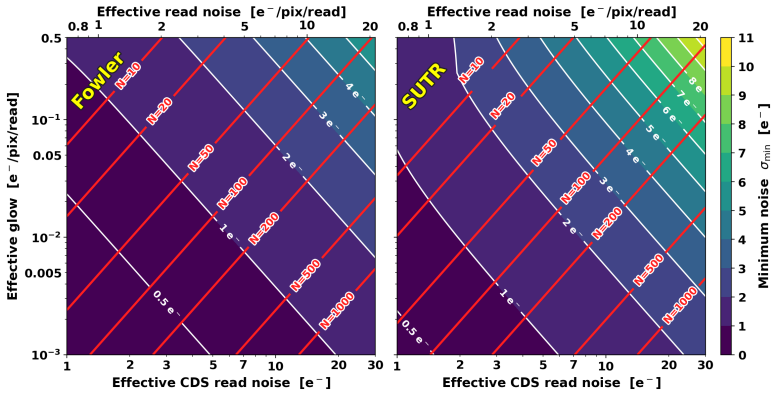
Readout glow, not only 1/f drift, explains why averaging many non-destructive reads gives less noise reduction than 1/sqrt(N), and it sets a floor sigma_min ~ 1.5 sigma_RN^{1/2} G^{1/4}.
T0 review reviewed 2026-08-04 challenge →
load-bearing objection Clean analytic floor for glow-limited averaging, but the LmAPD validation is a fit and the independence assumption is untested. the 4 major comments →
Fundamental Noise Limits of Infrared Detectors in the Presence of Readout Glow
The pith
A machine-rendered reading of the paper's core claim, the machinery that carries it, and where it could break.
The reading
Core claim
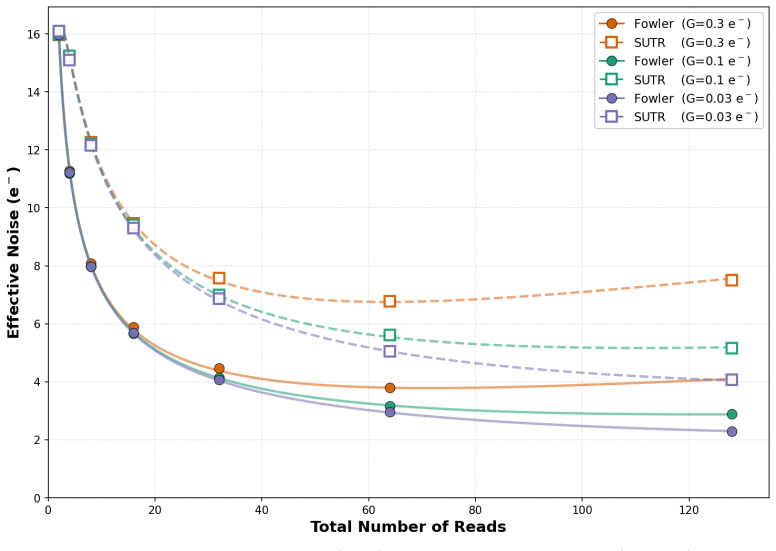
For Fowler sampling with N reads in each group, the variance of the difference is (2N/3 + 1/(3N))G + 2σ_RN^2/N, where G is the per-read glow mean and variance and σ_RN the single-read noise. The read-noise term shrinks as 1/N while the glow term grows linearly with N, so the curve turns around at N_opt ≈ 1.7 σ_RN/√G, leaving σ_min ≈ 1.5 σ_RN^{1/2} G^{1/4}. Sample-up-the-ramp gives the same structure with coefficients 3.2 and 2.8. For amplified sensors, gain suppresses read noise as 1/M^2 but leaves the glow variance (scaled by F_g c^2) untouched, so the floor improves only as M^{−1/2}. The paper confirms this by measuring glow independently, fitting the noise-versus-N curve, and finding agre
What carries the argument
The central object is the per-read glow realization g_k, treated as an independent Poisson random variable with mean and variance G. The derivation counts how many times each g_k enters the averaged readout: in Fowler-N, the first group's average contains g_k with weight (N−k+1)/N, which generates the cumulative variance and the covariance between the two groups that survives subtraction. Balancing the linearly growing glow variance (2N/3)G against the 1/N read-noise term yields the optimum N and the σ_min ≈ 1.5 σ_RN^{1/2} G^{1/4} floor; the same machinery extends to SUTR and, with substitutions σ_RN→σ_RN/M and G→F_g c^2 G, to avalanche photodiodes.
Load-bearing premise
The formulas assume that the glow photoelectrons added on each read are independent Poisson draws with the same mean and variance; if glow has temporal correlations (for instance a 1/f component from the source-follower), or if its per-read variance is not Poisson, the floor scaling and the conclusion that glow rather than 1/f drift causes the plateau would not follow.
What would settle it
Measure the per-read glow contribution as a time series by reading out fast with a reset between every frame and differencing; then estimate the autocorrelation of consecutive glow estimates. If the autocorrelation at any nonzero lag is clearly nonzero, the independent-Poisson premise fails. Alternatively, suppress glow with a blocking layer and check whether the noise-versus-N floor moves exactly as σ_RN^{1/2} G^{1/4} with the measured change in G.
If this is right
- Any non-destructive readout scheme has an optimal read count; beyond it, additional reads make the measurement noisier.
- Reducing glow by a factor of ten cuts the noise floor only in half (one-fourth power), so meaningful gains require large glow reductions or blocking layers.
- In linear-mode avalanche photodiodes, glow—not 1/f drift—is what stops averaging from reaching deep sub-electron noise; the floor sits near 0.5 e− at current glow levels.
- Fowler and SUTR estimators are biased by glow (e.g., Fowler-N adds a bias of N G electrons), which must be subtracted for precision photometry.
- The noise-versus-N curve shape can be used to separate glow from other noise sources in real detectors.
Where Pith is reading between the lines
- If glow is the dominant plateau mechanism, then detectors designed with glow-blocking layers or low-glow ROICs should show a lower noise floor that scales as the one-fourth power of the residual glow—an experimentally testable prediction the authors do not carry out.
- The same cumulative-noise mechanism may apply to any integrating detector that injects a per-sample charge, such as some CMOS or skipper-CCD readout modes; revisiting their averaging behavior with a per-sample noise term might resolve similar plateaus.
- The ratio of the fitted glow variance to the directly measured mean glow gives cF_g (Eq. 29), a quantity that could be used to identify the physical photon-generation mechanism inside the source follower.
- For mission planning, the floor implies that future space observatories cannot rely on averaging alone to reach sub-electron noise; glow mitigation at the ROIC level becomes a mission-critical requirement.
Editorial analysis
A structured set of objections, weighed in public.
Referee Report
Summary. This paper proposes that readout glow — photoelectrons generated by the detector readout electronics during each nondestructive read — sets a fundamental limit on how far read noise can be reduced by averaging. The authors model glow as an independent Poisson random variable added on each read, derive noise-optimal averaging formulas for Fowler sampling (Eq. 16) and sample-up-the-ramp (Eq. 22), giving a floor σ_min ∝ σ_RN^{1/2} G^{1/4}, and extend the model to linear-mode avalanche photodiodes by introducing partial-gain factors c and F_g (Section 4.2, Eqs. 27–28). The analytic results are checked against numerical simulations (Appendix A). Laboratory data are presented for a Magellan/FIRE H2RG detector and an Ike Pono LmAPD; the authors conclude that glow, rather than 1/f drift, explains the observed inability to average down noise in the LmAPD, with agreement to 0.1 e- over two decades of averaging.
Significance. If the central claim holds, this is a practically important result for infrared detector development, with direct implications for ELT instruments and the Habitable Worlds Observatory. The analytic derivations are transparent, the simulations in Appendix A strongly support the variance calculations, and the paper usefully identifies the weak G^{1/4} dependence of the noise floor. However, the experimental validation is the load-bearing part of the claim that glow—not 1/f drift—limits averaging, and that validation is currently incomplete: the close-looking agreement in Fig. 6 is largely a two-parameter fit, and the forward prediction is a broad band. The manuscript also never empirically tests the independence/Poisson assumption on which the scaling and the glow-not-1/f attribution rest.
major comments (4)
- [§6.2.2, Fig. 6] The abstract's claim that the LmAPD 'follows the predicted noise value to within 0.1 e-' is not supported by the figure as presented. The solid curves in Fig. 6 are two-parameter fits of the amplified noise model (σ_RN/M and F_g c^2 G free) to the very same noise-vs-N curves, so they cannot be called a prediction. The only forward-prediction element is the shaded wedge, built from the directly measured mean glow cG and sweeping cF_g over 0.3–1.0. That wedge is permissive; many curves, including the 1/f-drift hypothesis, could pass through such a band. Please separate 'fit' from 'prediction' in the text and quantify the agreement using the forward wedge, not the fitted curves.
- [Appendix B, Eqs. (39), (44); §4.2] The entire derivation of the noise floor and the attribution of the averaging limit to glow rather than 1/f drift depends on the assumption that per-read glow values g_k are independent Poisson random variables with variance equal to their mean G. Eq. (39) explicitly invokes independence of the g_k, and Eq. (44) does the same for the covariance. The LmAPD validation fits a model that assumes this independence; it does not test it. The H2RG data (Sec. 6.1) are background-limited and the measured noise exceeds the theory, so they do not discriminate either. If glow has temporal correlations (e.g., a persistent component from the source follower) or is overdispersed, the covariance structure changes, the σ_RN^{1/2} G^{1/4} scaling no longer follows, and the conclusion that glow, not 1/f drift, limits averaging would not be established. Please add a direct empirical check: estimate per-read
- [§6.2.2, Table 2] The internal consistency of the LmAPD glow measurements is not as good as the text suggests. At 6 V, the fitted glow variance F_g c^2 G is 20.6×10^-3 e-/pix/read while the directly measured mean glow cG is 9.82×10^-3 e-/pix/read, giving a ratio of about 2.1, which lies well outside the paper's stated range cF_g = 0.3–1.0. At 8 V the ratio is about 1.2, also above unity. The text says the two measurements are 'consistent within the uncertainties but persistently offset'; for 6 V that seems inconsistent. This discrepancy is directly relevant to the quantitative validation claim and should be addressed, ideally with an explicit error budget for the ratio and a discussion of what would make the 6 V point compatible with the model.
- [§6.1.2, Fig. 5] The H2RG test does not validate the glow-floor prediction: the measured noise lies above the theory and the paper attributes the difference to structured noise and dark current, with dark current exceeding glow. As the text itself says, 'glow is not limiting in this particular instrument.' Including this data set in the abstract's claim of 'laboratory data using both sensor architectures' is misleading. The H2RG data can be retained as a glow detection and a qualitative check, but the manuscript should not present it as confirmation of the noise-floor model.
minor comments (5)
- [§2, Table 1] The 'Independent per read' designation for glow in Table 1 is an assumption, not an established property. Please mark it as an assumption and point forward to the empirical test suggested above.
- [Figure 1] The caption reads 'See text in this section for an explanation,' but no explanation of Figure 1 appears in Section 5. Either add a proper description or refer to the specific paragraph that interprets the plot.
- [§3.2, Eq. (16)] The approximations leading to N_opt and σ_min are not stated. For a reader trying to reproduce the coefficients 1.7 and 1.5, it would help to show the intermediate step (e.g., minimizing 2σ_RN^2/N + 2NG/3).
- [§6.2.2] The paper states 'We focus on 10 V in what follows' but then Table 2 includes 6 and 8 V with no further interpretation. Either discuss those rows or move them to an appendix.
- [General] There are several minor typos: inconsistent capitalization of 'Fowler' (e.g., 'fowler' in Appendix B), and the use of 'f texp' versus 'f·t_exp' in equations. A careful proofread would improve readability.
Circularity Check
Core Fowler/SUTR noise-floor derivation is self-contained, but the headline LmAPD 'within 0.1 e-' validation is a two-parameter fit presented as a prediction, giving partial circularity.
specific steps
-
fitted input called prediction
[Abstract; §6.2.2 and Fig. 6 caption; Conclusion]
"Solid curves are the two-parameter fits of the amplified noise model of Section 4.2. The shaded wedge is the forward model built from the directly measured mean glow cG, with the glow variance Fg c2 G swept over c Fg = 0.3 to 1.0 ... and "the LmAPD following the predicted noise value to within 0.1 e- over two decades of averaging.""
The 'predicted noise value' advertised in the abstract is the two-parameter fit in Fig. 6: the fit solves for sigma_RN,eff and F_g c^2 G (Eq. 26) from the same noise-versus-N data that is then said to agree with prediction. A fitted curve cannot independently confirm the model that generated it. The only parameter-free forward check is the shaded wedge, but it sweeps cF_g over 0.3-1.0, producing a wide range, so it does not by itself justify a 'within 0.1 e-' precision claim. Thus the headline LmAPD validation is partly circular, even though the analytic Fowler/SUTR floor derivations themselves are not.
full rationale
The central Fowler/SUTR noise-floor formula is derived from an explicit stochastic model rather than from the data: Appendix B evaluates the variance of Fowler group averages using the assumed independence of per-read glow g_k (Eqs. 39-46), giving Eq. 15, and the SUTR case substitutes the photon-shot-noise covariance for glow (Eq. 20). Monte Carlo simulations in Appendix A confirm Eqs. 15 and 20. That derivation chain is self-contained and not circular. The H2RG test is an external application with independently estimated G and DC, and the paper acknowledges background and structured noise exceed the theory. The LmAPD comparison is where the circular burden lies: the impressive 'within 0.1 e-' agreement is based on two-parameter fits to the measured averaging curves (solid curves in Fig. 6), while the forward model built from the directly measured mean glow is permissive because cF_g is swept over a factor of about three. The attribution that glow rather than 1/f noise explains the LmAPD floor is an underdetermined model-selection claim rather than a circular one, since no 1/f alternative was fitted. No load-bearing self-citation chain was found: prior glow work (Refs. 7-9, 11) is external, and the coauthored Ref. 14 is used only for test-bench context. Overall score 4: the core analytic result is independent, but a prominent validation claim partly reduces to the fitted model.
Axiom & Free-Parameter Ledger
free parameters (4)
- Per-read glow mean G (or effective glow variance F_g c^2 G) =
LmAPD 10 V: F_g c^2 G = (7.05 +/- 0.76)e-3 e-/pix/read; H2RG: G = 0.021 +/- 0.01 e-/pix/read
- Read noise sigma_RN =
LmAPD 10 V: sigma_RN,eff ~ 1.19-1.26 e- (direct and fitted); H2RG CDS read noise 15-20 e-
- Glow fractional gain c =
c ~ 0.5 (tentative)
- Glow excess noise factor F_g =
F_g ~ 1.1 (assumed; cF_g swept 0.3-1.0 in forward model)
axioms (6)
- domain assumption Read noise realizations are independent zero-mean Gaussians with fixed variance sigma_RN^2 per read.
- domain assumption Per-read glow g_k is an independent Poisson random variable with mean and variance G and no read-to-read correlation.
- standard math KTC/reset noise is a fixed offset after reset and is perfectly removed by CDS/Fowler subtraction.
- domain assumption For SUTR, glow has the same covariance structure as photon shot noise and can be substituted f_texp -> f_texp + (N-1)G in Rauscher's variance formula.
- domain assumption Avalanche gain is a random variable characterized by mean M and excess noise factors F, F_g; signal, glow, and dark see gain M, cM, and ~0 respectively.
- domain assumption Glow originates in the pixel source-follower/ROIC and is absorbed in HgCdTe, independent of signal.
Cite this review
Pith. "Pith review of Fundamental Noise Limits of Infrared Detectors in the Presence of Readout Glow." pith.science (2026). https://pith.science/paper/HDZVKUXD
@misc{pith2026260800354,
  author       = {Pith},
  title        = {Pith review of: Fundamental Noise Limits of Infrared Detectors in the Presence of Readout Glow},
  year         = {2026},
  howpublished = {\url{https://pith.science/paper/HDZVKUXD}},
  note         = {Machine review of arXiv:2608.00354}
}
abstract
Read noise in infrared sensor arrays remains a major obstacle for ground- and space-based astronomy. It has long been recognized that the upcoming extremely large telescopes cannot meet their full potential unless read noise is significantly improved, and it is also a prohibitive constraint on the Habitable Worlds Observatory, a space telescope with the goal of detection and characterization of nearby Earth-like exoplanets. The main strategy for lowering read noise is averaging through multiple non-destructive reads. However, this typically results in less noise reduction than the 1/$\sqrt{N}$ scaling predicted by theory. In this work, we show the poor averaging behavior can largely be explained by readout glow, photon emission from the sensor electronics that generates photoelectrons in the pixels during readout. Because glow accumulates with reads rather than averaging, this imposes a fundamental noise floor of \sigma_{\rm min} ~ 1.5 sigma_RN^(1/2)G^(1/4). This limits averaging in HxRG-like sensors to about 2-3 e- of noise, and linear-mode avalanche photodiodes (LmAPDs) to about 0.5 e-. We present laboratory data using both sensor architectures, with the LmAPD following the predicted noise value to within 0.1 e- over two decades of averaging.
Figures


Reference graph
Works this paper leans on
-
[1]
Feinberg, L. D., Sitarski, B. N., McElwain, M. W., Arney, G., Baker, C., Bolcar, M. R., Levine, M., Liu, A., Mennesson, B., Roberge, A., et al., “Habitable worlds observatory’s concept and technology maturation: Initial feasibility and trade space exploration,”arXiv preprint arXiv:2601.11803(2026)
arXiv 2026
-
[2]
A Calibrated Measurement of the Near-IR Continuum Sky Brightness Using Magellan/FIRE,
Sullivan, P. W. and Simcoe, R. A., “A Calibrated Measurement of the Near-IR Continuum Sky Brightness Using Magellan/FIRE,”Publications of the Astronomical Society of the Pacific124, 1336–1346 (Dec. 2012)
2012
-
[3]
The habitable exoplanet observatory (habex) mission concept study final report,
Gaudi, B. S., Seager, S., Mennesson, B., Kiessling, A., Warfield, K., Cahoy, K., Clarke, J. T., Domagal- Goldman, S., Feinberg, L., Guyon, O., et al., “The habitable exoplanet observatory (habex) mission concept study final report,”arXiv preprint arXiv:2001.06683(2020)
Pith/arXiv arXiv 2001
-
[4]
The luvoir mission concept study final report,
Team, L. et al., “The luvoir mission concept study final report,”arXiv preprint arXiv:1912.06219(2019)
Pith/arXiv arXiv 1912
-
[5]
Teledyne H1RG, H2RG, and H4RG Noise Generator,
Rauscher, B. J., “Teledyne H1RG, H2RG, and H4RG Noise Generator,”Publications of the Astronomical Society of the Pacific127, 1144 (Nov. 2015)
2015
-
[6]
NIRSpec detectors: Noise properties and the effect of signal dependent inter-pixel crosstalk,
Giardino, G., Sirianni, M., Birkmann, S. M., Rauscher, B. J., Lindler, D., Boeker, T., Ferruit, P., Marchi, G. D., Stuhlinger, M., Jensen, P., and Strada, P., “NIRSpec detectors: Noise properties and the effect of signal dependent inter-pixel crosstalk,” in [High Energy, Optical, and Infrared Detectors for Astronomy V], 8453, 565, SPIE (Sept. 2012)
2012
-
[7]
Zero dark current in H2RG detectors: it is all multiplexer glow,
Regan, M. W. and Bergeron, L. E., “Zero dark current in H2RG detectors: it is all multiplexer glow,” Journal of Astronomical Telescopes, Instruments, and Systems6, 1 (Feb. 2020)
2020
-
[8]
Characterisation, performance and oper- ational aspects of the h4rg-15 near infrared detectors for the moons instrument,
Ives, D., Alvarez, D., Bezawada, N., George, E., and Serra, B., “Characterisation, performance and oper- ational aspects of the h4rg-15 near infrared detectors for the moons instrument,” in [X-Ray, Optical, and Infrared Detectors for Astronomy IX],11454, 299–318, SPIE (2020)
2020
-
[9]
Pixel source follower glow in HxRG detector,
Pichon, T. and Boucher, L., “Pixel source follower glow in HxRG detector,”Astronomische Nachrichten344, e20230102 (Oct. 2023)
2023
-
[10]
Optimal Fitting and Debiasing for Detectors Read Out Up-the-Ramp,
Brandt, T. D., “Optimal Fitting and Debiasing for Detectors Read Out Up-the-Ramp,”Publications of the Astronomical Society of the Pacific136, 045004 (Apr. 2024)
2024
-
[11]
Detectors for the James Webb Space Telescope Near-Infrared Spectrograph. I. Readout Mode, Noise Model, and Calibration Considerations,
Rauscher, B. J., Fox, O., Ferruit, P., Hill, R. J., Waczynski, A., Wen, Y., Xia-Serafino, W., Mott, B., Alexander, D., Brambora, C. K., Derro, R., Engler, C., Garrison, M. B., Johnson, T., Manthripragada, S. S., Marsh, J. M., Marshall, C., Martineau, R. J., Shakoorzadeh, K. B., Wilson, D., Roher, W. D., Smith, M., Cabelli, C., Garnett, J., Loose, M., Wong...
2007
-
[12]
Modeling the performance of single-bit and multi-bit quanta image sensors,
Fossum, E. R., “Modeling the performance of single-bit and multi-bit quanta image sensors,”IEEE Journal of the Electron Devices Society1(9), 166–174 (2013)
2013
-
[13]
FIRE: A Facility Class Near-Infrared Echelle Spectrometer for the Magellan Telescopes,
Simcoe, R. A., Burgasser, A. J., Schechter, P. L., Fishner, J., Bernstein, R. A., Bigelow, B. C., Pipher, J. L., Forrest, W., McMurtry, C., Smith, M. J., and Bochanski, J. J., “FIRE: A Facility Class Near-Infrared Echelle Spectrometer for the Magellan Telescopes,”Publications of the Astronomical Society of the Pacific125, 270 (Mar. 2013)
2013
-
[14]
First tests of a 1 megapixel near-infrared avalanche photodiode array for ultra-low background space astronomy,
Claveau, C.-A. et al., “First tests of a 1 megapixel near-infrared avalanche photodiode array for ultra-low background space astronomy,” in [X-Ray, Optical, and Infrared Detectors for Astronomy X],Proc. SPIE 12191, 330–346 (2022)
2022
-
[15]
emcee: The MCMC hammer,
Foreman-Mackey, D., Hogg, D. W., Lang, D., and Goodman, J., “emcee: The MCMC hammer,”Publica- tions of the Astronomical Society of the Pacific125(925), 306–312 (2013)
2013
This paper was first reviewed by deepseek-v4-flash on August 4, 2026.
discussion (0)
Sign in with ORCID, Apple, or X to comment. Anyone can read and Pith papers without signing in.