REVIEW 3 major objections 5 minor 29 references
Adaptive operator-generated subspaces for effective many-body Hamiltonians
T0 review · 3 major / 5 minor · reviewed 2026-08-05 · deepseek-v4-flash
Pith's one-line read A-CASE shows that a single reference state plus one Pauli-word cache can reproduce FCI on a frozen H4 active space and reach chemical accuracy when warm-started.
desk verdict A-CASE is an honest, well-scoped QSD paper with machine-precision mapping checks, but the adaptive growth heuristic fails on a benchmark and is the clear weak link. read the letter →
The pith
A machine-rendered reading of the paper's core claim, the machinery that carries it, and where it could break.
The reading
What carries the argument
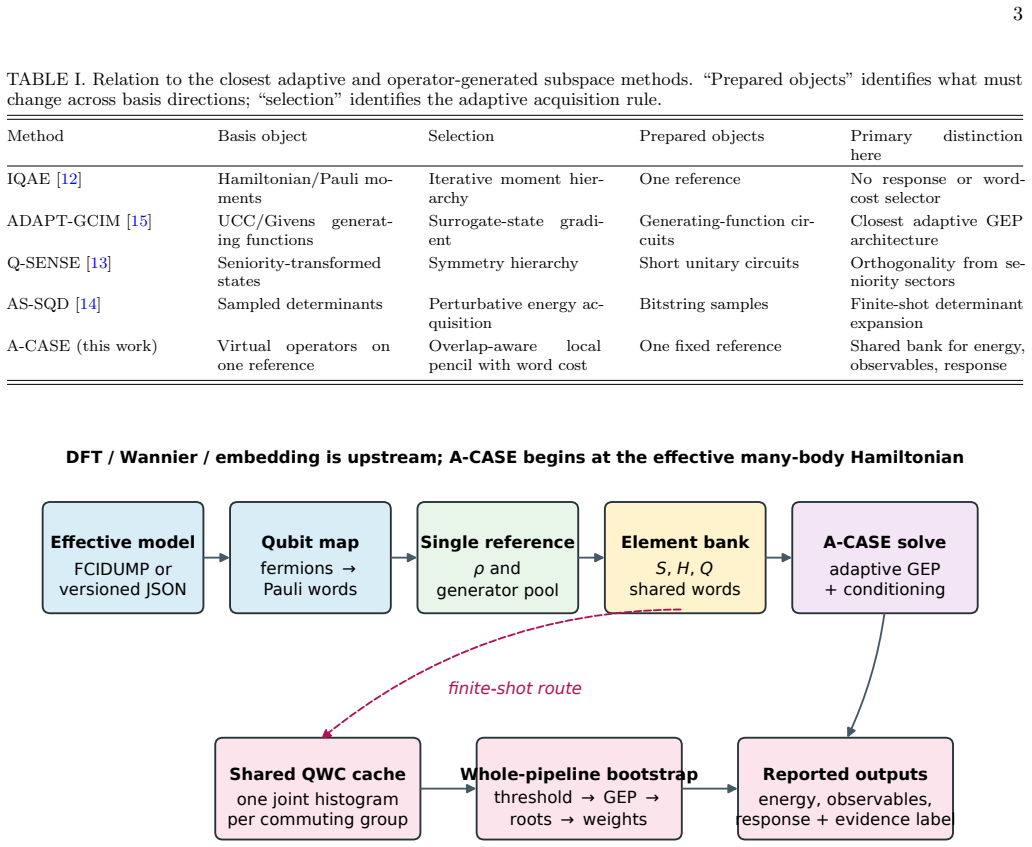
The key machinery is the operator-generated Rayleigh–Ritz construction with a shared matrix-element bank. Virtual basis vectors A_i|ψ⟩ are never prepared; every matrix element is a linear combination of Pauli expectations measured on one reference ρ, and one qubit-wise-commuting partition of the union word set supplies S, H, and Q. Adaptive growth uses the overlap-aware 2×2 pencil score Δ_a = max(0, E − λ_min) with orthogonality and leakage rejection, and the resource ledger (M, rank S, κ_S, W, S_H, S_A, ℓ_N, ℓ_Sz) makes compactness three-dimensional.
What would settle it
On the 2×3 Hubbard cluster at M=26, ask whether any compound/configuration generator that passes the adaptive score lowers the energy below the reported 1.09t error; if none does, the selection rule's transferability is falsified. Separately, parse any frozen FCIDUMP with the strict adapter and compare the mapped sector energy to an independent determinant FCI result: a difference beyond numerical tolerance (about 1e-12 Ha) would falsify the interchange boundary.
Extended reading notes
Core claim
The central claim is that one reference density operator ρ and one cached bank of Pauli-word expectations carry the entire projected eigensolver: for any generator family {A_i}, the overlap, Hamiltonian, and observable matrices are S_ij=tr(ρ A_i†A_j), H_ij=tr(ρ A_i†H A_j), Q_ij=tr(ρ A_i†Q A_j), and no separately prepared state A_j|ψ⟩ is required. A-CASE grows the basis with an overlap-aware 2×2 generalized-eigenproblem score, rejects sector leakage and near-linear dependence, and accepts a strict FCIDUMP boundary for the active-space input. On frozen linear H4 STO-3G CAS(4e,4o), the mapped sector energy agrees with external determinant FCI to 3.1×10^{-15} Ha; with eight adaptive additions th
Load-bearing premise
The load-bearing premise is that the local two-by-two energy-lowering score, operating over a fixed hand-chosen hierarchy of candidate generators, can discover a subspace that spans the relevant physics of any given Hamiltonian; the paper itself shows this premise failing on the 2x3 Hubbard cluster and on the leakage-rejected word pool for H4.
Editorial extensions
If this is right
- If A-CASE is correct, one prepared reference and one cached Pauli-word universe suffice to compute the projected ground state, correlations, and response of an effective Hamiltonian; no distinct circuit or state per basis vector is needed.
- A two-operator adaptive variational reference can pull the nine-vector A-CASE error from 3.019 mHa to 0.342 mHa on H4 at a fixed subspace budget, turning a warm start into chemical accuracy even when the adaptive state alone is 27.091 mHa off.
- Under a matched contract, the operator-generated route needs one state preparation versus ninety for the adaptive variational comparator, at roughly an order of magnitude more measured Pauli words, so the favorable side of that trade is a hardware question, not a settled win.
- The local two-by-two selection rule is not universally sufficient: closing the 2×2 Hubbard sector requires compound/configuration generators, and the same extension leaves the 2×3 cluster 1.09t from the exact energy.
- Finite-shot bootstrap intervals for spectral lines are conditional on replicas that preserve rank and root identity; acceptance drops from 200/200 to 139/200 when overlap conditioning worsens, so a narrow band must not be read as a confidence certificate.
Reading between the lines
- The generator-resolution dependence of W (7371 vs 2240 words for the same retained subspace) suggests that any reported measurement width is method-comparable only if paired with its generator granularity; a natural next step is a reporting standard that gives both counts.
- The non-monotonic warm-start trend (k=2 best, deeper references worse) implies that reference and candidate pool are coupled design choices; one could test whether a reference tailored to the pool's excitation structure outperforms a generic better-energy reference on other molecules.
- The 2×3 Hubbard failure points to the local pencil score's myopia; a residual-block or preconditioned batch acquisition rule, closer to Davidson methods, may discover the missing competing-order direction and is directly testable on that cluster.
- Because the bootstrap excludes rank-changed replicas, the 'worst draws' are hidden from percentile bands; a genuine finite-sample certificate would need a confidence set over the correlated matrix pencil and a root-isolation event, which the paper leaves open.
Editorial analysis
A structured set of objections, weighed in public.
Referee Report
Summary. The paper introduces A-CASE, a single-reference, operator-generated Rayleigh–Ritz eigensolver. Overlap, Hamiltonian, observable, and response matrices are reconstructed from one shared Pauli-expectation bank on a fixed reference state. An adaptive growth rule ranks candidate generators by the predicted lowering of an overlap-aware 2×2 pencil, rejecting sector leakage and near-linear dependence. Benchmarks include a closed-form two-site Hubbard dimer oracle, a linear H4 STO-3G CAS(4e,4o) FCIDUMP checked against independent determinant FCI (3.1e-15 Ha), warm-started ADAPT-VQE references, an exact ADAPT-GCIM comparator on a matched pool, fixed QSE/Krylov/generator-coordinate baselines, Hubbard and Kitaev lattice rungs, and a grouped bootstrap for finite-shot response. The paper is careful to label what is exact, finite-sample, or heuristic, and explicitly disclaims scaling, materials accuracy, and quantum advantage.
Significance. If the central claims hold, the paper provides an executable workflow connecting effective many-body Hamiltonians at an interchange boundary to energies, correlations, and response, using a single reference and a single Pauli-word cache. The independent checks are genuine strengths: the dimer matches closed-form expressions to nine digits, the mapped H4 sector agrees with external FCI to 3.1e-15 Ha, and the Krylov width identity is verified against direct enumeration. The resource ledger (M, rank, κS, W, etc.) is a useful step beyond reporting only basis sizes. However, the adaptive selection rule is the weakest link: Sec. V.B reports a clear failure on the open-boundary 2×3 Hubbard cluster, with no diagnostic for detecting when the selected subspace lacks essential span. This leaves the method's trust boundary undefined and makes the central 'adaptivity' claim conditional.
major comments (3)
- [Sec. II.D (Eq. 9) and Sec. V.B] The local 2×2 overlap-aware pencil score is the method's adaptive selection mechanism, but the paper demonstrates that it can fail to discover essential competing-order directions: on the open-boundary 2×3 Hubbard cluster, level-4 A-CASE leaves a 1.09t error at M=26, while the 2×2 Hubbard closure is only achieved after compound/configuration generators are admitted. Since no diagnostic is provided to detect when the selected subspace is missing essential span, a user cannot know whether A-CASE's energy is trustworthy for a new Hamiltonian. This is a load-bearing limitation for a method whose name and claimed contribution center on adaptivity. Please either supply a practical diagnostic (e.g., residual norm, overlap with a cheap fixed-Krylov reference, or convergence of the score with M) or explicitly restrict the claim to systems where such a diagnostic is passed.
- [Sec. IV.D] The word-resolution A-CASE arm that achieves W=2240 and reverses the width comparison against Krylov is run with the leakage rule disabled. Under the declared default tolerance, every odd-Y word is rejected, leaving M=1 and the Hartree–Fock energy. Thus the key measurement-width advantage is not part of the method's default contract. The paper acknowledges this, but the consequence is stronger than stated: the default adaptive procedure at word resolution on H4 finds no correlations at all. The reader needs a clear statement of when the leakage-disabled variant is allowed and whether the method, as a default, is expected to reject entire physically relevant candidate pools on other systems.
- [Sec. VII] Reproducibility is weakened by the lack of a public code repository. Section VII states that the implementation is in a private development repository, that public access to the moving development branch is not claimed, and that only a frozen snapshot will be provided to editors and referees on request. For a computational methods paper, readers cannot independently rerun the benchmarks after publication. While the included independent checks and exact arithmetic records mitigate this, the paper should either provide a persistent public archive or explicitly discuss the journal's code-availability policy in the reproducibility statement.
minor comments (5)
- [Fig. 2] The notation 'n/t' appears in the figure caption but is never defined there. In Table V, 'n/t' means 'not the applicable measurement primitive,' while in Fig. 2 it apparently means 'not run.' Please define the abbreviation separately or use different symbols.
- [Sec. II.A] In Eq. (6), the notation supp(A_i† A_j) is used without defining 'supp.' Please define the support of a Pauli operator or state that it is the set of nontrivial Pauli words in its decomposition.
- [Sec. IV.D] The phrase 'operator leakage sqrt(2) out of particle number' is unclear. Suggest specifying the relative commutator norm used in Eq. (7) and giving the exact numerical value of the leakage tolerance.
- [Sec. VII] The command 'python -m clifford qc.verify' appears to have a space in the module name. If this is not a typo in the manuscript, it would be clearer to format as 'python -m clifford_qc.verify' consistent with typical Python module conventions.
- [Sec. II.C] The phrase 'The reported 10^-8 count is admitted only when...' uses 'admitted' in an unusual sense. Consider 'accepted' or 'reported' for clarity.
Circularity Check
No significant circularity: the derivation is self-contained and independently checked.
full rationale
I traced the derivation chain from the effective-Hamiltonian input (FCIDUMP or versioned JSON) through the matrix-element definitions (Eqs. 2-4), the adaptive growth score (Eq. 9), and the reported benchmark tables. The matrix elements are direct Pauli-expectation reconstructions on a fixed reference state; no target energy or observable is inserted as an input. The H4 mapped-sector energy is checked against an external determinant FCI value and against an independent OpenFermion reconstruction of the Hamiltonian. The dimer oracle is compared to closed-form expressions that share no projected-observable code path. The adaptive score is a local 2x2 generalized pencil used only to select candidate generators; the final energies are recomputed exactly from the full retained subspace, so the reported results are not equal to the score by construction. The only self-citation, [19], supplies a Clifford-algebra representation and is explicitly stated to be a representation choice, not extra expressivity or a source of the derived energies. The paper's admitted failures of the adaptive growth rule on the 2x3 Hubbard cluster and under the leakage rule on H4 are stated limitations, not hidden fits or circular reductions. No load-bearing step reduces to its own inputs.
Assumptions & free parameters
assumptions (5)
- standard math Rayleigh-Ritz generalized eigenproblem with thresholded overlap gives a variational approximation to the projected Hamiltonian.
- standard math The Pauli expansion of A†_i H A_j and its expectations on a single reference density ρ reconstruct the subspace matrices exactly in the infinite-shot limit.
- domain assumption The FCIDUMP record faithfully represents the active-space Hamiltonian, and the Jordan-Wigner mapping preserves the fermionic commutation relations.
- ad hoc to paper The fixed candidate hierarchy (identity, symmetry-preserving determinant excitations, commutator-response directions, Hamiltonian powers, compound products, and competing-order configurations) is sufficient to span the relevant correlation space for the target problem.
- ad hoc to paper The local 2x2 pencil score is a reliable proxy for global energy lowering in the adaptive growth.
Cite this review
Pith. "Pith review of Adaptive operator-generated subspaces for effective many-body Hamiltonians." pith.science (2026). https://pith.science/paper/7WX5YNOP
@misc{pith2026260800560,
  author       = {Pith},
  title        = {Pith review of: Adaptive operator-generated subspaces for effective many-body Hamiltonians},
  year         = {2026},
  howpublished = {\url{https://pith.science/paper/7WX5YNOP}},
  note         = {Machine review of arXiv:2608.00560}
}
abstract
Electronic-structure and embedding workflows terminate in effective many-body Hamiltonians, whereas quantum eigensolver studies often start from hand-built qubit models. We present the Adaptive Clifford-Algebra Subspace Eigensolver (A-CASE), a single-reference, operator-generated Rayleigh--Ritz method. Overlap, Hamiltonian, observable, and response matrices are reconstructed from one shared Pauli-expectation bank, while adaptive growth scores overlap-aware local pencils and rejects symmetry leakage or near-linear dependence. A strict FCIDUMP adapter supplies the active-space boundary. For linear H$_4$ in STO-3G with CAS(4e,4o), the mapped sector agrees with independent determinant FCI to $3.1\times10^{-15}$ Ha. At a nine-vector budget A-CASE has a $3.019$ mHa error; replacing the determinant reference by a two-operator ADAPT-VQE state reduces it to $0.342$ mHa, without implying a matched total-cost advantage. Under a matched contract, the fixed-reference route uses one state preparation versus ADAPT-VQE's ninety but measures roughly an order of magnitude more Pauli words. Exact fixed-angle ADAPT-GCIM gives $13.364$ mHa at the nearest size match and $10.674$ mHa at the iteration match, with its transition-pair burden reported separately. Across a broader benchmark ladder, fixed Krylov bases are generally more accurate and often narrower but substantially less well conditioned. A grouped bootstrap propagates finite-shot variability through thresholding, diagonalization, root matching, spectral weights, susceptibility, and broadening; its bands are explicitly heuristic and conditional, not finite-sample confidence certificates. The work establishes an executable path from an interchange Hamiltonian to energies, correlations, and response, without claiming materials accuracy, favorable scaling, or quantum advantage.
Figures


Reference graph
Works this paper leans on
-
[1]
Marzari, A
N. Marzari, A. A. Mostofi, J. R. Yates, I. Souza, and D. Vanderbilt, Maximally localized wannier functions: Theory and applications, Reviews of Modern Physics84, 1419 (2012)
2012
- [2]
-
[3]
F. Aryasetiawan, M. Imada, A. Georges, G. Kotliar, S. Biermann, and A. I. Lichtenstein, Frequency-dependent local interactions and low-energy effective models from electronic structure calculations, Physical Review B70, 195104 (2004)
work page 2004
-
[4]
Georges, G
A. Georges, G. Kotliar, W. Krauth, and M. J. Rozen- berg, Dynamical mean-field theory of strongly correlated fermion systems and the limit of infinite dimensions, Re- views of Modern Physics68, 13 (1996)
1996
-
[5]
Peruzzo, J
A. Peruzzo, J. McClean, P. Shadbolt, M.-H. Yung, X.-Q. Zhou, P. J. Love, A. Aspuru-Guzik, and J. L. O’Brien, A variational eigenvalue solver on a photonic quantum processor, Nature Communications5, 4213 (2014)
2014
-
[6]
J. R. McClean, M. E. Kimchi-Schwartz, J. Carter, and W. A. de Jong, Hybrid quantum-classical hierarchy for mitigation of decoherence and determination of excited states, Physical Review A95, 042308 (2017)
work page 2017
-
[7]
W. J. Huggins, J. Lee, U. Baek, B. O’Gorman, and K. B. Whaley, A non-orthogonal variational quantum eigen- solver, New Journal of Physics22, 073009 (2020)
2020
-
[8]
N. H. Stair, R. Huang, and F. A. Evangelista, A multiref- erence quantum krylov algorithm for strongly correlated electrons, Journal of Chemical Theory and Computation 16, 2236 (2020)
work page 2020
Show all 29 references
-
[9]
N. V. Tkachenko, L. Cincio, A. I. Boldyrev, S. Tretiak, P. A. Dub, and Y. Zhang, Quantum davidson algorithm for excited states, Quantum Science and Technology9, 035012 (2024)
2024
-
[10]
O’Leary, L
T. O’Leary, L. W. Anderson, D. Jaksch, and M. Kiffner, Partitioned quantum subspace expansion, Quantum9, 1726 (2025)
2025
-
[11]
Y. O. Nakagawa, M. Kamoshita, W. Mizukami, S. Sudo, and Y.-y. Ohnishi, ADAPT-QSCI: Adaptive construction of an input state for quantum-selected configuration in- teraction, Journal of Chemical Theory and Computation 20, 10817 (2024)
2024
-
[12]
Bharti and T
K. Bharti and T. Haug, Iterative quantum-assisted eigen- solver, Physical Review A104, L050401 (2021)
2021
-
[13]
Patel, P
S. Patel, P. Jayakumar, R. Huang, T. Zeng, and A. F. Izmaylov, Quantum seniority-based subspace expansion: Linear combinations of short-circuit unitary transforma- tions for the electronic structure problem, Journal of Chemical Theory and Computation22, 3937 (2026)
2026
-
[14]
Miura, Active sampling sample-based quantum di- agonalization from finite-shot measurements (2026), arXiv:2603.13536 [quant-ph]
R. Miura, Active sampling sample-based quantum di- agonalization from finite-shot measurements (2026), arXiv:2603.13536 [quant-ph]
2026 arXiv
-
[15]
Zheng, B
M. Zheng, B. Peng, A. Li, X. Yang, and K. Kowalski, Unleashed from constrained optimization: quantum com- puting for quantum chemistry employing generator coor- dinate inspired method, npj Quantum Information10, 127 (2024)
2024
-
[16]
E. N. Epperly, L. Lin, and Y. Nakatsukasa, A theory of quantum subspace diagonalization, SIAM Journal on Matrix Analysis and Applications43, 1263 (2022)
2022
-
[17]
G. Lee, D. Lee, and J. Huh, Sampling error analysis in quantum krylov subspace diagonalization, Quantum8, 1477 (2024)
2024
-
[18]
Zhang, A
Z. Zhang, A. Wang, X. Xu, and Y. Li, Measurement- efficient quantum krylov subspace diagonalisation, Quan- tum8, 1438 (2024)
2024
- [19]
-
[20]
P. J. Knowles and N. C. Handy, A determinant based full configuration interaction program, Computer Physics Communications54, 75 (1989)
1989
-
[21]
J. R. McClean, N. C. Rubin, K. J. Sung,et al., Open- Fermion: the electronic structure package for quantum computers, Quantum Science and Technology5, 034014 (2020)
2020
-
[22]
J. I. Colless, V. V. Ramasesh, D. Dahlen, M. S. Blok, M. E. Kimchi-Schwartz, J. R. McClean, J. Carter, W. A. de Jong, and I. Siddiqi, Computation of molecular spectra on a quantum processor with an error-resilient algorithm, 13 Physical Review X8, 011021 (2018)
2018
-
[23]
Umeano, F
C. Umeano, F. Jamet, L. P. Lindoy, I. Rungger, and O. Kyriienko, Quantum subspace expansion approach for simulating dynamical response functions of kitaev spin liquids, Physical Review Materials9, 034401 (2025)
2025
-
[24]
Verteletskyi, T.-C
V. Verteletskyi, T.-C. Yen, and A. F. Izmaylov, Mea- surement optimization in the variational quantum eigen- solver using a minimum clique cover, Journal of Chemical Physics152, 124114 (2020)
2020
-
[25]
Efron, Bootstrap methods: Another look at the jack- knife, The Annals of Statistics7, 1 (1979)
B. Efron, Bootstrap methods: Another look at the jack- knife, The Annals of Statistics7, 1 (1979)
1979
-
[26]
Q. Sun, T. C. Berkelbach, N. S. Blunt, G. H. Booth, S. Guo, Z. Li, J. Liu, J. D. McClain, E. R. Sayfutyarova, S. Sharma, S. Wouters, and G. K.-L. Chan, PySCF: the python-based simulations of chemistry framework, WIREs Computational Molecular Science8, e1340 (2018)
2018
-
[27]
H. R. Grimsley, S. E. Economou, E. Barnes, and N. J. May- hall, An adaptive variational algorithm for exact molecular simulations on a quantum computer, Nature Communica- tions10, 3007 (2019)
2019
-
[2240]
Grad.” is the total number of active-pool gradients evaluated; “opt
The two arms are not merely close. They return the same energy to 4×10⁻¹⁶ Ha, the same M = 9 and κS = 1, and their retained subspaces have all nine principal angles zero—they are the same subspace, reached by generators of different granularity, at 3 .3× different measurement ...
-
[7371]
Which side of that trade is favorable is a hardware question this paper does not answer
The fixed-reference operator route trades a 90 × reduction in state preparations for roughly an order of magnitude more measured words. Which side of that trade is favorable is a hardware question this paper does not answer. The exact ADAPT-GCIM comparison changes the base- li...
Reviewed August 5, 2026 · model on record in the stance chip above.
Discussion (0). Sign in to comment.