REVIEW 4 major objections 5 minor 55 references
Staged fine-tuning on injection-and-recovery traces lifts a 4-billion-parameter planner's dynamic task success from 33.3% to 76.2%.
Reviewed by Pith at T0; open to challenge. T0 means a machine referee read the full paper against a public rubric. the ladder, T0–T4 →
T0 review · deepseek-v4-flash
2026-08-05 00:31 UTC pith:TD2WMODE
load-bearing objection The recovery-supervision training works in their controlled setup, but the headline 'robust' claim outruns the evidence: training and evaluation share the same perturbation families. the 4 major comments →
From Failures to Supervision: DynamicEnvPlan for Robust Long-Horizon Embodied Planning
The pith
A machine-rendered reading of the paper's core claim, the machinery that carries it, and where it could break.
Core claim
DynamicEnvPlan's central claim is that dynamic deviations which invalidate a plan — a cabinet that changed its open state, an object relocated after observation, a grasp that failed, a placement that regressed — form a learnable unit of supervision, which the paper calls a recovery decision point. The data-synthesis loop realizes this with three components: MeHLP proposes a reasoning-action step from egocentric observation, semantic memory (a scene graph and semantic map), and episodic memory; DynaPerturb injects physically plausible context-grounded perturbations; and DynaGuard, with privileged simulator state, approves valid proposals or replaces faulty ones in prevention and reflection mo
What carries the argument
The load-bearing mechanism is the closed-loop data-synthesis loop itself: the interaction among MeHLP (proposal generator), DynaPerturb (deviation injector), and DynaGuard (privileged corrector) that turns simulator rollouts into context-target pairs whose target is always a guarded, recoverable next action. The central object is the recovery decision point — a step where the planner's belief is stale or a primitive has failed, and the correct supervision is a recovery action rather than a nominal next step. The transfer mechanism is two-stage supervised fine-tuning: stage 1 aligns the backbone to the primitive-skill interface, structured memory format, and long-horizon reasoning style; stag
Load-bearing premise
DynaGuard's corrected recovery outputs are used as ground truth without ever checking them against an independent judge, so the planner could be inheriting the guard's mistakes or its conservative replanning style.
What would settle it
Evaluate the fully trained DynaPlanner under a DynaPerturb configuration that enables the perturbation families the paper leaves optional — object relocation and hard navigation failure — and measure recovery. If success falls back to the base-planner level, the learned recovery skill is a pattern match to the two injected deviation types rather than general recovery. A complementary check: have independent judges score a random sample of DynaGuard's corrected traces; if a large fraction are wrong or needlessly conservative, the reported 76% partly measures imitation of the guard.
If this is right
- A trained 4B planner reaches 76.2% test success under injected perturbations, matching Claude Opus 4.6 while outperforming all baselines on recovery and repeated-invalid-action rate, so recovery supervision can compensate for model scale on this benchmark.
- Both failure-state exposure (DynaPerturb) and guarded correction (DynaGuard) are needed: a matched ablation shows exposure alone raises success from 33% to 43%, and adding the guard raises it to 76%.
- The gain is a learned behavior, not test-time help: DynaGuard is absent during evaluation, and the 9B variant reaches 85% success under the same protocol.
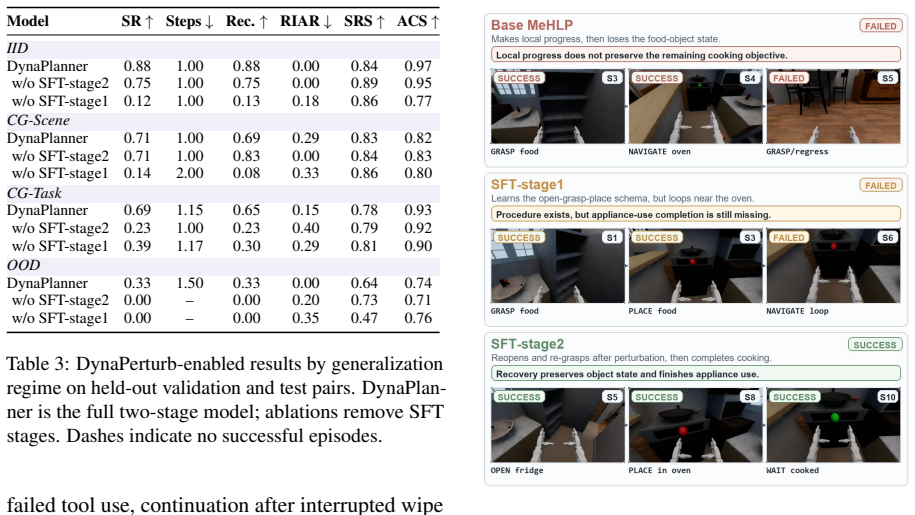
- Generalization is uneven: the second stage sharply improves new-task-in-familiar-scene (CG-Task) success from 23% to 69%, while unseen-scene generalization (CG-Scene) stays brittle and OOD success is limited but nonzero.
- Recovery is cheap: successful recovery after perturbations takes a mean of 1.08 planner decisions, and recovery overhead does not grow sharply with task horizon up to nine primitives.
Where Pith is reading between the lines
- Editorial extension: the deviation set is typed and budgeted (state flips, forced action failures), so the claimed recovery skill is demonstrated only inside that distribution; testing under the families the paper marks optional (object relocation, hard navigation failure) would show whether recovery generalizes to unseen deviation types.
- Editorial extension: because DynaGuard's corrections are accepted as ground truth, part of the 76% success is the planner learning the guard's correction policy; without an external audit of those corrections, the method's ceiling is tied to the guard's own judgment.
- Editorial extension: the two short LoRA training stages suggest the effective ingredient is the concentration of supervision around failure states; a testable corollary is that sampling more perturbation types at the same data volume would yield further gains.
- Editorial extension: the same synthesis loop could apply to lower-level control or real robots only if a substitute for DynaGuard's privileged state exists; a natural next step would be a learned auditor that judges corrections without simulator access.
Editorial analysis
A structured set of objections, weighed in public.
Referee Report
Summary. The paper presents DynamicEnvPlan, a closed-loop framework for high-level embodied planning under dynamic perturbations. It extends OmniGibson with three components: MeHLP, a memory-enhanced proposal generator; DynaPerturb, a controllable perturbation engine; and DynaGuard, a privileged correction agent. The framework generates recovery-oriented trajectories that are used to fine-tune a Qwen3VL-4B Thinking backbone in two SFT stages, producing DynaPlanner. Evaluation is carried out on 104 task-scene combinations under IID, CG, and OOD splits. The main reported results show that the full two-stage model improves test success rate from 33.3% (base) to 76.2% and recovery from 16.7% to 69.1%, with matched ablations in Appendix G and a stronger-backbone check in Appendix F.
Significance. If the central claim holds, the paper makes a useful contribution: it shows that concentrated supervision around dynamically induced failure states can teach a small VLM to recover from closed-loop perturbations more data-efficiently than nominal SFT alone. The matched component ablation in Appendix G is a genuine strength, as is the absence of DynaGuard at evaluation time and the stronger-backbone validation in Appendix F. However, the evidence base is small, with only 21 test task-scene combinations, no error bars or seeds, and an OOD bucket of roughly three task variants. Moreover, the training and evaluation protocols use the same perturbation families, so the measured recovery improvement may reflect in-distribution response learning rather than general closed-loop recovery skill. The title and abstract claim 'robust' performance, but the perturbation-transfer question is not addressed. The significance is therefore conditional on additional experiments or a more careful framing of the claim's scope.
major comments (4)
- [§5.5, Tables 2 and 3; §5.6] The headline result is built on 10 validation and 21 test task-scene combinations, with no confidence intervals, standard errors, or multiple seeds. The OOD bucket appears to contain roughly three task variants (bowling ball, box fan, lawnmower) in unseen store/garden templates, yet Section 5.6 and the abstract draw conclusions about OOD generalization from it. A difference from 33.3% to 76.2% on n=21 is suggestive but not statistically grounded as reported. The manuscript should report per-combination results, bootstrap confidence intervals, or multiple seeds, and temper claims about OOD robustness accordingly.
- [§4.3, §5.6, Table 7] The evaluation uses the same default DynaPerturb families that were used to generate the Stage-2 training data: pre_open_state_flip, pre_toggle_state_flip, and action_forced_failure. The OOD split holds out task/scene combinations, not perturbation types. Consequently, the reported improvement in Recovery from 0.17 to 0.69 could reflect the model learning a small set of perturbation-response patterns rather than a general recovery capability. The central 'robust' claim needs evidence of transfer to the disabled perturbation families listed in Table 7 (object relocation, placement regression, hard navigation failure), or the manuscript should explicitly limit its claim to the tested perturbation families.
- [§4.4, Appendix H] DynaGuard's corrected outputs are used as training targets, but no audit of DynaGuard's correctness is provided. Appendix H reports intervention frequencies and trigger types, but not an accuracy rate against an external judge or a manual annotation study. If DynaGuard frequently approves infeasible actions or replaces valid ones with conservative suboptimal actions, the SFT targets encode that noise, and the Stage-2 gains partly reflect imitation of the guard. The paper should report at least a sample-based correctness audit of DynaGuard's decisions, or otherwise justify why its corrections can be treated as ground-truth recovery supervision.
- [§5.6, Table 3] The claim that Stage 2 improves recovery behavior is contradicted in the CG-Scene row: DynaPlanner achieves Recovery 0.69 and RIAR 0.29, while w/o SFT-stage2 achieves Recovery 0.83 and RIAR 0.00. The text says only that 'CG-Scene remains more brittle,' but the full model is worse on both recovery metrics in this regime. Since no error bars are reported, this may be noise, but as presented it weakens the uniform claim that the second stage improves recovery. The authors should either explain this pattern or avoid claiming consistent recovery gains across all regimes.
minor comments (5)
- [Abstract and §5.4] The abstract says 'all seven evaluation metrics critical to physical-world interaction,' but Table 2 lists six named metrics (SR, Steps, Recovery, RIAR, SRS, ACS). If a seventh metric exists (e.g., RSR in Appendix J), it should be defined and reported in the main table.
- [§5.8, Table 4] The memory ablation reports 'Full MeHLP' test SR of 0.67, whereas the main DynaPlanner result in Table 2 is 0.76 under the same DynaPerturb-enabled setting. The text acknowledges the runs are not seed-matched, but the discrepancy makes the memory ablation difficult to interpret; consider aligning the protocols or reporting why the main model differs.
- [§1] Minor typo: 'physical interaction require' should be 'physical interaction requires.'
- [Appendices] The appendix reports several useful diagnostic tables, but some are based on very small samples (e.g., Appendix I has n=4 long-horizon tasks and n=4 medium-horizon tasks). Please state the sample sizes in the captions and avoid strong claims such as 'no sharp increase in recovery overhead' based on such small counts.
- [§5.3] The episodic memory window K=5 is fixed; no sensitivity analysis is provided. Given the memory ablation shows episodic memory is critical, a K sweep would strengthen the analysis.
Circularity Check
No significant circularity: the reported gains are empirical SFT results under a shared perturbation protocol, not derivations from the training targets.
full rationale
The claimed derivation chain is empirical rather than tautological: DynaPerturb injects perturbations, DynaGuard produces corrected recovery traces, stage-2 SFT trains DynaPlanner on those traces, and evaluation is then run in the simulator with DynaGuard disabled. The reported metrics (SR, Recovery, RIAR, SRS, ACS) are simulator-side outcomes, not the training loss evaluated on DynaGuard's own approval labels. Imitating DynaGuard would not by construction yield task success, safety, or affordance compliance: the model must actually execute valid goal-progressing actions in the simulator. Therefore the central improvement from 33.3% to 76.2% test SR is not forced by definition. The shared perturbation families between training and evaluation (Table 7: open/closed flips, toggle flips, and action failures enabled across train/val/test) narrow the generalization claim to these perturbation types, and the OOD split varies task/scene rather than perturbation type; this is a scope or correctness-risk concern, not a circularity. Held-out task-scene combinations provide independent grounding on the task and scene axes. No load-bearing self-citation was found: references to prior correction/reflection work are external and not used to justify the central claim. The paper's own limitations—privileged DynaGuard, simulator artifacts, and modest scale—weaken external validity but do not make the derivation circular.
Axiom & Free-Parameter Ledger
free parameters (2)
- episodic memory window K =
5
- DynaPerturb perturbation budget =
2 perturbations/episode, at most 1 environment-level and 1 execution-level
axioms (6)
- domain assumption The OmniGibson simulator and its primitive-execution interface are faithful enough to model physical-world interaction for planning.
- domain assumption The high-level primitive set (Appendix B) covers the task-relevant action space, so every recovery can be expressed as a primitive.
- domain assumption DynaGuard's approve/replace decisions are correct supervision.
- domain assumption The perturbation families (open/toggle flips, action failure) are the relevant dynamic deviations for embodied household tasks.
- domain assumption Supervised fine-tuning on LLM-generated approved traces transfers closed-loop recovery behavior.
- standard math Held-out task-scene combinations are independent samples of the target distribution.
invented entities (2)
-
DynaGuard privileged correction agent
no independent evidence
-
DynaPerturb perturbation engine
no independent evidence
Cite this review
Pith. "Pith review of From Failures to Supervision: DynamicEnvPlan for Robust Long-Horizon Embodied Planning." pith.science (2026). https://pith.science/paper/TD2WMODE
@misc{pith2026260800613,
  author       = {Pith},
  title        = {Pith review of: From Failures to Supervision: DynamicEnvPlan for Robust Long-Horizon Embodied Planning},
  year         = {2026},
  howpublished = {\url{https://pith.science/paper/TD2WMODE}},
  note         = {Machine review of arXiv:2608.00613}
}
read the original abstract
Physical-world interaction is inherently dynamic, as environments can evolve during execution, requiring agents to adapt their plans under non-stationary conditions. We study this challenge through long-horizon embodied planning under environment deviations and execution uncertainty. Existing embodied-task benchmarks can expose such failures, but these failures are usually treated as evaluation outcomes instead of learnable signals for training agents to recover. In this work, we introduce DynamicEnvPlan, a closed-loop framework for high-level planning in dynamic environments. It extends embodied task execution with humanoid agents, high-level primitive skills, structured semantic memory, and controllable perturbations. Our data synthesis design consists of planning, perturbation, and guarded correction modules that turn dynamic execution states into recovery-oriented traces. The resulting traces are used for staged supervised fine-tuning, enabling the planner to learn from both nominal execution and perturbed recovery trajectories. Using 104 task-scene combinations spanning i.i.d., compositional generalization, and out-of-distribution settings for fine-tuning and evaluation, DynamicEnvPlan boosts success rate from 33.3% for the base planner to 76.2%, while improving across all seven evaluation metrics critical to physical-world interaction, including safety and affordance compliance.
Figures



Reference graph
Works this paper leans on
-
[1]
Maxime Chevalier. BabyAI:. 7th International Conference on Learning Representations,. 2019 , url =
work page 2019
-
[2]
Mohit Shridhar and Jesse Thomason and Daniel Gordon and Yonatan Bisk and Winson Han and Roozbeh Mottaghi and Luke Zettlemoyer and Dieter Fox , title =. 2020. 2020 , url =
work page 2020
-
[3]
Chengshu Li and Ruohan Zhang and Josiah Wong and Cem Gokmen and Sanjana Srivastava and Roberto Mart. CoRR , volume =. 2024 , url =. doi:10.48550/ARXIV.2403.09227 , eprinttype =
-
[4]
EgoTaskQA: Understanding Human Tasks in Egocentric Videos , booktitle =
Baoxiong Jia and Ting Lei and Song. EgoTaskQA: Understanding Human Tasks in Egocentric Videos , booktitle =. 2022 , url =
work page 2022
-
[5]
RoboVQA: Multimodal Long-Horizon Reasoning for Robotics , booktitle =
Pierre Sermanet and Tianli Ding and Jeffrey Zhao and Fei Xia and Debidatta Dwibedi and Keerthana Gopalakrishnan and Christine Chan and Gabriel Dulac. RoboVQA: Multimodal Long-Horizon Reasoning for Robotics , booktitle =. 2024 , url =
work page 2024
-
[6]
Yi Chen and Yuying Ge and Yixiao Ge and Mingyu Ding and Bohao Li and Rui Wang and Ruifeng Xu and Ying Shan and Xihui Liu , title =. Int. J. Comput. Vis. , volume =. 2026 , url =
work page 2026
-
[7]
Lu Qiu and Yi Chen and Yuying Ge and Yixiao Ge and Ying Shan and Xihui Liu , title =. Int. J. Comput. Vis. , volume =. 2026 , url =
work page 2026
-
[8]
Xiaoya Lu and Zeren Chen and Xuhao Hu and Yijin Zhou and Weichen Zhang and Dongrui Liu and Lu Sheng and Jing Shao , editor =. IS-Bench: Evaluating Interactive Safety of VLM-Driven Embodied Agents in Daily Household Tasks , booktitle =. 2026 , url =
work page 2026
-
[9]
Ruolin Chen and Yinqian Sun and Jihang Wang and Mingyang Lv and Qian Zhang and Yi Zeng , title =. CoRR , volume =. 2025 , url =. doi:10.48550/ARXIV.2509.25885 , eprinttype =
-
[10]
ANNIE: Be Careful of Your Robots
Yiyang Huang and Zixuan Wang and Zishen Wan and Yapeng Tian and Haobo Xu and Yinhe Han and Yiming Gan , title =. CoRR , volume =. 2025 , url =. doi:10.48550/ARXIV.2509.03383 , eprinttype =
work page internal anchor Pith review Pith/arXiv arXiv doi:10.48550/arxiv.2509.03383 2025
-
[11]
Lorenzo Baraldi and Zifan Zeng and Chongzhe Zhang and Aradhana Nayak and Hongbo Zhu and Feng Liu and Qunli Zhang and Peng Wang and Shiming Liu and Zheng Hu and Angelo Cangelosi and Lorenzo Baraldi , title =. CoRR , volume =. 2025 , url =. doi:10.48550/ARXIV.2510.05865 , eprinttype =
-
[12]
Santiago Cifuentes , title =. CoRR , volume =. 2026 , url =. doi:10.48550/ARXIV.2602.03146 , eprinttype =
-
[13]
Anthony GX. Efficient Exploration and Discriminative World Model Learning with an Object-Centric Abstraction , booktitle =. 2025 , url =
work page 2025
-
[14]
SG-Nav: Online 3D Scene Graph Prompting for LLM-based Zero-shot Object Navigation , booktitle =
Hang Yin and Xiuwei Xu and Zhenyu Wu and Jie Zhou and Jiwen Lu , editor =. SG-Nav: Online 3D Scene Graph Prompting for LLM-based Zero-shot Object Navigation , booktitle =. 2024 , url =
work page 2024
-
[15]
Anatoly Onishchenko and Alexey K. Kovalev and Aleksandr I. Panov , title =. CoRR , volume =. 2025 , url =. doi:10.48550/ARXIV.2512.21243 , eprinttype =
-
[16]
Taofeng Xue and Chong Peng and Mianqiu Huang and Linsen Guo and Tiancheng Han and Haozhe Wang and Jianing Wang and Xiaocheng Zhang and Xin Yang and Dengchang Zhao and Jinrui Ding and Xiandi Ma and Yuchen Xie and Peng Pei and Xunliang Cai and Xipeng Qiu , title =. CoRR , volume =. 2026 , url =. doi:10.48550/ARXIV.2601.15876 , eprinttype =
-
[17]
Chengshu Li and Mengdi Xu and Arpit Bahety and Hang Yin and Yunfan Jiang and Huang Huang and Josiah Wong and Sujay Garlanka and Cem Gokmen and Ruohan Zhang and Weiyu Liu and Jiajun Wu and Roberto Mart. MoMaGen: Generating Demonstrations under Soft and Hard Constraints for Multi-Step Bimanual Mobile Manipulation , journal =. 2025 , url =. doi:10.48550/ARXI...
-
[18]
Tony Lee and Andrew Wagenmaker and Karl Pertsch and Percy Liang and Sergey Levine and Chelsea Finn , title =. CoRR , volume =. 2026 , url =. doi:10.48550/ARXIV.2601.00675 , eprinttype =
-
[19]
Reason-RFT: Reinforcement Fine-Tuning for Visual Reasoning of Vision Language Models , author=. 2025 , eprint=
work page 2025
-
[20]
Kangrui Wang and Pingyue Zhang and Zihan Wang and Yaning Gao and Linjie Li and Qineng Wang and Hanyang Chen and Chi Wan and Yiping Lu and Zhengyuan Yang and Lijuan Wang and Ranjay Krishna and Jiajun Wu and Li Fei. CoRR , volume =. 2025 , url =. doi:10.48550/ARXIV.2510.16907 , eprinttype =
-
[21]
RefineBench: Evaluating Refinement Capability of Language Models via Checklists , journal =
Young. RefineBench: Evaluating Refinement Capability of Language Models via Checklists , journal =. 2025 , url =. doi:10.48550/ARXIV.2511.22173 , eprinttype =
-
[22]
Jeongeun Park and Seungwon Lim and Joonhyung Lee and Sangbeom Park and Minsuk Chang and Youngjae Yu and Sungjoon Choi , title =. 2024 , url =
work page 2024
-
[23]
Hanyang Chen and Mark Zhao and Rui Yang and Qinwei Ma and Ke Yang and Jiarui Yao and Kangrui Wang and Hao Bai and Zhenhailong Wang and Rui Pan and Mengchao Zhang and Jose A. Barreiros and Aykut. CoRR , volume =. 2025 , url =. doi:10.48550/ARXIV.2510.12693 , eprinttype =
-
[24]
Qingxiang Liu and Ting Huang and Zeyu Zhang and Hao Tang , title =. CoRR , volume =. 2025 , url =. doi:10.48550/ARXIV.2509.10884 , eprinttype =
-
[25]
Yifu Yuan and Haiqin Cui and Yaoting Huang and Yibin Chen and Fei Ni and Zibin Dong and Pengyi Li and Yan Zheng and Jianye Hao , title =. CoRR , volume =. 2025 , url =. doi:10.48550/ARXIV.2508.13998 , eprinttype =
-
[26]
Dongyoung Kim and Sumin Park and Huiwon Jang and Jinwoo Shin and Jaehyung Kim and Younggyo Seo , title =. CoRR , volume =. 2025 , url =. doi:10.48550/ARXIV.2506.00070 , eprinttype =
-
[27]
Zirui Song and Guangxian Ouyang and Mingzhe Li and Yuheng Ji and Chenxi Wang and Zixiang Xu and Zeyu Zhang and Xiaoqing Zhang and Qian Jiang and Fengxian Ji and Zhenhao Chen and Zhongzhi Li and Xiuying Chen , editor =. ManipLVM-R1: Reinforcement Learning for Reasoning in Embodied Manipulation with Large Vision-Language Models , booktitle =. 2026 , url =
work page 2026
-
[28]
Hanqing Wang and Shaoyang Wang and Yiming Zhong and Zemin Yang and Jiamin Wang and Zhiqing Cui and Jiahao Yuan and Yifan Han and Mingyu Liu and Yuexin Ma , editor =. Affordance-R1: Reinforcement Learning for Generalizable Affordance Reasoning in Multimodal Large Language Models , booktitle =. 2026 , url =
work page 2026
-
[29]
Li Kang and Xiufeng Song and Heng Zhou and Yiran Qin and Jie Yang and Xiaohong Liu and Philip Torr and Lei Bai and Zhenfei Yin , title =. CoRR , volume =. 2025 , url =. doi:10.48550/ARXIV.2506.09049 , eprinttype =
-
[30]
Siyu Yuan and Zehui Chen and Zhiheng Xi and Junjie Ye and Zhengyin Du and Jiecao Chen , title =. CoRR , volume =. 2025 , url =. doi:10.48550/ARXIV.2501.11425 , eprinttype =
-
[31]
Re-ReST: Reflection-Reinforced Self-Training for Language Agents , booktitle =
Zi. Re-ReST: Reflection-Reinforced Self-Training for Language Agents , booktitle =. 2024 , url =
work page 2024
-
[32]
Moo Jin Kim and Karl Pertsch and Siddharth Karamcheti and Ted Xiao and Ashwin Balakrishna and Suraj Nair and Rafael Rafailov and Ethan Paul Foster and Pannag R. Sanketi and Quan Vuong and Thomas Kollar and Benjamin Burchfiel and Russ Tedrake and Dorsa Sadigh and Sergey Levine and Percy Liang and Chelsea Finn , editor =. OpenVLA: An Open-Source Vision-Lang...
work page 2024
-
[33]
Sanketi and Dorsa Sadigh and Chelsea Finn and Sergey Levine , editor =
Dibya Ghosh and Homer Rich Walke and Karl Pertsch and Kevin Black and Oier Mees and Sudeep Dasari and Joey Hejna and Tobias Kreiman and Charles Xu and Jianlan Luo and You Liang Tan and Lawrence Yunliang Chen and Quan Vuong and Ted Xiao and Pannag R. Sanketi and Dorsa Sadigh and Chelsea Finn and Sergey Levine , editor =. Octo: An Open-Source Generalist Rob...
work page 2024
-
[34]
Alexander Khazatsky and Karl Pertsch and Suraj Nair and Ashwin Balakrishna and Sudeep Dasari and Siddharth Karamcheti and Soroush Nasiriany and Mohan Kumar Srirama and Lawrence Yunliang Chen and Kirsty Ellis and Peter David Fagan and Joey Hejna and Masha Itkina and Marion Lepert and Yecheng Jason Ma and Patrick Tree Miller and Jimmy Wu and Suneel Belkhale...
work page 2024
-
[35]
Abby O'Neill and Abdul Rehman and Abhiram Maddukuri and Abhishek Gupta and Abhishek Padalkar and Abraham Lee and Acorn Pooley and Agrim Gupta and Ajay Mandlekar and Ajinkya Jain and Albert Tung and Alex Bewley and Alexander Herzog and Alex Irpan and Alexander Khazatsky and Anant Rai and Anchit Gupta and Andrew E. Wang and Anikait Singh and Animesh Garg an...
work page 2024
-
[36]
Joshi and Ryan Julian and Dmitry Kalashnikov and Yuheng Kuang and Isabel Leal and Kuang
Anthony Brohan and Noah Brown and Justice Carbajal and Yevgen Chebotar and Joseph Dabis and Chelsea Finn and Keerthana Gopalakrishnan and Karol Hausman and Alexander Herzog and Jasmine Hsu and Julian Ibarz and Brian Ichter and Alex Irpan and Tomas Jackson and Sally Jesmonth and Nikhil J. Joshi and Ryan Julian and Dmitry Kalashnikov and Yuheng Kuang and Is...
work page 2023
-
[37]
Tran and Radu Soricut and Anikait Singh and Jaspiar Singh and Pierre Sermanet and Pannag R
Brianna Zitkovich and Tianhe Yu and Sichun Xu and Peng Xu and Ted Xiao and Fei Xia and Jialin Wu and Paul Wohlhart and Stefan Welker and Ayzaan Wahid and Quan Vuong and Vincent Vanhoucke and Huong T. Tran and Radu Soricut and Anikait Singh and Jaspiar Singh and Pierre Sermanet and Pannag R. Sanketi and Grecia Salazar and Michael S. Ryoo and Krista Reymann...
work page 2023
-
[38]
Zhao and Quan Vuong and Chongyi Zheng and Philippe Hansen
Homer Rich Walke and Kevin Black and Tony Z. Zhao and Quan Vuong and Chongyi Zheng and Philippe Hansen. BridgeData. Conference on Robot Learning, CoRL 2023, 6-9 November 2023, Atlanta, GA,. 2023 , url =
work page 2023
- [39]
-
[40]
Zhenyu Jiang and Yuqi Xie and Kevin Lin and Zhenjia Xu and Weikang Wan and Ajay Mandlekar and Linxi Jim Fan and Yuke Zhu , title =. 2025 , url =
work page 2025
-
[41]
Soroush Nasiriany and Abhiram Maddukuri and Lance Zhang and Adeet Parikh and Aaron Lo and Abhishek Joshi and Ajay Mandlekar and Yuke Zhu , title =. CoRR , volume =. 2024 , url =. doi:10.48550/ARXIV.2406.02523 , eprinttype =
-
[42]
Soroush Nasiriany and Sepehr Nasiriany and Abhiram Maddukuri and Yuke Zhu , title =. CoRR , volume =. 2026 , url =. doi:10.48550/ARXIV.2603.04356 , eprinttype =
-
[43]
The Twelfth International Conference on Learning Representations,
Lirui Wang and Yiyang Ling and Zhecheng Yuan and Mohit Shridhar and Chen Bao and Yuzhe Qin and Bailin Wang and Huazhe Xu and Xiaolong Wang , title =. The Twelfth International Conference on Learning Representations,. 2024 , url =
work page 2024
-
[44]
Yufei Wang and Zhou Xian and Feng Chen and Tsun. RoboGen: Towards Unleashing Infinite Data for Automated Robot Learning via Generative Simulation , booktitle =. 2024 , url =
work page 2024
-
[45]
EmbodiedGPT: Vision-Language Pre-Training via Embodied Chain of Thought , booktitle =
Yao Mu and Qinglong Zhang and Mengkang Hu and Wenhai Wang and Mingyu Ding and Jun Jin and Bin Wang and Jifeng Dai and Yu Qiao and Ping Luo , editor =. EmbodiedGPT: Vision-Language Pre-Training via Embodied Chain of Thought , booktitle =. 2023 , url =
work page 2023
-
[46]
Robotic Control via Embodied Chain-of-Thought Reasoning , booktitle =
Michal Zawalski and William Chen and Karl Pertsch and Oier Mees and Chelsea Finn and Sergey Levine , editor =. Robotic Control via Embodied Chain-of-Thought Reasoning , booktitle =. 2024 , url =
work page 2024
-
[47]
2025 , eprint=
CoT-VLA: Visual Chain-of-Thought Reasoning for Vision-Language-Action Models , author=. 2025 , eprint=
2025
-
[48]
Masoud Moghani and Mahdi Azizian and Animesh Garg and Yuke Zhu and Sean Huver and Ajay Mandlekar , title =. CoRR , volume =. 2026 , url =. doi:10.48550/ARXIV.2603.25725 , eprinttype =
-
[49]
Wenlong Huang and Pieter Abbeel and Deepak Pathak and Igor Mordatch , editor =. Language Models as Zero-Shot Planners: Extracting Actionable Knowledge for Embodied Agents , booktitle =. 2022 , url =
work page 2022
-
[50]
Jiahan Zhang and Muqing Jiang and Nanru Dai and Taiming Lu and Arda Uzunoglu and Shunchi Zhang and Yana Wei and Jiahao Wang and Vishal M. Patel and Paul Pu Liang and Daniel Khashabi and Cheng Peng and Rama Chellappa and Tianmin Shu and Alan L. Yuille and Yilun Du and Jieneng Chen , title =. CoRR , volume =. 2025 , url =. doi:10.48550/ARXIV.2510.18135 , ep...
-
[51]
Manning and Stefano Ermon and Chelsea Finn , editor =
Rafael Rafailov and Archit Sharma and Eric Mitchell and Christopher D. Manning and Stefano Ermon and Chelsea Finn , editor =. Direct Preference Optimization: Your Language Model is Secretly a Reward Model , booktitle =. 2023 , url =
2023
-
[52]
Qwen Team , title =. CoRR , volume =. 2025 , url =. doi:10.48550/ARXIV.2511.21631 , eprinttype =
-
[53]
2026 , url =
Introducing. 2026 , url =
2026
-
[54]
and Shen, Yelong and Wallis, Phillip and Allen-Zhu, Zeyuan and Li, Yuanzhi and Wang, Shean and Wang, Lu and Chen, Weizhu , booktitle =
Hu, Edward J. and Shen, Yelong and Wallis, Phillip and Allen-Zhu, Zeyuan and Li, Yuanzhi and Wang, Shean and Wang, Lu and Chen, Weizhu , booktitle =. 2022 , url =
2022
-
[55]
International Conference on Learning Representations , year =
Decoupled Weight Decay Regularization , author =. International Conference on Learning Representations , year =
discussion (0)
Sign in with ORCID, Apple, or X to comment. Anyone can read and Pith papers without signing in.