REVIEW 2 major objections 5 minor 36 references
Text-to-video models under-develop irreversible attributes instead of reversing them, shown by a null-tested progress/stasis protocol.
Reviewed by Pith at T0; open to challenge. T0 means a machine referee read the full paper against a public rubric. the ladder, T0–T4 →
Text-to-video generators under-develop irreversible processes: near-zero progress and 92-100% stasis versus real footage (rho=+0.40, 35% static), confirmed by human raters.
T0 review reviewed 2026-08-05 challenge →
load-bearing objection A null-checked protocol and seven-model diagnosis of under-development in T2V; the readout-validity gap is manageable but should be controlled before publication. the 2 major comments →
Diagnosing Under-Development of Irreversible Processes in Video Generation
The pith
A machine-rendered reading of the paper's core claim, the machinery that carries it, and where it could break.
The reading
Core claim
The paper's central claim is that current text-to-video generators fail irreversible processes by under-development, not by systematic time reversal, and that this can be established reliably only with a null-tested two-part protocol. Using a per-attribute directional readout (a vision-language similarity to prompts like 'rusted' minus 'clean') and running real reference footage through the identical pipeline, the authors report real clips advance (rho = +0.40, 35% static) while every one of seven generators shows near-zero progress and 92–100% stasis; nine annotators rate real clips 2.75 vs 0.99 on a 0–4 scale of how much the process advances. Naive reversal metrics—a per-clip violation rat
What carries the argument
Central machinery: a directional attribute readout a(x) = <phi(x), u>, where phi is a vision-language image encoder and u is a text-defined attribute direction; a progress–stasis protocol built from the rank correlation between time and the readout plus a stasis rate, both calibrated against null baselines; and, for the repair, a swap-consistency trained disentangled autoencoder D(z_a, z_c) whose scalar or vector attribute latent z_a is forced monotone by isotonic projection or softplus increment dynamics. The readout carries the diagnosis; the monotone latent carries the proposed construction; an independent probe (e.g. a color statistic) certifies that apparent changes are real.
Load-bearing premise
The central diagnosis assumes the per-attribute measurement—comparing frames against text descriptions like 'rusted' versus 'clean'—tracks true attribute progress in both real and generated clips; if it partly responds to camera motion, lighting, or image quality, the reported gap between real and generated footage would shrink.
What would settle it
Take a clip of an object whose attribute never changes but whose camera moves steadily; if the directional text-based readout rises with the motion, the metric is not measuring the attribute, and the real-vs-generated separation would need to be re-scored.
If this is right
- Any evaluation of irreversibility in text-to-video that reports a normalized violation rate or a generic embedding-monotonicity score should be re-run with the progress/stasis protocol; those metrics score pure noise and static clips favorably.
- Unless training or architecture changes reward directional progress, new text-to-video models will likely continue to under-develop irreversible attributes; stasis is the dominant failure mode, not reversal.
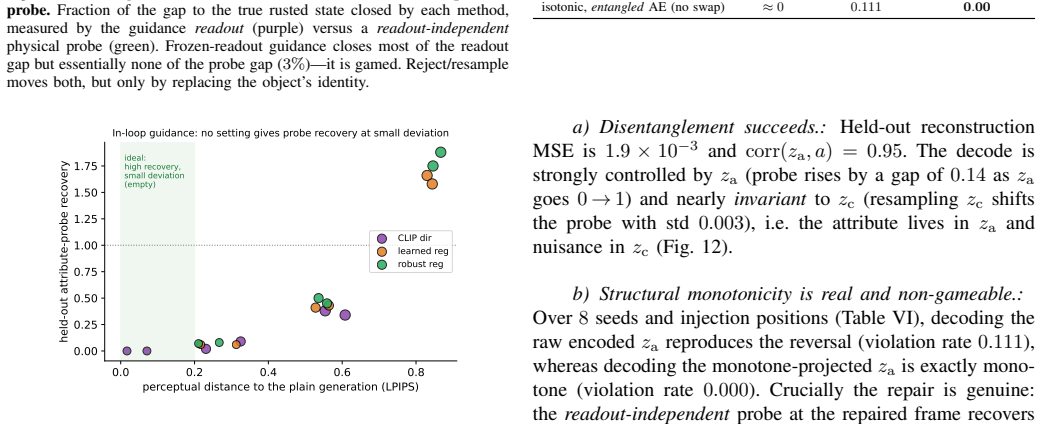
- Readout-guided editing or sampling that optimizes a frozen vision-language score cannot certify that the attribute was added; an independent probe is required, and even then the readout gap can close while the attribute stays flat.
- Monotone-by-construction repair is only as good as the disentanglement: without a faithful attribute latent, a perfectly monotone latent can leave the visible attribute unchanged.
- The protocol's progress and stasis numbers can serve as a reusable measurement instrument for future text-to-video models.
Where Pith is reading between the lines
- If the stasis finding generalizes, the right training fix is an explicit progress reward or a prompt-conditioned progress floor, not just an arrow-of-time constraint; a static clip already satisfies monotonicity.
- The gaming result suggests a cheap safeguard for text-to-video evaluation: keep the score used to steer a model separate from the score used to judge it, and include a readout-independent physical or held-out probe.
- The disentanglement bottleneck—leaky nuisance codes on real content—identifies a concrete research target: better attribute/nuisance separation on natural video could move the repair mechanism from synthetic renderers to real generators.
- The null-degeneracy of normalized reversal metrics may apply beyond video generation, to any near-static time series where a monotone signal is measured with noise.
Editorial analysis
A structured set of objections, weighed in public.
Referee Report
Summary. The paper addresses whether text-to-video generators respect irreversible physical processes. It argues that naive metrics—a per-clip violation rate, a variance-normalized reversal residual, and a generic monotonicity score—are null-degenerate or reward stasis, and it proposes a two-part protocol: progress (correlation between time and an attribute-specific readout) and a stasis rate read against a matched real baseline. Applying this protocol to seven T2V models and 108 real reference clips, the paper reports a clean separation: real footage advances (rho=+0.40, 35% static) whereas generators show near-zero progress and 92–100% stasis. A nine-annotator human study validates the ordering. The paper further shows that post-hoc frozen-readout optimization is gameable: the readout rises while an independent physical probe stays flat. As an alternative, it enforces monotonicity by construction in a disentangled attribute latent, validating this in a controlled renderer and on Stable-Diffusion semi-synthetic content, with elementary propositions in the supplement.
Significance. If the diagnosis holds, the paper contributes a reusable, null-robust evaluation protocol for irreversibility in video generation and a well-supported negative finding: current generators under-develop irreversible attributes rather than systematically reversing them. The paper is unusually careful in several ways: it null-tests its own proposed metrics (Tables I and II), runs real reference footage through the identical pipeline, uses bootstrap CIs, category-level paired tests, leave-one-category-out checks, and a human study, and it distinguishes between readout, probe, and ground truth. The guiding assumptions are stated and empirically checked in controlled settings, and the theoretical claims are elementary but explicit. The main weakness is that the central large-scale diagnosis relies on a CLIP directional readout whose attribute-specificity on natural video is not established against the confound of general dynamicness; this is load-bearing and fixable with additional controls, so the paper merits major revision rather than rejection.
major comments (2)
- [III-l and III-m (Table III)] The central diagnosis uses the per-category CLIP directional readout a(x)=<phi(x),u> as the measure of irreversible-attribute progress. This readout can in principle increase under any visual change with a component along u—lighting drift, camera motion, global color shifts—not only under the named attribute. Section III-f itself reports that generated clips make 2–3x less overall change than real reference footage, so the observed separation (ρ=+0.40 vs. ≈0; stasis 35% vs. 92–100%) could be partly or entirely a separation in general dynamicness rather than in attribute-specific development. The human validation in III-m uses a 0–4 rating of 'how much the process advances,' which can track the same dynamicness. No control separates the attribute-specific direction from generic directional change: e.g., a reversible attribute axis, an axis-orthogonal direction u_perp, motion-matched real/
- [III-h] The readout-validity study in III-h is carried out on text-embedding-interpolated graded sequences (fixed latent, only the prompt attribute varies). This construct guarantees that the only systematic variation is the intended attribute and does not test discriminant validity against non-attribute sources of visual change (motion, camera, lighting, quality) in natural videos. Since the seven-model diagnosis is applied to real reference footage and generated clips with substantial motion differences, the protocol needs a demonstration that a(x) is insensitive to non-attribute change—for instance, a null experiment on reversed or frame-shuffled clips, or a comparison of a(x) with an independent probe on a sample of real videos. As written, the measurement study supports the readout's sensitivity to controlled attribute changes but not its specificity on the data to which the diagnosis is ap
minor comments (5)
- [Throughout] Several section references such as 'Sec. III-0d' and 'Sec. III-l' appear to be formatting artifacts from auto-numbering; please fix.
- [Table III] The CogVideoX-2b row reports ρ=+0.16 and stasis 90% without a confidence interval, unlike the other rows. State how the 40 clips (5 processes x 8 seeds) are aggregated and whether the other models' clips are per-prompt independent.
- [III-a and III-m] Section III-a mentions 'human evaluation (a three-annotator study we run below)' but Section III-m describes nine annotators; reconcile the numbers.
- [IV-b and IV-c] The section title says 'adversarially gamed,' but the body qualifies this for in-loop guidance (perceptibly directional but partial, with identity preservation underpowered). Align the title or abstract wording with the qualified claim.
- [S2] In Proposition 3, the constants m and κ are estimated through proxy probes; this limitation is stated in the supplement but should appear in the main text where the proposition is invoked.
Circularity Check
No significant circularity in the central diagnosis; one minor self-definitional loop in the readout-support validation.
specific steps
-
self definitional
[Sec. III-h (readout measurement study); cf. Sec. S3-a (readout and synthetic-sequence construction)]
"Using text-embedding interpolation to synthesize graded sequences (fixed latent, attribute prompt interpolated 0→1) for five processes, an independent CLIP directional readout recovers the ground-truth progress with median rank correlation≈0.84 ... The attribute readout is a CLIP ViT-B/32 directional score a(x)=⟨ϕ(x), u⟩ with u=normalize(ψ(end)−ψ(start)); graded attribute sequences are produced by interpolating the CLIP text-encoder embedding from a start-state prompt e0 to an end-state prompt e1 as (1−α)e0 + αe1."
The 'ground-truth progress' in this validation is the interpolation level α used to generate the synthetic clip. The readout axis u is exactly the normalized difference of the same two prompt embeddings (ψ(end)−ψ(start)) that are linearly interpolated to produce the clip. A CLIP image encoder trained to align image and text embeddings will therefore produce ⟨φ(x_α), u⟩ monotonically increasing in α by construction; the high rank correlation and 100% reversal detection are a self-consistency check of CLIP's text-image alignment, not an independent confirmation that the readout isolates the visual attribute. The seven-model diagnosis uses this same per-category directional readout, so this support step is partly self-fulfilling. The central real-vs-generated separation is nevertheless not re
full rationale
The paper's central derivation chain is genuinely self-contained. The seven-model diagnosis (Sec. III-l, Table III) applies a fixed per-category CLIP directional readout to both real reference footage and generated clips, with no parameter fitted to the data determining the outcome; the real/generated separation is then corroborated by nine human annotators on source-hidden clips (Sec. III-m). The protocol's null checks (Tables I-II) are simulations with explicit noise models and do not presuppose the conclusion; the paper explicitly refuses to report the degenerate V statistic. The theoretical guarantees (Props. 1-6) are stated as conditional on Assumptions 1-2 (faithful, disentangled decoder), which are empirically probed in the controlled renderer and SD semi-synthetic grid; the assumptions are not the target result. The controlled monotone-by-construction validation includes the decisive entangled-latent ablation showing monotonicity alone gives zero repair, so the benefit is attributed to disentanglement rather than to the constraint. The only concrete circularity is in the readout-support study of Sec. III-h: the synthetic 'ground-truth' progress is generated by interpolating the same prompt-embedding endpoints that define the readout axis u, so the reported rank correlation is partly a self-consistency check of CLIP rather than independent evidence of attribute-specific tracking. This step is not load-bearing for the headline real-vs-generated separation, which survives human validation and threshold sweeps, but it does weaken the attribute-specificity argument. There are no load-bearing self-citations; the cited benchmarks are external. The paper's explicit scope/limitation statements (S1) further reduce any hidden-circularity concern by disclaiming reversal claims and acknowledging probe faithfulness limits.
Axiom & Free-Parameter Ledger
free parameters (3)
- stasis threshold tau =
0.05 (swept over 0.03-0.12)
- violation threshold epsilon =
0.003 (used for CogVideoX violation-rate measurement)
- progress floor epsilon in floored dynamics =
not reported
axioms (4)
- domain assumption Assumption 1 (A1, A2): the decoder is attribute-faithful in z_a and z_c carries no attribute information.
- domain assumption Assumption 2 (A1', A2'): approximate faithful disentanglement with margin m and defect kappa.
- domain assumption Factored renderer x=R(u,v) with attribute u and independent nuisance v, and exact swap reconstruction.
- domain assumption The per-category CLIP directional readout and the mean orange-blue chroma probe are valid proxies for the true irreversible attribute.
Cite this review
Pith. "Pith review of Diagnosing Under-Development of Irreversible Processes in Video Generation." pith.science (2026). https://pith.science/paper/GKAAWSHC
@misc{pith2026260800617,
  author       = {Pith},
  title        = {Pith review of: Diagnosing Under-Development of Irreversible Processes in Video Generation},
  year         = {2026},
  howpublished = {\url{https://pith.science/paper/GKAAWSHC}},
  note         = {Machine review of arXiv:2608.00617}
}
abstract
Many physical attributes are \emph{irreversible}: ice melts but does not re-freeze, paper chars but does not un-burn. Do video generators respect this? We show the question is hard to measure, and that what can be measured reliably is \emph{development} rather than reversal. Metrics of local reversal are null-degenerate: a per-clip violation rate scores $0.50$ on pure noise, and a variance-normalized reversal residual sits at its noise ceiling. What survives null-testing is a two-part protocol: progress (a directional attribute correlation) and a stasis rate. Under this protocol, generated video separates cleanly from real footage, and the gap is human-validated. Across seven text-to-video models, real reference footage advances ($\rho{=}{+}0.40$, $35\%$ static) while every generator shows near-zero progress and $92$--$100\%$ stasis; nine annotators rate real footage far above generated ($2.75$ vs.\ $0.99$ on a $0$--$4$ scale). The reliable finding is \emph{under-development}: generators barely advance irreversible attributes rather than reversing them. As a complementary mechanism, we show that post-hoc readout guidance is gameable, whereas enforcing monotonicity by construction in a disentangled attribute latent removes the gameable readout, validated in controlled and semi-synthetic settings.
Figures




Reference graph
Works this paper leans on
-
[1]
OSCBench: Benchmarking Object State Change in Text-to-Video Generation
X. Han, B. Zhu, S. Hu, F. M. Li, P. Carrington, R. Zimmermann, and J. Chen, “OSCBench: Benchmarking object state change in text-to-video generation,”arXiv preprint arXiv:2603.11698, 2026
work page internal anchor Pith review Pith/arXiv arXiv 2026
-
[2]
ChronoMagic-Bench: A benchmark for metamorphic evaluation of text-to-time-lapse video generation,
S. Yuan, J. Huanget al., “ChronoMagic-Bench: A benchmark for metamorphic evaluation of text-to-time-lapse video generation,”arXiv preprint arXiv:2406.18522, 2024
Pith/arXiv arXiv 2024
-
[3]
Do generative video models understand physical principles?
S. Motamed, L. Culp, K. Swersky, P. Jaini, and R. Geirhos, “Do generative video models understand physical principles?” inIEEE/CVF Winter Conference on Applications of Computer Vision (WACV), 2026, pp. 948–958
work page 2026
-
[4]
Videophy: Evaluating physical commonsense for video generation,
H. Bansal, Z. Lin, T. Xie, Z. Zong, M. Yarom, Y . Bitton, C. Jiang, Y . Sun, K.-W. Chang, and A. Grover, “Videophy: Evaluating physical commonsense for video generation,” inInternational Conference on Learning Representations (ICLR), 2025
work page 2025
-
[5]
Worldmodelbench: Judging video generation models as world models,
D. Li, Y . Fang, Y . Chen, S. Yang, S. Cao, J. Wong, M. Luo, X. Wang, H. Yin, J. Gonzalez, I. Stoica, S. Han, and Y . Lu, “Worldmodelbench: Judging video generation models as world models,” inAdvances in Neural Information Processing Systems (NeurIPS), 2025
work page 2025
-
[6]
Look for the change: Learning object states and state-modifying actions from untrimmed web videos,
T. Sou ˇcek, J.-B. Alayrac, A. Miech, I. Laptev, and J. Sivic, “Look for the change: Learning object states and state-modifying actions from untrimmed web videos,” inCVPR, 2022
work page 2022
-
[7]
Seeing the arrow of time in large multimodal models,
Z. Xue, M. Luo, and K. Grauman, “Seeing the arrow of time in large multimodal models,”arXiv preprint arXiv:2506.03340, 2025
arXiv 2025
-
[8]
AUTM flow: Atomic unrestricted time machine for monotonic normalizing flows,
D. Cai, Y . Ji, H. He, Q. Ye, and Y . Xi, “AUTM flow: Atomic unrestricted time machine for monotonic normalizing flows,” inUAI, 2022
work page 2022
-
[9]
Invertible Monotone Operators for Normalizing Flows
B. Ahn, C. Kim, Y . Hong, and H. J. Kim, “Invertible monotone operators for normalizing flows,”arXiv preprint arXiv:2210.08176, 2022
work page internal anchor Pith review Pith/arXiv arXiv 2022
-
[10]
Constrained synthesis with projected diffusion models,
J. K. Christopher, S. Baek, and F. Fioretto, “Constrained synthesis with projected diffusion models,” inNeurIPS, 2024
work page 2024
-
[11]
Towards world simulator: Crafting physical commonsense-based benchmark for video generation,
F. Meng, J. Liao, X. Tan, W. Shao, Q. Lu, K. Zhang, Y . Qiao, and P. Luo, “Towards world simulator: Crafting physical commonsense-based benchmark for video generation,”arXiv preprint arXiv:2410.05363, 2024
Pith/arXiv arXiv 2024
-
[12]
GenHowTo: Learning to generate actions and state transformations from instructional videos,
T. Sou ˇcek, D. Damen, M. Wray, I. Laptev, and J. Sivic, “GenHowTo: Learning to generate actions and state transformations from instructional videos,” inCVPR, 2024
work page 2024
-
[13]
WISA: World simulator assistant for physics-aware text- to-video generation,
J. Wang, A. Ma, K. Cao, J. Zheng, J. Feng, Z. Zhang, W. Pang, and X. Liang, “WISA: World simulator assistant for physics-aware text- to-video generation,” inAdvances in Neural Information Processing Systems (NeurIPS), 2025
work page 2025
-
[14]
Physical simulator in-the-loop video generation,
L. G. Foo, M. H. Huang, A. Lattas, S. Moschoglou, T. Beeler, and C. Theobalt, “Physical simulator in-the-loop video generation,” in IEEE/CVF Conference on Computer Vision and Pattern Recognition (CVPR), 2026, pp. 4301–4311
work page 2026
-
[15]
Y . Shen, J. Xiong, T. Yu, and I. Lourentzou, “PHANTOM: Physics- infused video generation via joint modeling of visual and latent physical dynamics,” inIEEE/CVF Conference on Computer Vision and Pattern Recognition (CVPR), 2026, pp. 11 185–11 194
work page 2026
-
[16]
Latent video diffusion models for high-fidelity long video generation,
Y . He, T. Yang, Y . Zhanget al., “Latent video diffusion models for high-fidelity long video generation,”arXiv:2211.13221, 2022
Pith/arXiv arXiv 2022
-
[17]
VideoComposer: Compositional video synthesis with motion controllability,
X. Wang, H. Yuan, S. Zhanget al., “VideoComposer: Compositional video synthesis with motion controllability,”NeurIPS, 2023
work page 2023
-
[18]
LSTD: Long short-term temporal diffusion for video generation,
H. Zhao, J. Gu, S. Wang, T. Lu, X. Zhang, Z. Wu, H. Xu, and Y .-G. Jiang, “LSTD: Long short-term temporal diffusion for video generation,” IEEE Transactions on Multimedia, vol. 28, pp. 2460–2473, 2026
work page 2026
-
[19]
FluencyVE: Marrying temporal- aware mamba with bypass attention for video editing,
M. Cai, Y . Li, O. Yoshie, and Y . Ieiri, “FluencyVE: Marrying temporal- aware mamba with bypass attention for video editing,”IEEE Transac- tions on Multimedia, vol. 28, pp. 3202–3213, 2026
work page 2026
- [20]
-
[21]
Constrained monotonic neural networks,
D. Runje and S. M. Shankaranarayana, “Constrained monotonic neural networks,” inICML, 2023
work page 2023
-
[22]
Learning dynamical systems from partial observations,
I. Ayed, E. de B ´ezenac, A. Pajotet al., “Learning dynamical systems from partial observations,”arXiv:1902.11136, 2019
Pith/arXiv arXiv 1902
-
[23]
Challenging common assump- tions in the unsupervised learning of disentangled representations,
F. Locatello, S. Bauer, M. Lucicet al., “Challenging common assump- tions in the unsupervised learning of disentangled representations,” in ICML, 2019
work page 2019
-
[24]
Variational autoencoders and nonlinear ICA: A unifying framework,
I. Khemakhem, D. Kingma, R. Monti, and A. Hyvarinen, “Variational autoencoders and nonlinear ICA: A unifying framework,” inAISTATS, 2020
work page 2020
-
[25]
P. W. Koh, T. Nguyen, Y . S. Tanget al., “Concept bottleneck models,” inICML, 2020
work page 2020
-
[26]
H. Chen, X. Wang, G. Zeng, Y . Zhang, Y . Zhou, F. Han, Y . Wu, and W. Zhu, “VideoDreamer: Customized multi-subject text-to-video generation with disen-mix finetuning on language-video foundation IEEE TRANSACTIONS ON MULTIMEDIA 11 models,”IEEE Transactions on Multimedia, vol. 27, pp. 2875–2885, 2025
work page 2025
-
[27]
Defining and characterizing reward gaming,
J. Skalse, N. Howe, D. Krasheninnikov, and D. Krueger, “Defining and characterizing reward gaming,” inAdvances in Neural Information Processing Systems (NeurIPS), vol. 35, 2022, pp. 9460–9471
work page 2022
-
[28]
Scaling laws for reward model overoptimization,
L. Gao, J. Schulman, and J. Hilton, “Scaling laws for reward model overoptimization,”ICML, 2023
work page 2023
-
[29]
C. Li, O. Michel, X. Pan, S. Liu, M. Roberts, and S. Xie, “PISA exper- iments: Exploring physics post-training for video diffusion models by watching stuff drop,” inInternational Conference on Machine Learning (ICML), 2025, pp. 35 685–35 709
work page 2025
-
[30]
Temporal cycle-consistency learning (video time alignment),
D. Dwibedi, Y . Aytar, J. Tompson, P. Sermanet, and A. Zisserman, “Temporal cycle-consistency learning (video time alignment),” inCVPR, 2019
work page 2019
-
[31]
I. Hadji, K. G. Derpanis, and A. D. Jepson, “Representation learning via global temporal alignment and cycle-consistency (phase/time align- ment),” inCVPR, 2021
work page 2021
-
[32]
Learning transferable visual models from natural language supervision,
A. Radford, J. W. Kim, C. Hallacy, A. Ramesh, G. Goh, S. Agarwal, G. Sastry, A. Askell, P. Mishkin, J. Clarket al., “Learning transferable visual models from natural language supervision,” inICML, 2021
2021
-
[33]
Adversarial diffusion distillation,
A. Sauer, D. Lorenz, A. Blattmann, and R. Rombach, “Adversarial diffusion distillation,” inarXiv preprint arXiv:2311.17042, 2023
Pith/arXiv arXiv 2023
-
[34]
High- resolution image synthesis with latent diffusion models,
R. Rombach, A. Blattmann, D. Lorenz, P. Esser, and B. Ommer, “High- resolution image synthesis with latent diffusion models,” inCVPR, 2022
2022
-
[35]
CogVideoX: Text-to-video diffusion models with an expert transformer,
Z. Yang, J. Teng, W. Zheng, M. Ding, S. Huanget al., “CogVideoX: Text-to-video diffusion models with an expert transformer,”arXiv preprint arXiv:2408.06072, 2024. IEEE TRANSACTIONS ON MULTIMEDIA 12 Supplementary Material IEEE TRANSACTIONS ON MULTIMEDIA 13 S1. SCOPE ANDLIMITATIONS We deliberately scope v1 togradual, approximately scalar irreversible attrib...
Pith/arXiv arXiv 2024
-
[64]
Evaluation injects a reversal at a mid-sequence frame over8seeds/positions
to(z a ∈R 1, zc ∈R 8)and a mirrored deconv decoder; it is trained for6000Adam steps (lr2×10 −3, batch128) on L=∥ˆx−x∥ 2 +∥D(z a, z(π) c )−R(a,nuis (π))∥2 +0.5∥z a −a∥ 2, whereπis a random permutation (the swap term) andRthe renderer. Evaluation injects a reversal at a mid-sequence frame over8seeds/positions. c) Latent dynamics and monotone-variant baselin...
This paper was first reviewed by deepseek-v4-flash on August 5, 2026.
discussion (0)
Sign in with ORCID, Apple, or X to comment. Anyone can read and Pith papers without signing in.