REVIEW 4 major objections 5 minor 95 references
HEIMAT debiases language models by asking them about their own stereotypes and balancing the answers.
Reviewed by Pith at T0; open to challenge. T0 means a machine referee read the full paper against a public rubric. the ladder, T0–T4 →
HEIMAT debiases language models by generating heuristic prompts, building substitution sets, and fine-tuning the model with a Jensen-Shannon divergence loss to align predictions across demographic groups, with no fixed preference datasets.
T0 review reviewed 2026-08-05 challenge →
load-bearing objection HEIMAT is a cheap, plausible debiasing method with consistent benchmark gains, but the debiasing target is built from the model's own top-k predictions and coverage is never shown—worth referee time, not acceptance as is. the 4 major comments →
A Heuristic Perspective on Debiasing Language Models
The pith
A machine-rendered reading of the paper's core claim, the machinery that carries it, and where it could break.
The reading
Core claim
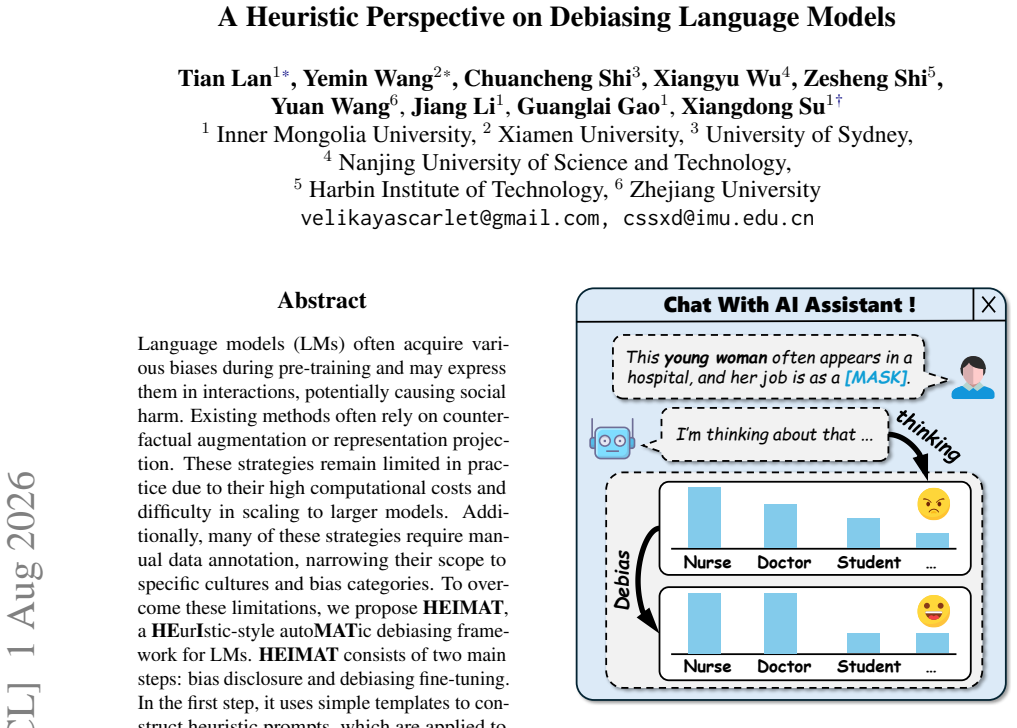
The central claim is that a model's own biased predictions can be turned into the training signal that removes the bias. HEIMAT first uses six heuristic templates to generate prompts whose continuation reveals which demographic attributes the model associates with a given context, and seven association prompts to expand those attributes into a substitution list. It then creates context prompt sets that differ only in the substituted demographic term and fine-tunes the model by minimizing the Jensen-Shannon divergence among the prediction distributions. The result, according to the paper, is a model whose predictions no longer shift systematically with demographic attributes, while its natura
What carries the argument
The central mechanism is the 'context prompt set' (CPS): a group of prompts identical except for the demographic attribute (e.g., 'This person works as a [MASK] and people know this person's race is [Caucasian/Hispanic/Asian]'). The demographic attributes are discovered by the model's own top-k predictions under heuristic prompts, expanded by association prompts. The debiasing fine-tuning then minimizes the Jensen-Shannon divergence (JSD) between the prediction distributions induced by each member of the CPS, forcing demographic-invariant behavior.
Load-bearing premise
The debiasing target is defined by the model's own top-k predictions under the heuristic prompts; if the model's initial bias causes it to omit or misrepresent a demographic group in that list, HEIMAT will align predictions across those imperfectly defined groups and may entrench rather than remove the bias.
What would settle it
Run HEIMAT on a model with a deliberately skewed substitution list that omits one racial group. If the model's bias against the omitted group does not decrease (or worsens) on an external benchmark like CrowS-Pairs, the representativeness assumption fails.
If this is right
- HEIMAT reduces gender and race bias on CrowS-Pairs, StereoSet, and SEAT to near-ideal values (e.g., BERT gender from 58.01 to 50.00, race from 58.12 to 47.48) without hurting GLUE performance.
- Debiasing only gender and race also shifts scores across other categories—nationality, religion, socioeconomic status—suggesting correlated bias structure.
- The framework extends to French models with grammatically gendered nouns, where static word lists fail, by regenerating prompts in the target language.
- The method requires only 0.5 hours of compute on one A100 GPU, compared to 20–41 hours for existing methods, and no external corpora.
Where Pith is reading between the lines
- Because the substitution list is built from the model's own top-k predictions, HEIMAT's debiasing target is defined by the model's existing associations; a model that omits a demographic group from its predictions would not be corrected for that group. This suggests testing HEIMAT with substitution lists that deliberately omit salient groups to see if bias against those groups persists.
- The paper evaluates bias via benchmarks that use masked occupations and stereotyped sentences; a natural extension is to measure whether HEIMAT changes open-ended generation distributions, e.g., the relative probability of 'nurse' vs 'doctor' under varied pronouns, beyond the qualitative example given.
- The claim of cross-category generalization implies that biases are shared structure; one could test this by applying HEIMAT to only one category (e.g., race) and checking whether gender bias decreases more than from random fine-tuning.
- HEIMAT's reliance on a language model to generate heuristic prompts raises the question of whether the generator's own cultural slant is imported; a controlled study varying the generating model might reveal the sensitivity of the debiasing outcome.
Editorial analysis
A structured set of objections, weighed in public.
Referee Report
Summary. The paper proposes HEIMAT, a two-stage debiasing framework for language models. Stage one ('bias disclosure') constructs heuristic prompts from six templates, samples top-k demographic tokens from the model's own predictions, expands them via association prompts into substitution lists, and builds sets of context prompts (CPS) that differ only in a demographic attribute. Stage two ('debiasing fine-tuning') fine-tunes the model by minimizing the Jensen-Shannon divergence (JSD) of the prediction distributions over each CPS (Eq. 4). The authors evaluate on CrowS-Pairs, StereoSet, and SEAT for BERT, ALBERT, TinyBERT, LLaMA-2, and GPT-2, plus French (CamemBERT, FrALBERT) using CrowS-Pairs/FLUE, and report GLUE results to show NLU is preserved. The core claim is that HEIMAT consistently reduces gender and race bias while retaining NLU performance, and that the template/association-prompt design makes the method automatically adaptable across languages, cultures, and bias categories.
Significance. If the central claim holds, HEIMAT is a valuable low-cost, automatic debiasing method that avoids fixed preference datasets and manual lexicons. Its strengths include a simple, parameter-light loss (JSD), transparent prompt templates, evaluation across several model families and two languages, and an explicit check that GLUE/FLUE performance is broadly preserved. The paper also reports efficiency and sensitivity analyses (Tables 12-13) that are useful for reproducibility. However, the validity of the method depends on the completeness of the automatically generated substitution lists, and several empirical claims go beyond what the reported tables support. The approach is promising but the current evidence is insufficient to establish the 'different cultures' generalization and the cross-category transfer claims.
major comments (4)
- [Section 3.2, Eq. (1), Appendix A] The substitution list SL is constructed from the top-k tokens predicted by the model being debiased, yet the paper never reports these lists, never documents which model generates the association-prompt expansions, and never checks coverage against the demographic groups in CrowS-Pairs/StereoSet. If the model's top-k omits a salient group (e.g., a particular race), that group never appears in any CPS and is therefore absent from the JSD loss in Eq. (4). Aligning over the remaining groups can then sharpen relative stereotypes for the omitted group while aggregate scores improve. This is load-bearing for the claim of 'automatic' debiasing across cultures. The authors should either provide the substitution lists and a coverage analysis, or report per-group bias scores before and after debiasing to show the omitted-group risk does not materialize.
- [Section 4.2, Table 3] The text claims that debiasing on gender and race leads to 'consistent score shifts' and 'cross-category improvements' across unseen bias categories. Table 3 contradicts this. For English BERT, nationality moves away from 50 (62.94→64.15), age moves away (55.23→63.22), and disability changes direction (61.68→58.33, closer). For ALBERT, race worsens (51.36→53.49) and socio-economic status worsens (60.47→63.37); for FrALBERT, sexuality worsens substantially (40.28→58.33). These are not 'consistent improvements.' The transfer claim should either be restricted to categories that actually improve or be backed by a per-category quantitative analysis (e.g., with significance testing of movement toward/away from 50).
- [All experimental tables (Tables 1-8)] No error bars, confidence intervals, or significance tests are reported. Fine-tuning with 20,000 prompts and a learning rate of 5e-6 can produce run-to-run variation; the claim that HEIMAT 'consistently' achieves best or near-best results is therefore not statistically grounded. At minimum, multiple seeds should be reported for the main comparisons (e.g., BERT/ALBERT on CrowS-Pairs and StereoSet) with mean and standard deviation, and a paired significance test where baselines are available.
- [Section 4.3, Section 2.2] The 'different cultures' generalization is supported only by English and French, both Western, high-resource languages. The introduction explicitly discusses broader cultural coverage (India, Europe) and the UN inclusivity frame, but no non-Western language or culture is tested. The claim that HEIMAT 'can be readily extended to other languages and cultures' is a plausible design argument, but it is not validated by the experiments. Either add at least one non-Western language/culture evaluation or temper the claim to 'English and French'.
minor comments (5)
- [Table 3] The column header 'Apperance' should be 'Appearance', and the row/column layout makes it hard to tell which entries are 'Best'. Add a caption that explains why a score below 50 is not necessarily bad (since CrowS-Pairs measures stereotype direction, not just magnitude).
- [Appendix D, Table 12] The abbreviation 'UP' (word usage proportion) is used in Table 12 but is not defined in the main text or in the table caption. Define the quantity and state how it is computed from the '20,000 heuristic prompts' mentioned in Section B.4.
- [Section 3.2] The sentence 'For Given this prompt, a language model may generate...' has a grammatical error ('For Given'). Also, the contribution bullet in Section 1 reads 'that operates. It consists of two stages' — the sentence is split incorrectly.
- [Appendix A] The association prompt templates in Table 11 include both synonym and antonym prompts, but the paper does not explain why antonyms are useful for expanding demographic coverage. This is a methodological detail that should be justified in the main text or appendix.
- [Table 5] The qualitative generations for LLaMA-2 are presented as evidence of reduced 'identity-conditioned violent associations'. Consider reporting probabilities of violent/non-violent continuations over a larger set of prompts rather than a single cherry-picked pair, to strengthen the claim.
Circularity Check
No circularity: HEIMAT's JSD objective is defined independently of the bias benchmarks; self-derived substitution lists are a coverage limitation, not a circular reduction.
full rationale
The paper's derivation chain is: heuristic prompts elicit top-k demographic tokens W_L (Sec. 3.2); association prompts expand W_L into a substitution list SL; SL generates context prompts CPS; fine-tuning minimizes the Jensen-Shannon divergence (Eq. 4) among prediction distributions over CPS. The JSD loss is an independent regularizer: it contains no term derived from CrowS-Pairs, StereoSet, or SEAT scores, and no debiasing parameter is fitted to those benchmarks. The self-referential step — W_L and SL are extracted from the same model that is later fine-tuned — does not make the evaluation circular, because the reported bias reductions are measured on external benchmark items, not on the JSD value itself. The paper would be circular only if it defined 'bias reduction' as 'JSD decreased' or if the substitution list were built from the benchmark items it later reports; neither is the case. The self-citations (Lan et al. 2025a,b) are motivational and not load-bearing; no uniqueness theorem or ansatz is imported from the authors' prior work. The substitution-list coverage gap (the model's top-k may omit salient demographic groups, and the paper does not report the generated lists or per-group results) is a real empirical limitation and a correctness risk, but under the stated rules it is not a circularity: the benchmark scores are external and could in principle disagree with the method's internal objective.
Axiom & Free-Parameter Ledger
free parameters (6)
- number_of_heuristic_prompts =
20000
- word_usage_proportion =
1
- top_k =
5
- number_of_association_terms_n =
not specified
- learning_rate =
5e-6
- batch_size =
8
axioms (6)
- standard math Jensen-Shannon divergence is a valid measure of distributional divergence
- domain assumption Aligning prediction distributions across demographic groups reduces social bias without destroying NLU
- domain assumption LLM-generated heuristic prompts and association prompts produce meaningful demographic attribute sets
- domain assumption CrowS-Pairs and StereoSet scores closer to 50 indicate lower bias
- domain assumption The model's top-k predictions on heuristic prompts capture its demographic associations
- domain assumption The substitution list generated by association prompts spans the relevant demographic categories
Cite this review
Pith. "Pith review of A Heuristic Perspective on Debiasing Language Models." pith.science (2026). https://pith.science/paper/TSQKHCOP
@misc{pith2026260800622,
  author       = {Pith},
  title        = {Pith review of: A Heuristic Perspective on Debiasing Language Models},
  year         = {2026},
  howpublished = {\url{https://pith.science/paper/TSQKHCOP}},
  note         = {Machine review of arXiv:2608.00622}
}
read the original abstract
Language models (LMs) often acquire various biases during pre-training and may express them in interactions, potentially causing social harm. Existing methods often rely on counterfactual augmentation or representation projection. These strategies remain limited in practice due to their high computational costs and difficulty in scaling to larger models. Additionally, many of these strategies require manual data annotation, narrowing their scope to specific cultures and bias categories. To overcome these limitations, we propose HEIMAT, a HEurIstic-style autoMATic debiasing framework for LMs. HEIMAT consists of two main steps: bias disclosure and debiasing fine-tuning. In the first step, it uses simple templates to construct heuristic prompts, which are applied to reveal model biases and generate corresponding context prompts. In the second step, it fine-tunes the model by minimizing the Jensen-Shannon divergence of predictions on these context prompts to reduce bias. Extensive experiments show that HEIMAT effectively mitigates bias in different cultures while maintaining the model's natural language understanding (NLU) performance.
Figures


Reference graph
Works this paper leans on
-
[1]
Aho and Jeffrey D
Alfred V. Aho and Jeffrey D. Ullman , title =. 1972
1972
-
[2]
Publications Manual , year = "1983", publisher =
1983
-
[3]
Ashok K. Chandra and Dexter C. Kozen and Larry J. Stockmeyer , year = "1981", title =. doi:10.1145/322234.322243
-
[4]
Scalable training of
Andrew, Galen and Gao, Jianfeng , booktitle=. Scalable training of. 2007 , url=
2007
-
[5]
Dan Gusfield , title =. 1997
1997
-
[6]
Tetreault , title =
Mohammad Sadegh Rasooli and Joel R. Tetreault , title =. Computing Research Repository , volume =. 2015 , url =
2015
-
[7]
A Framework for Learning Predictive Structures from Multiple Tasks and Unlabeled Data , Volume =
Ando, Rie Kubota and Zhang, Tong , Issn =. A Framework for Learning Predictive Structures from Multiple Tasks and Unlabeled Data , Volume =. Journal of Machine Learning Research , Month = dec, Numpages =. 2005 , url=
2005
-
[8]
and Tukey, John W
Cooley, James W. and Tukey, John W. , journal=. An algorithm for the machine calculation of complex. 1965 , url=
1965
-
[9]
Attention is All you Need , url =
Vaswani, Ashish and Shazeer, Noam and Parmar, Niki and Uszkoreit, Jakob and Jones, Llion and Gomez, Aidan N and Kaiser, ukasz and Polosukhin, Illia , booktitle =. Attention is All you Need , url =
-
[10]
BERT : Pre-training of Deep Bidirectional Transformers for Language Understanding
Devlin, Jacob and Chang, Ming-Wei and Lee, Kenton and Toutanova, Kristina. BERT : Pre-training of Deep Bidirectional Transformers for Language Understanding. Proceedings of the 2019 Conference of the North A merican Chapter of the Association for Computational Linguistics: Human Language Technologies, Volume 1 (Long and Short Papers). 2019. doi:10.18653/v...
-
[11]
2019 , eprint=
RoBERTa: A Robustly Optimized BERT Pretraining Approach , author=. 2019 , eprint=
2019
-
[12]
2020 , eprint=
ALBERT: A Lite BERT for Self-supervised Learning of Language Representations , author=. 2020 , eprint=
2020
-
[13]
2020 , eprint=
TinyBERT: Distilling BERT for Natural Language Understanding , author=. 2020 , eprint=
2020
-
[14]
Proceedings of the 2018 CHI Conference on Human Factors in Computing Systems , pages =
Diaz, Mark and Johnson, Isaac and Lazar, Amanda and Piper, Anne Marie and Gergle, Darren , title =. Proceedings of the 2018 CHI Conference on Human Factors in Computing Systems , pages =. 2018 , isbn =. doi:10.1145/3173574.3173986 , abstract =
-
[15]
2018 , eprint=
Examining Gender and Race Bias in Two Hundred Sentiment Analysis Systems , author=. 2018 , eprint=
2018
-
[16]
2021 , eprint=
The Authors Matter: Understanding and Mitigating Implicit Bias in Deep Text Classification , author=. 2021 , eprint=
2021
-
[17]
2019 , eprint=
The Woman Worked as a Babysitter: On Biases in Language Generation , author=. 2019 , eprint=
2019
-
[18]
2019 , eprint=
On Measuring Social Biases in Sentence Encoders , author=. 2019 , eprint=
2019
-
[19]
and Gebru, Timnit and McMillan-Major, Angelina and Shmitchell, Shmargaret , title =
Bender, Emily M. and Gebru, Timnit and McMillan-Major, Angelina and Shmitchell, Shmargaret , title =. Proceedings of the 2021 ACM Conference on Fairness, Accountability, and Transparency , pages =. 2021 , isbn =. doi:10.1145/3442188.3445922 , abstract =
-
[20]
Proceedings of the 2018 AAAI/ACM Conference on AI, Ethics, and Society , pages =
Dixon, Lucas and Li, John and Sorensen, Jeffrey and Thain, Nithum and Vasserman, Lucy , title =. Proceedings of the 2018 AAAI/ACM Conference on AI, Ethics, and Society , pages =. 2018 , isbn =. doi:10.1145/3278721.3278729 , abstract =
-
[21]
Peters, Matthew E. and Neumann, Mark and Iyyer, Mohit and Gardner, Matt and Clark, Christopher and Lee, Kenton and Zettlemoyer, Luke. Deep Contextualized Word Representations. Proceedings of the 2018 Conference of the North A merican Chapter of the Association for Computational Linguistics: Human Language Technologies, Volume 1 (Long Papers). 2018. doi:10...
-
[22]
Tagging Performance Correlates with Author Age
Hovy, Dirk and S gaard, Anders. Tagging Performance Correlates with Author Age. Proceedings of the 53rd Annual Meeting of the Association for Computational Linguistics and the 7th International Joint Conference on Natural Language Processing (Volume 2: Short Papers). 2015. doi:10.3115/v1/P15-2079
-
[23]
Energy and Policy Considerations for Deep Learning in NLP
Strubell, Emma and Ganesh, Ananya and McCallum, Andrew. Energy and Policy Considerations for Deep Learning in NLP. Proceedings of the 57th Annual Meeting of the Association for Computational Linguistics. 2019. doi:10.18653/v1/P19-1355
-
[24]
Don ' t Stop Pretraining: Adapt Language Models to Domains and Tasks
Gururangan, Suchin and Marasovi \'c , Ana and Swayamdipta, Swabha and Lo, Kyle and Beltagy, Iz and Downey, Doug and Smith, Noah A. Don ' t Stop Pretraining: Adapt Language Models to Domains and Tasks. Proceedings of the 58th Annual Meeting of the Association for Computational Linguistics. 2020. doi:10.18653/v1/2020.acl-main.740
-
[25]
Learning Gender-Neutral Word Embeddings
Zhao, Jieyu and Zhou, Yichao and Li, Zeyu and Wang, Wei and Chang, Kai-Wei. Learning Gender-Neutral Word Embeddings. Proceedings of the 2018 Conference on Empirical Methods in Natural Language Processing. 2018. doi:10.18653/v1/D18-1521
-
[26]
Liu , title =
Colin Raffel and Noam Shazeer and Adam Roberts and Katherine Lee and Sharan Narang and Michael Matena and Yanqi Zhou and Wei Li and Peter J. Liu , title =. Journal of Machine Learning Research , year =
-
[27]
Self-Diagnosis and Self-Debiasing: A Proposal for Reducing Corpus-Based Bias in NLP , author=. 2021 , eprint=
work page 2021
-
[28]
FineDeb: A Debiasing Framework for Language Models , author=. 2023 , eprint=
work page 2023
-
[29]
Black is to Criminal as Caucasian is to Police: Detecting and Removing Multiclass Bias in Word Embeddings , author=. 2019 , eprint=
work page 2019
-
[30]
Gender Bias in Neural Natural Language Processing , author=. 2019 , eprint=
work page 2019
-
[31]
Language (Technology) is Power: A Critical Survey of "Bias" in NLP , author=. 2020 , eprint=
work page 2020
-
[32]
Diagnosing and Debiasing Corpus-Based Political Bias and Insults in GPT2 , author=. 2023 , eprint=
work page 2023
-
[33]
2020 , eprint=
RealToxicityPrompts: Evaluating Neural Toxic Degeneration in Language Models , author=. 2020 , eprint=
2020
-
[34]
Auto-Debias: Debiasing Masked Language Models with Automated Biased Prompts
Guo, Yue and Yang, Yi and Abbasi, Ahmed. Auto-Debias: Debiasing Masked Language Models with Automated Biased Prompts. Proceedings of the 60th Annual Meeting of the Association for Computational Linguistics (Volume 1: Long Papers). 2022. doi:10.18653/v1/2022.acl-long.72
-
[35]
Frequency Effects on Syntactic Rule Learning in Transformers , author=. 2021 , eprint=
work page 2021
-
[36]
Advances in neural information processing systems , volume=
Man is to computer programmer as woman is to homemaker? debiasing word embeddings , author=. Advances in neural information processing systems , volume=
-
[37]
Reducing Sentiment Bias in Language Models via Counterfactual Evaluation
Huang, Po-Sen and Zhang, Huan and Jiang, Ray and Stanforth, Robert and Welbl, Johannes and Rae, Jack and Maini, Vishal and Yogatama, Dani and Kohli, Pushmeet. Reducing Sentiment Bias in Language Models via Counterfactual Evaluation. Findings of the Association for Computational Linguistics: EMNLP 2020. 2020. doi:10.18653/v1/2020.findings-emnlp.7
-
[38]
Disclosure and Mitigation of Gender Bias in LLMs , author=. 2024 , eprint=
work page 2024
-
[39]
CrowS-Pairs: A Challenge Dataset for Measuring Social Biases in Masked Language Models , author=. 2020 , eprint=
work page 2020
-
[40]
StereoSet: Measuring stereotypical bias in pretrained language models , author=. 2020 , eprint=
work page 2020
-
[41]
F lau BERT : Unsupervised Language Model Pre-training for F rench
Le, Hang and Vial, Lo. F lau BERT : Unsupervised Language Model Pre-training for F rench. Proceedings of the Twelfth Language Resources and Evaluation Conference. 2020
work page 2020
-
[42]
Measuring and Reducing Gendered Correlations in Pre-trained Models , author=. 2021 , eprint=
work page 2021
-
[43]
Counterfactual Data Augmentation for Mitigating Gender Stereotypes in Languages with Rich Morphology , author=. 2020 , eprint=
work page 2020
-
[44]
Null It Out: Guarding Protected Attributes by Iterative Nullspace Projection , author=. 2020 , eprint=
work page 2020
-
[45]
On the Usability of Transformers-based models for a French Question-Answering task , author=. 2022 , eprint=
work page 2022
- [46]
- [47]
-
[48]
C amem BERT : a Tasty F rench Language Model
Martin, Louis and Muller, Benjamin and Ortiz Su \'a rez, Pedro Javier and Dupont, Yoann and Romary, Laurent and de la Clergerie, \'E ric and Seddah, Djam \'e and Sagot, Beno \^ t. C amem BERT : a Tasty F rench Language Model. Proceedings of the 58th Annual Meeting of the Association for Computational Linguistics. 2020. doi:10.18653/v1/2020.acl-main.645
-
[49]
N. F rench C row S -Pairs: Extending a challenge dataset for measuring social bias in masked language models to a language other than E nglish. Proceedings of the 60th Annual Meeting of the Association for Computational Linguistics (Volume 1: Long Papers). 2022. doi:10.18653/v1/2022.acl-long.583
-
[50]
GLUE: A Multi-Task Benchmark and Analysis Platform for Natural Language Understanding
-
[51]
Debiasing Pre-trained Contextualised Embeddings , author=. 2021 , eprint=
work page 2021
-
[52]
Calculating political bias and fighting partisanship with AI , author=. 2019 , publisher=
work page 2019
-
[53]
2019 , eprint=
Decoupled Weight Decay Regularization , author=. 2019 , eprint=
2019
-
[54]
, journal=
Lin, J. , journal=. Divergence measures based on the Shannon entropy , year=
-
[55]
BBQ : A hand-built bias benchmark for question answering
Parrish, Alicia and Chen, Angelica and Nangia, Nikita and Padmakumar, Vishakh and Phang, Jason and Thompson, Jana and Htut, Phu Mon and Bowman, Samuel. BBQ : A hand-built bias benchmark for question answering. Findings of the Association for Computational Linguistics: ACL 2022. 2022. doi:10.18653/v1/2022.findings-acl.165
-
[56]
An Empirical Survey of the Effectiveness of Debiasing Techniques for Pre-trained Language Models , author=. 2022 , eprint=
work page 2022
-
[57]
Science , volume=
Semantics derived automatically from language corpora contain human-like biases , author=. Science , volume=. 2017 , publisher=
2017
-
[58]
ChatGPT Based Data Augmentation for Improved Parameter-Efficient Debiasing of LLMs , author=. Proceedings of the Fourth Workshop on Language Technology for Equality, Diversity, Inclusion , pages=
-
[59]
Prompt Tuning Pushes Farther, Contrastive Learning Pulls Closer: A Two-Stage Approach to Mitigate Social Biases , author=. Proceedings of the 61st Annual Meeting of the Association for Computational Linguistics (Volume 1: Long Papers) , pages=
-
[60]
Bias Vector: Mitigating Biases in Language Models with Task Arithmetic Approach
Shirafuji, Daiki and Takenaka, Makoto and Taguchi, Shinya. Bias Vector: Mitigating Biases in Language Models with Task Arithmetic Approach. Proceedings of the 31st International Conference on Computational Linguistics. 2025
work page 2025
-
[61]
The United Nations System Shared Framework for Action, New York , year=
Equality and Non-Discrimination at the Heart of Sustainable Development , author=. The United Nations System Shared Framework for Action, New York , year=
- [62]
-
[63]
Self-Diagnosis and Self-Debiasing:
Timo Schick and Sahana Udupa and Hinrich Sch. Self-Diagnosis and Self-Debiasing:. CoRR , volume =. 2021 , url =. 2103.00453 , timestamp =
Pith/arXiv arXiv 2021
-
[64]
2024 , eprint=
Bias and Fairness in Large Language Models: A Survey , author=. 2024 , eprint=
2024
-
[65]
Logic, language, and security: essays dedicated to Andre Scedrov on the occasion of his 65th birthday , pages=
Gender bias in neural natural language processing , author=. Logic, language, and security: essays dedicated to Andre Scedrov on the occasion of his 65th birthday , pages=. 2020 , publisher=
2020
-
[66]
Proceedings of the 57th annual meeting of the association for computational linguistics , pages=
Energy and policy considerations for deep learning in NLP , author=. Proceedings of the 57th annual meeting of the association for computational linguistics , pages=
-
[67]
Auto-debias: Debiasing masked language models with automated biased prompts , author=. Proceedings of the 60th Annual Meeting of the Association for Computational Linguistics (Volume 1: Long Papers) , pages=
-
[68]
Proceedings of the 31st International Conference on Computational Linguistics , pages=
Bias vector: Mitigating biases in language models with task arithmetic approach , author=. Proceedings of the 31st International Conference on Computational Linguistics , pages=
-
[69]
BiasDPO: Mitigating Bias in Language Models through Direct Preference Optimization , author=. Proceedings of the 62nd Annual Meeting of the Association for Computational Linguistics (Volume 4: Student Research Workshop) , pages=
-
[70]
B ias F ilter: An Inference-Time Debiasing Framework for Large Language Models
Cheng, Xiaoqing and Chen, Ruizhe and Zan, Hongying and Jia, Yuxiang and Peng, Min. B ias F ilter: An Inference-Time Debiasing Framework for Large Language Models. Findings of the Association for Computational Linguistics: EMNLP 2025. 2025. doi:10.18653/v1/2025.findings-emnlp.821
-
[71]
Proceedings of the 2025 Conference on Empirical Methods in Natural Language Processing , pages=
F ^2 Bench: An Open-ended Fairness Evaluation Benchmark for LLMs with Factuality Considerations , author=. Proceedings of the 2025 Conference on Empirical Methods in Natural Language Processing , pages=
2025
-
[72]
P rom DA : Prompt-based Data Augmentation for Low-Resource NLU Tasks
Wang, Yufei and Xu, Can and Sun, Qingfeng and Hu, Huang and Tao, Chongyang and Geng, Xiubo and Jiang, Daxin. P rom DA : Prompt-based Data Augmentation for Low-Resource NLU Tasks. Proceedings of the 60th Annual Meeting of the Association for Computational Linguistics (Volume 1: Long Papers). 2022. doi:10.18653/v1/2022.acl-long.292
-
[73]
arXiv preprint arXiv:2307.09288 , year=
Llama 2: Open foundation and fine-tuned chat models , author=. arXiv preprint arXiv:2307.09288 , year=
-
[74]
5: A party of foundation models , author=
Qwen2. 5: A party of foundation models , author=. 2024 , publisher=
work page 2024
-
[75]
M c BE : A Multi-task C hinese Bias Evaluation Benchmark for Large Language Models
Lan, Tian and Su, Xiangdong and Liu, Xu and Wang, Ruirui and Chang, Ke and Li, Jiang and Gao, Guanglai. M c BE : A Multi-task C hinese Bias Evaluation Benchmark for Large Language Models. Findings of the Association for Computational Linguistics: ACL 2025. 2025. doi:10.18653/v1/2025.findings-acl.313
-
[76]
Blind Men and the Elephant: Diverse Perspectives on Gender Stereotypes in Benchmark Datasets
Zakizadeh, Mahdi and Pilehvar, Mohammad Taher. Blind Men and the Elephant: Diverse Perspectives on Gender Stereotypes in Benchmark Datasets. Proceedings of the 2025 Conference on Empirical Methods in Natural Language Processing. 2025. doi:10.18653/v1/2025.emnlp-main.1162
-
[77]
arXiv preprint arXiv:2403.08295 , year=
Gemma: Open models based on gemini research and technology , author=. arXiv preprint arXiv:2403.08295 , year=
-
[78]
OpenAI blog , volume=
Language models are unsupervised multitask learners , author=. OpenAI blog , volume=
-
[79]
Debiasing Large Language Models with Structured Knowledge
Ma, Congda and Zhao, Tianyu and Okumura, Manabu. Debiasing Large Language Models with Structured Knowledge. Findings of the Association for Computational Linguistics: ACL 2024. 2024. doi:10.18653/v1/2024.findings-acl.612
-
[80]
Prompting for fairness: mitigating gender bias in large language models with self-debiasing prompting , author=. 2024
work page 2024
This paper was first reviewed by deepseek-v4-flash on August 5, 2026.
discussion (0)
Sign in with ORCID, Apple, or X to comment. Anyone can read and Pith papers without signing in.