REVIEW 2 major objections 7 minor 48 references
A distributed-memory implementation of the quasi-four-component relativistic DFT method extends self-consistent four-component simulations to periodic supercells with 3,383 atoms and 216,628 basis functions, with near-ideal scaling from 336
Reviewed by Pith at T0; open to challenge. T0 means a machine referee read the full paper against a public rubric. the ladder, T0–T4 →
T0 review · deepseek-v4-flash
2026-08-05 00:18 UTC pith:2BHQFXKC
load-bearing objection A real distributed-memory Q4C implementation with credible scaling to ~3,400 atoms, but the distributed matrix assembly needs an explicit small-system correctness check before I'd trust the physics. the 2 major comments →
A Large-scale Parallel Implementation of Quasi-Four-Component Relativistic Density Functional Theory with Numeric Atom-centered Orbitals
The pith
A machine-rendered reading of the paper's core claim, the machinery that carries it, and where it could break.
Core claim
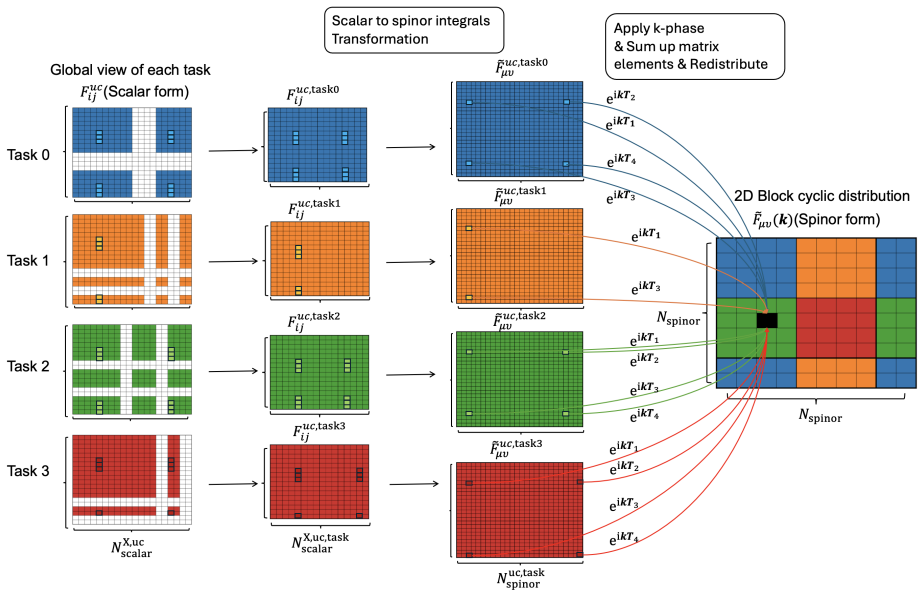
On its own terms, the paper shows that quasi-four-component (Q4C) relativistic DFT can be implemented with order-N real-space integration in distributed memory. Spinors are expanded in atom-centered basis functions whose small component is tied to the large component by a free-atom kinetic-balance operator, so only positive-energy states enter. Scalar integrals are evaluated on partitioned grid batches; each MPI task stores only its locally nonzero block, transforms it to spinor form with Clebsch-Gordan coefficients, and sums contributions with Bloch phases into a block-cyclic layout, never assembling the full matrix. Demonstration: band structures of Bi-doped lead-iodide perovskite supercel
What carries the argument
The central object is the quasi-four-component (Q4C) spinor basis: each four-component spinor is a linear combination of atom-centered spinors whose small component is generated from the large component by a fixed free-atom operator (atomic balance), so the basis contains separate radial functions for j=l+1/2 and j=l-1/2 channels from the start. The carrying mechanism is locally-indexed real-space domain decomposition: overlapping atom-centered integration grids are partitioned into per-task batches; each MPI task evaluates scalar-format integrals only over basis functions with nonzero support in its batches, transforms them to spinor form using Clebsch-Gordan coefficient matrices, and then
Load-bearing premise
The implementation assumes that the bookkeeping which maps local grid-batch contributions to their places in the global matrix captures every contribution exactly once; since the full matrix is never assembled for a cross-check, a dropped or double-counted batch would silently corrupt the band structure.
What would settle it
Run the same small periodic system (for example the 40-atom CsPbBr3 cell at one k-point) through the distributed path and through a single-task, full-matrix assembly, and compare the Hamiltonian and overlap matrix elements or the resulting eigenvalues to tight numerical tolerance. Any discrepancy beyond integration tolerance would show that the locally-indexed decomposition is incomplete; agreement would validate the phase and index bookkeeping.
If this is right
- Defect-scale supercells of heavy-element semiconductors can be treated at a fully relativistic, self-consistent level, including spin-orbit coupling from the start, rather than only as a post-processing correction.
- The two-step scalar-relativistic plus non-self-consistent SOC route is shown to be incomplete for such systems: without separate p1/2 radial functions it can misplace valence bands and defect states relative to Q4C.
- Real-space integration and density update scale roughly linearly with system size, while the dense eigenproblem dominates; the near-ideal 336-to-672-core speedup suggests the implementation is not yet at its scaling limit.
- The Q4C calculation needs four times as many scalar basis functions as scalar relativity and raises eigenproblem time by roughly 18-24x, identifying the eigensolver as the critical bottleneck for even larger cells.
Where Pith is reading between the lines
- If the order-N integration claim holds, the practical ceiling for fully relativistic periodic DFT is set by the dense eigensolver, so iterative or localized eigensolvers could push the demonstrated few-thousand-atom limit substantially higher.
- The same locally-indexed decomposition and block-cyclic assembly pattern could in principle be lifted into other local-basis relativistic codes, since it is formulated in terms of scalar partial integrals and Clebsch-Gordan transformations rather than code-specific data structures.
- The Q4C band differences for the doped perovskites are specific enough to be tested: optical or transport measurements sensitive to the Bi-derived defect level, or a reference four-component calculation on a smaller cell, would indicate whether the extra gap reduction and level shifts are quantitatively right.
Editorial analysis
A structured set of objections, weighed in public.
Referee Report
Summary. The paper describes a distributed-memory parallel implementation of quasi-four-component (Q4C) relativistic DFT in FHI-aims using numeric atom-centered orbitals. The authors use a locally-indexed real-space domain decomposition for the Hamiltonian, overlap, and density-update integrations, transform scalar matrix elements to the spinor basis, redistribute them into a block-cyclic layout, and solve the generalized eigenvalue problem with ELPA via ELSI. They benchmark the code on CsPbBr3 supercells and on Bi-doped (PEA)2(Pb1-xBix)I4 supercells up to 3,383 atoms (216,628 scalar basis functions), reporting near-ideal strong scaling between 336 and 672 CPU cores and reduced per-task memory with more nodes. They also present SR, SR+SOC, and Q4C band structures for the 1,504- and 3,383-atom perovskite supercells. The central claim is that the implementation extends fully relativistic DFT to several thousand atoms per unit cell while retaining near-linear real-space integration and efficient distributed eigensolution.
Significance. If the implementation is correct, this is a substantial advance for relativistic DFT: it moves four-component-type calculations from the ~100-atom scale to the few-thousand-atom scale for periodic systems, using a well-described algorithmic framework and publicly deposited data. The scaling evidence in Tables I and II and Fig. 6 supports the parallel-efficiency claims for the tested range, and the paper is transparent about the underlying approximations (Dirac-Coulomb Hamiltonian, scalar-relativistic xc functional). The authors also provide machine-readable input structures and timing/memory data, which is a strength. However, the physical validity of the large-scale results rests on the completeness and correctness of the distributed matrix assembly, and the paper does not yet supply a direct numerical verification against an independent full-matrix construction or the previously validated Q4C implementation. That missing check is the main uncertainty.
major comments (2)
- [Sec. III A, Eqs. (33)-(36) and Algorithm 1] The correctness of the distributed assembly is asserted but not verified. The global spinor Hamiltonian/overlap matrices are assembled by summing per-task partial integrals and k-phases (Eqs. 33-36), with the statement that the full matrix is never gathered. A dropped or double-counted batch contribution, or a phase/index error, would leave all timings and scalability results unchanged while making the band structures wrong. The paper does not compare against the previous validated Q4C implementation (Ref. 3) even for a small molecule or small supercell, nor against a serial full-matrix construction, and the NOMAD deposit does not include raw matrices. Please add a numerical validation: reproduce total energies and/or band structures for a small system with both the new parallel code and the previous implementation, or compare selected assembled H/S matrix elements against a reference fu
- [Sec. IV A, Table II and surrounding text] The sentence 'Decreasing the node counts from 16 to 8 effectively reduces the maximum peak memory by nearly 55–63%' contradicts Table II. Going from 16 to 8 nodes increases per-task peak memory from 1693 to 2688 MB (1504-atom system) and from 3096 to 5585 MB (3383-atom system). The actual per-task memory reductions when going from 8 to 16 nodes are about 37% and 45%, not 55–63%. Please correct the direction and the percentages, or rewrite the sentence to describe the memory-per-task reduction as the node count is increased.
minor comments (7)
- [Sec. IV B, Fig. 7] The text appears to swap panels (b) and (d) for the 1504-PEPI case: it refers to 'the SR band structure from Fig. 7 (d)' and 'The quasi-four-component (Q4C) from Fig.7 (b)', while the caption labels (b) as SR and (d) as Q4C. Please correct the references.
- [Sec. IV A, memory paragraph] The statement that D_S accounts for 'roughly 15–20%' of peak per-task memory is slightly off for the 1504-atom cases (about 21%). Please check the rounding.
- [Eq. (36)] There is a typo in the phase factor: it should be T_{M(µ')}, not 'T_{M)(µ')'.
- [Fig. 6] The axes of Fig. 6(b) are not described in the text. Please define the abscissa (e.g., number of atoms or basis functions) and state whether the plot uses logarithmic axes, so the claimed O(N)/near-ideal scaling can be read quantitatively.
- [Sec. V] Typo: 'Several directions are are still needed' should be 'Several directions are still needed'.
- [Sec. IV B] The strong-scaling claim rests on only one doubling (336 to 672 cores). This is acceptable for the stated range, but a third data point or a weak-scaling test would strengthen the generality of the 'nearly ideal' conclusion.
- [Sec. II A / Abstract] The paper uses the phrase 'fully relativistic DFT' while explicitly neglecting orbital current terms and using scalar-relativistic xc functionals. These qualifications are stated in Sec. II A; consider repeating a brief qualifier in the abstract or conclusions to avoid overstatement.
Circularity Check
No significant circularity: the paper's central claims are direct benchmarks and demonstrable band structures, not outputs forced by fitted inputs or self-citation.
full rationale
The paper's central assertions—per-SCF wall times, scaling factors, peak memory, and band structures for the 1504- and 3383-atom supercells—are direct measurements of an implementation, not quantities derived from fitted parameters. No parameter is fitted to the scaling result and no physical prediction is extracted from a fit; the timings are presented as measured outcomes. The derivation of the Q4C Hamiltonian (Eqs. 16-19) follows from the free-atom Dirac radial solutions and the kinetic-balance relation for the basis, which are stated assumptions rather than restatements of the paper's benchmark conclusions. The paper does rely on prior work by the same authors (Ref. 3 for Q4C, Refs. 18/37 for FHI-aims locally indexed grids, Refs. 33-35 for ELPA/ELSI), but this is disclosed lineage and is not load-bearing in a circular sense: the scalable distributed-memory assembly in Section III A is the new contribution and its correctness is asserted algorithmically, not imported as a pre-fitted result. The absence of an independent full-matrix cross-check is a correctness risk (a dropped or double-counted batch would invalidate the band structures while leaving timings intact), but no equation in the paper defines the benchmark output in terms of an input fitted to that output, so this does not constitute circularity under the specified standards.
Axiom & Free-Parameter Ledger
axioms (6)
- domain assumption Dirac-Coulomb Hamiltonian under the no-pair approximation, without orbital currents
- domain assumption Q4C shares one coefficient vector C+ between large and small components (Eq. 6)
- domain assumption Atomic-balance kinetic identities, Eqs. (17a,b), with free-atom epsilon and V
- domain assumption Overlapping atom-centered grids with Stratmann partition-of-unity weights
- standard math Locally-indexed sum over batches/tasks equals the global matrix element
- domain assumption PBE exchange-correlation functional is the DFT approximation
Cite this review
Pith. "Pith review of A Large-scale Parallel Implementation of Quasi-Four-Component Relativistic Density Functional Theory with Numeric Atom-centered Orbitals." pith.science (2026). https://pith.science/paper/2BHQFXKC
@misc{pith2026260800773,
  author       = {Pith},
  title        = {Pith review of: A Large-scale Parallel Implementation of Quasi-Four-Component Relativistic Density Functional Theory with Numeric Atom-centered Orbitals},
  year         = {2026},
  howpublished = {\url{https://pith.science/paper/2BHQFXKC}},
  note         = {Machine review of arXiv:2608.00773}
}
read the original abstract
We present a large-scale parallel implementation of fully relativistic density functional theory (DFT) for both molecules and periodic solids, using the quasi-four-component (Q4C) method and numeric atom-centered orbital basis sets. Our approach employs a domain decomposition method on nonuniform real-space integration grids, which enables order-N integration of the Q4C Hamiltonian matrix elements using efficient, distributed-memory and compute-parallel real-space operations. Next, we build the Hamiltonian and overlap matrices in a two-dimensional block-cyclic distribution layout. The resulting generalized eigenvalue problems are solved with the massively parallel ELPA eigenvalue solver library. We benchmark memory usage, parallel efficiency, and scalability across multiple MPI tasks and compute nodes. This algorithm extends the reach of fully relativistic DFT simulations for periodic solids, tested up to 3,383 atoms per unit cell (216,628 basis functions) and likely still well below the true reach of the implementation. As a demonstration, we calculate the fully relativistic band structure for a 3,383 atom-per-unit-cell doped hybrid organic-inorganic perovskite, (PEA)2(Pb1-xBix)I4 (PEA=phenethylammonium), showing nearly ideal scalability between 336 and 672 physical CPU cores.
Figures




Reference graph
Works this paper leans on
-
[1]
https://pubchem.ncbi.nlm.nih.gov/compound/241 title PubChem Compound Summary for CID 241, Benzene, Retrieved June 3, 2026 from \\ https://pubchem.ncbi.nlm.nih.gov/compound/benzene. \ ( year 2026 ) NoStop
work page 2026
-
[2]
author author Y. Baskin \ and\ author L. Meyer ,\ 10.1103/PhysRev.100.544 journal journal Phys. Rev. \ volume 100 ,\ pages 544 ( year 1955 ) NoStop
-
[3]
author author C. C. \ Stoumpos , author C. D. \ Malliakas , author J. A. \ Peters , author Z. Liu , author M. Sebastian , author J. Im , author T. C. \ Chasapis , author A. C. \ Wibowo , author D. Y. \ Chung , author A. J. \ Freeman , author B. W. \ Wessels , \ and\ author M. G. \ Kanatzidis ,\ 10.1021/cg400645t journal journal Crystal Growth & Design \ v...
-
[4]
author author H. Lu , author G. Koknat , author Y. Yao , author J. Hao , author X. Qin , author C. Xiao , author R. Song , author F. Merz , author M. Rampp , author S. Kokott , author C. Carbogno , author T. Li , author G. Teeter , author M. Scheffler , author J. J. \ Berry , author D. B. \ Mitzi , author J. L. \ Blackburn , author V. Blum , \ and\ author...
-
[5]
Dirac ,\ @noop journal journal Proc
author author P. Dirac ,\ @noop journal journal Proc. Roy. Soc. London. Series A \ volume 117 ,\ pages 610 ( year 1928 ) NoStop
work page 1928
-
[6]
author author W. P. \ Huhn \ and\ author V. Blum ,\ 10.1103/PhysRevMaterials.1.033803 journal journal Phys. Rev. Mater. \ volume 1 ,\ pages 033803 ( year 2017 ) NoStop
-
[7]
author author R. Zhao , author V. W.-z. \ Yu , author K. Zhang , author Y. Xiao , author Y. Zhang , \ and\ author V. Blum ,\ 10.1103/PhysRevB.103.245144 journal journal Phys. Rev. B \ volume 103 ,\ pages 245144 ( year 2021 ) NoStop
-
[8]
author author D. D. \ Koelling \ and\ author B. N. \ Harmon ,\ 10.1088/0022-3719/10/16/019 journal journal Journal of Physics C: Solid State Physics \ volume 10 ,\ pages 3107 ( year 1977 ) NoStop
-
[9]
author author L. Keller , author V. Blum , author P. Rinke , \ and\ author D. Golze ,\ 10.1063/5.0018231 journal journal The Journal of Chemical Physics \ volume 153 ,\ pages 114110 ( year 2020 ) NoStop
-
[10]
author author J. Autschbach ,\ 10.1098/rsta.2012.0489 journal journal Philosophical Transactions of the Royal Society A: Mathematical, Physical and Engineering Sciences \ volume 372 ,\ pages 20120489 ( year 2014 ) ,\ http://arxiv.org/abs/https://royalsocietypublishing.org/rsta/article-pdf/doi/10.1098/rsta.2012.0489/399878/rsta.2012.0489.pdf https://royals...
-
[11]
author author W. Liu , author F. Wang , \ and\ author L. Li ,\ 10.1142/S0219633603000471 journal journal Journal of Theoretical and Computational Chemistry \ volume 02 ,\ pages 257 ( year 2003 ) NoStop
-
[12]
author author Y. Zhang , author B. Suo , author Z. Wang , author N. Zhang , author Z. Li , author Y. Lei , author W. Zou , author J. Gao , author D. Peng , author Z. Pu , author Y. Xiao , author Q. Sun , author F. Wang , author Y. Ma , author X. Wang , author Y. Guo , \ and\ author W. Liu ,\ 10.1063/1.5143173 journal journal The Journal of Chemical Physic...
-
[13]
author author D. A. \ Rehn , author J. M. \ Wills , author T. E. \ Battelle , \ and\ author A. E. \ Mattsson ,\ 10.1103/PhysRevB.101.085114 journal journal Physical Review B \ volume 101 ,\ pages 085114 ( year 2020 ) NoStop
-
[14]
author author P. Blaha , author K. Schwarz , author F. Tran , author R. Laskowski , author G. K. H. \ Madsen , \ and\ author L. D. \ Marks ,\ 10.1063/1.5143061 journal journal The Journal of Chemical Physics \ volume 152 ,\ pages 074101 ( year 2020 ) NoStop
-
[15]
author author T. Saue \ and\ author T. Helgaker ,\ https://doi.org/10.1002/jcc.10066 journal journal Journal of Computational Chemistry \ volume 23 ,\ pages 814 ( year 2002 ) NoStop
-
[16]
author author L. Belpassi , author M. De Santis , author H. M. \ Quiney , author F. Tarantelli , \ and\ author L. Storchi ,\ 10.1063/5.0002831 journal journal The Journal of Chemical Physics \ volume 152 ,\ pages 164118 ( year 2020 ) NoStop
-
[17]
author author M. Kadek , author M. Repisky , \ and\ author K. Ruud ,\ 10.1103/PhysRevB.99.205103 journal journal Phys. Rev. B \ volume 99 ,\ pages 205103 ( year 2019 ) NoStop
-
[18]
author author D. B. \ Williams-Young , author A. Petrone , author S. Sun , author T. F. \ Stetina , author P. Lestrange , author C. E. \ Hoyer , author D. R. \ Nascimento , author L. Koulias , author A. Wildman , author J. Kasper , author J. J. \ Goings , author F. Ding , author A. E. \ DePrince III , author E. F. \ Valeev , \ and\ author X. Li ,\ @noop j...
work page 2019
-
[19]
author author L. Visscher \ and\ author E. van Lenthe ,\ https://doi.org/10.1016/S0009-2614(99)00458-3 journal journal Chemical Physics Letters \ volume 306 ,\ pages 357 ( year 1999 ) NoStop
-
[20]
author author W. A. \ de Jong , author R. J. \ Harrison , \ and\ author D. A. \ Dixon ,\ 10.1063/1.1329891 journal journal The Journal of Chemical Physics \ volume 114 ,\ pages 48 ( year 2001 ) NoStop
-
[21]
author author A. D. \ Becke ,\ 10.1063/1.454033 journal journal The Journal of Chemical Physics \ volume 88 ,\ pages 2547 ( year 1988 ) NoStop
doi:10.1063/1.454033 1988
-
[22]
author author V. Blum , author R. Gehrke , author F. Hanke , author P. Havu , author V. Havu , author X. Ren , author K. Reuter , \ and\ author M. Scheffler ,\ https://doi.org/10.1016/j.cpc.2009.06.022 journal journal Computer Physics Communications \ volume 180 ,\ pages 2175 ( year 2009 ) NoStop
-
[23]
author author V. Havu , author V. Blum , author P. Havu , \ and\ author M. Scheffler ,\ https://doi.org/10.1016/j.jcp.2009.08.008 journal journal Journal of Computational Physics \ volume 228 ,\ pages 8367 ( year 2009 ) NoStop
-
[24]
uneis , author J. G\
author author J. W. \ Abbott , author C. M. \ Acosta , author A. Akkoush , author A. Ambrosetti , author V. Atalla , author A. Bagrets , author J. Behler , author D. Berger , author H. Bertschi , author B. Bieniek , author J. Bj\"ork , author V. Blum , author S. Bohloul , author C. L. \ Box , author N. Boyer , author D. S. \ Brambila , author G. A. \ Bram...
2026
-
[25]
author author A. K. \ Rajagopal \ and\ author J. Callaway ,\ 10.1103/PhysRevB.7.1912 journal journal Phys. Rev. B \ volume 7 ,\ pages 1912 ( year 1973 ) NoStop
-
[26]
author author A. K. \ Rajagopal ,\ 10.1088/0022-3719/11/24/002 journal journal Journal of Physics C: Solid State Physics \ volume 11 ,\ pages L943 ( year 1978 ) NoStop
-
[27]
author author K. G. \ Dyall \ and\ author K. F gri Jr. ,\ @noop title Introduction to Relativistic Quantum Chemistry \ ( publisher Oxford University Press ,\ year 2007 ) NoStop
work page 2007
-
[28]
author author J. Autschbach ,\ 10.1063/1.3702628 journal journal The Journal of Chemical Physics \ volume 136 ,\ pages 150902 ( year 2012 ) NoStop
-
[29]
author author A. Almoukhalalati , author S. Knecht , author H. J. A. \ Jensen , author K. G. \ Dyall , \ and\ author T. Saue ,\ 10.1063/1.4959452 journal journal The Journal of Chemical Physics \ volume 145 ,\ pages 074104 ( year 2016 ) NoStop
-
[30]
author author W. Liu \ and\ author D. Peng ,\ 10.1063/1.3159445 journal journal The Journal of Chemical Physics \ volume 131 ,\ pages 031104 ( year 2009 ) NoStop
-
[31]
author author W. Kutzelnigg \ and\ author W. Liu ,\ 10.1063/1.2137315 journal journal The Journal of Chemical Physics \ volume 123 ,\ pages 241102 ( year 2005 ) NoStop
-
[32]
author author K. G. \ Dyall ,\ 10.1063/1.473860 journal journal The Journal of Chemical Physics \ volume 106 ,\ pages 9618 ( year 1997 ) NoStop
-
[33]
author author W. Liu \ and\ author D. Peng ,\ 10.1063/1.2222365 journal journal The Journal of Chemical Physics \ volume 125 ,\ pages 044102 ( year 2006 ) NoStop
-
[34]
author author L. Visscher , author P. J. C. \ Aerts , author O. Visser , \ and\ author W. C. \ Nieuwpoort ,\ https://doi.org/10.1002/qua.560400816 journal journal International Journal of Quantum Chemistry \ volume 40 ,\ pages 131 ( year 1991 ) NoStop
-
[35]
author author O. Čertík , author J. E. \ Pask , \ and\ author J. Vackář ,\ https://doi.org/10.1016/j.cpc.2013.02.014 journal journal Computer Physics Communications \ volume 184 ,\ pages 1777 ( year 2013 ) NoStop
-
[36]
author author A. Marek , author V. Blum , author R. Johanni , author V. Havu , author B. Lang , author T. Auckenthaler , author A. Heinecke , author H.-J. \ Bungartz , \ and\ author H. Lederer ,\ 10.1088/0953-8984/26/21/213201 journal journal Journal of Physics: Condensed Matter \ volume 26 ,\ pages 213201 ( year 2014 ) NoStop
-
[37]
author author V. W. \ zhe Yu , author F. Corsetti , author A. García , author W. P. \ Huhn , author M. Jacquelin , author W. Jia , author B. Lange , author L. Lin , author J. Lu , author W. Mi , author A. Seifitokaldani , author Álvaro Vázquez-Mayagoitia , author C. Yang , author H. Yang , \ and\ author V. Blum ,\ https://doi.org/10.1016/j.cpc.2017.09.007...
-
[38]
author author V. W. \ zhe Yu , author C. Campos , author W. Dawson , author A. García , author V. Havu , author B. Hourahine , author W. P. \ Huhn , author M. Jacquelin , author W. Jia , author M. Keçeli , author R. Laasner , author Y. Li , author L. Lin , author J. Lu , author J. Moussa , author J. E. \ Roman , author Álvaro Vázquez-Mayagoitia , author C...
-
[39]
author author F. Knuth , author C. Carbogno , author V. Atalla , author V. Blum , \ and\ author M. Scheffler ,\ https://doi.org/10.1016/j.cpc.2015.01.003 journal journal Computer Physics Communications \ volume 190 ,\ pages 33 ( year 2015 ) NoStop
- [40]
-
[41]
author author S. Kokott , author F. Merz , author Y. Yao , author C. Carbogno , author M. Rossi , author V. Havu , author M. Rampp , author M. Scheffler , \ and\ author V. Blum ,\ 10.1063/5.0208103 journal journal The Journal of Chemical Physics \ volume 161 ,\ pages 024112 ( year 2024 ) NoStop
-
[42]
author author B. Delley ,\ 10.1063/1.458452 journal journal The Journal of Chemical Physics \ volume 92 ,\ pages 508 ( year 1990 ) NoStop
-
[43]
author author V. Lebedev ,\ https://doi.org/10.1016/0041-5553(75)90133-0 journal journal USSR Computational Mathematics and Mathematical Physics \ volume 15 ,\ pages 44 ( year 1975 ) NoStop
-
[44]
author author V. Lebedev ,\ https://doi.org/10.1016/0041-5553(76)90100-2 journal journal USSR Computational Mathematics and Mathematical Physics \ volume 16 ,\ pages 10 ( year 1976 ) NoStop
-
[45]
author author R. Stratmann , author G. E. \ Scuseria , \ and\ author M. J. \ Frisch ,\ https://doi.org/10.1016/0009-2614(96)00600-8 journal journal Chemical Physics Letters \ volume 257 ,\ pages 213 ( year 1996 ) NoStop
-
[46]
author author J. P. \ Perdew , author K. Burke , \ and\ author M. Ernzerhof ,\ 10.1103/PhysRevLett.77.3865 journal journal Phys. Rev. Lett. \ volume 77 ,\ pages 3865 ( year 1996 ) NoStop
-
[47]
author author S. Sun , author T. F. \ Stetina , author T. Zhang , author H. Hu , author E. F. \ Valeev , author Q. Sun , \ and\ author X. Li ,\ 10.1021/acs.jctc.1c00137 journal journal Journal of Chemical Theory and Computation \ volume 17 ,\ pages 3388 ( year 2021 ) ,\ note pMID: 34029469 NoStop
-
[48]
author author M. A. \ Blanco , author M. Flórez , \ and\ author M. Bermejo ,\ https://doi.org/10.1016/S0166-1280(97)00185-1 journal journal Journal of Molecular Structure: THEOCHEM \ volume 419 ,\ pages 19 ( year 1997 ) NoStop
discussion (0)
Sign in with ORCID, Apple, or X to comment. Anyone can read and Pith papers without signing in.