REVIEW 3 major objections 5 minor 42 references
A 13,000-parameter model produces calibrated trajectory bands for differential equations it has never seen.
Reviewed by Pith at T0; open to challenge. T0 means a machine referee read the full paper against a public rubric. the ladder, T0–T4 →
T0 review · deepseek-v4-flash
2026-08-05 00:12 UTC pith:NW3BDU74
load-bearing objection A genuinely useful hypergraph surrogate for mass-conserving ODEs, with a real overreach in the 'arbitrary parameter distribution' claim that should be fixed before acceptance. the 3 major comments →
HyperODE: Zero-Shot Surrogate for Simulation and Inference of Dynamical Systems
The pith
A machine-rendered reading of the paper's core claim, the machinery that carries it, and where it could break.
Core claim
HyperODE's central claim is that zero-shot transfer across ODE structures is possible if the functional form of the dynamics is separated from the neural architecture. A system's ODE is converted into a directed hypergraph: each state is a node, each additive monomial term is a directed hyperedge with the involved states as sources and the updated state as target, and parameter distributions are attached as quantile-valued edge features. A single shared operator pools source states, multiplies their raw values in a mass-action product, and emits a message scaled by the edge coefficient; integrating the resulting field with a fixed-step solver yields quantile trajectories for every state. Tra
What carries the argument
The central object is a directed hypergraph neural ODE: each additive monomial on the right-hand side of the ODE becomes a hyperedge from its source states to its target state, and every hyperedge is processed by the same small MLP operator shared across the whole system. The operator pools the source hidden states, forms the exact mass-action product of the raw source states, concatenates the product with the hyperedge size and features, and produces a message summed into the target node's derivative. Each node and each edge carries a vector of quantiles rather than a scalar, so the same network represents parameter and trajectory distributions. The explicit product is the load-bearing indu
Load-bearing premise
The transfer claim rests on the trained operator being generic enough that structural changes—new compartments, larger networks, higher-order terms, broken conservation, or time-varying coefficients—fall within what the training distribution of small mass-conserving polynomial systems already taught it.
What would settle it
Take the frozen pretrained operator and evaluate it on a new mass-conserving compartmental family with quadratic monomials but a topology unlike ring-coupled meta-populations, such as a dense random directed reaction graph with cycles, at sizes up to 128 states and parameter distributions it never saw; if the 90% band coverage falls far from 0.90 or the weighted-interval score grows sharply with system size, the zero-shot claim is false.
If this is right
- A single frozen HyperODE model replaces per-structure surrogates for compartmental and reaction-network ODEs: on held-out SEIR systems up to 257 states and random reaction networks up to 128 states it keeps coverage near 0.90 without retraining.
- Cross-structure training is not a compromise: the generalist beats a same-architecture specialist trained on each structure by 7–11% in weighted-interval score.
- For inverse calibration, the shared encoder turns a noisy trajectory into parameter quantiles in 6–13 ms, competitive with per-structure NPE/NRE and with limited-budget MCMC, and the gradient-based inverse is the most accurate method in the comparison.
- External forcing can be added after training by swapping in a time-varying hypergraph: seasonal SEIR is reproduced to about 2–5% relative error with coverage near 0.91.
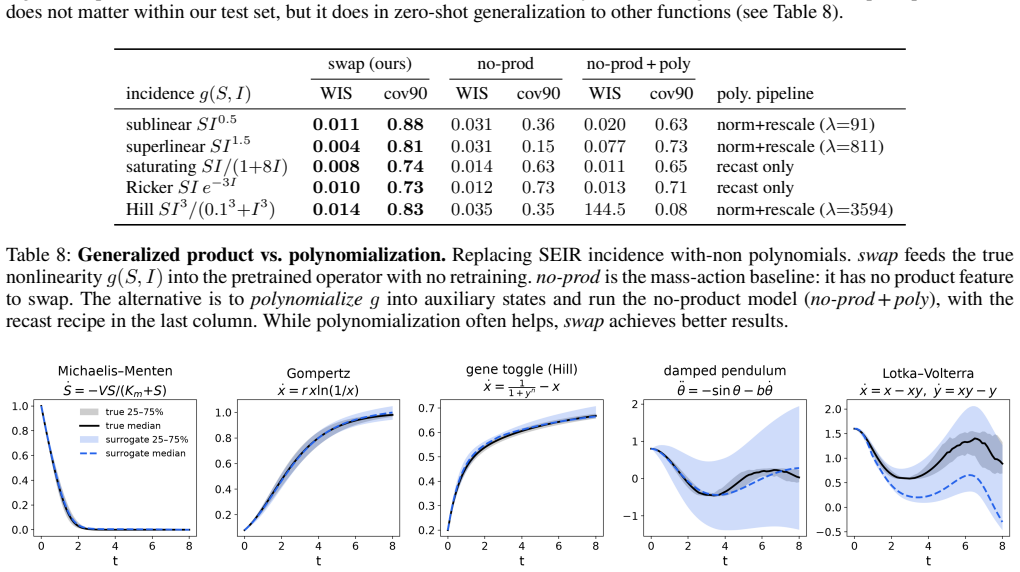
- The product feature can be replaced at inference by any nonnegative driving nonlinearity, letting the same operator integrate non-polynomial incidence functions (saturating, Ricker, Hill) and other ODE families without retraining.
Where Pith is reading between the lines
- An untested extension of the generalized-product result: the frozen operator should be probed on functional families it never saw in any form, such as cubic incidence without polynomialization or rational terms with state-dependent denominators, to see whether calibration holds or only the five reported swaps survive.
- The paper's two-stage variance argument implies a practical rule for any quantile-surrogate training pipeline: when between-system variance dominates, generate more ODE structures rather than more Monte Carlo rollouts per structure. The author's numbers support this for their class, and the rule should transfer wherever the same loss is used.
- The encoder is described as the transpose of the forward operator; a natural stress test is to feed it trajectories generated under a different observation model, such as aggregated counts or non-Gaussian noise, to see whether the shared structure still anchors calibration.
- If the zero-shot claims survive broader holdouts, the same hypergraph representation could be applied to semi-discretized partial differential equations, whose spatial terms are also sums of products of neighboring states; the paper does not attempt this.
Editorial analysis
A structured set of objections, weighed in public.
Referee Report
Summary. HyperODE is a hypergraph-neural-ODE surrogate for a class of mass-conserving polynomial compartmental/reaction ODEs. Given an ODE structure and a parameter distribution encoded by five quantiles per coefficient, it predicts per-state trajectory quantile bands in one forward pass. The same frozen surrogate is used for inverse calibration, either by gradient descent on parameter quantiles or through a single-pass GRU/message-passing encoder that maps noisy trajectories to parameter quantiles. Training uses SIS/SIR/SI and random reaction networks; evaluation is on held-out SEIR, larger system sizes, higher interaction orders, external forcing, vital dynamics, and selected non-polynomial terms via a product-feature swap. The paper reports WIS and coverage at the MC-oracle level for the forward task and millisecond-scale inverse inference that is competitive with MCMC and per-structure SBI on the tested cases.
Significance. If the central claims hold, this is a meaningful step toward reusable surrogates: a single roughly 13k-parameter model transfers across structures, scales, and interaction orders, and the explicit mass-action product is a clean, well-ablated inductive bias. The paper is stronger than typical surrogate papers because it uses structure-level OOD splits, compares against per-structure specialists, includes an MC-oracle floor and a Monte-Carlo sample-size ANOVA, and releases code. The inverse single-pass encoder, evaluated through the frozen surrogate, is a promising amortized alternative to MCMC for the tested families. The main qualifications are the lossy five-quantile representation of parameter distributions and the manual component of the non-polynomial extensions.
major comments (3)
- [Abstract; Quantile (UQ) Forward Surrogate] The abstract claims the method handles 'an arbitrary parameter distribution defined through quantiles.' This is not supported: the input representation is a Q=5 quantile vector per coefficient, and distinct distributions can share the same five quantiles while inducing different trajectory quantiles. Example: A is beta=0.2 with probability 0.5 and beta=0.8 with probability 0.5; B is beta=0.2 with probability 0.5, uniform(0.2,0.8) with probability 0.25, and beta=0.8 with probability 0.25. Both have quantiles (0.2,0.2,0.2,0.8,0.8), but under a nonlinear ODE their Monte-Carlo trajectory quantiles differ. Because HyperODE is deterministic in these edge features, it must emit the same band for both. This is a representational identifiability issue in the core forward machinery, not an OOD generalization issue, and the Appendix's K-sufficiency ANOVA addresses rollout noise rather than input am
- [Extension: Generalized Product; Table 8] The zero-shot claims for non-polynomial terms rely on replacing the mass-action product feature with the true nonlinearity g(S,I) and on per-family shifting/normalization and rescaling constants (lambda=91, 811, 3594 in the 'poly. pipeline' column). This requires the user to know the exact functional form and to tune constants; it is not a property of the frozen pretrained model alone. The 'no-prod+poly' baseline also involves hand-specified recasting. These experiments should be presented as proof-of-concept demonstrations with a clear statement of which components are automatic and which require manual specification; as written, 'zero-shot' is overstated.
- [Inverse: Noisy Data to Calibration; Single-pass Encoder] The inverse task is described as recovering 'a distribution over the parameters,' but the encoder outputs a deterministic five-quantile vector per parameter, which is a lossy summary rather than a posterior or a full distribution. The paper correctly evaluates the posterior-predictive band rather than parameter recovery in the main experiments, and this is a defensible choice for unidentifiable systems. However, the terminology in the abstract and the method section should be adjusted, and the fact that the single-pass encoder's calibration is evaluated through the same frozen surrogate should be stated explicitly so that any forward-surrogate bias is transparent.
minor comments (5)
- [Experiments] Typo: 'We intende to demonstrate' should be 'We intend to demonstrate.' Also, Figure 1's caption and surrounding text refer to k coupled groups, but some notation is used before it is defined; a small notation table would help.
- [Method: HyperODE] The product term prod_h is written as a product of the raw state vectors x_s, but it is not explicitly stated that this is an elementwise product over the Q quantile dimensions. Please clarify, since this affects the interpretation of the network.
- [Table 1] The generalist-vs-specialist comparison reports WIS only, without standard errors or paired significance tests. Given the small WIS differences (7-11%), adding confidence intervals would strengthen the claim.
- [Appendix: Monte-Carlo Sample Size Sufficiency] The two-stage variance formula is a useful contribution, but the text should note that the unbiasedness holds for a fixed predictor; after training on the same rollouts, the empirical loss is not an unbiased estimate of the final model's generalization error. The reported SEs are still useful for a fixed test model.
- [Extension: Generalized Product] Figure 10 shows results on oscillators with the statement that the band 'over-covers,' but the reported WIS and coverage numbers for those cases are not given in the main text. Adding quantitative values would make the limitation concrete.
Circularity Check
Inverse encoder is evaluated through the same frozen surrogate it was trained against; the forward zero-shot claim is independent.
specific steps
-
fitted input called prediction
[Inverse: Noisy Data to Calibration (Single-pass Encoder) and Appendix Metrics]
"The encoder is trained through the frozen forward surrogate as a fixed decoder F: it predicts ˆθ=Eη(y), F re-simulates a band, and the loss is the reconstruction WIS against the observation, L(η)=WIS(D( ˆθ), y). ... For the inverse task we report the reconstruction WIS of the posterior-predictive band and coverage based on observed noisy trajectory."
The inverse encoder is fit by minimizing the WIS between the frozen surrogate's reconstruction D(θ̂) and the observed noisy trajectory y. For the same encoder, the inverse evaluation reports exactly the same reconstruction WIS and coverage of the same posterior-predictive band, generated by the same frozen surrogate. The reported calibration is therefore the training objective evaluated on held-out observations through the fitted simulator, not an independent measure against the true ODE or against MCMC's posterior-predictive band. Systematic surrogate errors can be exploited during training and remain invisible in this closed-loop evaluation, so the inverse 'competitive with existing methods' claim partially reduces to self-consistency. The forward zero-shot surrogate is trained and score
full rationale
The forward surrogate is a standard supervised quantile-regression model: it is trained by minimizing pinball (WIS) loss against Monte-Carlo rollouts of the true ODE and evaluated on out-of-distribution structures. This is genuine generalization, not a derivation loop. The architectural choice of an explicit mass-action product is an inductive bias tested by ablations, not a fitted parameter renamed as a prediction. The extensions (dynamic hypergraphs for forcing, generalized product with known nonlinearities) feed extra known structure into a frozen operator, which is not circular. The main circularity concern is confined to the inverse encoder: both training and evaluation use the same frozen forward surrogate as the decoder and the same reconstruction WIS as the metric, so the inverse calibration claim is partially self-referential. Because the forward claim is independently validated against MC oracles and the paper compares against external benchmarks, the overall circularity score is low.
Axiom & Free-Parameter Ledger
free parameters (5)
- Forward surrogate network weights (h32-L3) =
~13k parameters
- Inverse encoder network weights (h128-L2) =
~140k parameters
- K=48 Monte-Carlo rollouts per training system =
48
- Per-family product-swap rescale constants =
lambda=91 (SI^0.5), 811 (SI^1.5), 3594 (Hill); none for saturating and Ricker
- Architecture and training hyperparameters =
width 32, depth 3, lambda_mono=1, learning rate schedule, gradient clipping
axioms (6)
- domain assumption The training distribution of mass-conserving polynomial ODEs is representative of the target class of approximately mass-conserving compartmental and reaction models.
- domain assumption A shared hyperedge operator with an explicit mass-action product can represent the trajectory distribution map for the whole class.
- domain assumption Quantile-wise composition of separate state and coefficient marginal quantiles can be corrected by the network to produce calibrated trajectory bands.
- standard math Quadratization of non-polynomial ODEs via auxiliary variables is applicable and preserves boundedness and timescales.
- domain assumption The learned operator's locality and time-independence make dynamic hypergraph swaps (forcing) and clamped source or sink nodes (vital dynamics) valid zero-shot.
- standard math Two-stage sampling of systems and rollouts gives an unbiased estimate of population WIS with K=48.
invented entities (4)
-
Directed hypergraph representation of an ODE
no independent evidence
-
Aggregate pseudo-node in random reaction networks
no independent evidence
-
Auxiliary clamped source and sink nodes for vital dynamics
no independent evidence
-
Auxiliary state M=1/N for frequency-dependent transmission
no independent evidence
Cite this review
Pith. "Pith review of HyperODE: Zero-Shot Surrogate for Simulation and Inference of Dynamical Systems." pith.science (2026). https://pith.science/paper/NW3BDU74
@misc{pith2026260800852,
  author       = {Pith},
  title        = {Pith review of: HyperODE: Zero-Shot Surrogate for Simulation and Inference of Dynamical Systems},
  year         = {2026},
  howpublished = {\url{https://pith.science/paper/NW3BDU74}},
  note         = {Machine review of arXiv:2608.00852}
}
read the original abstract
Understanding and controlling complex dynamical systems often requires executing thousands of numerical simulations across vast parametric landscapes, which is time-consuming. Machine learning surrogates significantly accelerate simulation by predicting state trajectories across different initializations and parameter values. However, surrogate models are specialized to one simulation model. Modifying the underlying differential equations - e.g., adding a physiological state or altering an epidemiological contact network - renders trained models obsolete and forces computationally expensive retraining from scratch. We introduce HyperODE, a surrogate capable of operating across an entire class of approximately mass-conserving compartmental models without retraining. By mapping the structure of ordinary differential equations (ODEs) into directed hypergraphs, HyperODE decouples the functional form of system interactions from the neural network architecture. HyperODE takes a compartmental model in the form of an ODE with an arbitrary parameter distribution defined through quantiles and transforms it into a hypergraph. It outputs the distribution of the trajectories for all the states in the original ODE in the form of quantiles. We then use this surrogate to build an encoder that takes a noisy trajectory and outputs a distribution over the parameters of the original ODE, thus calibrating the model in a single pass. On families and system sizes never seen in training, HyperODE produces calibrated quantile bands in a single forward pass, with weighted-interval score and coverage on par with specialized surrogates for each structure. For inverse inference, HyperODE produces calibration from noisy state trajectories in a few milliseconds with a single shared encoder, competitive with existing methods. HyperODE extends zero-shot to ODEs that break mass conservation and to external forcing.
Figures




Reference graph
Works this paper leans on
-
[1]
1977 , publisher=
Sampling techniques , author=. 1977 , publisher=
1977
-
[2]
Modeling of Future COVID-19 Cases, Hospitalizations, and Deaths, by Vaccination Rates and Nonpharmaceutical Intervention Scenarios—United States, April--September 2021 , author=. MMWR. Morbidity and Mortality Weekly Report , volume=. 2021 , publisher=
work page 2021
-
[3]
Statistical inference using GLEaM model with spatial heterogeneity and correlation between regions , author=. Scientific Reports , volume=. 2022 , publisher=
work page 2022
-
[4]
Journal of Mathematical Physics , volume =
Universal Formats for Nonlinear Ordinary Differential Systems , author =. Journal of Mathematical Physics , volume =
-
[5]
Electronic Journal of Differential Equations , volume =
Some Properties of Solutions to Polynomial Systems of Differential Equations , author =. Electronic Journal of Differential Equations , volume =
-
[6]
Computational Methods in Systems Biology (CMSB) , year =
On the Complexity of Quadratization for Polynomial Differential Equations , author =. Computational Methods in Systems Biology (CMSB) , year =
-
[7]
Journal of the Royal Statistical Society: Series B , volume =
Bayesian Calibration of Computer Models , author =. Journal of the Royal Statistical Society: Series B , volume =
-
[8]
Learning Nonlinear Operators via
Lu, Lu and Jin, Pengzhan and Pang, Guofei and Zhang, Zhongqiang and Karniadakis, George Em , journal =. Learning Nonlinear Operators via
-
[9]
International Conference on Learning Representations (ICLR) , year =
Learning Mesh-Based Simulation with Graph Networks , author =. International Conference on Learning Representations (ICLR) , year =
-
[10]
Proceedings of the National Academy of Sciences , volume =
Machine Learning--Accelerated Computational Fluid Dynamics , author =. Proceedings of the National Academy of Sciences , volume =
-
[11]
Communication, Simulation, and Intelligent Agents: Implications of Personal Intelligent Machines for Medical Education
Clancey, William J. Communication, Simulation, and Intelligent Agents: Implications of Personal Intelligent Machines for Medical Education. Proceedings of the Eighth International Joint Conference on Artificial Intelligence (IJCAI-83)
-
[12]
Classification Problem Solving
Clancey, William J. Classification Problem Solving. Proceedings of the Fourth National Conference on Artificial Intelligence
-
[13]
, title =
Robinson, Arthur L. , title =. 1980 , doi =. https://science.sciencemag.org/content/208/4447/1019.full.pdf , journal =
1980
-
[14]
New Ways to Make Microcircuits Smaller---Duplicate Entry
Robinson, Arthur L. New Ways to Make Microcircuits Smaller---Duplicate Entry. Science
-
[15]
Clancey and Glenn Rennels , abstract =
Diane Warner Hasling and William J. Clancey and Glenn Rennels , abstract =. Strategic explanations for a diagnostic consultation system , journal =. 1984 , issn =. doi:https://doi.org/10.1016/S0020-7373(84)80003-6 , url =
-
[16]
and Rennels, Glenn R
Hasling, Diane Warner and Clancey, William J. and Rennels, Glenn R. and Test, Thomas. Strategic Explanations in Consultation---Duplicate. The International Journal of Man-Machine Studies
-
[17]
Poligon: A System for Parallel Problem Solving
Rice, James. Poligon: A System for Parallel Problem Solving
-
[18]
Transfer of Rule-Based Expertise through a Tutorial Dialogue
Clancey, William J. Transfer of Rule-Based Expertise through a Tutorial Dialogue
-
[19]
The Engineering of Qualitative Models
Clancey, William J. The Engineering of Qualitative Models
-
[20]
2023 , eprint=
Attention Is All You Need , author=. 2023 , eprint=
2023
-
[21]
Pluto: The 'Other' Red Planet
NASA. Pluto: The 'Other' Red Planet
-
[22]
Advances in Neural Information Processing Systems (NeurIPS) , year =
Neural Ordinary Differential Equations , author =. Advances in Neural Information Processing Systems (NeurIPS) , year =
-
[23]
arXiv preprint arXiv:1911.07532 , year =
Graph Neural Ordinary Differential Equations , author =. arXiv preprint arXiv:1911.07532 , year =
Pith/arXiv arXiv 1911
-
[24]
International Conference on Learning Representations (ICLR) , year =
Fourier Neural Operator for Parametric Partial Differential Equations , author =. International Conference on Learning Representations (ICLR) , year =
-
[25]
Proceedings of the National Academy of Sciences , volume =
Discovering Governing Equations from Data by Sparse Identification of Nonlinear Dynamical Systems , author =. Proceedings of the National Academy of Sciences , volume =
-
[26]
arXiv preprint arXiv:2001.04385 , year =
Universal Differential Equations for Scientific Machine Learning , author =. arXiv preprint arXiv:2001.04385 , year =
Pith/arXiv arXiv 2001
-
[27]
Journal of Computational Physics , volume =
Physics-Informed Neural Networks: A Deep Learning Framework for Solving Forward and Inverse Problems Involving Nonlinear Partial Differential Equations , author =. Journal of Computational Physics , volume =
-
[28]
Advances in Neural Information Processing Systems (NeurIPS) , year =
Fast -free Inference of Simulation Models with Bayesian Conditional Density Estimation , author =. Advances in Neural Information Processing Systems (NeurIPS) , year =
-
[29]
International Conference on Machine Learning (ICML) , year =
Automatic Posterior Transformation for Likelihood-Free Inference , author =. International Conference on Machine Learning (ICML) , year =
-
[30]
International Conference on Machine Learning (ICML) , year =
Likelihood-Free MCMC with Amortized Approximate Ratio Estimators , author =. International Conference on Machine Learning (ICML) , year =
-
[31]
Radev, Stefan T. and Mertens, Ulf K. and Voss, Andreas and Ardizzone, Lynton and K. IEEE Transactions on Neural Networks and Learning Systems , year =
-
[32]
Foundation Inference Models for Ordinary Differential Equations
Foundation Inference Models for Ordinary Differential Equations , author =. arXiv preprint arXiv:2602.08733 , year =
work page internal anchor Pith review Pith/arXiv arXiv
-
[33]
International Conference on Learning Representations (ICLR) , year =
d'Ascoli, St. International Conference on Learning Representations (ICLR) , year =
-
[34]
Journal of Open Source Software , volume =
sbi: A Toolkit for Simulation-Based Inference , author =. Journal of Open Source Software , volume =
-
[35]
AAAI Conference on Artificial Intelligence , year =
Hypergraph Neural Networks , author =. AAAI Conference on Artificial Intelligence , year =
-
[36]
Advances in Neural Information Processing Systems (NeurIPS) , year =
Interaction Networks for Learning about Objects, Relations and Physics , author =. Advances in Neural Information Processing Systems (NeurIPS) , year =
-
[37]
International Conference on Machine Learning (ICML) , year =
Learning to Simulate Complex Physics with Graph Networks , author =. International Conference on Machine Learning (ICML) , year =
-
[38]
Journal of Economic Perspectives , volume =
Quantile Regression , author =. Journal of Economic Perspectives , volume =
-
[39]
Journal of Machine Learning Research , volume =
A Tutorial on Conformal Prediction , author =. Journal of Machine Learning Research , volume =
-
[40]
PLOS Computational Biology , volume =
Evaluating Epidemic Forecasts in an Interval Format , author =. PLOS Computational Biology , volume =
-
[41]
Advances in Neural Information Processing Systems (NeurIPS) , year =
Hamiltonian Neural Networks , author =. Advances in Neural Information Processing Systems (NeurIPS) , year =
-
[42]
arXiv preprint arXiv:2003.04630 , year =
Lagrangian Neural Networks , author =. arXiv preprint arXiv:2003.04630 , year =
Pith/arXiv arXiv 2003
discussion (0)
Sign in with ORCID, Apple, or X to comment. Anyone can read and Pith papers without signing in.