Combinatorics · arXiv:2608.00899 v3 · submitted 1 Aug 2026
Asymptotically optimal bracketing covers for anchored boxes with applications to star discrepancy
The paper says
“Bracketing covers and δ-covers provide finite discretizations of the anchored boxes that define the star discrepancy. Let N[](d,δ) and N(d,δ) denote the corresponding bracketing and covering numbers.”
more of the abstract
We prove the lower bounds \[ N_[](d,\delta)\ge \lceil \delta^-dc̊eil, \qquad N(d,\delta)\ge \left\lceil \fracd!d^d\,\delta^-di̊ghtc̊eil. \] We give two explicit constructions of bracketing covers. For every fixed d, together with the lower bound they imply N[](d,δ) = (1 + od(1))δ−d as $\delta\downarrow0$. A first construction uses box-dependent anisotropic local grids and gives simple explicit bounds. A second, homothetic logarithmic-shell construction again attains this coefficient and gives $\limsup_{d\to\infty}N_{[]}(d,\delta)^{1/d}\le\delta^{-1}+e+O(\delta)$ as $\delta\downarrow0$. Combining these finite estimates with Gnewuch's general bracketing bound and a Hoeffding–Bernstein chaining argument shows that, for every d,n ∈ ℕ, there exists an n-point set with star discrepancy at most 2.3463√(d/n). Consequently, $\lceil5.5052d\varepsilon^{-2}\rceil$ points suffice for star discrepancy at most ε.
from the abstract
Pith says
Machine review · deepseek-v4-flash · 15 Aug 2026 · of version 1 of the paper; version 3 is newer · what was read was not recorded · not checked by a person
It can be wrong. Challenge this review or reply to it.
Holds up. Sharp fixed-d asymptotics for bracketing covers of anchored boxes, closing a constant left open for d>=3; the main inequalities check out. This line is wrong
2 minor
How often objections from reviews like this one are right: not yet measured
Not checked: figures, code, what the references say.
2 minor objections
The paper says, at Corollary 5.2 (proof)
Pith says: minor objection 1 of 2
After the choice K=⌈√(A_{d,δ}/(2δ))⌉, the displayed inequalities A_{d,δ}/(2K)≤√(A_{d,δ}δ)/2 and δK≤√(A_{d,δ}δ)/2+δ are not both correct in general (for example, A=1, δ=0.01, K=8 gives A/(2K)=0.0625>0.05=√(Aδ)/2). The intended estimate (16) follows instead from A/(2K)≤√(Aδ/2) and δK≤√(Aδ/2)+δ, whose sum is √(2Aδ)+δ; the same repair is needed in the estimates used for the covering bound (17).
The paper says, at Title
Pith says: minor objection 2 of 2
The title contains a typo: 'ASYMPTOTICALL Y' should read 'ASYMPTOTICALLY'.
What would settle it
Independently verify Lemma 4.1 numerically for d=3: for each s=1,2,3 and for K∈{10,10^3,10^5} with δ=10^{-3}, confirm that (T_{s−1})^s (T_s)^{d−s} ≤ K^{d−s}(T_{d−1})^s, where T_p=∑_{r=1}^K(δ+r(1−δ)/K)^p. If the inequality fails for any choice, the upper-bound count in (11) does not follow and the asymptotic coefficient 1 is unproven.
from the skeptic's reading
How the review went
4 readings by deepseek-v4-flash · 15 Aug 2026
- Reader holds up
- Skeptic agrees
- Editor wrote the verdict above
- Referee minor revision: 2 minor
Not run on this paper: the simulated authors' defence.
Pith did not check this review's objections against the paper.
The review in full
The review in brief, machine-written
The paper proves lim_{delta->0} deltad N[](d,delta) = 1 for every fixed d. That settles a question that was open for d>=3, where the leading coefficient was only bracketed between 1 and dd/d!. Dimension two was known; this extends it cleanly to all dimensions.
The lower bound is the real novelty. The measure nu_d in (6) has mass at most deltad on every delta-bracket, via two AM-GM steps. I re-derived (7) and it holds exactly as stated, with equality only for homothetic brackets. The upper bound is a coarse partition with box-dependent anisotropic local grids. The telescoping identity verifies the bracket condition, and the counting contracts correctly through Holder. The Euler-Maclaurin estimate in Section 5 makes the asymptotic explicit. I found no gaps, no circular steps, and no hidden dependence on K. The stress-test note is accurate: every load-bearing inequality checks out.
Credit where due: this is a clean solution of a genuine open problem. The writing is honest about what is not solved: the delta-cover coefficient remains between d!/dd and 1, and the authors note their fixed-d asymptotics do not improve inverse-discrepancy constants. The AI-use disclosure is transparent, and the math appears independently verified.
Soft spots, in proportion: the delta-cover result is incomplete in the sense that the upper and lower coefficients do not match, so the main asymptotic theorem is only for bracketing numbers. That is not a flaw in the paper; it is a stated boundary. The construction is intricate, and the paper is a bit terse about why the measure in (6) was chosen beyond the algebraic fit. A short remark on the geometric intuition would help. These are expositional nits, not mathematical concerns. The explicit bounds in Corollary 5.3 have constants that are clearly not optimal, but that is not the main point.
Who this is for: discrepancy theorists, people working on certified star-discrepancy algorithms, and the quasi-Monte Carlo community in general. A serious referee should engage with this; it deserves peer review and, if the proof holds up under independent checking, acceptance. I would cite it in my own work.
Recommendation: send it to review. It is a solid, verifiable advance, not a claim that evaporates on inspection.
The strongest objection
I found no load-bearing concern in the central claim. The lower bound for N_{[]} rests on the measure (6); the mass estimate (7) follows by writing ν_d(B)=V(y)^d∏(1−r_i^d) and applying AM-GM twice. I re-derived it and it holds for every bracket, with equality only in the homothetic case. The upper bound rests on the coarse-grid construction in §4.1: the telescoping identity in Theorem 4.2 correctly bounds V(y)−V(x) by ∑(y_j−x_j)A_j(q)≤δ, and the count (12) expands over subsets S of coordinates. I verified the summation identity ∑_k∏_{j∈S}A_j(q_k)=T_{s−1}^{s}T_s^{d−s} and the Hölder interpolation (9), which together give the binomial contraction to (11). The explicit bounds in Corollaries 5.2–5.3 follow from the Euler–Maclaurin estimate (15), whose local error expansion I checked coefficient-by-coefficient against the comparison ph^2/12((x+h)^{p−1}−x^{p−1}). The fixed-d limit δ^d N_{[]}→1 is a direct consequence, with no hidden dependence on K or on boundary effects.
The reader's weakest assumption is the mass estimate (7) for the auxiliary measure ν_d; I agree that this is the load-bearing step for the lower bound and the matching target for the upper construction. After independently re-deriving (7) from (6), the measure's total mass, and the AM-GM chain, the inequality ν_d(B)≤(V(y)−V(x))^d holds for every parameter bracket, so the lower bound M≥δ^{-d} is sound. I also checked the upper-bound machinery: the telescoping identity in Theorem 4.2 is exact, the coordinate-wise side-length choice ensures each microbox is a δ-bracket, and the counting sum factors exactly as T_{s−1}^s T_s^{d−s} for each subset S of coordinates. The Hölder interpolation in Lemma 4.1 is valid for all 1≤s≤d and reduces the sum to a binomial, yielding (11). The Euler–Maclaurin-type bound in Lemma 5.1 has a correct expansion, including the linear h/2(1−δ^p) term that is essential for the explicit constants. No circular reasoning, omitted proofs, or internal inconsistencies were found. The paper's main theorem and its supporting estimates are correct, so the reader's ACCEPT verdict should stand.
The referee's report
The paper closes, for every fixed dimension, the previously open question of the leading coefficient for bracketing covers: the coefficient is exactly one. The lower-bound measure is elegant and the mass estimate is verifiable in a few lines. The upper construction is explicit, self-contained, and yields dimension-explicit constants, and the shared-vertex counting correctly removes the factor two from the δ-cover upper bound. I checked the key steps—the AM-GM mass estimate (7), the telescoping volume bound in Theorem 4.2, the binomial/Hölder counting, and the Euler–Maclaurin estimate in Lemma 5.1—and found them correct. The only defect I found is a typographical error in the proof of Corollary 5.2, which is local and does not affect the main theorems.
Pith's reading of the paper (a machine's summary, not the authors')
This paper determines, up to a factor of $1+o_d(1)$, how many parameter boxes are needed to discretize the anchored axis-parallel boxes that define the star discrepancy. It proves that the minimal bracketing cover number $N_{[]}(d,\delta)$ is asymptotically $\delta^{-d}$ as $\delta\to 0$, with leading constant exactly $1$ in every fixed dimension $d$. This closes a gap left open for $d\geq 3$, where the best previous upper coefficient was $d^d/d!$. The paper also gives new lower bounds for the bracketing and $\delta$-cover numbers and constructs explicit covers that achieve the upper bound with constant one. If correct, any method that represents the star-discrepancy supremum through such brackets cannot use asymptotically fewer than $\delta^{-d}$ boxes, and the construction shows the bound is attainable.
What carries the argument. The load-bearing object is the volume-biased probability measure $\nu_d$ from equation (6), with density $d^d$ times $\prod_{i=1}^d z_i^{d-1}$. Its key identity, equation (7), says every $\delta$-bracket has mass at most $\delta^d$; this single estimate supplies the lower bound by subadditivity. The upper construction is a two-scale grid: a coarse partition with side lengths $\ell=(1-\delta)/K$, and on each coarse box a local anisotropic grid whose $j$-th side is divided into $m_j(k)=\lceil d\ell A_j(q_k)/\delta\rceil$ pieces, where $A_j(q_k)$ is the product of the other coordinates of the box's upper endpoint. This makes the local number of microboxes per unit volume equal $\delta^{-d}d^d V(z)^{d-1}$, exactly the density of $\nu_d$, so the counting sum has leading term $\delta^{-d}$.
Core claim. The central discovery is that the bracketing number of anchored boxes satisfies the two-sided estimate $N_{[]}(d,\delta)=(1+o_d(1))\delta^{-d}$ as $\delta\downarrow 0$ for every fixed $d$. The lower bound $N_{[]}(d,\delta)\ge\lceil\delta^{-d}\rceil$ comes from a probability measure $\nu_d$ on $[0,1]^d$ whose density is $d^d\prod_{i=1}^d z_i^{d-1}$: every bracket $[x,y]$ has $\nu_d$-mass at most $(V(y)-V(x))^d\le\delta^d$, so $M$ brackets cover mass at most $M\delta^d$, forcing $M\ge\delta^{-d}$. The matching upper bound is built from a coarse geometric partition of $[\delta,1]^d$ together with box-dependent anisotropic grids, chosen so that the local microbox density reproduces the density of $\nu_d$. The same construction's vertex set gives $\delta$-covers with leading coefficient $1$, improving the upper bound to $\limsup \delta^d N(d,\delta)\le 1$, while the new lower bound $N(d,\delta)\ge\lceil(d!/d^d)\delta^{-d}\rceil$ improves the previous constant by a factor $5/2$.
The premise it rests on. The argument stands on the mass estimate that every $\delta$-bracket carries $\nu_d$-measure at most $\delta^d$; if that estimate fails for even one bracket, the lower bound and the matching upper construction both collapse.
If the paper is right (Pith's inferences, not the authors')
Every $\delta$-bracketing cover of anchored boxes has at least $\lceil\delta^{-d}\rceil$ brackets, and there are covers with only $(1+o_d(1))\delta^{-d}$ brackets; the asymptotic minimal size is exactly $\delta^{-d}$ in every fixed dimension.
Certified star-discrepancy algorithms that compute the supremum by evaluating boxes in a bracketing cover can be guaranteed an additive error $\delta$ using about $\delta^{-d}$ test boxes, and no bracketing-based method can use asymptotically fewer.
The $\delta$-cover number $N(d,\delta)$ has upper coefficient $1$ and lower coefficient $d!/d^d$, narrowing the unknown constant for $\varepsilon$-approximation of the star-discrepancy supremum to the interval $[d!/d^d, 1]$.
The explicit bounds (18) and (19) hold for all $d\geq 2$ and $0<\delta<1$, giving computable constants rather than only asymptotic statements.
The same measure-matching tactic may extend to other monotone classes of sets (for instance unanchored boxes or boxes with unequal lower corners), where the leading constant would then be the maximum density of a suitable product measure.
Feeding the explicit Corollary 5.3 bounds into the cover-based concentration arguments for the inverse star-discrepancy problem could improve the constants in $n^*(d,\varepsilon)$ bounds, although the present paper does not carry out that optimization.
Because equality in (7) holds only for homothetic brackets, a refined analysis of the construction's second-order term might pin down $\delta^d N_{[]}(d,\delta)-1$ up to $O(\delta^{1/2})$ or better; this is not examined in the paper.
Check this review
Pith stored no record of this review's passes and took no fingerprint of it. Reviews made by code from 13 Nov 2026 on carry both.
How often reviews like this one are right
Reviews like this one: written by deepseek-v4-flash, where what was read was not recorded.
How often objections from reviews like this one are right: not yet measured
Reviews by people
This review was written by a machine. No person has reviewed this paper on Pith yet. A scientist listed on Pith can review it for a fee, and their review is published here whatever it concludes.
How Pith checks papers · The full audit of this paper · Review history (2 versions)
The paper
Abstract
Bracketing covers and δ-covers provide finite discretizations of the anchored boxes that define the star discrepancy. Let N[](d,δ) and N(d,δ) denote the corresponding bracketing and covering numbers. We prove the lower bounds \[ N_[](d,\delta)\ge \lceil \delta^-dc̊eil, \qquad N(d,\delta)\ge \left\lceil \fracd!d^d\,\delta^-di̊ghtc̊eil. \] We give two explicit constructions of bracketing covers. For every fixed d, together with the lower bound they imply N[](d,δ) = (1 + od(1))δ−d as $\delta\downarrow0$. A first construction uses box-dependent anisotropic local grids and gives simple explicit bounds. A second, homothetic logarithmic-shell construction again attains this coefficient and gives $\limsup_{d\to\infty}N_{[]}(d,\delta)^{1/d}\le\delta^{-1}+e+O(\delta)$ as $\delta\downarrow0$. Combining these finite estimates with Gnewuch's general bracketing bound and a Hoeffding–Bernstein chaining argument shows that, for every d,n ∈ ℕ, there exists an n-point set with star discrepancy at most 2.3463√(d/n). Consequently, $\lceil5.5052d\varepsilon^{-2}\rceil$ points suffice for star discrepancy at most ε.
The paper's own sentences, arranged, kept beside the review and separate from it. Each label is drawn from a closed vocabulary; the number beside it is the probability the classifier gave that label. No sentence in this record was written by a model.
abstract compiled · 2026-09-23
The authors' main claim, as the classifier picked it out 0.51
“Combining these finite estimates with Gnewuch's general bracketing bound and a Hoeffding--Bernstein chaining argument shows that, for every $d,n\in\mathbb N$, there exists an $n$-point set with star discrepancy at most $2.3463\sqrt{d/n}$.”
How the main claim is stated: asserted 1.00
What the abstract itself states, as probabilities: claims first 0.04 · states limitation 0.16 · human participants 0.01 · controlled comparison 0.02 · randomized assignment 0.01 · states quantitative result 0.99 · compares with prior results 0.52 · mentions code or data availability 0.02
The abstract, sentence by sentence
This table labels the abstract only (arXiv listing abstract v3). The number is the probability the classifier gave the label.
| Sentence | Role | The authors' own work | States the main conclusion | Strength |
|---|---|---|---|---|
| Bracketing covers and $\delta$-covers provide finite discretizations of the anchored boxes that define the star discrepancy. | background 1.00 | 0.08 | 0.03 | asserted 1.00 |
| Let $N_{[]}(d,\delta)$ and $N(d,\delta)$ denote the corresponding bracketing and covering numbers. | background 0.97 | 0.21 | 0.02 | asserted 0.59 |
| We prove the lower bounds \[ N_{[]}(d,\delta)\ge \lceil \delta^{-d}\rceil, \qquad N(d,\delta)\ge \left\lceil \frac{d!}{d^d}\,\delta^{-d}\right\rceil. | result 0.98 | 0.88 | 0.17 | asserted 1.00 |
| \] We give two explicit constructions of bracketing covers. | contribution 0.93 | 0.94 | 0.04 | asserted 1.00 |
| For every fixed $d$, together with the lower bound they imply $N_{[]}(d,\delta)=(1+o_d(1))\delta^{-d}$ as $\delta\downarrow0$. | result 0.61 | 0.91 | 0.29 | asserted 1.00 |
| A first construction uses box-dependent anisotropic local grids and gives simple explicit bounds. | method 0.86 | 0.90 | 0.03 | asserted 0.99 |
| A second, homothetic logarithmic-shell construction again attains this coefficient and gives $\limsup_{d\to\infty}N_{[]}(d,\delta)^{1/d}\le\delta^{-1}+e+O(\delta)$ as $\delta\downarrow0$. | result 0.49 | 0.94 | 0.10 | asserted 1.00 |
| Combining these finite estimates with Gnewuch's general bracketing bound and a Hoeffding--Bernstein chaining argument shows that, for every $d,n\in\mathbb N$, there exists an $n$-point set with star discrepancy at most $2.3463\sqrt{d/n}$. | result 0.87 | 0.85 | 0.47 | asserted 1.00 |
| Consequently, $\lceil5.5052d\varepsilon^{-2}\rceil$ points suffice for star discrepancy at most $\varepsilon$. | result 0.76 | 0.84 | 0.30 | asserted 0.99 |
What kind of paper the classifier reports this is: theoretical result 1.00 · evidence from proof or derivation 1.00
What was examined, and what was not
Sources read
- arXiv listing abstract v3
Not examined
- full text
- figures and tables
- references and citing sentences
- relations to other papers
Levels run
- P abstract
Not run
- S sections
- T body sentences
- C citations
- R cross-paper relations
How the labels were made
Compiled by classifier-1.13.0 via TypeSafe API, question bank abstract-p1-20260923, 2026-09-23: 1 request, 7,186 input tokens.
Every quoted sentence on this record is the authors'. Every label is from Pith's closed vocabulary, with the probability shown beside it. This record as JSON
Figures (1)
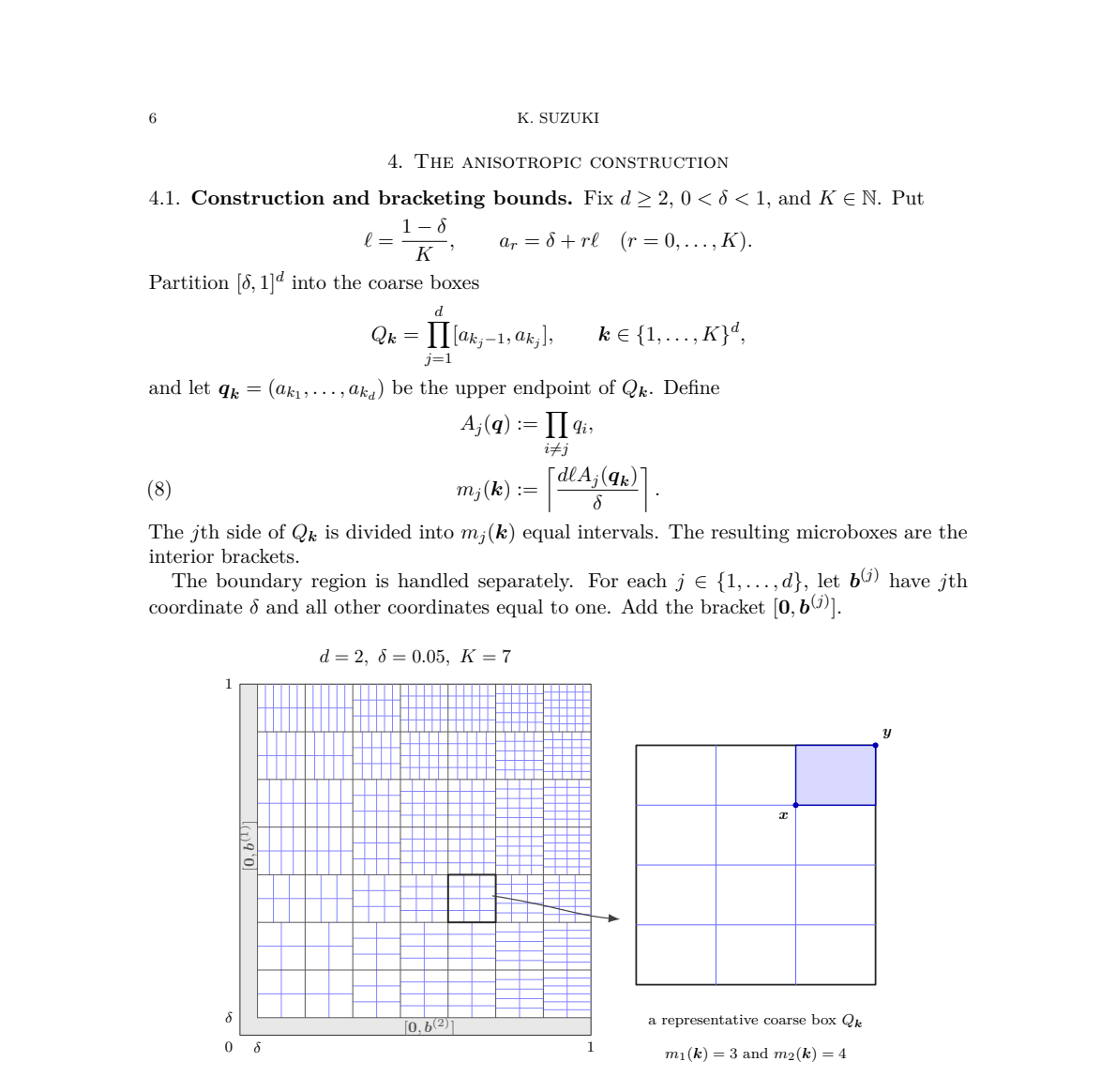
Figures are the authors', reproduced from the paper.
How the literature uses it
1 arXiv paper cite this in 3 sentences
Papers citing it · 1 sentence without a confident label
Uses its method or tool 1 paper
-
The standard argument of dyadic chaining produces finite families $ℬ_μ$ and $_h$, $μ<h≤H$, such that [equation] and, deterministically, [equation] see [ref] .
Bounded independence for the inverse star discrepancy · Bounded-independence transfer of the chaining argument · 0.84
What it cites · 1 sentence without a confident label
Cites as background 1 paper
-
Related volume-biased product measures also occur in generalized discrepancy [ref] .
The curse of dimensionality for geometric $L_1$-discrepancies with nonnegative weights · Bracketing numbers · 0.92
Challenges and discussion
Disagree with the review, or know something it missed? Leave a comment, or challenge this review formally: a challenge becomes a permanent entry in this paper's record, and its decision is published here.
Come back by email
A short list of the week's newly reviewed papers. Nothing is sent until you confirm from your inbox, and every email has a link that stops it. No account.
No comments yet.
Sign in to comment