REVIEW 3 major objections 4 minor 94 references
Properties of the $D_{s0}^*(2317)^\pm$ in hot and dense nuclear matter
T0 review · 3 major / 4 minor · reviewed 2026-08-15 · deepseek-v4-flash
Pith's one-line read The paper predicts that in hot dense nuclear matter the D_s0*(2317)+ is pulled down and broadened by density, while its antiparticle is governed by temperature, and that the two states remain dynamically generated molecules throughout.
desk verdict A clean, transparent calculation that extends in-medium D_s0* studies to combined density and temperature, but its headline D+ shifts are imported from one external spectral function and can reverse sign under a different but plausible choice. read the letter →
The pith
A machine-rendered reading of the paper's core claim, the machinery that carries it, and where it could break.
The reading
What carries the argument
The load-bearing machinery is the in-medium two-meson loop function inside the coupled-channel $T$-matrix $T=(V^{-1}-G)^{-1}$. For the $D_{s0}^*(2317)^+$, the $DK$ loop is built from the Matsubara sum of a $D$ propagator dressed by the in-medium $D$-meson spectral function and an undressed kaon, and enters together with the $D_s\eta$ channel; for the $D_{s0}^*(2317)^-$, the same construction uses the $\bar{K}$ spectral function with an undressed $\bar{D}$. The second ingredient is the interaction kernel $V$, whose medium dependence enters through the pion decay constant via the Gell-Mann-Oakes-Renner relation; lowering $f_\pi$ strengthens the attraction and shifts the dynamically generated poles.
What would settle it
Take the same coupled-channel kernel and replace the in-medium D-meson spectral function with the alternative one used in the earlier dense-matter study; the paper already reports that this reverses the sign of the mass shift at saturation density and cuts the width from about 150 MeV to about 40 MeV, so the sign of the in-medium mass shift is a decisive test.
Extended reading notes
Core claim
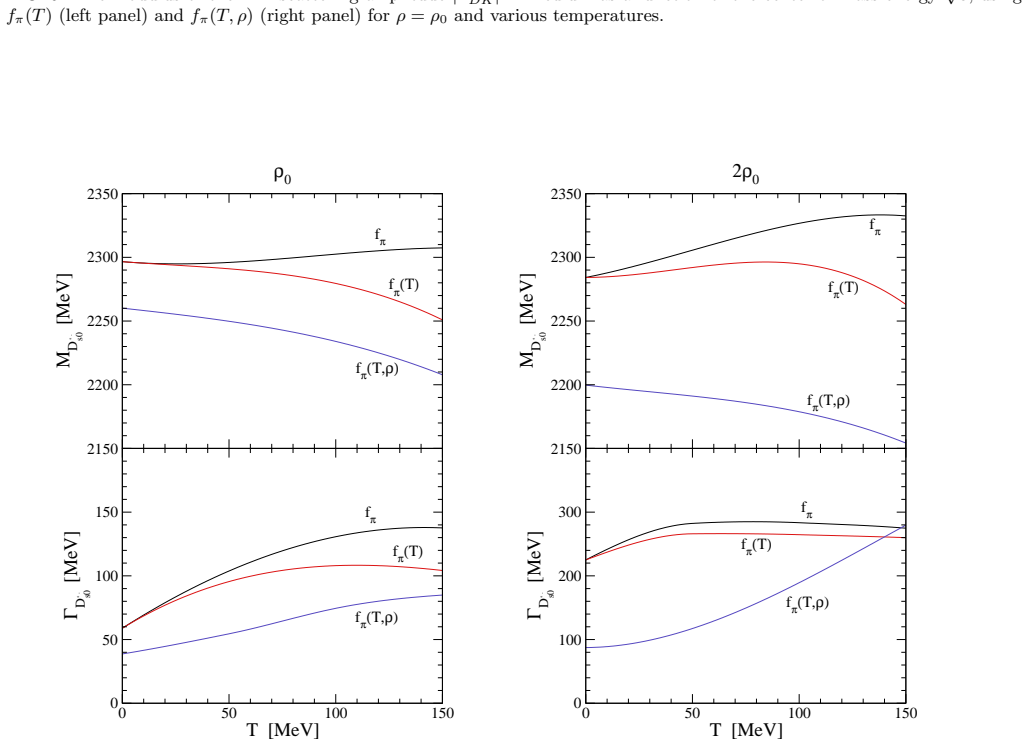
The central claim is that $D_{s0}^*(2317)^+$ and $D_{s0}^*(2317)^-$ remain dynamically generated bound states under all studied conditions but respond to the medium in opposite ways. The positively charged state feels density mainly through its $DK$ component: as density rises, the $D$ quasiparticle mixes with a $\Sigma_c(2800)$ nucleon-hole mode, and the $D_{s0}^*(2317)^+$ peak tracks that spectral function, shifting to lower energy and broadening to about 150 MeV at saturation density. Temperature partially reverses this: thermal smearing of the Fermi surface and melting of the hole excitation move the peak back toward its free-space mass and narrow it. The negatively charged state is governed by the $\bar{K}$ spectral function: density lowers its mass, temperature pulls it back toward free space, and its width broadens and saturates. A medium-dependent pion decay constant deepens the binding further, lowering the $D_{s0}^*(2317)^+$ mass by roughly 50 MeV at $\rho_0$ and about 120 MeV at $2\rho_0$ at zero temperature, with additional temperature shifts of order 50 to 100 MeV.
Load-bearing premise
The D+ predictions inherit a particular in-medium D-meson broadening profile, and the paper itself shows that swapping in a different published profile reverses the mass shift and shrinks the width; the D- predictions likewise lean on the antikaon broadening profile and on neglecting anticharmed-meson dressing.
Editorial extensions
If this is right
- In heavy-ion conditions at CBM/FAIR, the $D_{s0}^*(2317)^+$ should appear as a broad peak shifted below its vacuum mass, while the $D_{s0}^*(2317)^-$ should be less density-sensitive but broaden with temperature; the particle-antiparticle asymmetry is a direct experimental fingerprint.
- If the medium-dependent pion decay constant is right, the $D_{s0}^*(2317)^+$ mass drops by roughly 50 MeV at saturation density and 120 MeV at twice saturation, providing a quantitative target for in-medium spectroscopy.
- The states persist as identifiable quasiparticle peaks at all densities and temperatures studied, so the molecular character does not dissolve under these conditions.
- Discrepancies with the earlier dense-matter study are attributed to three modeling choices — the $D$-meson spectral function, a repulsive kaon shift, and coupling to the $D_s\eta$ channel — so the sign of the in-medium mass shift can discriminate between models.
Reading between the lines
- If the molecular picture is right, a compact tetraquark or quark-model state should respond more weakly to density and temperature, so measuring the asymmetry between $D_{s0}^*(2317)^+$ and $D_{s0}^*(2317)^-$ in heavy-ion collisions could distinguish molecular from compact internal structure.
- The strong sensitivity to the choice of in-medium $D$-meson spectral function means the predicted 150 MeV width is not a firm number; improved calculations of the $D$ self-energy in matter would sharpen or overturn the central prediction.
- Including in-medium dressing for the $\eta$ and $D_s$ mesons, which the authors neglect, could add density-dependent broadening to the coupled-channel loop and modify the $D_{s0}^*(2317)^+$ lineshape at high density.
- The $f_\pi(T,\rho)$ prescription uses a single value of the pion-nucleon sigma term and a low-density expansion; testing the sigma-term range 45 to 60 MeV would quantify the uncertainty in the predicted 50 to 120 MeV mass drop.
Signed reviews
Editorial analysis
A structured set of objections, weighed in public.
Referee Report
Summary. The manuscript computes the in-medium spectral properties of the D_{s0}^*(2317)^+ and D_{s0}^*(2317)^- in hot and dense nuclear matter. The states are generated as coupled-channel DK–D_s η and \bar D\bar K–\bar D_s η molecules from an NLO heavy-meson chiral perturbation theory kernel. Finite-density and finite-temperature effects enter through the two-meson loop functions, which are evaluated using external D-meson and \bar K-meson spectral functions from Refs. [64] and [65], respectively. The paper also considers a medium-dependent pion decay constant f_π(T,ρ) in the kernel. It finds that with increasing density the D_{s0}^*(2317)^+ shifts downward and broadens to a width of about 150 MeV at ρ0, tracking the D-meson spectral function of Ref. [64], while temperature shifts the peak back toward its vacuum mass and narrows it. The D_{s0}^*(2317)^- is governed by the \bar K spectral function: its mass also drops with density and its width broadens and saturates with temperature. Including f_π(T,ρ) lowers both masses by tens to about 150 MeV, with opposite width behavior for the particle and antiparticle. The resulting particle-antiparticle asymmetry is proposed as an observable probe in heavy-ion collisions.
Significance. If the results hold, the paper provides concrete predictions for the CBM/FAIR program and a plausible connection between chiral restoration and the in-medium behavior of charmed-strange mesons. The formal setup is transparent: the free-space loop functions are given analytically in Appendix B, two regularization schemes are compared, and the discrepancies with the previous calculation of Ref. [63] are discussed openly. The main weakness is that the central quantitative predictions are not self-contained: the density dependence of the D_{s0}^*(2317)^+ is imported from one external D-meson spectral function, and the largest mass shifts come from a factorized f_π(T,ρ) ansatz evaluated with a single value of σπN. Because these inputs are not bracketed, the headline numbers are conditional on external model choices. The paper is a useful contribution, but it needs a sensitivity analysis before its quantitative claims can be considered robust.
major comments (3)
- [Sec. IV, Figs. 3–4 and comparison with Ref. [63]] The load-bearing prediction that the D_{s0}^*(2317)^+ shifts downward and acquires a width of about 150 MeV at ρ0 is inherited from the D-meson spectral function of Ref. [64]; it is not derived or validated within this work. The manuscript reports that Ref. [63], using the D spectral function of Ref. [89] together with a repulsive kaon shift and no D_s η coupling, obtains instead an upward shift of about 30 MeV and a width of 40 MeV at ρ0, and attributes the difference to three similarly sized effects. Since no calculation isolates the contribution of the spectral-function choice and no observable is given that selects Ref. [64] over Ref. [89], the sign and magnitude of the central D_{s0}^*(2317)^+ shift are conditional on an external model. I request either a bracketing calculation with the alternative spectral function, with the other two effects switched on one at a time, or an explicit statement that the sign of the density shift is model-dependent.
- [Sec. V, Eq. (16)] The large mass drops highlighted in the abstract—about 50 MeV at ρ0 and up to roughly 120 MeV at 2ρ0, with further temperature shifts—follow from the factorized ansatz f_π(T,ρ)=f_π(1 − σπN ρ/(2 m_π^2 f_π^2))(1 − T^2/(12 f_π^2)). This expression is introduced by combining the lowest-order density expansion of the chiral condensate with the low-temperature chiral perturbation theory result, but no justification is given for applying it at T=150 MeV and ρ=2ρ0, where nonlinearities in both variables should be important. The results also depend on the choice σπN=50 MeV within the cited range of 45–60 MeV. Because the f_π(T,ρ) scenario is one of the main quantitative claims, I ask for a sensitivity band in σπN, at least one alternative model for f_π(T,ρ), or a clear downgrading of these numbers to illustrative estimates.
- [Sec. IV, D_{s0}^*(2317)^- discussion] The D_{s0}^*(2317)^- prediction relies on the \bar K spectral function of Ref. [65] together with the explicit neglect of in-medium \bar D dressing. The paper itself notes that Ref. [63] uses a different \bar D spectral function and that a direct comparison of the two calculations is therefore not straightforward. This makes the D^- mass shift and width conditional on the same kind of external-input choice as the D^+ result, but no bracketing over the \bar D treatment is provided. A quantitative estimate of the \bar D-dressing uncertainty—for example, using the \bar D spectral function of Ref. [64] or of Ref. [90]—should be added before the D^- result is presented as a firm prediction.
minor comments (4)
- [Sec. III] The statement that the D_{s0}^*(2317) is 'dynamically generated' should be qualified: the regularization parameters Λ=615 MeV and a=−1.79 (Table III) are fixed by requiring the vacuum amplitude to have a pole at the empirical mass, so the free-space pole position is an input. This does not invalidate the in-medium shifts, but the qualification should be explicit.
- [Sec. IV, Figs. 5 and 6] For the \bar D\bar K channel only the dimensional-regularization results are shown; the text states consistency between the two schemes for the DK channel, but no cutoff-scheme counterpart is displayed for D^-. Please add the cutoff results or explain why only the DR scheme is used in this case.
- [Sec. II.B, Eq. (11) and Table III] The integration window [ω_min, ω_max] is a numerical input with no reported test of sensitivity to its boundaries. Since the spectral functions have non-negligible tails, a brief convergence check should be added.
- [Sec. V] When presenting the f_π(T,ρ) scenarios, the text should state explicitly that the medium-modified f_π enters only the interaction kernel, while the loop functions continue to use vacuum masses and the external spectral functions. This is a reasonable first step, but leaving it implicit may give the impression that all f_π-dependent effects are included consistently.
Circularity Check
Free-space pole is calibrated by tuning, and the central in-medium D+ behavior is largely imported from same-group spectral functions; the combined hot-dense calculation is nonetheless a genuine computation.
-
fitted input called prediction
[Sec. III (paragraph before Fig. 2) and Appendix A, Table III]
"The regularization parameters have been adjusted to reproduce the empirical mass of the D∗ s0(2317)+ state. The resulting values are Λ = 615 MeV for the cutoff scheme, and a subtraction constant of a = −1.79 for the DR scheme at a regularization scale of µ = 1000 MeV. Utilizing these parameters, the modulus of the DK T-matrix ... showing a clear pole corresponding to the dynamically generated bound state."
The free-space pole at 2317 MeV is not a prediction: the two regularization parameters Λ and a are tuned to reproduce the empirical mass, and the pole is then presented as evidence of a dynamically generated state. This is calibration of the input rather than an independent result. It does not by itself make the medium predictions circular, because the in-medium mass and width are computed relative to this calibrated vacuum pole, but it anchors the 'dynamically generated' claim to the fit.
-
self citation load bearing
[Sec. II B 1 (Eq. 11) and Sec. IV (comparison with Ref. [63])]
"In evaluating Eq. (11), we use the D-meson spectral function in nuclear matter obtained in Ref. [64]. ... These differences are mostly attributed to the different D-meson spectral function employed in the DK loop. The study of Ref. [63] implemented the D-meson spectral function obtained in Ref. [89]."
The central D+ prediction—a downward shift and a large broadening with density—is inherited from the D-meson spectral function of Ref. [64], whose authors overlap with the present paper. The paper's own comparison with Ref. [63] shows that replacing this input with the Ref. [89] spectral function changes the density shift from attractive to repulsive and reduces the width from about 150 MeV to about 40 MeV. Thus the sign and magnitude of the lead in-medium effect reduce to the choice of a self-cited, unvalidated external input rather than being derived or benchmarked inside the paper. The circularity is only partial because the in-medium loop, the coupled-channel amplitude, and the fπ(T,ρ) effects are computed rather than fitted.
full rationale
The paper solves a well-defined coupled-channel scattering equation with medium-modified two-meson loop functions, so the in-medium pole positions and widths are computed, not fitted to the Ds0*(2317) medium data. The free-space regularization constants are tuned to the vacuum mass, which is standard calibration and does not force the medium shifts. The main circularity concern is the load-bearing reliance on same-group external spectral functions: Ref. [64] for the D meson and Ref. [65] for the anti-K meson. These are not machine-checked or parameter-free, and the paper's own comparison with Ref. [63] demonstrates that choosing a different D spectral function reverses the central D+ density shift. This makes the central quantitative claims conditional on a self-cited input, but it is not a full constructional circularity because the hot-dense calculation, the temperature dependence, and the medium-dependent pion-decay-constant effects are new computations with independent content. Score 4 captures this partial, load-bearing input dependence.
Assumptions & free parameters
free parameters (4)
- Sharp cutoff Lambda =
615 MeV
- Dimensional-regularization subtraction constant a(mu) =
-1.79 at mu = 1000 MeV
- Pion-nucleon sigma term sigma_piN =
50 MeV
- Spectral-function integration window =
1510-2450 MeV (DK), 50-1500 MeV (DbarKbar)
assumptions (6)
- domain assumption The D_s0*(2317)± is a pure s-wave DK or DbarKbar molecule dynamically generated without a bare seed state.
- domain assumption NLO HMChPT with lattice-determined low-energy constants describes the DK-Ds eta interaction.
- domain assumption The in-medium D and Kbar spectral functions from Refs. [64] and [65] are reliable inputs.
- ad hoc to paper The medium-dependent pion decay constant factorizes as in Eq. (16).
- domain assumption The K meson in the DK loop and the Dbar meson in the DbarKbar loop are treated as undressed.
- domain assumption Isospin symmetry is assumed throughout.
Cite this review
Pith. "Pith review of Properties of the $D_{s0}^*(2317)^\pm$ in hot and dense nuclear matter." pith.science (2026). https://pith.science/paper/DLQJLYDB
@misc{pith2026260801272,
  author       = {Pith},
  title        = {Pith review of: Properties of the $D_s0^*(2317)^\pm$ in hot and dense nuclear matter},
  year         = {2026},
  howpublished = {\url{https://pith.science/paper/DLQJLYDB}},
  note         = {Machine review of arXiv:2608.01272}
}
abstract
We investigate the properties of the $D_{s0}^\ast(2317)^\pm$ in hot and dense nuclear matter using a coupled-channel molecular model built on next-to-leading-order heavy meson chiral perturbation theory. In-medium modifications to the $D_{s0}^\ast(2317)^+$ stem from changes to the $DK$ channel within the coupled $DK$-$D_s \eta$ system. As nuclear density increases, the $D_{s0}^\ast(2317)^+$ quasiparticle peak shifts toward lower energies and broadens, tracking the behavior of the $D$-meson spectral function. As for temperature effects, those are milder, with the thermal smearing of the Fermi surface and the melting of $\Sigma_c N^{-1}$ excitations in the $D$-meson spectral function shifting the $D_{s0}^\ast(2317)^+$ peak back toward its free-space mass while narrowing it. Conversely, the behavior of the $D_{s0}^\ast(2317)^-$ is governed by the $\bar D \bar K$ channel and its medium behavior is driven by the $\bar K$ spectral function. With increasing temperature, the $D_{s0}^\ast(2317)^-$ also approaches its free-space mass, but its width broadens before saturating at high temperatures. Incorporating explicit medium dependencies into the interaction kernel, driven by density and/or temperature variations in the pion decay constant, further shifts the $D_{s0}^\ast(2317)^+$ mass lower and narrows its width with temperature. As for $D_{s0}^\ast(2317)^-$, its mass also drops with temperature but its width increases. These contrasting medium behaviors offer a promising pathway to constrain the internal structure of these exotic states.
Figures


Figures from the paper (7 more)


Reference graph
Works this paper leans on
-
[64]
Pseudoscalar and vector open-charm mesons at finite temperature
G. Monta˜ na, `A. Ramos, L. Tolos, and J. M. Torres-Rincon, Phys. Rev. D102, 096020 (2020), arXiv:2007.12601 [hep-ph]
work page Pith review arXiv 2020
- [89]
-
[63]
V. Montesinos, M. Albaladejo, J. Nieves, and L. Tolos, Phys. Lett. B853, 138656 (2024), arXiv:2403.00451 [hep- ph]
arXiv 2024
-
[65]
Recent progress on in-medium properties of heavy mesons from finite-temperature EFTs
G. Montana, A. Ramos, L. Tolos, and J. M. Torres-Rincon, Front. in Phys.11, 1250939 (2023), arXiv:2307.03640 [hep-ph]
work page Pith review arXiv 2023
-
[90]
D. Jido, T. Hatsuda, and T. Kunihiro, Phys. Lett. B 670, 109 (2008), arXiv:0805.4453 [nucl-th]
arXiv 2008
-
[1]
In-medium and finite-temperature loop function Finite-temperature and finite-density effects can be in- corporated into the two-meson loop functions through the thermal statistical factors and the in-medium mod- ification of the meson propagators. At finite tempera- ture, the two-meson loop function is evaluated within the imaginary-time formalism by repl...
-
[2]
Unidad de Excelencia Mar´ ıa de Maeztu
Density and temperature dependent pion decay constant So far, we have not accounted for the possible density and temperature dependence of the interaction kernel. In our approach, the interaction is proportional to the uni- versal vector meson coupling constantg, related to the pion decay constant byg=m V/(2fπ), wherem V is an appropriate vector meson mas...
-
[3]
Y. Mikamiet al.(Belle), Phys. Rev. Lett.92, 012002 (2004), arXiv:hep-ex/0307052
arXiv 2004
Show all 94 references
-
[4]
Aubertet al.(BaBar), Phys
B. Aubertet al.(BaBar), Phys. Rev. Lett.90, 242001 (2003), arXiv:hep-ex/0304021
2003 arXiv
-
[5]
Bessonet al.(CLEO), Phys
D. Bessonet al.(CLEO), Phys. Rev. D68, 032002 (2003), [Erratum: Phys.Rev.D 75, 119908 (2007)], arXiv:hep-ex/0305100
2003 arXiv
-
[6]
J. Zeng, J. W. Van Orden, and W. Roberts, Phys. Rev. D52, 5229 (1995), arXiv:hep-ph/9412269
1995 arXiv
-
[7]
Godfrey and N
S. Godfrey and N. Isgur, Phys. Rev. D32, 189 (1985)
1985
-
[8]
Godfrey and R
S. Godfrey and R. Kokoski, Phys. Rev. D43, 1679 (1991)
1991
-
[9]
T. A. Lahde, C. J. Nyfalt, and D. O. Riska, Nucl. Phys. A674, 141 (2000), arXiv:hep-ph/9908485
2000 arXiv
-
[10]
S. N. Gupta and J. M. Johnson, Phys. Rev. D51, 168 (1995), arXiv:hep-ph/9409432
1995 arXiv
-
[11]
Ebert, V
D. Ebert, V. O. Galkin, and R. N. Faustov, Phys. Rev. D57, 5663 (1998), [Erratum: Phys.Rev.D 59, 019902 (1999)], arXiv:hep-ph/9712318
1998 arXiv
-
[12]
Colangelo and F
P. Colangelo and F. De Fazio, Phys. Lett. B570, 180 (2003), arXiv:hep-ph/0305140
2003 arXiv
-
[13]
Di Pierro and E
M. Di Pierro and E. Eichten, Phys. Rev. D64, 114004 (2001), arXiv:hep-ph/0104208
2001 arXiv
-
[14]
Navaset al.(Particle Data Group), Phys
S. Navaset al.(Particle Data Group), Phys. Rev. D110, 030001 (2024)
2024
-
[15]
W. A. Bardeen, E. J. Eichten, and C. T. Hill, Phys. Rev. D68, 054024 (2003), arXiv:hep-ph/0305049
2003 arXiv
-
[16]
Dai, C.-S
Y.-B. Dai, C.-S. Huang, C. Liu, and S.-L. Zhu, Phys. Rev. D68, 114011 (2003), arXiv:hep-ph/0306274
2003 arXiv
-
[17]
Narison, Phys
S. Narison, Phys. Lett. B605, 319 (2005), arXiv:hep- ph/0307248
2005
-
[18]
Lakhina and E
O. Lakhina and E. S. Swanson, Phys. Lett. B650, 159 (2007), arXiv:hep-ph/0608011
2007 arXiv
-
[19]
I. W. Lee, T. Lee, D. P. Min, and B.-Y. Park, Eur. Phys. J. C49, 737 (2007), arXiv:hep-ph/0412210
2007 arXiv
-
[20]
Z. G. Wang and S. L. Wan, Phys. Rev. D73, 094020 (2006), arXiv:hep-ph/0603007
2006 arXiv
-
[21]
Chen and X.-Q
Y.-Q. Chen and X.-Q. Li, Phys. Rev. Lett.93, 232001 (2004), arXiv:hep-ph/0407062
2004 arXiv
-
[22]
Cheng and W.-S
H.-Y. Cheng and W.-S. Hou, Phys. Lett. B566, 193 (2003), arXiv:hep-ph/0305038
2003 arXiv
-
[23]
Terasaki, Phys
K. Terasaki, Phys. Rev. D68, 011501 (2003), arXiv:hep- ph/0305213
2003
-
[24]
Wang and S.-L
Z.-G. Wang and S.-L. Wan, Nucl. Phys. A778, 22 (2006), arXiv:hep-ph/0602080
2006 arXiv
-
[25]
Maiani, F
L. Maiani, F. Piccinini, A. D. Polosa, and V. Riquer, Phys. Rev. D71, 014028 (2005), arXiv:hep-ph/0412098
2005 arXiv
-
[26]
M. E. Bracco, A. Lozea, R. D. Matheus, F. S. Navarra, and M. Nielsen, Phys. Lett. B624, 217 (2005), arXiv:hep-ph/0503137
2005 arXiv
-
[27]
E. E. Kolomeitsev and M. F. M. Lutz, Phys. Lett. B582, 39 (2004), arXiv:hep-ph/0307133
2004 arXiv
-
[28]
Barnes, F
T. Barnes, F. E. Close, and H. J. Lipkin, Phys. Rev. D 68, 054006 (2003), arXiv:hep-ph/0305025
2003 arXiv
-
[29]
A. P. Szczepaniak, Phys. Lett. B567, 23 (2003), arXiv:hep-ph/0305060
2003 arXiv
-
[30]
Gamermann, E
D. Gamermann, E. Oset, D. Strottman, and M. J. Vi- cente Vacas, Phys. Rev. D76, 074016 (2007), arXiv:hep- ph/0612179
2007
-
[31]
Hofmann and M
J. Hofmann and M. F. M. Lutz, Nucl. Phys. A733, 142 (2004), arXiv:hep-ph/0308263
2004 arXiv
-
[32]
Guo, P.-N
F.-K. Guo, P.-N. Shen, H.-C. Chiang, R.-G. Ping, and B.-S. Zou, Phys. Lett. B641, 278 (2006), arXiv:hep- ph/0603072
2006
-
[33]
F.-K. Guo, C. Hanhart, S. Krewald, and U.-G. Meissner, Phys. Lett. B666, 251 (2008), arXiv:0806.3374 [hep-ph]
2008 arXiv
-
[34]
Faessler, T
A. Faessler, T. Gutsche, V. E. Lyubovitskij, and Y.-L. Ma, Phys. Rev. D76, 014005 (2007), arXiv:0705.0254 [hep-ph]
2007 arXiv
-
[35]
J. M. Flynn and J. Nieves, Phys. Rev. D75, 074024 (2007), arXiv:hep-ph/0703047
2007 arXiv
-
[36]
Guo, U.-G
Z.-H. Guo, U.-G. Meißner, and D.-L. Yao, Phys. Rev. D 92, 094008 (2015), arXiv:1507.03123 [hep-ph]
2015 arXiv
-
[37]
F.-K. Guo, C. Hanhart, and U.-G. Meissner, Eur. Phys. J. A40, 171 (2009), arXiv:0901.1597 [hep-ph]
2009 arXiv
-
[38]
L. Liu, K. Orginos, F.-K. Guo, C. Hanhart, and U.-G. Meissner, Phys. Rev. D87, 014508 (2013), arXiv:1208.4535 [hep-lat]
2013 arXiv
-
[39]
F.-K. Guo, C. Hanhart, U.-G. Meißner, Q. Wang, Q. Zhao, and B.-S. Zou, Rev. Mod. Phys.90, 015004 (2018), [Erratum: Rev.Mod.Phys. 94, 029901 (2022)], arXiv:1705.00141 [hep-ph]
2018 arXiv
-
[40]
Albaladejo, P
M. Albaladejo, P. Fernandez-Soler, F.-K. Guo, and J. Nieves, Phys. Lett. B767, 465 (2017), arXiv:1610.06727 [hep-ph]
2017 arXiv
-
[41]
Albaladejo, D
M. Albaladejo, D. Jido, J. Nieves, and E. Oset, Eur. Phys. J. C76, 300 (2016), arXiv:1604.01193 [hep-ph]
2016 arXiv
-
[42]
P. G. Ortega, J. Segovia, D. R. Entem, and F. Fernandez, Phys. Rev. D94, 074037 (2016), arXiv:1603.07000 [hep- ph]
2016 arXiv
-
[43]
T. E. Browder, S. Pakvasa, and A. A. Petrov, Phys. Lett. B578, 365 (2004), arXiv:hep-ph/0307054
2004 arXiv
-
[44]
van Beveren and G
E. van Beveren and G. Rupp, Phys. Rev. Lett.91, 012003 (2003), arXiv:hep-ph/0305035
2003 arXiv
-
[45]
Dougall, R
A. Dougall, R. D. Kenway, C. M. Maynard, and C. McNeile (UKQCD), Phys. Lett. B569, 41 (2003), arXiv:hep-lat/0307001
2003 arXiv
-
[46]
Albaladejo, P
M. Albaladejo, P. Fernandez-Soler, J. Nieves, and P. G. Ortega, Eur. Phys. J. C78, 722 (2018), arXiv:1805.07104 [hep-ph]
2018 arXiv
-
[47]
G. S. Bali, Phys. Rev. D68, 071501 (2003), arXiv:hep- ph/0305209
2003
-
[48]
C. B. Lang, L. Leskovec, D. Mohler, S. Prelovsek, and R. M. Woloshyn, Phys. Rev. D90, 034510 (2014), arXiv:1403.8103 [hep-lat]
2014 arXiv
-
[49]
Mohler, S
D. Mohler, S. Prelovsek, and R. M. Woloshyn, Phys. Rev. D87, 034501 (2013), arXiv:1208.4059 [hep-lat]
2013 arXiv
-
[50]
Mohler, C
D. Mohler, C. B. Lang, L. Leskovec, S. Prelovsek, and R. M. Woloshyn, Phys. Rev. Lett.111, 222001 (2013), arXiv:1308.3175 [hep-lat]
2013 arXiv
-
[51]
Alexandrou, J
C. Alexandrou, J. Berlin, J. Finkenrath, T. Leontiou, and M. Wagner, Phys. Rev. D101, 034502 (2020), arXiv:1911.08435 [hep-lat]
2020 arXiv
-
[52]
G. S. Bali, S. Collins, A. Cox, and A. Sch¨ afer, Phys. Rev. D96, 074501 (2017), arXiv:1706.01247 [hep-lat]
2017 arXiv
-
[53]
G. K. C. Cheung, C. E. Thomas, D. J. Wilson, G. Moir, M. Peardon, and S. M. Ryan (Hadron Spectrum), JHEP 02, 100 (2021), arXiv:2008.06432 [hep-lat]
2021 arXiv
-
[54]
Albaladejo, J
M. Albaladejo, J. Nieves, and E. Ruiz-Arriola, Phys. Rev. D108, 014020 (2023), arXiv:2304.03107 [hep-ph]
2023 arXiv
-
[55]
Yang, G.-J
Z. Yang, G.-J. Wang, J.-J. Wu, M. Oka, and S.-L. Zhu, Phys. Rev. Lett.128, 112001 (2022), arXiv:2107.04860 [hep-ph]
2022 arXiv
-
[56]
Liu, J.-X
Z.-W. Liu, J.-X. Lu, and L.-S. Geng, Phys. Rev. D107, 16 074019 (2023), arXiv:2302.01046 [hep-ph]
2023 arXiv
-
[57]
Albaladejo, J
M. Albaladejo, J. M. Nieves, and L. Tolos, Phys. Rev. C104, 035203 (2021), arXiv:2102.08589 [hep-ph]
2021 arXiv
-
[58]
Ikeno, G
N. Ikeno, G. Toledo, and E. Oset, Phys. Lett. B847, 138281 (2023), arXiv:2305.16431 [hep-ph]
2023 arXiv
-
[59]
J. M. Torres-Rincon, A. Ramos, and L. Tolos, Phys. Rev. D108, 096008 (2023), arXiv:2307.02102 [hep-ph]
2023 arXiv
-
[60]
Monta˜ na, A
G. Monta˜ na, A. Ramos, L. Tolos, and J. M. Torres-Rincon, Phys. Lett. B806, 135464 (2020), arXiv:2001.11877 [hep-ph]
2020 arXiv
-
[61]
Montesinos, M
V. Montesinos, M. Albaladejo, J. Nieves, and L. Tolos, Phys. Rev. C108, 035205 (2023), arXiv:2306.17673 [hep- ph]
2023 arXiv
-
[62]
Molina, D
R. Molina, D. Gamermann, E. Oset, and L. Tolos, Eur. Phys. J. A42, 31 (2009), arXiv:0806.3711 [nucl-th]
2009 arXiv
-
[66]
M. F. M. Lutz and M. Soyeur, Nucl. Phys. A813, 14 (2008), arXiv:0710.1545 [hep-ph]
2008 arXiv
-
[67]
Tolos, A
L. Tolos, A. Ramos, and T. Mizutani, Phys. Rev. C77, 015207 (2008), arXiv:0710.2684 [nucl-th]
2008 arXiv
-
[68]
Tolos, D
L. Tolos, D. Cabrera, and A. Ramos, Phys. Rev. C78, 045205 (2008), arXiv:0807.2947 [nucl-th]
2008 arXiv
-
[69]
Z.-H. Guo, L. Liu, U.-G. Meißner, J. A. Oller, and A. Rusetsky, Eur. Phys. J. C79, 13 (2019), arXiv:1811.05585 [hep-ph]
2019 arXiv
-
[70]
L. S. Geng, N. Kaiser, J. Martin-Camalich, and W. Weise, Phys. Rev. D82, 054022 (2010), arXiv:1008.0383 [hep-ph]
2010 arXiv
-
[71]
L. M. Abreu, D. Cabrera, F. J. Llanes-Estrada, and J. M. Torres-Rincon, Annals Phys.326, 2737 (2011), arXiv:1104.3815 [hep-ph]
2011 arXiv
-
[72]
Waas and W
T. Waas and W. Weise, Nucl. Phys. A625, 287 (1997)
1997
-
[73]
Matsubara, Prog
T. Matsubara, Prog. Theor. Phys.14, 351
-
[74]
J. I. Kapusta and C. Gale,Finite-temperature field theory: Principles and applications, Cambridge Mono- graphs on Mathematical Physics (Cambridge University Press, 2011)
2011
-
[75]
C. E. Jimenez-Tejero, A. Ramos, L. Tolos, and I. Vidana, Phys. Rev. C84, 015208 (2011), arXiv:1102.4786 [hep- ph]
2011 arXiv
- [76]
-
[77]
M. Post, S. Leupold, and U. Mosel, Nucl. Phys. A741, 81 (2004), arXiv:nucl-th/0309085
2004 arXiv
-
[78]
in contrast to the cutoff approach employed in [76], a phenomenon recently discussed in [79]. Ignoring this mode, we can summarize the various findings in the lit- erature by stating that theηandD s spectral functions in nuclear matter present well-distinguished quasiparti- cl...
-
[79]
C. E. Jimenez-Tejero, A. Ramos, and I. Vidana, Phys. Rev. C80, 055206 (2009), arXiv:0907.5316 [hep-ph]
2009 arXiv
-
[80]
M. F. M. Lutz and C. L. Korpa, Phys. Lett. B633, 43 (2006), arXiv:nucl-th/0510006
2006 arXiv
-
[81]
Hofmann and M
J. Hofmann and M. F. M. Lutz, Nucl. Phys. A763, 90 (2005), arXiv:hep-ph/0507071
2005 arXiv
-
[82]
E. E. Garcia-Gonzales, V. K. Magas, and A. Ramos, (2026), arXiv:2605.21205 [hep-ph]
2026 arXiv
-
[83]
Tolos and L
L. Tolos and L. Fabbietti, Prog. Part. Nucl. Phys.112, 103770 (2020), arXiv:2002.09223 [nucl-ex]
2020 arXiv
-
[84]
Gasser and H
J. Gasser and H. Leutwyler, Phys. Lett. B184, 83 (1987)
1987
-
[85]
Gerber and H
P. Gerber and H. Leutwyler, Nucl. Phys. B321, 387 (1989)
1989
- [86]
-
[87]
Bochkarev and J
A. Bochkarev and J. I. Kapusta, Phys. Rev. D54, 4066 (1996), arXiv:hep-ph/9602405
1996 arXiv
- [88]
- [91]
-
[92]
Tolos, C
L. Tolos, C. Garcia-Recio, and J. Nieves, Phys. Rev. C 80, 065202 (2009), arXiv:0905.4859 [nucl-th]
2009 arXiv
-
[93]
Garcia-Recio, V
C. Garcia-Recio, V. K. Magas, T. Mizutani, J. Nieves, A. Ramos, L. L. Salcedo, and L. Tolos, Phys. Rev. D 79, 054004 (2009), arXiv:0807.2969 [hep-ph]
2009 arXiv
-
[94]
J. A. Oller, E. Oset, and J. R. Pelaez, Phys. Rev. D59, 074001 (1999), [Erratum: Phys.Rev.D 60, 099906 (1999), Erratum: Phys.Rev.D 75, 099903 (2007)], arXiv:hep- ph/9804209
1999
Reviewed August 15, 2026 · model on record in the stance chip above.
Discussion (0). Continue with ORCID to comment.