REVIEW 3 major objections 5 minor 35 references
A dual-source depth prior, built by aligning monocular depth to multi-view depth and keeping only verified agreement regions, can correct sparse-camera dynamic 4D Gaussian reconstruction.
Reviewed by Pith at T0; open to challenge. T0 means a machine referee read the full paper against a public rubric. the ladder, T0–T4 →
2026-08-05 00:30 UTC pith:R4OKATPZ
load-bearing objection Coherent systems paper with useful ablations, but the 1.33 dB claim rests on an untested mono-only depth assumption and missing artifacts, so it needs referee probing before I'd trust it. the 3 major comments →
D²-4DGS: Dual-Depth Guided Sparse-Camera 4D Gaussian Splatting
The pith
A machine-rendered reading of the paper's core claim, the machinery that carries it, and where it could break.
Core claim
D2-4DGS claims that sparse-camera dynamic 4D Gaussian Splatting failures—missing structure and floating primitives—can be corrected by a dual-source depth prior that never trusts either source alone. It fits a positive scale and shift to put monocular depth into the multi-view depth coordinate frame, then keeps only pixels with small relative discrepancy as verified anchors. Verified anchors drive pruning of persistently inconsistent or weakly visible Gaussians and supervise depth during RGB-D optimization; pixels covered only by aligned monocular depth become proposals where new Gaussians are seeded. Empirically, on N3DV, Technicolor, and ENeRF-Outdoor under two-, three-, and four-view sett
What carries the argument
The load-bearing object is the dual-source depth prior D⋆, built per frame by aligning monocular depth D^m (dense, scale-ambiguous) to multi-view geometric depth D^g (incomplete, coordinate-consistent) with a per-frame positive scale and shift, then keeping only pixels whose relative disagreement falls below τ_c as verified anchors (Ω^v). Verified anchors drive the pruning score and depth supervision; aligned mono-only pixels outside Ω^v are back-projected to seed new Gaussians in under-reconstructed regions; conflicting pixels are discarded. The mechanism is the split: verified anchors constrain, mono-only proposals complete.
Load-bearing premise
The load-bearing premise is that after monocular depth has been aligned to multi-view depth where both exist, the same scale-and-shift correction remains trustworthy where multi-view depth does not exist; if a mono-only region is badly wrong, the method will seed Gaussians on phantom geometry.
What would settle it
In a scene where one region is visible to only a single camera, perturb the aligned monocular depth in that region to a deliberately wrong value, keeping all multi-view anchors intact, and rerun training. If final render quality and depth coherence are unchanged, the mono-only densification path is not responsible for the reported gains; if they degrade, the claimed mechanism is confirmed.
If this is right
- Sparse-camera capture (2–4 synchronized views) becomes a usable regime for dynamic novel view synthesis, lowering hardware and labor cost for free-viewpoint video.
- The depth-guided structure updates sit on top of an existing 4D Gaussian parameterization, so improved geometry can carry over to future backbone models without retraining the depth pipeline.
- Single-source depth guidance is strictly weaker: ablations show mono-only and MVS-only priors both improve the backbone, but neither reaches dual-source with alignment and verification.
- The hardest case benefits most: the largest PSNR gains appear with two views, where RGB-only Gaussian placement is most ambiguous.
- Depth consistency works as a pruning signal: geometrically wrong Gaussians that still fit sparse RGB views are removed by combining depth inconsistency with opacity contribution.
Where Pith is reading between the lines
- Editorial inference: the alignment–verification–densification recipe is not tied to dynamics; it should transfer to static sparse-view Gaussian reconstruction, where the same missing-structure and floating-primitive failures appear.
- Editorial inference: the most decisive untested extension is to promote mono-only aligned depth from densification proposal to soft constraint—if that helps, the dual-source prior is under-used; if it hurts, the paper's caution about mono-only regions is justified.
- Editorial inference: because each setting's comparison is against that setting's best competitor, the headline 1.33 dB is a summary of nine separate margins, not a single fixed-baseline improvement; readers comparing to one method should consult the per-dataset tables.
Editorial analysis
A structured set of objections, weighed in public.
Referee Report
Summary. The paper proposes D²-4DGS, a sparse-camera dynamic 4D Gaussian splatting method that fuses two depth sources to guide geometry optimization. Monocular depth (Depth Anything V2) is aligned to multi-view COLMAP MVS depth via a per-frame, per-view affine fit; pixels where the aligned mono depth agrees with MVS depth are treated as verified anchors. These anchors are used for consistency-aware pruning and depth supervision, while verified geometric depths and aligned mono-only estimates are used as densification proposals. An RGB-D joint loss with verified-depth regularization is used for refinement. The paper reports PSNR, SSIM, and LPIPS on N3DV, Technicolor, and ENeRF-Outdoor under 2/3/4-view settings, claiming the highest PSNR across all nine settings and an average improvement of 1.33 dB over the best competing method in each setting.
Significance. If the reported gains are reproducible, D²-4DGS is a useful and well-motivated contribution to sparse-camera dynamic novel view synthesis. The paper's strengths include a clear formulation of the dual-depth alignment/verification scheme, explicit use of depth priors for structure updates rather than only as auxiliary losses, and a thoughtful ablation that separates single-source, unaligned, and unverified prior variants. The headline empirical claim is concrete and falsifiable. However, the evidence is entirely single-run and the ablation is performed on a single scene, so the statistical strength of the claim is limited. The paper does not release code or a supplement with implementation details in this version, which also limits reproducibility.
major comments (3)
- [Sec. 4.1–4.2, Eqs. (4)–(7), (10)–(14)] The densification step relies on mono-only depth in regions without multi-view anchors. Eq. (4) fits a single global scale and shift per frame/view using only pixels in Ω^g; this affine model cannot correct spatially varying bias in monocular depth. Eq. (7) then assigns D* = aligned mono depth wherever M^g=0 and the aligned value is positive. Such pixels enter U_t,n in Eq. (10) and are back-projected by Eq. (11) to insert new Gaussians. However, the pruning score in Eq. (12) and the depth loss in Eq. (14) are masked to verified pixels Ω^v, so Gaussians inserted in mono-only regions are never directly penalized by a geometric check. The Limitations section concedes that large mono-depth errors may reduce structural-completion accuracy, but no experiment quantifies how often aligned mono depth is badly wrong in mono-only regions or whether such errors produce persistent artifacts. I reques
- [Table 1 and Sec. 5.2] All quantitative results are single runs; no seeds, standard deviations, or error bars are reported. The paper's central claim—highest PSNR in all nine settings, 1.33 dB average gain—could be sensitive to run-to-run variance in Gaussian optimization. The gaps to the second-best method are as small as 0.87 dB (N3DV 3-view) and about 1.06 dB (Technicolor 2-view), so it would be important to know whether the advantage persists across multiple random initializations. I ask for repeated runs with reported mean and variance, or at least a stability check on a subset of scenes/settings.
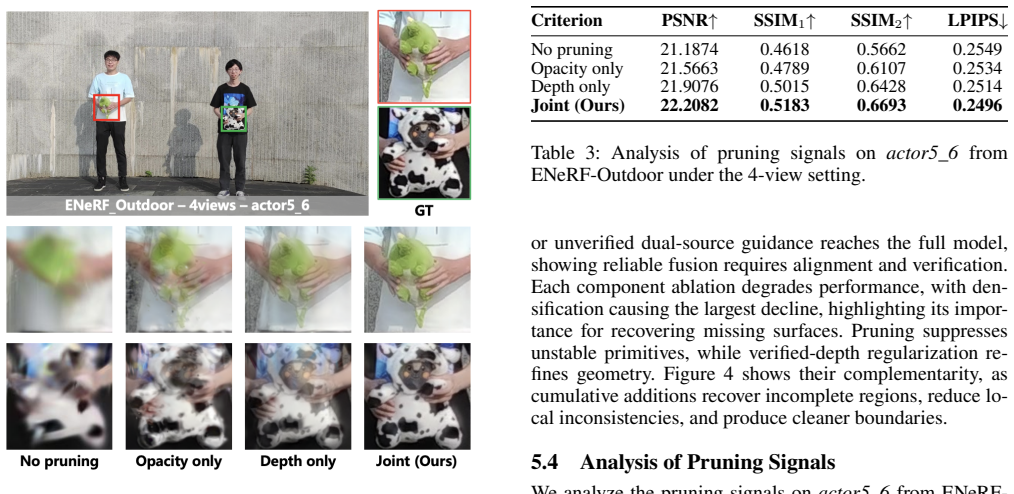
- [Table 2 and Sec. 5.3] The ablation study is performed on a single scene (sear_steak of N3DV) under a single view setting (4 views). The conclusion that each component contributes and that densification causes the largest performance decline is based on one comparison. The central contribution of the paper is the combination of dual-depth guidance with densification, pruning, and RGB-D optimization; that claim would be much more convincing if the ablation were repeated on at least one scene from each dataset or on the 2-view setting where the method claims the largest gains.
minor comments (5)
- [Sec. 5.1] The paper states that SSIM1 and SSIM2 use data ranges of 1.0 and 2.0, but it does not specify the exact SSIM implementation (e.g., scikit-image vs. the one used in prior 4DGS papers). Please clarify for reproducibility.
- [Sec. 5.1] Several implementation details are deferred to the supplementary material, but the submission does not include a supplement. Please either include the supplement or move the essential details (e.g., exact hyperparameters, densification sampling schedule, initialization) into the main text or an appendix.
- [Sec. 4.2, Eq. (12)] The definition of eE_k is a weighted average of relative depth errors, but the subsequent normalization E_k = min(eE_k/τ_u, 1) is not explained intuitively. A sentence clarifying that τ_u acts as a saturation threshold would help.
- [Sec. 5.1] The evaluation protocol states that 4C4D uses its official settings but 'regenerating initialization for each subset.' Please specify what initialization is used and whether all baselines use the same initialization strategy, since this can affect fairness.
- [Throughout] There are minor typographical issues, including inconsistent spacing in 'D 2-4DGS' and broken line breaks in the abstract. A careful proofread is recommended.
Circularity Check
No significant circularity: depth priors are external, the affine alignment is not fitted to PSNR, and no load-bearing self-citation chain exists.
full rationale
I walked each load-bearing step of the claimed derivation chain. (1) In Eq. 4, a per-frame affine scale-and-shift is fit from monocular depth to COLMAP MVS depth only on MVS-valid pixels; this is an alignment of two external priors, not a fit to the reported PSNR or to any downstream prediction. (2) In Eqs. 6-7, the verified region and dual-source prior D* are defined by agreement between the two external depth sources; the pruning score in Eq. 12 and depth loss in Eq. 14 then use D* as a target. This is a designed use of input priors, not a prediction that reduces by construction to its own fitting target. (3) In Eq. 11, densification back-projects D* at under-reconstructed pixels; this is an empirically evaluated heuristic insertion rule, not a quantity that is defined as the output of the same fit. No parameter is tuned to the evaluation PSNR, and all depth sources come from off-the-shelf external estimators (Depth Anything V2 and COLMAP PatchMatch Stereo). The author cites no prior work of their own, so there is no self-citation load-bearing argument. The Limitations section explicitly concedes that 'large errors may reduce structural-completion accuracy' where mono-only depth is used; that is an acknowledged robustness limitation, not a circular reduction. The central claim is an empirical benchmark result comparing against fixed baselines, so the paper's own equations do not make any derived quantity equivalent by definition to the depth inputs. Honest finding: no circularity; score 0.
Axiom & Free-Parameter Ledger
free parameters (6)
- per-frame alignment scale a and shift b =
not reported
- verification threshold tau_c =
not reported
- rendered-depth validity threshold tau_v =
not reported
- under-reconstruction discrepancy threshold tau_u =
not reported
- pruning persistence threshold tau_p =
not reported
- loss weights lambda_e, lambda_o, lambda_d =
not reported
axioms (6)
- domain assumption Gaussian splatting differentiable rendering (Kerbl et al. 2023) is a valid differentiable approximation of scene radiance.
- standard math The 4D slicing and conditioning equations (Eqs. 1-3) correctly model time-varying 3D Gaussians as given by Yang et al. 2024c.
- domain assumption COLMAP MVS depth after geometric-consistency filtering is reliable in its retained regions.
- domain assumption Depth Anything V2 monocular depth, after a per-frame affine transform, matches metric depth up to the same affine relationship everywhere.
- domain assumption Synchronized, calibrated cameras with known intrinsic and extrinsic parameters are provided.
- ad hoc to paper Cross-source agreement (relative discrepancy below tau_c) implies both depths are accurate at that pixel.
Cite this review
Pith. "Pith review of D^2-4DGS: Dual-Depth Guided Sparse-Camera 4D Gaussian Splatting." pith.science (2026). https://pith.science/paper/R4OKATPZ
@misc{pith2026260801588,
  author       = {Pith},
  title        = {Pith review of: D^2-4DGS: Dual-Depth Guided Sparse-Camera 4D Gaussian Splatting},
  year         = {2026},
  howpublished = {\url{https://pith.science/paper/R4OKATPZ}},
  note         = {Machine review of arXiv:2608.01588}
}
read the original abstract
Dynamic 4D Gaussian Splatting has emerged as an efficient representation for dynamic novel view synthesis through explicit scene modeling and real-time rendering. However, existing methods typically require dense multi-view videos for sufficient geometric constraints, making capture expensive and limiting sparse-camera deployment. Reducing input views lowers acquisition cost but weakens geometry supervision, often causing missing structures and floating Gaussians. Depth priors provide geometric cues, yet no single source offers both dense coverage and reliable geometry. Monocular depth provides dense structure but is scale-ambiguous and locally biased, whereas multi-view geometric depth provides incomplete anchors consistent with the reconstruction coordinate system. To exploit their complementarity, we propose D$^2$-4DGS, a sparse-camera dynamic 4D Gaussian Splatting framework guided by dual-source depth priors. We align monocular estimates with valid multi-view geometric depths and verify their consistency to identify reliable geometric anchors. These verified anchors support consistency-aware pruning and depth supervision, while verified geometric depths and aligned mono-only estimates provide candidate geometry for densification in under-reconstructed regions. Finally, RGB-D joint optimization improves appearance fidelity and geometric consistency under sparse-view supervision. Across all nine dataset--view settings, D$^2$-4DGS achieves the highest PSNR, improving by 1.33 dB on average over the best competing method in each setting.
Figures


Reference graph
Works this paper leans on
-
[1]
, author=
3d gaussian splatting for real-time radiance field rendering. , author=. ACM Trans. Graph. , volume=
-
[2]
Proceedings of the IEEE/CVF conference on computer vision and pattern recognition , pages=
4d gaussian splatting for real-time dynamic scene rendering , author=. Proceedings of the IEEE/CVF conference on computer vision and pattern recognition , pages=
-
[3]
Proceedings of the IEEE/CVF Conference on Computer Vision and Pattern Recognition , pages=
Spacetime gaussian feature splatting for real-time dynamic view synthesis , author=. Proceedings of the IEEE/CVF Conference on Computer Vision and Pattern Recognition , pages=
-
[4]
Advances in Neural Information Processing Systems , volume=
Depth anything v2 , author=. Advances in Neural Information Processing Systems , volume=
-
[5]
Proceedings of the IEEE conference on computer vision and pattern recognition , pages=
Structure-from-motion revisited , author=. Proceedings of the IEEE conference on computer vision and pattern recognition , pages=
-
[6]
European conference on computer vision , pages=
Pixelwise view selection for unstructured multi-view stereo , author=. European conference on computer vision , pages=. 2016 , organization=
2016
-
[7]
Proceedings of the IEEE/CVF conference on computer vision and pattern recognition , pages=
Deformable 3d gaussians for high-fidelity monocular dynamic scene reconstruction , author=. Proceedings of the IEEE/CVF conference on computer vision and pattern recognition , pages=
-
[8]
2024 International Conference on 3D Vision (3DV) , pages=
Dynamic 3d gaussians: Tracking by persistent dynamic view synthesis , author=. 2024 International Conference on 3D Vision (3DV) , pages=. 2024 , organization=
2024
-
[9]
ACM SIGGRAPH 2024 Conference Papers , pages=
4d-rotor gaussian splatting: towards efficient novel view synthesis for dynamic scenes , author=. ACM SIGGRAPH 2024 Conference Papers , pages=
2024
-
[10]
International Conference on Learning Representations , volume=
Real-time photorealistic dynamic scene representation and rendering with 4d gaussian splatting , author=. International Conference on Learning Representations , volume=
-
[11]
Proceedings of the IEEE/CVF Conference on Computer Vision and Pattern Recognition , pages=
Gaussian-flow: 4d reconstruction with dynamic 3d gaussian particle , author=. Proceedings of the IEEE/CVF Conference on Computer Vision and Pattern Recognition , pages=
-
[12]
IEEE Transactions on Circuits and Systems for Video Technology , volume=
Motion-aware 3d gaussian splatting for efficient dynamic scene reconstruction , author=. IEEE Transactions on Circuits and Systems for Video Technology , volume=. 2024 , publisher=
work page 2024
-
[13]
Sparsegs: Real-time 360 sparse view synthesis using gaussian splatting , author=. arXiv e-prints , pages=
-
[14]
European conference on computer vision , pages=
Fsgs: Real-time few-shot view synthesis using gaussian splatting , author=. European conference on computer vision , pages=. 2024 , organization=
2024
-
[15]
Proceedings of the IEEE/CVF Conference on Computer Vision and Pattern Recognition , pages=
Depth-regularized optimization for 3d gaussian splatting in few-shot images , author=. Proceedings of the IEEE/CVF Conference on Computer Vision and Pattern Recognition , pages=
-
[16]
European conference on computer vision , pages=
Cor-gs: sparse-view 3d gaussian splatting via co-regularization , author=. European conference on computer vision , pages=. 2024 , organization=
2024
-
[17]
Proceedings of the IEEE/CVF conference on computer vision and pattern recognition , pages=
Dngaussian: Optimizing sparse-view 3d gaussian radiance fields with global-local depth normalization , author=. Proceedings of the IEEE/CVF conference on computer vision and pattern recognition , pages=
-
[18]
Proceedings of the IEEE/CVF conference on computer vision and pattern recognition , pages=
pixelsplat: 3d gaussian splats from image pairs for scalable generalizable 3d reconstruction , author=. Proceedings of the IEEE/CVF conference on computer vision and pattern recognition , pages=
-
[19]
European conference on computer vision , pages=
Mvsplat: Efficient 3d gaussian splatting from sparse multi-view images , author=. European conference on computer vision , pages=. 2024 , organization=
2024
-
[20]
arXiv preprint arXiv:2403.20309 , year=
Instantsplat: Sparse-view gaussian splatting in seconds , author=. arXiv preprint arXiv:2403.20309 , year=
-
[21]
Proceedings of the IEEE/CVF Conference on Computer Vision and Pattern Recognition , pages=
4C4D: 4 Camera 4D Gaussian Splatting , author=. Proceedings of the IEEE/CVF Conference on Computer Vision and Pattern Recognition , pages=
-
[22]
IEEE transactions on pattern analysis and machine intelligence , volume=
Towards robust monocular depth estimation: Mixing datasets for zero-shot cross-dataset transfer , author=. IEEE transactions on pattern analysis and machine intelligence , volume=. 2020 , publisher=
2020
-
[23]
Proceedings of the IEEE/CVF international conference on computer vision , pages=
Vision transformers for dense prediction , author=. Proceedings of the IEEE/CVF international conference on computer vision , pages=
-
[24]
Proceedings of the European conference on computer vision (ECCV) , pages=
Mvsnet: Depth inference for unstructured multi-view stereo , author=. Proceedings of the European conference on computer vision (ECCV) , pages=
-
[25]
Proceedings of the IEEE/CVF conference on computer vision and pattern recognition , pages=
Cascade cost volume for high-resolution multi-view stereo and stereo matching , author=. Proceedings of the IEEE/CVF conference on computer vision and pattern recognition , pages=
-
[26]
Proceedings of the IEEE/CVF conference on computer vision and pattern recognition , pages=
Patchmatchnet: Learned multi-view patchmatch stereo , author=. Proceedings of the IEEE/CVF conference on computer vision and pattern recognition , pages=
-
[27]
Proceedings of the IEEE/CVF conference on computer vision and pattern recognition , pages=
Transmvsnet: Global context-aware multi-view stereo network with transformers , author=. Proceedings of the IEEE/CVF conference on computer vision and pattern recognition , pages=
-
[28]
arXiv preprint arXiv:2208.02541 , year=
Mvsformer: Multi-view stereo by learning robust image features and temperature-based depth , author=. arXiv preprint arXiv:2208.02541 , year=
-
[29]
Proceedings of the IEEE/CVF conference on computer vision and pattern recognition , pages=
Neural 3d video synthesis from multi-view video , author=. Proceedings of the IEEE/CVF conference on computer vision and pattern recognition , pages=
-
[30]
Proceedings of the IEEE conference on computer vision and pattern recognition Workshops , pages=
Dataset and pipeline for multi-view light-field video , author=. Proceedings of the IEEE conference on computer vision and pattern recognition Workshops , pages=
-
[31]
SIGGRAPH Asia 2022 conference papers , pages=
Efficient neural radiance fields for interactive free-viewpoint video , author=. SIGGRAPH Asia 2022 conference papers , pages=
work page 2022
-
[32]
Advances in Neural Information Processing Systems , volume=
Fully explicit dynamic gaussian splatting , author=. Advances in Neural Information Processing Systems , volume=
-
[33]
arXiv preprint arXiv:2503.12307 , year=
Swift4d: Adaptive divide-and-conquer gaussian splatting for compact and efficient reconstruction of dynamic scene , author=. arXiv preprint arXiv:2503.12307 , year=
-
[34]
Proceedings of the SIGGRAPH Asia 2025 Conference Papers , pages=
Clustered Error Correction with Grouped 4D Gaussian Splatting , author=. Proceedings of the SIGGRAPH Asia 2025 Conference Papers , pages=
work page 2025
-
[35]
arXiv preprint arXiv:2511.10647 , year=
Depth Anything 3: Recovering the Visual Space from Any Views , author=. arXiv preprint arXiv:2511.10647 , year=
This paper was first reviewed by deepseek-v4-flash on August 5, 2026.
discussion (0)
Sign in with ORCID, Apple, or X to comment. Anyone can read and Pith papers without signing in.