REVIEW 4 major objections 4 minor 34 references
Replacing full reference solutions with structured problem-space guidance improves question-only reasoning accuracy.
Reviewed by Pith at T0; open to challenge. T0 means a machine referee read the full paper against a public rubric. the ladder, T0–T4 →
T0 review · deepseek-v4-flash
2026-08-05 00:31 UTC pith:V62DQNNU
load-bearing objection Good idea, honest writing, but the headline result is an oracle envelope rather than a single model; needs a fixed-checkpoint rerun. the 4 major comments →
Is More Privileged Information Better? From Solution Traces to Problem-Solving Structure in Self-Distilled Reasoning
The pith
A machine-rendered reading of the paper's core claim, the machinery that carries it, and where it could break.
Core claim
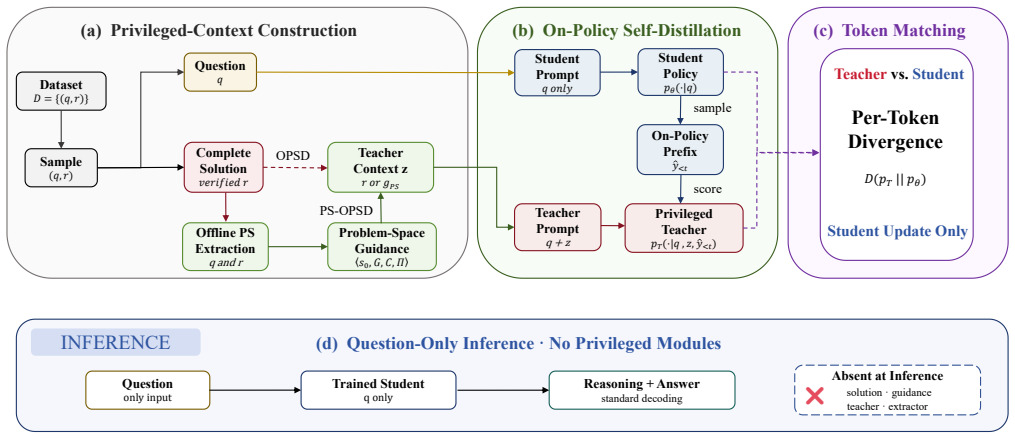
The paper's central claim is that more privileged information is not automatically more transferable in on-policy self-distillation. In standard OPSD, the privileged teacher is conditioned on the question, the student prefix, and the complete reference solution; PS-OPSD conditions the same teacher on a four-field serialization called Problem-Space Guidance—Initial State, Goal Conditions, Constraints, and a Selected State-Transition Path in which each transition specifies an Operator, its Preconditions, the induced Transformation, and the Resulting State. The student rollout and the token-level clipped-KL distillation objective are left unchanged, and at inference the student sees only the qu
What carries the argument
The central object is Problem-Space Guidance, a trajectory-grounded serialization written g_PS(q,r)=⟨s0,G,C,π⟩, where s0 is the Initial State, G the Goal Conditions, C the Constraints, and π=(τ1,...,τk) a Selected State-Transition Path. Each transition is τ_i=(o_i, pre_i, transform_i, s_i), naming the Operator, its Preconditions, the Transformation, and the Resulting State. An offline extractor builds this representation once from each question–verified-solution pair; the cached guidance replaces the complete reference solution in the privileged teacher's context, while the question-only student rollout and the OPSD distribution-matching objective stay fixed. This object carries the argument
Load-bearing premise
The offline extractor must faithfully convert every verified solution into Problem-Space Guidance that captures the initial state, goal conditions, constraints, and a coherent transition path without injecting reference-specific wording or dropping critical relations; if extraction is lossy or biased, the comparison tests the extractor's formatting rather than the representation principle.
What would settle it
Train the same 4B student with a teacher that receives the full reference solution compressed to the same token budget as the guidance with all field labels stripped; if question-only accuracy matches PS-OPSD, the gains come from token budget and formatting rather than problem-space structure. Alternatively, run PS-OPSD with guidance produced by an extractor that copies only the first sentence of the reference solution; if accuracy stays at PS-OPSD levels, the extractor's relational fidelity is not the driver.
If this is right
- If PS-OPSD's central claim is correct, privileged-context design becomes a first-class lever in on-policy self-distillation: what the teacher reads matters as much as how the student is supervised.
- Problem-Space Guidance offers a fixed, offline representation that can be cached before training, so the extractor adds no cost during optimization or question-only inference.
- The representation controls imply that target-relevant guidance is necessary: feeding guidance from a different problem removes the advantage, and path-coherent transitions matter more than preserving local step semantics alone.
- The lower explicit invocation of unavailable reference materials on both training and held-out problems suggests that structured guidance reduces reliance on reference-specific information that cannot be recovered from the question alone.
Where Pith is reading between the lines
- Editorial inference: the same representation principle likely extends beyond OPSD to other methods that consume reference traces—adaptive prefix exposure, harness-based self-distillation, or plan-weighted tuning—where replacing raw solution tokens with state-transition structure could similarly improve transfer, though the paper does not test this.
- Editorial inference: because the paper's extractor is a powerful offline model, the comparison between PS-OPSD and OPSD may partly reflect the extractor's reformatting rather than the representation itself; a cleaner test would use human-authored or templated guidance while holding format fixed.
- Editorial inference: field-level ablations (removing Goal Conditions, Constraints, or Initial State one at a time) would isolate which part of Problem-Space Guidance carries the accuracy gain; the paper's controls vary relevance, path coherence, and field visibility but not individual field content.
- Editorial inference: the entropy analysis suggests gains are not obtained by sharpening the token distribution along correct paths; a natural next step is to measure semantic strategy diversity directly, which the paper explicitly notes its entropy metric does not capture.
Editorial analysis
A structured set of objections, weighed in public.
Referee Report
Summary. The paper proposes PS-OPSD, a variant of on-policy self-distillation in which the privileged teacher context is changed from the complete reference solution to an extracted 'Problem-Space Guidance' (initial state, goal conditions, constraints, and a selected state-transition path). The student rollout and the token-level OPSD objective are unchanged. The method is evaluated on Qwen3-1.7B/4B/8B on AIME24, AIME25, and HMMT25, with additional representation controls and behavioral diagnostics. The manuscript's central claim is that PS-OPSD achieves the highest aggregate question-only accuracy among the compared methods, and that this supports the view that more privileged information is not automatically more transferable when the teacher context is structured around problem-solving relations.
Significance. If the result holds, the paper makes a useful conceptual contribution to self-distilled reasoning: it reframes privileged-context design as a representation problem rather than solely a loss-design problem. The setup is clean—OPSD is kept fixed and only the teacher input is varied—and the paper is transparent about reporting all benchmark cells, including cases where PS-OPSD does not win. It also provides explicit limitations and behavioral diagnostics. However, the strength of the central claim is currently undermined by the oracle-envelope evaluation protocol, which selects a per-benchmark best checkpoint using the test benchmark itself. The aggregate 'Avg' reported in Table 1 is therefore not the accuracy of any single deployable student. The claim is defensible in principle, but it needs a fixed-checkpoint evaluation before the headline result can be accepted.
major comments (4)
- [§5 (Main Question-Only Performance) and Table 1 caption] The headline result is operationalized by an oracle-envelope selection. The caption states that, for each post-training method and benchmark, the checkpoint with the highest accuracy averaged across the three seeds is selected, and that Avg is the unweighted mean across benchmarks and may therefore combine checkpoints. Section 5 explicitly calls this the 'oracle envelope.' Consequently, the reported Avg for each method is not the accuracy of any single trained student; it can stitch together different checkpoints for AIME24, AIME25, and HMMT25, each chosen by looking at that benchmark's test accuracy. The 1.54–2.04-point margins over the strongest baseline are therefore properties of a selection envelope, not of a fixed question-only model. A fixed-checkpoint protocol (e.g., the final checkpoint, or a single checkpoint chosen on a validation split) is needed for all three scales and all
- [§5, Figure 3] Figure 3 is the only matched-checkpoint evidence, and it covers only the 4B scale and only OPSD, AVSD, and PS-OPSD. The text also notes that the endpoint advantage emerges later rather than holding uniformly. No analogous fixed-checkpoint curves are given for the 1.7B and 8B scales, so the cross-scale conclusion rests entirely on the oracle-envelope comparison. The authors should provide fixed-checkpoint results (at minimum final-checkpoint numbers, and preferably training curves) for all scales and all compared methods.
- [§4 (Guidance extractor) and §3 (Explicit Problem-Space Guidance)] The extractor Qwen3.6-35B-A3B is a load-bearing component of the method, but no validation of extraction fidelity is reported. If the extractor is lossy, format-dependent, or biased toward particular reference-solution phrasings, the comparison between PS-OPSD and OPSD tests the extractor's formatting rather than the representation principle claimed to be isolated. The paper should include extraction-quality audits, such as human or LLM-judge evaluations of the four fields, consistency checks against the original solution, and an analysis of extraction failures. Ideally, a gold-guidance control should be compared with the extracted guidance.
- [Table 2 and §3, Eq. (6)] Table 2 reports the representation-control comparisons without error bars or significance measures, and each score is selected by the per-benchmark oracle-best protocol. The gaps (0.71, 2.56, and 2.13 points) are therefore uncalibrated, and the claim that 'relevance' and 'coherence' contribute to gains is weaker than presented. Additionally, the clipping threshold c and temperature T in Eq. (6) are never reported; the sentence in §3 claiming they 'remainboundtoeachrunmanifest' is incomplete and should be corrected. Since the paper states that the clipping configuration differs across scales and runs, the exact values are needed for reproducibility and for assessing whether the comparisons are hyperparameter-consistent.
minor comments (4)
- [§3, text near Eq. (7)] 'remainboundtoeachrunmanifest' appears to be a typo or garbled phrase. The intended meaning should be stated clearly: either the values are reported in an appendix, or they are omitted for a stated reason.
- [§5 (Main Question-Only Performance)] The 'consistency criterion' is introduced only after the results are reported. To avoid post-hoc criteria, the selection rule and the criterion for 'consistently highest' should be specified before the experiments are described.
- [§4 (Experimental Setup)] The paper does not state many basic experimental details: LoRA rank and alpha, learning rate, batch size, number of steps, or the exact prompt templates used for the teacher and student. For a method whose contribution is the teacher context, the prompt template is essential and should be included.
- [General] No code or data are released, and the offline extractor is an external model. Adding a reproducibility statement with code, extracted-guidance examples, and hyperparameters would strengthen the paper substantially.
Circularity Check
No significant circularity; the headline result is an empirical comparison on external benchmarks, with a minor self-citation to the authors' own OPSD framework that is not load-bearing.
full rationale
The paper's central claim—that PS-OPSD achieves the highest aggregate question-only accuracy—is an empirical evaluation on AIME24, AIME25, and HMMT25. The method is defined by a fixed offline extraction and an unchanged OPSD objective; no parameter is fitted to the reported accuracy in a way that would force the outcome. The only close-to-circular element is the self-citation to Zhao et al. (2026) for the OPSD objective, which the paper reuses verbatim. This is a prior method by overlapping authors (Shiwan Zhao appears in both author lists), but it is used as a fixed component and as a baseline, not as an unverified premise from which the conclusion is deduced. The oracle checkpoint selection procedure (Table 1 caption) is a methodological weakness because it picks the best checkpoint per benchmark on the test set, but this affects external validity rather than circularity: the reported accuracies are measured, not derived from the selection rule. No equation in the paper reduces to another by construction, and no fitted parameter is renamed as a prediction. The representation controls (Flattened, Mismatched, Path-Corrupted) are empirical ablations, not tautological comparisons. Therefore the derivation is self-contained in the sense required by the circularity rubric; the minor self-citation justifies a score of 2 rather than 0.
Axiom & Free-Parameter Ledger
free parameters (1)
- OPSD temperature T and clipping threshold c
axioms (5)
- domain assumption Problem-space representation (initial state, goal, operators, constraints) is a faithful abstraction of mathematical problem solving.
- domain assumption The offline extractor Qwen3.6-35B-A3B transforms each verified solution into correct, coherent guidance without loss or added bias.
- standard math The coordinate-clipped mean KL objective is an appropriate distillation loss.
- domain assumption Reference solutions in OpenThoughts are verified and correct.
- ad hoc to paper Oracle-envelope checkpoint selection over the evaluated benchmarks is a fair comparison criterion.
invented entities (1)
-
Problem-Space Guidance (PSG)
no independent evidence
Cite this review
Pith. "Pith review of Is More Privileged Information Better? From Solution Traces to Problem-Solving Structure in Self-Distilled Reasoning." pith.science (2026). https://pith.science/paper/V62DQNNU
@misc{pith2026260801589,
  author       = {Pith},
  title        = {Pith review of: Is More Privileged Information Better? From Solution Traces to Problem-Solving Structure in Self-Distilled Reasoning},
  year         = {2026},
  howpublished = {\url{https://pith.science/paper/V62DQNNU}},
  note         = {Machine review of arXiv:2608.01589}
}
read the original abstract
On-policy self-distillation (OPSD) improves reasoning by using a privileged view of a model conditioned on reference solutions to supervise a student view that observes only the question. However, the teacher-provided token-level targets may depend on reference-specific information unavailable at inference time. We propose Problem-Space-Guided OPSD (PS-OPSD), which replaces the complete solution with trajectory-grounded guidance describing the initial state, goal conditions, constraints, and a selected state-transition path. The student rollout and OPSD objective remain unchanged. Across three mathematical reasoning benchmarks and model scales ranging from 1.7B to 8B, PS-OPSD achieves the highest aggregate question-only accuracy among the compared methods. Controlled experiments further indicate that guidance relevance and path coherence contribute to these gains, highlighting the representation of privileged information as an important design choice in OPSD.
Figures


Reference graph
Works this paper leans on
-
[1]
2015 , eprint =
Distilling the Knowledge in a Neural Network , author =. 2015 , eprint =
2015
-
[2]
Proceedings of the 2016 Conference on Empirical Methods in Natural Language Processing , pages =
Sequence-Level Knowledge Distillation , author =. Proceedings of the 2016 Conference on Empirical Methods in Natural Language Processing , pages =. 2016 , doi =
work page 2016
-
[3]
Advances in Neural Information Processing Systems , volume =
Scheduled Sampling for Sequence Prediction with Recurrent Neural Networks , author =. Advances in Neural Information Processing Systems , volume =
-
[4]
A Reduction of Imitation Learning and Structured Prediction to No-Regret Online Learning , author =. Proceedings of the Fourteenth International Conference on Artificial Intelligence and Statistics , volume =
-
[5]
International Conference on Learning Representations , year =
Unifying Distillation and Privileged Information , author =. International Conference on Learning Representations , year =
-
[6]
The Twelfth International Conference on Learning Representations , year =
Let's Verify Step by Step , author =. The Twelfth International Conference on Learning Representations , year =
-
[7]
Findings of the Association for Computational Linguistics: ACL 2025 , year =
Unveiling the Key Factors for Distilling Chain-of-Thought Reasoning , author =. Findings of the Association for Computational Linguistics: ACL 2025 , year =
work page 2025
-
[8]
Deconstructing Long Chain-of-Thought: A Structured Reasoning Optimization Framework for Long
Luo, Yijia and Song, Yulin and Zhang, Xingyao and Liu, Jiaheng and Wang, Weixun and Chen, GengRu and Su, Wenbo and Zheng, Bo , year =. Deconstructing Long Chain-of-Thought: A Structured Reasoning Optimization Framework for Long. 2503.16385 , archivePrefix =
-
[9]
2025 , eprint =
OpenThoughts: Data Recipes for Reasoning Models , author =. 2025 , eprint =
2025
-
[10]
The Twelfth International Conference on Learning Representations , year =
On-Policy Distillation of Language Models: Learning from Self-Generated Mistakes , author =. The Twelfth International Conference on Learning Representations , year =
-
[11]
2026 , eprint =
Self-Distilled Reasoner: On-Policy Self-Distillation for Large Language Models , author =. 2026 , eprint =
2026
-
[12]
2026 , eprint =
The Many Faces of On-Policy Distillation: Pitfalls, Mechanisms, and Fixes , author =. 2026 , eprint =
2026
-
[13]
Rethinking On-Policy Self-Distillation for Thinking Models , author =. 2026 , eprint =
work page 2026
-
[14]
Shen, Zhanming and Tong, Jintao and Yan, Shaotian and Shen, Chen and Chen, Hao and Ye, Wentao and Hu, Xiaomeng and Miao, Rui and Wang, Haobo and Zhao, Junbo and Chen, Gang and Ye, Jieping , year =. Purified. 2607.02234 , archivePrefix =
-
[15]
Why Does Self-Distillation (Sometimes) Degrade the Reasoning Capability of
Kim, Jeonghye and Luo, Xufang and Kim, Minbeom and Lee, Sangmook and Kim, Dohyung and Jeon, Jiwon and Li, Dongsheng and Yang, Yuqing , year =. Why Does Self-Distillation (Sometimes) Degrade the Reasoning Capability of. doi:10.48550/arXiv.2603.24472 , note =. 2603.24472 , archivePrefix =
-
[16]
Not All Disagreement Is Learnable: Token Teachability in On-Policy Distillation , author =. 2026 , eprint =. doi:10.48550/arXiv.2605.26844 , note =
-
[17]
Privileged Information Distillation for Language Models , author =. 2026 , eprint =. doi:10.48550/arXiv.2602.04942 , note =
-
[18]
Tan, Zhiquan and Hong, Yinrong , year =. 2604.26573 , archivePrefix =
-
[19]
Adaptive Teacher Exposure for Self-Distillation in
Han, Zihao and Zhang, Tiangang and Wang, Huaibin and Sun, Yilun , year =. Adaptive Teacher Exposure for Self-Distillation in. doi:10.48550/arXiv.2605.11458 , note =. 2605.11458 , archivePrefix =
-
[20]
Training with Harnesses: On-Policy Harness Self-Distillation for Complex Reasoning , author =. 2026 , eprint =
work page 2026
-
[21]
Nguyen, Duy and Xiao, Hanqi and Prasad, Archiki and Khan, Zaid and Das, Anirban and Zhang, Austin and Sahu, Sambit and Lee, Hyunji and Stengel-Eskin, Elias and Bansal, Mohit , year =. 2605.20643 , archivePrefix =
-
[22]
Selective Off-Policy Reference Tuning with Plan Guidance , author =. 2026 , eprint =
work page 2026
-
[23]
Learning to Hint for Reinforcement Learning , author =. 2026 , eprint =
work page 2026
-
[24]
and Cui, Bin and Yan, Shuicheng , year =
Yang, Ling and Yu, Zhaochen and Zhang, Tianjun and Xu, Minkai and Gonzalez, Joseph E. and Cui, Bin and Yan, Shuicheng , year =. SuperCorrect: Advancing Small. doi:10.48550/arXiv.2410.09008 , note =. 2410.09008 , archivePrefix =
-
[25]
Reasoning Scaffolding: Distilling the Flow of Thought from
Wen, Xiangyu and Huang, Junhua and Li, Zeju and Li, Min and Zhong, Jianyuan and Xu, Zhijian and Yuan, Mingxuan and Huang, Yongxiang and Xu, Qiang , year =. Reasoning Scaffolding: Distilling the Flow of Thought from. doi:10.48550/arXiv.2509.23619 , note =. 2509.23619 , archivePrefix =
-
[26]
Shao, Zhihong and Wang, Peiyi and Zhu, Qihao and Xu, Runxin and Song, Junxiao and Bi, Xiao and Zhang, Haowei and Zhang, Mingchuan and Li, Y. K. and Wu, Yang and others , year =. doi:10.48550/arXiv.2402.03300 , note =. 2402.03300 , archivePrefix =
-
[27]
Yang, An and Li, Anfeng and Yang, Baosong and Zhang, Beichen and Hui, Binyuan and Zheng, Bo and Yu, Bowen and Gao, Chang and Huang, Chengen and Lv, Chenxu and others , year =. 2505.09388 , archivePrefix =
-
[28]
2026 , month = apr, url =
2026
- [29]
- [30]
-
[31]
Structure-Mapping: A Theoretical Framework for Analogy , author =. Cognitive Science , volume =. 1983 , doi =
work page 1983
-
[32]
Cognitive Psychology , volume =
Schema Induction and Analogical Transfer , author =. Cognitive Psychology , volume =. 1983 , doi =
work page 1983
-
[33]
A New Learning Paradigm: Learning Using Privileged Information , author =. Neural Networks , volume =. 2009 , doi =
work page 2009
-
[34]
Yang, Chenxu and Qin, Chuanyu and Si, Qingyi and Chen, Minghui and Gu, Naibin and Yao, Dingyu and Lin, Zheng and Wang, Weiping and Wang, Jiaqi and Duan, Nan , journal =. Self-Distilled
discussion (0)
Sign in with ORCID, Apple, or X to comment. Anyone can read and Pith papers without signing in.