REVIEW 3 major objections 5 minor 69 references
RL-Lock is the first reinforcement learning framework for generating interlocking assemblies, learning piece-construction decisions with MCTS-guided policy-value training, and it reports finding valid assemblies on all nine tested decomposi
Reviewed by Pith at T0; open to challenge. T0 means a machine referee read the full paper against a public rubric. the ladder, T0–T4 →
A reinforcement learning framework that generates interlocking assemblies by treating shape decomposition as sequential decision-making, solving test puzzles where prior methods timed out.
T0 review reviewed 2026-08-04 challenge →
load-bearing objection A sensible first RL treatment of interlocking assembly decomposition, with a useful action-chunking+MCTS recipe, but the 'no handcrafted heuristics' claim is oversold and the evaluation leans on a reused checker oracle. the 3 major comments →
RL-Lock: Reinforcement Learning for Generating Interlocking Assemblies
The pith
A machine-rendered reading of the paper's core claim, the machinery that carries it, and where it could break.
The reading
Core claim
The central claim is that a policy-value network trained through MCTS-guided self-play can replace handcrafted search heuristics in generating interlocking assemblies. The method works by iterative shape decomposition: from the input voxel grid, each step extracts one connected piece from the remaining volume, and three checkers—connectivity, graph-based interlocking, and removability—judge the intermediate assembly. Action chunking treats the construction of an entire piece as one high-level action, reducing the decision horizon from roughly the total number of voxel assignments to K−1 piece-level choices, with a reward of 1/K for each checker-accepted transition. MCTS, guided by the networ
What carries the argument
The load-bearing mechanism is structured action chunking over an iterative decomposition MDP: each high-level action is an ordered sequence of n voxel assignments that constructs one connected piece, with the first voxel sampled from the frontier of the previous piece and each later voxel from the frontier of the current piece. This converts the search from roughly N single-voxel decisions into K−1 piece decisions, making long-horizon credit assignment feasible. The MCTS-guided policy-value network—backboned by a 3D U-Net—then evaluates these chunks, with its output probabilities and value trained against MCTS search probabilities and cumulative checker rewards. The DESIA-style graph-based i
Load-bearing premise
The method's whole validity chain rests on the assumption that the interlocking test it uses as a reward and acceptance oracle never wrongly passes or rejects an assembly, and the paper gives no independent check.
What would settle it
Physically 3D-print one reported assembly, such as the 25-piece 6^3 cube, assemble it, and try to remove the key followed by the other pieces in the disassembly order; if any non-key piece moves or the key cannot be removed, the claimed validity is refuted. Alternatively, run an independent interlocking test that recomputes single-key interlocking from scratch, not reusing the DESIA checker, on every output.
If this is right
- Action chunking cuts the number of decisions from about N voxel assignments to K−1 piece constructions, which is the concrete reason RL-Lock scales to larger K where per-voxel RL fails.
- MCTS-guided learning is essential to the result: with the same checkers and network backbone, the PPO baseline and the no-chunking MCTS variant both fail on most tasks, isolating the contribution of chunking plus MCTS.
- For a fixed input shape and piece count, training cost is paid once; after that, generating new valid assemblies takes on the order of minutes, so batch generation of many interchangeable designs is the practical use case.
- The same framework handles irregular voxel shapes—a ring with a hole and a sofa with concave features—so the method is not restricted to cubes.
- If the checker is accepted as ground truth, the method establishes a template for learning other hard geometric-constraint decomposition problems beyond interlocking assemblies.
Where Pith is reading between the lines
- Because the DESIA checker is used as both the reward signal and the final validity oracle, RL-Lock is only as good as that test: a conservative checker would make RL-Lock miss valid interlocking designs that a more complete test would accept.
- The per-task retraining requirement implies the method is most attractive for amortized production of many assemblies within one shape class; for a one-off design, the training cost may exceed the heuristic search time on easy cases.
- The experiments do not test whether the learned policy transfers across shapes or piece counts; all reported generalizations are within the same trained task, so transferable design knowledge remains untested.
- A natural extension, left implicit by the paper, is to use the trained value and policy network as a warm-start prior for heuristic search rather than only as a standalone generator.
Editorial analysis
A structured set of objections, weighed in public.
Referee Report
Summary. The paper presents RL-Lock, a reinforcement learning framework for generating interlocking assemblies from voxelized 3D shapes. The problem is formulated as an MDP over iterative shape decomposition, with action chunking that constructs each piece as a high-level action. A policy–value neural network is trained via MCTS-guided self-play, using three state checkers (connectivity, interlocking, removability) taken from the DESIA system. Experiments cover nine cube tasks (4^3, 5^3, 6^3 with varying piece counts K) and two non-cubic shapes. RL-Lock succeeds on all nine tasks, while PPO fails on all, RL-Lock_Action succeeds on two, and DESIA fails on one and takes substantially longer on several others. The paper claims to be the first RL framework for interlocking assembly generation without handcrafted search heuristics.
Significance. If the underlying interlocking checker is correct, the paper makes a notable contribution by demonstrating that a learned search policy with MCTS can outperform a handcrafted heuristic search (DESIA) on challenging decomposition tasks. The method is clearly described, and the ablations help isolate the contribution of action chunking and MCTS. However, the central claim of 'without handcrafted heuristics' is weakened by the use of a frontier-growth sampling heuristic and by the reuse of DESIA's checker as both reward and acceptance oracle. The paper's validity, therefore, largely rests on an unverified component, which limits the strength of the empirical conclusions.
major comments (3)
- [Section 4.1, Abstract] The claim 'without relying on handcrafted search heuristics' is contradicted by the action chunking procedure. The first voxel of each piece is seeded in the six-connected frontier of the previous piece, and subsequent voxels are grown from the current piece's frontier. This is a handcrafted piece-growth strategy, similar in spirit to the seed selection and growth heuristics of prior work. The paper should qualify the claim (e.g., 'without handcrafted search guidance') and explicitly state which components are learned and which are fixed priors.
- [Section 4.1, 'Interlocking checker' and Section 5] The DESIA graph-based checker is used both as the reward signal in MCTS and as the acceptance oracle for all reported results. The paper provides no proof that this checker is equivalent to the single-key interlocking and disassemblability definitions in Section 3, and no independent verification (e.g., physical tests or an alternative checker implementation). Since the RL agent is optimized to satisfy this checker, any false positives would directly invalidate the claimed generated interlocking assemblies. This is load-bearing for the paper's core empirical claim. The authors should add a correctness argument, cross-validate against an independent checker, or physically test representative outputs.
- [Section 5, Tables 1 and 2] The inference-time comparison with DESIA excludes RL-Lock's training time, which ranges from 29 to 107 minutes in Table 1. For the claim that RL-Lock is 'effective' and 'efficient' for challenging cases, the total cost (training plus inference) should be reported, or the comparison should clearly separate one-time training from per-instance inference. Additionally, the paper does not report success rates (number of valid assemblies found per total episodes). Reporting success rates or the number of valid assemblies found would make the timing statistics more meaningful.
minor comments (5)
- [Section 4.1] The first voxel of P1 is not specified. The seeding rule refers to the frontier of P_{i-1}, but for i=1 there is no previous piece. Please clarify the initialization for the first piece.
- [Figure 3] The caption mentions 'black X' and 'blue X' markers, but in grayscale or colorblind print these may be indistinguishable. Please use distinct symbols or labels.
- [Section 5, Implementation] Only one random seed (seed 0) is used for RL training. Given the stochastic nature of RL and MCTS, reporting results over multiple seeds (or at least the variance) would strengthen the reproducibility of the claim that RL-Lock succeeds on all nine tasks.
- [Section 5, Implementation and Tables] The criterion 'training losses stabilize' is vague. Please specify the stopping rule (e.g., a threshold on loss change or a fixed number of iterations). Also, the validation metric used to select the best checkpoint is not defined.
- [Table 2] For DESIA, the table reports 'total computation time divided by five', but it is unclear whether failed runs (hitting the 60-minute limit) are included in this total. Please clarify how the runtime for DESIA is aggregated across independent runs.
Circularity Check
RL-Lock's central 'valid interlocking assembly' claim is carried by the same DESIA graph checker used as reward and acceptance oracle, a self-cited, unverified test; the RL search itself is independent.
specific steps
-
self citation load bearing
[Section 4.1 'Interlocking checker' and Section 4.2 'MCTS']
"To check whether a state si is interlocking, we use the graph-based testing approach in (Wang, Song, and Pauly 2018), which first builds base directional blocking graphs for the intermediate assembly and then checks if these graphs are strongly connected except the key piece. ... Since candidate action chunks are checker-accepted, each valid transition advances the decomposition by one piece and receives a reward of 1/K."
The paper's only evidence that RL-Lock's outputs satisfy the Section 3 definition of interlocking is that they pass the DESIA graph checker, which is (a) the reward signal ('receives a reward of 1/K'), (b) the MCTS action filter ('We discard checker-rejected action chunks'), and (c) the acceptance oracle for the reported statistics ('number of valid assemblies found'). Therefore 'RL-Lock succeeded on all the nine tasks' means, by construction, 'found checker-accepted decompositions'; it is not independent evidence of the geometric interlocking property. The equivalence of the checker to the definition is not proved here; it is imported from Wang, Song, and Pauly 2018, which shares two authors (Ziqi Wang and Peng Song), making the central empirical claim rest on a self-cited, unverified ora
full rationale
The algorithmic derivation of RL-Lock is not circular: the MCTS/policy-value search is a genuine learning method, and the ablation against PPO and RL-Lock_Action is meaningful because all methods share the same state checkers. However, the paper's headline claim—that RL-Lock generates interlocking assemblies—reduces to the correctness of the interlocking checker borrowed from DESIA (Wang, Song, and Pauly 2018), which shares two authors with the present paper. Section 4.1 defines the interlocking check by citing that prior graph-based test; Section 4.2 uses checker acceptance as the reward and as the only route to a 'valid' transition; Section 5 counts 'valid assemblies found' as checker-accepted trajectories. Thus the success statistics are, by construction, statistics about the checker, not about the geometric interlocking property of Section 3. No theorem, independent implementation, physical assembly test, or formal proof is given that the graph test is equivalent to 'all pieces except the key, and every subset of pieces, are immobilized.' This is a load-bearing self-citation: if the checker has blind spots, both RL-Lock and the DESIA baseline share them, and the Table 2 comparison cannot reveal the error. The RL contribution itself is independent, so the circularity is partial (score 4) rather than total.
Axiom & Free-Parameter Ledger
free parameters (4)
- MCTS simulation count per state =
256
- Candidate chunks per state Mc =
32
- Adam learning rate =
5e-5
- Policy-value network weights theta =
trained per task
axioms (4)
- domain assumption The DESIA directional-blocking-graph test exactly characterizes single-key interlocking and removability at each intermediate state.
- domain assumption Satisfying local connectivity, interlocking, and removability requirements at every decomposition step guarantees the final assembly is interlocking and disassemblable.
- ad hoc to paper Restricting voxel growth to six-connected frontiers, with each new piece seeded in the frontier of the previous piece, does not exclude all valid interlocking decompositions.
- domain assumption The best-performing checkpoint on 64 validation episodes remains representative during final inference on same-distribution episodes.
Cite this review
Pith. "Pith review of RL-Lock: Reinforcement Learning for Generating Interlocking Assemblies." pith.science (2026). https://pith.science/paper/63BWQHHL
@misc{pith2026260801744,
  author       = {Pith},
  title        = {Pith review of: RL-Lock: Reinforcement Learning for Generating Interlocking Assemblies},
  year         = {2026},
  howpublished = {\url{https://pith.science/paper/63BWQHHL}},
  note         = {Machine review of arXiv:2608.01744}
}
read the original abstract
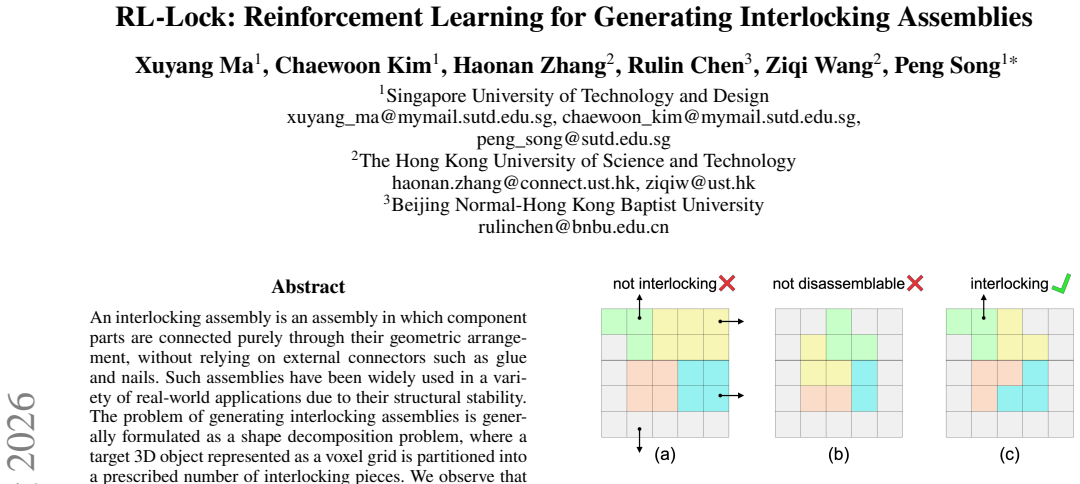
An interlocking assembly is an assembly in which component parts are connected purely through their geometric arrangement, without relying on external connectors such as glue and nails. Such assemblies have been widely used in a variety of real-world applications due to their structural stability. The problem of generating interlocking assemblies is generally formulated as a shape decomposition problem, where a target 3D object represented as a voxel grid is partitioned into a prescribed number of interlocking pieces. We observe that generating interlocking assemblies is inherently a sequential decision-making problem, where an agent repeatedly decides which piece each voxel should be assigned to. Inspired by the observation, we propose the first reinforcement learning framework RL-Lock for generating interlocking assemblies, without relying on handcrafted search heuristics as existing works did. RL-Lock combines structured action chunking with MCTS-guided policy-value learning to efficiently navigate the large combinatorial search space for interlocking assembly generation. We demonstrate through experiments that RL-Lock allows effective generation of interlocking assemblies, especially for challenging cases in which existing approaches take too long or even fail to find a valid solution.
Figures


Reference graph
Works this paper leans on
-
[1]
Shell Structures for Architecture: Form Finding and Optimization , publisher =
-
[2]
Automation in Construction , volume =
Guy Austern and Isaac Guedi Capeluto and Yasha Jacob Grobman , title =. Automation in Construction , volume =. 2018 , pages =
work page 2018
-
[3]
Helmut Pottmann and Michael Eigensatz and Amir Vaxman and Johannes Wallner , title =. 2015 , pages =
work page 2015
-
[4]
Bernd Bickel and Paolo Cignoni and Luigi Malomo and Nico Pietroni , title =. 2018 , pages =
work page 2018
-
[5]
Bermano and Thomas Funkhouser and Szymon Rusinkiewicz , title =
Amit H. Bermano and Thomas Funkhouser and Szymon Rusinkiewicz , title =. 2017 , pages =
work page 2017
-
[6]
Patrick Baudisch and Stefanie Mueller , title =. Foundations and Trends. 2017 , pages =
work page 2017
-
[7]
Medical Image Computing and Computer-Assisted Intervention (MICCAI) , series =
Olaf Ronneberger and Philipp Fischer and Thomas Brox , title =. Medical Image Computing and Computer-Assisted Intervention (MICCAI) , series =. 2015 , publisher =
work page 2015
-
[8]
Medical Image Computing and Computer-Assisted Intervention (MICCAI) , pages =
3D U-Net: Learning Dense Volumetric Segmentation from Sparse Annotation , year =. Medical Image Computing and Computer-Assisted Intervention (MICCAI) , pages =
-
[9]
James Bradbury and Roy Frostig and Peter Hawkins and Matthew James Johnson and Yash Katariya and Chris Leary and Dougal Maclaurin and George Necula and Adam Paszke and Jake Vander
-
[10]
Peng Song , title =. Materials Today: Proceedings (International Conference on Additive Manufacturing for a Better World) , volume =. 2022 , pages =
work page 2022
- [11]
-
[12]
Zezhou Sun and Devin Balkcom and Emily Whiting , title =. 2024 , pages =
work page 2024
-
[13]
Amy Sniffen and Zezhou Sun and Samuel Lensgraf and Emily Whiting and Alberto Quattrini Li and Devin Balkcom , title =. Proc. of Robotics: Science and Systems , year =
-
[14]
IEEE Transactions on Automation Science and Engineering , year =
Yinan Zhang and Yotto Koga and Devin Balkcom , title =. IEEE Transactions on Automation Science and Engineering , year =
-
[15]
Interlocking Structure Assembly with Voxels , author =
-
[16]
Shen-Guan Shih , title =. Proc. of Advances in Architectural Geometry , pages =
-
[17]
Shen-Guan Shih , title =. Proc. of Bridges: Mathematics, Art, Music, Architecture, Education, Culture , pages =
-
[18]
Shen-Guan Shih and Chih-Hung Yen and Long-Wei Chou , title =. Proc. of Bridges: Mathematics, Art, Music, Architecture, Education, Culture , pages =
-
[19]
Bastian Wibranek and Yuxi Liu and Niklas Funk and Boris Belousov and Jan Peters and Oliver Tessmann , title =. Proc. of the 39th Education and Research in Computer Aided Architectural Design in Europe (eCAADe) Conference , pages =
-
[20]
Rulin Chen and Ziqi Wang and Peng Song and Bernd Bickel , title =
-
[21]
Ziqi Wang and Peng Song and Florin Isvoranu and Mark Pauly , title =. 2019 , volume =
work page 2019
-
[22]
Keke Tang and Peng Song and Xiaofei Wang and Bailin Deng and Chi-Wing Fu and Ligang Liu , title =. 2019 , volume =
work page 2019
- [23]
-
[24]
Peng Song and Chi-Wing Fu and Yueming Jin and Hongfei Xu and Ligang Liu and Pheng-Ann Heng and Daniel Cohen-Or , title =. 2017 , pages =
work page 2017
-
[25]
Miaojun Yao and Zhili Chen and Weiwei Xu and Huamin Wang , title =. 2017 , pages =
work page 2017
-
[26]
Peng Song and Bailin Deng and Ziqi Wang and Zhichao Dong and Wei Li and Chi-Wing Fu and Ligang Liu , title =. 2016 , pages =
work page 2016
-
[27]
Chi-Wing Fu and Peng Song and Xiaoqi Yan and Lee Wei Yang and Pradeep Kumar Jayaraman and Daniel Cohen-Or , title =. 2015 , pages =
work page 2015
- [28]
-
[29]
Peng Song and Chi-Wing Fu and Daniel Cohen-Or , title =. 2012 , volume =
work page 2012
-
[30]
Shi-Qing Xin and Chi-Fu Lai and Chi-Wing Fu and Tien-Tsin Wong and Ying He and Daniel Cohen-Or , title =. 2011 , volume =
work page 2011
-
[31]
Jiahao Li and Yusheng Luo and Yunzhong Lou and Xiangdong Zhou , title =
-
[32]
Ke Niu and Haiyang Yu and Zhuofan Chen and Mengyang Zhao and Teng Fu and Bin Li and Xiangyang Xue , title =
-
[33]
Sam Earle and Zehua Jiang and Eugene Vinitsky and Julian Togelius , title =. Proc. of the AAAI Conference on Artificial Intelligence and Interactive Digital Entertainment , pages =
-
[34]
Ahmed Khalifa and Philip Bontrager and Sam Earle and Julian Togelius , title =. Proc. of the AAAI Conference on Artificial Intelligence and Interactive Digital Entertainment , pages =
-
[35]
Procedural Material Generation with Reinforcement Learning , journal = TOG_SIGA, volume =
Beichen Li and Yiwei Hu and Paul Guerrero and Milo. Procedural Material Generation with Reinforcement Learning , journal = TOG_SIGA, volume =
-
[36]
Engineering Applications of Artificial Intelligence , volume =
Yejun Choi and Yeoneung Kim and Keun Park , title =. Engineering Applications of Artificial Intelligence , volume =
-
[37]
Julian Whitman and Raunaq Bhirangi and Matthew Travers and Howie Choset , title =
-
[38]
Expert Systems with Applications , volume =
Zhen Liu and Hongwei Deng and Yongcan Wang and Changzheng Yue and Tao Xie and Jiefeng Zhang and Chao Wu and Jiali Zhou and Zheyuan Zhou , title =. Expert Systems with Applications , volume =
-
[39]
Hichem Seriket and Oualid Bougzime and Yuyang Song and H. Jerry Qi and Fr. Reinforcement Learning-enabled Design of Topological Interlocking Materials for Sustainable Multi-material Additive Manufacturing , journal =
-
[40]
Gabriel Vallat and Jingwen Wang and Anna Maddux and Maryam Kamgarpour and Stefana Parascho , title =. Proc. of the 8th ACM Symposium on Computational Fabrication , pages =
-
[41]
Taylor and Jaesik Park and Minsu Cho , title =
Hyunsoo Chung and Jungtaek Kim and Boris Knyazev and Jinhwi Lee and Graham W. Taylor and Jaesik Park and Minsu Cho , title =
-
[42]
ACADIA 2020: Distributed Proximities, Volume I: Technical Papers , pages =
Tyson Hosmer and Panagiotis Tigas and David Reeves and Ziming He , title =. ACADIA 2020: Distributed Proximities, Volume I: Technical Papers , pages =
work page 2020
-
[43]
arXiv preprint arXiv:1707.06347 , year=
Proximal policy optimization algorithms , author=. arXiv preprint arXiv:1707.06347 , year=
-
[44]
Ruize Zhang and Zelai Xu and Chengdong Ma and Chao Yu and Wei-Wei Tu and Wenhao Tang and Shiyu Huang and Deheng Ye and Wenbo Ding and Yaodong Yang and Yu Wang , title =
-
[45]
David Silver and Aja Huang and Chris J. Maddison and Arthur Guez and Laurent Sifre and George van den Driessche and Julian Schrittwieser and Ioannis Antonoglou and Veda Panneershelvam and Marc Lanctot and Sander Dieleman and Dominik Grewe and John Nham and Nal Kalchbrenner and Ilya Sutskever and Timothy Lillicrap and Madeleine Leach and Koray Kavukcuoglu ...
-
[46]
David Silver and Julian Schrittwieser and Karen Simonyan and Ioannis Antonoglou and Aja Huang and Arthur Guez and Thomas Hubert and Lucas Baker and Matthew Lai and Adrian Bolton and Yutian Chen and Timothy Lillicrap and Fan Hui and Laurent Sifre and George van den Driessche and Thore Graepel and Demis Hassabis , title =. Nature , volume =
-
[47]
Science , volume =
David Silver and Thomas Hubert and Julian Schrittwieser and Ioannis Antonoglou and Matthew Lai and Arthur Guez and Marc Lanctot and Laurent Sifre and Dharshan Kumaran and Thore Graepel and Timothy Lillicrap and Karen Simonyan and Demis Hassabis , title =. Science , volume =
-
[48]
Ziqi Wang and Wenjun Liu and Jingwen Wang and Gabriel Vallat and Fan Shi and Stefana Parascho and Maryam Kamgarpour , title =
-
[49]
Ozgur Aslan and Burak Bolat and Batuhan Bal and Tugba Tumer and Erol Sahin and Sinan Kalkan , title =
-
[50]
Automation in Construction , volume =
Aleksandra Anna Apolinarska and Matteo Pacher and Hui Li and Nicholas Cote and Rafael Pastrana and Fabio Gramazio and Matthias Kohler , title =. Automation in Construction , volume =
-
[51]
Somay. Review and Taxonomies of Assembly and Disassembly Path Planning Problems and Approaches , journal = CAD, volume =. 2015 , pages =
work page 2015
-
[52]
P. Jim. Survey on Assembly Sequencing: A Combinatorial and Geometrical Perspective , journal =. 2013 , pages =
work page 2013
-
[53]
A Survey of Constraints in Automated Assembly Planning , author =
- [54]
-
[55]
Jiayi Liu and Manolis Savva and Ali Mahdavi-Amiri , title =
-
[56]
Peter Kulits and Cordelia Schmid , title =
-
[57]
Ava Pun and Kangle Deng and Ruixuan Liu and Deva Ramanan and Changliu Liu and Jun-Yan Zhu , title =
-
[58]
Hao Xu and Yuqing Zhang and Yiqian Wu and Xinyang Zheng and Yutao Liu and Xiangjun Tang and Yunhan Yang and Ding Liang and Yingtian Liu and Yuanchen Guo and Yanpei Cao and Xiaogang Jin , title =
-
[59]
Jiahao Ge and Mingjun Zhou and Hanyou Zheng and Hao Xu and Chi-Wing Fu , title =
-
[60]
Jiahao Ge and Mingjun Zhou and Chi-Wing Fu , title =
-
[61]
Jiahao Ge and Mingjun Zhou and Wenrui Bao and Hao Xu and Chi-Wing Fu , title =
-
[62]
Mengqi Guo and Chen Li and Yuyang Zhao and Gim Hee Lee , title =
-
[63]
Rylee Thompson and Elahe Ghalebi and Terrance DeVries and Graham W. Taylor , title =. Machine Learning for Engineering Modeling, Simulation, and Design Workshop at Neural Information Processing Systems , year =
-
[64]
Yuan Shui and Yandong Guan and Zhanwei Zhang and Juncheng Hu and Jing Zhang and Dong Xu and Qian Yu , title =
-
[65]
Ziang Cao and Fangzhou Hong and Zhaoxi Chen and Liang Pan and Ziwei Liu , title =
-
[66]
Ruijie Lu and Yu Liu and Jiaxiang Tang and Junfeng Ni and Yuxiang Wang and Diwen Wan and Gang Zeng and Yixin Chen and Siyuan Huang , title =
-
[67]
Jiayi Su and Youhe Feng and Zheng Li and Jinhua Song and Yangfan He and Botao Ren and Botian Xu , title =
-
[68]
Long Le and Jason Xie and William Liang and Hung-Ju Wang and Yue Yang and Yecheng Jason Ma and Kyle Vedder and Arjun Krishna and Dinesh Jayaraman and Eric Eaton , title =
-
[69]
Chang and Manolis Savva and Ali Mahdavi-Amiri , title =
Jiayi Liu and Denys Iliash and Angel X. Chang and Manolis Savva and Ali Mahdavi-Amiri , title =
This paper was first reviewed by deepseek-v4-flash on August 4, 2026.
discussion (0)
Sign in with ORCID, Apple, or X to comment. Anyone can read and Pith papers without signing in.