REVIEW 3 major objections 6 minor 63 references
Magnetocaloric response of six 2D Ising lattices collapses to one universal curve.
Reviewed by Pith at T0; open to challenge. T0 means a machine referee read the full paper against a public rubric. the ladder, T0–T4 →
2026-08-04 20:22 UTC pith:7KEP5FNJ
load-bearing objection Solid Monte Carlo study of MCE scaling in 2D Ising lattices, but the bilayer model as written contradicts the simulated coordination numbers, weakening the central universal-scaling claim. the 3 major comments →
Universal Scaling of the Magnetocaloric Effect in 2D Ising Monolayers and Bilayer
The pith
A machine-rendered reading of the paper's core claim, the machinery that carries it, and where it could break.
Core claim
The paper claims that the magnetocaloric effect in 2D Ising monolayers and bilayers is universal once expressed in reduced variables. Using Binder-cumulant crossings to locate Tc for each of the six systems, the authors show that normalized -ΔS_M/ΔS_max plotted against the rescaled temperature θ collapses for each lattice across fields and, at a fixed low field (h/J=0.15; the exponent n at h/J=0.08), across all six lattices. Critical scaling with 2D Ising exponents gives n(Tc)≈0.533, matching the simulations. At the same time, the peak value of -ΔS_M decreases with coordination number (largest for honeycomb, r=3; smallest for triangular, r=6), peak ΔT_ad increases with coordination number, a
What carries the argument
The load-bearing object is the normalized entropy-change curve ΔS_M/ΔS_max plotted against the rescaled temperature θ, defined from the two temperatures at which ΔS_M falls to half its peak on each side of Tc. Because θ scales like t·h^{-1/Δ}, this collapse is equivalent to the free-energy scaling relation F(λ^{a_T} t, λ^{a_h} h)=λ F(t,h); the field exponent n comes from the logarithmic field derivative of ΔS_M. Binder-cumulant crossings supply Tc for each lattice. The master curve does the work: it encodes the claim that one universal function describes the cooling response of all six geometries.
Load-bearing premise
The two-layer systems, with periodic boundary conditions along the stacking direction and equal interlayer and intralayer couplings, still belong to the same 2D Ising universality class as their monolayers; if the finite two-layer thickness or unequal couplings changed the universality class, the cross-lattice master-curve collapse would not hold.
What would settle it
Run the same Monte Carlo analysis for a bilayer with unequal interlayer coupling, say J⊥=0.5J, and check whether ΔS_M/ΔS_max versus θ still falls on the six-lattice master curve at h/J=0.15. If it does not, the claimed layer-count universality fails. An independent check: compute n(Tc) on a 256×256 triangular monolayer at h/J=0.08; if it deviates from 0.533 by more than the Monte Carlo error bars, the critical-scaling identification is falsified.
If this is right
- Honeycomb monolayers give the largest peak -ΔS_M, so a designer wanting maximum entropy change should choose low-coordination lattices.
- Triangular bilayers give the largest adiabatic temperature change ΔT_ad even though their -ΔS_M is smaller, decoupling the two common MCE metrics.
- Relative cooling power and cooling capacity are nearly the same across all six lattices, so switching to a low-coordination lattice need not sacrifice useful refrigeration capacity.
- The field dependencies of -ΔS_M, RCP, and q follow power laws up to roughly 2.6 T (for J≈1 meV), allowing extrapolation beyond directly simulated fields.
- Because all six lattices fall on one normalized curve, the master curve can serve as a numerical fingerprint of the 2D Ising universality class.
- Lattices with lower coordination show faster narrowing of hysteresis loops with temperature, coupling large entropy change with low coercivity near Tc.
Where Pith is reading between the lines
- If the collapse survives beyond the six lattices studied, it predicts that any two-dimensional Ising-like magnet in the same universality class will show the same normalized MCE curve; deviations would signal a different effective universality class.
- The near-constancy of RCP and q across coordination numbers suggests that peak height alone is the wrong design metric for 2D refrigerants; the paper leaves this design principle implicit.
- A direct testable extension is to vary the interlayer coupling J⊥ relative to J∥: the paper fixes them equal, so the master-curve collapse for unequal couplings is not established.
- Extending the analysis to three or more layers, or to frustrated next-nearest-neighbor couplings, would test where layer-count and geometry universality break down; the paper's outlook explicitly leaves those cases open.
Editorial analysis
A structured set of objections, weighed in public.
Referee Report
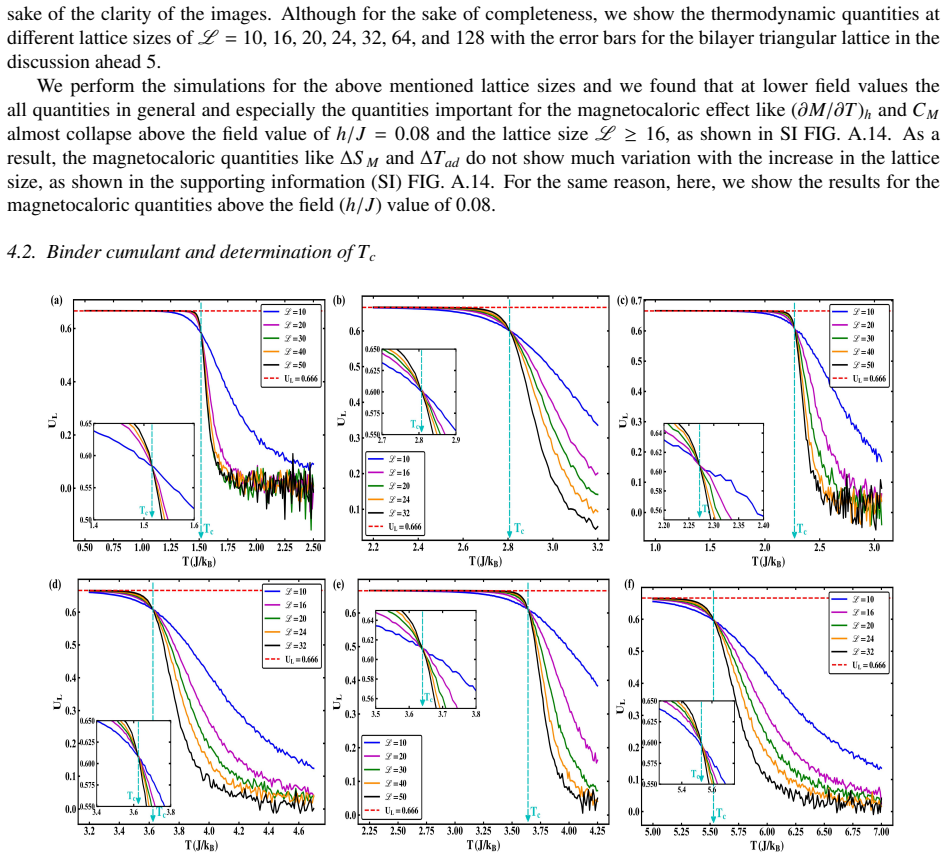
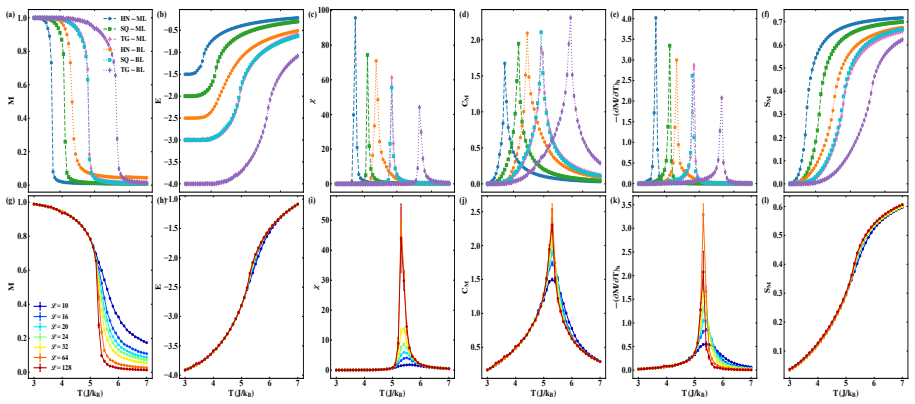
Summary. The paper presents Monte Carlo simulations of the ferromagnetic Ising model on honeycomb, square, and triangular lattices in monolayer and bilayer forms, with the aim of establishing universal scaling of the magnetocaloric effect across all six geometries. The authors locate T_c by Binder cumulants, compute the magnetic entropy change, adiabatic temperature change, magnetic Grüneisen parameter, relative cooling power, and cooling capacity, and report collapse of normalized quantities and of the field exponent n onto master curves both for varying field at fixed lattice and across all lattices at fixed field. They also report power-law field dependencies in a low-field regime and a qualitative hysteresis study. The central claim is that the normalized MCE response is universal across coordination number and layer count within the 2D Ising universality class.
Significance. If the central claims are quantitatively supported, this would be a useful numerical demonstration that phenomenological Franco-type master curves extend across lattice geometries and layer count in the 2D Ising universality class, with practical implications for screening 2D magnetic refrigerants. The paper has clear strengths: it reproduces the exact monolayer T_c values (honeycomb ≈1.516, square ≈2.27, triangular ≈3.64), uses Binder cumulants for T_c, considers a wide set of MCE observables, and explicitly discusses known limitations of scaling away from the critical region. The main weaknesses are that the bilayer model is defined inconsistently with the stated coordination numbers, and the central collapse and power-law claims lack quantitative uncertainty estimates. These issues are load-bearing for the abstract's universality claim, so the manuscript requires substantial revision.
major comments (3)
- [§2.1–§2.2 and Table 1] The model definition and the simulated bilayer coordination numbers are internally inconsistent. Equation (2) contains a single interlayer term −J⊥ Σ_i σ_{i,1}σ_{i,2}, so with J∥=J⊥ each spin has exactly one interlayer neighbor; the effective coordination numbers should be r=4, 5, 7 for honeycomb/square/triangular bilayers, even with periodic boundary conditions along z when unique bonds are counted. Section 2.2 instead states that periodic boundary conditions add two extra nearest neighbors, giving r=5, 6, 8. The reported square-bilayer T_c=3.62 (Table 1) is essentially equal to the triangular-monolayer T_c=3.64, which is consistent with r=6 (two interlayer bonds per spin) and not with Eq. (2). Section 6 repeats the r=5,6,8 list and explicitly identifies square bilayer with triangular monolayer via topological equivalence, further indicating that the simulations used an effective interl
- [§4.3.1, Fig. 10] The central universal-collapse claim is presented without error bars or a quantitative collapse metric. The text states that Jackknife error bars are dropped for clarity, and representative errors are only shown for one lattice in Fig. 5(g-l). No uncertainties are propagated to ΔS_M, n, or θ, and no measure such as the RMS spread of the normalized curves about a common master curve is given. This matters because the normalization by each curve's own peak and by T_{r1}, T_{r2} (Eq. 27) automatically enforces that every curve passes through (0,1) and through ±1 at half maximum; a visual collapse across fields and lattices is therefore partly built into the construction. To make the abstract's 'universal master curve' claim testable, the authors should show representative error bars and provide a quantitative collapse statistic with bootstrap/jackknife confidence intervals for the per-latti
- [§4.3.1, Fig. 11] The power-law statements for ΔS_M^{max}, ΔT_ad^{max}, RCP, q, and Γ_M^{max} are not documented as fits. No fit functions, fitted exponents, fit ranges, standard errors, or goodness-of-fit measures are given, and no comparison with the theoretical exponents from Section 3 (e.g., n(T_c)=8/15≈0.533, q∝h^{16/15}) is made. Since the abstract and introduction emphasize the power-law field dependence up to ~2.6 T, the authors should provide a table of fitted exponents with uncertainties and explicitly state the h/J range included in each fit.
minor comments (6)
- [§6] The Tesla conversion uses g=2 and μ_B=5.788×10^{-5} eV/T, whereas Section 2.1 sets g=1 and μ_B=1. Please state the conversion consistently with the units used in the figures.
- [Fig. 10 caption] Panel (b) uses h/J=0.08 while panels (a), (c), and (d) use h/J=0.15. The abstract says both ΔS_M and n collapse at a fixed low field; please justify the different field choice or show that the n-collapse is unchanged at h/J=0.15.
- [§4.1] The finite-size scaling statement for the susceptibility peak reads χ_max(L)∼L^{ν/γ}; the standard relation is χ_max(L)∼L^{γ/ν}. Please correct.
- [§5] The hysteresis conclusion is only qualitative. Since the paper states that lower-coordination lattices show faster reduction of loop width with temperature, please provide quantitative loop-width or coercivity data as a function of T/T_c for all six lattices.
- [§2.2] There are two nearly identical paragraphs beginning 'For investigating thermodynamic behavior using numerical methods...' in Section 2.2. One should be deleted.
- [References] Reference [29] is cited repeatedly as supporting the mean-field behavior but is described as 'In progress'. Please provide a preprint or DOI, or soften the reliance on an unavailable manuscript.
Circularity Check
No significant circularity: the universal-collapse claim is an independently demonstrated data collapse; only minor non-load-bearing self-citations are present.
full rationale
The central result is the collapse of normalized magnetocaloric quantities. Normalization by each curve's own peak and half-maximum reference temperatures fixes only three anchor points per curve; it does not force full-curve collapse across fields or across the six lattices, and the field exponent n is obtained from unnormalized field derivatives, so the collapse of n is a nontrivial check. The critical-scaling plots using t h^{-1/Δ} with standard 2D Ising exponents provide an independent test that does not use the fitted peak normalization. The power-law comparisons use known 2D Ising exponents (β=1/8, γ=7/4) rather than exponents fit from the same data. The paper does cite the authors' own in-progress mean-field study [29] several times as supporting remarks, but the Monte Carlo collapse is fully presented and does not depend on that citation, so this is a minor self-citation rather than load-bearing circularity. A separate internal inconsistency—Section 2.2 assigns periodic-boundary bilayers coordination numbers r=5,6,8 (two extra interlayer neighbors) while the bilayer Hamiltonian, Eq. (2), contains only one interlayer bond per site (r=4,5,7)—is a correctness/model-consistency concern that should be weighed independently, but it is not a circular reduction of the scaling claim.
Axiom & Free-Parameter Ledger
free parameters (1)
- Exchange coupling J for Tesla conversion =
1 meV (assumed)
axioms (6)
- standard math The singular part of the free energy is a generalized homogeneous function: F(lambda^{a_T} t, lambda^{a_h} h) = lambda F(t,h) (Eq. 17).
- domain assumption The six lattices (three monolayers and their bilayers with periodic z-boundary conditions) all belong to the 2D Ising universality class.
- domain assumption J_parallel = J_perp = J for bilayers, and J=1 sets the energy scale.
- domain assumption The brick model representation of honeycomb and triangular lattices is topologically equivalent to the original lattices.
- domain assumption Metropolis and Wolff algorithms sample the Boltzmann distribution, and the system is equilibrated after 3.33e5 steps with 1e6 averaging steps.
- domain assumption Franco's phenomenological master curve procedure (normalizing Delta_SM by its peak and rescaling T with half-maximum temperatures) is an unbiased test of universality.
read the original abstract
We report a Monte Carlo study of the magnetocaloric effect (MCE) in two-dimensional ferromagnetic Ising models on square, honeycomb, and triangular lattices with monolayer and bilayer configurations. Using Binder cumulant analysis, we determine the critical temperature ($T_c$) of each structure and find that $T_c$ increases with coordination number, from the honeycomb ($r=3$) to the triangular ($r=6$) lattice. In contrast, the magnetic entropy change ($-\Delta S_M$) decreases with coordination number, reaching its maximum for the honeycomb lattice. After normalization by their peak values and appropriate temperature scaling, both $-\Delta S_M$ and the field exponent $n$ collapse onto universal master curves for different magnetic fields and across all six lattice structures at a fixed low field. This demonstrates universal MCE scaling independent of coordination number and layer count. Critical scaling analysis further supports the observed universality and power-law behavior. Unlike $-\Delta S_M$, the adiabatic temperature change ($\Delta T_{ad}$) increases with coordination number, whereas the magnetic Gr\"{u}neisen parameter ($\Gamma_M$) follows the same trend as $-\Delta S_M$. Although the peak value of $-\Delta S_M$ decreases with coordination number, the relative cooling power and cooling capacity remain nearly unchanged due to compensating broadening of the $-\Delta S_M$ curves. The field dependence of $-\Delta S_M$, relative cooling power, and cooling capacity follows power laws up to $\sim2.6$ T (assuming $J\approx1$ meV). Hysteresis analysis shows that lattices with lower coordination numbers exhibit a faster reduction in loop width with increasing temperature. These results establish the universal scaling behavior of the magnetocaloric effect in two-dimensional monolayer and bilayer magnetic lattices and provide guidelines for designing magnetic refrigerants.
Figures




Reference graph
Works this paper leans on
-
[1]
P. Weiss, A. Piccard, Le phénomène magnétocalorique, Journal de Physique Théorique et Appliquée 7 (1) (1917) 103–109.doi:10.1051/jphystap:019170070010300
-
[2]
A. Tishin, Y . Spichkin, The Magnetocaloric Effect and its Applications, 2010.doi:10.1201/9781420033373. 23
-
[3]
G. W. McNerney, The environmental impact and energy efficiency of magnetocaloric refrigeration systems, International Journal of Environmental Sustainability and Green Technologies 15 (1) (2025) 1–13.doi:10. 4018/ijesgt.369160
2025
-
[4]
U. Lucia, G. Grisolia, Magnetocaloric refrigeration in the context of sustainability: A review of thermodynamic bases, the state of the art, and future prospects, Energies 17 (14) (2024) 3585.doi:10.3390/en17143585
-
[5]
K. Gschneidner, V . Pecharsky, Thirty years of near room temperature magnetic cooling: Where we are today and future prospects, International Journal of Refrigeration 31 (6) (2008) 945–961.doi:10.1016/j.ijrefrig. 2008.01.004
-
[6]
V . K. Pecharsky, K. A. Gschneidner, Jr, Giant Magnetocaloric Effect InGD5(SI2GE2), Physical Review Letters 78 (23) (1997) 4494–4497.doi:10.1103/physrevlett.78.4494
-
[7]
P. Debye, Einige Bemerkungen zur Magnetisierung bei tiefer Temperatur, Annalen der Physik 386 (25) (1926) 1154–1160.doi:10.1002/andp.19263862517
-
[8]
W. F. Giauque, A Thermodynamic Treatment of Certain Magnetic Effects. A Proposed Method of Producing Temperatures considerably Below 1° Absolute, Journal of the American Chemical Society 49 (8) (1927) 1864– 1870.doi:10.1021/ja01407a003
-
[9]
V . Franco, J. Blázquez, J. Ipus, J. Law, L. Moreno-Ramírez, A. Conde, Magnetocaloric effect: From materials research to refrigeration devices, Progress in Materials Science 93 (2017) 112–232.doi:10.1016/j.pmatsci. 2017.10.005
-
[10]
O. Gutfleisch, T. Gottschall, M. Fries, D. Benke, I. Radulov, K. P. Skokov, H. Wende, M. Gruner, M. Acet, P. Entel, M. Farle, Mastering hysteresis in magnetocaloric materials, Philosophical Transactions of the Royal Society A Mathematical Physical and Engineering Sciences 374 (2074) (2016) 20150308.doi:10.1098/ rsta.2015.0308
arXiv 2074
-
[11]
B. Widom, Equation of state in the neighborhood of the critical point, The Journal of Chemical Physics 43 (11) (1965) 3898–3905.doi:10.1063/1.1696618
-
[12]
H. Oesterreicher, F. T. Parker, Magnetic cooling near Curie temperatures above 300 K, Journal of Applied Physics 55 (12) (1984) 4334–4338.doi:10.1063/1.333046
-
[13]
V . Franco, J. S. Blázquez, A. Conde, Field dependence of the magnetocaloric effect in materials with a second order phase transition: A master curve for the magnetic entropy change, Applied Physics Letters 89 (22) (11 2006).doi:10.1063/1.2399361
-
[14]
A. Arrott, J. E. Noakes, Approximate Equation of State For Nickel Near its Critical Temperature, Physical Review Letters 19 (14) (1967) 786–789.doi:10.1103/physrevlett.19.786
-
[15]
J. Lyubina, M. D. Kuz’min, K. Nenkov, O. Gutfleisch, M. Richter, D. L. Schlagel, T. A. Lograsso, K. A. Gschnei- dner, Magnetic field dependence of the maximum magnetic entropy change, Physical Review B 83 (1) (1 2011). doi:10.1103/physrevb.83.012403
-
[16]
X. Liu, E. Lv, X. Cui, H. Ge, F. Song, Z. Tian, G. Su, K. Zhao, J. Xiang, P. Sun, W. Li, ISing Supercriticality and Universal Magnetocalorics in Spiral Antiferromagnet ND 3 BWO 9, Physical Review Letters 136 (24) (5 2026).doi:10.1103/nqcw-pz8v
-
[17]
V . Franco, A. Conde, J. M. Romero-Enrique, J. S. Blázquez, A universal curve for the magnetocaloric effect: an analysis based on scaling relations, Journal of Physics Condensed Matter 20 (28) (2008) 285207.doi: 10.1088/0953-8984/20/28/285207
-
[18]
A. I. Guerrero, S. G. J, Magnetocaloric effect in theJ 1˘J2 transverse Ising model, Journal of Magnetism and Magnetic Materials 514 (2020) 167140.doi:10.1016/j.jmmm.2020.167140. 24
arXiv 2020
-
[19]
J. D. Alzate-Cardona, J. S. Salcedo-Gallo, D. F. Rodríguez-Patiño, C. D. Acosta-Medina, E. Restrepo-Parra, Unveiling a scaling and universal behavior for the magnetocaloric effect in cubic crystal structures: a Monte Carlo simulation, Scientific Reports 9 (1) (2019) 5228.doi:10.1038/s41598-019-41321-y
-
[20]
L. Patra, Y . Quan, B. Liao, Impact of dimensionality on the magnetocaloric effect in two-dimensional magnets, Journal of Applied Physics 136 (2) (7 2024).doi:10.1063/5.0218007
-
[21]
B. Schmidt, P. Thalmeier, N. Shannon, Magnetocaloric effect in the frustrated square latticeJ 1−J 2 model, Physical Review B 76 (12) (9 2007).doi:10.1103/physrevb.76.125113
-
[22]
R. Zeng, S. Q. Wang, G. D. Du, J. L. Wang, J. C. Debnath, P. Shamba, Z. Y . Fang, S. X. Dou, Abnormal magnetic behaviors and large magnetocaloric effect in MnPS3 nanoparticles, Journal of Applied Physics 111 (7) (3 2012). doi:10.1063/1.3679409
-
[23]
Y . S. Hou, J. H. Yang, H. J. Xiang, X. G. Gong, First-principles study of the magnetic interactions in honeycomb Na2IrO3, Physical review. B./Physical review. B 98 (9) (9 2018).doi:10.1103/physrevb.98.094401
-
[24]
F. Gao, J. Sheng, W. Ren, Q. Zhang, X. Luo, J. Qi, M. Cong, B. Li, L. Wu, Z. Zhang, Incommensurate spin density wave and magnetocaloric effect in the metallic triangular lattice HoAl2Ge2, Physical review. B./Physical review. B 106 (13) (10 2022).doi:10.1103/physrevb.106.134426
-
[25]
J. Gong, L. Tian, L. Zhang, Z. Mo, Y . Wang, J. Shen, Magnetism and cryogenic magnetocaloric effect of triangular-lattice LnOF (Ln=Gd, Dy, Ho, and Er) compounds, Journal of Rare Earths 43 (1) (2023) 98–104. doi:10.1016/j.jre.2023.10.005
-
[26]
E. P. Nóbrega, N. A. De Oliveira, P. J. V on Ranke, A. Troper, The magnetocaloric effect in R5Si4(R=Gd, Tb): a Monte Carlo calculation, Journal of Physics Condensed Matter 18 (4) (2006) 1275–1283.doi:10.1088/ 0953-8984/18/4/013
2006
-
[27]
W. Li, Z. Liu, D. Xie, Magnetocaloric properties and critical behavior of rare-earth perovskite LaMnO3, Journal of Magnetism and Magnetic Materials 655 (2026) 174333.doi:10.1016/j.jmmm.2026.174333
arXiv 2026
-
[28]
R. Masrour, A. Jabar, M. S. B. Kraiem, M. Ellouze, N. Randrianantoandro, S. Labidi, Experimental and monte carlo simulation studies of the magnetocaloric effect inr2 f e17 compounds (r=nd, gd), Indian Journal of Physics 94 (11) (2019) 1717–1724.doi:10.1007/s12648-019-01615-3
-
[29]
Iqbal, K
B. Iqbal, K. Sarkar, Mean Field Analysis of Magnetocaloric Effect of the 2D Ferromagnetic Ising Model (In progress)
-
[30]
D. P. Landau, K. Binder, A guide to Monte Carlo simulations in Statistical Physics, Cambridge University Press, 2015
2015
-
[31]
N. Metropolis, A. W. Rosenbluth, M. N. Rosenbluth, A. H. Teller, E. Teller, Equation of state calculations by fast computing machines, The Journal of Chemical Physics 21 (6) (1953) 1087–1092.doi:10.1063/1.1699114
-
[32]
R. J. Glauber, Time-Dependent Statistics of the Ising model, Journal of Mathematical Physics 4 (2) (1963) 294–307.doi:10.1063/1.1703954
-
[33]
R. K. P. Zia, B. Schmittmann, Probability currents as principal characteristics in the statistical mechanics of non- equilibrium steady states, Journal of Statistical Mechanics Theory and Experiment 2007 (07) (2007) P07012. doi:10.1088/1742-5468/2007/07/p07012
-
[34]
U. Wolff, Collective Monte Carlo updating for spin systems, Physical Review Letters 62 (4) (1989) 361–364. doi:10.1103/physrevlett.62.361
-
[35]
Luijten, Introduction to Cluster Monte Carlo Algorithms, 2007.doi:10.1007/3-540-35273-2_1
E. Luijten, Introduction to Cluster Monte Carlo Algorithms, 2007.doi:10.1007/3-540-35273-2_1. 25
-
[36]
K. Wakabayashi, M. Fujita, H. Ajiki, M. Sigrist, Electronic and magnetic properties of nanographite ribbons, Physical review. B, Condensed matter 59 (12) (1999) 8271–8282.doi:10.1103/physrevb.59.8271
-
[37]
S. Morita, S. Suzuki, Phase Transition of Two-Dimensional Ising Models on the Honeycomb and Related Lattices with Striped Random Impurities, Journal of Statistical Physics 162 (1) (2015) 123–138.doi: 10.1007/s10955-015-1400-0
-
[38]
E. P. Nobrega, N. A. De Oliveira, P. J. V on Ranke, A. Troper, Magnetocaloric effect in (GdxTb 1−x)5S i4 by Monte Carlo simulations, Physical Review B 74 (14) (10 2006).doi:10.1103/physrevb.74.144429
-
[39]
L. De Castro, C. Morais, F. Zimmer, M. Schmidt, Size effects on the magnetism and magnetocaloric properties of a polymeric Ising chain, Physica E Low-dimensional Systems and Nanostructures (2025) 116272doi:10. 1016/j.physe.2025.116272
arXiv 2025
-
[40]
B.-C. Li, W. Wang, Influence of a new long-range interaction on the magnetic properties of a 2D Ising layered model by using Monte Carlo method, Chinese Journal of Physics 87 (2023) 525–539.doi:10.1016/j.cjph. 2023.12.023
doi:10.1016/j.cjph 2023
-
[41]
M. Yang, F. Wang, W. Wang, B.-C. Li, J.-Q. Lv, Insight into magnetic properties and magnetocaloric effect of an Ising-type polyhedral chain, Polymer 246 (2022) 124756.doi:10.1016/j.polymer.2022.124756
arXiv 2022
-
[42]
E. Grüneisen, Über die thermische Ausdehnung und die spezifische Wärme der Metalle, Annalen der Physik 331 (6) (1908) 211–216.doi:10.1002/andp.19083310611
-
[43]
E. Grüneisen, Theorie des festen Zustandes einatomiger Elemente, Annalen der Physik 344 (12) (1912) 257–306. doi:10.1002/andp.19123441202
-
[44]
Y . Yu, R. Liu, L. Zhang, G. Yao, Q. Wang, J. Zhu, S. Yang, W. Cui, Enhanced magnetocaloric effects in Gd2In1−xAlx (0.4≤x≤1) system by the hysteresis-free metamagnetism, Journal of Magnetism and Magnetic Materials 524 (2020) 167648.doi:10.1016/j.jmmm.2020.167648
arXiv 2020
-
[45]
L. Zhu, M. Garst, A. Rosch, Q. Si, Universally diverging Grüneisen parameter and the magnetocaloric effect close to quantum critical points, Physical Review Letters 91 (6) (2003) 066404.doi:10.1103/physrevlett. 91.066404
-
[46]
H. E. Stanley, Scaling, universality, and renormalization: Three pillars of modern critical phenomena, Reviews of Modern Physics 71 (2) (1999) S358–S366.doi:10.1103/revmodphys.71.s358
-
[47]
A. Smith, K. K. Nielsen, C. R. H. Bahl, Scaling and universality in magnetocaloric materials, Physical Review B 90 (10) (9 2014).doi:10.1103/physrevb.90.104422
-
[48]
W. Liu, Y . Wang, J. Fan, L. Pi, M. Ge, L. Zhang, Y . Zhang, Field-dependent anisotropic magnetic coupling in layered ferromagnetic Fe3-xGeTe2, Physical review. B./Physical review. B 100 (10) (9 2019).doi:10.1103/ physrevb.100.104403
2019
-
[49]
V . Franco, A. Conde, D. Sidhaye, B. L. V . Prasad, P. Poddar, S. Srinath, M. H. Phan, H. Srikanth, Field de- pendence of the magnetocaloric effect in core-shell nanoparticles, Journal of Applied Physics 107 (9) (4 2010). doi:10.1063/1.3335514
-
[50]
C. M. Bonilla, J. Herrero-Albillos, F. Bartolomé, L. M. García, M. Parra-Borderías, V . Franco, Universal be- havior for magnetic entropy change in magnetocaloric materials: An analysis on the nature of phase transitions, Physical Review B 81 (22) (6 2010).doi:10.1103/physrevb.81.224424
-
[51]
B. Iqbal, K. Sarkar, Monte Carlo Simulation of An-Isotropic Ising model using Metropolis and Wolffalgorithm, Springer proceedings in physics (2024) 9–28doi:10.1007/978-981-96-0828-7_2
-
[52]
A. Malakis, N. G. Fytas, G. Gülpinar, Critical binder cumulant and universality: Fortuin-kasteleyn clusters and order-parameter fluctuations, Phys. Rev. E 89 (2014) 042103.doi:10.1103/PhysRevE.89.042103. 26
-
[53]
G. Kamieniarz, H. W. J. Blote, Universal ratio of magnetization moments in two-dimensional Ising models, Journal of Physics A Mathematical and General 26 (2) (1993) 201–212.doi:10.1088/0305-4470/26/2/009
-
[54]
Yamamoto, Correlated cluster mean-field theory for spin systems, Physical Review B 79 (14) (4 2009)
D. Yamamoto, Correlated cluster mean-field theory for spin systems, Physical Review B 79 (14) (4 2009). doi:10.1103/physrevb.79.144427
-
[55]
N. A. Spaldin, Magnetic materials, 2010.doi:10.1017/cbo9780511781599. URLhttps://doi.org/10.1017/cbo9780511781599
-
[56]
J. Yin, D. P. Landau, Phase diagram and critical behavior of the square-lattice Ising model with competing nearest-neighbor and next-nearest-neighbor interactions, Physical Review E 80 (5) (2009) 051117.doi:10. 1103/physreve.80.051117
2009
-
[57]
A. A. Gangat, Weak first-order phase transitions in the frustrated square lattice J1-J2 classical Ising model, Physical review. B./Physical review. B 109 (10) (3 2024).doi:10.1103/physrevb.109.104419
-
[58]
J. L. Morán-López, F. Aguilera-Granja, J. M. Sanchez, First-order phase transitions in the Ising square lattice with first- and second-neighbor interactions, Physical review. B, Condensed matter 48 (5) (1993) 3519–3522. doi:10.1103/physrevb.48.3519
-
[59]
D. Gessert, M. Weigel, W. Janke, Frustrated Ising model on the honeycomb lattice: Metastability and universal- ity, Physical review. B./Physical review. B 113 (10) (2 2026).doi:10.1103/gqwy-n84r
-
[60]
A. Malakis, N. Fytas, P. Kalozoumis, First-order transition features of the triangular Ising model with nearest- and next-nearest-neighbor antiferromagnetic interactions, Physica A Statistical Mechanics and its Applications 383 (2) (2007) 351–371.doi:10.1016/j.physa.2007.04.051
-
[61]
R. Abe, Some Remarks on Perturbation Theory and Phase Transition with an Application to Anisotropic Ising Model, Progress of Theoretical Physics 44 (2) (1970) 339–347.doi:10.1143/ptp.44.339
-
[62]
The Widom line in the Ising model on a decorated bilayer lattice
J. Chapman, J. Gidziunas, B. Tomasello, S. Carr, The Widom line in the Ising model on a decorated bilayer lattice, arXiv (Cornell University) (4 2026).doi:10.48550/arxiv.2604.11606
work page internal anchor Pith review Pith/arXiv arXiv doi:10.48550/arxiv.2604.11606 2026
-
[63]
Magnetocaloric effect in bilayer material: Spin-S Ising model
Ü. Akıncı, Y . Yüksel, Magnetocaloric effect in bilayer material: Spin-S Ising model, arXiv (Cornell University) (12 2020).doi:10.48550/arxiv.2012.02161. Appendix A. Finite Size scaling analysis The finite-size effect of the magnetocaloric properties∆S M and∆T ad. The magnetocaloric properties show some differences at low fields up toh/J=0.08 and up to a ...
work page internal anchor Pith review Pith/arXiv arXiv doi:10.48550/arxiv.2012.02161 2020
This paper was first reviewed by deepseek-v4-flash on August 4, 2026.
discussion (0)
Sign in with ORCID, Apple, or X to comment. Anyone can read and Pith papers without signing in.