REVIEW 3 major objections 5 minor 27 references
Predictive Maintenance: Deep Learning-Based Remaining Useful Life Prediction for Combat Aircraft Engines
T0 review · 3 major / 5 minor · reviewed 2026-08-04 · deepseek-v4-flash
Pith's one-line read A two-layer LSTM predicts remaining engine life to within 13.28 flight cycles on the NASA C-MAPSS benchmark, outperforming larger BiLSTM and CNN-LSTM hybrids while staying computationally light.
desk verdict Competent incremental LSTM on C-MAPSS with an unvalidated what-if simulator; the headline accuracy claim is within run-to-run noise, so it needs revision before the comparison is convincing. read the letter →
The pith
A machine-rendered reading of the paper's core claim, the machinery that carries it, and where it could break.
The reading
What carries the argument
The central object is a compact two-layer LSTM with 76,651 trainable parameters that processes multivariate sliding-window tensors to extract temporal degradation features. Work it does: it is the sole predictive engine—the same learned representation feeds the RUL regression, the 30-cycle safety classifier, and the stress-multiplier simulator. Supporting the FD004 claim is a regime-aware preprocessing pipeline of K-Means clustering followed by localized Z-score standardization, which removes flight-condition noise so the LSTM can track wear. The NASA asymmetric risk score provides the safety-critical evaluation lens, and the what-if simulator's tiered stress multipliers are the mechanism th
What would settle it
An independent test could apply the same 0.8x–1.5x stress-multiplier logic to a fleet of engines with known failure times and aggressive mission histories, then check whether the simulator's predicted RUL tracks actual remaining life within the model's ~13-cycle RMSE. A systematic mismatch larger than that error band would falsify the simulator's validity. Alternatively, a tuned BiLSTM or CNN-LSTM achieving RMSE below 13.28 on FD001 under identical data splits would falsify the 'simpler is better' claim.
Extended reading notes
Core claim
The central claim is that a two-layer LSTM—100 hidden units followed by 50, with 20% dropout, Adam optimization, and MSE loss—trained on 50-step sliding windows for FD001 and 30-step windows for FD004, achieves state-of-the-art-level RUL prediction without architectural complexity. On FD001 it records RMSE 13.28, R2 0.8901, and a NASA asymmetric score of 320.34; on FD004, using K-Means clustering plus per-regime Z-score standardization, it reaches RMSE 15.71. In head-to-head comparison, it outperforms RF (RMSE 15.54), BiLSTM (14.44), and CNN-LSTM (15.62). The same network, thresholded at 30 cycles, produces a binary maintenance classifier with AUC 0.9973, and the simulator applies 0.8x–1.5x
Load-bearing premise
The load-bearing premise is that run-to-failure data from the C-MAPSS simulator—and the simulator's arbitrary stress multipliers applied to that data—faithfully represent how real combat aircraft engines degrade under combat stress; if they do not, the claimed operational readiness gains do not transfer to actual engines.
Editorial extensions
If this is right
- If the reported numbers hold, a simple unidirectional LSTM is sufficient for C-MAPSS-style RUL prediction, and the added cost of BiLSTM or CNN-LSTM layers buys no accuracy on this data.
- A 30-cycle early-warning threshold derived from the continuous RUL output can flag critical engine states with high reliability (AUC 0.9973), supporting practical maintenance logistics.
- Regime-aware normalization lets a single LSTM architecture transfer from controlled single-regime data to multi-regime, dual-fault data without architectural modification.
- The interactive simulator offers a template for turning a static regression model into a mission-planning tool that quantifies the RUL cost of aggressive flight profiles.
- Robustness across five random seeds (mean RMSE 13.86 ± 0.58) suggests the performance is not a lucky initialization artifact.
Reading between the lines
- (editorial) The simulator's stress-multiplier scheme is an ad hoc overlay, not validated against physical engine behavior; a natural test is to apply the same multipliers to FD004 engines with known regime changes and see if the predicted RUL shifts match the actual degradation pattern.
- (editorial) The 'simpler is better' conclusion depends on the baselines not being tuned; a fairer comparison would include hyperparameter-optimized BiLSTM and CNN-LSTM on the same splits.
- (editorial) The 30-cycle threshold is tied to C-MAPSS cycle units; real combat missions have varying cycle lengths and stresses, so field deployment would need recalibration on mission-specific data.
- (editorial) Since the data are simulated run-to-failure turbofan trajectories, the framework is a proof of concept for real engines; transfer would require domain adaptation or fine-tuning on actual flight recorder data.
Editorial analysis
A structured set of objections, weighed in public.
Referee Report
Summary. The paper presents a two-layer LSTM architecture for remaining useful life (RUL) prediction on the NASA C-MAPSS FD001 and FD004 turbofan datasets. The methodology combines min-max normalization (FD001), regime-aware K-Means clustering with per-cluster Z-score standardization (FD004), sliding-window tensor construction, and a piecewise-linear RUL target. The authors report RMSE=13.28, R²=0.8901, and NASA score 320.34 on FD001, and RMSE=15.71 on FD004. They also benchmark against RF, CNN-LSTM, and BiLSTM, convert the regression output into a binary 30-cycle critical-failure classifier (AUC 0.9973), and propose an interactive what-if simulator that applies an 'Operational Stress Multiplier' to sensor inputs to forecast RUL under simulated combat stress. The central claims are that the streamlined LSTM provides superior predictive precision relative to the selected baselines without the computational overhead of hybrid architectures, and that the simulator supports operational maintenance decisions.
Significance. If the results are robust, the paper offers a useful, lightweight baseline for RUL prediction and a practical decision-support tool for military aviation maintenance. The use of two C-MAPSS sub-datasets, the explicit robustness-run table, the domain-specific NASA asymmetric score, and the clear preprocessing pipeline are commendable. However, the paper does not provide code or reproduce published state-of-the-art results, and the headline comparison is based on a single favorable run. The simulator's stress-modelling assumptions are not validated against physics or real combat data. These issues currently limit the contribution's reliability and generalizability, though they are addressable in revision.
major comments (3)
- [§3.2, Tables 5 and 6] The central claim that the proposed LSTM 'provides superior predictive precision' over BiLSTM and CNN-LSTM is not statistically established. Table 5 reports single-run RMSE values (13.28 vs 14.44 vs 15.62), while Table 6 shows that the proposed model's five-run mean is 13.86 ± 0.58, with the headline 13.28 being a favorable run and 13.06 the best seed. The gap to BiLSTM (14.44) is 0.58 RMSE units, exactly one reported standard deviation. The baselines are reported without seeds, variance, or paired comparison. The text's assertion that the model 'consistently outperforms' the baselines is therefore unsupported by the evidence as presented. Please report multi-seed results for all baselines and provide a paired significance test (e.g., Wilcoxon or bootstrap confidence intervals on the RMSE difference).
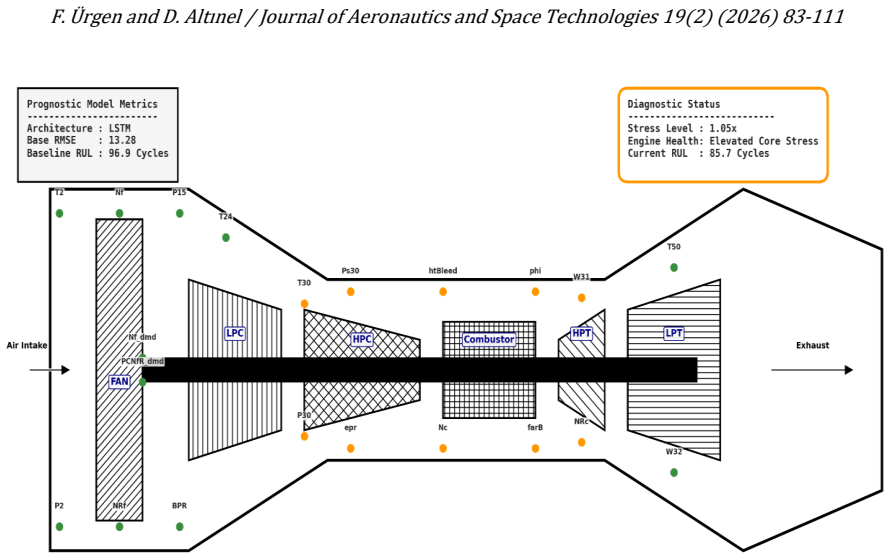
- [§3.5, What-If Simulator] The simulator's core mechanism is not scientifically validated. The 'Operational Stress Multiplier' (0.8x–1.5x), the four sensitivity tiers, and the 'exponential thermodynamic wear factor' are introduced without mathematical definitions or empirical justification. The dynamic RUL is produced by feeding stress-scaled sensor tensors into the already-trained LSTM and coupling the output with an ad hoc wear factor; no comparison to real combat data, physics-based models, or even a synthetic ground truth is provided. As written, the simulator is an extrapolation whose predictions have no demonstrated validity. The paper should either remove the claim that the simulator 'validates' the maintenance protocol under combat profiles, or provide formal equations, a validation protocol, and a discussion of uncertainty. This is load-bearing because the simulator is presented as a primary contribution
- [§3.2 and §2.5] The claim that the proposed architecture achieves 'superior predictive precision without the overhead associated with more complex hybrid frameworks' is not supported by measured computational cost. The paper reports only the parameter count (76,651). It does not provide training time, inference time, FLOPs, or a runtime comparison against BiLSTM/CNN-LSTM. Since the motivation in the introduction is explicitly computational efficiency and real-time what-if capability, please add at least a measured inference-time comparison on the same hardware, or temper the claim to 'fewer parameters' rather than 'without overhead.'
minor comments (5)
- [Table 4] The NASA score for the proposed LSTM is given as 320.34 in the text and Table 2, but Table 4 lists 320.01. Please correct the inconsistency.
- [§3.2, residual analysis] The text states that the standard deviation is 'mathematically equivalent' to the RMSE (13.28). Given the reported bias of -0.12, RMSE² = Bias² + SD² implies SD ≈ 13.28, so the statement is approximately true but should be phrased as 'approximately equal' to avoid the implication of exact identity.
- [Conclusion] The paper promises that the source code 'will be made publicly available upon publication' but gives no repository or license information. If reproducibility is a priority, please provide a link or an explicit data-availability statement.
- [§3.4] The confusion matrix numbers (73 TN, 24 TP, 1 FN, 2 FP) and the derived precision/sensitivity/specificity are internally consistent, but the text says 'a suitably conservative false-positive rate' while also highlighting minimal false positives. For a safety-critical system, the trade-off between false positives and false negatives should be discussed more explicitly.
- [§2.2, FD004 preprocessing] The description states that K-Means is applied to Settings 1–3 to define six regimes, but no analysis of cluster stability or assignment confidence is provided. Since downstream standardization depends entirely on these clusters, a brief validation (e.g., silhouette score or cluster-size table) would strengthen the methodology.
Circularity Check
Core C-MAPSS results are empirical and self-contained; minor circularity in the what-if simulator's self-referential 'validation' of the maintenance protocol.
-
other
[Abstract; Section 3.5 (Interactive Decision-Support What-If Simulator)]
"Additionally, a decision-support simulator has been developed to validate this protocol under aggressive combat flight profiles. ... the LSTM's baseline sequential inference is mathematically coupled with an exponential thermodynamic wear factor, instantly calculating the structurally adjusted dynamic RUL."
The simulator claims to validate the proposed maintenance protocol under combat stress, but its 'dynamic RUL' is produced by the same trained LSTM that defines the protocol. The user selects a stress multiplier, the simulator scales the sensor tensors, and the LSTM re-infers an RUL, optionally adjusted by a hand-crafted exponential wear factor. Therefore the simulator's outputs are not independent evidence; they are the model's own predictions on artificially modified inputs. Calling this a 'validation' of the protocol is circular: the protocol is judged by the very model on which it is based, with no new data or external ground truth from real combat operations.
full rationale
The paper's main quantitative claims—RMSE 13.28 on FD001, RMSE 15.71 on FD004, R2, NASA asymmetric scores, and the AUC 0.9973 at the 30-cycle threshold—are direct empirical evaluations on the standard NASA C-MAPSS test partitions using conventional metrics. These results do not reduce by construction to any fitted parameter or self-citation; they are self-contained benchmark measurements. No load-bearing self-citations or imported uniqueness theorems are present. The only notable circularity concern is the what-if simulator, which is presented in the abstract as validating the protocol under aggressive combat profiles but actually re-applies the same LSTM to hand-scaled sensor inputs. That is an extrapolation or illustration of the model's behavior rather than an independent validation, so it is a minor self-referential step in an auxiliary component. The reported discrepancy between the headline 13.28 RMSE and the five-run mean of 13.86 ± 0.58 is a statistical robustness concern, not a circularity issue.
Assumptions & free parameters
free parameters (11)
- sequence_length_FD001 =
50
- sequence_length_FD004 =
30
- RUL_cap =
125
- hidden_units_lstm1 =
100
- hidden_units_lstm2 =
50
- dropout_rate =
0.2
- early_stopping_patience =
10
- max_epochs =
100
- critical_threshold_30_cycles =
30
- stress_multiplier_range =
0.8 to 1.5
- sensitivity_tier_thresholds =
1.05x and 1.45x
assumptions (6)
- domain assumption Piecewise linear degradation with RUL cap at 125 cycles
- standard math Min-max normalization computed on training set only
- domain assumption K-Means clustering with k=6 partitions FD004 operational settings into flight regimes
- domain assumption Two-layer LSTM with 100/50 units and dropout 0.2 captures degradation patterns
- domain assumption Sliding window of length 50 (FD001) and 30 (FD004) with unspecified padding preserves information
- ad hoc to paper The thermodynamic sensitivity logic and exponential wear factor coupling stress to RUL are valid
invented entities (3)
-
Operational Stress Multiplier
-
Four sensitivity tiers based on engine component location
-
Exponential thermodynamic wear factor
Cite this review
Pith. "Pith review of Predictive Maintenance: Deep Learning-Based Remaining Useful Life Prediction for Combat Aircraft Engines." pith.science (2026). https://pith.science/paper/N6GZVELD
@misc{pith2026260801819,
  author       = {Pith},
  title        = {Pith review of: Predictive Maintenance: Deep Learning-Based Remaining Useful Life Prediction for Combat Aircraft Engines},
  year         = {2026},
  howpublished = {\url{https://pith.science/paper/N6GZVELD}},
  note         = {Machine review of arXiv:2608.01819}
}
read the original abstract
To improve the operational readiness of combat aircraft engines and reduce unplanned maintenance costs, accurately estimating the remaining useful life (RUL) is critical. Traditional maintenance often proves insufficient under dynamic mission profiles. In this study, a deep learning-based predictive maintenance model capable of autonomously extracting features from multivariate sensor data was developed. Using the NASA C-MAPSS FD001 and FD004 datasets, data were converted into sequential blocks via 50- and 30-step sliding windows, respectively. The model's architectural superiority in autonomously extracting temporal degradation features was validated against RF, CNN-LSTM, and BiLSTM baselines. On FD001, it achieved an R-squared (R2) of 0.8901, a 13.28 RMSE, and a 320.34 NASA risk score, demonstrating generalizability on the multi-regime FD004 dataset with a 15.71 RMSE. The proposed maintenance protocol achieved a 0.9973 AUC at the critical 30-cycle threshold, ensuring high reliability. Additionally, a decision-support simulator has been developed to validate this protocol under aggressive combat flight profiles.
Figures


Figures from the paper (9 more)



Reference graph
Works this paper leans on
-
[1]
Predictive maintenance in the Industry 4.0: A systematic literature review,
T. Zonta, C. A. da Costa, R. da Rosa Righi, M. J. Lima, E. S. da Trindade, and G. P. Li, "Predictive maintenance in the Industry 4.0: A systematic literature review," Computers & Industrial Engineering, vol. 150, p. 106889, 2020
2020
-
[2]
Machinery health prognostics: A systematic review from data acquisition to RUL prediction,
Y. Lei, N. Li, L. Guo, N. Li, T. Yan, and J. Lin, "Machinery health prognostics: A systematic review from data acquisition to RUL prediction," Mechanical Systems and Signal Processing, vol. 104, pp. 799-834, 2018
2018
-
[3]
Remaining useful life estimation in prognostics using deep convolution neural networks,
X. Li, Q. Ding, and J. -Q. Sun, "Remaining useful life estimation in prognostics using deep convolution neural networks," Reliability Engineering & System Safety, vol. 172, pp. 1-11, Apr. 2018
2018
-
[4]
Damage propagation modeling for aircraft engine run -to-failure simulation,
A. Saxena, K. Goebel, D. Simon, and N. Eklund, "Damage propagation modeling for aircraft engine run -to-failure simulation," in Proc. International Conference on Prognostics and Health Management, Denver, CO, USA, Oct. 2008, pp. 1-9
2008
-
[5]
Deep convolutional neural network based regression approach for estimation of remaining useful life,
G. S. Babu, P. Zhao, and X.-L. Li, "Deep convolutional neural network based regression approach for estimation of remaining useful life," in Proc. Database Systems for Advanced Applications (DASFAA), Dallas, TX, USA, Apr. 2016, pp. 214-228
2016
-
[6]
Long short -term memory network for remaining useful life estimation,
S. Zheng, K. Ristovski, A. Farahat, and C. Gupta, "Long short -term memory network for remaining useful life estimation," in Proc. IEEE International Conference on Prognostics and Health Management (ICPHM), Dallas, TX, USA, Jun. 2017, pp. 88-95
2017
-
[7]
RUL Estimation Enhancement using Hybrid Deep Learning Methods,
I. Remadna, L. S. Terrissa, S. Ayad, and N. Zerhouni, "RUL Estimation Enhancement using Hybrid Deep Learning Methods," Int. J. Progn. Health Manag., vol. 12, no. 1, pp. 1-19, 2021
2021
-
[8]
Remaining Useful Life Prediction Based on Multi -scale Residual Convolutional Network for Aero -engine,
J. Yu, Y. Peng, and Q. Deng, "Remaining Useful Life Prediction Based on Multi -scale Residual Convolutional Network for Aero -engine," in Proc. IEEE International Conference on Prognostics and Health Management (ICPHM) , Detroit, MI, USA, Jun. 2021, pp. 1-6
2021
Show all 27 references
-
[9]
Remaining Useful Life Prediction of Aero -Engine Based on Multi -Scale Channel Enhanced BiLSTM,
Y. Liu et al., "Remaining Useful Life Prediction of Aero -Engine Based on Multi -Scale Channel Enhanced BiLSTM," in Proc. Prognostics and System Health Management Conference (PHM), 2024, pp. 293-299
2024
-
[10]
Remaining useful life estimation via transformer encoder enhanced by a gated convolutional unit,
Y. Mo, Q. Wu, X. Li, and B. Huang, "Remaining useful life estimation via transformer encoder enhanced by a gated convolutional unit," IEEE Transactions on Reliability , vol. 70, no. 4, pp. 1627-1638, Dec. 2021
2021
-
[11]
Remaining useful life prediction for turbofan engines using an attention -based data -driven deep -learning approach,
O. A. Ghoneim, A. Sleem, I. Gad, and T. Allam, "Remaining useful life prediction for turbofan engines using an attention -based data -driven deep -learning approach," PeerJ Computer Science, vol. 11, Art. no. e3438, Dec. 2025
2025
-
[12]
Research on the Remaining Useful Life Prediction Algorithm for Aero -Engines Based on Transformer –KAN–BiLSTM,
K. Xu, Y. Guo, and Q. Zhou, "Research on the Remaining Useful Life Prediction Algorithm for Aero -Engines Based on Transformer –KAN–BiLSTM," Aerospace, vol. 12, no. 11, Art. no. 998, Nov. 2025. F. Ürgen and D. Altınel / Journal of Aeronautics and Space Technologies 19(2) (2026...
2025
-
[13]
Modeling fuel consumption curves in jet UAVs with machine learning,
G. Ceylan and M. Turan, "Modeling fuel consumption curves in jet UAVs with machine learning," Journal of Aeronautics and Space Technologies , vol. 19, no. 1, pp. 46 -66, Jan. 2026
2026
-
[14]
Deep learning-based airspeed estimation system for a commercial aircraft,
U. Kılıç, "Deep learning-based airspeed estimation system for a commercial aircraft," Journal of Aeronautics and Space Technologies, vol. 16, no. 2, pp. 20-35, Jul. 2023
2023
-
[15]
Performance benchmarking and analysis of prognostic methods for CMAPSS datasets,
E. Ramasso and A. Saxena, "Performance benchmarking and analysis of prognostic methods for CMAPSS datasets," Int. J. Progn. Health Manag. , vol. 5, no. 2, pp. 1 -15, 2014
2014
-
[16]
Remaining useful life estimation of engineered systems using vanilla LSTM neural networks,
Y. Wu, M. Yuan, S. Dong, L. Lin, and Y. Liu, "Remaining useful life estimation of engineered systems using vanilla LSTM neural networks," Neurocomputing, vol. 275, pp. 167-179, Jan. 2018
2018
-
[17]
Deep learning and its applications to machine health monitoring,
R. Zhao, R. Yan, Z. Chen, K. Mao, P. Wang, and R. X. Gao, "Deep learning and its applications to machine health monitoring," Mechanical Systems and Signal Processing, vol. 115, pp. 213-237, Jan. 2019
2019
-
[18]
Random forests,
L. Breiman, "Random forests," Machine Learning, vol. 45, no. 1, pp. 5–32, Oct. 2001
2001
-
[19]
Deep -Convolution-Based LSTM Network for Remaining Useful Life Prediction,
M. Ma and Z. Mao, "Deep -Convolution-Based LSTM Network for Remaining Useful Life Prediction," IEEE Transactions on Industrial Informatics, vol. 17, no. 3, pp. 1658- 1667, Mar. 2021
2021
-
[20]
Joint learning of degradation assessment and RUL prediction for aero -engines via dual -task deep LSTM networks,
H. Miao, B. Li, C. Sun, and J. Liu, "Joint learning of degradation assessment and RUL prediction for aero -engines via dual -task deep LSTM networks," IEEE Transactions on Industrial Informatics, vol. 15, no. 9, pp. 5023-5032, Sept. 2019
2019
-
[21]
Uncertainty-Aware Deep Learning Framework for Remaining Useful Life Prediction in Turbofan Engines with Learned Aleatoric Uncertainty,
K. Sharma, "Uncertainty-Aware Deep Learning Framework for Remaining Useful Life Prediction in Turbofan Engines with Learned Aleatoric Uncertainty," arXiv preprint arXiv:2511.19124, Nov. 2025
2025
-
[22]
TTSNet: Transformer –Temporal Convolutional Network –Self-Attention with Feature Fusion for Prediction of Remaining Useful Life of Aircraft Engines,
Z. Li, S. Luo, H. Liu, C. Tang, and J. Miao, "TTSNet: Transformer –Temporal Convolutional Network –Self-Attention with Feature Fusion for Prediction of Remaining Useful Life of Aircraft Engines," Sensors, vol. 25, no. 2, Art. no. 432, Jan. 2025
2025
-
[23]
LSTM: A search space odyssey,
K. Greff, R. K. Srivastava, J. Koutník, B. R. Steunebrink, and J. Schmidhuber, "LSTM: A search space odyssey," IEEE Transactions on Neural Networks and Learning Systems, vol. 28, no. 10, pp. 2222-2232, Oct. 2017
2017
-
[24]
Dropout: A simple way to prevent neural networks from overfitting,
N. Srivastava, G. Hinton, A. Krizhevsky, I. Sutskever, and R. Salakhutdinov, "Dropout: A simple way to prevent neural networks from overfitting," Journal of Machine Learning Research, vol. 15, no. 1, pp. 1929-1958, 2014
1929
-
[25]
Adam: A method for stochastic optimization,
D. P. Kingma and J. Ba, "Adam: A method for stochastic optimization," arXiv preprint arXiv:1412.6980, Dec. 2014
2014 arXiv
-
[26]
Ensemble of data-driven prognostic algorithms for robust prediction of remaining useful life,
C. Hu, H. Youn, P. Wang, and Y. Yoon, "Ensemble of data-driven prognostic algorithms for robust prediction of remaining useful life," IEEE Transactions on Reliability , vol. 61, no. 1, pp. 210-222, Mar. 2012
2012
-
[27]
Prediction of Remaining Useful Life of Aero -engines Based on CNN-LSTM-Attention,
S. Deng and J. Zhou, "Prediction of Remaining Useful Life of Aero -engines Based on CNN-LSTM-Attention," International Journal of Computational Intelligence Systems , vol. 17, no. 1, Art. no. 232, Sept. 2024. F. Ürgen and D. Altınel / Journal of Aeronautics and Space Technolog...
2024
Reviewed August 4, 2026 · model on record in the stance chip above.
Discussion (0). Sign in to comment.