REVIEW 5 major objections 5 minor 84 references
PartMat: Material-Aware 3D Part Decomposition with a Single Global Latent
T0 review · 5 major / 5 minor · reviewed 2026-08-15 · deepseek-v4-flash
Pith's one-line read A single global latent decodes every material part of a 3D object in one pass.
desk verdict Genuinely useful single-latent multi-part representation; the SOTA claim is slightly overreaching because the full pipeline isn't in the table. read the letter →
The pith
A machine-rendered reading of the paper's core claim, the machinery that carries it, and where it could break.
The reading
What carries the argument
The load-bearing object is the multi-channel SDF decoder in PartVAE: one global latent z is shared by all parts, and a K-channel linear head outputs a signed distance field per material component in a single pass. A suppression loss keeps unused channels constrained to a negative interval so only real parts carve out geometry, and padding channels stay away from the zero level set. Around this core, Stage II trains a flow-matching transformer to predict the latent from image and geometry conditions, then post-trains it with a differentiable SDF reward (order-invariant matching plus overlap penalty) via direct-gradient RL; Stage III refines thin structures with a sparse-voxel flow model that interleaves full self-attention, within-part attention, and image cross-attention.
What would settle it
Measure decode latency and Sem-IoU on a test set dominated by objects with many small material regions and with component capacity pushed above K=32; if latency grows substantially with the number of parts or small regions are systematically missed, the constant-latency single-latent claim would fail.
Extended reading notes
Core claim
The central discovery is that a variational autoencoder with K parallel signed-distance-field output channels—one per material component, with K=32—can jointly encode and decode all material parts through a single shared latent vector. The decoder's final linear head predicts all K part SDFs at once, so decoding cost is independent of the actual number of parts M, which the authors state is the first such VAE for multi-component geometry. They then train a flow-matching transformer to generate this latent from a reference image and a whole-object mesh, align it with a differentiable reward that matches predicted parts to target parts and penalizes overlap, and refine fine details with a part-attention sparse-voxel flow model. On the paper's benchmark, this yields Sem-IoU 50.51 with RL alignment, versus 43.00 for the strongest prior method, and a constant decode latency of about 1.7 seconds for 1, 16, or 32 components.
Load-bearing premise
The approach assumes that a fixed-size global latent with 32 SDF channels can faithfully and smoothly encode every object's material components, so that flow matching can sample valid decompositions and small material regions are not lost.
Editorial extensions
If this is right
- Decoding latency stays roughly constant as component count scales to 32, unlike per-part methods whose cost grows linearly with the number of parts.
- Each decoded SDF channel maps to one material slot, so the output natively exposes editable component IDs for independent PBR assignment, replacement, or restyling.
- All components are decoded in a shared object coordinate system, so they assemble into the whole object without additional transformations or post-hoc alignment.
- The pipeline's material decomposition accuracy is reported as Sem-IoU 50.51 versus 43.00 for the closest baseline, with competitive Chamfer distance and F1 score on whole-geometry fidelity.
- The combination of a differentiable SDF reward and sparse-voxel refinement recovers sharp edges and micro-structures lost in the compact latent, addressing the boundary blur typical of implicit decoding.
Reading between the lines
- The single-global-latent principle is not inherently tied to materials: the same multi-channel SDF representation could be trained with functional, articulated, or user-defined part annotations, provided the annotations are available at scale.
- A testable extension is to push the channel capacity beyond K=32 and measure whether the constant-latency property and latent smoothness hold; the paper itself states that the fixed capacity is a limitation.
- The differentiable SDF reward may generalize to other implicit-geometry generators, offering a way to apply RL post-training directly in field space without meshing every sampled latent, which is the cost that motivates the design.
- If the latent space is truly smooth, the same PartVAE could enable part-level editing by interpolating latents—swapping the material style of one component while preserving the others—something the paper does not explicitly demonstrate.
Signed reviews
Editorial analysis
A structured set of objections, weighed in public.
Referee Report
Summary. The paper proposes PartMat, a three-stage pipeline for material-aware 3D part decomposition from a reference image and a single whole-object geometry. Stage I introduces PartVAE, which encodes all material components into a single global latent and decodes K=32 part SDF channels in one forward pass. Stage II trains a conditional flow-matching PartDiT in this latent, post-trained with a differentiable SDF reward that combines a soft assignment matching reward and an overlap penalty. Stage III refines the decoded parts with a sparse-voxel flow model equipped with part attention. The authors claim state-of-the-art material decomposition accuracy (Sem-IoU 50.51 vs 43.00 for the closest baseline), comparable geometric fidelity, and decoding latency that does not grow with part count. The paper includes VAE reconstruction comparisons, image-conditioned generation comparisons, ablations of the latent representation, and qualitative results.
Significance. If the claims hold, PartMat addresses a real and under-served problem: decomposing 3D assets along editable material boundaries rather than functional parts. The constant-latency property of a single global latent for multi-part geometry is a useful architectural contribution, and the proposed direct-gradient RL alignment in implicit SDF space is an interesting alternative to mesh-level rewards. The paper also introduces a substantial material-annotated training set (~300K shapes) and evaluates against several recent part-level baselines. These are genuine strengths. However, the central quantitative claim is currently attached to an ablation variant rather than the full pipeline, and the absence of uncertainty quantification weakens the reported SOTA margins. The contribution is promising and the gaps appear addressable in revision.
major comments (5)
- [Table 1] The headline SOTA claim is not supported for the full system as described in the abstract and method. Table 1 reports three PartMat variants: "PartMat" (46.92 Sem-IoU), "PartMat w/ RL" (50.51), and "PartMat w/ geometry refine" (49.19). The best Sem-IoU comes from the RL-only variant, while the variant including the geometry refiner—which is the closer match to the complete three-stage pipeline—has lower Sem-IoU. No row reports the combined system with both RL alignment and geometry refinement active. Since the paper's central claim is about the full PartMat pipeline, the authors must either add a row for the complete pipeline or clearly designate which variant is the official system and adjust the claims accordingly. Without this, the reader cannot verify that the submitted system, rather than an ablation, achieves the claimed SOTA.
- [Tables 1 and 2] No error bars, confidence intervals, or significance tests are reported anywhere in the quantitative evaluation. The claimed margin over X-Part (50.51 vs 43.00) is substantial, but with a single point estimate per configuration, and given the observed drop when adding geometry refinement (50.51 to 49.19), it is impossible to assess whether the margin is stable. At minimum, the authors should report standard deviations over multiple training seeds or bootstrap confidence intervals on the main benchmark, and avoid the word "significantly" in the abstract and results unless a statistical test is provided.
- [Table 2 and Stage I] The claim of "constant decode latency" is only partially supported by the reported numbers. PartVAE decode times are 1.860s for 1 component, 1.302s for 16 components, and 1.698s for 32 components. This is not constant, and the 1-component case is slower than both multi-component cases. The authors should clarify the measurement protocol (e.g., whether padding channels are processed in all cases), explain the non-monotonic behavior, and report variance. If the intended claim is that latency does not grow with part count, the data supports that weaker claim, but the word "constant" is overstated.
- [Section 'Differentiable SDF reward'] Equation (8) uses a "differentiable soft assignment πij" to make the matching reward order-invariant, but πij is never defined or specified. This is a load-bearing component of the RL objective: the entire alignment signal depends on how predicted and target channels are matched. The authors must provide the exact construction of πij (e.g., Sinkhorn normalization, softmax over rows/columns, or a straight-through assignment) and any temperature or regularization parameters.
- [Stage III and Table 1] The paper states that the refined meshes "inherit the material slots produced by PartDiT," yet the only quantitative evidence, Table 1, shows that adding geometry refinement reduces Sem-IoU from 50.51 to 49.19 while improving CD and F1. This suggests the refiner may alter material component identities or boundaries. The authors should provide a direct evaluation of material-slot consistency before and after refinement (e.g., per-slot overlap with ground-truth parts), or otherwise explain why the Sem-IoU drop is not a failure of the full pipeline's material decomposition.
minor comments (5)
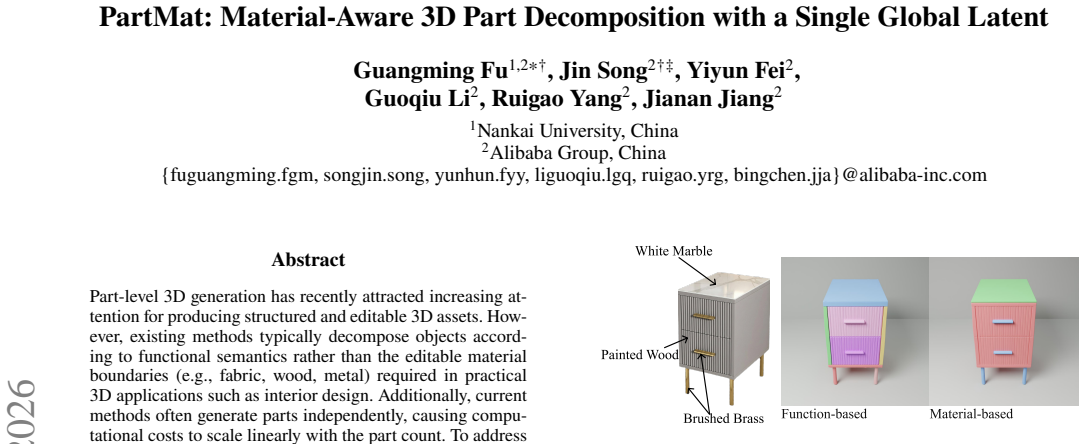
- [Contributions] The phrase "to the best of our knowledge, which is the first VAE" is awkwardly worded and can be simplified to "the first VAE, to the best of our knowledge." Also, given the existence of PartPacker and UniPart, the novelty claim should be phrased more precisely: the distinction is a single global latent with dedicated per-part SDF channels and constant decoding cost.
- [Equation (10)] The RL objective is written as E[max(0, c - R_sdf(z_hat))], which resembles a hinge loss rather than a policy-gradient objective. The paper should clarify why direct backpropagation through the frozen PartVAE decoder is sufficient and how the expectation is estimated (e.g., how many samples per optimization step).
- [Figure 3] The overview figure is information-dense and the thin annotation lines are hard to follow. Adding numbered callouts that correspond to the three stages in the text would improve readability.
- [Experimental Setup] The description of the training data is terse: "material slots assigned to mesh faces" is not enough to understand how components are defined, whether a material component may contain multiple disconnected surfaces (as claimed in Figure 1), or how the benchmark avoids label noise. A more detailed data-construction section in the main text or supplementary is needed.
- [Abstract] The phrase "significantly outperforms existing baselines" is used without statistical support; consider replacing "significantly" with "consistently" or adding the corresponding tests.
Circularity Check
No circularity: PartMat's central claims are tested against external baselines on a material-annotated benchmark, and its RL rewards are training signals rather than the reported evaluation metric.
full rationale
The paper's derivation chain is self-contained against external evidence. PartVAE is an architectural adaptation of Hunyuan3D 2.1 ShapeVAE, and its reconstruction quality is compared directly with Hunyuan2.1, TRELLIS2, PartCrafter, and PartPacker on CD, F1@0.01, token count, and decode latency (Table 2). The image-conditioned generation claims are evaluated against X-Part, PartCrafter, PartPacker, HoloPart, and OmniPart on a material-annotated benchmark using Sem-IoU after optimal component matching, CD, and F1@0.01 (Table 1). The RL rewards in Eq. 8-10 are computed against ground-truth target SDF soft occupancies and are used as a post-training objective; they are not repurposed as the evaluation metric, so this is not a fitted-input-called-prediction pattern. The paper's cited prior works, including Hunyuan3D, TRELLIS2, and LeapAlign, are external systems with independent implementations, and the method is measured on a benchmark derived from material slots in the training data rather than on the same loss used for training. The claim that PartVAE is 'the first VAE to represent multi-component geometry with a single global latent' is a novelty assertion, not a circular derivation, and it is not load-bearing for the quantitative comparisons. The ablation comparing Local-box, Packed-sem, and Global multi-channel is an empirical architecture study, and the statement that Packed-sem 'destroys the continuous latent space strictly required by the downstream PartDiT' is an observed consequence of that ablation, not an assumption smuggled in via self-citation. The skeptic's observation that Table 1 lacks a row for the complete PartMat pipeline (the full PartDiT + RL + geometry refine system described in the abstract) is a legitimate correctness and reporting concern about which ablation achieves the best Sem-IoU, but it is not a circularity concern: even if the headline SOTA number is reported for a partial variant, the comparison still uses external baselines and held-out material annotations. No step in the derivation reduces by construction to its inputs, no fitted parameter is renamed as a prediction, and no load-bearing argument rests on a self-citation chain. The manuscript therefore exhibits no significant circularity.
Assumptions & free parameters
free parameters (7)
- K (number of material channels) =
32
- lambda_KL
- lambda_match
- lambda_overlap
- reward margin c
- soft occupancy temperature tau_s
- SDF suppression bounds (s_lower, s_upper) =
-1.0, -0.1
assumptions (4)
- domain assumption Material components are well-defined by the material slots assigned to mesh faces in the training data, and these annotations are the correct ground truth for editable decomposition.
- domain assumption The global latent space learned by PartVAE is smooth and continuous enough for flow matching to generate valid multi-part latents.
- domain assumption A single reference image plus whole-object geometry provides sufficient evidence to infer material decomposition.
- standard math Standard background: SDF as shape representation, Marching Cubes surface extraction, flow matching objective Eq. (8), and Transformer architectures are assumed valid.
Cite this review
Pith. "Pith review of PartMat: Material-Aware 3D Part Decomposition with a Single Global Latent." pith.science (2026). https://pith.science/paper/JN46KMEV
@misc{pith2026260801825,
  author       = {Pith},
  title        = {Pith review of: PartMat: Material-Aware 3D Part Decomposition with a Single Global Latent},
  year         = {2026},
  howpublished = {\url{https://pith.science/paper/JN46KMEV}},
  note         = {Machine review of arXiv:2608.01825}
}
read the original abstract
Part-level 3D generation has recently attracted increasing attention for producing structured and editable 3D assets. However, existing methods typically decompose objects according to functional semantics rather than the editable material boundaries (e.g., fabric, wood, metal) required in practical 3D applications such as interior design. Additionally, current methods often generate parts independently, causing computational costs to scale linearly with the part count. To address these limitations, we present PartMat, an efficient material-aware 3D part decomposition pipeline that represents multi-part geometry with a single global latent. Given a reference image and a single whole-object geometry, PartMat decomposes the object into parts that follow material boundaries. First, we propose PartVAE to learn such a unified representation and decode all material parts in a single forward pass, thereby decoupling inference cost from the number of parts. Second, with this representation, a diffusion model is trained for part generation and refined via reinforcement learning for accurate material assignment and overlap suppression. Finally, to recover fine-grained geometric details, we introduce a sparse-voxel flow-matching model with part attention for geometry post-processing. Extensive experiments demonstrate that PartMat significantly outperforms existing baselines in material-aware decomposition accuracy and achieves comparable geometric quality, while maintaining efficient inference.
Figures


Figures from the paper (4 more)


Reference graph
Works this paper leans on
-
[1]
dscdyc , howpublished=
-
[2]
Proceedings of the IEEE/CVF International Conference on Computer Vision , pages=
Partfield: Learning 3d feature fields for part segmentation and beyond , author=. Proceedings of the IEEE/CVF International Conference on Computer Vision , pages=
-
[4]
ACM Transactions on Graphics (TOG) , volume=
Robust inside-outside segmentation using generalized winding numbers , author=. ACM Transactions on Graphics (TOG) , volume=. 2013 , publisher=
2013
-
[5]
Proceedings of the IEEE/CVF Conference on Computer Vision and Pattern Recognition , pages=
X-Part: High Fidelity And Structure Coherent Shape Decomposition And Completion , author=. Proceedings of the IEEE/CVF Conference on Computer Vision and Pattern Recognition , pages=
-
[6]
arXiv preprint arXiv:2507.17745 , year=
Ultra3d: Efficient and high-fidelity 3d generation with part attention , author=. arXiv preprint arXiv:2507.17745 , year=
-
[7]
ACM Transactions on Graphics (TOG) , volume=
BANG: Dividing 3D assets via generative exploded dynamics , author=. ACM Transactions on Graphics (TOG) , volume=. 2025 , publisher=
work page 2025
-
[8]
Advances in neural information processing systems , volume=
Partcrafter: Structured 3d mesh generation via compositional latent diffusion transformers , author=. Advances in neural information processing systems , volume=
-
[9]
Proceedings of the SIGGRAPH Asia 2025 Conference Papers , pages=
Omnipart: Part-aware 3d generation with semantic decoupling and structural cohesion , author=. Proceedings of the SIGGRAPH Asia 2025 Conference Papers , pages=
2025
Show all 84 references
-
[10]
arXiv preprint arXiv:2510.26140 , year=
FullPart: Generating each 3D Part at Full Resolution , author=. arXiv preprint arXiv:2510.26140 , year=
-
[11]
ACM Transactions On Graphics (TOG) , volume=
3dshape2vecset: A 3d shape representation for neural fields and generative diffusion models , author=. ACM Transactions On Graphics (TOG) , volume=. 2023 , publisher=
2023
-
[12]
Proceedings of the IEEE/CVF Conference on Computer Vision and Pattern Recognition , pages=
Unipart: Part-level 3d generation with unified 3d geom-seg latents , author=. Proceedings of the IEEE/CVF Conference on Computer Vision and Pattern Recognition , pages=
-
[13]
2025 , eprint=
MoCA: Mixture-of-Components Attention for Scalable Compositional 3D Generation , author=. 2025 , eprint=
2025
-
[14]
International conference on machine learning , pages=
Learning representations and generative models for 3d point clouds , author=. International conference on machine learning , pages=. 2018 , organization=
2018
-
[15]
Proceedings of the IEEE/CVF international conference on computer vision , pages=
Pointflow: 3d point cloud generation with continuous normalizing flows , author=. Proceedings of the IEEE/CVF international conference on computer vision , pages=
-
[16]
Proceedings of the IEEE conference on computer vision and pattern recognition , pages=
3d shapenets: A deep representation for volumetric shapes , author=. Proceedings of the IEEE conference on computer vision and pattern recognition , pages=
-
[17]
European conference on computer vision , pages=
3d-r2n2: A unified approach for single and multi-view 3d object reconstruction , author=. European conference on computer vision , pages=. 2016 , organization=
2016
-
[18]
A papier-mach
Groueix, Thibault and Fisher, Matthew and Kim, Vladimir G and Russell, Bryan C and Aubry, Mathieu , booktitle=. A papier-mach
-
[19]
Proceedings of the IEEE/CVF conference on computer vision and pattern recognition , pages=
Deepsdf: Learning continuous signed distance functions for shape representation , author=. Proceedings of the IEEE/CVF conference on computer vision and pattern recognition , pages=
-
[20]
Proceedings of the IEEE/CVF conference on computer vision and pattern recognition , pages=
Occupancy networks: Learning 3d reconstruction in function space , author=. Proceedings of the IEEE/CVF conference on computer vision and pattern recognition , pages=
-
[21]
Proceedings of the IEEE/CVF conference on computer vision and pattern recognition , pages=
Diffusion probabilistic models for 3d point cloud generation , author=. Proceedings of the IEEE/CVF conference on computer vision and pattern recognition , pages=
-
[22]
Advances in Neural Information Processing Systems , year=
LION: Latent Point Diffusion Models for 3D Shape Generation , author=. Advances in Neural Information Processing Systems , year=
-
[23]
arXiv preprint arXiv:2212.08751 , year=
Point-e: A system for generating 3d point clouds from complex prompts , author=. arXiv preprint arXiv:2212.08751 , year=
-
[24]
European conference on computer vision , pages=
Nerf: Representing scenes as neural radiance fields for view synthesis , author=. European conference on computer vision , pages=
-
[25]
Proceedings of the IEEE/CVF International Conference on Computer Vision , pages=
Learning object-compositional neural radiance field for editable scene rendering , author=. Proceedings of the IEEE/CVF International Conference on Computer Vision , pages=
-
[26]
Proceedings of the IEEE/CVF Conference on Computer Vision and Pattern Recognition , pages=
Neural scene graphs for dynamic scenes , author=. Proceedings of the IEEE/CVF Conference on Computer Vision and Pattern Recognition , pages=
-
[27]
Proceedings of the IEEE/CVF International Conference on Computer Vision , pages=
In-place scene labelling and understanding with implicit scene representation , author=. Proceedings of the IEEE/CVF International Conference on Computer Vision , pages=
-
[28]
arXiv preprint arXiv:2209.14988 , year=
Dreamfusion: Text-to-3d using 2d diffusion , author=. arXiv preprint arXiv:2209.14988 , year=
-
[29]
arXiv preprint arXiv:2303.11328 , year=
Zero-1-to-3: Zero-shot one image to 3d object , author=. arXiv preprint arXiv:2303.11328 , year=
-
[30]
arXiv preprint arXiv:2306.16928 , year=
One-2-3-45: Any single image to 3d mesh in 45 seconds without per-shape optimization , author=. arXiv preprint arXiv:2306.16928 , year=
-
[31]
Proceedings of the IEEE conference on computer vision and pattern recognition , pages=
Pointnet: Deep learning on point sets for 3d classification and segmentation , author=. Proceedings of the IEEE conference on computer vision and pattern recognition , pages=
-
[32]
Advances in neural information processing systems , volume=
Pointnet++: Deep hierarchical feature learning on point sets in a metric space , author=. Advances in neural information processing systems , volume=
-
[33]
Proceedings of the IEEE/CVF conference on computer vision and pattern recognition , pages=
Partnet: A large-scale benchmark for fine-grained and hierarchical part-level 3d object understanding , author=. Proceedings of the IEEE/CVF conference on computer vision and pattern recognition , pages=
-
[34]
ACM Transactions on Graphics (tog) , volume=
Dynamic graph cnn for learning on point clouds , author=. ACM Transactions on Graphics (tog) , volume=
-
[35]
ACM SIGGRAPH Asia 2008 papers , pages=
Randomized cuts for 3D mesh analysis , author=. ACM SIGGRAPH Asia 2008 papers , pages=
2008
-
[36]
The Visual Computer , volume=
Consistent mesh partitioning and skeletonisation using the shape diameter function , author=. The Visual Computer , volume=
-
[37]
Proceedings of the IEEE/CVF International Conference on Computer Vision , pages=
BAE-NET: Branched autoencoder for shape co-segmentation , author=. Proceedings of the IEEE/CVF International Conference on Computer Vision , pages=
-
[38]
arXiv preprint arXiv:2211.04604 , year=
StructDiffusion: Language-Guided Creation of Physically-Valid Structures using Unseen Objects , author=. arXiv preprint arXiv:2211.04604 , year=
-
[39]
arXiv preprint arXiv:2501.12202 , year=
Hunyuan3d 2.0: Scaling diffusion models for high resolution textured 3d assets generation , author=. arXiv preprint arXiv:2501.12202 , year=
-
[40]
arXiv preprint arXiv:2506.15442 , year=
Hunyuan3d 2.1: From images to high-fidelity 3d assets with production-ready pbr material , author=. arXiv preprint arXiv:2506.15442 , year=
-
[41]
Advances in neural information processing systems , volume=
Flow-grpo: Training flow matching models via online rl , author=. Advances in neural information processing systems , volume=
-
[42]
Advances in Neural Information Processing Systems , volume=
Denoising Diffusion Probabilistic Models , author=. Advances in Neural Information Processing Systems , volume=
-
[43]
International Conference on Machine Learning , pages=
Learning Transferable Visual Models From Natural Language Supervision , author=. International Conference on Machine Learning , pages=
-
[44]
Advances in Neural Information Processing Systems , volume=
Efficient part-level 3d object generation via dual volume packing , author=. Advances in Neural Information Processing Systems , volume=
-
[45]
Proceedings of the IEEE/CVF conference on computer vision and pattern recognition , pages=
Structured 3d latents for scalable and versatile 3d generation , author=. Proceedings of the IEEE/CVF conference on computer vision and pattern recognition , pages=
-
[46]
International Conference on Learning Representations , year=
Auto-encoding variational bayes , author=. International Conference on Learning Representations , year=
-
[47]
Proceedings of the IEEE/CVF Conference on Computer Vision and Pattern Recognition , year=
High-resolution image synthesis with latent diffusion models , author=. Proceedings of the IEEE/CVF Conference on Computer Vision and Pattern Recognition , year=
-
[48]
Advances in Neural Information Processing Systems , volume=
Attention is all you need , author=. Advances in Neural Information Processing Systems , volume=
-
[49]
Transactions on Machine Learning Research , year=
Oquab, Maxime and Darcet, Timoth. Transactions on Machine Learning Research , year=
-
[50]
Long, Xiaoxiao and Guo, Yuan-Chen and Lin, Cheng and Liu, Yuan and Dou, Zhiyang and Liu, Lingjie and Ma, Yuexin and Zhang, Song-Hai and Habermann, Marc and Theobalt, Christian and Wang, Wenping , booktitle=
-
[51]
Shi, Yichun and Wang, Peng and Ye, Jianglong and Long, Mai and Li, Kejie and Yang, Xiao , journal=
-
[52]
Chen, Qimin and Chen, Zhiqin and Zhang, Hao and Chaudhuri, Siddhartha and Guibas, Leonidas and Su, Hao , booktitle=
-
[53]
Proceedings of the Computer Vision and Pattern Recognition Conference , pages=
Partgen: Part-level 3d generation and reconstruction with multi-view diffusion models , author=. Proceedings of the Computer Vision and Pattern Recognition Conference , pages=
-
[54]
Proceedings of the IEEE conference on computer vision and pattern recognition , pages=
Learning shape abstractions by assembling volumetric primitives , author=. Proceedings of the IEEE conference on computer vision and pattern recognition , pages=
-
[55]
Li, Jun and Xu, Kai and Chaudhuri, Siddhartha and Yumer, Ersin and Zhang, Hao and Guibas, Leonidas , journal=
-
[56]
Proceedings of the 14th Annual Conference on Computer Graphics and Interactive Techniques (SIGGRAPH) , pages=
Marching cubes: A high resolution 3D surface construction algorithm , author=. Proceedings of the 14th Annual Conference on Computer Graphics and Interactive Techniques (SIGGRAPH) , pages=
-
[57]
Niemeyer, Michael and Geiger, Andreas , booktitle=
-
[58]
Proceedings of the IEEE/CVF conference on computer vision and pattern recognition , pages=
Xcube: Large-scale 3d generative modeling using sparse voxel hierarchies , author=. Proceedings of the IEEE/CVF conference on computer vision and pattern recognition , pages=
-
[59]
International Conference on Learning Representations , volume=
Lrm: Large reconstruction model for single image to 3d , author=. International Conference on Learning Representations , volume=
-
[60]
IEEE Transactions on Pattern Analysis and Machine Intelligence , year=
Triposg: High-fidelity 3d shape synthesis using large-scale rectified flow models , author=. IEEE Transactions on Pattern Analysis and Machine Intelligence , year=
-
[61]
Advances in Neural Information Processing Systems , volume=
Direct3d-s2: Gigascale 3d generation made easy with spatial sparse attention , author=. Advances in Neural Information Processing Systems , volume=
-
[62]
Proceedings of the IEEE/CVF International Conference on Computer Vision , pages=
Sparseflex: High-resolution and arbitrary-topology 3d shape modeling , author=. Proceedings of the IEEE/CVF International Conference on Computer Vision , pages=
-
[63]
ACM SIGGRAPH 2024 Conference Papers , pages=
Part123: Part-aware 3D reconstruction from a single-view image , author=. ACM SIGGRAPH 2024 Conference Papers , pages=
2024
-
[64]
arXiv preprint arXiv:2412.18608 , year=
PartGen: Part-level 3D Generation and Reconstruction with Multi-View Diffusion Models , author=. arXiv preprint arXiv:2412.18608 , year=
-
[65]
arXiv preprint arXiv:2504.07943 , year=
HoloPart: Generative 3D Part Amodal Segmentation , author=. arXiv preprint arXiv:2504.07943 , year=
-
[66]
Proceedings of the IEEE/CVF Conference on Computer Vision and Pattern Recognition , pages=
Dora: Sampling and benchmarking for 3d shape variational auto-encoders , author=. Proceedings of the IEEE/CVF Conference on Computer Vision and Pattern Recognition , pages=
-
[67]
Proceedings of the IEEE/CVF Conference on Computer Vision and Pattern Recognition , pages=
Native and compact structured latents for 3d generation , author=. Proceedings of the IEEE/CVF Conference on Computer Vision and Pattern Recognition , pages=
-
[68]
Proceedings of the IEEE/CVF Conference on Computer Vision and Pattern Recognition , pages=
Lattice: Democratize high-fidelity 3d generation at scale , author=. Proceedings of the IEEE/CVF Conference on Computer Vision and Pattern Recognition , pages=
-
[69]
Proceedings of the IEEE/CVF Conference on Computer Vision and Pattern Recognition , pages=
LeapAlign: Post-Training Flow Matching Models at Any Generation Step by Building Two-Step Trajectories , author=. Proceedings of the IEEE/CVF Conference on Computer Vision and Pattern Recognition , pages=
-
[70]
Proceedings of the IEEE/CVF international conference on computer vision , pages=
Point transformer , author=. Proceedings of the IEEE/CVF international conference on computer vision , pages=
-
[71]
Proceedings of the IEEE/CVF International Conference on Computer Vision , pages=
Segment Anything , author=. Proceedings of the IEEE/CVF International Conference on Computer Vision , pages=
-
[72]
Proceedings of the IEEE/CVF International Conference on Computer Vision , pages=
SATR: Zero-Shot Semantic Segmentation of 3D Shapes , author=. Proceedings of the IEEE/CVF International Conference on Computer Vision , pages=
-
[73]
Proceedings of the IEEE/CVF Conference on Computer Vision and Pattern Recognition , pages=
PartSLIP: Low-Shot Part Segmentation for 3D Point Clouds via Pretrained Image-Language Models , author=. Proceedings of the IEEE/CVF Conference on Computer Vision and Pattern Recognition , pages=
-
[74]
arXiv preprint arXiv:2408.13679 , year=
Segment Any Mesh: Zero-Shot Mesh Part Segmentation via Lifting Segment Anything 2 to 3D , author=. arXiv preprint arXiv:2408.13679 , year=
-
[75]
European Conference on Computer Vision , pages=
3 2: 3d object part segmentation by 2d semantic correspondences , author=. European Conference on Computer Vision , pages=. 2024 , organization=
2024
-
[76]
Proceedings of the IEEE/CVF Conference on Computer Vision and Pattern Recognition , pages=
PartDistill: 3D Shape Part Segmentation by Vision-Language Model Distillation , author=. Proceedings of the IEEE/CVF Conference on Computer Vision and Pattern Recognition , pages=
-
[77]
European Conference on Computer Vision , pages=
MeshSegmenter: Zero-Shot Mesh Semantic Segmentation via Texture Synthesis , author=. European Conference on Computer Vision , pages=
-
[78]
arXiv preprint arXiv:2411.07184 , year=
SAMPart3D: Segment Any Part in 3D Objects , author=. arXiv preprint arXiv:2411.07184 , year=
-
[79]
arXiv preprint arXiv:2509.06784 , year=
P3-SAM: Native 3D Part Segmentation , author=. arXiv preprint arXiv:2509.06784 , year=
-
[80]
Proceedings of the IEEE/CVF International Conference on Computer Vision , pages=
Kestrel: 3D Multimodal LLM for Part-Aware Grounded Description , author=. Proceedings of the IEEE/CVF International Conference on Computer Vision , pages=
-
[81]
Advances in Neural Information Processing Systems , year=
AutoPartGen: Autoregressive 3D Part Generation and Discovery , author=. Advances in Neural Information Processing Systems , year=
-
[82]
Shen, Tianchang and Li, Zhaoshuo and Law, Marc and Atzmon, Matan and Fidler, Sanja and Lucas, James and Gao, Jun and Sharp, Nicholas , booktitle=
-
[83]
Li, Weiyu and Toisoul, Antoine and Monnier, Tom and Shapovalov, Roman and Ranjan, Rakesh and Tan, Ping and Vedaldi, Andrea , booktitle=
-
[84]
ACM Transactions on Graphics (TOG) , volume=
Nexus: Native Mesh Generation with Diffusion , author=. ACM Transactions on Graphics (TOG) , volume=. 2026 , publisher=
2026
-
[85]
arXiv preprint arXiv:2607.10623 , year=
Long, Hang and Zhao, Tianhao and Lin, Junkai and Zhang, Youjia and Guo, Huipeng and Liang, Rendong and Xu, Jiale and Hladk. arXiv preprint arXiv:2607.10623 , year=
Reviewed August 15, 2026 · model on record in the stance chip above.
Discussion (0). Continue with ORCID to comment.