REVIEW 3 major objections 5 minor 25 references
Complex audio problems can be solved by an agent that hears, invokes external skills, and reasons over returned evidence; training on complete interaction trajectories yields 15-point gains over fixed-input audio models.
Reviewed by Pith at T0; open to challenge. T0 means a machine referee read the full paper against a public rubric. the ladder, T0–T4 →
T0 review · deepseek-v4-flash
2026-08-04 18:57 UTC pith:BCXIHRX3
load-bearing objection Solid training recipe and a useful new benchmark, but the OOD generalization claim is undercut by the shared LLM generator and co-tuned evaluation weights. the 3 major comments →
Hear, Invoke, and Understand: A Skill-Calling Multimodal Agent for Large Audio Language Models
The pith
A machine-rendered reading of the paper's core claim, the machinery that carries it, and where it could break.
Core claim
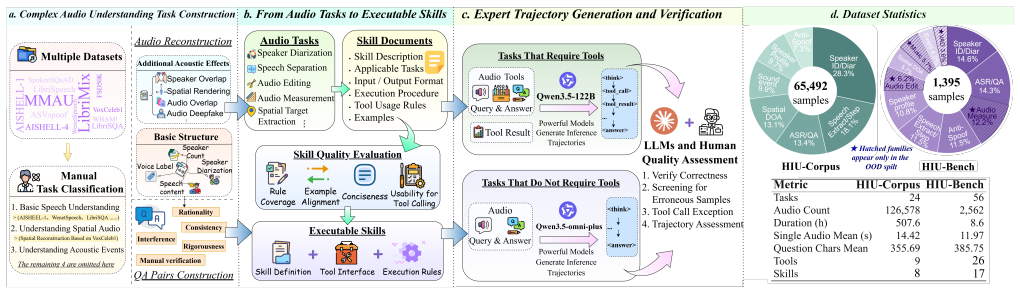
The paper's central claim is that large audio language models should be cast as interactive agents that hear the input, invoke external skills, and understand the returned evidence, rather than answer directly from a fixed clip. The authors establish this by constructing a corpus of 65,492 verified interaction trajectories spanning 24 tasks, 8 skills, and 9 tools, then train SpeechAgent-R to select skill documents, execute tools, and integrate observations. On the companion benchmark, the trained agent improves the base model under the same harness from 65.01 to 80.05 overall, with the largest gains on tool-related scores, and the authors attribute the improvement to learning skill-tool coor
What carries the argument
The load-bearing object is the Hear-Invoke-Understand loop: at each step the agent maintains a context of query, audio, skill documents, past actions, and tool observations; it either retrieves the description of a selected skill, invokes one of that skill's tools, or emits a final response. The training machinery is trajectory-based supervised fine-tuning, which masks user and tool tokens while weighting agent actions, followed by multi-turn GRPO with a composite reward combining format validity, tool interaction quality, and task accuracy. The HIU-Corpus supplies the verified trajectories and skill documents that make this loop learnable.
Load-bearing premise
The out-of-distribution split in HIU-Bench is generated by the same LLM-driven pipeline used to create the training corpus, so the claim that SpeechAgent-R generalizes to unseen tool configurations rests on this synthetic distribution shift standing in for real-world novelty.
What would settle it
Replace the OOD split with human-authored tasks and workflows that use no training tools, run SpeechAgent-R under the same harness, and compare against the reported 70.94 OOD score; if tool-call accuracy collapses to near chance or the total score falls to the base-harness level, the generalization claim would be falsified.
If this is right
- A single audio model can learn to coordinate external acoustic tools for multi-step problems, so fixed-input audio benchmarks understate what large audio language models can do.
- Answer-only supervised fine-tuning gives only small gains; trajectory-level supervision is what establishes reliable skill selection and tool use.
- Multi-turn reinforcement learning refines learned tool behavior, reducing incorrect tool-selection failures by roughly a third and tool-result-utilization failures by about a sixth relative to SFT.
- When ground-truth tool outputs replace actual tool responses, the ID score rises from 84.2 to 91.4, indicating that after tool selection is learned, further progress depends on tool output quality and the model's own reasoning.
- The same agent harness without training does not reliably help: some models actually score lower with tool access, so training is necessary for effective tool use.
Where Pith is reading between the lines
- Editorial inference: because the OOD split is generated by the same LLM-based pipeline as the training corpus, the reported 70.94 OOD score may partly reflect imitation of the generator's style; a cleaner test would use human-designed OOD workflows.
- Editorial inference: the hear-invoke-understand recipe could transfer to other modalities or to user-defined skill libraries at inference time, since the skill-retrieval step is what lets the agent handle tools not seen in training.
- Editorial inference: the paper's own stated limitation in the conclusion — that the benchmark needs more complex and realistic scenarios — reinforces that real deployment would require field trials with novel, human-authored tasks.
Editorial analysis
A structured set of objections, weighed in public.
Referee Report
Summary. The paper formulates tool-interactive audio reasoning as a Hear-Invoke-Understand (HIU) process, constructs a large corpus (HIU-Corpus) of 65,492 interaction trajectories with 507.6 hours of audio, trains a multimodal agent (SpeechAgent-R) via trajectory-based SFT followed by multi-turn GRPO, and introduces HIU-Bench with ID and OOD splits. The main empirical claim is that SpeechAgent-R outperforms the base model under the same agent harness by 15.40 points on ID and 14.23 points on OOD tasks, and that this demonstrates generalization of skill and tool coordination to diverse unseen task settings.
Significance. If the generalization claim were convincingly established, this would be a useful contribution: the corpus is large, the two-stage training recipe is sensible, and the internal ablations in Table 2 and the oracle analysis in Table 4 provide credible evidence that trajectory-level SFT and RL improve interaction behavior on this benchmark. The paper also clearly separates direct-answer evaluation from agent-harness evaluation and reports per-tool performance, which is informative. However, the central OOD generalization claim is weakened because the OOD benchmark is generated by the same LLM pipeline as the training data and is scored with an author-designed rubric whose weights match the training reward weights. The internal ablations support the training recipe but do not, by themselves, establish transfer to genuinely unseen tool configurations.
major comments (3)
- [§5.1, Table 1] The OOD split is 'constructed through the same pipeline' as HIU-Corpus, using the same LLMs (Claude-Opus-4.7, Qwen3.5-122B) and the same task-template grammar. Task-level disjointness and MD5 file checks do not prevent leakage of stylistic patterns, skill-document phrasing, action formatting, or answer conventions. The model's OOD score of 70.94 could therefore reflect fitting the generator's conventions rather than acquiring transferable tool-coordination skills. I would like to see evaluation on independently constructed or human-annotated OOD tasks, or at least a cross-generator robustness check where OOD samples are produced by a different pipeline and scored by independent annotators.
- [§4.2 Eq. (4), §5.2, §6.3] The evaluation metric weights in HIU-Bench are 0.05/0.25/0.70, identical to the training reward weights λ_f/λ_t/λ_a, and Section 6.3 reports that these weights were selected by ablations that optimize the overall HIU-Bench score. Thus the headline numbers in Table 1 are partly a product of tuning the evaluation criterion to the training objective. The statement that evaluation metrics are 'independently computed on held-out annotations' addresses annotation leakage but not weight co-tuning. Please report results across a range of evaluation weights, or justify that the 0.05/0.25/0.70 choice is principled rather than selected to maximize the reported score.
- [§5.2, Table 4] The oracle-tool analysis that attributes remaining errors to tool-output quality and answer reasoning is performed only on the ID split. Since the central claim concerns OOD generalization, an OOD oracle analysis or an OOD error decomposition is needed. Without it, the paper does not show whether OOD gains come from skill/tool coordination or from the model learning the generator's interaction style and answer format.
minor comments (5)
- [§5.1] The text says ID and OOD share 'only two tools' while Figure 4(b) reports 'no overlap' in gold tool chains; please clarify the distinction between tool-level and chain-level overlap to avoid apparent inconsistency.
- [Table 1] The table headers are difficult to parse, especially the 'Tool Answer Total Time' spans. Please add explicit subheadings and define what 'Time' measures (wall-clock inference time? tool execution time?).
- [§6.3] The reward-weight ablation is described only qualitatively. Please provide a table with all tested weight settings and the resulting ID/OOD/overall scores, and state the number of random seeds used.
- [Table 3] The Base model achieves 100.0 on the sound-event-detector metric while SFT drops to 86.8; the text says tool execution performance remains 'comparable,' but this is a notable regression. Please explain whether this reflects different tool versions, metric sensitivity, or evaluation noise.
- [§7] The limitation paragraph is only one sentence. Given that the OOD benchmark is synthetic and generated in-house, a more detailed discussion of benchmark limitations and the need for external validation would strengthen the paper.
Circularity Check
The headline HIU-Bench score is the same weighted sum as the GRPO training reward, with the reward weights selected on that benchmark, and the OOD split is generated by the same LLM pipeline as the training corpus; the central generalization claim is therefore partially circular.
specific steps
-
fitted input called prediction
[Section 5.2 (Evaluation Protocol) vs. Section 4.2 / Eqs. (3)-(5) and Section 6.3]
"We define S total on HIU-Bench from three evaluation dimensions: format correctness (Sf), tool interaction (St) and answer quality (Sa), weighted by 0.05/0.25/0.70, with their effects analyzed in Section 6.3."
The GRPO reward in Eq. (4) is R = 0.05 R_f + 0.25 R_t + 0.70 R_a, and Section 5.2 defines the benchmark total with the identical weights 0.05/0.25/0.70; it also states that S_f and S_a follow the same criteria as R_f and R_a, and that for ID tasks S_t follows the training-time scorer. Thus the reported HIU-Bench total is the very objective that GRPO maximizes. Section 6.3 further says 'Reward weight ablations show that 0.05/0.25/0.70 weighting achieves the best overall score', so the evaluation weights were selected by maximizing this same benchmark. The headline improvement of SpeechAgent-R over baselines is therefore partly the training reward, with weights tuned on the test benchmark, restated as an evaluation result rather than an independent measure of skill/tool coordination.
-
other
[Section 5.1 (Benchmark Construction) vs. Section 4.1 (Corpus Construction)]
"HIU-Bench comprises an ID split that follows the same task, skill and tool distributions as HIU-Corpus while using independent audio instances, and an OOD split constructed through the same pipeline with new task scenarios and skill compositions."
HIU-Corpus is the training data, built by a three-stage pipeline in Section 4.1 that uses Claude-Opus-4.7 to check QA pairs and trajectories and Qwen3.5-122B to generate trajectories. The OOD split of HIU-Bench is 'constructed through the same pipeline', so the supposedly out-of-distribution test tasks are generated by the same LLMs, template grammar, skill-document style, and action-format conventions as the training trajectories. Task-level disjointness does not remove this shared generative source. Consequently, the OOD score largely measures how well the model imitates the generator's conventions, not generalization to an independent distribution of tool configurations. The central claim of generalization to 'diverse task settings and adaptive tool interactions' is thus supported by a
full rationale
The two circular steps above affect the main quantitative support for the paper's central claim. First, the evaluation metric on HIU-Bench is definitionally aligned with the GRPO training reward: the same weights (0.05/0.25/0.70) appear in Eq. (4) and in Section 5.2, S_f/S_a are said to follow R_f/R_a, and S_t follows the training-time scorer for ID tasks. Moreover, Section 6.3 states that this weighting was chosen as the one that gives the best overall score on HIU-Bench, meaning the benchmark result is at least partially fitted. Second, the OOD split is generated by the same LLM pipeline as HIU-Corpus, so the claimed out-of-distribution generalization is not measured against a genuinely independent distribution; the model can succeed by matching the generator's style. That said, the paper does contain some independent content: the trajectory-SFT vs. answer-only-SFT ablation and the oracle-tool analysis show behavioral differences under the same harness, and the answer-quality metrics are computed on held-out annotations. No load-bearing self-citation chain or imported uniqueness theorem is present. These independent components prevent the paper from being fully circular, but the headline ID/OOD scores used to demonstrate skill/tool-coordination generalization are substantially compromised by the two reductions above.
Axiom & Free-Parameter Ledger
free parameters (2)
- Reward weights (lambda_f, lambda_t, lambda_a) =
0.05, 0.25, 0.70
- Evaluation metric weights (Sf, St, Sa) =
0.05, 0.25, 0.70
axioms (4)
- domain assumption Skill documents describing tools, interfaces, and calling rules are sufficient for the agent to use both seen and unseen tools correctly at inference.
- domain assumption AI-generated trajectories from Qwen3.5 models, verified by Claude-Opus-4.7 and manual correction, are high-quality supervision for learning interaction behavior.
- domain assumption The agent harness executes tools with deterministic, correct or partially correct outputs during evaluation.
- standard math GRPO is a valid policy-gradient objective for multi-turn RL.
Cite this review
Pith. "Pith review of Hear, Invoke, and Understand: A Skill-Calling Multimodal Agent for Large Audio Language Models." pith.science (2026). https://pith.science/paper/BCXIHRX3
@misc{pith2026260801881,
  author       = {Pith},
  title        = {Pith review of: Hear, Invoke, and Understand: A Skill-Calling Multimodal Agent for Large Audio Language Models},
  year         = {2026},
  howpublished = {\url{https://pith.science/paper/BCXIHRX3}},
  note         = {Machine review of arXiv:2608.01881}
}
read the original abstract
Complex acoustic problems may require models to perform acoustic operations, interact with external tools and reason over the resulting textual or processed-audio observations rather than answer directly from a fixed audio input. We study such problems as tool-interactive audio reasoning and develop SpeechAgent-R, an audio agent that coordinates its intrinsic multimodal understanding with external skills and tools. To support this capability, we construct HIU-Corpus, comprising 65,492 interaction trajectories and 507.6 hours of audio across 24 tasks, 8 skills and 9 tools. SpeechAgent-R first learns structured interaction behaviors through trajectory-based supervised fine-tuning and then improves its decisions through multi-turn reinforcement learning. We further introduce HIU-Bench to jointly evaluate task performance, interaction quality and generalization to diverse task settings. It contains 1,395 samples across 56 tasks, including in-distribution (ID) and out-of-distribution (OOD) splits with substantial shifts in tool usage and workflow composition. SpeechAgent-R achieves 84.17 on ID tasks and 70.94 on OOD tasks, improving over the base model under the same agent harness by 15.40 and 14.23 points. These results demonstrate that learning skill and tool coordination improves audio agents' ability to handle diverse task settings and adaptive tool interactions.
Figures



Reference graph
Works this paper leans on
-
[4]
FSD50K: an Open Dataset of Human-Labeled Sound Events.CoRR, abs/2010.00475. Fu, Y.; Cheng, L.; and Lv, S
Pith/arXiv arXiv 2010
-
[8]
Liu, X.; Wang, X.; and Sahidullah, M
Full-Duplex-Bench- v3: Benchmarking Tool Use for Full-Duplex Voice Agents Under Real-World Disfluency.CoRR, abs/2604.04847. Liu, X.; Wang, X.; and Sahidullah, M
-
[10]
MMAR: A Challenging Benchmark for Deep Reasoning in Speech, Audio, Music, and Their Mix.CoRR, abs/2505.13032. Maben, L. M.; Lakshmy, G. G.; and Radhakrishnan, S
-
[11]
InIEEE Au- tomatic Speech Recognition and Understanding Workshop, ASRU2025,Honolulu,HI,USA,December6-10,2025,1–4
AURA: Agent for Understanding, Reasoning, and Automated Tool Use in Voice-Driven Tasks. InIEEE Au- tomatic Speech Recognition and Understanding Workshop, ASRU2025,Honolulu,HI,USA,December6-10,2025,1–4. IEEE. Nagrani, A.; Chung, J. S.; and Zisserman, A
2025
-
[12]
In Lacerda, F., ed.,18th Annual Conference of the Inter- national Speech Communication Association, Interspeech 2017, Stockholm, Sweden, August 20-24, 2017, 2616–2620
Vox- Celeb: A Large-Scale Speaker Identification Dataset. In Lacerda, F., ed.,18th Annual Conference of the Inter- national Speech Communication Association, Interspeech 2017, Stockholm, Sweden, August 20-24, 2017, 2616–2620. ISCA. Pahwa, R.; Beedu, A.; and Priye, P
2017
-
[13]
Audio2Tool: Speak, Call, Act - A Dataset for Benchmarking Speech Tool Use.CoRR, abs/2604.22821. Rong, Y.; Li, C.; and Yu, D
-
[14]
Sakshi, S.; Tyagi, U.; and Kumar, S
AudioGenie-Reasoner: ATraining-FreeMulti-AgentFrameworkforCoarse-to-Fine Audio Deep Reasoning.CoRR, abs/2509.16971. Sakshi, S.; Tyagi, U.; and Kumar, S
-
[16]
Qwen3-Omni Technical Report.CoRR, abs/2509.17765. Team, Q
-
[17]
Qwen3.5-Omni Technical Report.CoRR, abs/2604.15804. Tian, F.; Zhang, X. T.; and Zhang, Y
-
[18]
Step-Audio-R1 Technical Report.CoRR, abs/2511.15848. Tong, S.; Li, X.; and Wang, Y
-
[19]
AuTAgent: A Rein- forcement Learning Framework for Tool-Augmented Audio Reasoning.CoRR, abs/2602.13685. Wang, B.; Zou, X.; and Lin, G
-
[20]
AudioBench: A Uni- versal Benchmark for Audio Large Language Models. In Proceedings of the 2025 Conference of the Nations of the AmericasChapteroftheAssociationforComputationalLin- guistics:HumanLanguageTechnologies,NAACL2025-Vol- ume 1: Long Papers, Albuquerque, New Mexico, USA, April 29-May4,2025,4297–4316.AssociationforComputational Linguistics. Wang, ...
2025
-
[21]
MSU-Bench: To- wards Understanding the Conversational Multi-talker Sce- narios.CoRR, abs/2508.08155. Wang, Y.; Peng, J.; and Li, H
-
[22]
Wijngaard,G.;Formisano,E.;andDumontier,M.2025
Audio-Mind: An Au- ditableAgenticFrameworkforAudioUnderstanding.CoRR, abs/2605.28480. Wijngaard,G.;Formisano,E.;andDumontier,M.2025. Au- dioToolAgent: An Agentic Framework for Audio-Language Models.CoRR, abs/2510.02995. Wu, D.; Zhang, X.; and Yang, D
Pith/arXiv arXiv 2025
-
[23]
Echo: Towards Ad- vanced Audio Comprehension via Audio-Interleaved Rea- soning.CoRR, abs/2602.11909. Xie,Z.;Lin,M.;andLiu,Z.2025. Audio-Reasoner:Improv- ingReasoningCapabilityinLargeAudioLanguageModels. InProceedings of the 2025 Conference on Empirical Meth- odsinNaturalLanguageProcessing,EMNLP2025,Suzhou, China, November 4-9, 2025, 23829–23851. Associati...
arXiv 2025
-
[24]
EChO-Agent: Evidence Chain Orchestration Agent for Audio Reasoning. CoRR, abs/2606.15141. Zhao, Z.; Jiang, Y.; and Liu, H
-
[2017]
Chen, L.; Chen, H.; and Cai, Y
AISHELL-1: An Open- SourceMandarinSpeechCorpusandASpeechRecognition Baseline.CoRR, abs/1709.05522. Chen, L.; Chen, H.; and Cai, Y
-
[2018]
Li, L.; Chen, H.; Li, Z.; Hu, Q.; Kang, J.; Li, J.; Xie, L.; and Li,Y.2026
Spoken SQuAD: A Study of Mitigating the Impact of Speech Recognition Errors on Listening Comprehension.CoRR, abs/1804.00320. Li, L.; Chen, H.; Li, Z.; Hu, Q.; Kang, J.; Li, J.; Xie, L.; and Li,Y.2026. Audio-Cogito:TowardsDeepAudioReasoning in Large Audio Language Models. arXiv:2604.12527. Lin, G.; Chen, C.; and Chen, Z
Pith/arXiv arXiv 2026
-
[2020]
LibriMix: An Open-Source Dataset for Generalizable Speech Separation. arXiv:2005.11262. Dinkel,H.;Li,G.;andLiu,J.2025.MiDashengLM:Efficient Audio Understanding with General Audio Captions.CoRR, abs/2508.03983. Fonseca, E.; Favory, X.; and Pons, J
Pith/arXiv arXiv 2005
-
[2021]
Jain, D.; Shukla, H.; and Rajeev, G
AISHELL-4: An Open Source Dataset for Speech Enhancement, Separation, Recognition and Speaker Diarization in Conference Sce- nario.CoRR, abs/2104.03603. Jain, D.; Shukla, H.; and Rajeev, G
-
[2022]
ASVspoof 2021: Towards Spoofed and Deepfake Speech Detection in the Wild.CoRR, abs/2210.02437. Ma, Z.; Ma, Y.; and Zhu, Y
Pith/arXiv arXiv 2021
-
[2023]
LibriSQA: Ad- vancing Free-form and Open-ended Spoken Question An- swering with a Novel Dataset and Framework.CoRR, abs/2308.10390
-
[2024]
MMAU: A Mas- siveMulti-TaskAudioUnderstandingandReasoningBench- mark.CoRR, abs/2410.19168. Sussman, E. S
-
[2025]
VoiceAgent- Bench:AreVoiceAssistantsreadyforagentictasks?CoRR, abs/2510.07978. KimiTeam;Ding,D.;andJu,Z.2025. Kimi-AudioTechnical Report.CoRR, abs/2504.18425. Kumar,S.;Sedlácek,S.;andLokegaonkar,V.2026.MMAU- Pro: A Challenging and Comprehensive Benchmark for Holistic Evaluation of Audio General Intelligence. InForti- ethAAAIConferenceonArtificialIntellige...
arXiv 2025
-
[2026]
AudioRouter: Data EfficientAudioUnderstandingviaRLbasedDualReasoning. CoRR, abs/2602.10439. Chu,Y.;Xu,J.;andYang,Q.2024. Qwen2-AudioTechnical Report.CoRR, abs/2407.10759. Cosentino, J.; Pariente, M.; Cornell, S.; Deleforge, A.; and Vincent, E
arXiv 2024
discussion (0)
Sign in with ORCID, Apple, or X to comment. Anyone can read and Pith papers without signing in.