REVIEW 3 major objections 4 minor 15 references
CultureVidBench: Benchmarking Cultural Understanding in Text-to-Video Generation
T0 review · 3 major / 4 minor · reviewed 2026-08-04 · deepseek-v4-flash
Pith's one-line read A 1,000-prompt benchmark across 12 countries argues that text-to-video models ace prompt-following and visual quality yet misrepresent fine-grained cultural details—rituals, underrepresented regions, text, and audio.
desk verdict First dedicated T2V cultural benchmark with a solid core result, but the headline claim about underrepresented regions rests on unvalidated MLLM country-level scores and needs the human data the authors already collected. read the letter →
The pith
A machine-rendered reading of the paper's core claim, the machinery that carries it, and where it could break.
The reading
What carries the argument
Two instruments carry the argument. CultureVidBench itself: 1,000 prompts built from cultural elements in CulturalAtlas and Wikipedia, organized into three categories (material culture; social practice & performance; ritual & ceremony) spanning 14 aspects, with templates that embed human actions, interactions, or procedural sub-steps in every prompt so video, not static imagery, is required. Second, the target-explicit evaluation protocol: a three-step procedure in which the evaluator names the expected cultural element, subject, or action from the prompt, extracts observations from the video about that target, then assigns a score. This separation is what distinguishes cultural failure from
What would settle it
Re-run the benchmark with matched prompt pairs that differ only in country name but keep the same action, subject, and syntax, and have native evaluators grade without being told which country is targeted. If the country gap in cultural scores shrinks or disappears, the reported bias is prompt-difficulty, not cultural representation. A second check: have non-native evaluators score the same videos; if the country ordering persists, the scores track objective content rather than evaluator familiarity.
Extended reading notes
Core claim
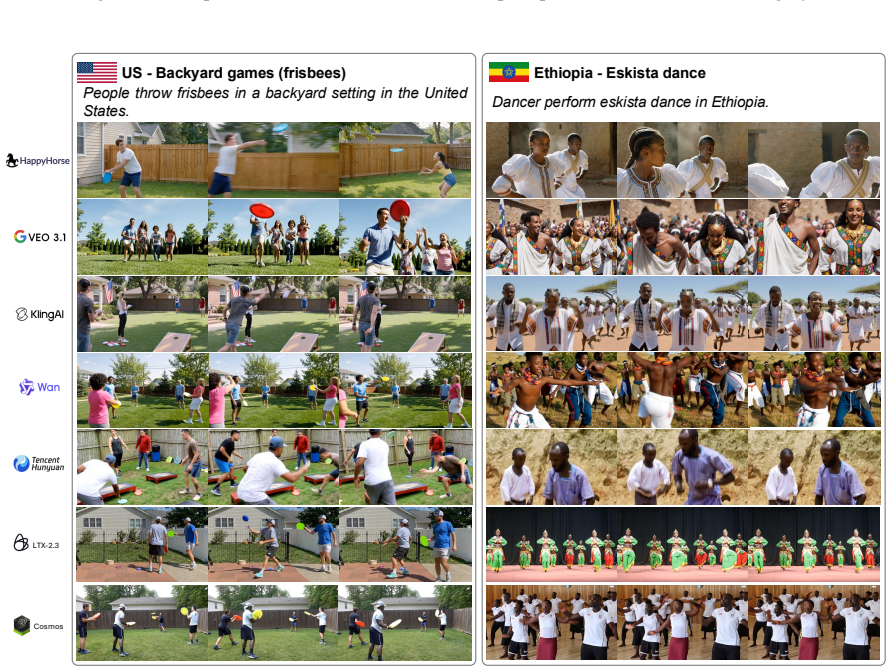
The paper's discovery is that cultural fidelity is an independent failure axis in text-to-video generation. Across all seven evaluated models, scores for cultural element alignment and consistency fall well below subject/action alignment and visual quality: a video can match its prompt and look realistic while showing wrong instruments, wrong gestures, or foreign symbols in a local ceremony. The gap has a consistent geography—the United States scores highest, Ethiopia and Malaysia lowest, across all models—read as evidence of imbalanced cultural coverage in training data. Culture is also stratified by type: material culture is relatively easy; social practices, ritual procedures, and multimo
Load-bearing premise
The cross-country conclusion assumes the 12 country prompt sets are equally hard, the three native evaluators per country grade with equal strictness, and the MLLM's scores carry no hidden country-specific bias—if any of these fails, the reported cultural gap could be a benchmark artifact rather than a true model bias.
Editorial extensions
If this is right
- Benchmarks that score only perceptual quality, motion, and text-video alignment will overstate T2V capability: cultural errors persist in videos that score high on those axes, so cultural evaluation needs its own dimensions.
- Visible-text rendering is the single hardest sub-skill—even the strongest proprietary models score only about 0.43–0.46 on it—pointing to glyph-level or script-aware supervision as the concrete bottleneck.
- The consistent country ordering across all seven models (United States highest; Ethiopia, Malaysia lowest) implies that training-data coverage, not architecture, drives cultural bias; rebalanced, culture-aware data sampling is the predicted remedy.
- Ritual and ceremony generation requires procedural knowledge and action planning, not just visual appearance, since models handle food, clothing, and architecture far better than greetings, dances, or weddings.
- The target-explicit evaluation protocol is reliable enough to serve as a scalable proxy for human cultural judgment, making large-scale cultural audits of generative video models feasible without per-country human panels.
Reading between the lines
- Editorial inference: if the country ordering reflects training-data skew, CultureVidBench can be reused as a diagnostic instrument—measure the ordering before and after culture-aware data sampling to verify that the gap actually closes, a test the paper does not run.
- Editorial inference: because audio and visible text are scored separately, a natural ablation is to silence or swap the audio track of a generated video and re-score; a large drop in cultural scores would prove audio carries much of the cultural signal, isolating where the generation pipeline should be fixed.
- Editorial inference: the identify-then-observe-then-score protocol is a generic recipe that could be lifted into a reward model for fine-tuning, using CultureVidBench scores as the training signal—target-explicit reasoning is exactly the structure a cultural reward model would need.
- Editorial inference: since prompts were authored from English-language sources, part of the US advantage may be linguistic; building prompts natively inside each target culture's language and comparing scores would test whether the gap is cultural knowledge or prompt language.
Editorial analysis
A structured set of objections, weighed in public.
Referee Report
Summary. The paper introduces CultureVidBench, a benchmark for evaluating cultural understanding in text-to-video (T2V) generation. It contains 1,000 curated prompts spanning 12 countries, 8 cultural regions, 14 cultural aspects, organized into material culture, social practice & performance, and ritual & ceremony. The authors evaluate seven T2V models (four open-source, three proprietary) along four dimensions: cultural faithfulness, multimodal cultural rendering, semantic adherence, and perceptual quality, using both human evaluators (native speakers per country) and MLLM-based automatic assessment. They report that current models achieve strong semantic adherence and visual quality but often fail on fine-grained cultural details, with larger gaps for underrepresented regions, rituals, and multimodal cues. They also validate MLLM evaluation against human judgments using country-averaged rank correlations.
Significance. The benchmark is a timely and potentially valuable resource. Its construction is careful: prompts are grounded in CulturalAtlas/Wikipedia, manually verified, and deliberately designed for video-specific cultural dynamics (actions, rituals, text, audio). The human evaluation protocol—native evaluators per country, translated questionnaires, attention checks—is a notable strength. The comparison of seven T2V models and the target-explicit MLLM evaluation protocol are also useful methodological contributions. If the main findings hold, the paper demonstrates an important dissociation between general prompt-following/visual quality and cultural fidelity, which would be of broad interest to the generation and evaluation communities. However, the cross-country 'underrepresented regions' finding—one of the headline claims in the abstract—is currently not adequately validated against human judgments at the country level, which limits the strength of the conclusions until addressed.
major comments (3)
- [Section 5.3, Figs. 5–6, Table 2, Eq. (1)] The cross-country conclusion ('this limitation is more pronounced in underrepresented cultural regions') rests entirely on Gemini-3.1-Pro country-level scores. The human–MLLM validation in Table 2 is computed within each country and then averaged (Eq. 1); it therefore does not test whether the MLLM reproduces human country-level means. Section 4.3 states that the 168-prompt human subset samples one prompt per aspect per country, which would allow direct human country-level scores to be computed, but no such comparison is reported. As written, the observed Ethiopia/Malaysia deficit could be an artifact of Gemini's own cultural bias or scoring behavior rather than a property of the T2V models. Please report human country-level scores on this subset (or a suitable calibration), and analyze whether the MLLM-country-level gap is consistent with the human gap.
- [Section 5.3, Fig. 3] Cross-country differences are interpreted as cultural representation effects, but prompt difficulty is not controlled. Although the aspect counts are described as 'relatively balanced' in Fig. 3, within-aspect prompt difficulty can vary substantially across countries (e.g., an obscure ritual procedure vs. a widely known object). The country-level averages in Figs. 5–6 pool all aspects, so a country with systematically harder prompts would appear underrepresented regardless of T2V model capability. The one-prompt-per-aspect-per-country human subset is a natural control for aspect mix; reporting scores broken down by aspect, or using human ratings to calibrate difficulty, would address this confound. Without such analysis, the 'underrepresented regions' claim is not yet established.
- [Figs. 5–8] The paper reports point estimates without confidence intervals or significance tests. For the cross-country comparisons and the category-level differences in Fig. 8, some gaps are small (e.g., several adjacent countries in Fig. 5a), and human ratings are averaged over only three evaluators per country. Given that the data already contain multiple models and raters, uncertainty quantification is feasible. Adding error bars or a simple significance test (e.g., bootstrap or permutation) would strengthen the 'systematic cultural disparities' claim and help readers judge whether differences are meaningful.
minor comments (4)
- [Fig. 3] The x-axis label 'Quantity' is vague; use 'Number of prompts' or 'Count' to clarify what is being plotted.
- [Table 1] In the HappyHorse-1.0 row, several numbers are concatenated (e.g., '0.7420.757', '0.4340.674'). Please fix the table formatting.
- [Section 5.3 / Appendix D] The term 'underrepresented' is used repeatedly but never operationally defined. Consider clarifying whether it refers to training-data prevalence, geographic region, or something else. Also, the qualitative statements in Appendix D about 'low human scores' are not linked to a quantitative table/figure; adding the corresponding scores would make the failure analysis more verifiable.
- [Fig. 4] The caption says 'Overall performance rankings of T2V models' but it is not stated whether this is an average across all eight dimensions or a separate visualization per dimension. Please clarify.
Circularity Check
No significant circularity: the benchmark's central measurements are validated by external human evaluators, and no fitted parameter or self-citation is presented as a prediction.
full rationale
CultureVidBench is an empirical evaluation benchmark rather than a derivation. The central claims — that T2V models achieve strong semantic adherence and visual quality but fail on fine-grained cultural details, and that failures are more pronounced for underrepresented regions, rituals, and multimodal cues — are presented as measured outcomes, not as consequences of a fitted quantity or a self-referential definition. The evaluation protocol uses a target-explicit MLLM prompt that supplies the expected cultural element (Table 6, Appendix C.2); this is an evaluation instrument, not a generative prediction, and its reliability is checked against human judgments from three native evaluators per country on a 168-prompt subset (Section 4.3, Table 2). The cross-country 'underrepresented regions' conclusion in Section 5.3 is based on Gemini-3.1-Pro country-level scores; the paper does not validate country-level MLLM means against country-level human means, and prompt-difficulty or evaluator-bias confounds could affect those disparities. However, that is a validity or confounding concern about an empirical measurement, not a circularity of the kind where the output reduces to the input by construction. The related-work citations to OSCBench (Han et al., 2026) and RoboTrustBench (Li et al., 2026) involve overlapping authors but are not load-bearing: they are contextual references, and the benchmark's stated contributions do not depend on them. No equation is fitted to the target outcome, no uniqueness theorem is imported from the authors' prior work, and no known result is merely renamed. The findings are externally checkable against the released benchmark and human annotations, so the paper is self-contained with respect to its evidence base.
Assumptions & free parameters
assumptions (5)
- domain assumption CulturalAtlas and Wikipedia are accurate and sufficient sources for cultural elements and practices.
- domain assumption The World Values Survey cultural regions are an appropriate basis for country selection and representation of world culture.
- domain assumption Three native, culturally familiar evaluators per country provide reliable ground truth for evaluating cultural faithfulness.
- domain assumption Cross-country performance differences reflect cultural representation rather than differential prompt difficulty or evaluator strictness.
- domain assumption MLLM-based evaluation can approximate human judgment for cultural dimensions.
Cite this review
Pith. "Pith review of CultureVidBench: Benchmarking Cultural Understanding in Text-to-Video Generation." pith.science (2026). https://pith.science/paper/CL7RAEMQ
@misc{pith2026260801942,
  author       = {Pith},
  title        = {Pith review of: CultureVidBench: Benchmarking Cultural Understanding in Text-to-Video Generation},
  year         = {2026},
  howpublished = {\url{https://pith.science/paper/CL7RAEMQ}},
  note         = {Machine review of arXiv:2608.01942}
}
read the original abstract
Text-to-video (T2V) generation models have advanced rapidly, yet their ability to represent diverse cultural contexts remains underexplored. Existing benchmarks mainly focus on perceptual quality, physical plausibility, and text-video alignment, but do not directly assess whether generated videos capture culturally specific objects, actions, rituals, visible text, or audio cues. We introduce CultureVidBench, a comprehensive benchmark for evaluating cultural understanding in T2V generation. CultureVidBench contains 1,000 curated prompts covering 12 countries, 6 continents, 8 cultural regions, and 14 cultural aspects organized into three categories: material culture, social practice & performance, and ritual & ceremony. Designed specifically for video generation, CultureVidBench emphasizes dynamic and multimodal cultural representation, including social interactions, ritual procedure, and culturally appropriate visible text and audio. We evaluate seven representative T2V models through human user studies and MLLM-based automatic assessment across cultural faithfulness, multimodal cultural rendering, semantic adherence, and perceptual quality. Results show that although current models achieve strong semantic adherence and visual quality, they often fail to faithfully capture fine-grained cultural details, particularly for underrepresented regions, rituals, and multimodal cultural cues.
Figures


Figures from the paper (9 more)





Reference graph
Works this paper leans on
-
[1]
Read the cultural element and text prompt carefully
-
[2]
Curve: A benchmark for cultural and mul- tilingual long video reasoning. InProceedings of the IEEE/CVF Conference on Computer Vision and Pattern Recognition (CVPR), pages 32860–32871. Kaiyue Sun, Kaiyi Huang, Xian Liu, Yue Wu, Zihan Xu, Zhenguo Li, and Xihui Liu. 2025. T2v-compbench: A comprehensive benchmark for compositional text- to-video generation. I...
arXiv 2025
-
[3]
If the video does not contain relevant text or culture-related audio, select NA for the corresponding text/audio question
Score each question using the 1–5 scale. If the video does not contain relevant text or culture-related audio, select NA for the corresponding text/audio question
-
[4]
Example: When evaluating whether the action is correctly shown, focus only on the action, even if the specific cultural element is imperfect
Evaluate each question independently. Example: When evaluating whether the action is correctly shown, focus only on the action, even if the specific cultural element is imperfect. Evaluation Criteria
-
[5]
Turn on the sound and watch the entire video from beginning to end
-
[8]
Cultural Faithfulness 1a. Cultural Element Alignment Does the video correctly present the cultural element specified in the prompt? 1 Very poor: The cultural element is completely absent or replaced by something entirely unrelated. 2 Poor: The cultural element appears, but it is clearly incorrect or belongs to the wrong cultural category. 3 Fair: The cult...
-
[9]
Text Rendering Correctness If text appears in the video, is it correctly rendered and culturally appropriate? Select NA if no text appears in the video
Multimodal Cultural Rendering 2a. Text Rendering Correctness If text appears in the video, is it correctly rendered and culturally appropriate? Select NA if no text appears in the video. 1 Very poor: The basic composition of the text is incorrect, meaningless, or completely inappropriate for the target culture. 2 Poor: The text is partially visible, but i...
-
[10]
Semantic Alignment 3a. Subject / Participant Alignment Does the video correctly show the subject or participants described in the prompt? 1 Very poor: The required subject or participant is absent or entirely unrelated. 2 Poor: The subject or participant appears, but does not match the category described in the prompt. 3 Fair: The subject or participant i...
Show all 15 references
-
[11]
Realism Does the video look like a real-world video? 1 Very poor: The video looks highly artificial, distorted, or obviously fake
Realism and Visual Quality 4a. Realism Does the video look like a real-world video? 1 Very poor: The video looks highly artificial, distorted, or obviously fake. 2 Poor: The video contains many visual artifacts, unrealistic motion, or unnatural textures. 3 Fair: Some parts loo...
2026
-
[12]
Cultural Faithfulness
-
[13]
Multimodal Cultural Rendering
-
[14]
Semantic Alignment Very Poor Poor Fair Good Excellent
-
[15]
17 Families decorate homes for Hari Raya with a festival banner in Malaysia
Realism and Visual Quality Very Poor Poor Fair Good Excellent Figure 11: Human evaluation interface used for rating generated videos. 17 Families decorate homes for Hari Raya with a festival banner in Malaysia. US - Christmas decoration Malaysia - Hari Raya decoration Families...
-
[2024]
NA" if no visible text appears. - For audio cultural alignment, use
and CulturalFrames (Nayak et al., 2025). While prior benchmarks mainly use static descrip- tions or simple human actions, CultureVidBench includes culturally grounded interactions, multi- step ritual activities, and explicit visible-text cues. Such prompt designs enable a more...
2025
-
[2026]
InThe Fourteenth International Conference on Learning Representa- tions
Culture in action: Evaluating text-to-image models through social activities. InThe Fourteenth International Conference on Learning Representa- tions. Fanqing Meng, Jiaqi Liao, Xinyu Tan, Wenqi Shao, Quanfeng Lu, Kaipeng Zhang, Yu Cheng, Dianqi Li, Yu Qiao, and Ping Luo. 2024....
2024 arXiv
Reviewed August 4, 2026 · model on record in the stance chip above.
Discussion (0). Sign in to comment.