REVIEW 2 major objections 4 minor 59 references
In metals, the time-dependent quantum geometric tensor separates into a Drude-weight slope and a divergent time-independent piece that cancels from every physical response, making the ratio D/S1 a lattice-scale probe of itinerant versus bou
Reviewed by Pith at T0; open to challenge. T0 means a machine referee read the full paper against a public rubric. the ladder, T0–T4 →
For metals, the time-dependent quantum geometric tensor decomposes into a Drude-weight linear term and a divergent time-independent Fermi-surface term, and the ratio D/S1 distinguishes itinerant from bound charge at the lattice scale.
T0 review reviewed 2026-08-04 challenge →
load-bearing objection Solid analytical extension of the tQGT to metals, but the headline decomposition is proven only for Slater-determinant ground states while the paper claims many-body generality. the 2 major comments →
Long and short time linear response of metals: a geometric approach
The pith
A machine-rendered reading of the paper's core claim, the machinery that carries it, and where it could break.
The reading
Core claim
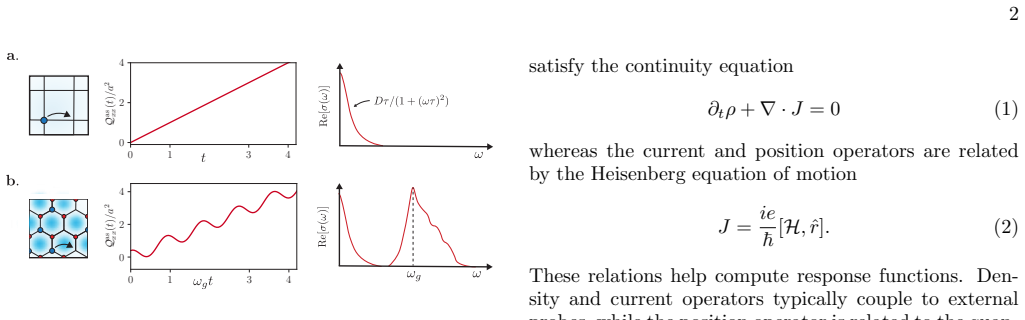
The central claim is that for metals with well-defined quasiparticle bands, the time-dependent quantum geometric tensor Q(t) decomposes exactly (within the Slater-determinant evaluation) as Q_intra(t) = D t + F~, where D is the charge stiffness — the Drude weight — and F~ is a time-independent, divergent object supported on the Fermi surface. The divergence is the same one known from the metallic localization length; it cancels in every physical response because the conductivity is built from the time-derivative of the antisymmetric part of Q. The paper identifies the ratio D/S1, with S1 the total f-sum spectral weight, as the fraction of mobile electrons and computes it for the kagome latti
What carries the argument
The workhorse is the time-dependent quantum geometric tensor Qμν(t)=⟨rμ(t)(1−P)rν⟩, which measures dipole fluctuations of the projected position operator; its antisymmetric part's time derivative equals the optical conductivity. The load-bearing identity is the intra-band decomposition Q_intra = D t + F~, obtained by shifting a momentum derivative from a delta function onto occupation factors and matrix elements; the linear term's coefficient D is the charge stiffness and the surviving time-independent piece F~ is the divergent Fermi-surface term. The decomposition also yields D = Σ∫(−∂f/∂ε)(∂_k ε)^2 and F~ = Σ∫ ∂_k f ⟨ψ|r|ψ⟩, supported on the Fermi surface, and its cancellation in response
Load-bearing premise
The explicit Fermi-surface formulas for D, F~, and the Hall conductivity assume a Slater-determinant ground state with well-defined quasiparticle bands; if interactions, disorder, or correlations invalidate that single-particle picture, the decomposition and the D/S1 interpretation need not survive.
What would settle it
Measure the optical conductivity of a clean kagome metal (or a material with comparable band structure) at the two van Hove fillings and extract D/S1 from the Drude peak and the integrated inter-band absorption; a ratio that is the same at both fillings, or a Drude weight that does not match the slope of the time-domain dipole correlator computed from the same response, would contradict the central claim. Alternatively, exact diagonalization of a small interacting metallic cluster where the tQGT slope disagrees with the independently computed charge stiffness would falsify the single-particle
If this is right
- The Drude weight acquires a geometric meaning: it is the rate at which dipole fluctuations spread linearly in time, measurable from the slope of Q(t).
- The ratio D/S1 is a lattice-scale observable that separates itinerant from bound charge; the kagome calculation shows two van Hove fillings with identical Fermi surfaces differ by about 20 percent, so Fermi-surface shape alone does not fix the mobile fraction.
- In 2D Dirac semimetals, inter-band dipole fluctuations are logarithmic in time and scale invariant, explaining the minimal conductivity without an adjustable parameter; in Weyl semimetals they decay as 1/t, restoring a separation of scales.
- The Hall conductivity of a metal contains a Fermi-surface term from the orbital magnetic moment in addition to the Fermi-sea Berry curvature; this term is required to recover the correct bulk orbital magnetization.
- The divergent term F~ carries no signature in dc transport, so the quantum weight of a metal is not directly accessible; only the time-derivative and antisymmetric combination appear in response.
Where Pith is reading between the lines
- If the decomposition holds beyond the clean limit, the ratio D/S1 should be observable in optical conductivity as the zero-frequency weight relative to integrated absorption; a doping-dependent measurement on a kagome-like material could test the predicted 0.46/0.57 asymmetry.
- The cancellation of F~ relies on taking the time derivative before evaluating the singular matrix element; experiments that probe the equal-time tensor (for example via static structure-factor-like probes) might still encounter the divergence, suggesting that only time-resolved or antisymmetrized quantities are safe observables.
- The paper leaves the metallic Hall correction σ_M^H at the perturbative level and acknowledges that a many-body derivation is open; a non-perturbative proof would confirm that the orbital-magnetic-moment term is not an artifact of the quasiparticle approximation.
- One could extend the kagome calculation to the interacting Hubbard model near the van Hove fillings to see whether correlation-driven spectral weight transfer shifts D/S1 and sharpens the distinction between the two fillings.
Editorial analysis
A structured set of objections, weighed in public.
Referee Report
Summary. The paper extends the time-dependent quantum geometric tensor (tQGT) framework to gapless phases, focusing on metals and semimetals. For a Slater-determinant ground state it derives the decomposition of the intra-band tQGT into a linear-in-time Drude term D t and a divergent time-independent term F̃, and shows that the divergence is a Fermi-surface property that drops out of conductivities. It also discusses the Hall response, identifying a metallic correction proportional to the orbital magnetic moment, and proposes the ratio D/S1 of Drude to total spectral weight as a lattice-scale probe of itinerant versus bound charge. The proposal is illustrated on the kagome lattice at two van Hove fillings with identical Fermi surfaces but different D/S1, and the framework is applied to Dirac and Weyl semimetals, where closed-form time-domain results are obtained for the inter-band tQGT.
Significance. If the main claims hold, the paper provides a useful geometric language for separating itinerant and bound charge in metals and gives a concrete, observable-motivated ratio D/S1 that is sensitive to wavefunction geometry rather than just dispersion. Strengths of the paper are that the noninteracting derivations are explicit and internally consistent, the semimetal integrals are evaluated in closed form, the kagome example is a sharp falsifiable illustration, and the paper candidly flags its own limitations, including the Slater-determinant assumption in Sec. II and the perturbative status of Eq. (17). No fitting or numerical data are used for the central claims. The main weakness is that the strongest concluding statement—that the decomposition and cancellation hold beyond single-particle theory—is not backed by a many-body derivation; the derived results are established only for quasiparticle Slater-determinant states.
major comments (2)
- [Sec. VI, first paragraph; Sec. II B; Sec. III] The concluding claim that the decomposition Q(t) = D t + F̃ and the cancellation of the divergent term 'hold beyond single-particle theory' is broader than what is derived. Sec. II explicitly limits the explicit evaluations to 'a Slater-determinant ground state,' and Sec. III and Appendix A obtain both D and F̃ from Bloch states and the single-particle identity Eq. (22). The many-body order-of-limits argument in Sec. II fixes D through the f-sum rule, but it does not by itself justify the intra-band decomposition or the divergent time-independent term. Please either provide a many-body derivation or a controlled quasiparticle-validity argument, or revise the Discussion to state the result for Slater-determinant/quasiparticle states.
- [Sec. II.C, Eq. (17); Sec. III, Eq. (27)] Eq. (17) is introduced as a conjecture, and Appendix B derives the resulting Hall formula in perturbation theory; the text in Sec. VI correctly says the many-body generalization is open. This is acceptable, but it should be made explicit in the main text that all Hall conclusions—including the orbital-magnetic-moment term and its role in bulk magnetization—are conditional on the perturbative one-loop/Slater result. As written, the statement in Sec. III that 'this result could not have been obtained without the Fermi surface contribution that follows from Eq. (17)' may be read as a general theorem rather than a result valid at the presented level of perturbation theory.
minor comments (4)
- [Sec. II, Eq. (12)] Please state the convention for σ(t): retarded conductivity, factors of e and ℏ, and whether Θ(t) is included in the definition used for the f-sum rule. This would remove ambiguity in comparing with the δ(t) result in Eq. (40).
- [Sec. V, Eq. (38)] The measure in the 2D Dirac integral should be labelled as the radial measure, e.g., after angular integration, dk = |k| d|k|. The displayed ∫ dk/(2π) is dimensionally not transparent.
- [Sec. IV, Fig. 2] In panels (c) and (d), explicitly identify which curve corresponds to μ = 0 and which to μ = -2t. The caption currently leaves this to inference.
- [Appendix A, Eqs. (A3)-(A5)] The statement that the two forms of F̃ agree only when the T→0 limit is taken after regularizing the position matrix element is subtle; a one-sentence derivation or a reference would help the reader.
Circularity Check
No substantive circularity: the metallic tQGT decomposition is derived rather than fitted, and self-citations only supply the framework, not the load-bearing result.
full rationale
The main claimed chain is: define tQGT (Eq. 11), connect it to conductivity (Eq. 12), then derive the Fermi-surface decomposition Q_intra = D t + F̃ (Eq. 23) from Bloch-state matrix elements using the identity in Eq. (22), with D given by the band formula Eq. (18) and F̃ by Eq. (24). This is an actual derivation in Sec. III and Appendix A, not a parameter fitted to the target quantity. The D/S1 kagome statement is computed from a nearest-neighbor tight-binding model via the f-sum rule (Eq. 33); it is not a fit renamed as a prediction. The Dirac semimetal result (Eqs. 38-40) is checked against the known minimal conductivity, an external benchmark. The only notable self-citations are to the authors' prior tQGT work [11] (and related [6], [22]) for the tQGT-conductivity relation and the clean-metal statement 'the dipole correlator grows with slope D [11]'. These set up the formalism, but the linear coefficient is re-derived microscopically as the Drude weight, so the citation is not load-bearing for the central claim. The paper also explicitly flags its scope: 'the explicit evaluations of Sec. III assume a Slater-determinant ground state.' This is a genuine limitation of the many-body claim in Sec. VI, but it is a support gap or overclaim, not an input-output equivalence. No circular step satisfying the quoted-reduction test was found.
Axiom & Free-Parameter Ledger
axioms (5)
- domain assumption Slater-determinant ground state built from single-particle Green's function G(k,iω) with well-defined quasiparticle bands
- domain assumption Transport limit q→0 before ω→0 defines the tQGT and the longitudinal Drude response
- domain assumption f-sum rule and Kramers-Kronig relation imposed by gauge invariance
- standard math Bloch dipole identity lim_{q→0} ⟨ψ_{k+q}|r_ν|ψ_k⟩ (ε_{k+q}-ε_k) = -i ∂_{kν} ε_k
- domain assumption Regularization of IR/UV divergences in Dirac/Weyl integrals does not affect physical response
Cite this review
Pith. "Pith review of Long and short time linear response of metals: a geometric approach." pith.science (2026). https://pith.science/paper/G2VMWCGF
@misc{pith2026260802298,
  author       = {Pith},
  title        = {Pith review of: Long and short time linear response of metals: a geometric approach},
  year         = {2026},
  howpublished = {\url{https://pith.science/paper/G2VMWCGF}},
  note         = {Machine review of arXiv:2608.02298}
}
abstract
The time-dependent quantum geometric tensor, which captures dipole fluctuations of bound electrons, is essential for understanding the electronic properties of insulators, superconductors, and flat bands. It is often considered subleading for low-energy descriptions of metals that are dominated by intra-band processes. Here, we revisit this perspective and highlight scenarios where the quantum geometry of the wavefunctions close to the Fermi surface plays a significant role. We compute the time-dependent quantum geometric tensor for metals, explain its divergence, and contrast it against singular geometric tensors of Dirac and Weyl semi-metals. We identify the ratio of Drude to total spectral weight, $D/\mathcal{S}_1$, as a lattice-scale probe of bound versus itinerant charge, and quantify it in the kagome metal, where the two van Hove fillings respond differently despite identical Fermi surfaces.
Figures

Reference graph
Works this paper leans on
-
[1]
Ashcroft, N
N. Ashcroft, N. Mermin, and R. Smoluchowski, Solid state physics, Physics Today30, 61 (1977)
1977
-
[2]
Pines,Theory of quantum liquids: normal Fermi liq- uids(CRC Press, 2018)
D. Pines,Theory of quantum liquids: normal Fermi liq- uids(CRC Press, 2018)
2018
-
[3]
S. M. Girvin, A. H. MacDonald, and P. M. Platzman, Magneto-roton theory of collective excitations in the frac- 10 tional quantum hall effect, Phys. Rev. B33, 2481 (1986)
1986
-
[4]
M. V. Berry, Quantal phase factors accompanying adia- batic changes, Proceedings of the Royal Society of Lon- don. A. Mathematical and Physical Sciences392, 45 (1984)
1984
-
[5]
J. P. Provost and G. Vallee, Riemannian structure on manifolds of quantum states, Commun. Math. Phys.76, 289 (1980)
1980
- [6]
-
[7]
J. Yu, B. A. Bernevig, R. Queiroz, E. Rossi, P. T¨ orm¨ a, and B.-J. Yang, Quantum geometry in quan- tum materials, npj Quantum Mater.10, 101 (2025), arXiv:2501.00098 [cond-mat.mes-hall]
Pith/arXiv arXiv 2025
-
[8]
Souza, T
I. Souza, T. Wilkens, and R. M. Martin, Polarization and localization in insulators: Generating function approach, Phys. Rev. B62, 1666 (2000)
2000
-
[9]
Y. Onishi and L. Fu, Quantum weight, arXiv preprint arXiv:2401.13847 (2024)
Pith/arXiv arXiv 2024
-
[10]
I. Souza, R. M. Martin, and M. Stengel, Optical bounds on many-electron localization, SciPost Phys.18, 127 (2025), arXiv:2407.17908 [cond-mat.mtrl-sci]
Pith/arXiv arXiv 2025
-
[11]
N. Verma and R. Queiroz, Instantaneous response and quantum geometry of insulators, Proceed- ings of the National Academy of Sciences122, 10.1073/pnas.2405837122 (2025)
-
[12]
Resta, Polarization fluctuations in insulators and met- als: New and old theories merge, Phys
R. Resta, Polarization fluctuations in insulators and met- als: New and old theories merge, Phys. Rev. Lett.96, 137601 (2006)
2006
-
[13]
Komissarov, T
I. Komissarov, T. Holder, and R. Queiroz, The quantum geometric origin of capacitance in insulators, Nat. Com- mun.15, 4621 (2024)
2024
-
[14]
M. N. Y. Lhachemi and J. Cano, A unifying framework for sum rules and bounds on optical, thermoelectric and thermal transport from quantum geometry, arxiv (2026), arXiv:2603.10121, arXiv:2603.10121
arXiv 2026
-
[15]
Guan and B
Y. Guan and B. Bradlyn, Exploring many-body quan- tum geometry beyond the quantum metric with correla- tion functions: A time-dependent perspective, Phys. Rev. Res.8, 013291 (2026)
2026
-
[16]
W. Ji, A. Palomino, N. Goldman, T. Ozawa, P. Rise- borough, Z. Wang, and B. Mera, Density matrix ge- ometry and sum rules, arxiv (2025), arXiv:2507.14028, arXiv:2507.14028
Pith/arXiv arXiv 2025
-
[17]
J. Y. Yan, X. Guo, R. Bhandia, T. F. Rosenbaum, N. Drichko, and N. P. Armitage, Many-body quan- tum geometric effects and entanglement at the 3d metal-insulator quantum phase transition, arxiv 10.48550/arXiv.2606.21648 (2026), arXiv:2606.21648 [cond-mat.str-el]
-
[18]
E. Abelev, R. Romero III, and N. P. Armitage, Deriva- tion and application of a general scaling relation be- tween the dc and asymptotic high-frequency optical hall responses, arxiv 10.48550/arXiv.2607.15043 (2026), arXiv:2607.15043 [cond-mat.str-el]
work page internal anchor Pith review Pith/arXiv arXiv doi:10.48550/arxiv.2607.15043 2026
-
[19]
Onishi and L
Y. Onishi and L. Fu, Topological bound on the structure factor, Phys. Rev. Lett.133, 206602 (2024)
2024
-
[20]
Ba lut, B
D. Ba lut, B. Bradlyn, and P. Abbamonte, Quantum en- tanglement and quantum geometry measured with inelas- tic x-ray scattering, Phys. Rev. B111, 125161 (2025)
2025
-
[21]
D. Mao, J. F. Mendez-Valderrama, and D. Chowd- hury, Is the low-energy optical absorption in corre- lated insulators controlled by quantum geometry?, arXiv e-prints , arXiv:2410.16352 (2024), arXiv:2410.16352 [cond-mat.str-el]
Pith/arXiv arXiv 2024
-
[22]
Verma and R
N. Verma and R. Queiroz, Framework to measure quan- tum metric from step response, Phys. Rev. Lett.134, 106403 (2025)
2025
-
[23]
P. M. Tam, J. Herzog-Arbeitman, and J. Yu, Corner charge fluctuation as an observable for quantum geome- try, arXiv preprint arXiv:2406.17023 (2024)
Pith/arXiv arXiv 2024
-
[24]
Y. Onishi and L. Fu, Topological bound on structure fac- tor, arXiv preprint arXiv:2406.18654 (2024)
Pith/arXiv arXiv 2024
-
[25]
M. Kang, S. Kim, Y. Qian, P. M. Neves, L. Ye, J. Jung, D. Puntel, F. Mazzola, S. Fang, C. Jozwiak, A. Bost- wick, E. Rotenberg, J. Fuji, I. Vobornik, J.-H. Park, J. G. Checkelsky, B.-J. Yang, and R. Comin, Measurements of the quantum geometric tensor in solids, Nature Physics 21, 110 (2025), arXiv:2412.17809 [cond-mat.mtrl-sci]
Pith/arXiv arXiv 2025
-
[26]
Resta and S
R. Resta and S. Sorella, Electron localization in the in- sulating state, Phys. Rev. Lett.82, 370 (1999)
1999
-
[27]
Jeon and S
J. Jeon and S. Sakai, Quantum hyperuniformity and quantum weight, Phys. Rev. B113, 241113 (2026)
2026
-
[28]
P. M. Tam, Y. Sheffer, X.-C. Wu, F. D. M. Haldane, and S. Ryu, Fermi surface geometry from charge fluctuations in three-dimensional metals (2026), arXiv:2605.13951 [cond-mat.str-el]
Pith/arXiv arXiv 2026
-
[29]
Resta, Drude weight and superconducting weight, J
R. Resta, Drude weight and superconducting weight, J. Phys.: Condens. Matter30, 414001 (2018)
2018
-
[30]
Kohn, Theory of the insulating state, Phys
W. Kohn, Theory of the insulating state, Phys. Rev.133, A171 (1964)
1964
-
[31]
F. D. M. Haldane, Berry curvature on the fermi surface: Anomalous hall effect as a topological fermi-liquid prop- erty, Phys. Rev. Lett.93, 206602 (2004)
2004
-
[32]
D. J. Scalapino, S. R. White, and S. Zhang, Insulator, metal, or superconductor: The criteria, Phys. Rev. B47, 7995 (1993)
1993
-
[33]
Resta, The insulating state of matter: a geometrical theory, The European Physical Journal B79, 121 (2011)
R. Resta, The insulating state of matter: a geometrical theory, The European Physical Journal B79, 121 (2011)
2011
-
[34]
D. J. Thouless, M. Kohmoto, M. P. Nightingale, and M. den Nijs, Quantized hall conductance in a two- dimensional periodic potential, Phys. Rev. Lett.49, 405 (1982)
1982
-
[35]
Smrˇ cka and P
L. Smrˇ cka and P. Stˇ reda, Transport coefficients in strong magnetic fields, J. Phys. C: Solid State Phys.10, 2153 (1977)
1977
-
[36]
Stˇ reda, Theory of quantised hall conductivity in two dimensions, J
P. Stˇ reda, Theory of quantised hall conductivity in two dimensions, J. Phys. C: Solid State Phys.15, L717 (1982)
1982
-
[37]
Nagaosa, J
N. Nagaosa, J. Sinova, S. Onoda, A. H. MacDonald, and N. P. Ong, Anomalous hall effect, Rev. Mod. Phys.82, 1539 (2010)
2010
-
[38]
X. Wang, D. Vanderbilt, J. R. Yates, and I. Souza, Fermi- surface calculation of the anomalous hall conductivity, Phys. Rev. B76, 195109 (2007)
2007
-
[39]
Shinada and N
K. Shinada and N. Nagaosa, Quantum geometric bounds for observables: Linear responses, drude weight, and or- bital magnetization, Phys. Rev. B112, 155158 (2025)
2025
-
[40]
D. Xiao, J. Shi, and Q. Niu, Berry phase correction to electron density of states in solids, Phys. Rev. Lett.95, 137204 (2005)
2005
-
[41]
Thonhauser, D
T. Thonhauser, D. Ceresoli, D. Vanderbilt, and R. Resta, Orbital magnetization in periodic insulators, Phys. Rev. Lett.95, 137205 (2005)
2005
-
[42]
J. Shi, G. Vignale, D. Xiao, and Q. Niu, Quantum theory of orbital magnetization and its generalization to inter- 11 acting systems, Phys. Rev. Lett.99, 197202 (2007)
2007
-
[43]
D. N. Basov and T. Timusk, Electrodynamics of high-t c superconductors, Rev. Mod. Phys.77, 721 (2005)
2005
-
[44]
M. L. Kiesel and R. Thomale, Sublattice interference in the kagome hubbard model, Phys. Rev. B86, 121105(R) (2012)
2012
-
[45]
M. L. Kiesel, C. Platt, and R. Thomale, Unconventional fermi surface instabilities in the kagome hubbard model, Phys. Rev. Lett.110, 126405 (2013)
2013
-
[46]
Wang, Z.-Z
W.-S. Wang, Z.-Z. Li, Y.-Y. Xiang, and Q.-H. Wang, Competing electronic orders on kagome lattices at van hove filling, Phys. Rev. B87, 115135 (2013)
2013
-
[47]
Liu, Y.-B
Y.-Q. Liu, Y.-B. Liu, W.-S. Wang, D. Wang, and Q.- H. Wang, Electronic orders on the kagome lattice at the lower van hove filling, Phys. Rev. B109, 075127 (2024)
2024
-
[48]
Peotta and P
S. Peotta and P. T¨ orm¨ a, Superfluidity in topologically nontrivial flat bands, Nat. Commun.6, 8944 (2015)
2015
-
[49]
Torma, S
P. Torma, S. Peotta, and B. A. Bernevig, Superconduc- tivity, superfluidity and quantum geometry in twisted multilayer systems, Nat. Rev. Phys.4, 528 (2022)
2022
-
[50]
J. G. Checkelsky, B. A. Bernevig, P. Coleman, Q. Si, and S. Paschen, Flat bands, strange metals and the kondo effect, Nat. Rev. Mater.9, 509 (2024)
2024
-
[51]
Ahn and N
J. Ahn and N. Nagaosa, Superconductivity-induced spec- tral weight transfer due to quantum geometry, Phys. Rev. B104, L100501 (2021)
2021
-
[52]
M. C. Deven P. Carmichael, Probing the quantum geom- etry of correlated metals using optical conductivity, arxiv (2025), arXiv:2504.11428 [cond-mat.str-el]
arXiv 2025
-
[53]
Antebi, J
O. Antebi, J. Mitscherling, and T. Holder, Drude weight of an interacting flat-band metal, Phys. Rev. B110, L241111 (2024)
2024
-
[54]
A. A. Burkov, Quantum geometric contribution to the diffusion constant, Physical Review B113, 155145 (2026), arXiv:2512.16986 [cond-mat.mes-hall]
Pith/arXiv arXiv 2026
-
[55]
Ahn, G.-Y
J. Ahn, G.-Y. Guo, and N. Nagaosa, Low-frequency di- vergence and quantum geometry of the bulk photovoltaic effect in topological semimetals, Phys. Rev. X10, 041041 (2020)
2020
-
[56]
A. W. W. Ludwig, M. P. A. Fisher, R. Shankar, and G. Grinstein, Integer quantum hall transition: An alter- native approach and exact results, Phys. Rev. B50, 7526 (1994)
1994
-
[57]
T. Ando, Y. Zheng, and H. Suzuura, Dynamical conduc- tivity and zero-mode anomaly in honeycomb lattices, J. Phys. Soc. Jpn.71, 1318 (2002)
2002
-
[58]
M. I. Katsnelson, Zitterbewegung, chirality, and minimal conductivity in graphene, Eur. Phys. J. B51, 157 (2006)
2006
-
[59]
R. R. Nair, P. Blake, A. N. Grigorenko, K. S. Novoselov, T. J. Booth, T. Stauber, N. M. R. Peres, and A. K. Geim, Fine structure constant defines visual transparency of graphene, Science320, 1308 (2008)
2008
This paper was first reviewed by deepseek-v4-flash on August 4, 2026.
discussion (0)
Sign in with ORCID, Apple, or X to comment. Anyone can read and Pith papers without signing in.