REVIEW 3 major objections 5 minor 143 references
Attention entropy tells video transformers exactly which keys each token needs, so dense attention can be replaced by a temporally decaying radius mask—training-free.
Reviewed by Pith at T0; open to challenge. T0 means a machine referee read the full paper against a public rubric. the ladder, T0–T4 →
T0 review · deepseek-v4-flash
2026-08-04 05:56 UTC pith:BHGBKHT7
load-bearing objection TRA is a plausible training-free speedup with a clean entropy-to-radius idea, but the quality claim rests on a local-motion prior the paper itself concedes. the 3 major comments →
Token Radius Attention for Efficient Video Generation
The pith
A machine-rendered reading of the paper's core claim, the machinery that carries it, and where it could break.
Core claim
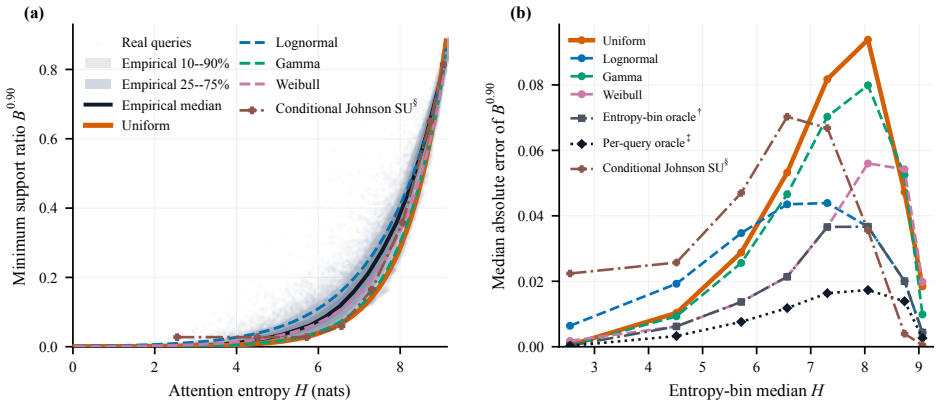
The central claim is that token-specific attention demand in video diffusion transformers is readable from attention entropy and spatially structured as query-centered disks. The paper establishes two empirical regularities: retained density—the minimum top-key fraction needed to preserve a given attention mass—varies by orders of magnitude across queries yet grows log-linearly with entropy (R² ≈ 0.94–0.99), and normalized attention scores decay roughly exponentially with 2D spatial distance, so each query's dominant interactions live in a circle of token-dependent radius. TRA converts entropy H into budget ⌈τ exp(H)⌉, converts that budget into a base radius r_i via disk-area counting with t
What carries the argument
The Token Radius mask—M_ij = I[d_s(i,j) ≤ r_i exp(−γ|f_j − f_i|)]—is the object that carries the argument: it converts a query-specific scalar budget into a regular, coordinate-defined spatiotemporal support. The entropy-to-budget map B ≈ τ exp(H)/N is its parameter-free companion: it turns attention entropy, computed cheaply during dense warm-up, into the number of keys to retain. Together they replace per-query top-k selection with a monotonic radius rule, and the paper's fused kernels plus tile-major reordering make that logical mask practical by mapping it to a block-sparse attention backend.
Load-bearing premise
The load-bearing premise is that every query's important keys live in a query-centered spatial disk whose extent is predictable from entropy; the paper itself concedes in its limitations section that this fixed distance-based pattern may miss long-range object correspondence, nonlocal motion, and scene-dependent attention structures, and if a significant share of attention is content-dependent rather than distance-based, the radius mask silently deletes those interactions and
What would settle it
Generate videos with a small, fast-moving object (for example, a ball crossing the frame) using TRA and dense attention at the same seed, then compare the object's presence and fidelity across frames: if TRA loses or distorts the object more than dense output does, that is the predicted failure of the distance-based mask. A quantitative version: for tokens in frames separated by large displacement, measure the attention mass falling outside the radius mask; if that mass exceeds the target τ, the entropy-to-radius transmission breaks.
If this is right
- Sparse attention for video diffusion transformers can be decided at query-token granularity without paying per-query ranking costs; entropy is a sufficient budget signal.
- TRA is training-free and transfers across model families and tasks: Wan2.1, Wan2.2, and HunyuanVideo, and text-to-video and image-to-video, use the same pipeline.
- Keeping only 9–19% of attention interactions yields 1.56×–2.05× end-to-end speedups; the remaining overhead is mainly mask construction and block-sparse execution, which the paper's kernels reduce by roughly 10×.
- Generation quality measured by VBench stays competitive with dense attention; on Wan2.1-14B T2V the sparse model is within about 0.02 points of dense on the overall score.
- Because entropy is reused across denoising steps after warm-up, the amortized cost of adaptivity is small; ablations show warm-up length is the main quality/runtime knob.
Where Pith is reading between the lines
- The entropy–density relation is likely not specific to video DiTs: any attention distribution whose effective support grows exponentially in entropy would benefit from the same budget rule, so the idea may transfer to long-context language models or image diffusion models.
- The fixed temporal decay rate (0.6 for Wan, 0.95 for HunyuanVideo) is a content-independent knob; tuning it per scene or conditioning it on motion magnitude could extend TRA to fast camera motion, where the radius pattern is most at risk.
- A direct test against content-aware alternatives: at matched FLOPs, measure attention recall on prompts with large object displacement; if recall drops below the target mass τ, the radius prior—not the entropy budget—is the bottleneck.
- TRA composes with orthogonal acceleration methods such as step distillation, caching, and quantization, so its practical speedup in deployed systems could be larger than the isolated 1.56×–2.05× reported.
Editorial analysis
A structured set of objections, weighed in public.
Referee Report
Summary. The paper proposes Token Radius Attention (TRA), a training-free sparse-attention method for video diffusion transformers. For each query, TRA estimates a token budget from attention entropy via an analytic uniform-support surrogate, converts the budget into a query-specific spatial radius, applies exponential temporal decay, and executes the resulting masks through a fused CUDA kernel on a block-sparse backend. The authors evaluate TRA on seven Wan2.1/Wan2.2/HunyuanVideo T2V/I2V configurations, reporting 9–19% retained attention density, 1.56x–2.05x speedups, and VBench scores close to dense attention, along with ablations and kernel-level efficiency results.
Significance. If the empirical claims hold, TRA is a useful contribution: it introduces token-level adaptivity into sparse video attention without per-query key ranking, provides a closed-form entropy-to-budget mapping, and demonstrates practical speedups on large public models. The paper also ships code, validates the two motivating observations on multiple architectures, and includes a detailed distributional analysis in the appendix (Lognormal/Gamma/Weibull surrogates). These are concrete strengths: the analytic mapping is not fitted to the benchmark, and the cross-model generalization is explicitly tested. The main risk is that the central premise—dominant attention is contained in a query-centered, temporally decaying disk—is only tested on aggregate distance-decay statistics and overall VBench means, not on difficult nonlocal-motion cases.
major comments (3)
- [§4.1, Table 1] The Radial Attention baseline is evaluated at a different resolution (768x1280 vs 720x1280) and with different frame counts (69/77/117 vs 81/129). Since VBench dimensions such as Temporal Flickering, Motion Smoothness, and Background Consistency depend on both resolution and temporal length, the Table 1 comparison between TRA and Radial is confounded. The claim that TRA provides a favorable quality-efficiency trade-off over Radial is therefore not established as reported. Please re-run Radial under the same resolution/frame count as the other methods, or provide a quantitative analysis of how the resolution/frame-count difference affects the reported metrics.
- [§B.1, Table 5] The 'Entropy and Mask Refresh' rows report identical PSNR/SSIM/LPIPS (21.6030/0.7589/0.2035) for 'Never' and refresh intervals of 10, 5, and 2 steps, with only runtime changing. Moreover, the 'Never' row does not match the default 10-step warm-up row in the same table (23.4520/0.8020/0.1615). This is internally inconsistent. Either the refresh ablation was run under a different configuration not stated in the caption, or the numbers are erroneous. As printed, Table 5 cannot be used as evidence for the design choice of not refreshing entropy/masks. Please correct the table or add a clear explanation of the configuration used for those rows.
- [§D, Eq. (14)] The method's hard radius mask deletes every key outside the query-centered disk r_i * exp(-gamma |t - f_i|). The authors acknowledge in Section D that this 'may not fully capture content-dependent interactions, including long-range object correspondence, nonlocal motion, or scene-dependent attention structures.' Because all quality results are reported only as overall VBench means, there is no evidence that TRA preserves quality for videos where the dominant attention mass lies far from the query (fast motion, occlusion, scene changes). The abstract-level claim of 'competitive generation quality' is thus conditional on a test distribution of mostly local, stable motion. Please provide motion- or content-stratified results, or a direct measurement of the actual attention mass captured by Eq. (14) for queries with large temporal displacement. Without such evidence, the central claim is not
minor comments (5)
- [Figure 2] 'Attention recall' is plotted but never defined in the main text or appendix. Please specify how it is computed (e.g., fraction of true top-k mass contained in the mask) and how the density axis is calculated.
- [§A.2, Eq. (16)] The analytic mapping uses slope 1 in log-B vs H, while the empirical fits in Figures 3 and 7 report slopes of approximately 0.72–0.85. Table 4 shows a reasonable MAE, but a short discussion of why the uniform-support slope is preferred over using the empirical slope (which would still be parameter-free if fixed) would strengthen the justification.
- [§C.1, Algorithm 1] The block-voting rule introduces undocumented thresholds: a key column is 'high coverage' if c_j > b/3, and the block is retained if |C_hi| > 0.6|C|. These thresholds affect the actual mask and efficiency, but no sensitivity analysis or rationale is given. Please at least state that they are fixed and comment on their role.
- [Table 2] The row labeled 'w/o Radius Masking' is described in the text as replacing the budget-preserving radius with a 1D radial distance. The label is misleading; consider 'w/o 2D radius (1D distance)' or similar.
- [Table 1] VBench scores are reported without error bars or multiple-seed variance. Given that generation is stochastic, a small number of seeds and standard deviations would help confirm the claim that TRA 'nearly matches' dense attention and is consistently best among sparse methods.
Circularity Check
No load-bearing circularity; TRA's entropy-to-budget mapping is parameter-free and its quality claims are externally benchmarked, with only minor self-citations that are independently validated in the paper.
full rationale
TRA's central derivation chain is not circular. The entropy-to-budget mapping (Eqs. 5-8) is an explicit uniform-support surrogate; it is not fitted to the evaluation benchmarks. The paper even notes the empirical log-linear slopes are about 0.77-0.85 (Figs. 3, 7) while TRA uses the parameter-free slope-1 surrogate, and Appendix A.2 validates the surrogate against oracle budgets (Table 4). The budget-to-radius construction (Eqs. 10-14) matches the mask's key count to the predicted budget by definition, but the paper does not present that as a prediction of quality; generation quality is measured externally on VBench/PSNR against dense attention and baselines. The token-radius pattern is supported by the paper's own measurements (Figs. 4, 8; R^2=0.791/0.994) rather than only by citation. The self-citations to EcoVideo (Chen et al. 2026a) and Radial Attention (Li et al. 2026) are not load-bearing: cross-step entropy stability is independently validated in Fig. 10 (minimum cosine 0.945), and the temporal exponential decay is explicitly adopted as a modeling prior, with Section D acknowledging that the fixed distance-based pattern 'may not fully capture content-dependent interactions, including long-range object correspondence, nonlocal motion, or scene-dependent attention structures.' These are correctness/scope limitations, not circular reductions. Score 2 reflects the minor self-citation/imported-prior residue, not a self-definitional or fitted-input circularity.
Axiom & Free-Parameter Ledger
free parameters (4)
- target attention mass τ =
0.9 (used in appendix analysis; not explicitly fixed in main experiments)
- temporal decay rate γ =
0.6 for Wan models, 0.95 for HunyuanVideo
- dense warm-up length =
25% of denoising steps (10 of 40 steps)
- block size =
90 (default)
axioms (5)
- domain assumption Attention entropy is a reliable query-specific budget signal (retained density grows approximately log-linearly with entropy).
- domain assumption Dominant attention interactions lie within query-centered 2D disks with temporally decaying radii.
- domain assumption Query-wise entropy is stable across denoising steps, so warm-up entropy can be reused later.
- domain assumption Tile-major reordering and block-sparse execution exactly implement the token-radius mask.
- ad hoc to paper The uniform-support surrogate gives a valid entropy-to-budget approximation.
read the original abstract
Video Diffusion Transformers (VDiTs) enable high-fidelity generation but incur quadratic cost from dense 3D self-attention. Existing head- and block-level sparse methods share computation budgets across queries, overlooking token-specific attention demand. We observe that retained density varies across queries yet correlates log-linearly with attention entropy, while dominant interactions form query-centered neighborhoods with token-dependent radii. Based on these findings, we propose Token Radius Attention (TRA), a training-free framework that maps query entropy to an analytic token budget and converts it into a temporally decayed radius without explicit key ranking. Fused entropy extraction, warm-up reuse, and block-sparse mask construction further reduce overhead. Across seven Wan2.1, Wan2.2, and HunyuanVideo T2V/I2V configurations, TRA retains only 9-19% of attention interactions and achieves 1.56x-2.05x speedup with competitive generation quality. Code is available at https://github.com/IF-LAB-PKU/Token-Radius-Attention.
Figures




Reference graph
Works this paper leans on
-
[1]
arXiv preprint arXiv:2506.08009 , year=
Self forcing: Bridging the train-test gap in autoregressive video diffusion , author=. arXiv preprint arXiv:2506.08009 , year=
-
[3]
arXiv preprint arXiv:2602.02214 , year=
Causal Forcing: Autoregressive Diffusion Distillation Done Right for High-Quality Real-Time Interactive Video Generation , author=. arXiv preprint arXiv:2602.02214 , year=
-
[4]
Proceedings of the IEEE/CVF international conference on computer vision , pages=
Scalable diffusion models with transformers , author=. Proceedings of the IEEE/CVF international conference on computer vision , pages=
-
[5]
arXiv preprint arXiv:2503.20314 , year=
Wan: Open and advanced large-scale video generative models , author=. arXiv preprint arXiv:2503.20314 , year=
-
[6]
arXiv preprint arXiv:2408.06072 , year=
Cogvideox: Text-to-video diffusion models with an expert transformer , author=. arXiv preprint arXiv:2408.06072 , year=
-
[7]
arXiv preprint arXiv:2508.13009 , year=
Matrix-game 2.0: An open-source real-time and streaming interactive world model , author=. arXiv preprint arXiv:2508.13009 , year=
-
[8]
arXiv preprint arXiv:2507.17744 , year=
Yume: An interactive world generation model , author=. arXiv preprint arXiv:2507.17744 , year=
-
[9]
arXiv preprint arXiv:2601.10553 , year=
Inference-time Physics Alignment of Video Generative Models with Latent World Models , author=. arXiv preprint arXiv:2601.10553 , year=
-
[10]
arXiv preprint arXiv:2602.18422 , year=
Generated Reality: Human-centric World Simulation using Interactive Video Generation with Hand and Camera Control , author=. arXiv preprint arXiv:2602.18422 , year=
-
[11]
arXiv preprint arXiv:2512.17661 , year=
Vidarc: Embodied Video Diffusion Model for Closed-loop Control , author=. arXiv preprint arXiv:2512.17661 , year=
-
[12]
arXiv preprint arXiv:2602.15922 , year=
World action models are zero-shot policies , author=. arXiv preprint arXiv:2602.15922 , year=
-
[13]
arXiv preprint arXiv:2510.02283 , year=
Self-forcing++: Towards minute-scale high-quality video generation , author=. arXiv preprint arXiv:2510.02283 , year=
-
[14]
arXiv preprint arXiv:2509.22622 , year=
Longlive: Real-time interactive long video generation , author=. arXiv preprint arXiv:2509.22622 , year=
-
[15]
arXiv preprint arXiv:2509.25161 , year=
Rolling forcing: Autoregressive long video diffusion in real time , author=. arXiv preprint arXiv:2509.25161 , year=
-
[16]
arXiv preprint arXiv:2602.07775 , year=
Rolling Sink: Bridging Limited-Horizon Training and Open-Ended Testing in Autoregressive Video Diffusion , author=. arXiv preprint arXiv:2602.07775 , year=
-
[17]
arXiv preprint arXiv:2603.12513 , year=
MemRoPE: Training-Free Infinite Video Generation via Evolving Memory Tokens , author=. arXiv preprint arXiv:2603.12513 , year=
-
[18]
arXiv preprint arXiv:2512.05081 , year=
Deep forcing: Training-free long video generation with deep sink and participative compression , author=. arXiv preprint arXiv:2512.05081 , year=
-
[19]
Proceedings of the IEEE/CVF Conference on Computer Vision and Pattern Recognition , pages=
From slow bidirectional to fast autoregressive video diffusion models , author=. Proceedings of the IEEE/CVF Conference on Computer Vision and Pattern Recognition , pages=
-
[20]
arXiv preprint arXiv:2406.11838 , year=
Autoregressive Image Generation without Vector Quantization , author=. arXiv preprint arXiv:2406.11838 , year=
-
[21]
Lumina-mgpt:
Liu, Dongyang and Zhao, Shitian and Zhuo, Le and Lin, Weifeng and Qiao, Yu and Li, Hongsheng and Gao, Peng , journal=. Lumina-mgpt:
-
[22]
arXiv preprint arXiv:2505.13211 , year =
MAGI‐1: Autoregressive Video Generation at Scale , author =. arXiv preprint arXiv:2505.13211 , year =
-
[23]
Xie, Jinheng and Mao, Weijia and Bai, Zechen and Zhang, David Junhao and Wang, Weihao and Lin, Kevin Qinghong and Gu, Yuchao and Chen, Zhijie and Yang, Zhenheng and Shou, Mike Zheng , journal=. Show-o:
-
[24]
Visual autoregressive modeling:
Tian, Keyu and Jiang, Yi and Yuan, Zehuan and Peng, Bingyue and Wang, Liwei , journal=NIPS, year=. Visual autoregressive modeling:
-
[25]
Infinity:
Han, Jian and Liu, Jinlai and Jiang, Yi and Yan, Bin and Zhang, Yuqi and Yuan, Zehuan and Peng, Bingyue and Liu, Xiaobing , journal=. Infinity:
-
[26]
Tang, Haotian and Wu, Yecheng and Yang, Shang and Xie, Enze and Chen, Junsong and Chen, Junyu and Zhang, Zhuoyang and Cai, Han and Lu, Yao and Han, Song , journal=
-
[27]
Frequency‐Aware Autoregressive Modeling for Efficient High‐Resolution Image Synthesis , author =
-
[28]
arXiv preprint arXiv:2506.08908 , year=
SkipVAR: Accelerating Visual Autoregressive Modeling via Adaptive Frequency-Aware Skipping , author=. arXiv preprint arXiv:2506.08908 , year=
-
[29]
arXiv preprint arXiv:2505.19602 , year=
Memory-Efficient Visual Autoregressive Modeling with Scale-Aware KV Cache Compression , author=. arXiv preprint arXiv:2505.19602 , year=
-
[30]
arXiv preprint arXiv:2504.09261 , year=
Head-aware kv cache compression for efficient visual autoregressive modeling , author=. arXiv preprint arXiv:2504.09261 , year=
-
[31]
arXiv preprint arXiv:2503.23367 , year=
Fastvar: Linear visual autoregressive modeling via cached token pruning , author=. arXiv preprint arXiv:2503.23367 , year=
-
[32]
Collaborative decoding makes visual auto-regressive modeling efficient , author=
-
[33]
arXiv preprint arXiv:2411.17178 , year=
Litevar: Compressing visual autoregressive modelling with efficient attention and quantization , author=. arXiv preprint arXiv:2411.17178 , year=
-
[34]
Ghosh, Dhruba and Hajishirzi, Hannaneh and Schmidt, Ludwig , journal=NIPS, volume=
-
[35]
Li, Daiqing and Kamko, Aleks and Akhgari, Ehsan and Sabet, Ali and Xu, Linmiao and Doshi, Suhail , journal=
-
[36]
Advances in Neural Information Processing Systems , volume=
Imagereward: Learning and evaluating human preferences for text-to-image generation , author=. Advances in Neural Information Processing Systems , volume=
-
[37]
arXiv preprint arXiv:2403.05135 , year =
Ella: Equip Diffusion Models with LLM for Enhanced Semantic Alignment , author =. arXiv preprint arXiv:2403.05135 , year =
-
[38]
Scaling Test-Time Compute Optimally Can be More Effective than Scaling
Snell, Charlie Victor and Lee, Jaehoon and Xu, Kelvin and Kumar, Aviral , year =. Scaling Test-Time Compute Optimally Can be More Effective than Scaling
-
[39]
Autoregressive Model Beats Diffusion:
Sun, Peize and Jiang, Yi and Chen, Shoufa and Zhang, Shilong and Peng, Bingyue and Luo, Ping and Yuan, Zehuan , journal=. Autoregressive Model Beats Diffusion:
-
[40]
Taming transformers for high-resolution image synthesis , author=
-
[41]
arXiv preprint arXiv:2306.09341 , year=
Human preference score v2: A solid benchmark for evaluating human preferences of text-to-image synthesis , author=. arXiv preprint arXiv:2306.09341 , year=
-
[42]
Pattern Recognition , volume=
Entropy guided attention network for weakly-supervised action localization , author=. Pattern Recognition , volume=. 2022 , publisher=
2022
-
[43]
2023 , doi =
Active Visual Exploration Based on Attention‐Map Entropy , author =. 2023 , doi =
2023
-
[44]
vid‐TLDR: Training Free Token merging for Light‐weight Video Transformer , author =
-
[45]
SIGGRAPH Asia , pages=
Follow-your-emoji: Fine-controllable and expressive freestyle portrait animation , author=. SIGGRAPH Asia , pages=
-
[46]
Follow your pose: Pose-guided text-to-video generation using pose-free videos , author=
-
[47]
arXiv preprint arXiv:2410.21759 , year=
IntLoRA: Integral Low-rank Adaptation of Quantized Diffusion Models , author=. arXiv preprint arXiv:2410.21759 , year=
-
[48]
Transfusion:
Zhou, Chunting and Yu, Lili and Babu, Arun and Tirumala, Kushal and Yasunaga, Michihiro and Shamis, Leonid and Kahn, Jacob and Ma, Xuezhe and Zettlemoyer, Luke and Levy, Omer , journal=. Transfusion:
-
[49]
Gu, Jiatao and Wang, Yuyang and Zhang, Yizhe and Zhang, Qihang and Zhang, Dinghuai and Jaitly, Navdeep and Susskind, Josh and Zhai, Shuangfei , journal=
-
[50]
Neural discrete representation learning , author=
-
[51]
Conditional image generation with pixelcnn decoders , author=
-
[52]
2020 , organization=
Generative pretraining from pixels , author=. 2020 , organization=
2020
-
[53]
arXiv preprint arXiv:2001.08361 , year=
Scaling laws for neural language models , author=. arXiv preprint arXiv:2001.08361 , year=
Pith/arXiv arXiv 2001
-
[54]
arXiv preprint arXiv:2307.01952 , year=
Podell, Dustin and English, Zion and Lacey, Kyle and Blattmann, Andreas and Dockhorn, Tim and M. arXiv preprint arXiv:2307.01952 , year=
-
[55]
High-resolution image synthesis with latent diffusion models , author=
-
[56]
Scaling rectified flow transformers for high-resolution image synthesis , author=
-
[57]
He, Yefei and Chen, Feng and He, Yuanyu and He, Shaoxuan and Zhou, Hong and Zhang, Kaipeng and Zhuang, Bohan , journal=
-
[58]
Cai, Tianle and Li, Yuhong and Geng, Zhengyang and Peng, Hongwu and Lee, Jason D and Chen, Deming and Dao, Tri , journal=
-
[59]
2023 , organization=
Fast inference from transformers via speculative decoding , author=. 2023 , organization=
2023
-
[60]
arXiv preprint arXiv:2305.10427 , year=
Accelerating transformer inference for translation via parallel decoding , author=. arXiv preprint arXiv:2305.10427 , year=
-
[61]
arXiv preprint arXiv:2410.01699 , year=
Accelerating auto-regressive text-to-image generation with training-free speculative jacobi decoding , author=. arXiv preprint arXiv:2410.01699 , year=
-
[62]
Wang, Xinlong and Zhang, Xiaosong and Luo, Zhengxiong and Sun, Quan and Cui, Yufeng and Wang, Jinsheng and Zhang, Fan and Wang, Yueze and Li, Zhen and Yu, Qiying and others , journal=
-
[63]
2024 , organization=
Chen, Junsong and Ge, Chongjian and Xie, Enze and Wu, Yue and Yao, Lewei and Ren, Xiaozhe and Wang, Zhongdao and Luo, Ping and Lu, Huchuan and Li, Zhenguo , booktitle=ECCV, pages=. 2024 , organization=
2024
-
[64]
Attention is all you need , author=
-
[65]
Chen, Junsong and Yu, Jincheng and Ge, Chongjian and Yao, Lewei and Xie, Enze and Wu, Yue and Wang, Zhongdao and Kwok, James and Luo, Ping and Lu, Huchuan and others , journal=
-
[66]
Achiam, Josh and Adler, Steven and Agarwal, Sandhini and Ahmad, Lama and Akkaya, Ilge and Aleman, Florencia Leoni and Almeida, Diogo and Altenschmidt, Janko and Altman, Sam and Anadkat, Shyamal and others , journal=
-
[67]
arXiv preprint arXiv:2202.00512 , year=
Progressive distillation for fast sampling of diffusion models , author=. arXiv preprint arXiv:2202.00512 , year=
-
[68]
On distillation of guided diffusion models , author=
-
[69]
Li, Xiuyu and Liu, Yijiang and Lian, Long and Yang, Huanrui and Dong, Zhen and Kang, Daniel and Zhang, Shanghang and Keutzer, Kurt , booktitle=ICCV, pages=
-
[70]
Li, Senmao and Hu, Taihang and Khan, Fahad Shahbaz and Li, Linxuan and Yang, Shiqi and Wang, Yaxing and Cheng, Ming-Ming and Yang, Jian , journal=NIPS, year=
-
[71]
Wan, Zhongwei and Wu, Ziang and Liu, Che and Huang, Jinfa and Zhu, Zhihong and Jin, Peng and Wang, Longyue and Yuan, Li , journal=
-
[72]
Fu, Qichen and Cho, Minsik and Merth, Thomas and Mehta, Sachin and Rastegari, Mohammad and Najibi, Mahyar , journal=
-
[73]
arXiv preprint arXiv:2309.17453 , year=
Efficient streaming language models with attention sinks , author=. arXiv preprint arXiv:2309.17453 , year=
-
[74]
Model tells you what to discard:
Ge, Suyu and Zhang, Yunan and Liu, Liyuan and Zhang, Minjia and Han, Jiawei and Gao, Jianfeng , journal=. Model tells you what to discard:
-
[75]
Zhang, Zhenyu and Sheng, Ying and Zhou, Tianyi and Chen, Tianlong and Zheng, Lianmin and Cai, Ruisi and Song, Zhao and Tian, Yuandong and R
-
[76]
Autoregressive image generation using residual quantization , author=
-
[77]
Generating diverse high-fidelity images with
Razavi, Ali and Van den Oord, Aaron and Vinyals, Oriol , journal=NIPS, volume=. Generating diverse high-fidelity images with
-
[78]
Vector-quantized image modeling with improved
Yu, Jiahui and Li, Xin and Koh, Jing Yu and Zhang, Han and Pang, Ruoming and Qin, James and Ku, Alexander and Xu, Yuanzhong and Baldridge, Jason and Wu, Yonghui , journal=. Vector-quantized image modeling with improved
-
[79]
Zheng, Chuanxia and Vuong, Tung-Long and Cai, Jianfei and Phung, Dinh , journal=NIPS, volume=
-
[80]
arXiv preprint arXiv:2010.14701 , year=
Scaling laws for autoregressive generative modeling , author=. arXiv preprint arXiv:2010.14701 , year=
Pith/arXiv arXiv 2010
-
[81]
Language models are few-shot learners , author=
discussion (0)
Sign in with ORCID, Apple, or X to comment. Anyone can read and Pith papers without signing in.