REVIEW 2 major objections 5 minor 74 references
A Simple Approximation to the Distribution of the Ridge Regression Estimator
T0 review · 2 major / 5 minor · reviewed 2026-08-04 · deepseek-v4-flash
Pith's one-line read Ridge regression's finite-sample distribution is a simple Gaussian whose bias and variance follow from the penalty and the shrinkage target.
desk verdict Theorem 1 is a clean, correct generalization of Knight–Fu to HAC errors; the tuning-rule story has an unidentifiability problem that the simulations paper over. read the letter →
The pith
A machine-rendered reading of the paper's core claim, the machinery that carries it, and where it could break.
The reading
What carries the argument
The central device is the joint rescaling lambda_n/n -> lambda and beta_n = beta_0 + b/sqrt(n) + o(1/sqrt(n)), which keeps shrinkage bias and sampling noise at the same order. The Gaussian law in Theorem 1 is the engine: its mean term -lambda(Sigma + lambda I)^{-1}b captures misspecification of the shrinkage target, and its covariance term (Sigma + lambda I)^{-1}Omega(Sigma + lambda I)^{-1} carries heteroskedasticity and autocorrelation through Omega. This approximation then feeds directly into the excess-risk function and the closed-form tuning rules.
What would settle it
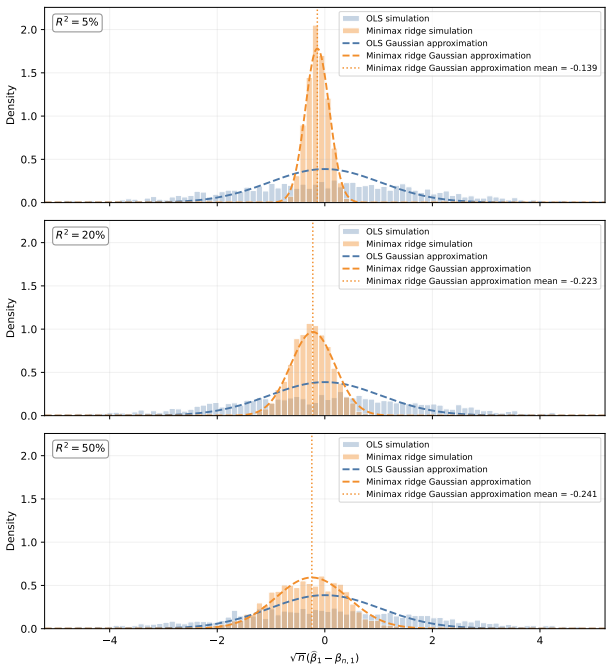
Run a Monte Carlo with k fixed, x_i and epsilon_i satisfying Assumption 1, beta_n = beta_0 + b/sqrt(n), and lambda_n/n -> lambda; compare the empirical distribution of sqrt(n)(beta_hat_lambda_n - beta_n) to N(-lambda(Sigma + lambda I)^{-1}b, (Sigma + lambda I)^{-1}Omega(Sigma + lambda I)^{-1}). If the first two moments deviate systematically beyond Monte Carlo error, Theorem 1 is refuted. Setting beta fixed away from beta_0 instead should make the bias grow with sqrt(n), confirming that the local assumption is load-bearing.
Extended reading notes
Core claim
Under Assumption 1 (convergence of the design second-moment matrix Sigma and asymptotic normality of the score with covariance Omega), Theorem 1 states that if lambda_n/n converges in probability to lambda and sqrt(n)(beta_n - beta_0) converges to b, then sqrt(n)(beta_hat_lambda_n - beta_n) converges in distribution to N_k(-lambda(Sigma + lambda I_k)^{-1}b, (Sigma + lambda I_k)^{-1}Omega(Sigma + lambda I_k)^{-1}). This is the paper's central claim: in finite samples ridge is roughly Gaussian with shrinkage bias proportional to lambda and to the distance from the reference vector, and variance given by the usual sandwich form with the ridge-adjusted denominator. Theorem 2 converts this into a
Load-bearing premise
The true regression coefficients must lie within O(1/sqrt(n)) of the shrinkage reference vector beta_0; if they do not, the Gaussian approximation's bias term is wrong and the tuning rules that rely on the local parameter b lose their justification.
Editorial extensions
If this is right
- If Theorem 1 is correct, ridge's finite-sample distribution in low-dimensional designs is a known Gaussian, so prediction intervals and risk comparisons can be made without assuming Gaussian errors or independence.
- Heteroskedasticity and serial correlation enter only through Omega, so the approximation covers time-series and clustered data, not just i.i.d. samples.
- The isotropic tuning formula lambda_n = n*tr(Omega_hat)/(sigma_hat_x^2 * B^2) gives an explicit ridge penalty that minimizes worst-case approximate excess risk, replacing cross-validation with a one-line calculation.
- The paper's own DGP-3 results (k/n = 0.6) show the approximation and the minimax rule degrade away from the low-risk region and do not uniformly beat leave-one-out cross-validation, so the stated guarantees are low-dimensional.
Reading between the lines
- Editorial inference: because b is unidentified, the practical content of the tuning rules is really a mapping from the user's bound or prior to a penalty; two researchers with different B or pi will get different lambda even from the same data, and nothing in the data can resolve the disagreement.
- Editorial inference: the same local-to-reference rescaling could be applied to lasso-type estimators under Assumption 1, potentially producing analogous risk-based tuning rules; the paper suggests this extension but does not carry it out.
- Editorial inference: the Gaussian approximation implies a simple shrinkage-bias-adjusted confidence ellipse for ridge predictions, but the paper does not develop this inferential use.
- Editorial inference: in time-series settings Omega is the long-run variance, so the optimal lambda adapts to serial correlation; estimating Omega reliably in that setting may become the binding constraint.
Editorial analysis
A structured set of objections, weighed in public.
Referee Report
Summary. The paper proposes a Gaussian approximation to the finite-sample distribution of the ridge regression estimator under high-level assumptions that allow heteroskedasticity and autocorrelation. The key asymptotic setup lets the regularization parameter grow with the sample size, λ_n/n →_p λ, and treats the true coefficient as local to the shrinkage reference vector, √n(β_n−β_0)→b. Theorem 1 derives the limiting distribution of √n(β̂_{λ_n}−β_n). Theorem 2 uses this to approximate the excess prediction risk, and Theorem 3 gives closed-form tuning rules for isotropic features: λ* = n·trace(Ω)/(σ_x²E_π[b'b]) under a prior and λ* = n·trace(Ω)/(σ_x²B²) under a norm bound. Simulation evidence compares minimax ridge with LOO-CV and OLS in three DGPs.
Significance. If the results hold, the paper provides a clean and useful generalization of Knight and Fu (2000) to heteroskedastic and autocorrelated environments and to an arbitrary reference vector. The elementary proof of Theorem 1, the transparent use of local asymptotics, and the explicit admission that b is not identified are strengths. The risk approximation and the closed-form tuning rules are new and potentially useful in low-dimensional problems. The paper is also honest about the limitation that the tuning rules require user-specified prior/bound information. However, the empirical support for the proposed tuning rules is weakened by the oracle-based calibration of B in the simulations, so the practical advantage over LOO-CV is not yet established.
major comments (2)
- [§3.3, Eqs. (20)–(25); Theorem 3] The tuning rules depend critically on the unidentifiable local parameter b, through either the bound B or the prior π. The paper is candid that b cannot be estimated, but it nevertheless describes the strategies as 'data-driven recommendations.' As stated, the data enter only through Ω̂ and σ̂_x²; the key tuning input B or E_π[b'b] is user-specified. More importantly, if the true b violates the bound or lies in a low-probability region of π, the selected λ can be far from the risk minimizer even though Theorem 1 still holds. The authors should add a sensitivity analysis for B and π and provide practical guidance on how to elicit these inputs, otherwise the prescriptive claim is incomplete.
- [§4.1–4.3, Figures 2, 5, and 8] The simulation evaluation of the minimax rule uses oracle knowledge of the true DGP to calibrate B. In DGP-1, B is set to the true ||b||=√10; in DGP-2 and DGP-3, B is the 90th percentile of √n||β_n|| computed from the same coefficient-generating scheme. LOO-CV receives no such oracle input. The reported ~20% improvement over LOO-CV in Figure 2 and the competitiveness in Figures 5 and 8 therefore reflect an oracle advantage, not a fully data-driven comparison. Please report risk as a function of B (e.g., multiples of a data-based estimate) and clarify what a practitioner must supply. This does not affect the validity of Theorem 1, but it is essential for the paper's practical claims.
minor comments (5)
- [§4.1, first paragraph] The error term is scalar, so 'ϵ_i ∼ N_k(0, σ²)' should be 'ϵ_i ∼ N(0, σ²)'.
- [§4.2–4.3] The text notes that DGP-2 and DGP-3 depart from Assumption 2 (strict stationarity) by allowing heterogeneous variances. Since Theorem 2 uses Assumption 2, this means the simulations do not exactly satisfy the theorem's conditions. The paper should state more clearly whether these simulations are intended as a robustness check outside the formal assumptions.
- [Figures 1, 4, and 7] The horizontal-axis notation is garbled: 'n( 1 n, 1)' should be something like '√n(β̂₁−β_{n,1})'. Please fix the typesetting.
- [Theorem 2, condition (iii)] The uniform integrability condition is high-level. Providing primitive sufficient conditions, such as moment bounds on the design and errors and boundedness of λ_n/n, would make the theorem easier to verify in applications.
- [Eq. (3) vs. Eq. (13)] The estimator is denoted with λ_n in (3) and with λ in (13), and the text later says 'with λ replaced by λ_n.' Please unify the notation to avoid confusion.
Circularity Check
Simulation evaluation of the minimax ridge rule uses oracle knowledge of b (B set to the truth or calibrated from the same DGP), but the theorem derivations themselves are self-contained and not circular.
-
other
[Section 4.1 (DGP-1, p.18) and Section 4.2 (DGP-2, p.22)]
"We set B≡ ∥b∥= √10. ... For the minimax criterion, we calibrate the radius B from the same coefficient-generation scheme: for each target R2, we draw 2,000 coefficient vectors, rescale each draw to the target R2, compute √n∥βn∥, and use the 90th percentile as the baseline value of B."
With isotropic features, the minimax rule of Theorem 3 is λ*_minimax = n trace(Ω)/(σ_x²B²). For a known b, the excess-risk minimizer over λ is the same expression with B² replaced by ∥b∥² (see the derivative (32) in the proof of Theorem 3). In DGP-1 the paper sets B exactly equal to the true ∥b∥, so the evaluated 'minimax ridge' is the oracle rule that knows b, not a fully data-driven procedure. In DGP-2/3, B is calibrated from the same coefficient-generation scheme used to draw the true β_n. The reported simulation comparisons against LOO-CV are therefore partly self-referential, although this affects the empirical evaluation rather than the theorem derivations.
full rationale
The main derivation chain is not circular. Theorem 1 is a standard Slutsky/continuous-mapping result from Assumption 1 and the stated local-to-reference condition √n(β_n−β_0)→b; the paper is explicit that b is not identified and that unbounded √n(β_n−β_0) makes the asymptotic bias diverge. Theorem 2 follows from Theorem 1 by uniform integrability and Slutsky, and Theorem 3 is closed-form algebra from the risk approximation (31)–(32). The tuning rules depend on a user-supplied bound B or prior π, which the paper states candidly; this is a limitation, not a circular derivation. The self-citations (Velez 2024; Montiel Olea et al. 2026; Shen and Xiu 2025) are contextual and not load-bearing in the proofs. The only concrete circularity concern is in the simulations, where B is set to the true coefficient norm or calibrated from the DGP's coefficient-generating scheme, making the implemented minimax rule an oracle-aided benchmark rather than a strictly data-driven competitor to LOO-CV. Because this affects the empirical demonstration and not the mathematical results, the overall circularity score is low.
Assumptions & free parameters
free parameters (3)
- B (radius of the local-parameter ball) =
√10 in DGP-1; 90th percentile of simulated √n‖β_n‖ in DGP-2/3
- Eπ[b^Tb] or prior hyperparameter C² =
not used in simulations; user-specified
- Degrees-of-freedom adjustment n/(n−k) =
n=500, k=50 or 300
assumptions (8)
- domain assumption Assumption 1: (1/n)Σx_ix_i^T →_p Σ and (1/√n)Σx_iε_i →_d N(0,Ω)
- ad hoc to paper √n(β_n − β_0) → b (Eq. 5/14)
- domain assumption λ_n/n →_p λ ∈ [0,∞) (Eq. 6/14)
- domain assumption Strict stationarity of {(x_i, ε_i)} (Assumption 2)
- domain assumption E_P[x_iε_i]=0 and E_P[x_ix_i^T]=Σ (Theorem 2)
- standard math sup_n E[(Z_n^TΣZ_n)^{1+δ}] < ∞ (Theorem 2(iii))
- domain assumption Σ = σ_x² I_k (Theorem 3)
- domain assumption Eπ[b^Tb] finite and positive, or ‖b‖ ≤ B (Theorem 3)
Cite this review
Pith. "Pith review of A Simple Approximation to the Distribution of the Ridge Regression Estimator." pith.science (2026). https://pith.science/paper/B6722UWH
@misc{pith2026260802539,
  author       = {Pith},
  title        = {Pith review of: A Simple Approximation to the Distribution of the Ridge Regression Estimator},
  year         = {2026},
  howpublished = {\url{https://pith.science/paper/B6722UWH}},
  note         = {Machine review of arXiv:2608.02539}
}
abstract
We present a simple Gaussian approximation to the finite-sample distribution of the classical ridge regression estimator. Our approximation captures the fact that, in finite samples, the ridge regression estimator trades off bias and variance to reduce estimation and prediction error. Our approximation is based on nonstandard asymptotics where $i)$ we let the estimator's regularization parameter grow proportionally to the sample size; and $ii)$ we treat the population regression coefficients as \emph{local} to the reference vector that defines the estimator's direction of shrinkage. In contrast to other asymptotic approximations in the literature, we allow for general forms of heteroskedasticity and autocorrelation in the data generating process (at the cost of considering a low-dimensional model where the number of covariates is not allowed to grow with the sample size). We use our simple Gaussian approximation to propose two new strategies to select the regularization parameter for the ridge regression estimator. The suggested strategies select the regularization parameter to minimize either average or worst-case excess prediction risk, where risk is computed using our suggested Gaussian approximation.
Figures


Figures from the paper (13 more)




Reference graph
Works this paper leans on
-
[1]
Abadie, A. and M. Kasy (2019): Choosing among Regularized Estimators in Empirical Economics: The Risk of Machine Learning, The Review of Economics and Statistics, 101, 743--762
2019
-
[2]
Andrews, I. and A. Mikusheva (2022): Optimal decision rules for weak GMM, Econometrica, 90, 715--748
2022
-
[3]
Anup, A. K. and G. Maddala (1984): Ridge estimators for distributed lag models, Communications in Statistics-Theory and Methods, 13, 217--225
1984
-
[5]
Brockwell, P. J. and R. A. Davis (2013): Time series: theory and methods, Springer Science & Business Media
2013
-
[6]
Huang, and G
Cambanis, S., S. Huang, and G. Simons (1981): On the theory of elliptically contoured distributions, Journal of Multivariate Analysis, 11, 368--385
1981
-
[7]
Cattaneo, M. D., M. Jansson, and W. K. Newey (2018): Inference in linear regression models with many covariates and heteroscedasticity, Journal of the American Statistical Association, 113, 1350--1361
2018
-
[8]
(2008): Asymptotic Theory of Statistics and Probability, Springer Verlag
DasGupta, A. (2008): Asymptotic Theory of Statistics and Probability, Springer Verlag
2008
-
[9]
Dobriban, E. and S. Wager (2018): High-dimensional asymptotics of prediction: Ridge regression and classification, The Annals of Statistics, 46, 247--279
2018
Show all 74 references
-
[10]
Dou, L. and U. K. M \"u ller (2021): Generalized Local-to-Unity Models, Econometrica, 89, 1825--1854
2021
-
[11]
Ferguson, T. S. (1967): Mathematical Statistics: A Decision Theoretic Approach, New York: Academic Press
1967
-
[12]
Hastie, and R
Friedman, J., T. Hastie, and R. Tibshirani (2017): The elements of statistical learning: data mining, inference and prediction, vol. 1 of Series in Statistics, New York: Springer, second edition ed
2017
-
[13]
Gibbons, D. G. (1981): A Simulation Study of Some Ridge Estimators, Journal of the American Statistical Association, 76, 131--139
1981
-
[14]
(2022): Econometrics, Princeton University Press
Hansen, B. (2022): Econometrics, Princeton University Press
2022
-
[15]
Hansen, B. E. (2016): Efficient shrinkage in parametric models, Journal of Econometrics, 190, 115--132
2016
-
[16]
Montanari, S
Hastie, T., A. Montanari, S. Rosset, and R. J. Tibshirani (2022): Surprises in high-dimensional ridgeless least squares interpolation, The Annals of Statistics, 50, 949--986
2022
-
[17]
Hirano, K. and J. H. Wright (2017): Forecasting with model uncertainty: Representations and risk reduction, Econometrica, 85, 617--643
2017
-
[18]
Hoerl, A. E. (1962): Application of ridge analysis to regression problems, Chemical Engineering Progress, 58, 54--59
1962
-
[19]
Hoerl, A. E. and R. W. Kennard (1970): Ridge regression: Biased estimation for nonorthogonal problems, Technometrics, 12, 55--67
1970
-
[20]
Hoerl, R. W. (2020): Ridge regression: a historical context, Technometrics, 62, 420--425
2020
-
[21]
Hsu, D., S. M. Kakade, and T. Zhang (2012): Random design analysis of ridge regression, in Conference on learning theory, JMLR Workshop and Conference Proceedings, 9--1
2012
-
[22]
Knight, K. and W. Fu (2000): Asymptotics for lasso-type estimators, Annals of statistics, 1356--1378
2000
-
[23]
Kock, A. B., R. S. Pedersen, and J. R.-V. S rensen (2026): Data-driven tuning parameter selection for high-dimensional vector autoregressions, Journal of the American Statistical Association, 121, 289--299
2026
-
[24]
Zheng, and X
Liu, X., S. Zheng, and X. Feng (2020): Estimation of error variance via ridge regression, Biometrika, 107, 481--488
2020
-
[25]
Montiel Olea, J. L., C. Rush, A. Velez, and J. Wiesel (2026): The distributionally robust prediction error of the LASSO and related estimators, The Annals of Statistics, 54, 1006--1027
2026
-
[26]
(2022): Exact minimax risk for linear least squares, and the lower tail of sample covariance matrices, The Annals of Statistics, 50, 2157--2178
Mourtada, J. (2022): Exact minimax risk for linear least squares, and the lower tail of sample covariance matrices, The Annals of Statistics, 50, 2157--2178
2022
-
[27]
Mourtada, J. and L. Rosasco (2022): An elementary analysis of ridge regression with random design, Comptes Rendus. Math \'e matique , 360, 1055--1063
2022
-
[29]
Patil, P., Y. Wei, A. Rinaldo, and R. Tibshirani (2021): Uniform consistency of cross-validation estimators for high-dimensional ridge regression, in International conference on artificial intelligence and statistics, PMLR, 3178--3186
2021
-
[30]
Phillips, P. C. (1988): Regression theory for near-integrated time series, Econometrica: Journal of the Econometric Society, 1021--1043
1988
-
[31]
Powell, J. L. (2017): Identification and Asymptotic Approximations: Three Examples of Progress in Econometric Theory, Journal of Economic Perspectives, 31, 107--124
2017
-
[32]
Shen, Z. and D. Xiu (2025): Can Machines Learn Weak Signals? Working Paper 33421, National Bureau of Economic Research, Cambridge, MA
2025
-
[33]
Staiger, D. and J. H. Stock (1997): Instrumental Variables Regression with Weak Instruments, Econometrica, 65, 557--586
1997
-
[34]
Swindel, B. F. (1976): Good ridge estimators based on prior information, Communications in Statistics-Theory and Methods, 5, 1065--1075
1976
-
[36]
Golub and Michael Heath and Grace Wahba , journal =
Gene H. Golub and Michael Heath and Grace Wahba , journal =. Generalized Cross-Validation as a Method for Choosing a Good Ridge Parameter , urldate =
-
[37]
2025 , eprint=
Risk and cross validation in ridge regression with correlated samples , author=. 2025 , eprint=
2025
-
[38]
and Barajas-Ramirez, Eduardo A
Montesinos-López, Osval A. and Barajas-Ramirez, Eduardo A. and Montesinos-López, Abelardo and Lecumberry, Federico and Fariello, María Inés and Montesinos-López, José Cricelio and Ramirez Alcaraz, Juan Manuel and Crossa, José and Howard, Reka , TITLE =. Genes , VOLUME =. 2025 ...
2025
-
[39]
Teaching Econometrics , chapter=
Katherine Hauck and Tiemen Woutersen , title=. Teaching Econometrics , chapter=. 2026 , month=. doi:10.1007/978-3-031-97942-2_10 , url=
2026 doi
-
[40]
, publisher =
DasGupta, A. , publisher =. Asymptotic Theory of Statistics and Probability , year =
-
[41]
Deep Learning , Year =
Goodfellow, Ian and Bengio, Yoshua and Courville, Aaron , Publisher =. Deep Learning , Year =
-
[42]
The Annals of Statistics , volume=
High-dimensional asymptotics of prediction: Ridge regression and classification , author=. The Annals of Statistics , volume=. 2018 , publisher=
2018
-
[43]
The Annals of Statistics , volume=
Surprises in high-dimensional ridgeless least squares interpolation , author=. The Annals of Statistics , volume=. 2022 , publisher=
2022
-
[44]
Comptes Rendus
An elementary analysis of ridge regression with random design , author=. Comptes Rendus. Math
-
[45]
arXiv preprint arXiv:2408.04607 , year=
Risk and cross validation in ridge regression with correlated samples , author=. arXiv preprint arXiv:2408.04607 , year=
-
[46]
2022 , publisher=
Econometrics , author=. 2022 , publisher=
2022
-
[47]
The elements of statistical learning: data mining, inference and prediction , volume =
Friedman, Jerome and Hastie, Trevor and Tibshirani, Robert , edition =. The elements of statistical learning: data mining, inference and prediction , volume =
-
[48]
Communications in Statistics-Theory and Methods , volume=
Good ridge estimators based on prior information , author=. Communications in Statistics-Theory and Methods , volume=. 1976 , publisher=
1976
-
[49]
Communications in Statistics-Theory and Methods , volume=
Ridge estimators for distributed lag models , author=. Communications in Statistics-Theory and Methods , volume=. 1984 , publisher=
1984
-
[50]
Annals of statistics , pages=
Asymptotics for lasso-type estimators , author=. Annals of statistics , pages=. 2000 , publisher=
2000
-
[51]
Journal of Economic Perspectives , volume =
Identification and Asymptotic Approximations: Three Examples of Progress in Econometric Theory , author =. Journal of Economic Perspectives , volume =. 2017 , doi =
2017
-
[52]
Stock , title =
Douglas Staiger and James H. Stock , title =. Econometrica , volume =. 1997 , doi =
1997
-
[53]
2025 , month = jan, address =
Zhouyu Shen and Dacheng Xiu , title =. 2025 , month = jan, address =. doi:10.3386/w33421 , url =
2025 doi
-
[54]
Econometrica: Journal of the Econometric Society , pages=
Regression theory for near-integrated time series , author=. Econometrica: Journal of the Econometric Society , pages=. 1988 , publisher=
1988
-
[55]
Econometrica , volume=
Optimal decision rules for weak GMM , author=. Econometrica , volume=. 2022 , publisher=
2022
-
[56]
Econometrica , volume=
Generalized Local-to-Unity Models , author=. Econometrica , volume=. 2021 , publisher=
2021
-
[57]
Time series: theory and methods , year =
Brockwell, Peter J and Davis, Richard A , publisher =. Time series: theory and methods , year =
-
[58]
The Annals of Statistics , volume=
Exact minimax risk for linear least squares, and the lower tail of sample covariance matrices , author=. The Annals of Statistics , volume=. 2022 , publisher=
2022
-
[59]
The Review of Economics and Statistics , volume =
Abadie, Alberto and Kasy, Maximilian , title =. The Review of Economics and Statistics , volume =. 2019 , month =. doi:10.1162/rest_a_00812 , url =
2019 doi
-
[60]
2026 , eprint=
From Cross-Validation to SURE: Asymptotic Risk of Tuned Regularized Estimators , author=. 2026 , eprint=
2026
-
[61]
On the theory of elliptically contoured distributions , journal =
Stamatis Cambanis and Steel Huang and Gordon Simons , keywords =. On the theory of elliptically contoured distributions , journal =. 1981 , issn =. doi:https://doi.org/10.1016/0047-259X(81)90082-8 , url =
1981 doi
-
[62]
Current Population Survey, 2009 Annual Social and Economic Supplement (ASEC) [Machine-readable data file and technical documentation] , year =
2009
-
[63]
International conference on artificial intelligence and statistics , pages=
Uniform consistency of cross-validation estimators for high-dimensional ridge regression , author=. International conference on artificial intelligence and statistics , pages=. 2021 , organization=
2021
-
[64]
Ferguson , title =
Thomas S. Ferguson , title =. 1967 , isbn =
1967
-
[65]
Chemical Engineering Progress , volume=
Application of ridge analysis to regression problems , author=. Chemical Engineering Progress , volume=
-
[66]
Technometrics , volume=
Ridge regression: Biased estimation for nonorthogonal problems , author=. Technometrics , volume=. 1970 , publisher=
1970
-
[67]
Technometrics , volume=
Ridge regression: a historical context , author=. Technometrics , volume=. 2020 , publisher=
2020
-
[68]
arXiv preprint arXiv:2411.01864 , year=
On the asymptotic properties of debiased machine learning estimators , author=. arXiv preprint arXiv:2411.01864 , year=
-
[69]
Conference on learning theory , pages=
Random design analysis of ridge regression , author=. Conference on learning theory , pages=. 2012 , organization=
2012
-
[70]
A Simulation Study of Some Ridge Estimators , urldate =
Diane Galarneau Gibbons , journal =. A Simulation Study of Some Ridge Estimators , urldate =
-
[71]
arXiv preprint arXiv:2404.01233 , year=
Optimal ridge regularization for out-of-distribution prediction , author=. arXiv preprint arXiv:2404.01233 , year=
-
[72]
The Annals of Statistics , volume=
The distributionally robust prediction error of the LASSO and related estimators , author=. The Annals of Statistics , volume=. 2026 , publisher=
2026
-
[73]
Journal of Econometrics , volume=
Efficient shrinkage in parametric models , author=. Journal of Econometrics , volume=. 2016 , publisher=
2016
-
[74]
Biometrika , volume=
Estimation of error variance via ridge regression , author=. Biometrika , volume=. 2020 , publisher=
2020
-
[75]
Journal of the American Statistical Association , volume=
Inference in linear regression models with many covariates and heteroscedasticity , author=. Journal of the American Statistical Association , volume=. 2018 , publisher=
2018
-
[76]
Journal of the American Statistical Association , volume=
Data-driven tuning parameter selection for high-dimensional vector autoregressions , author=. Journal of the American Statistical Association , volume=. 2026 , publisher=
2026
-
[77]
Econometrica , volume=
Forecasting with model uncertainty: Representations and risk reduction , author=. Econometrica , volume=. 2017 , publisher=
2017
Reviewed August 4, 2026 · model on record in the stance chip above.
Discussion (0). Continue with ORCID to comment.